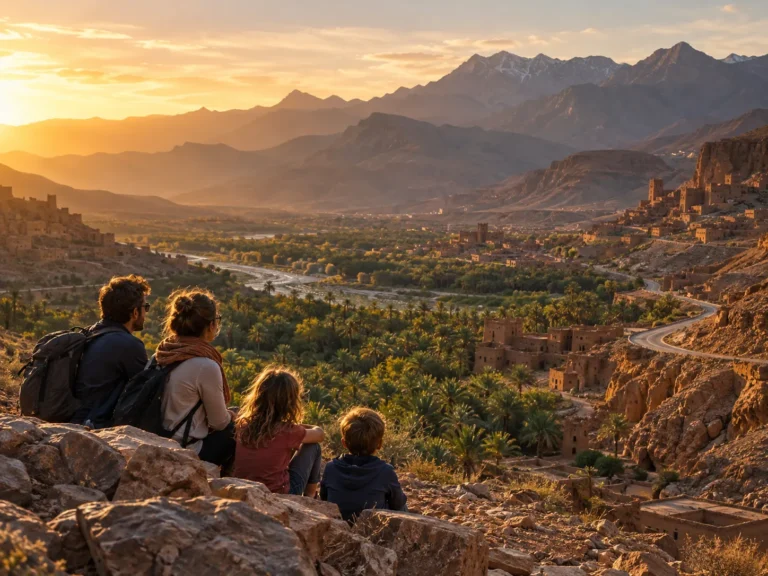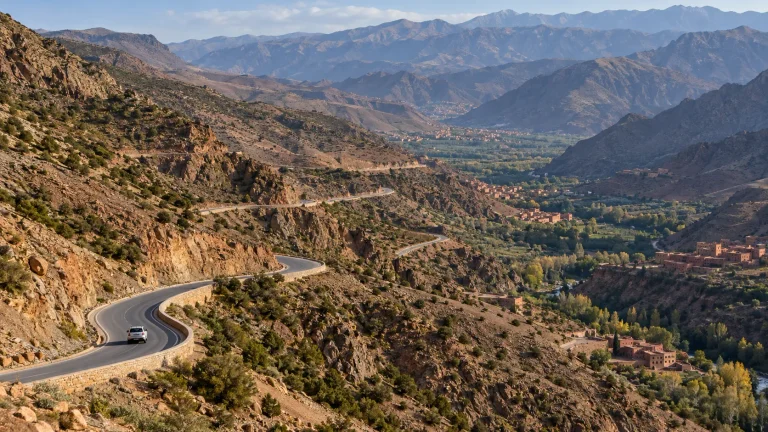
Morocco culture and etiquette become easier to navigate when you pay attention to the person and place in front of you. Greet someone before asking a question, follow a host’s lead, ask before taking a portrait, and treat a medina lane as a place where people live and work. These small decisions are more useful than memorising a list of rules supposedly followed by everyone in the country.
Arabic and Amazigh are Morocco’s official languages, while daily conversations may involve Darija, regional Amazigh languages, French, Spanish or English. Customs also differ between households, cities, rural communities, religious spaces and generations. This guide explains how to communicate and behave respectfully without assuming that a person speaks a particular language, wants a handshake or is available to be photographed.
It also goes beyond basic etiquette. Moroccan culture can be explored through medinas, family hospitality, food, craftsmanship, music, religious celebrations, imperial-city history, Roman archaeology, Amazigh communities and the quieter landscapes of the Atlas Mountains and Sahara. The aim is not to turn every cultural tradition into an attraction, but to help visitors understand the context of the places and people they encounter.
Morocco Culture and Etiquette: What Should Visitors Learn First?
Learn to greet, ask and accept an answer. Say hello before requesting directions or starting a transaction, notice whether someone offers a handshake or keeps their distance, and ask permission before entering or photographing a place. If a situation is unfamiliar, a short question to your host, guide or site staff is usually more reliable than a rule you read online.
Think in terms of three settings. In a public visitor space, follow posted rules and pay attention to the people sharing it. In a working or residential space, make room for deliveries, workers and residents rather than treating every doorway as a photo stop. In a home or religious space, follow the host’s or manager’s guidance, including instructions about shoes, dress, photography and access.
The same visitor may move between all three settings in a single afternoon. A historic medina can simultaneously be a visitor attraction, residential neighborhood, commercial center, workplace and religious environment.
If you are still deciding which cultural regions fit your journey, browse the Morocco destinations collection. The cultural questions to ask while exploring Fes are different from those on a hosted High Atlas visit or at a managed heritage site.
Which Languages Are Spoken in Morocco?
Arabic and Amazigh are Morocco’s official languages, while Moroccan Arabic, generally called Darija, is widely used in everyday speech. Different Amazigh varieties are spoken in different regions.
French is useful in many business, education and tourism settings. Spanish may be useful in parts of northern Morocco, while English is increasingly available in visitor-facing businesses. None of those broad patterns tells you which languages an individual person speaks.
The Moroccan National Tourist Office’s language guide distinguishes the official languages and provides useful expressions for travelers.
Written Arabic used in formal contexts is not identical to the everyday Darija you may hear in markets and cafés. Likewise, Amazigh should not be treated as one universal tourist phrasebook. Regional languages and speech vary.
| Situation | A useful opening | What to do next |
|---|---|---|
| Greeting someone | As-salaam alaykum or salam | Pause and let the other person set the pace of the conversation. |
| Thanking someone | Shukran | Say it sincerely and switch languages if another language works better for both of you. |
| Leaving a conversation | Bslama | Use a warm tone and give the person room to return to their day. |
| Needing detailed help | Ask which language is comfortable | Use simple questions, write down an address or show a map when useful. |
Spellings of spoken words vary when written in the Latin alphabet, and pronunciation changes by speaker and region. You do not need to imitate an accent or turn every interaction into a language lesson. A greeting and a clear, patient question usually go further than memorising a long script.
If someone replies in French or English, continue in whichever language helps both of you communicate. Do not assume everyone in a mountain community speaks the same Amazigh variety or that every city resident speaks French. Let local speakers name their own language and community.
How Should You Greet People and Respond to Moroccan Hospitality?
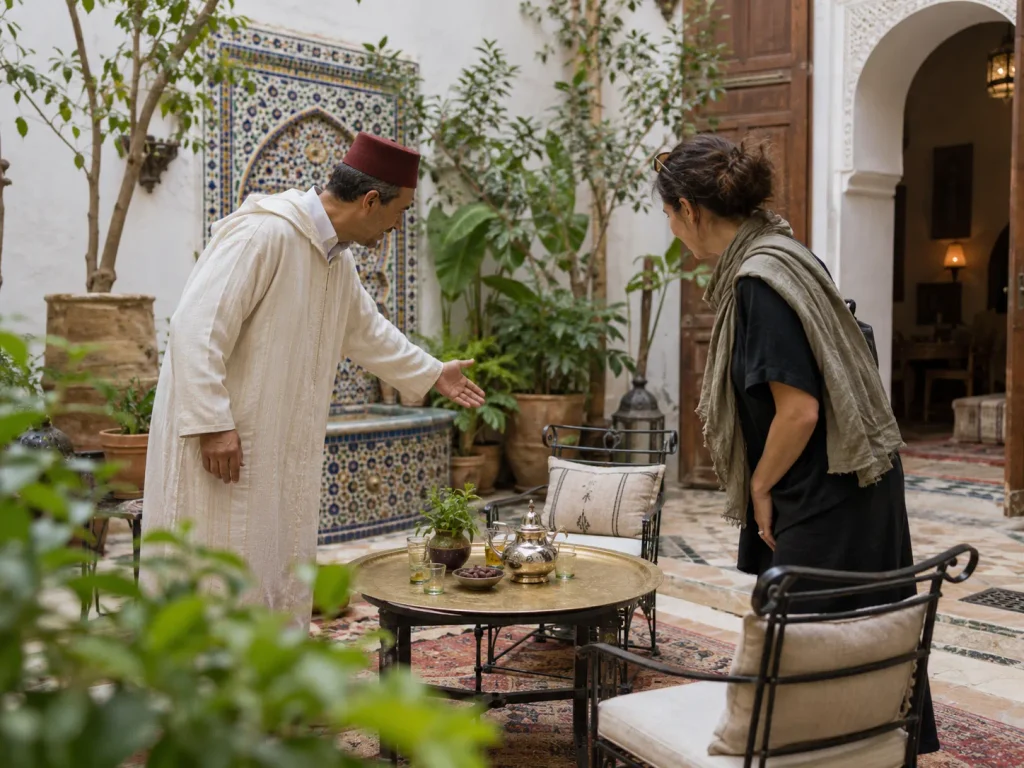
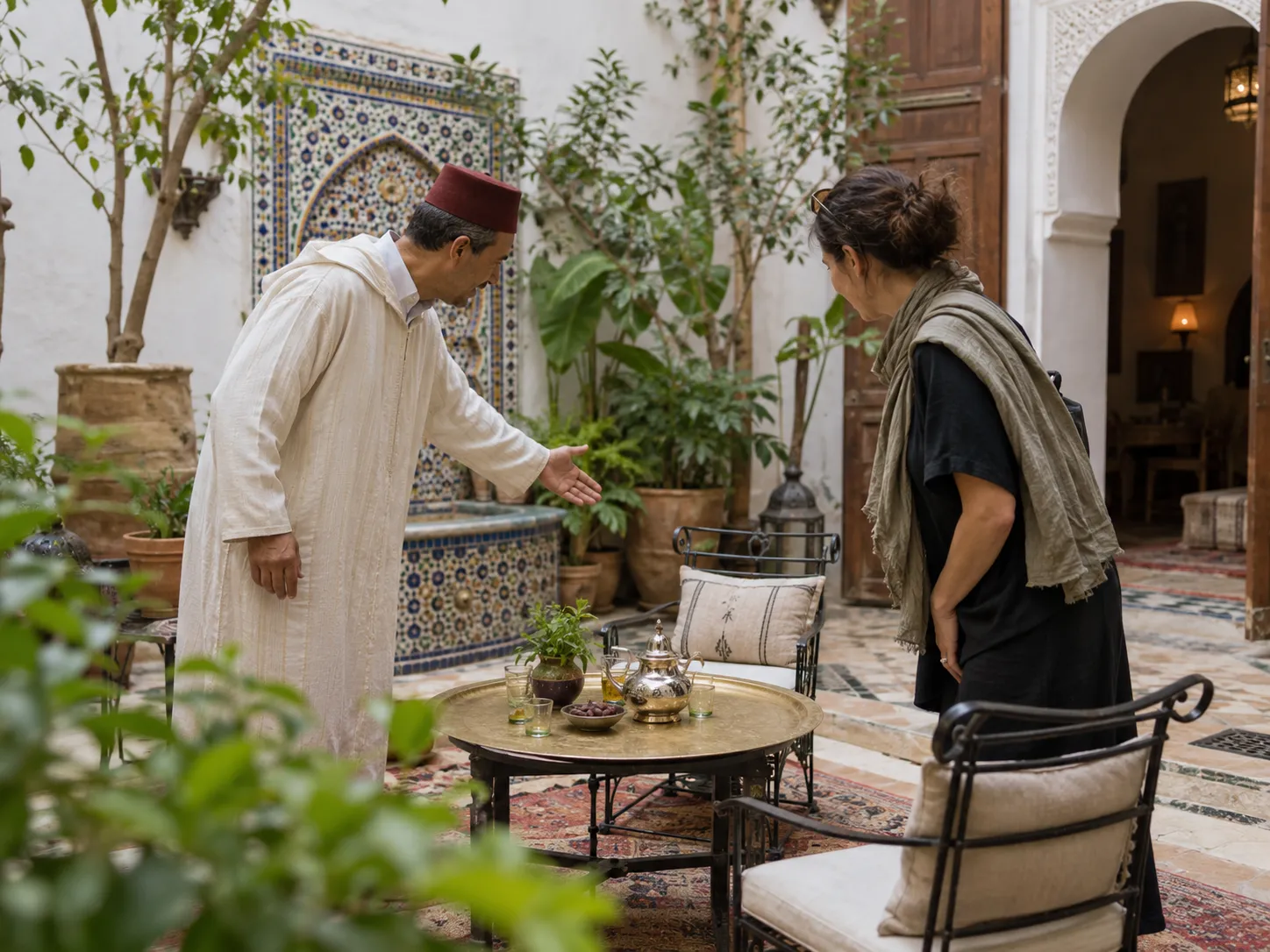
Start with a greeting and respond to what the other person offers. A handshake may be welcome in one interaction and unwanted in another, so allow the other person to lead or simply greet verbally. Be similarly considerate when introducing yourself to a family, shopkeeper or somebody helping with directions. Politeness does not require physical contact.
Hospitality is an important theme in Moroccan cultural life, but it should not be reduced to a fixed tourist ritual. Mint tea can be a gesture of welcome, part of a paid experience or simply something ordered in a café.
If tea is offered in a home, thank the host and accept if you want it. If you cannot or do not want to drink it, decline kindly. In a shop, tea does not create an obligation to purchase anything. If a tasting, demonstration or tea service appears connected to a commercial experience and the price matters to you, ask whether there is a charge.
An invitation into a home deserves a few practical questions. Confirm the time and location, ask whether you should remove your shoes if it is unclear, explain dietary requirements before food is prepared and check whether photographs are welcome.
Do not assume an invitation includes access to bedrooms, family photographs or other private areas. A host offering food is showing generosity, but you may still say when you have had enough.
When sharing a meal, let the host explain how it is being served. Some meals may be shared from a common dish while others arrive on individual plates. Wash your hands when appropriate, use the utensils or bread provided and follow the host’s example rather than relying on a universal instruction about how every Moroccan meal must be eaten.
If you have an allergy or dietary restriction, say so clearly before eating. A guest’s responsibility is to communicate rather than guess.
Food and Family Traditions in Morocco
Moroccan cuisine reflects the country’s diverse cultural history and regional traditions. Couscous, tagine and pastilla are among the dishes widely associated with Moroccan cooking, but recipes and eating habits differ between households and regions.
Food can also have a strong social role. Family meals may bring several generations together, especially around important gatherings and celebrations. Hospitality expressed through food is therefore often about conversation and time together as much as the particular dish being served.
Visitors can learn about this side of Moroccan culture through meals, markets and cooking experiences, but a cooking class should not be treated as a replacement for the variety of everyday home traditions across the country.
When invited into a household, let the host determine the pace and structure of the meal. When eating in a restaurant or taking a cooking class, treat it as a different environment with its own expectations.
What Should You Wear in Moroccan Streets, Villages and Historic Sites?
Choose clothing for the activity and setting, then check any site-specific dress instructions. There is no single outfit for every Moroccan street, beach, restaurant and religious site.
Comfortable clothing that provides reasonable coverage in residential areas and can be adjusted for heat or cool evenings is a practical starting point for visitors of any gender.
Beachwear makes sense at a beach or swimming pool. For a walk through a residential medina, village or historic institution, clothing with more coverage may fit the setting better.
At a site with a posted dress requirement, follow that requirement or ask staff before entering. A lightweight layer is useful because it can be added when a particular setting calls for it without assuming the same standard applies throughout the entire country.
Comfort matters as much as presentation. Medina streets can have uneven surfaces and mountain or village paths may be rough. Choose shoes suited to the route, bring sun protection where needed and check whether a particular visit requires removing shoes.
Do not assume that local residents all dress alike or that traditional clothing is a costume for visitors. If you are invited to try on or photograph clothing, agree on the context and any charge first.
Understanding Morocco’s Medinas as Living Cultural Spaces
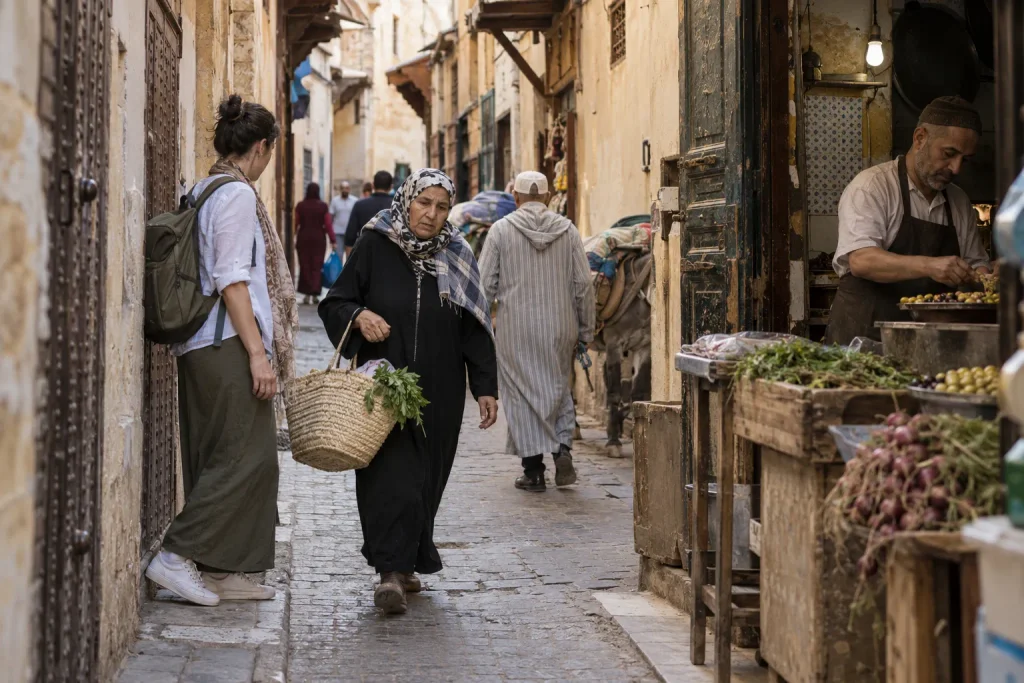
Morocco’s medinas are among the clearest places to see how architecture, commerce, craft, religion and everyday life overlap. They should not be treated only as sightseeing districts.
Use public routes, read signs and ask before crossing from a visitor area into a private or managed one. Medina lanes contain homes, schools, workshops, deliveries and active businesses alongside historic monuments.
UNESCO describes the Medina of Fez as a living historic city where cultural skills and everyday uses continue alongside its architecture. That is a useful principle for visiting any medina: stop where you can do so without blocking narrow lanes and make room for residents, workers and deliveries.
Marrakech Medina
The Marrakech medina is one of Morocco’s most famous historic urban centers. Jemaa el-Fna, the surrounding souks, the Koutoubia area, Bahia Palace and artisan districts provide very different ways of encountering the city’s cultural history.
The medina is lively and commercial, but shops and monuments exist alongside homes, mosques, schools and everyday neighborhood activity. Explore without assuming that every doorway, courtyard or rooftop is a visitor attraction.
Fes Medina
The Fes medina has a particularly strong association with traditional craft, scholarship and historic urban life. Artisan areas include leatherwork, pottery, metalwork and other trades, while the Al Quaraouiyine complex reflects the city’s long connection with religious learning and scholarship.
Follow streets open to visitors rather than assuming every courtyard or workshop is public. A tannery viewpoint is different from access to a production floor.
A guided Fes medina and tanneries walk can provide context for artisan quarters, streets, madrasas and tannery viewpoints. Confirm current entry arrangements before booking. A guided tour does not promise unrestricted access to workshops or places of worship.
Chefchaouen Medina
Chefchaouen offers a different medina experience. Its blue-painted lanes, cafés, small shops and Rif Mountain setting make it particularly attractive to photographers.
The visual character does not remove the need for normal residential etiquette. Ask before photographing residents closely or using private thresholds as portrait backgrounds.
Essaouira Medina
The Essaouira medina combines fortified walls, Atlantic-port history, craft shops, galleries and a strong artistic identity.
Visitors may encounter woodwork, jewellery, textiles, argan products and rugs in its markets, although a product being sold in Essaouira does not automatically establish where it was made.
The medina’s relationship with the port, music, art and Atlantic coast gives it a different cultural rhythm from Marrakech or Fes.
Tétouan Medina
Tétouan’s medina reflects strong Andalusian connections and has a different northern architectural character from Morocco’s larger inland medinas. Its narrow streets and traditional craft activity make it particularly interesting for travelers exploring northern Morocco.
Craft interests can include leatherwork and decorative or printed arts, alongside other goods used within the city itself. As in other medinas, ask before entering working areas or photographing craftspeople.
Marrakech, Fes, Essaouira and Tétouan have UNESCO-listed historic medinas. Chefchaouen is culturally important and highly distinctive, but visitors should not assume every famous Moroccan medina has UNESCO status.
How Do You Visit Workshops and Places of Worship Respectfully?
At workshops, ask before entering a working area, touching tools or taking close photographs. A demonstration arranged for visitors is different from entering somebody’s workplace without permission.
At a mosque, madrasa, synagogue, cemetery, shrine or other religious and heritage site, look for that site’s own visitor policy. Some spaces receive visitors at certain times, while others are reserved for worship or have limited access.
An attractive doorway, map listing or tour passing nearby does not provide permission to enter. Ask authorized staff about opening times, guided entry, dress and photography.
Step back from an ongoing service or gathering. Never presume that a guide can grant access that the manager or religious community responsible for the site has not approved.
Morocco’s Jewish heritage is also part of the country’s cultural history, including mellahs, synagogues and cemeteries in different cities. A historic neighborhood can be explored without every building within it being open to visitors.
Confirm the status of individual sites, respect active religious use and avoid treating the history of a Muslim, Jewish or Amazigh community as simply a photographic backdrop.
Spiritual and Reflective Travel in Morocco
The French material merged into this guide described Morocco as a place where mountains, desert landscapes, historic medinas and sensory markets can provide time for reflection. That idea can be useful as long as spiritual travel is not presented as automatic access to private religious life.
Atlas Mountains and Imlil
The Atlas Mountains can provide a quieter counterpoint to Morocco’s busy cities. Areas around Imlil are used for walking and mountain stays, while some travelers choose retreat-style experiences centered on nature, yoga or meditation.
Confirm current programs and what is actually included rather than assuming that every mountain guesthouse is a spiritual retreat.
Walking in a mountain landscape can be personally reflective without needing to turn local villages or residents into part of a staged spiritual experience.
Essaouira and Coastal Reflection
Essaouira provides a different kind of slower environment. The Atlantic coast, compact medina, galleries and walking pace can make it suitable for travelers wanting quieter days between busier city visits.
It should be considered separately from the Atlas Mountains rather than described as a mountain village.
The Sahara and Contemplation
The Sahara is another landscape that travelers may experience as contemplative. Sunrise, sunset, open desert views and a night beneath the stars can create moments of quiet that feel very different from city travel.
However, desert camps are organized travel experiences with staff, vehicles, neighboring camps and local communities. Respect the people who work there instead of presenting the desert as empty or uninhabited.
Fes and Marrakech
The medinas of Fes and Marrakech contain historic mosques, madrasas and other places connected with religious learning and community life. Visitors can appreciate their cultural and architectural significance while respecting restrictions on religious access.
Craft workshops and cooking experiences can also deepen cultural understanding without requiring access to sacred spaces.
The Souks as a Sensory Experience
Moroccan souks can be intensely sensory environments: voices, food, spices, metalwork, textiles, movement and changing light overlap in narrow streets.
Walking slowly and paying attention can be meaningful in itself. Each interaction does not need to become a purchase or photograph.
When Is It Appropriate to Photograph People and Performances?
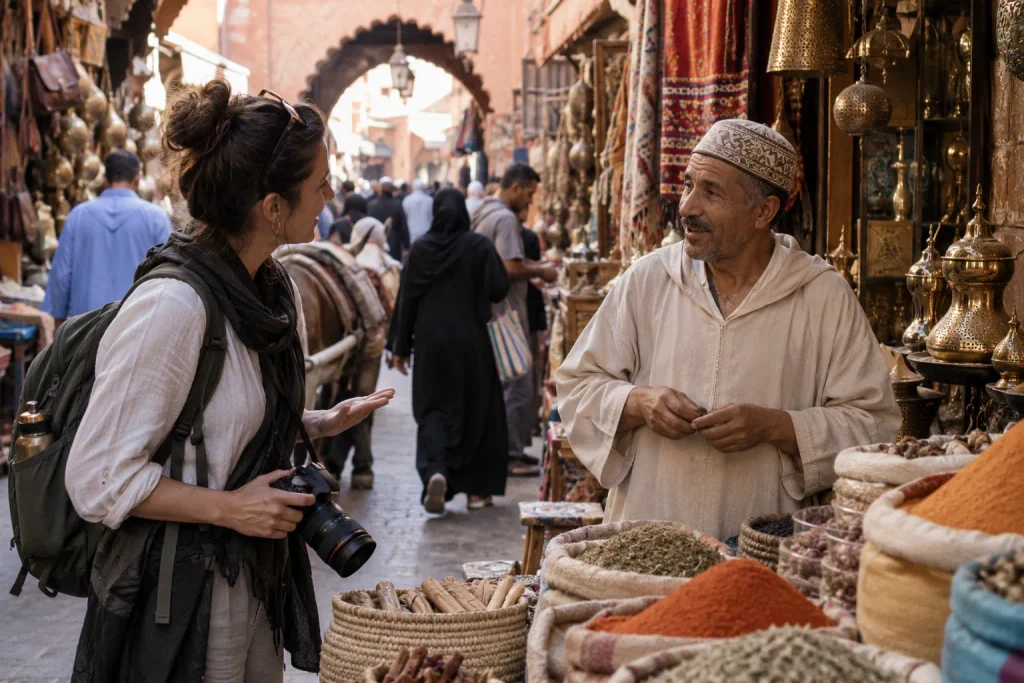
Ask before taking an identifiable person’s photograph and accept a refusal without trying another angle. This applies to market vendors, children, guides, performers and residents going about their day.
A broad crowd scene may still place an individual prominently in the foreground. If you are uncertain, frame the architecture or landscape instead.
A phone or camera pointed toward a private doorway can also feel intrusive even when nobody is clearly visible.
Ask separately about filming, publication and payment. Permission to take a personal photograph is not necessarily permission to publish it online or use it commercially.
A performer may work for tips or request payment for photographs. Ask what the arrangement is before recording. At an organized event, follow both the event’s policy and the performer’s wishes.
At workshops, ask whether makers are comfortable with photographs of their processes, designs or customers.
If somebody declines, put the camera away and continue normally. You can remember an exchange without turning it into content.
When photographing landscapes containing a village, ask your guide whether the path, roof terrace or viewpoint you are using is public before treating it as a shooting location.
How Should You Approach Amazigh Communities and Village Visits?
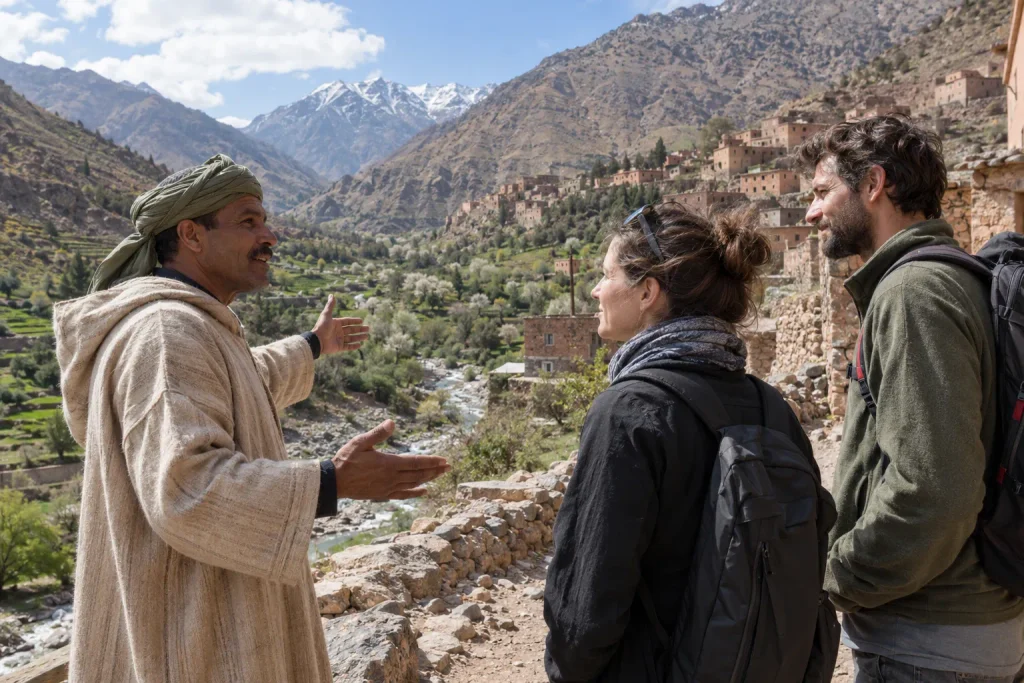
Identify the region and the host before choosing an experience. “An Amazigh village” does not describe one language, architecture, tradition or way of life.
Communities across the Rif, Atlas ranges, Souss and other parts of Morocco have different histories, linguistic traditions and crafts. Ask which village or valley the itinerary visits, who will host you, which areas are public and whether an activity has been arranged with residents.
The historical material merged into this guide also highlights the importance of Amazigh cultural influence on Morocco’s identity. That influence appears differently in architecture, language, rural life, food, textiles and regional traditions. It should not be reduced to a single “traditional village” image.
On a journey from Marrakech into the High Atlas, distinguish between a scenic viewpoint, guided walk along public village lanes and an invitation into somebody’s home. The first two do not automatically include the third.
If tea or a meal is part of a planned hosted visit, ask who provides it and whether payment or another contribution is included. Keep groups within agreed areas, avoid photographing residents without permission and give hosts the option to end the interaction.
You can start a mountain journey from the Marrakech destination page or consider the Atlas Mountains and village day trip from Marrakech. Confirm the current stops and any hosted element before booking.
A tour title does not give visitors permission to enter private homes or guarantee a particular personal interaction.
The same questions apply to cultural visits elsewhere: Who explains the place? Which residents or craftspeople have agreed to participate? Does payment reach the person providing the experience? Can you decline a demonstration or commercial stop?
Answers to those questions are more meaningful than describing unfamiliar communities as “untouched” or “timeless.”
Moroccan History for Travelers Who Want More Context
Morocco’s history includes Amazigh societies, Islamic dynasties, Andalusian connections, Jewish communities, Roman and pre-Roman archaeology, trans-Saharan exchange, colonial periods and modern urban life.
No one monument explains all of that history. Travelers interested in the country’s past can use several regions to understand different layers.
The Four Imperial Cities
Marrakech, Fes, Rabat and Meknes are traditionally known as Morocco’s four imperial cities. Each became a political or dynastic center at different periods and preserves a different architectural and urban legacy.
Marrakech contains the historic medina, Bahia Palace and other monuments that help explain the city’s royal and urban history.
Fes combines a medieval urban fabric with scholarship, religious institutions and long-established craft traditions.
Rabat combines modern capital-city life with major historic sites, while Meknes preserves monumental architecture associated with Morocco’s imperial past.
Volubilis and Roman-Era History
Volubilis provides another historical layer. The archaeological site contains substantial Roman-period remains and mosaics and is listed as a UNESCO World Heritage property.
It works particularly well when combined with Fes or Meknes because it helps place Morocco within a much longer Mediterranean and North African historical context.
Andalusian and Amazigh Influences
Moroccan architecture and cultural traditions reflect many historical influences rather than one single origin.
Andalusian connections can be seen in architectural, musical and urban traditions, especially in northern and historic cities. Amazigh traditions remain fundamental to Morocco’s languages, communities, crafts and regional identities.
Riads in Marrakech may display zellige, carved plaster and other forms of decorative craftsmanship, while mountain regions provide a different architectural and cultural context.
Visitors should understand those influences as living traditions rather than relics frozen in the past.
Museums for Historical Context
Museums can provide useful context before or after visiting historic sites. In Marrakech, Dar Si Saïd contains collections connected with Moroccan decorative and craft traditions, while the Maison de la Photographie provides a visual perspective on Morocco’s past through historic photography.
Museum collections, exhibitions and opening arrangements can change, so check current information before planning a visit around a particular display.
Moroccan Traditions: Hospitality, Celebrations and Everyday Culture
Moroccan traditions have developed through centuries of Amazigh, Arab, Andalusian, African, Mediterranean, Jewish and other cultural influences. Traditions should therefore be understood as diverse and regional rather than as one fixed national script.
Hospitality
Hospitality is often expressed through conversation, tea and food. Mint tea is widely associated with welcome and conviviality, but the setting matters. A family invitation, café order and commercial demonstration are not the same experience.
Food
Couscous, tagine and pastilla are among Morocco’s recognizable dishes. Meals can also be important family and social occasions, and cooking traditions differ between regions and households.
Eid Celebrations
Religious celebrations such as Eid al-Fitr and Eid al-Adha are important periods for many Moroccan families and communities.
Visitors should not treat private family celebrations as public performances. Business hours, transport patterns and daily routines can also change around major religious holidays, so check current local arrangements.
Moroccan Weddings
Moroccan weddings can involve music, dance, elaborate clothing, family gatherings and regionally specific customs. The scale and form of a wedding vary between families and communities.
If you are genuinely invited to a wedding, ask your host about timing, dress, gifts and photography instead of relying on a generic description of what a Moroccan wedding “always” involves.
Traditional Crafts
Pottery, weaving, leatherwork, jewellery, woodwork and metalwork are among Morocco’s important craft traditions. Markets and artisan quarters can provide opportunities to see these skills, but not every object in a souk is necessarily made locally or by the seller.
Ask who made an item, where it was produced and which part of the process happened in the workshop you are visiting.
What Do Ramadan and Other Celebrations Change for a Visitor?

During Ramadan, be attentive to people observing the month and confirm the operating hours of the specific places you plan to visit.
Many Muslims fast during daylight hours, but you cannot determine whether an individual is fasting by appearance. Visitors should not assume that every restaurant closes, every household follows identical routines or an invitation to an evening meal is a public attraction.
Eat and drink where food is appropriately available, while being considerate in a small workplace or family environment where others are fasting.
If you are invited to share an iftar, the meal that breaks the fast, ask about timing, any food contribution and whether photography is welcome.
Do not photograph prayer or a family’s gathering without permission. Give restaurants, guides and accommodation providers space to explain how their schedule works on that particular day.
Religious holiday dates move in relation to the Gregorian calendar, while local opening arrangements vary. Check current dates and business hours shortly before travel.
A religious festival, Eid celebration, regional moussem, music festival and performance in a public square are different kinds of gatherings with different expectations. Confirm whether an event welcomes visitors, whether tickets are needed and whether photography is allowed.
A festival name alone does not guarantee that a performance will occur during your visit.
How Can You Understand Moroccan Crafts and Music Without Flattening Them?
Ask who made a work, where it was made and how the form is used today. A building, textile, jewellery design or piece of music can have a specific regional and personal history; it does not need to represent the whole country.
In a craft workshop, ask which part of the process the maker performs and whether a pattern has a known regional, family or personal meaning.
If you share a photograph or story about a maker, credit that person by the name they choose, with permission.
A seller’s location does not automatically establish an object’s maker or origin. Material claims, pricing and purchase decisions require their own questions. The cultural story is about people and skills rather than an automatic sales pitch.
Music is similarly varied. A public performance in Marrakech, an Andalusian music concert, a festival set, a family celebration and a commercial dinner show may all have different performers, audiences and recording expectations.
Learn the name of the musical form and performer when possible rather than calling everything “traditional Moroccan music.” Ask whether recording is welcome and whether compensation or a ticket is expected.
Never assume a performance will be available on a particular night simply because it is commonly associated with a destination.
A Simple Way to Plan a Culturally Thoughtful Day
Choose one place, one question and enough time to listen to the answer.
In Fes, that might mean walking through a craft quarter, asking a maker about one part of their process and leaving room for the ordinary traffic of the medina.
In Marrakech, it could mean combining one historical site with a market or craft experience instead of trying to photograph every attraction in the city.
Near Marrakech, it might mean agreeing with a guide on a mountain route and understanding which stops are public viewpoints and which involve hosted interactions.
In Essaouira, it might mean spending time between the medina, workshops and Atlantic waterfront without treating the entire town as a shopping or photographic backdrop.
In the Sahara, it can mean enjoying silence, sunset or night skies while remembering that the desert experience is supported by local drivers, hosts, guides and camp workers.
In every setting, check access on the day, dress appropriately for the route and ask before photographing people.
FAQ
Do I need to speak Arabic or Darija before traveling to Morocco?
No. Arabic and Amazigh are official languages, while Darija is widely used in everyday conversation. French, Spanish and English are also used in different settings. A few polite Darija expressions can make an opening easier, but you can use another shared language, a written address or a map when necessary. Do not infer somebody’s language from their clothing, hometown or appearance.
Must I accept tea when someone offers it?
No. Thank the person and accept or decline politely. If tea is offered in a shop, accepting it does not obligate you to purchase anything. If you are unsure whether a tasting, demonstration or tea service has a charge, ask before accepting.
Can tourists enter mosques in Morocco?
Access depends on the particular mosque and its current visitor policy. Check posted guidance and ask authorized staff before entering. Do not assume that an open courtyard or doorway is an invitation to visit. The same principle applies to synagogues, shrines, cemeteries and other active religious sites.
Is it acceptable to photograph Moroccan souks and medinas?
Public streets can often be photographed subject to local restrictions, but ask before making an identifiable person the subject of a photograph, entering a private area or photographing somebody’s workplace. Performances may also have separate payment or recording rules.
Should visitors avoid eating in public during Ramadan?
Use the setting as your guide. Visitors can eat where food is being served, while showing consideration around people who are fasting, particularly in smaller shared work or family environments. Check restaurant and attraction hours because schedules can change during Ramadan.
Is an Amazigh village visit an invitation into residents’ homes?
No. A public road, village path or viewpoint is separate from a hosted home visit. Confirm the route, who has agreed to receive visitors, whether food or tea is arranged and what the photography boundaries are before you travel.
Leave Room for the People Who Live There
The most useful Morocco culture and etiquette habit is to treat each exchange as a conversation. Ask which language works, what an entrance allows, whether a photograph is welcome and how a cultural visit has been arranged with its hosts.
Morocco’s imperial cities, Roman remains, medinas, mosques, synagogues, mountains, Sahara landscapes, food, music, crafts and celebrations all contribute to the country’s history and identity, but none of them represents every Moroccan in the same way.
Travelers interested in history can spend time in Marrakech, Fes, Rabat, Meknes and Volubilis. Those looking for quiet reflection may find it in the Atlas, Essaouira or the Sahara. Visitors interested in living traditions can learn through food, craft workshops, celebrations and conversations. In every case, context and permission matter more than trying to reproduce a predetermined idea of “authentic Morocco.”
You will usually learn more from a clear answer in a particular place than from pretending every household, medina, community or region follows the same script.
Explore destinations, cultural tours and locally organized Morocco experiences with Visit Morocco Together.
Ready to Experience Morocco?
Turn this inspiration into your next adventure. Our travel experts are ready to help.