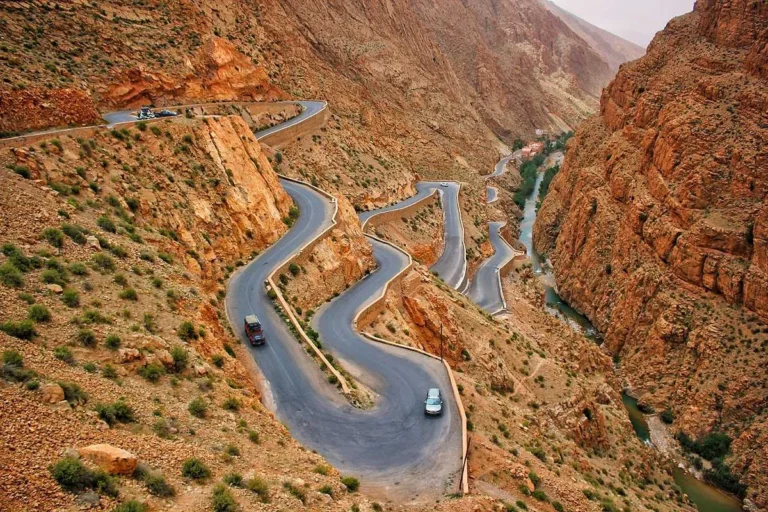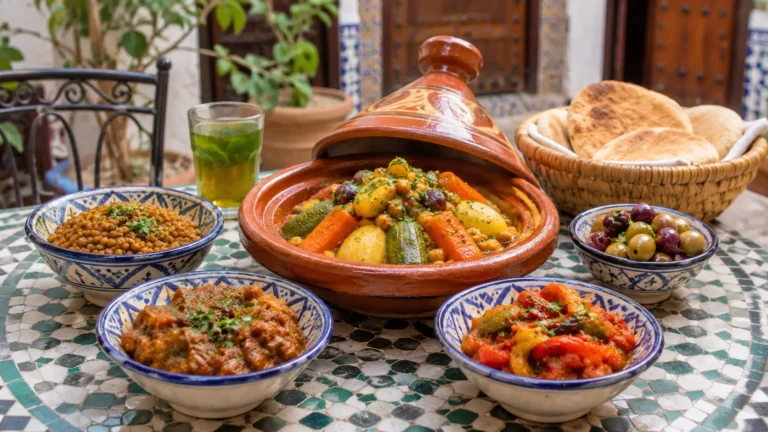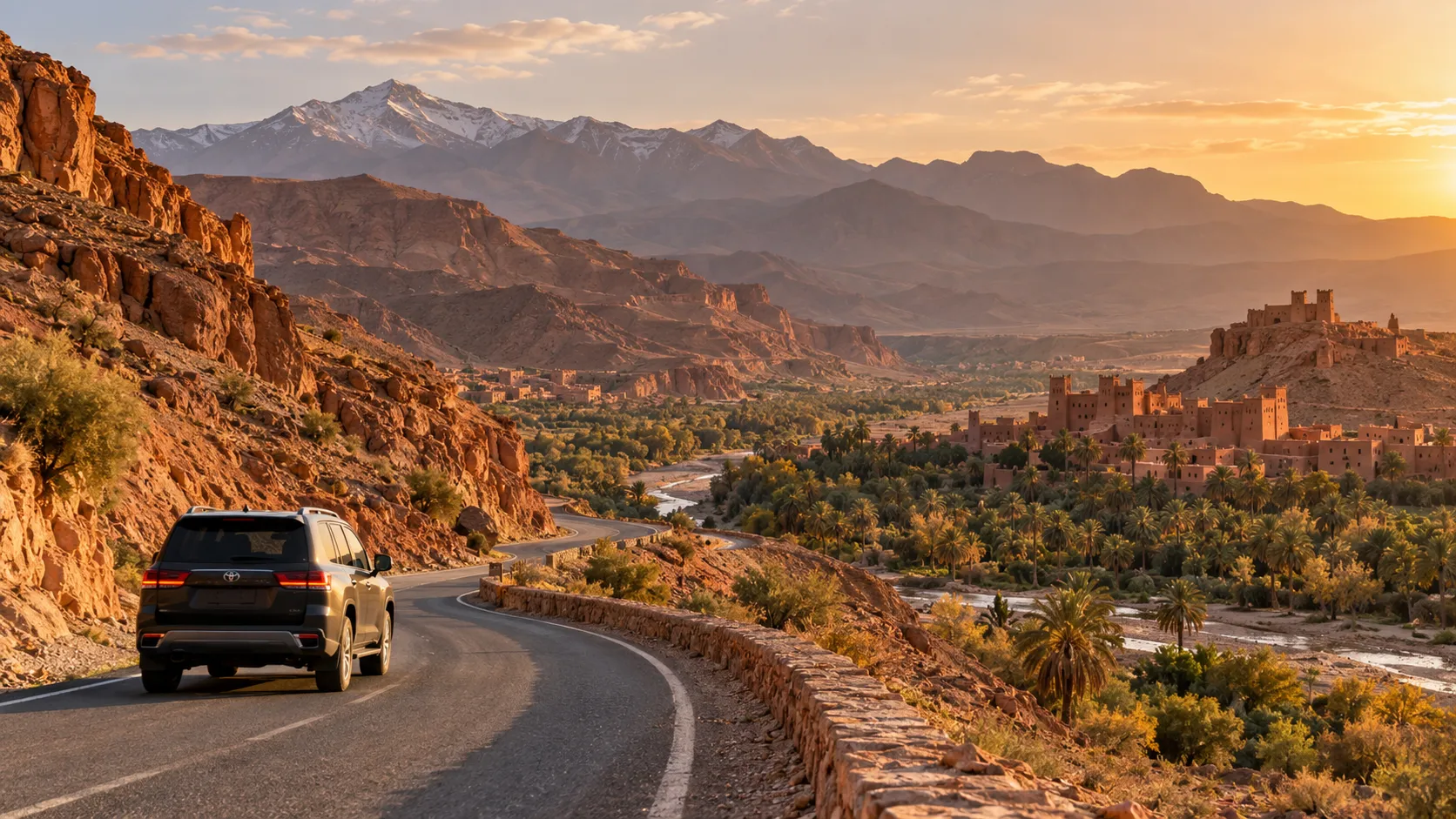
A 12-day Morocco road trip itinerary gives you enough time to combine historic cities, High Atlas scenery, dramatic valleys and a real Sahara experience without limiting the journey to one region. This route starts in Marrakech, continues into the Ourika Valley and southern Morocco, reaches the Erg Chebbi dunes at Merzouga, then travels north to Fes and Meknes before crossing to Casablanca and returning to Marrakech.
What makes this itinerary interesting is the contrast. In less than two weeks, you move from Marrakech’s medina and gardens to mountain villages, earthen kasbahs, deep gorges, Sahara dunes, the medieval streets of Fes and Casablanca’s Atlantic waterfront.
The original French itinerary gives two days each to Marrakech, the Ourika Valley, Ouarzazate and Dades, Merzouga, Fes and Meknes, and finally Casablanca with a return to Marrakech. This English version keeps all of those places and experiences while adding the practical details needed to understand the road days, overnight stops and pacing.
12-Day Morocco Road Trip Itinerary at a Glance
| Day | Route | Main experience |
|---|---|---|
| Day 1 | Marrakech | Medina, Jemaa el-Fna and souks |
| Day 2 | Marrakech | Majorelle Garden, Bahia Palace and Saadian Tombs |
| Day 3 | Marrakech → Ourika Valley | High Atlas foothills, river and villages |
| Day 4 | Ourika Valley | Hiking, local food and mountain stay |
| Day 5 | Ourika/Marrakech → Ouarzazate | High Atlas road, kasbahs and film history |
| Day 6 | Ouarzazate → Dades Valley | Rock formations, gorge scenery and walking |
| Day 7 | Dades → Merzouga | Southern landscapes, Erg Chebbi and sunset |
| Day 8 | Merzouga | Sahara sunrise, dunes and desert experience |
| Day 9 | Merzouga → Fes | Long scenic road day toward northern Morocco |
| Day 10 | Fes + Meknes | Medina, crafts and imperial-city history |
| Day 11 | Fes/Meknes → Casablanca | Hassan II Mosque and Corniche |
| Day 12 | Casablanca → Marrakech | Return to Marrakech and final Moroccan meal |
Days 1–2: Start the Road Trip in Marrakech
Begin the journey in Marrakech, where two days gives you time to settle into Morocco before beginning the longer road sections.
The first day can focus on the medina and its surrounding streets. Jemaa el-Fna is the natural starting point, especially later in the afternoon when food stalls, performers and crowds gradually transform the square.
Jemaa el-Fna sits within the UNESCO-listed Medina of Marrakech, while its cultural space has also received UNESCO recognition for its living oral and performance traditions.
From the square, continue into the surrounding souks. Rather than trying to follow every lane, use the first afternoon to become familiar with the rhythm of the medina.
Day 2: Gardens, Palaces and Historic Marrakech
The second day keeps the attractions from the original French itinerary: Majorelle Garden, Bahia Palace and the Saadian Tombs.
Majorelle Garden provides a very different atmosphere from the medina, with planted spaces, distinctive architecture and a more controlled visitor experience.
Bahia Palace introduces another side of Marrakech through decorated courtyards, carved details and rooms connected with the city’s nineteenth-century history.
The Saadian Tombs add an earlier historical layer and can be combined with the Kasbah area.
If you plan to self-drive, Marrakech is also the logical place to collect a rental vehicle. However, you do not necessarily need the car while exploring the medina. Depending on your rental terms and accommodation, collecting it when you are ready to leave the city may be easier than managing parking for two sightseeing days.
Days 3–4: Marrakech to Ourika Valley
Leave Marrakech for Ourika Valley in the foothills of the High Atlas Mountains.
The French article describes Ourika as roughly an hour from Marrakech. Actual road time varies with your starting point, traffic and where in the valley you are staying, but it remains one of the most accessible mountain areas from the city.
The scenery changes quickly. Marrakech’s urban landscape gives way to river scenery, terraced fields, mountain slopes and settlements along the valley.
Hiking in Ourika Valley
Use part of the first or second day for walking. Setti Fatma is one of the best-known areas for waterfall walks, but the difficulty and conditions can vary.
A guide can be useful if you want to go beyond an easy riverside walk or if current trail conditions are unclear.
There is no need to turn this section into a major trek. The purpose of the two-day stop is to introduce the Atlas landscape before the longer southern road journey.
Amazigh Villages and Local Life
The original French article refers to visiting Berber villages. Amazigh is also widely used for the Indigenous communities of Morocco and North Africa.
Pass through village areas respectfully and distinguish between public streets and an arranged hosted visit. Do not assume that a village stop automatically includes entry into a private home.
Traditional Food in the Valley
Keep time for the local meal included in the original itinerary. Restaurants along the river and valley roads provide an opportunity to slow down rather than treating the mountains as only a photo stop.
A tagine, couscous or another Moroccan meal can fit naturally into the day, but menus and availability vary by restaurant and season.
Spend the Night in the Mountains
The original route recommends spending a night in a picturesque kasbah. A kasbah-style guesthouse, mountain lodge or small hotel can all work.
Staying overnight gives you an evening and early morning outside Marrakech and reduces the temptation to turn the mountains into a rushed out-and-back excursion.
One practical consideration is the next section of the route. Ourika is not directly on the standard Marrakech-to-Ouarzazate corridor, so continuing to Ouarzazate may involve returning toward Marrakech before taking the main High Atlas road. Allow enough time and check the route shortly before departure.
Day 5: Drive to Ouarzazate
Continue toward Ouarzazate, crossing into the landscapes of southern Morocco.
This should be treated as a scenic road day rather than something to rush. Mountain conditions, traffic and stops can affect the journey.
Once in Ouarzazate, the original itinerary highlights two main attractions: Taourirt Kasbah and Atlas Studios.
Taourirt Kasbah
Taourirt Kasbah reflects the earthen architecture associated with southern Morocco. Allow time to look at the building in context rather than treating Ouarzazate purely as a refueling point on the way to the Sahara.
Atlas Film Studios
Ouarzazate has a long association with international film production. Atlas Studios is one of the best-known film-related attractions in the area.
If visiting the studios is important to you, check current opening arrangements before building the day’s timing around it.
Optional Ait Ben Haddou Stop
If the road schedule allows, Ait Ben Haddou can also be added around the Ouarzazate section.
The fortified settlement is one of southern Morocco’s most recognizable examples of earthen architecture and works naturally on a road trip through this region.
Do not add it if doing so means arriving at your accommodation very late after an already long mountain crossing.
Day 6: Ouarzazate to Dades Valley
Continue toward Dades Valley, where the landscape becomes a mixture of dry cliffs, green cultivated areas, villages, rock formations and winding mountain roads.
The original French itinerary emphasizes the unusual geological formations of the Dades area and recommends hiking through the gorge.
Walking here creates an important break from the vehicle. Even a shorter route lets you experience the valley differently from simply stopping at roadside viewpoints.
Dades Rock Formations and Gorge Scenery
The Dades region is known for weathered rock formations, including the formations commonly called Monkey Fingers, as well as dramatic road viewpoints farther through the valley.
Choose the length of the walk according to temperature, daylight and your fitness rather than trying to complete a fixed route simply because it appears in an itinerary.
Stay Near the Gorge
The original itinerary suggests an overnight in an auberge near the gorge. This is a good place to keep that plan.
An overnight around Dades breaks the journey toward Merzouga into more comfortable stages and gives you time to appreciate the valley in the evening and morning.
Day 7: Dades Valley to Merzouga and the Sahara
Leave Dades and continue toward Merzouga, the gateway to the Erg Chebbi dunes.
The Sahara section is the major landscape change in this 12-day Morocco road trip itinerary. After cities, mountains, kasbahs and gorges, the road eventually reaches open desert terrain and the large dunes beside Merzouga.
Plan the day’s departure around the sunset experience rather than assuming you can arrive whenever you like.
Camel Ride Into Erg Chebbi
The original article includes a camel excursion through the Erg Chebbi dunes. A sunset camel ride remains one of the classic ways to experience the landscape.
Camel riding is optional. If you are uncomfortable riding or have mobility concerns, many camps can arrange vehicle-based access.
The most important part is allowing enough time to reach the dunes before sunset rather than racing the final road section.
Watch Sunset Over the Sahara
Late-afternoon light brings out the ridges and shadows of the dunes. Weather conditions can change the colors from day to day, so avoid expecting one exact postcard image.
Night in a Desert Camp
The original itinerary includes an overnight in a desert camp, dinner and an evening around the fire with traditional music.
Keep that experience, but check the specific camp program before booking. Some camps arrange music or other evening activities while others provide a quieter experience.
Camp standards also vary. Ask about the tent, bathroom, meals, luggage arrangements and whether access is by camel, 4×4 or a combination.
Day 8: Sunrise and a Full Day Around Merzouga
Wake early for sunrise over Erg Chebbi, another experience specifically included in the French article.
Temperatures before dawn can be much cooler than expected, particularly outside summer, so keep a warm layer accessible rather than packed in your main luggage.
After sunrise and breakfast, use the rest of the day to slow down.
You can spend more time around Merzouga, rest after the previous road days or add an optional desert activity depending on your interests.
Possible options include:
- Walking around the dunes
- A 4×4 exploration of the wider desert area
- Visiting nearby settlements
- Photography
- Sandboarding where available
- Relaxing at your accommodation
- Another sunset viewpoint
Do not feel that you need to fill the entire day with organized activities. One of the advantages of allocating two days to Merzouga is having time to experience the desert without immediately leaving after sunrise.
Day 9: Merzouga to Fes
The journey from Merzouga to Fes is one of the longest road days of this itinerary.
Treat it accordingly. Start at a sensible time, take proper breaks and avoid planning a full Fes sightseeing program immediately after arrival.
The route gradually leaves the dry southeast and moves toward higher and greener landscapes before reaching Fes.
This geographical transition is one of the reasons overland travel is rewarding. Morocco looks very different by the time you arrive in the north.
Settle into your accommodation and keep the evening relatively simple. A relaxed dinner and short walk are usually a better use of the night than trying to explore the entire medina after a major transfer.
Day 10: Explore Fes and Visit Meknes
The original itinerary combines Fes with an excursion to nearby Meknes.
This is possible, but the day should be planned carefully because both places deserve time. If Fes is one of your main priorities, spend most of the day there and keep Meknes focused rather than trying to see every monument in both cities.
Fes Medina
Fes is famous for its historic medina, artisan quarters, religious architecture, food and traditional crafts.
Walk through Fes el-Bali and make time for workshops and neighborhood streets rather than moving only between headline sights.
A local guide can be particularly useful for understanding the structure and history of the medina.
Al-Qarawiyyin
The original article highlights Al Quaraouiyine. Founded in the ninth century, the institution has a long history of religious scholarship and education and is widely described among the world’s oldest surviving centers of learning.
Visitor access to active religious spaces can be restricted, so appreciate the complex from areas that are open to visitors and follow current access rules.
Meknes
Use the second part of the day, or a dedicated excursion if your timing permits, for Meknes.
The city is one of Morocco’s imperial cities and is known for monumental gates, historic walls, the old medina and sites connected with Sultan Moulay Ismail.
The original French itinerary specifically highlights its imposing walls and historic monuments, so keep those themes at the center of the visit rather than turning Meknes into only a lunch stop.
Day 11: Fes or Meknes to Casablanca
Continue west toward Casablanca, Morocco’s largest city and the modern urban contrast at the end of the trip.
Casablanca feels very different from Fes, Merzouga or Ourika. Rather than a preserved historic destination, it is a working Atlantic metropolis with modern districts, Art Deco architecture and one of Morocco’s best-known religious monuments.
Visit Hassan II Mosque
The original itinerary places Hassan II Mosque at the center of the Casablanca visit.
Its Atlantic setting and monumental scale make it the city’s major architectural landmark. If you want to see the interior, check the current visitor-tour schedule rather than assuming you can enter at any time.
Walk Along the Corniche
After the mosque, continue to the Corniche for the Atlantic side of Casablanca.
This provides a relaxed contrast after the medinas, desert and long overland sections of the previous days.
Spend the night in Casablanca rather than trying to immediately drive back to Marrakech after a full day of travel and sightseeing.
Day 12: Casablanca to Marrakech
The original itinerary finishes by returning to Marrakech.
Use the last day for the road back and keep the remaining schedule flexible according to your flight time.
If you have an evening available, return to the medina, revisit the souks or spend time at a rooftop café rather than adding another major excursion.
The French article ends with a traditional Moroccan meal in Marrakech, which is an appropriate way to finish the route.
Choose somewhere that allows you to sit down and enjoy the final evening rather than treating dinner as one last item on a sightseeing checklist.
Is This 12-Day Morocco Road Trip Too Fast?
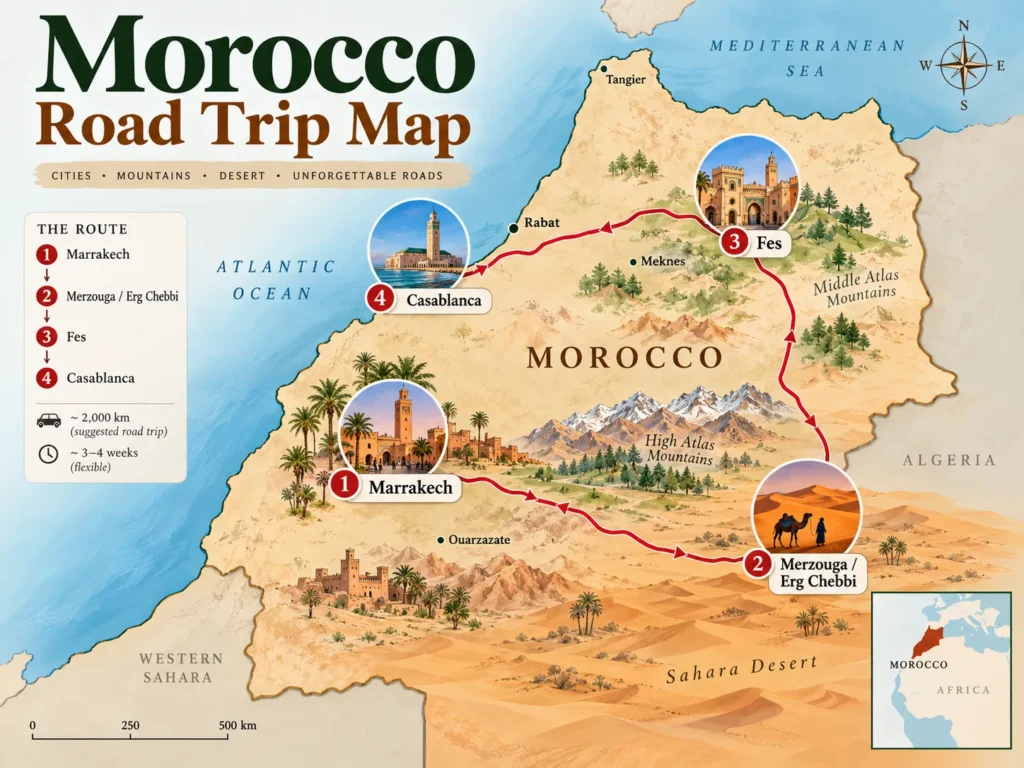
The itinerary is achievable, but it is an active road trip.
There are several substantial driving days, particularly the transitions toward Ouarzazate, from Dades to Merzouga, from Merzouga to Fes and later toward Casablanca and Marrakech.
The two-night allocations in Marrakech, Ourika and Merzouga help, but travelers who dislike frequent hotel changes may prefer simplifying the route.
The part most open to adjustment is the two-day Ourika section. The original itinerary keeps two days there, and this rewrite preserves that plan. However, travelers who want more desert or city time could use one Ourika day and move the spare night to Dades, Merzouga or Fes.
Self-Drive or Private Driver?
Both approaches can work for this route.
Self-Drive
A rental car gives you flexibility to stop at viewpoints, cafés and smaller places along the road.
It works best for confident drivers who are comfortable with mountain roads, city traffic, changing road conditions and navigation.
Parking can be inconvenient close to historic medinas, so check arrangements with your riad or hotel before arrival.
Private Driver
A private driver removes the need to navigate, manage parking or stay focused on the road during the long desert transfers.
It can be particularly useful if you want the road journey itself to include frequent scenic stops.
A driver is not automatically the same as a specialist city guide. If detailed historical interpretation in Marrakech or Fes matters to you, arrange an appropriate local guide separately where needed.
Best Time for a 12-Day Morocco Road Trip
Spring and autumn are useful periods for this itinerary because it crosses several climate zones.
Marrakech, the Atlas foothills, Dades, the Sahara, Fes and Casablanca can experience noticeably different conditions during the same journey.
Spring
Spring works well for combining cities, mountains and southeastern Morocco. Mountain landscapes can be particularly attractive, while daytime conditions are often more comfortable for walking than during peak summer.
Summer
Summer can be intensely hot around Marrakech, Ouarzazate, Dades and especially Merzouga.
Plan Sahara activities around early morning and late afternoon and avoid designing the same daily schedule you would use in a cooler season.
Autumn
Autumn is another useful period for a route that combines cities, Atlas scenery and desert travel.
Winter
Winter can provide comfortable city sightseeing, but mountain roads, desert mornings and nights can become cold.
Carry proper layers and check current road and weather conditions before major Atlas sections.
What to Pack for the Road Trip
- Comfortable walking shoes for medinas, valleys and kasbahs
- Lightweight daytime clothing
- Warmer layers for mountain and desert evenings
- Sun hat
- Sunglasses
- Sunscreen
- Reusable water bottle
- Small day bag
- Power bank for long road days
- Personal medication
- Light rain or wind protection depending on season
- Comfortable clothing for camel riding if you plan to participate
Keep luggage manageable because this itinerary involves several accommodation changes.
Road Trip Planning Tips
- Do not judge a road day only by distance. Mountain roads and sightseeing stops can make a journey much longer than expected.
- Avoid scheduling every important attraction immediately after a long transfer.
- Book accommodation with clear parking or vehicle drop-off instructions.
- Start long road days with enough daylight.
- Check current mountain weather before High Atlas travel.
- Keep water accessible in the vehicle.
- Allow breaks instead of treating every transfer as a race.
- Do not leave Merzouga immediately after sunrise if you have allocated two days to the desert.
- Confirm desert-camp access and luggage arrangements before arrival.
- Leave enough time on Day 12 if your international flight departs from Marrakech.
Who Is This 12-Day Morocco Itinerary Best For?
This route works well for travelers who want variety rather than a holiday centered entirely around one city.
It is particularly suitable if your priorities include:
- Marrakech and Fes
- High Atlas scenery
- Ourika Valley
- Kasbah architecture
- Road-trip landscapes
- Dades Valley
- The Sahara
- Camel trekking or a desert camp
- Moroccan crafts and medinas
- Imperial-city history
- Casablanca and the Atlantic coast
It is less suitable if you want a very slow trip with only two or three accommodation changes. In that case, remove one region rather than trying to make every driving day shorter.
FAQ
Is 12 days enough for a Morocco road trip?
Yes. Twelve days is enough to combine Marrakech, the Atlas foothills, southern Morocco, Merzouga, Fes, Meknes and Casablanca, but expect several long driving days. If you prefer a slower trip, remove one region or reduce the number of overnight changes.
Can I drive from Marrakech to the Sahara myself?
Yes, experienced travelers can self-drive toward Merzouga, but it should be planned as a multi-day journey rather than a normal day trip. Ouarzazate, Dades and other southern stops help divide the route into more manageable sections.
Is Merzouga worth two days?
Yes, especially if the Sahara is one of your main reasons for visiting Morocco. Two days gives you time for sunset, a desert camp, sunrise and additional time around Erg Chebbi instead of arriving late and leaving immediately the following morning.
Do I need a 4×4 for this Morocco road trip?
Not necessarily for the main paved route between the cities and valleys. However, individual camps or off-road desert experiences may use 4×4 vehicles. Confirm the access arrangements with your accommodation or operator before arriving in Merzouga.
What is the hardest driving day on this itinerary?
Merzouga to Fes is one of the most substantial road days because it covers a major change in geography and takes you from southeastern Morocco toward the north. Keep the evening in Fes light rather than scheduling a full guided tour after arrival.
Should I rent a car or book a private driver?
Rent a car if you are comfortable navigating independently and want maximum control over stops. A private driver is useful if you prefer to focus on the scenery, avoid parking and navigation issues and make the long southern transfers more relaxing.
Finish the Road Trip Where It Started
A 12-day Morocco road trip itinerary works because each section feels different from the one before it. Marrakech introduces the medina and palace architecture, Ourika brings you into the High Atlas foothills, Ouarzazate and Dades reveal the landscapes of southern Morocco, and Merzouga provides the Sahara experience at Erg Chebbi.
From there, the route changes again as you travel north to Fes and Meknes before finishing with Casablanca’s Atlantic character and a final return to Marrakech.
The journey contains substantial driving, but the road itself is part of the experience. Give the mountain and desert sections enough time, use overnight stops to break up the longest transfers and avoid filling every free hour with another attraction.
If you want to adjust the route around your arrival airport, driving preference, accommodation style or the number of nights in the Sahara, use the custom Morocco trip planner.
Explore destinations, tours and locally organized Morocco experiences with Visit Morocco Together.
Ready to Experience Morocco?
Turn this inspiration into your next adventure. Our travel experts are ready to help.