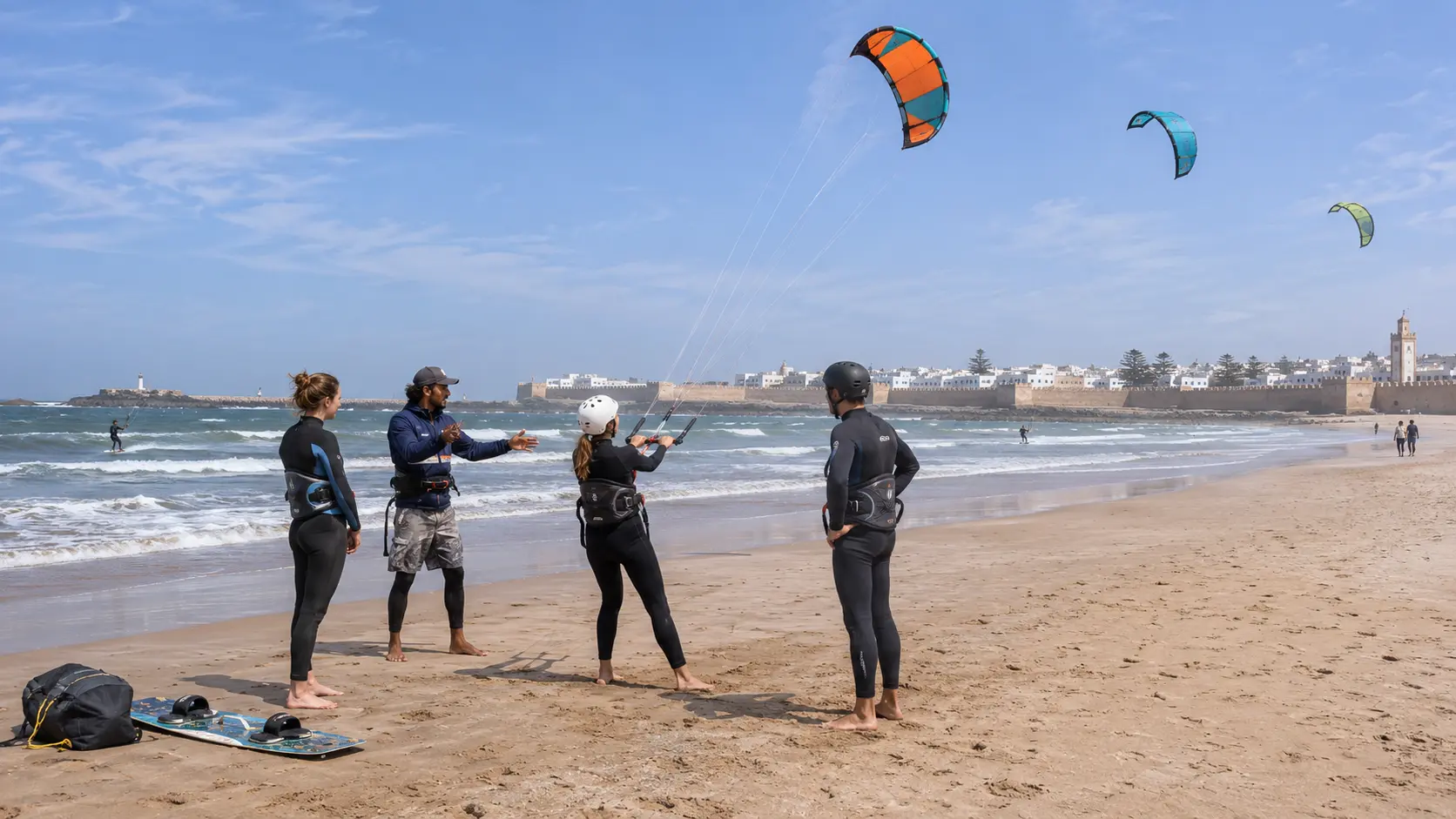
Essaouira kitesurfing lessons are a practical option for travelers who want to learn kiteboarding on Morocco’s Atlantic coast. The city’s broad sandy bay, established kitesurf schools and seasonal trade winds create opportunities for beginners to develop their skills with professional instruction.
Essaouira is a good place to learn kitesurfing, but stronger wind does not always mean easier conditions. The most reliable wind period generally runs from spring into early autumn, with particularly strong conditions during summer. Beginners may benefit from more moderate wind, while experienced riders often appreciate the stronger afternoons.
For a first experience, choose an introductory lesson with a qualified instructor. If your goal is to progress toward independent riding, allow several sessions across multiple days rather than expecting to master the sport in one afternoon.
This guide explains Essaouira’s wind patterns, the difference between beginner lesson options, where schools teach, what to expect during training and how to plan a comfortable coastal stay.
Is Essaouira Good for Beginner Kitesurfing?
Essaouira has several characteristics that make it attractive for learning to kitesurf. Its main bay offers an extensive sandy shoreline, while local schools provide beginner instruction, equipment and supervised training.
The prevailing northerly to northeasterly winds are another advantage. During the main wind season, they often provide opportunities for regular practice, although conditions vary from day to day.
For beginners, the main advantages include:
- Established instruction: Local kitesurf schools offer introductory lessons, private coaching and courses designed for different experience levels.
- Space for learning: Suitable sections of the bay provide room for supervised kite handling and water-based exercises.
- Seasonal wind: The trade winds create opportunities to practice kite control and riding techniques.
- Equipment availability: Many schools provide kites, boards, harnesses and protective equipment as part of their lessons.
- A convenient destination: Visitors can combine kitesurfing with Essaouira’s medina, fishing port, cafés and other coastal activities.
However, Essaouira is not a sheltered flat-water lagoon. Atlantic waves, wind-driven chop, currents and changing tides can make the water demanding.
The main beach also attracts other water users and visitors. A wide shoreline does not eliminate the need for appropriate training areas, careful kite launching and supervision.
For someone learning from the beginning, the quality of instruction and suitability of the conditions matter more than the destination’s reputation.
Essaouira Kitesurfing Lessons: Understanding the Wind
Wind is the most important factor when planning a kitesurfing lesson in Essaouira. It determines whether a session can take place, which equipment is appropriate and how demanding the exercises may feel.
Why Essaouira is known for its trade winds
Essaouira is often called Morocco’s Wind City because of the regular winds associated with its Atlantic location.
During the warmer months, prevailing northerly and northeasterly winds are frequently reinforced by thermal effects created by temperature differences between the land and ocean.
The wind often strengthens from late morning into the afternoon, although the exact timing depends on weather conditions.
These patterns help explain Essaouira’s popularity with kitesurfers and windsurfers. Nevertheless, wind strength and direction can change, and no individual session is guaranteed.
Spring: A useful period for beginners
Spring generally marks the development of Essaouira’s more regular kitesurfing conditions.
April, May and June can offer opportunities for beginners to practice in moderate winds, although stronger days also occur.
For travelers who want to learn without building their trip around the strongest summer conditions, late spring is worth considering.
Water temperatures can still feel cool, so suitable wetsuits and wind protection are important.
Summer: Reliable wind, but sometimes too strong
July and August are often among Essaouira’s windiest months.
These conditions can appeal to confident kitesurfers who already understand kite control, riding techniques and emergency procedures.
For complete beginners, however, strong wind can make everything happen faster. Kite handling becomes more demanding, and wind-driven chop may complicate exercises in the water.
A qualified instructor may select a different teaching time, adjust the equipment or postpone practical activities when conditions are unsuitable.
Do not choose the strongest wind period simply because you want to learn quickly. A controlled learning environment is more valuable than maximum kite power.
Autumn and winter: More variable conditions
September and October can still offer useful kitesurfing conditions, although the regularity of the summer winds gradually changes.
Late autumn and winter generally bring less predictable wind and more influence from Atlantic weather systems.
Kitesurfing remains possible on suitable days, but travelers should allow more flexibility. Larger waves, cooler conditions and changing weather can affect beginner lessons.
If you are visiting primarily to learn kitesurfing, a longer stay or a flexible activity schedule can reduce the disappointment of unsuitable conditions.
What time of day is best for a lesson?
There is no universally ideal hour. In the main wind season, morning conditions can be lighter, with winds often increasing later in the day.
That does not mean every beginner should book the earliest lesson. Very light wind may also make some kite exercises difficult.
The instructor should choose the session time according to the forecast, the student’s ability and the exercises being taught.
Ask your school to confirm the intended lesson time shortly before the session rather than assuming a fixed timetable will always provide suitable wind.
Where Do Kitesurfing Lessons Take Place in Essaouira?
Essaouira’s kitesurf schools use different sections of the coastline depending on conditions, available space and their operating arrangements.
The main bay and the southern beach area near Diabat are particularly relevant for beginner instruction.
Essaouira Bay: Convenient and accessible
The main beach stretches south from the city and is easily accessible from many accommodation areas.
Its sandy shoreline and established water-sports activity make it a common location for kitesurfing instruction and independent riding.
However, different parts of the beach have different conditions. Areas closer to the city can be busier, with swimmers, walkers, surfers and other recreational activities.
Buildings and local geography may also influence wind quality in some sections.
Schools should select suitable teaching and launching areas rather than treating the entire bay as one unrestricted kitesurfing zone.
Diabat: A quieter alternative for some schools
The beach area near Diabat, south of central Essaouira, is another location used for kitesurfing lessons.
Some schools prefer this section because it can provide more space away from the busiest parts of the city beach.
The suitability of Diabat still depends on wind, tides, waves and the number of people using the area. It should not be assumed that conditions are always calmer or safer.
Some providers arrange transport to their chosen teaching location, while others operate closer to the main bay.
Before booking, ask whether your lesson takes place near the city, at Diabat or somewhere else, and whether transport is included.
What about Sidi Kaouki and Moulay Bouzerktoun?
Experienced riders may also consider other wind-sports locations around Essaouira.
Sidi Kaouki, to the south, has an exposed Atlantic beach where wind and waves can create more demanding conditions.
Moulay Bouzerktoun, north of Essaouira, is particularly associated with windsurfing and wave-oriented wind sports. Its exposed conditions and rocky features require experience and appropriate local knowledge.
Neither location should automatically replace the main bay for a first kitesurfing lesson.
Beginners are better served by choosing a school that matches the location and conditions to their experience.
What Happens During Your First Kitesurfing Lesson?
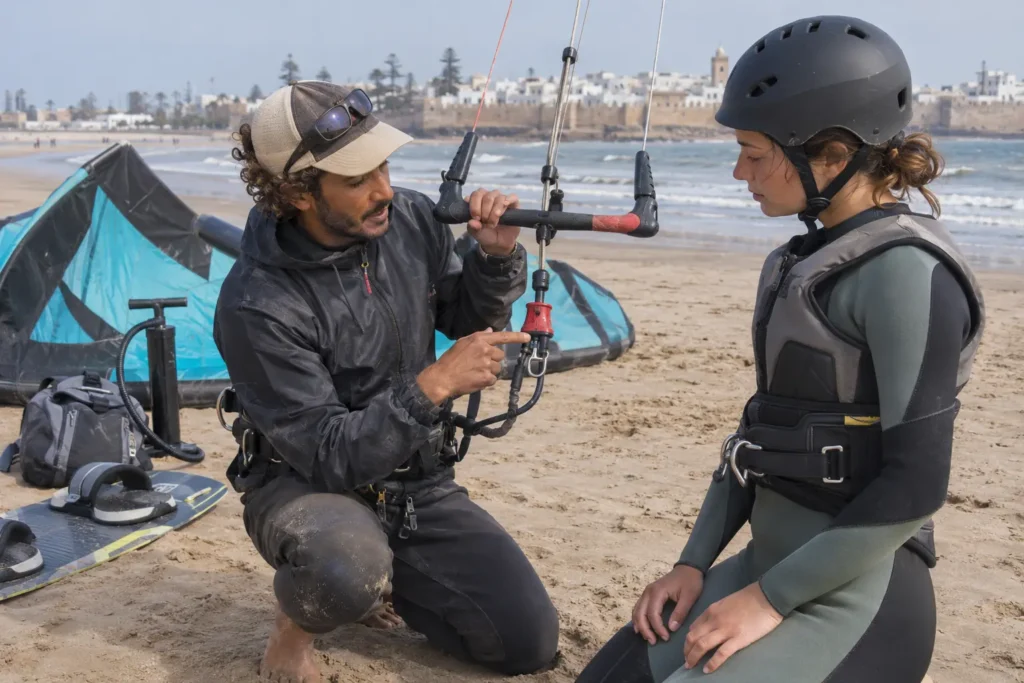
A beginner kitesurfing course normally progresses through several stages. The first objective is not to ride across the water immediately, but to understand how the kite works and how to control it safely.
Step 1: Wind awareness and equipment safety
Training generally begins with an introduction to wind direction, kite equipment and the environment around the teaching area.
Students learn about the wind window, how kite power changes with positioning and why maintaining clear space around the equipment is essential.
The instructor should also explain the safety-release systems and demonstrate what to do when kite control is lost.
Step 2: Learning to control the kite
After the initial briefing, students practice steering and controlling the kite under supervision.
This stage focuses on understanding how the kite responds to movements of the control bar and how to avoid generating excessive power.
Some exercises may take place on land, while others move into shallow or deeper water depending on conditions and teaching methods.
Step 3: Body dragging in the water
Body dragging involves using the kite’s pull to move through the water without standing on a board.
This helps students understand traction, directional control and how to recover their position.
Learning to recover a board and perform essential safety procedures is also part of developing independent kitesurfing skills.
Step 4: Water starts and first rides
Once kite control and basic water skills are sufficiently developed, students begin practicing water starts.
This involves positioning the board, controlling the kite’s power and attempting to rise onto the board.
Some learners reach this stage relatively quickly, while others need more practice. Progress depends on coordination, confidence, previous experience and the conditions.
A first lesson should not be sold as a guarantee that you will ride independently. Safe kite control is an achievement in itself, and building those foundations makes later progress more manageable.
Choosing Between Group, Semi-Private and Private Lessons
Essaouira kitesurfing schools offer several teaching formats. The most suitable option depends on your budget, previous experience, preferred learning pace and the amount of individual instruction you want.
Group lessons: An accessible introduction
Group sessions can be a practical option for first-time participants who want to understand the basics without immediately committing to an extended private course.
They are often less expensive per person, although teaching arrangements vary. Some group lessons involve sharing a kite between students and taking turns practicing.
This can be appropriate for initial exercises, but it may reduce your individual kite-handling time.
Before booking, ask how many participants share an instructor and whether each person has their own equipment during the practical stages.
Semi-private lessons: A balance of instruction and cost
Semi-private lessons generally involve fewer students than a standard group session.
They can work well for friends or couples with similar experience levels who want more personal feedback while sharing the cost of instruction.
However, learning speeds may differ. If one student progresses much faster, the instructor may need to adapt the activities for each participant.
Confirm whether equipment is shared and how practical time is divided.
Private lessons: More individualized coaching
Private instruction is useful for travelers who want focused attention, have particular learning needs or are returning to kitesurfing after a break.
An instructor can adapt the exercises more closely to the student’s current abilities and provide immediate feedback.
Private lessons generally cost more, and they do not eliminate weather restrictions. A private instructor cannot make unsafe conditions appropriate for learning.
Multi-day courses and kitesurf camps
For travelers hoping to develop beyond basic kite control, a course spread across several days is usually more useful than a single introductory session.
Some local schools offer packages combining lessons with equipment and accommodation, while others provide instruction separately.
Check exactly what is included. A course advertised in hours may count scheduled instruction differently from actual individual kite-flying time.
Also confirm how the provider handles lessons postponed because of wind or unsuitable sea conditions.
How to Choose a Kitesurf School in Essaouira
A well-organized school is particularly important for beginners because kitesurfing involves powerful equipment and an environment that can change quickly.
Instructor qualifications, appropriate equipment and clear safety procedures deserve more attention than promotional claims about how quickly students will learn.
Before booking, ask:
- Instructor qualifications: Are lessons taught by appropriately trained instructors, such as those holding current IKO or other recognized qualifications?
- Teaching format: How many students share an instructor, and how much individual practical time is provided?
- Equipment: Are the kite, board, harness, wetsuit, helmet and suitable flotation or impact protection included?
- Safety arrangements: What supervision, communication, emergency procedures and rescue arrangements are available?
- Lesson location: Where does the session take place, and how is the area chosen for the day’s conditions?
- Eligibility: What swimming ability, minimum age, weight or other participation requirements apply?
- Changing conditions: Can lessons be rescheduled, refunded or credited when wind or weather makes them unsuitable?
- Pricing: What does the advertised price cover, and are transport or additional equipment charges separate?
Do not assume that every school has identical qualifications, safety systems or cancellation policies.
If a provider cannot explain how beginners are supervised or what happens when conditions deteriorate, consider another option.
How Many Days Should You Allow for Learning?
Your ideal stay depends on whether you want to try kitesurfing once or develop enough skills to continue training independently elsewhere.
One day: An introductory experience
A short lesson can introduce the equipment, basic kite control and safety principles.
This is reasonable for travelers who simply want to discover whether the sport interests them.
However, it is not realistic to assume that a single session will provide every skill required for independent riding.
Two or three days: More opportunities to practice
Spending several days in Essaouira allows time for additional instruction and recovery between sessions.
You may be able to progress from kite handling toward body dragging and water starts, depending on your ability and conditions.
Progress is individual, so use these days as a flexible learning period rather than a deadline for riding.
A longer stay: Developing independence
Travelers who want to become confident independent kiters should consider a longer training period and additional coaching as needed.
Independent kitesurfing involves more than standing on the board. You must be able to assess conditions, manage equipment, recover your board, control your riding direction and respond appropriately to problems.
Only move from supervised lessons to equipment rental when your instructor has assessed you as sufficiently competent.
For a trip centered on lessons, an extra night can provide a useful buffer if the wind is unsuitable on one of your planned days.
Where to Stay and How to Reach Essaouira
Essaouira is accessible by road from Marrakech and Agadir, and Essaouira-Mogador Airport provides another possible arrival option depending on available flights.
Buses, rental cars and pre-arranged road transport can all be practical choices. Essaouira does not have a passenger railway station, so travelers arriving by train elsewhere in Morocco will need an onward connection.
Check transport schedules and allow for delays, particularly when traveling with surfing equipment.
Staying near the beach
Accommodation closer to the main beach can be convenient when lessons meet in the bay.
However, proximity to the city beach does not guarantee that your school will teach there. Some providers operate farther south or arrange transport to another location.
Confirm the meeting point before choosing accommodation specifically for kitesurfing.
Staying in the medina
The historic medina offers traditional guesthouses, cafés, restaurants and convenient access to Essaouira’s cultural attractions.
This can be a good choice for visitors who want to combine lessons with sightseeing.
Be aware that some medina accommodation requires walking through narrow lanes with luggage. Confirm the nearest practical vehicle drop-off point, especially if carrying large bags.
Staying in a surf or kitesurf camp
A kitesurf camp may simplify arrangements by combining accommodation with instruction and sometimes equipment or transport.
However, packages vary. Verify the location, lesson hours, meals, equipment, cancellation conditions and any additional services before booking.
For more ideas about accommodation areas and activities beyond the beach, explore our Essaouira destination guide.
What to Wear and Bring for Kitesurfing Lessons
Essaouira’s Atlantic water can feel cool even when the weather is sunny. Wind also makes standing on the beach between exercises feel colder than expected.
Useful items include:
- A suitable wetsuit: Many schools provide one, but confirm the size and seasonal suitability.
- Sun protection: Apply water-resistant sunscreen and bring appropriate protection for time outdoors.
- A towel and dry clothes: Useful after a lesson, particularly when the wind is strong.
- Drinking water: Kitesurfing is physically demanding, and hydration matters.
- A warm layer: A wind-resistant jacket can be useful before and after the session.
- Secure storage: Leave unnecessary valuables away from the water and confirm whether the school provides storage.
Use the safety equipment specified by your instructor. Do not remove your helmet or other protective equipment during training unless instructed to do so.
If you wear glasses or contact lenses, ask the school about practical precautions before entering the water.
Kitesurfing Safety and Responsible Beach Use
Kitesurfing uses wind power to move a rider across the water. Incorrect handling can create risks for the participant and other people nearby.
Beginners should always learn under suitable professional supervision and avoid launching large kites independently before developing the necessary skills.
Understand the risks of strong wind
Strong wind can generate substantial kite power and make mistakes more difficult to correct.
A wide sandy beach does not remove these risks. Obstacles, other beach users, waves and changes in wind direction still require attention.
Never pressure an instructor to proceed when the conditions are unsuitable. A postponed session is preferable to attempting exercises beyond your current ability.
Respect kite-launching areas
Kite lines can extend across a significant area and may be difficult for other beach users to notice.
Keep clear of launching and landing zones unless you are participating under instruction.
Follow local rules for separating kitesurfers from swimmers, surfers and other water users. These arrangements may vary across the beach and with seasonal activity.
Learn the essential safety procedures
Training should include understanding the kite’s safety releases, relaunch procedures and how to respond when you cannot continue riding normally.
Students should also learn how to assess wind direction, identify hazards and maintain appropriate separation from other people.
Do not rely on online videos as a substitute for supervised practice.
Respect Essaouira’s coastline
Essaouira’s beaches are shared by residents, visitors, fishers and different recreational activities.
Keep access routes clear, avoid disturbing animals or wildlife, and do not leave damaged equipment or litter on the sand.
Ask before photographing instructors, participants or residents at close range. Respect private property and areas where access is restricted.
What If the Wind Is Unsuitable for Kitesurfing?

Wind-related changes are part of planning a kitesurfing trip. Even during the main season, individual days may be too windy, too calm or otherwise unsuitable for your experience level.
If a lesson cannot proceed, ask the provider about rescheduling or other options under the agreed booking conditions.
Essaouira also offers activities that do not depend on kiteboarding conditions.
You can explore the medina, visit the fishing port, enjoy local cafés or spend time in galleries and craft shops.
Surfing may be an alternative when the waves are suitable, but it should not be assumed that poor kitesurfing conditions automatically create safe surfing conditions.
For a longer stay, keeping some sightseeing time flexible allows you to respond to the weather without losing the enjoyment of your trip.
FAQs
Can complete beginners learn kitesurfing in Essaouira?
Yes. Essaouira has schools offering lessons for people with no previous kiteboarding experience. Beginners should choose qualified instruction and confirm that the conditions, equipment and teaching area are suitable for their ability.
What is the best month for beginner kitesurfing in Essaouira?
Late spring and early autumn can offer a useful balance between seasonal wind and potentially more manageable conditions. July and August often bring stronger winds, which are not always ideal for complete beginners. Actual suitability depends on the day’s forecast.
Can you learn kitesurfing in one day?
You can learn introductory skills in a single session, but independent riding usually requires more training. Kite control, body dragging, water starts and safety procedures develop at different speeds for different learners.
Do I need to know how to swim?
Swimming ability is an important requirement for water-based kitesurfing training. Professional training programmes generally expect participants to be able to swim. Confirm the school’s specific eligibility requirements, and do not enter the water if you cannot meet them.
Are group or private kitesurfing lessons better?
Group lessons can be more economical and suitable for an introduction. Private lessons provide more individual attention and can help address specific learning difficulties. Compare actual hands-on practice time, instructor supervision and equipment arrangements.
Can beginners rent kitesurfing equipment without lessons?
Equipment rental is generally intended for riders who can demonstrate the necessary skills. A beginner should not rent and launch kitesurfing equipment independently without suitable training. Schools may assess your ability before agreeing to a rental.
Plan Your Essaouira Kitesurfing Experience Around Your Level
Essaouira offers a useful combination of established kitesurfing instruction, wide sandy beaches and seasonal Atlantic winds. However, the most important factor for a beginner is not finding the strongest wind or the shortest course.
Choose a qualified school, confirm the teaching location and select a lesson format that matches your learning goals. If you want to progress beyond the basics, allow multiple sessions and leave room for changes in weather.
Travelers combining kitesurfing with a wider Atlantic-coast journey can explore Morocco coastal travel options with Visit Morocco Together. Compare the available routes and inclusions to find a journey that fits your interests and available time.
For additional activity ideas, browse our things to do in Morocco guides.
The practical takeaway: Essaouira can be a rewarding place to learn kitesurfing when the conditions match your experience. Start with safe kite control, choose instruction over rushing toward your first ride and give yourself enough time to learn at a comfortable pace.
Ready to Experience Morocco?
Turn this inspiration into your next adventure. Our travel experts are ready to help.