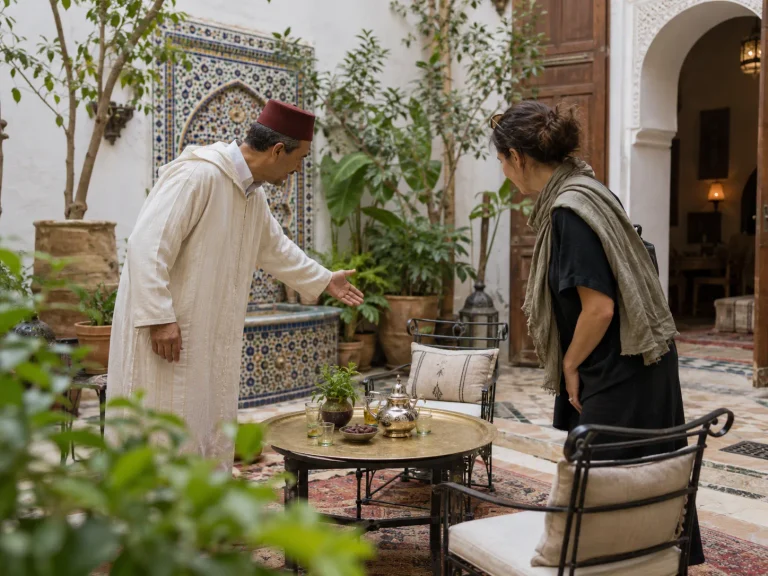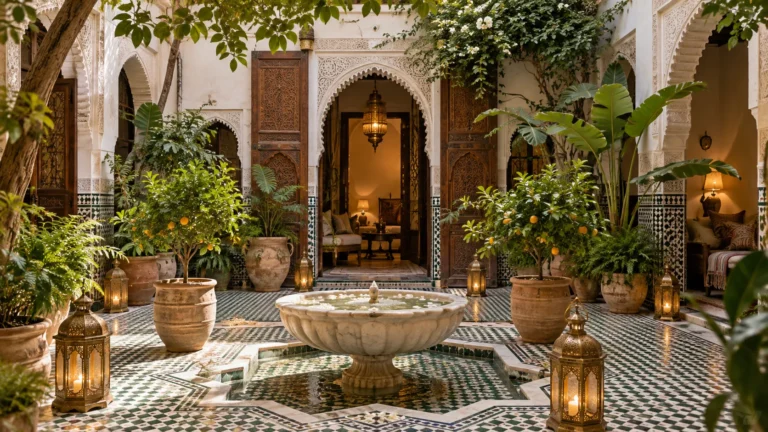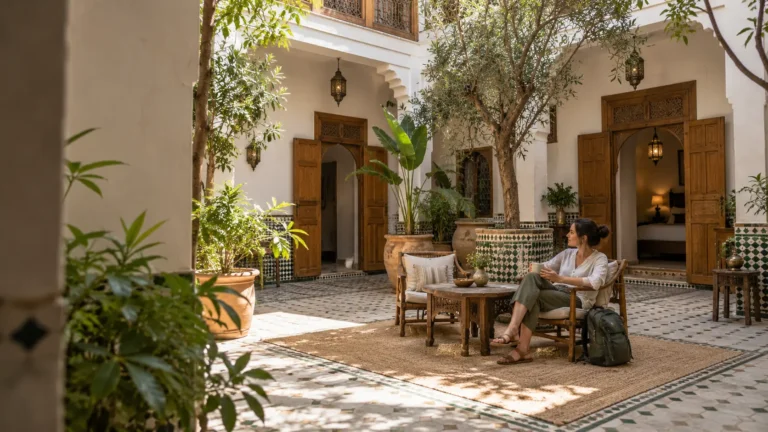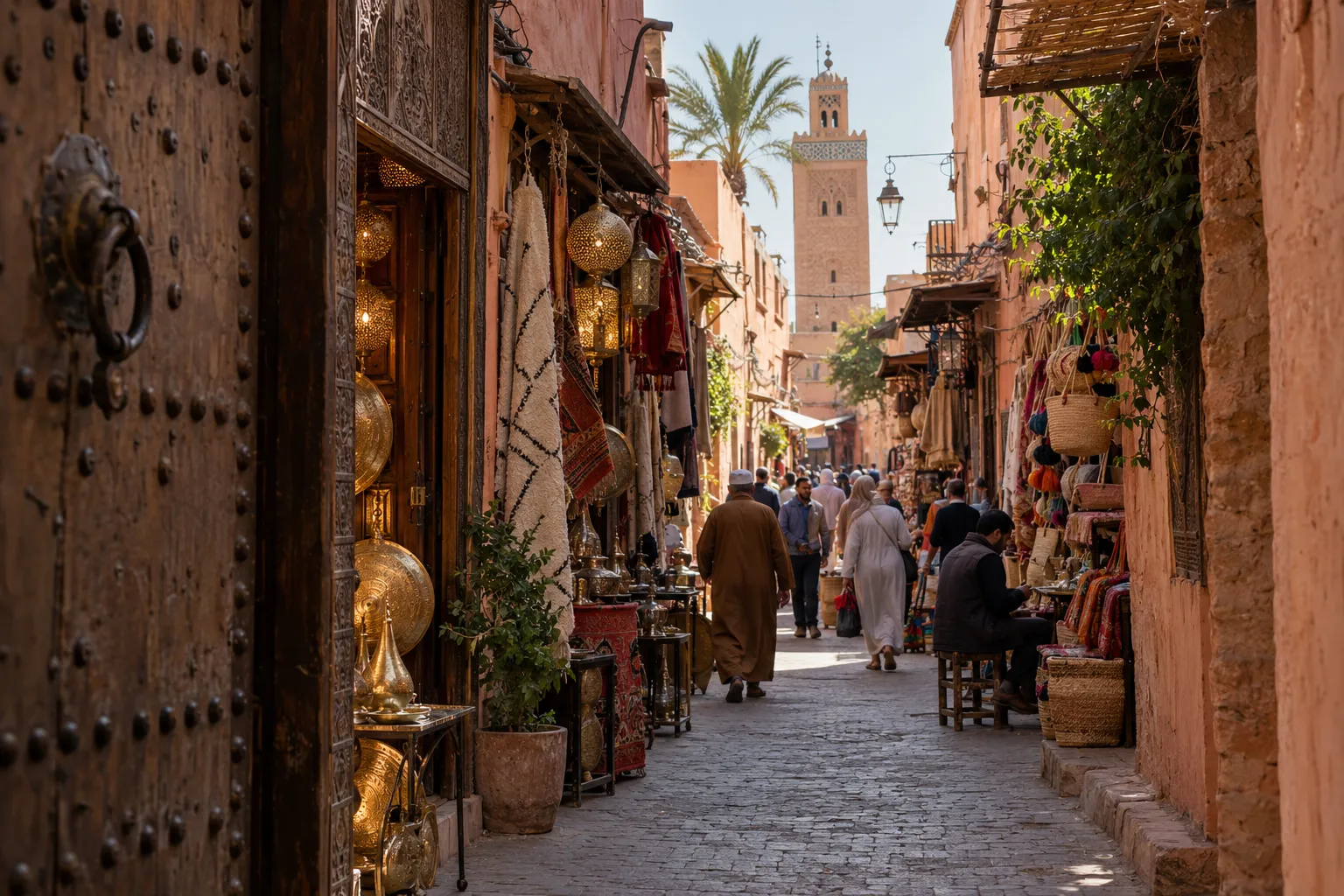
This Morocco photography guide starts with three practical questions: what do you want to photograph, when will the light suit that subject, and can you access the location at that time? A medina doorway, an artisan at work, an Atlantic harbour, an Atlas valley and a Sahara dune each require a different approach. A useful photography itinerary gives you enough time to observe, obtain permission and return when conditions change.
You can apply that approach with a phone or a camera. Choose a manageable set of places, leave room for repeated visits and build the journey around actual access. A famous viewpoint is only one possible photograph; surrounding streets, materials, landscapes, people and daily activities can give a photographic sequence much more meaning.
Morocco offers an unusually wide range of subjects within one country: historic medinas, geometric architecture, working souks, Atlantic ports, mountain villages, waterfalls, gorges, earthen kasbahs and Sahara dunes. The strongest photography trip does not try to collect every famous location. It gives the places that matter enough time for changing light, different compositions and respectful interaction with the people who live or work there.
What Should You Decide Before Booking a Photography Trip?
Choose your subjects before choosing equipment or adding destinations. Architecture, portraits, food, landscapes, street scenes and short videos all place different demands on timing, permissions, equipment and how much walking you can comfortably manage.
For each important location, make a short list containing three kinds of image:
- A wide view that establishes the place.
- A closer scene showing activity, structure or landscape form.
- A detail that adds context to the wider story.
For a pottery visit, for example, that might mean the overall workshop, an agreed photograph of the making process and the texture of a finished piece.
Then compare the proposed route with the Morocco travel guide. Count transfer days separately from days actually available for photography. If every sunset depends on a long drive finishing exactly on time, reduce the number of stops or add another night near the subject that matters most.
Morocco Photography Guide by Location: Where Should You Begin?
Choose destinations for the subjects they offer and for the practical conditions of photographing them. The suggestions below describe photographic possibilities; they do not establish opening hours, guaranteed rooftop access or permission to photograph an individual.
| Place or region | Subjects to consider | What should shape the visit? |
|---|---|---|
| Marrakech | Courtyards, carved details, souk lanes and Jemaa el-Fna | Admission times, changing shade and permission from traders or performers. |
| Fes | Medina streets, craft processes, architecture and tannery geometry | The particular workshop or terrace, working conditions and pedestrian access. |
| Chefchaouen | Blue walls, steps, doorways and the relationship between town and mountains | Residential privacy, steep lanes and viewpoint accessibility. |
| Rabat and Salé | Hassan Tower, urban details and Bouregreg views | The public approach, walking distance and current site restrictions. |
| Casablanca | Street architecture, waterfront and Hassan II Mosque | Separate exterior views from visitor and filming arrangements inside the mosque. |
| Tangier, Asilah and Tetouan | Medina textures, street art, coastal settings and Rif scenery | Keep the city route compact and give longer excursions their own day. |
| Essaouira and Atlantic coast | Harbour scenes, ramparts, waves, beaches and working towns | Wind, sea conditions, permitted port access and room for people to work. |
| Ait Ben Haddou and Ouarzazate | Earthen architecture, settlement patterns and surrounding terrain | Light direction, open paths and enough overnight time. |
| Merzouga and Erg Chigaga | Dune shapes, sand textures, sunrise, sunset and night skies | Camp location, weather, guiding, moonlight and the journey into the desert. |
| Atlas, valleys and waterfalls | Terraces, mountain layers, gorges, waterfalls and moving water | Trail conditions, weather, physical effort and a safe return route. |
Meknes, El Jadida, Safi, Taroudant and Tiznit can also suit architecture, landscape or craft-focused photography. Volubilis can add Roman archaeological subjects to a northern or Fes-based itinerary, while the Ziz Valley can add strong contrasts between palms, dry mountains and oasis landscapes.
Select these places because they fit your subject and route rather than treating every photogenic destination as a stop required for a complete collection.
Photogenic Morocco Without Chasing the Same Instagram Photograph
Morocco’s most recognizable photography locations include Jardin Majorelle, Chefchaouen’s blue streets, Fes el-Bali, Marrakech, Erg Chebbi, Essaouira and Ouarzazate. They are popular for a reason, but a photography trip becomes more interesting when the famous composition is only the starting point.
Once you have made the obvious wide photograph, look for repeating architectural shapes, changing shadows, smaller objects, activity around the location and details that explain how the place works.
A blue doorway in Chefchaouen may be visually striking, but the relationship between the doorway, stairs, mountain light and surrounding residential street can tell more of the story. A Sahara sunset can provide dramatic colour, but wind patterns, footprints and the transition between dunes and rocky terrain may give the series greater depth.
How Should You Photograph Marrakech, Fes and Chefchaouen?
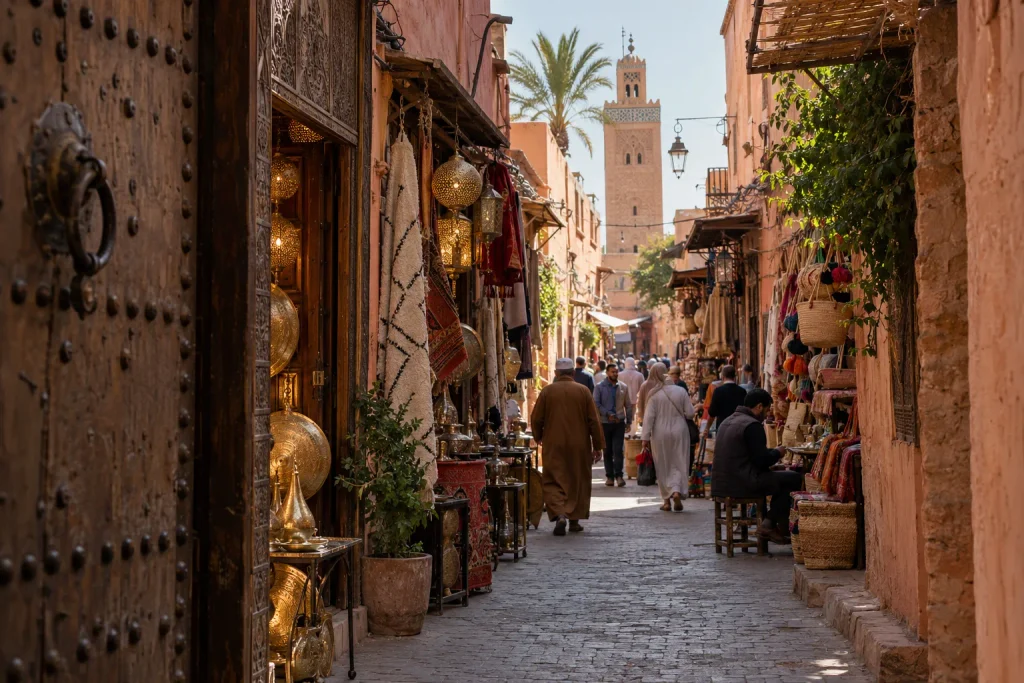
Work with the scale of the medina. Narrow streets often reward a small change of position, a simpler background or a return visit more than an attempt to fit every architectural detail into one frame.
What Works in Marrakech?
Separate outdoor street photography from ticketed interiors. At Bahia Palace or Ben Youssef Madrasa, work within the areas open to visitors and check current admission conditions. Courtyard shade can suit decorative details even when direct sunlight creates strong contrast outside.
For Jardin Majorelle, use the garden’s official website to reach its authorised ticket channel and check current visitor information. Confirm camera, tripod and filming arrangements for the specific spaces you intend to enter; do not assume a combined ticket means every part of the site has identical photography rules.
At Jemaa el-Fna, decide whether you want a broad environmental view or an agreed portrait. A terrace viewpoint depends on the individual business’s permission and conditions. At ground level, leave room for customers and performers to move.
Dusk changes throughout the year, so plan around the actual local sunset on your date rather than a fixed clock time copied from an older itinerary.
What Works in Fes?
Give one section of the medina enough time for an establishing photograph, a closer composition and smaller details.
A workshop is an active workplace. Your photography should fit around production rather than requiring an artisan to stop working repeatedly for photographs.
At Chouara tannery, establish which terrace you will enter, whether an access arrangement or charge applies and what photography is permitted. Access through a shop does not automatically create an obligation to buy, but clarify the arrangement before going upstairs.
Do not assume that every terrace is free, that every terrace has the same view or that the same viewpoint will remain accessible indefinitely.
Ask locally about activity and light on the day. There is no reliable basis for promising that every vat will be colourful, workers will be present at a particular time or the exact same rooftop composition shown online will be available.
What Works in Chefchaouen?
Use Chefchaouen as a base if you want more than a brief stop among the blue streets. Staying overnight gives you the possibility of returning to the same lane after observing how light, shade and pedestrian traffic change.
Look for plaster texture, repeating doors, arches, stairways and transitions between the medina and surrounding Rif Mountains.
Diffuse light can help retain texture across painted walls. Keep colours believable when editing; adjacent neutral surfaces and skin tones can quickly reveal excessively saturated blues.
The Chefchaouen photo walk through blue lanes, doors and stairways includes a local guide, a selected photography route and local photo tips. Food, drinks and entrance fees are separate. Confirm the meeting point and session length for your booking.
The experience lists wheelchair users as unsuitable. Discuss stairs, walking requirements and mobility needs before booking. Private steps, courtyards and doorways remain private even when they appear repeatedly in travel photography.
Coastal and Urban Photography
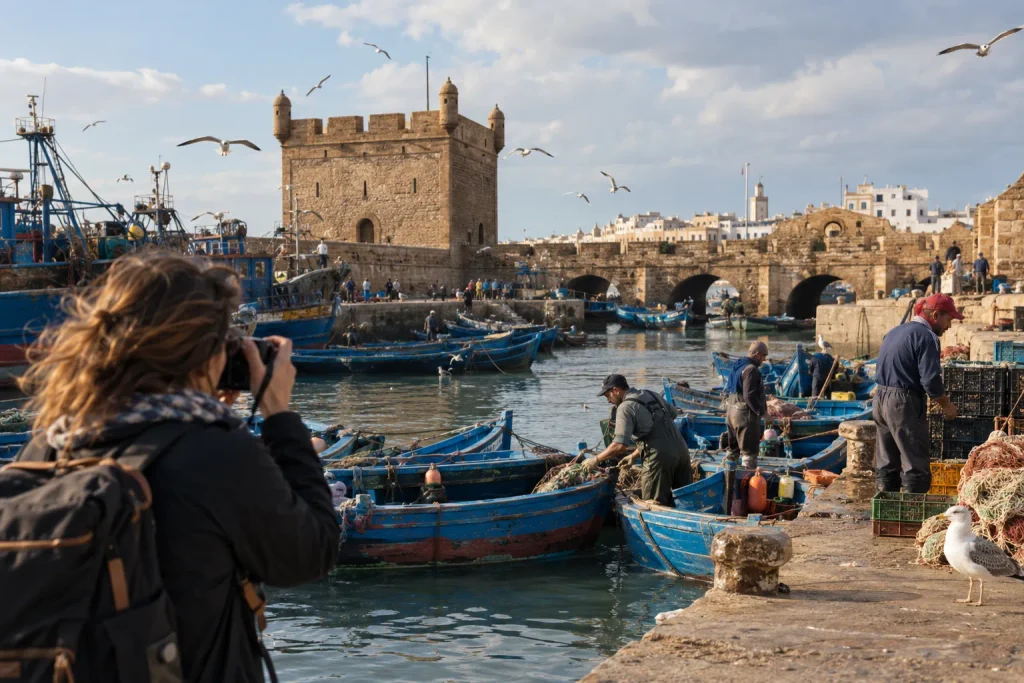
Essaouira
Balance the view you want with access, wind and working activity around you. At Essaouira’s harbour, use permitted visitor areas and keep clear of boat movements, landing activity, ropes, equipment and people carrying out their jobs.
Ask before making a fisherman, trader or other identifiable person the primary subject of a photograph.
Along ramparts and exposed shores, select a position that remains appropriate as wind and sea conditions change. Do not step onto wet rocks or move beyond barriers simply to remove an unwanted object from the composition.
A higher public viewpoint, harbour detail or street scene inside the medina may provide a stronger alternative when spray or wind makes the waterfront difficult.
Rabat and Salé
Rabat can provide cleaner architectural lines, Atlantic viewpoints and different urban rhythms from Marrakech or Fes.
The photography and viewpoints tour around Hassan Tower and the Atlantic corniche provides a city route with local guiding and photo stops. Meals, drinks and optional entrance fees are separate.
Ask which viewpoints will be used and whether the proposed timing matches your interests. A general photography-tour label should not be interpreted as a guaranteed sunset session, rooftop access or specialist technical camera instruction.
Casablanca
Casablanca provides a different visual language: broad streets, twentieth-century architecture, modern city scenes, the Atlantic waterfront and Hassan II Mosque.
Photograph exterior architecture separately from interior visitor arrangements. Large religious buildings are not ordinary street-photography environments, and camera or filming rules can differ inside.
Tangier, Asilah, Tetouan and Other Atlantic Towns
Tangier, Asilah and Tetouan offer medina textures, northern architecture, murals, coastal light and access to Rif landscapes.
Casablanca, El Jadida, Safi and Sidi Ifni provide different combinations of urban design and ocean settings. Photograph those differences instead of expecting every Atlantic town to reproduce Essaouira’s harbour.
Best Sunset Photography Locations in Morocco
The merged sunset material adds an important planning layer: sunset should not automatically mean the same subject or technique in every destination.
Merzouga and Erg Chebbi
Low evening light reveals dune ridges and creates strong separation between illuminated and shaded slopes. A simple dune composition can be more effective than attempting to include every camel caravan, camp and traveler in one frame.
Essaouira
The Atlantic horizon can create strong sunset colour, reflections and silhouettes, but wind and sea spray may affect equipment and footing.
Atlas Mountains and Imlil
Mountain layers can become increasingly distinct as the sun drops, while ridges may block direct light much earlier than the official sunset time. Scout the direction of the valleys before committing to one viewpoint.
Chefchaouen
Late light can work well for wider views that place the blue medina against the Rif Mountains. Within the narrow streets themselves, shade often arrives much earlier.
Agadir and the Atlantic Beaches
A broad western horizon creates a different kind of sunset photograph from a medina or desert scene. Use people, shoreline shapes or architecture to provide structure rather than photographing only an empty horizon.
How Should You Plan Ait Ben Haddou and Sahara Photographs?
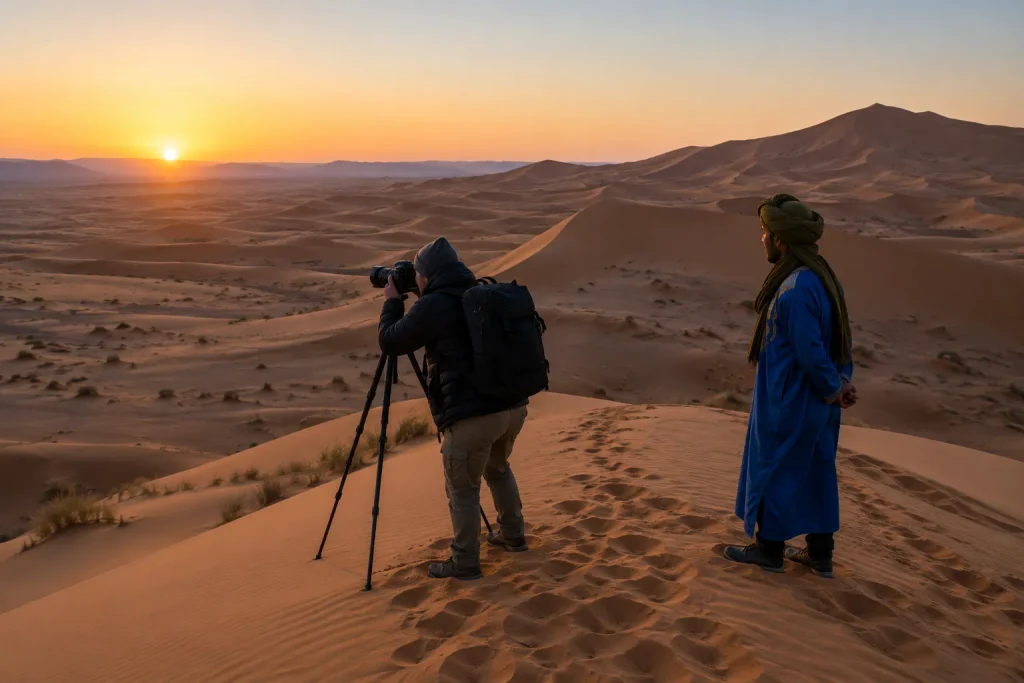
Stay close enough to your chosen subject to use the best light without depending on an unpredictable long transfer.
Ait Ben Haddou
At Ait Ben Haddou, UNESCO describes a fortified grouping of earthen buildings, providing opportunities for both settlement-wide compositions and smaller studies of earthen walls, towers, lanes and decorative details.
Observe which surfaces receive side light from an accessible position. Confirm open paths and use an authorised route rather than following an old photograph that may show conditions that no longer exist.
Treat buildings, roofs and private spaces as heritage structures with their own access conditions.
Merzouga and Erg Chebbi
For dune photography, ask where your accommodation or camp sits relative to the walking area and how a dawn outing would operate.
Merzouga and Erg Chigaga require different approach journeys. A sunset camel excursion does not automatically provide enough time to scout a location, select a composition, position a tripod and wait for changing light.
Try broad landscape photographs alongside tighter studies of dune ridges, shadow and wind-shaped sand patterns.
Make proposed portraits or staged camel photographs part of a clear agreement with the people involved. Avoid repeatedly crossing another visitor’s composition or disturbing people simply to create an apparently empty scene.
Night Photography in the Sahara
Check the date, moon position, cloud forecast and nearby camp lighting before planning astrophotography.
A desert camp cannot guarantee a visible Milky Way. Moonlight may reduce faint-star visibility but can illuminate dune surfaces and create another type of night photograph.
Arrange the walking route and return with your guide or operator. Account for charging, nighttime temperatures and the amount of sleep you will have before the following day’s drive.
Morocco’s Best Landscape Photography Regions
Morocco’s landscape photography extends far beyond the Sahara.
High Atlas Mountains
Mountain layers, snow in season, terraced agriculture, valleys and small settlements can produce both wide landscapes and detailed studies.
Do not assume that the most elevated viewpoint automatically produces the strongest photograph. Foreground structure, atmospheric conditions and the direction of light often matter more.
Ourika Valley
The Ourika area combines river landscapes, villages, valley walls and seasonal vegetation. Treat hiking and photography as one activity rather than stopping unpredictably in unsafe road locations.
Ouzoud Waterfalls
Ouzoud is useful for moving water, rock, vegetation and wider environmental frames. Long-exposure photography requires a stable position that does not block paths or create a hazard for other visitors.
Dades Valley and Todra Gorge
Dades can provide layered rock formations, road geometry, agricultural areas and village landscapes. Todra’s steep walls create very different light from an open mountain view.
Inside gorges, direct light may disappear well before the published sunset time.
Akchour
Akchour can add forest, water, rock and Rif landscapes to a Chefchaouen-focused photography trip, but access and walking conditions should be checked separately from city photography.
Ziz Valley and Oasis Landscapes
Oasis photography works especially well when green palm corridors contrast with the dry surrounding terrain. Look beyond the broad viewpoint to irrigation patterns, agriculture and the relationship between settlements and the valley.
When Should You Photograph Mountains, Valleys and Waterfalls?
Choose the route according to current access and your ability to carry equipment over it. Imlil, the Ourika Valley, Akchour, Ouzoud, Dades and Todra all require individual planning; a viewpoint beside a road is very different from one reached by a steep, wet or exposed trail.
Scout a safe position before concentrating on the composition.
Mountain ridges and gorge walls can delay direct sunlight in the morning or place a scene in shade well before sunset. Overcast conditions can still work very well for foliage, water and details provided the walking route remains safe.
Use a qualified local guide where the route requires one. Keep photography stops within the agreed walking plan, leave enough time for the return and avoid blocking narrow paths.
Observe wildlife from a distance without feeding, baiting or positioning animals for photographs.
How Do Sunrise, Sunset and the Season Affect Your Plan?
Use the specific date and location to estimate the sun’s position, then consider which buildings, dunes, mountains or cliffs may block the light.
Golden hour and blue hour describe types of light. They are not fixed clock appointments shared by Marrakech, Chefchaouen, the Atlas Mountains and Merzouga.
Low-angle sunlight can define dune texture and architectural relief. A shaded medina lane may suit portraits, colour studies or craft details while a nearby open square is experiencing harsh sunlight.
Midday is not automatically useless. Graphic shadows, covered markets, white architecture and permitted interiors can all work in stronger daytime light.
For dawn, establish the walking route, vehicle meeting point and site access on the previous day. Include enough time to reach the position and set up calmly.
At sunset, plan the journey back and respect site closing times even if the sky continues changing after access ends.
Use the Morocco seasonal travel guide to compare regional conditions before choosing dates. Heat, rain, mountain weather, desert temperatures and daylight length affect the workload of a photography day as much as the photograph itself.
If the subject matters greatly, keep another possible session in the itinerary rather than assuming the first planned sunrise or sunset will provide ideal conditions.
What Photography Permissions Should You Check?
Separate three questions:
- Are you allowed to enter or stand in the location?
- Do you have permission to photograph the subject?
- Does your intended use of the resulting image require additional permission?
Being admitted to a building does not automatically settle its rules for tripods, flash, video, professional equipment or commercial production.
| Setting | What to establish before taking photographs |
|---|---|
| Public street or square | Restrictions or security instructions, space for passers-by and permission for an identifiable portrait. |
| Shop, workshop, riad or rooftop | Owner’s agreement, areas available, any access charge and whether people present also agree. |
| Museum, garden or monument | Current rules for photographs, video, flash, tripods and the particular room or exhibit. |
| Religious site | Visitor eligibility, permitted areas and camera rules; an open doorway does not mean visitors may enter. |
| Match or organised event | Ticket conditions, camera and bag limits, recording rules and any accreditation requirement. |
| Commissioned shoot | Location and participant permissions, intended publication and applicable production authorisation. |
The FCDO’s Morocco advice states that taking photographs near sensitive political or military sites is illegal. It also advises asking permission before photographing people, especially children. Follow signs and official directions and ask when the status of a location is unclear.
Hassan II Mosque illustrates why venue-specific checks matter. Its published visitor rules prohibit video cameras inside. The foundation also maintains a separate shooting-authorisation process. Confirm your specific still-photography or video plans instead of assuming ordinary visitor admission covers professional or organised filming.
How Should You Photograph People, Artisans and Food?
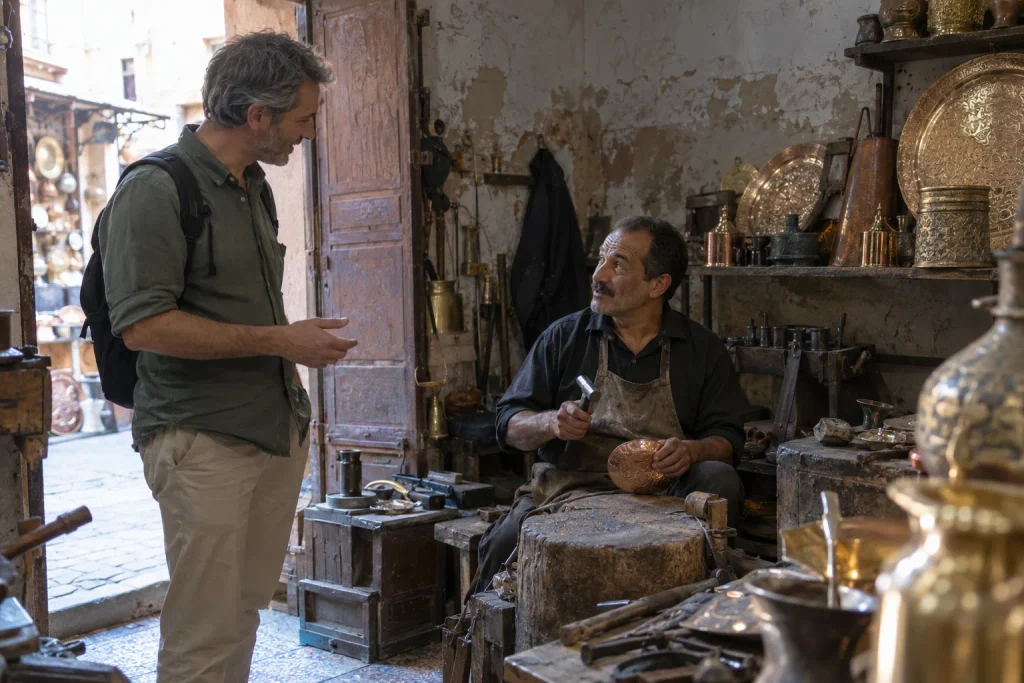
Ask first when someone will be the subject. Explain what you want to do and accept a refusal without continuing from another angle.
A guide can translate or introduce you, but the person being photographed still decides whether they want to participate.
Portraits
For a planned portrait, explain whether the image is for a private album, a public social account or a client project.
Discuss any payment and intended use before beginning. Payment is not a substitute for consent, and agreement to one still portrait does not automatically include a long video, advertising campaign or unrelated future use.
Children
Obtain permission from a parent or responsible guardian and respect the child’s own willingness.
Avoid publishing unnecessary information that could reveal a private home, school routine or other sensitive details.
Artisans
Inside a workshop, agree on where you may stand and which parts of the process can be photographed.
Keep bags away from equipment and do not ask someone to repeat hazardous work for the camera.
Hands can also identify a person or reveal a working process they prefer not to publish, so discuss those photographs as well.
Shopping should remain a separate decision. Permission to photograph a craftsperson does not create an obligation to buy, and entry into a workshop does not automatically create unlimited photography permission.
Food
Ask before filming food preparation or other customers.
Begin with the finished plate where it is served, use available light and keep the session brief enough that companions can eat.
If you publish an artisan’s object or a traditional dish, confirm the name and description rather than guessing its technique, region or cultural meaning from appearance alone.
Can You Take Good Travel Photographs With a Phone?
Yes. A phone can handle architecture, food, street details, sunsets and many landscapes when you pay attention to light, framing and stability.
Start with equipment you already understand rather than assuming a photography trip requires a completely new camera system.
Clean the lens, select the subject and inspect the edges of the frame. Use the available focus and exposure controls to preserve detail in bright plaster, sand or sky.
Compare the phone’s native camera views before relying on heavy digital zoom.
For a static evening photograph, hold the phone steady while night mode completes. Moving people may blur or be combined unevenly, so inspect the result rather than assuming computational processing worked perfectly.
Take a wider contextual photograph before concentrating only on small details, and keep walking routes clear while you stop.
What Camera Equipment Do You Actually Need?
A familiar camera and lens combination will often produce better results than travelling with several unfamiliar lenses.
Bring wider or longer lenses when they solve a specific photographic problem you expect to encounter.
A tripod earns space when you have a permitted and practical use for it. It is not useful when it obstructs a crowded souk lane or when the venue does not allow it.
Carry enough batteries and storage for the day’s work. Back up photographs regularly and confirm that the copies open before clearing a card or phone.
Keep route information available offline and reserve battery power for navigation and communication as well as photography.
Before sharing photographs publicly, review embedded location information and keep captions accurate about where and how the photograph was made.
How Can You Protect Equipment From Wind, Sand and Rain?
Change your photography plan when conditions require it.
On dunes or exposed Atlantic paths, keep the bag closed and fit the lens you expect to use before leaving shelter. Avoid changing lenses in blowing sand whenever possible.
Nikon’s lens-changing guidance notes the risk of dust entering a camera while the lens is removed. Follow the handling and cleaning recommendations for your own equipment, including its specific limits around water, dust and heat.
Carry appropriate protection and keep a clean cloth separate from sandy items.
Do not rub grit across optical surfaces. Seek shelter before opening camera compartments and avoid leaving sensitive electronics inside a vehicle exposed to extreme heat.
Weather resistance does not mean every camera, lens or phone is waterproof.
If strong wind, poor visibility or wet footing makes a location unsafe, stop the session and move to a sheltered accessible location where photography is permitted.
Can You Bring a Drone to Morocco?
Resolve the legal and import questions before travelling with a drone.
Morocco’s Ministry of Industry and Trade maintains its import procedures and forms, while current foreign-travel guidance also states that permission from Morocco’s Directorate General for Civil Aviation is required to fly a drone.
Check both the requirements for bringing the equipment into Morocco and the requirements for operating it at your proposed locations.
Do not assume that a small drone, permission from another country or permission from a hotel owner is sufficient.
If the relevant permissions remain unresolved, leave the drone at home rather than risking confiscation or penalties.
Professional Filming and Commercial Photography
A personal travel photograph and an organised commercial production are not necessarily governed in the same way.
For commissioned videos, advertisements, documentaries and other organised productions, consult the Moroccan Cinematographic Centre’s filming procedures and establish which requirements apply to your project.
Location permissions may need to be handled separately.
Do not assume that a small camera crew or phone-based professional production automatically avoids formal requirements.
Plan video as a sequence: a setting, an activity and supporting detail. Agree on sound recording as well as images, and avoid recording private conversations without consent.
What Should Visitors Know About Football Photography?
Check the organiser’s current camera, bag and recording rules for the exact match before choosing equipment.
A spectator ticket does not automatically provide permission for professional coverage, pitch access or unrestricted publication.
Detachable lenses, tripods, larger cameras and video equipment may be treated differently by individual venues or events.
Where photography is permitted, remain in your allocated spectator position and avoid obstructing another person’s view.
A faster shutter speed can help freeze action when available light allows it, while a phone may be more useful for a broad image of the stadium or crowd.
Ask before making another spectator the main subject.
For professional or commercial use, resolve accreditation, venue requirements and relevant image rights with the parties involved.
How Many Places Should You Include in a Morocco Photography Route?
Include enough nights to revisit important subjects and recover between early starts and late finishes.
The following are planning examples rather than fixed packages or guarantees of access.
Northern Cities: About Seven Nights
Two nights in Tangier, two in Chefchaouen and three in Fes creates a useful northern photography route.
Give intercity journeys their own time. Add Tetouan or Asilah by extending the trip or replacing another stop rather than trying to fit everything into one day.
Southern Architecture and Dunes: About Nine Nights
Three nights in Marrakech, one near Ait Ben Haddou, one around Dades, two around Merzouga, one around Ouarzazate and a final Marrakech night gives you time for medinas, earthen architecture, gorge landscapes and two different desert-light sessions.
Keep your international flight separate from the expected desert return rather than relying on a long road journey running exactly on schedule.
Atlantic Route: About Seven Nights
Two nights in Casablanca, two in Rabat and three in Essaouira can combine architecture, city life, monuments, waterfronts and working harbour scenes.
Allow a substantial travel period between cities instead of scheduling an important sunset session immediately after a long transfer.
Short Photography Trip
If you have only a few days, keep one base and one manageable excursion.
Marrakech with a nearby Atlas location, Chefchaouen with a Rif excursion or Fes with Meknes/Volubilis can provide a stronger photographic trip than racing between multiple regions.
Photography Tour or Independent Trip?
You do not need an organised photography tour to take strong photographs in Morocco.
Independent travel gives you control over pace and subject choice, while a local guide can help with navigation, introductions, route access and understanding how a location functions.
Photography instruction and local guiding are different services. A guide may know the city’s best streets and current access conditions without providing advanced technical camera tuition.
When discussing a route with Visit Morocco Together, share your preferred subjects, travel dates, equipment and walking requirements. Ask whether the service provides local guiding, photography instruction or both, and confirm session length, timing, entrance arrangements and any permissions that matter to the shoot.
FAQ
Can tourists take photographs freely in Morocco?
Photography is possible in many public and visitor areas, but it is not unrestricted. Avoid sensitive political or military sites, follow venue-specific rules and ask permission before making identifiable people the subject of a photograph. Shops, workshops, riads, rooftops, museums and religious sites may have their own access or camera rules.
Do I need permission to photograph people in Morocco?
Ask before taking a deliberate portrait, especially when someone is clearly identifiable. For children, obtain permission from a parent or responsible guardian and respect the child’s willingness as well. A guide can help introduce you, but consent still belongs to the person being photographed.
Where are the best places for photography in Morocco?
Marrakech and Fes are strong for architecture and medina life, Chefchaouen for colour and Rif scenery, Essaouira for coastal and harbour photography, Ait Ben Haddou for earthen architecture, the Atlas Mountains for landscapes and Merzouga or Erg Chigaga for dunes, sunrise, sunset and night photography. The best choices depend on the subjects you want rather than one universal ranking.
Where are the best sunsets to photograph in Morocco?
Merzouga provides low light across Erg Chebbi, Essaouira and Agadir provide Atlantic horizons, the Atlas can create layered mountain silhouettes and Chefchaouen offers broader views of the blue town against the Rif Mountains. Always plan around the actual season, horizon and access rather than assuming the published sunset time equals the best photographic light.
Can I bring and fly a drone in Morocco?
Do not travel assuming recreational drone use is automatically permitted. Check the current import requirements and obtain the required aviation permissions before bringing and operating a drone. If those requirements are unresolved, leaving the drone at home is the safest option.
Do I need professional camera equipment for a Morocco photography trip?
No. A phone or a familiar camera can produce strong photographs when you understand the equipment and pay attention to light, framing, access and timing. Carry additional lenses or a tripod only when they solve a specific photographic need and are practical and permitted at the locations you plan to visit.
Plan the Photograph, but Leave Room for the Place
A good Morocco photography trip is not simply a tour of famous Instagram locations.
Marrakech, Fes, Chefchaouen, Essaouira, Ait Ben Haddou, the Atlas Mountains and the Sahara all provide recognizable subjects, but the strongest photographs often come from returning to a location, observing how people use the space and working with whatever light and access actually exist that day.
The merged photography articles highlight Morocco’s cities, colourful streets, dramatic landscapes, deserts and sunsets. Those are all worth preserving, but photography becomes more rewarding when famous views are combined with smaller architectural details, craft processes, working landscapes and respectful portraits.
Use permissions as part of the planning rather than an inconvenience after arriving. Build enough time into the route for changing light, avoid depending on every transfer running perfectly and accept that some photographs will not be possible when access, weather or consent changes.
When discussing a route with Visit Morocco Together, share your subjects, dates, equipment and walking needs. Confirm whether the service provides local guiding, photography instruction or both, and choose the arrangement that gives you the time and access your photographs actually need.
Explore destinations, tours and locally organized Morocco experiences with Visit Morocco Together.
Ready to Experience Morocco?
Turn this inspiration into your next adventure. Our travel experts are ready to help.