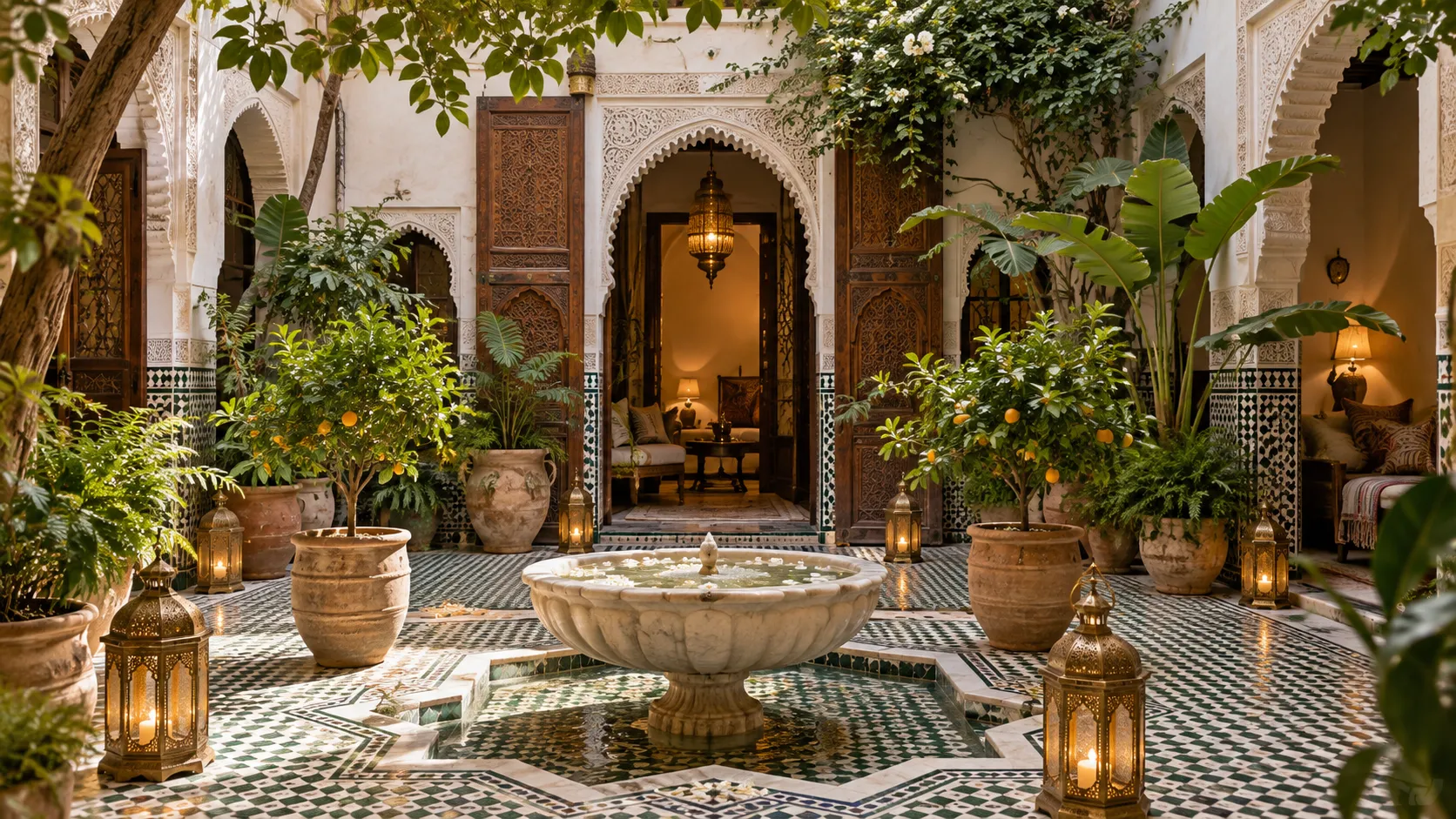
Staying in a Moroccan riad can be one of the most distinctive parts of a trip to Morocco. Instead of entering a conventional hotel lobby, you may walk through a narrow medina lane, pass through a simple doorway and suddenly arrive in a quiet courtyard filled with tilework, carved wood, plants or a fountain.
That contrast is part of the appeal, but a riad is not automatically the best accommodation for every traveler. Historic buildings can have stairs, compact rooms, limited vehicle access and layouts very different from modern hotels. Some riads are simple guesthouses, while others operate as high-end boutique properties with pools, restaurants, hammams and spa services.
The best way to choose one is to understand what a riad actually is, what facilities vary from property to property and how staying inside a medina changes practical details such as luggage, taxis, accessibility and late arrivals.
What Is a Moroccan Riad?
A riad is traditionally an inward-facing Moroccan house organized around a central courtyard or garden.
Instead of placing most attention on an exterior façade or street-facing windows, the architecture focuses inward. Rooms often open toward the central space, creating privacy from the street and a quieter interior environment.
Common architectural features can include:
- A central courtyard
- A fountain, garden or small pool
- Zellige tilework
- Carved plaster
- Wooden doors, ceilings or balconies
- Decorative textiles
- Upper-level galleries
- A rooftop terrace
Not every property marketed today as a riad retains the same historical layout, and not every traditional house has been restored in the same way.
Treat the term as the beginning of your accommodation research rather than as a guarantee of a particular room, pool or service level.
Why Are Riads Built Around a Courtyard?
The inward-facing layout creates a strong sense of separation between the street and the interior of the house.
This is especially noticeable in historic medinas such as Marrakech and Fes. Outside, the lanes may be busy with pedestrians, shops and daily activity. Inside, the atmosphere can feel considerably quieter.
The central courtyard also organizes circulation through the property. Bedrooms, salons and upper galleries may face toward it rather than toward the street.
Plants, fountains and decorative tilework can make the courtyard the visual center of the building.
What Does a Riad Stay Actually Feel Like?
A riad generally feels more intimate than a large conventional hotel because many properties have relatively few rooms.
Guests may see the same small team throughout the stay, eat breakfast in the courtyard or on the terrace and ask staff directly for local recommendations.
This smaller scale is one reason the old VMT articles emphasize personalized hospitality.
However, intimacy also means that you may hear activity from the central courtyard, nearby rooms or stairs more clearly than you would in a large purpose-built hotel.
Check reviews and room location when noise or privacy is particularly important to you.
Riad vs Hotel: Which Is Better?
Neither is automatically better. They solve different travel needs.
| Consideration | Riad | Modern hotel |
|---|---|---|
| Atmosphere | Traditional architecture and intimate setting | More standardized layout and services |
| Location | Often inside or near the historic medina | Often easier for vehicles to reach |
| Rooms | Often individually shaped and decorated | Usually more standardized |
| Accessibility | Can involve pedestrian lanes and stairs | More likely to have lifts and direct road access |
| Service | Often small-team and personal | Larger staff and more standardized departments |
| Facilities | Highly variable by property | Often easier to compare before booking |
Choose a riad when atmosphere, historic architecture and medina access matter most.
A modern hotel may work better when you need easy parking, elevators, large interconnected rooms, extensive resort facilities or simple early-morning vehicle access.
Where Are Riads Usually Located?
Many of Morocco’s best-known riads are located in or around historic medinas.
Marrakech
Marrakech has one of the country’s largest selections of riad accommodation, ranging from relatively simple guesthouses to highly polished luxury properties.
A medina riad works particularly well if you plan to spend several days visiting souks, palaces, restaurants and Jemaa el-Fna on foot.
Fes
Fes is another strong city for a riad stay because the architecture fits naturally with the historic environment of Fes el-Bali.
Vehicle access can be especially important to check because many medina properties require a walk from the nearest accessible street or gate.
Essaouira
Essaouira also has riads and smaller traditional properties within its compact medina.
Here, staying inside the historic center can place restaurants, ramparts, shops and the harbour within easy walking distance.
Other Cities
Traditional houses and riad-style guest accommodation can also be found in other Moroccan cities.
The experience varies by destination, building and restoration, so judge the specific property rather than expecting every riad in Morocco to follow the same formula.
What Are Riad Rooms Like?

Rooms in historic houses are not always standardized.
Even within the same riad, one room may be large with a sitting area while another may be smaller or shaped around the original structure.
Before booking, check:
- Actual room size
- Bed configuration
- Bathroom type
- Whether the bathroom is fully private
- Window and ventilation arrangements
- Air conditioning
- Heating
- Room location within the building
- Number of stairs required
Do not assume the least expensive room has the same layout as the room shown first in a property’s photo gallery.
Do Riad Rooms Have Exterior Windows?
Because traditional riads are inward-facing, some rooms look primarily toward the courtyard rather than directly onto an exterior street.
This can create a quiet, private feeling, but travelers accustomed to large street-facing windows should examine room photographs and descriptions carefully.
Ask about natural light and ventilation when either matters strongly to you.
Are Riads Quiet?
A riad can provide a striking sense of calm compared with the medina outside, but the internal architecture can also carry sound.
If bedrooms open onto the same courtyard where breakfast is served, early activity may be audible.
Rooftop restaurants, fountains, reception areas and neighboring rooms can also affect noise.
For light sleepers, ask:
- Where the room is located
- Whether it faces the main courtyard
- Whether the rooftop has evening dining
- Whether there are rooms on several levels
Do Riads Have Pools?
Some do, many do not.
A courtyard water feature shown in a photograph may be decorative rather than a swimming pool.
Some properties have a small plunge pool, while luxury riads may offer a larger courtyard or rooftop pool.
Check:
- Whether the pool is designed for swimming
- Its actual dimensions
- Whether it is heated
- Whether it is seasonal
- Whether children can use it
- Whether the terrace around it is shared
Do not book from a close-up photograph and assume it represents a resort-style pool.
What Is a Riad Rooftop Terrace Like?
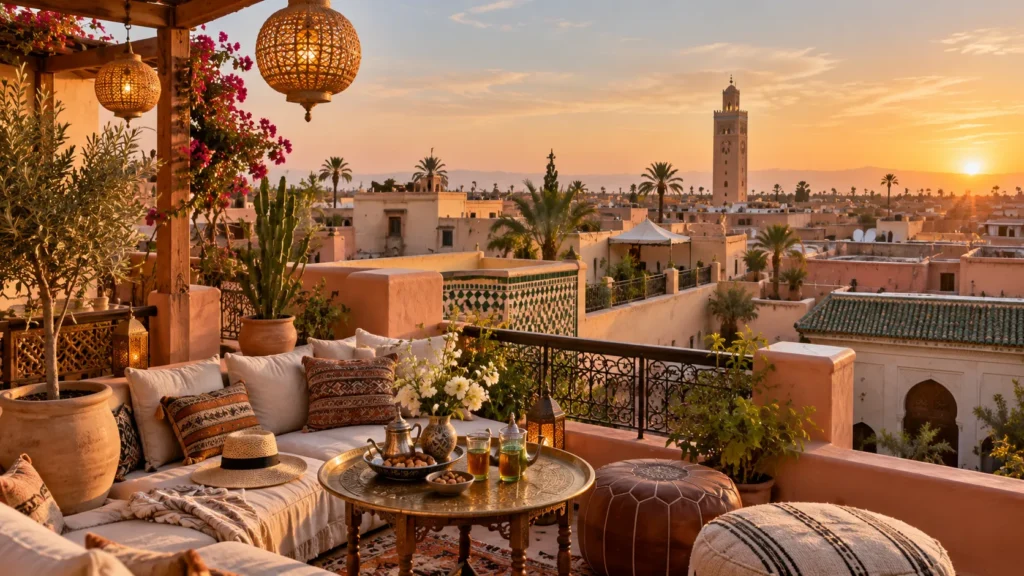
Rooftop terraces are common enough to be one of the features many travelers associate with a riad stay.
Depending on the property, the rooftop may contain:
- Breakfast seating
- Loungers
- Dining tables
- A small pool
- Views across the medina
- Views toward mountains or city landmarks
Not every riad has a panoramic view, and some rooftops are surrounded by neighboring buildings.
If the terrace is a major reason for choosing the property, check current photographs from the exact riad.
What Is Breakfast Like in a Riad?
Breakfast is often one of the most enjoyable parts of a riad stay.
Depending on the property, it may be served in the courtyard, dining room or rooftop terrace.
Typical items can include combinations of:
- Moroccan breads
- Msemen or other pancakes
- Jams or honey
- Olives
- Eggs
- Yogurt
- Fruit
- Juice
- Coffee
- Mint tea
Breakfast style varies considerably.
Check whether it is included, when it is served and whether an earlier breakfast can be arranged if you have a tour or transfer.
Can You Have Dinner at a Riad?
Many riads offer Moroccan meals, and food is a recurring theme across all of the old VMT riad articles.
Possible dishes can include tagines, couscous, salads, breads and other Moroccan preparations.
A riad dinner can be particularly convenient on the first evening when you arrive late or do not yet want to navigate the medina after dark.
However, not every property operates a full restaurant throughout the day.
Ask whether dinner must be ordered in advance and whether the menu is fixed or à la carte.
Do Riads Offer Cooking Classes?
Some do.
The merged source pages mention cooking classes and market visits as possible activities arranged by riads.
These can be useful when you want a hands-on cultural experience without organizing a separate activity provider.
Confirm the exact format:
- Does it include a market visit?
- How many participants are there?
- Which dishes are prepared?
- Is the class hands-on?
- Are ingredients and the meal included?
What Is Service Like in a Riad?
Smaller properties can provide more direct interaction with staff than a large hotel.
Depending on the riad, staff may help with:
- Restaurant recommendations
- Airport or station transfers
- Luggage arrival
- Local guides
- Excursions
- Dinner reservations
- Cooking activities
- Hammam or spa appointments
Do not assume every riad provides a 24-hour hotel concierge.
Reception hours and late-arrival procedures should be checked in advance.
What Does a Luxury Riad Add?
The old luxury-riads article describes the same underlying architectural idea but with a higher service and amenity level.
A luxury riad may add:
- Larger suites
- Higher-end furnishings
- More extensive restoration
- Spa or hammam facilities
- Massage treatments
- Restaurant service
- Concierge assistance
- Private dining
- Pool facilities
- More staff per guest
These are possibilities, not features guaranteed by the word “luxury.”
Compare actual facilities and recent room information instead of relying on marketing terminology.
Can a Simple Riad Be Better Than a Luxury Riad?
Yes, depending on what you want.
A small traditional guesthouse with a helpful team and excellent location may provide a more enjoyable stay than a larger high-end property if you spend most of the day exploring the city.
Paying more is most useful when you value the additional facilities.
For example, a hammam, restaurant, pool or large suite has little value if your itinerary means you will never use it.
Getting to a Riad Inside a Medina
This is one of the most important practical differences between a riad and a modern hotel.
Many historic medinas are pedestrian environments. A taxi, transfer vehicle or rental car may not be able to stop directly outside the accommodation.
You may instead be dropped at:
- A medina gate
- A nearby square
- A parking area
- The nearest street accessible to vehicles
From there, you walk to the property.
Before arrival, ask the riad:
- Where should my driver stop?
- How long is the walk?
- Will somebody meet me?
- Can staff help with luggage?
- Is the route easy to find after dark?
Save the accommodation’s contact details and arrival instructions offline.
What About Luggage?
Large suitcases can be inconvenient when accommodation is reached through narrow medina streets, stairs or uneven surfaces.
This does not mean you cannot stay in a riad with a full-size suitcase.
It means you should understand the arrival arrangement first.
Some properties arrange luggage assistance from the nearest vehicle point. Others may expect guests to walk independently.
Are Riads Accessible?
Accessibility varies considerably.
Traditional buildings may include:
- Steep staircases
- No elevator
- Raised thresholds
- Narrow passages
- Bathrooms designed around the historic room layout
- Pedestrian approaches over uneven medina surfaces
If mobility is a concern, contact the property before booking rather than relying on a general accessibility filter alone.
Ask about the exact route from the vehicle drop-off point to the bedroom, bathroom, breakfast area and rooftop.
Are Riads Good for Families?
They can be, but the building layout matters.
Families should check:
- Family rooms
- Connecting rooms
- Extra beds
- Staircases
- Pool access
- Balconies and rooftop areas
- Noise between rooms
- Whether young children can sleep in the same room as parents
A modern hotel may be easier for some families, while others will value the atmosphere and central medina location of a riad.
Are Riads Good for Couples and Honeymoons?
Yes, particularly when privacy, architecture, rooftop dining and a smaller property appeal to you.
The French source specifically describes some riads as suitable for romantic stays, and many travelers choose a riad for a honeymoon because the accommodation itself becomes part of the experience.
For a romantic trip, check whether the property actually offers:
- A quiet room
- Private or rooftop dining
- Hammam or spa treatments
- A pool
- Room upgrades
For broader itinerary planning, use the Morocco Honeymoon Guide.
Heating and Air Conditioning Matter More Than Photos
Traditional architecture can be beautiful, but comfort depends on the season and the specific room.
In summer, check whether the actual bedroom has functioning air conditioning rather than assuming the courtyard keeps the entire property cool.
In winter, ask about heating.
Courtyards and tiled rooms can feel considerably cooler in the evening than outdoor afternoon temperatures might suggest.
Use the Morocco Seasonal Travel Guide when planning around your month of travel.
Riads Named in the Original VMT Article
The merged French article names several properties as examples of different riad styles. These examples are useful for understanding the range of accommodation, but facilities, ownership, prices and services can change, so verify current information directly before booking.
Riad Yasmine, Marrakech
The original article highlights its central courtyard pool, decorative combination of Moroccan and contemporary influences and terrace breakfast experience.
Riad Anayela, Marrakech
The source presents it as a more intimate, romantic option and mentions personalized service and hammam facilities.
Riad Fes, Fes
The source highlights zellige, carved wood, luxury rooms and Moroccan dining.
The historic Medina of Fes is UNESCO World Heritage-listed; that status applies to the medina, not automatically to an individual hotel property.
Riad Kniza, Marrakech
The original article emphasizes traditional decoration, a hammam, terrace and proximity to the historic center.
Riad Dar One, Marrakech
The source presents this as a more contemporary-style riad and mentions a rooftop pool and quieter setting.
Use these names as starting points only. Verify current room types, facilities, location and booking conditions for your actual dates.
How to Choose a Moroccan Riad
Start with your itinerary rather than the property’s most attractive photograph.
1. Check the Location
Decide whether you actually want to be deep inside the medina or closer to vehicle access.
2. Check the Exact Room
Look at the room category you are booking rather than the property’s best suite.
3. Check Access
Ask how far you must walk from the nearest vehicle point.
4. Check Stairs
Historic buildings may not have elevators.
5. Check Heating and Cooling
This becomes especially important during summer and winter.
6. Check Breakfast and Dinner
Understand what is included and whether meals need advance notice.
7. Check the Pool
Confirm whether it is a real swimming pool, plunge pool or decorative water feature.
8. Check Rooftop Access
If the terrace is a major reason for booking, confirm that it is open to guests.
9. Check Arrival Hours
Arrange a meeting point if you arrive late or have never navigated that medina before.
10. Check Cancellation Terms
Read the conditions for your specific rate instead of assuming all rooms at the property use the same policy.
Should You Stay in a Riad Every Night in Morocco?
Not necessarily.
A mixed accommodation strategy often works better on a longer trip.
You might choose:
- A medina riad in Marrakech
- A traditional riad in Fes
- A guesthouse in the Atlas or southern valleys
- A desert camp near Merzouga
- A coastal hotel or riad in Essaouira
- A modern hotel before an early airport departure
This gives the trip more variety and lets the accommodation suit the geography instead of forcing the same style everywhere.
Common Riad Booking Mistakes
Assuming a Car Can Reach the Door
Many medina riads require a walk from the nearest vehicle access point.
Booking From Courtyard Photos Alone
The bedroom and bathroom matter more to your overnight comfort than the most photogenic common area.
Assuming Every Water Feature Is a Swimming Pool
Check the dimensions and intended use.
Ignoring Stairs
Rooftops and upper rooms may involve several flights of stairs.
Assuming “Luxury” Guarantees the Same Facilities
The term is used differently by different properties.
Arriving After Dark Without Instructions
Download the directions and arrange a meeting point before travel.
FAQ
What is a riad in Morocco?
A riad is traditionally an inward-facing Moroccan house organized around a central courtyard or garden. Many historic houses have been converted into small guesthouses or boutique accommodation while retaining features such as zellige tilework, carved wood, fountains and rooftop terraces.
Is staying in a Moroccan riad worth it?
It can be one of the most memorable accommodation experiences in Morocco, especially when you value architecture, medina access and a smaller property. Travelers who need direct vehicle access, elevators or large standardized facilities may prefer a modern hotel.
Do riads have private bathrooms?
Many tourist riads offer en-suite bathrooms, but you should check the exact room before booking. Historic layouts vary, and bathroom size, privacy and design can differ substantially between rooms.
Do Moroccan riads have air conditioning and heating?
Some do and some do not. Check the exact room category. Reliable cooling can matter during hot weather, while heating becomes important during winter nights, particularly in courtyard-style properties.
Can taxis drive directly to a riad?
Not always. Many riads sit inside pedestrian medinas where vehicles cannot reach the front door. Ask for the nearest drop-off point, walking distance and whether staff can meet you or assist with luggage.
Which cities are best for a riad stay?
Marrakech and Fes provide particularly large selections of traditional and luxury riads, while Essaouira also offers attractive medina stays. The best choice depends on your route, budget and whether historic atmosphere or easy vehicle access matters more.
Choose the Riad for the Stay You Actually Want
The attraction of a Moroccan riad is not simply decorative tilework or a photogenic courtyard.
A good riad stay combines the architecture with a location and service style that suits your trip. For some travelers, that means a small guesthouse deep inside the Marrakech medina. For others, it means a luxury property with a hammam, restaurant and rooftop pool. In Fes, medina atmosphere may matter more than easy road access, while the final night before an early flight may be better spent in a conventional hotel.
The four merged articles contain the right foundations: courtyards, fountains, zellige, carved wood, Moroccan food, intimate service, medina locations, cooking activities, spa treatments and examples of well-known riads. The important improvement is adding the practical details travelers need before paying: room type, stairs, luggage, taxi access, heating, cooling, pools, rooftop access and arrival instructions.
Use the Morocco Seasonal Travel Guide when choosing facilities for your month of travel, and browse Marrakech, Fes and Essaouira when deciding where a riad fits into your route.
If you want accommodation selected as part of a longer itinerary, use the custom Morocco trip planner and specify your preferred room style, budget, accessibility needs, pool or hammam requirements and whether medina atmosphere or easy vehicle access matters more.
Explore destinations, tours and locally organized Morocco experiences with Visit Morocco Together.
Ready to Experience Morocco?
Turn this inspiration into your next adventure. Our travel experts are ready to help.