Sahara desert tours in Morocco can range from a fast three-day journey to Merzouga to a two-week route combining mountains, oasis valleys, historic kasbahs and several nights around the desert. Choosing the right tour is less about finding the longest list of attractions and more about deciding how much time you have, where you are starting and which desert landscape you actually want to experience.
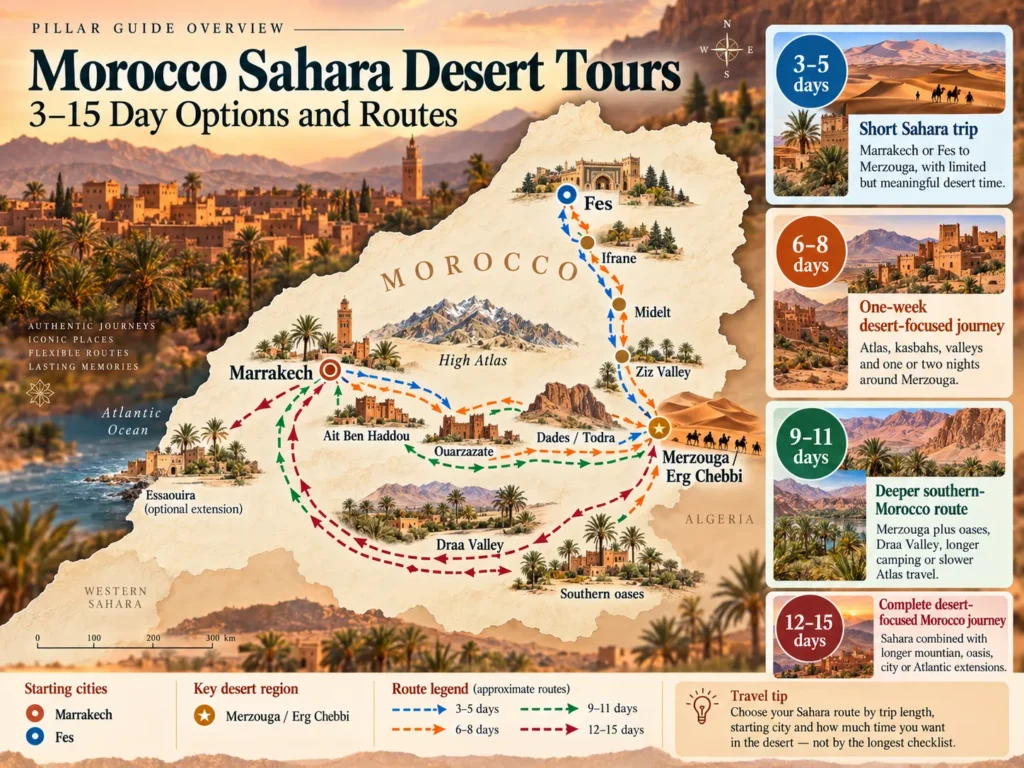
Marrakech and Fes are the two most common starting points for Merzouga. Marrakech approaches the Sahara through the High Atlas, Ait Ben Haddou, Ouarzazate and the valleys of southern Morocco. Fes reaches the dunes through the Middle Atlas, Ifrane, Midelt and the Ziz Valley. Longer routes can continue through the Draa Valley, oasis settlements and other parts of the south rather than immediately returning along the same road.
This guide compares the main Sahara tour lengths, starting cities, desert regions and travel styles. The detailed day-by-day itineraries are kept in the separate duration guides so you can choose the right route here without duplicating the same information across several pages.
Sahara Desert Tours by Duration
| Duration | Best use | Typical route style | Detailed guide |
|---|---|---|---|
| 3–5 days | Short Sahara trip | Marrakech or Fes to Merzouga, with limited but meaningful desert time | 3-5 Day Sahara Desert Tours |
| 6–8 days | One-week desert-focused journey | Atlas, kasbahs, valleys and one or two nights around Merzouga | 6-8 Day Sahara Desert Tours |
| 9–11 days | Deeper southern-Morocco route | Merzouga plus oases, Draa Valley, longer camping or slower Atlas travel | 9-11 Day Sahara Desert Tours |
| 12–15 days | Complete desert-focused Morocco journey | Sahara combined with longer mountain, oasis, city or Atlantic extensions | Best treated as a dedicated long-duration route |
How Many Days Do You Need for a Sahara Desert Tour?
Three days is generally the minimum for a Marrakech-to-Merzouga route, but it is an express journey with significant road time. Four or five days creates more room for the High Atlas, Ait Ben Haddou, Dades and Todra while still reaching Erg Chebbi.
Six to eight days changes the balance noticeably. You can spend a full day around Merzouga, add a second desert night, explore the wider region or include a more substantial Atlas or kasbah section.
Nine to eleven days allows the journey to move beyond Merzouga into southern oasis country, including places such as Rissani, Tazzarine, Agdz and the Draa Valley. Longer camel trekking, camping or hiking also becomes easier to include.
Twelve to fifteen days is best when the Sahara is the central theme of a much broader Morocco journey. The extra time should usually create slower stays rather than simply adding more cities.
3–5 Day Sahara Tours: Best for Limited Time
A short Sahara tour is for travelers who have limited vacation time but consider the desert a priority.
From Marrakech, a typical short route crosses the High Atlas, passes Ait Ben Haddou and the southern valleys and reaches Merzouga beside Erg Chebbi. From Fes, the route approaches the desert through the Middle Atlas and Ziz region.
The biggest trade-off is road time. A three-day journey can reach the dunes, but four or five days gives you considerably more room to enjoy the landscapes between the city and desert.
Compare the specific three-, four- and five-day options in the 3-5 Day Sahara Desert Tours guide.
6–8 Day Sahara Tours: More Time at Merzouga
Six to eight days is one of the best ranges for travelers who want the Sahara to be a major part of the holiday without dedicating the entire Morocco trip to the south.
The additional days can support a full Erg Chebbi day, two nights near Merzouga, the Dades and Todra landscapes, the Ziz Valley, the Draa route or dedicated Atlas walking.
This duration also makes private, luxury, camping-focused and activity-heavy routes easier to design because the itinerary does not need to squeeze every experience into one afternoon.
See the route options in the 6-8 Day Sahara Desert Tours guide.
9–11 Day Sahara Tours: Desert, Oases and Southern Morocco
Nine to eleven days is where the desert journey can expand beyond the standard Marrakech–Merzouga round trip.
A longer southern circuit can combine the High Atlas, Ait Ben Haddou, Ouarzazate, Todra, Merzouga, Rissani, Tazzarine, the Draa Valley and Agdz.
You can also protect several nights near Erg Chebbi, spend longer walking or camel trekking and include hosted cultural or craft activities without turning the itinerary into a sequence of long transfers.
Compare the deeper routes in the 9-11 Day Sahara Desert Tours guide.
12–15 Day Sahara Tours: Complete Desert-Focused Routes
Twelve to fifteen days is appropriate when the desert and southern Morocco are the backbone of a larger journey.
Instead of spending every additional day adding another destination, use the time for meaningful two-night stays, more Atlas walking, several days around Merzouga, a slower Draa Valley section or an extension toward another region of Morocco.
This duration can also work well for travelers combining the Sahara with Fes, Marrakech and either northern Morocco or the Atlantic coast.
Keep the Sahara at the center of the itinerary rather than allowing a long tour to become an unrelated country-wide checklist.
Marrakech to the Sahara: The Classic Southern Route
Marrakech is one of the most common starting points for Sahara desert tours.
The route preserved from the original article travels through the High Atlas toward Ouarzazate and Merzouga, with historic architecture, kasbah landscapes and major changes in terrain along the way.
High Atlas Mountains
Leaving Marrakech, the road climbs into the High Atlas before descending toward southern Morocco.
The mountains are not simply an obstacle on the way to the dunes. They provide one of the most dramatic landscape transitions of the entire trip.
Ait Ben Haddou
Ait Ben Haddou is a natural stop on this route.
The historic ksar is known for traditional earthen architecture and is UNESCO World Heritage-listed. Give yourself enough time to walk through the settlement rather than viewing it only from the road.
Ouarzazate
Ouarzazate provides a practical overnight point and another cultural component.
The original article specifically includes Taourirt Kasbah and the region’s film studios. Those stops can be included when film history interests you, but they should not overshadow the wider southern-Morocco landscape.
Dades and Todra
The merged Marrakech route also preserves the Dades Valley, with its striking rock landscapes, as part of the journey toward Merzouga.
Todra Gorge adds another useful walking stop on longer itineraries.
Merzouga and Erg Chebbi
Merzouga sits beside Erg Chebbi, one of Morocco’s best-known dune fields.
The dunes rise dramatically from the surrounding rocky desert and provide the landscape associated with sunset camel rides, dune walks, desert camps and sunrise views.
For detailed landscape advice, use the Merzouga Dunes guide.
Fes to the Sahara: Middle Atlas and Ziz Route
The merged Fes article provides an important alternative to the Marrakech route.
A journey beginning in Fes passes through the Middle Atlas rather than the High Atlas and southern kasbah route.
Fes
Fes itself deserves time for Fes el-Bali, artisans, traditional food and historic architecture before you leave for the desert.
Middle Atlas
The road south crosses greener and cooler landscapes before reaching Morocco’s more arid southeastern regions.
Ifrane
Ifrane is a common stop because its architecture and mountain setting provide a striking contrast with the desert landscapes later in the route.
Midelt and the Ziz Region
Longer tours can break the route around Midelt before continuing toward the Ziz Valley.
The Ziz corridor adds palm landscapes and viewpoints before the journey eventually reaches the Merzouga region.
Why Start From Fes?
Fes is particularly useful when your wider Morocco itinerary already includes northern or central Morocco.
Instead of returning to Fes after Merzouga, consider continuing through Todra, Dades and Ait Ben Haddou toward Marrakech. This creates an efficient one-way desert route.
Fes to Marrakech via Merzouga
One of the strongest Sahara itineraries is not a round trip at all.
A route can travel:
Fes → Middle Atlas → Ziz Valley → Merzouga → Todra → Dades → Ait Ben Haddou → Marrakech.
This connects the two major cities through some of Morocco’s most distinctive landscapes and avoids retracing the same road.
The exact number of days determines whether the route is an express transfer or a slower desert-focused journey.
Merzouga and Erg Chebbi
Merzouga is the main base for visiting Erg Chebbi.
The original source correctly emphasizes the dramatic dunes and camel journeys at sunset. Erg Chebbi’s highest dunes reach roughly 150 metres above the surrounding terrain. :chatgpt-content-reference{index=”5″}
Merzouga works well because the dunes can be experienced in several different ways:
- Walking
- Camel trekking
- 4×4 exploration
- Sandboarding
- Photography
- Sunrise and sunset
- Desert camps
You do not need to do all of them on the same trip.
Erg Chebbi or Erg Chigaga?
The merged adventure article mentions both Erg Chebbi and Erg Chigaga, and the distinction is worth keeping.
Erg Chebbi
Erg Chebbi lies beside Merzouga and is comparatively easy to integrate into routes from both Marrakech and Fes.
Choose it when you want major dunes but also need a route that connects naturally with Dades, Todra or the Ziz Valley.
Erg Chigaga
Erg Chigaga lies farther southwest and is associated with routes through the Draa Valley and M’Hamid area.
It generally requires more off-road travel and works better when remoteness is part of what you want from the trip.
Do not try to include both dune regions simply because both are famous. They belong to different route structures.
Merzouga, Zagora or Agafay?
| Area | Landscape | Best for |
|---|---|---|
| Merzouga / Erg Chebbi | Large sand dunes | Classic Sahara dune experience and routes between Fes and Marrakech |
| Zagora / Draa Valley | Palm valleys, arid landscapes and southern kasbah country | Travelers prioritizing southern Morocco and the Draa region |
| Agafay | Rocky, arid terrain near Marrakech | Short desert-style experience when you do not have time for the Sahara |
Do not use these names interchangeably. Travelers looking specifically for large wind-shaped sand dunes should usually prioritize Merzouga or Erg Chigaga rather than Agafay.
Camel Trekking in the Sahara
Camel trekking is one of the experiences preserved across all three merged articles.
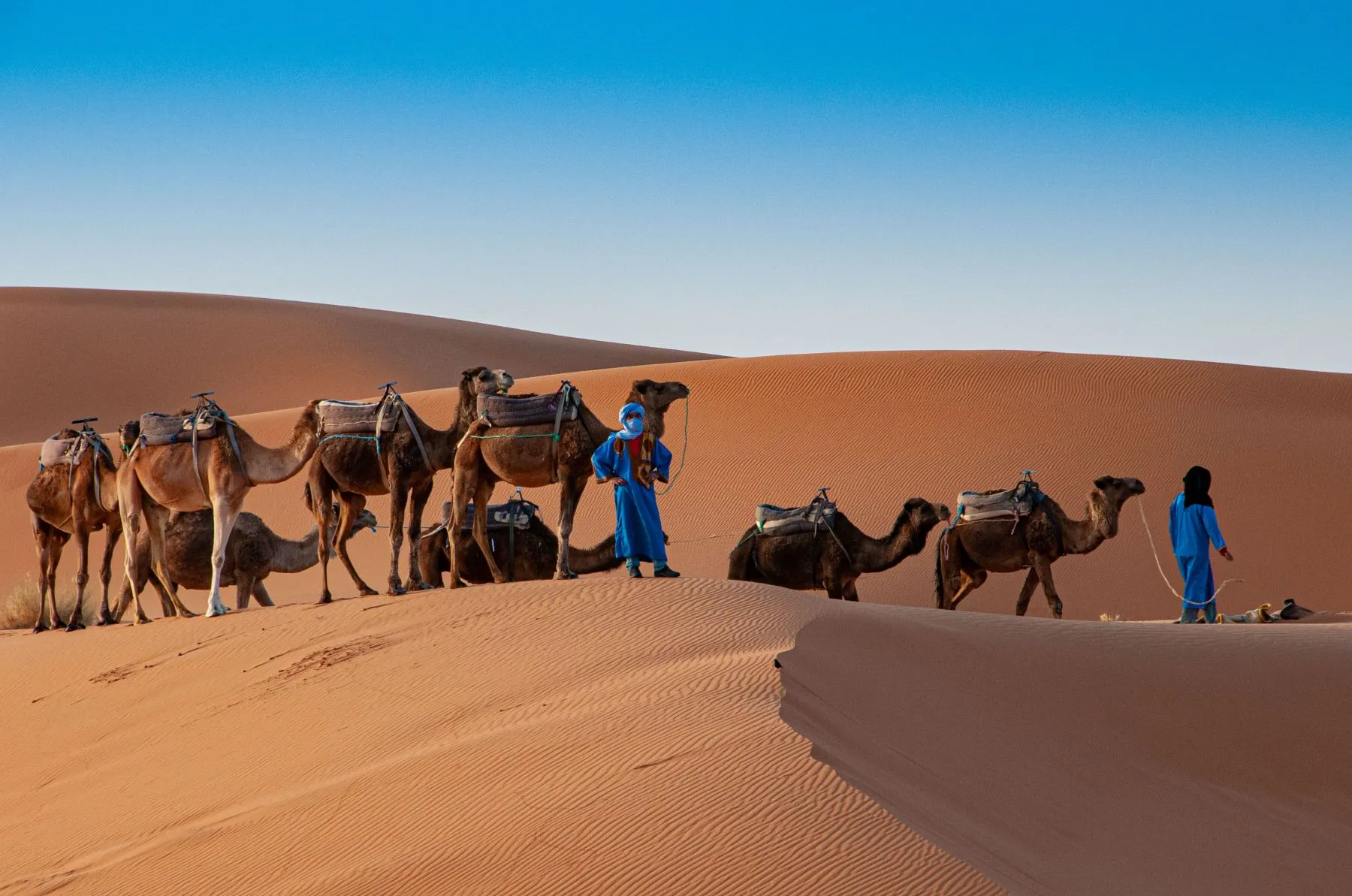
A typical Merzouga stay may use a camel ride around sunset or as one way of reaching a desert camp.
It is an optional activity rather than a requirement for visiting the dunes.
Travelers who prefer not to ride can often walk or arrange vehicle access depending on the camp.
For detailed information on ride lengths, sunrise, sunset and longer trekking options, use the Sahara Camel Trekking guide.
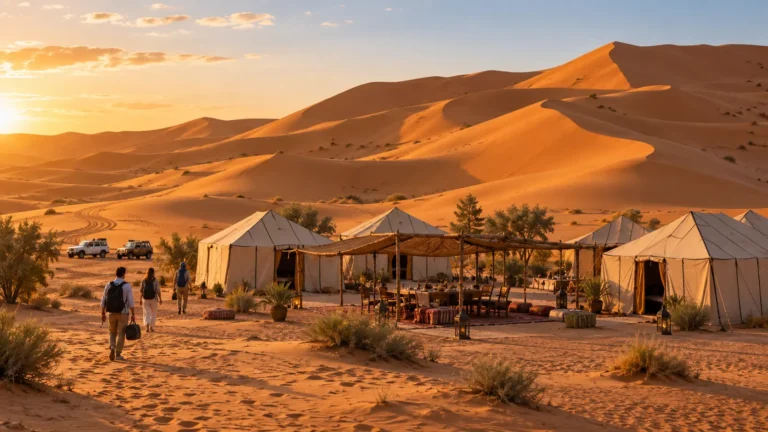
Desert Camps and Stargazing
Spending a night near the dunes is another central theme of the source articles.
Camp experiences can include dinner, sunrise, sunset and music where actually arranged. Stargazing can be excellent when cloud, moonlight, dust and artificial lighting cooperate.
Camp standards vary greatly, so do not choose only by labels such as “standard” or “luxury.”
Before booking, confirm:
- Private or shared tent
- Private or shared bathroom
- Bed configuration
- Electricity
- Heating or cooling arrangements
- Meals
- Camel or 4×4 transfer
- Luggage arrangements
Use the Merzouga Desert Trip guide for more detailed camp planning.
Activities Beyond Camel Trekking
The merged adventure article includes several useful alternatives and additions to camel riding.
Dune Walking
Walking is one of the simplest ways to experience Erg Chebbi.
Deep sand is more tiring than it appears, so keep longer walks for cooler parts of the day.
Sandboarding
Sandboarding can be included on suitable dunes and works particularly well when your itinerary already includes a full desert day.
4×4 Exploration
A guided 4×4 route can cover a wider part of the Merzouga region than a camel ride or short walk.
Quad Bikes
Quad or buggy excursions are available around some desert areas, but they provide a very different experience from walking or camel travel.
Use appropriate routes and local operators rather than treating every dune as unrestricted driving terrain.
Photography
Sunrise and sunset provide the strongest directional light, while dune ridges, footprints and distant caravans can show the scale of the landscape.
Ait Ben Haddou, Ouarzazate and the Kasbah Route
The original keep article places Ouarzazate and Ait Ben Haddou at the heart of the Marrakech approach to the Sahara.
This content should remain in the parent pillar because the route itself is one of the main decisions travelers need to understand.
Ait Ben Haddou adds traditional earthen architecture, while Ouarzazate provides Taourirt Kasbah, film history and a practical overnight base.
These stops work especially well on four-day-and-longer routes where sightseeing does not need to compete with reaching Merzouga before sunset.
Dades Valley and Todra Gorge
The merged Marrakech article specifically includes Dades Valley as part of the scenic route to Merzouga.
Dades and Todra help divide the long distance between Marrakech and Erg Chebbi while adding landscapes that are very different from the dunes.
On longer tours, spend some time walking rather than treating the valleys only as overnight stops.
Middle Atlas, Ifrane and Fes Routes
The merged Fes article contributes a separate mountain route that should not be flattened into the Marrakech itinerary.
Fes travelers can combine:
- Fes el-Bali
- Middle Atlas scenery
- Cedar landscapes
- Ifrane
- Midelt
- Ziz Valley
- Merzouga
This route is particularly strong for travelers already arriving in Fes or northern Morocco.
Culture and Communities Along Sahara Routes
The source articles repeatedly refer to “Berber culture” and hospitality.
Amazigh is also widely used for the Indigenous peoples of Morocco and North Africa. Communities across the Atlas and southeastern Morocco are diverse and should not be presented as one unchanging traditional lifestyle.
Useful cultural experiences can include:
- Local guesthouses
- Hosted meals
- Craft workshops
- Markets
- Local guides
- Music experiences
- Khamlia and Gnawa traditions
Ask what is actually included rather than assuming every village stop provides a cultural program.
Private, Group or Guided Sahara Tour?
Shared Group Tour
Shared tours can lower the per-person transport cost and work well for solo travelers or visitors comfortable with a fixed schedule.
Private Tour
A private route usually gives you more control over departure time, roadside stops, accommodation and activity choices.
Guided Tour
A guide can provide cultural and historical interpretation, but check whether the person traveling with you is a driver, driver-guide or specialist local guide.
The three terms are not interchangeable.
Luxury Sahara Tours
Luxury does not require a separate geographical route.
A higher-end Sahara journey can follow the same High Atlas, kasbah, valley and Merzouga route while upgrading:
- Vehicle
- Riads and hotels
- Desert tent
- Bathroom facilities
- Private guiding
- Dining
- Pacing
- Private transfers and activities
Compare the actual inclusions instead of relying on the word “luxury.”
Best Time for Sahara Desert Tours
Spring
Spring works well for tours combining the Atlas, southern Morocco and desert activities.
Summer
Summer can be extremely hot around Merzouga and other inland desert areas. Plan outdoor activities for early morning and late afternoon and reconsider demanding daytime activities during extreme heat.
Autumn
Autumn is another strong period as the most intense summer heat begins to decrease.
Winter
Daytime conditions can be comfortable, but nights and sunrise periods can be cold. Mountain conditions may differ substantially from Merzouga.
October through April is commonly favored for Erg Chebbi because conditions are generally milder than the hottest summer period. :chatgpt-content-reference{index=”6″}
What to Pack for a Sahara Tour
- Comfortable walking shoes
- Lightweight clothing that can be layered
- Warm layer for nights and sunrise
- Sun hat
- Sunglasses
- Sunscreen
- Light scarf for wind, sun and sand
- Reusable water bottle
- Small day or overnight bag
- Power bank
- Personal medication
- Comfortable trousers if camel riding
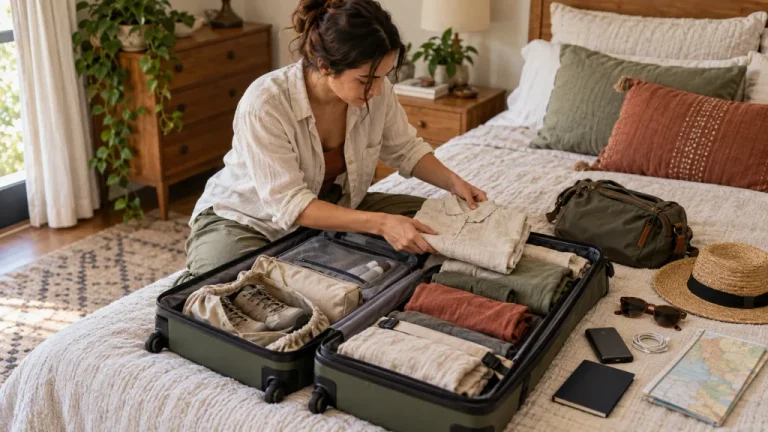
Remember that Sahara tours often cross mountains, valleys and desert terrain during the same trip. Pack for the complete route rather than only hot sand.
How Much Does a Sahara Desert Tour Cost?
There is no useful universal price because two tours following similar routes can include very different services.
Cost depends on:
- Number of days
- Starting and finishing cities
- Shared or private transport
- Hotel level
- Camp category
- Number of desert nights
- Guides
- Camel rides
- 4×4 excursions
- Meals
- Season
Compare a written list of inclusions rather than simply choosing the lowest headline price.
What Should You Check Before Booking?
- Exact route
- Where you sleep each night
- Longest driving days
- Vehicle type
- Private or shared transport
- Hotel and camp category
- Private or shared bathroom
- Camel or vehicle transfer
- Meals
- Guides
- Entrance fees
- Activities
- Luggage handling
- Cancellation and modification policy
A long list of destination names does not automatically mean a better Sahara tour. Pacing matters.
Which Sahara Tour Should You Choose?
| Your priority | Good starting point |
|---|---|
| Very limited time | 3-5 day Sahara route |
| One-week desert journey | 6-8 day Sahara route |
| Oases and deeper southern Morocco | 9-11 day Sahara route |
| High Atlas, kasbahs and Erg Chebbi | Start from Marrakech |
| Middle Atlas and Ziz Valley | Start from Fes |
| Major sand dunes | Merzouga / Erg Chebbi |
| Remote southern desert route | Draa Valley / M’Hamid / Erg Chigaga route |
Common Sahara Tour Planning Mistakes
Choosing Only by the Number of Days
Two five-day routes can provide completely different amounts of desert time. Check the actual overnight locations.
Treating Marrakech to Merzouga as a Quick Transfer
The High Atlas, Ait Ben Haddou, Dades and Todra are important parts of the journey.
Confusing Agafay With the Sahara Dunes
Agafay is an arid rocky landscape close to Marrakech. Merzouga and Erg Chebbi provide the major dune environment.
Assuming Camel Riding Is Mandatory
It is optional. Many desert experiences can use walking or vehicle transfers instead.
Booking a Camp Based Only on the Word “Luxury”
Verify the actual tent, bathroom, electricity, meals and transport arrangement.
Trying to Complete Every Activity
A full desert day does not need to include camel trekking, sandboarding, quad bikes, 4×4, village visits and a long hike all at once.
FAQ
How many days do you need for a Sahara desert tour in Morocco?
Three days is a common minimum for reaching Merzouga from Marrakech, but it involves substantial driving. Four or five days is more comfortable. Six to eight days gives you more time at Erg Chebbi and on the route, while nine to eleven days works well for a deeper southern-Morocco and oasis circuit.
Is Marrakech or Fes better for a Sahara desert tour?
Choose Marrakech when you want the High Atlas, Ait Ben Haddou, Ouarzazate, Dades and Todra as part of the journey. Choose Fes when you want the Middle Atlas, Ifrane, Midelt and Ziz Valley. A one-way Fes-to-Marrakech route via Merzouga can combine both.
Is Merzouga the best place for Sahara dunes in Morocco?
Merzouga is one of the most practical places for travelers who want large sand dunes because it sits beside Erg Chebbi and connects naturally with routes from both Fes and Marrakech. Erg Chigaga is another major dune option for travelers following a more remote route through the Draa and M’Hamid region.
Do Sahara tours include camel rides and desert camps?
Many do, but inclusions vary. Camel rides can often be replaced by walking or vehicle transfers, and camp standards range widely. Check exactly what is included before booking.
What is the best time for a Sahara desert tour?
Spring and autumn are strong choices for routes that combine mountains and desert. October through April generally provides milder Erg Chebbi conditions than the hottest summer months. Winter nights can be cold, while summer afternoons can be extremely hot.
Should I book a private or group Sahara tour?
A group tour can reduce the per-person cost and suits travelers comfortable with a fixed timetable. A private route provides greater control over stops, pacing, accommodation and activities. The best choice depends on your budget and desired flexibility.
Choose the Sahara Route Before Choosing the Package
The best Sahara desert tour starts with geography rather than a package name.
Decide first whether you want the Marrakech route through the High Atlas and kasbah country, the Fes route through the Middle Atlas and Ziz Valley or a deeper southern journey through the Draa region.
Then decide how much time the Sahara itself deserves.
Three to five days works for a short tour. Six to eight days allows considerably more desert and southern-Morocco time. Nine to eleven days lets the oasis regions and longer camping or trekking become genuine parts of the journey. Twelve to fifteen days can turn the Sahara into the central theme of a much broader Morocco route.
For detailed planning, compare the 3-5 Day Sahara Desert Tours, 6-8 Day Sahara Desert Tours and 9-11 Day Sahara Desert Tours.
For Erg Chebbi itself, read the Merzouga Dunes guide. For camel-specific planning, use the Sahara Camel Trekking guide. For accommodation and overnight desert planning, use the Merzouga Desert Trip guide.
If you want a private route built around your starting city, travel dates, desired number of desert nights and preferred pace, use the custom Morocco trip planner.
Explore destinations, tours and locally organized Morocco experiences with Visit Morocco Together.
Ready to Experience Morocco?
Turn this inspiration into your next adventure. Our travel experts are ready to help.