A 6-8 day Sahara desert tour gives you much more flexibility than a short express trip to the dunes. With almost a week or more, the journey can include the High Atlas, historic kasbahs, Dades and Todra, a full day around Erg Chebbi, the Ziz Valley, Atlas trekking or a slower Draa Valley route rather than simply driving to Merzouga, sleeping at camp and leaving again the next morning.
The best route depends on where you start. Marrakech works naturally with the High Atlas, Ait Ben Haddou, Ouarzazate and southern valleys. Fes approaches Merzouga through the Middle Atlas and Ziz Valley. Casablanca can combine Rabat and Fes with the desert, although six days creates a faster itinerary. Travelers interested in the Draa Valley and Zagora can build a different southern route instead of making Erg Chebbi the only focus.
This guide compares six-, seven- and eight-day Sahara routes so you can choose the right starting city, desert region, activity level and travel style without creating dozens of overlapping desert-tour itineraries.
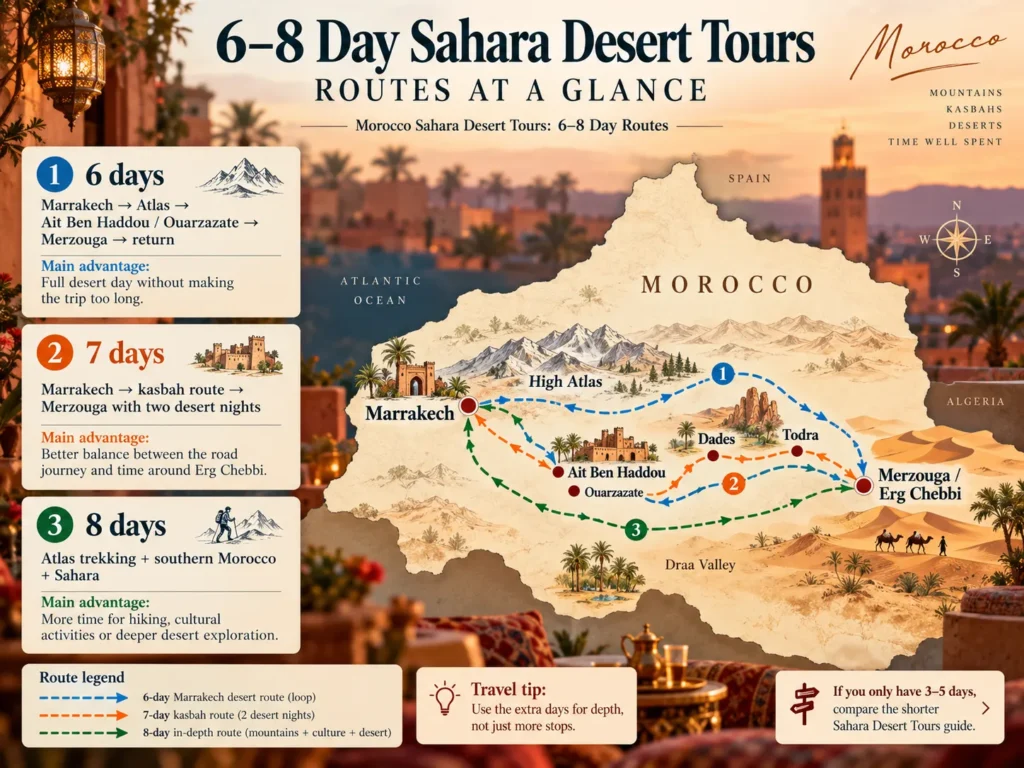
6-8 Day Sahara Desert Tours at a Glance
| Duration | Good route style | Main advantage |
|---|---|---|
| 6 days | Marrakech → Atlas → Ait Ben Haddou/Ouarzazate → Merzouga → return, or Fes/Casablanca alternatives | Enough time for a full desert day without making the overall trip too long |
| 7 days | Marrakech → kasbah route → Merzouga with two desert nights or slower southern return | Better balance between the road journey and time around Erg Chebbi |
| 8 days | Atlas trekking + southern Morocco + Sahara, or a deeper kasbah/desert route | Allows hiking, cultural activities or extra desert exploration without constant transfers |
If you have only three to five days, compare the shorter options in the 3-5 Day Sahara Desert Tours guide.
Why Choose 6-8 Days for the Sahara?
The main benefit is time.
A three-day Marrakech-to-Merzouga journey is possible, but much of the first and final day is spent on the road. With six to eight days, the places between Marrakech or Fes and the dunes can become part of the trip rather than brief roadside stops.
You can use the additional days for:
- Ait Ben Haddou
- Ouarzazate
- Dades Valley
- Todra Gorge
- Rissani
- Ziz Valley
- Draa Valley
- A full Erg Chebbi day
- A second desert night
- Atlas hiking
- 4×4 exploration
- Sandboarding
- Cooking or cultural activities where arranged
- Slower return stages
This does not mean every six- or eight-day tour should include all of them. The extra time is most useful when it creates depth rather than a longer checklist.
Which Duration Is Best?
Choose 6 Days for a Focused Sahara Journey
Six days works well when the Sahara is the central experience but you still want enough time for the landscapes on the way.
From Marrakech, this can include the High Atlas, Ait Ben Haddou, Ouarzazate and the Merzouga dunes.
From Fes, it can include Ifrane, Middle Atlas landscapes, Midelt, the Ziz Valley and Erg Chebbi.
From Casablanca, six days is possible but noticeably faster because Rabat and Fes sit between the Atlantic coast and the desert.
Choose 7 Days for More Time Around Merzouga
Seven days is a strong middle ground.
You can spend two nights around Merzouga, visit Rissani or Khamlia, explore the dunes beyond the standard sunset camel ride and still divide the road journey into comfortable stages.
A seven-day route also gives you more freedom to choose between budget, private and higher-comfort desert experiences without every day being built around an early departure.
Choose 8 Days for Atlas Trekking or Deeper Desert Travel
Eight days is particularly useful when the mountains are a real priority.
You can include dedicated Atlas walking rather than simply crossing the mountains by road, then continue through Ait Ben Haddou, southern valleys and Merzouga.
Alternatively, use the extra time for a deeper kasbah route, two full desert days or a slower Draa Valley journey.
6-Day Sahara Desert Tour from Marrakech: Atlas and Merzouga
The original article being rewritten follows a six-day route beginning and ending in Marrakech. Its main experiences remain useful and are preserved here.
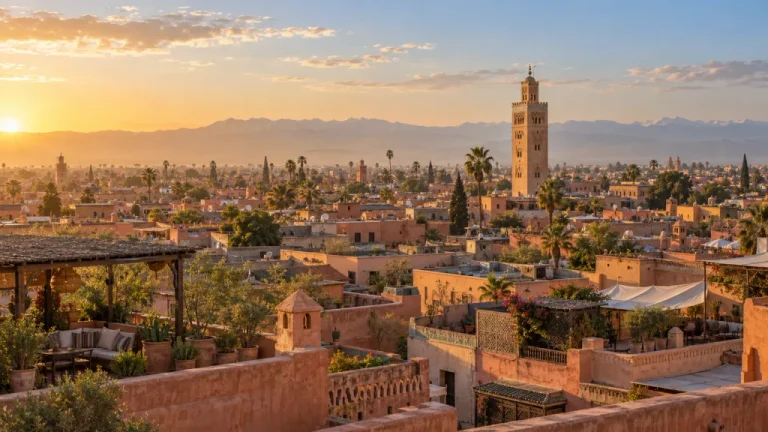
Day 1: Marrakech
Begin in Marrakech.
The original itinerary includes:
- Markets and souks
- Historic sights
- Jemaa el-Fna
- Koutoubia Mosque
- Majorelle Garden
- Moroccan food
If your international flight arrives late, do not try to complete all of these before the desert route begins. Use the first day according to your actual arrival time.
Day 2: Marrakech to the Atlas Mountains
Leave Marrakech and travel toward the High Atlas.
The old route emphasizes mountain scenery, green valleys, traditional villages and a local lunch before crossing the Tizi n’Tichka area.
The road itself provides dramatic views, but travelers who want genuine hiking should treat that as a separate activity rather than assuming a driving day is the same as an Atlas trek.
Older tourism material often describes mountain communities broadly as “Berber villages.” Amazigh is also widely used for Indigenous North African communities.
Day 3: Ait Ben Haddou and Ouarzazate
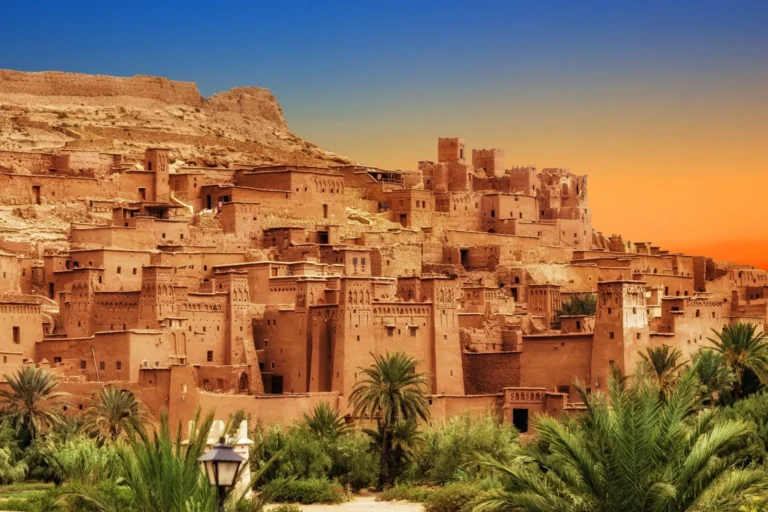
Visit Ait Ben Haddou, the UNESCO-listed ksar known for its traditional earthen architecture.
Continue toward Ouarzazate.
The original article includes the region’s film history and Atlas Studios. Include a studio visit when that genuinely interests you and current access fits the day’s schedule.
Ouarzazate also works as a practical overnight base before continuing east toward the valleys and Sahara.
Day 4: Continue to Merzouga
Travel toward Merzouga and Erg Chebbi.
The original six-day route includes a sunset camel trek followed by a desert camp, Moroccan dinner, music and storytelling.
Camel riding is optional. Many travelers can arrange a 4×4 transfer or another vehicle option instead.
Camp entertainment varies, so music or a campfire program should be described as something offered when actually scheduled rather than a guaranteed universal experience.
Day 5: Sunrise and Return Journey
Wake early for sunrise if desired.
After breakfast, begin the journey west, using markets, villages or landscape stops according to the chosen return route.
The old article returns to Marrakech on Day 5. That remains possible, but a six-day desert-focused version can also use an intermediate overnight if you prefer less time in the vehicle.
Day 6: Marrakech and Departure
Use the final day for any Marrakech experiences you missed earlier.
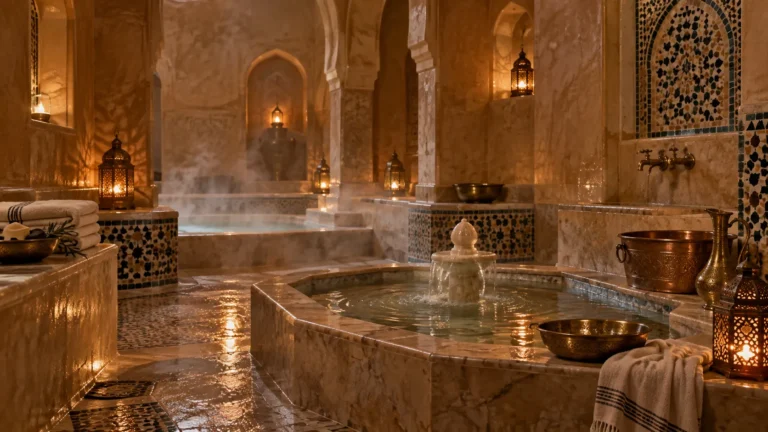
A traditional hammam, final medina walk, shopping or relaxed breakfast can work well depending on your flight schedule.
A Better Desert-Focused 6-Day Marrakech Route
If your primary goal is the Sahara rather than Marrakech sightseeing, another structure is:
- Day 1: Marrakech → High Atlas → Ait Ben Haddou
- Day 2: Ait Ben Haddou/Ouarzazate → Dades Valley
- Day 3: Dades → Todra Gorge → Merzouga
- Day 4: Full Erg Chebbi day and desert camp
- Day 5: Merzouga → southern overnight stop
- Day 6: Return through the High Atlas to Marrakech
This uses the six days more efficiently when Marrakech itself is already covered elsewhere in your Morocco itinerary.
Kasbah Route: Ait Ben Haddou, Ouarzazate and Merzouga
Several articles in the merge cluster focus specifically on a kasbah-and-desert route.
The main appeal is the progression of landscapes:
- High Atlas roads
- Earthen architecture
- Ouarzazate
- Palm groves
- Rocky southern terrain
- Erg Chebbi
Ait Ben Haddou should be explored on foot rather than reduced to a film-location photograph.
Longer six- to eight-day tours are better suited to this route because the historic and landscape stops do not need to be squeezed into one long road day.
Dades Valley and Todra Gorge
Dades Valley and Todra Gorge are natural parts of many Marrakech–Merzouga routes.
The old merge articles preserve hiking, panoramic viewpoints, dramatic canyon walls and village scenery.
Use these areas to break up the journey and spend some time outside the vehicle.
A short Todra walk or a slower Dades overnight can be more valuable than adding another distant attraction.
Full Day at Erg Chebbi
A complete desert day is one of the biggest differences between an express Sahara trip and a six- to eight-day tour.
Possible activities include:
- Walking in the dunes
- Sunrise and sunset
- Camel trekking
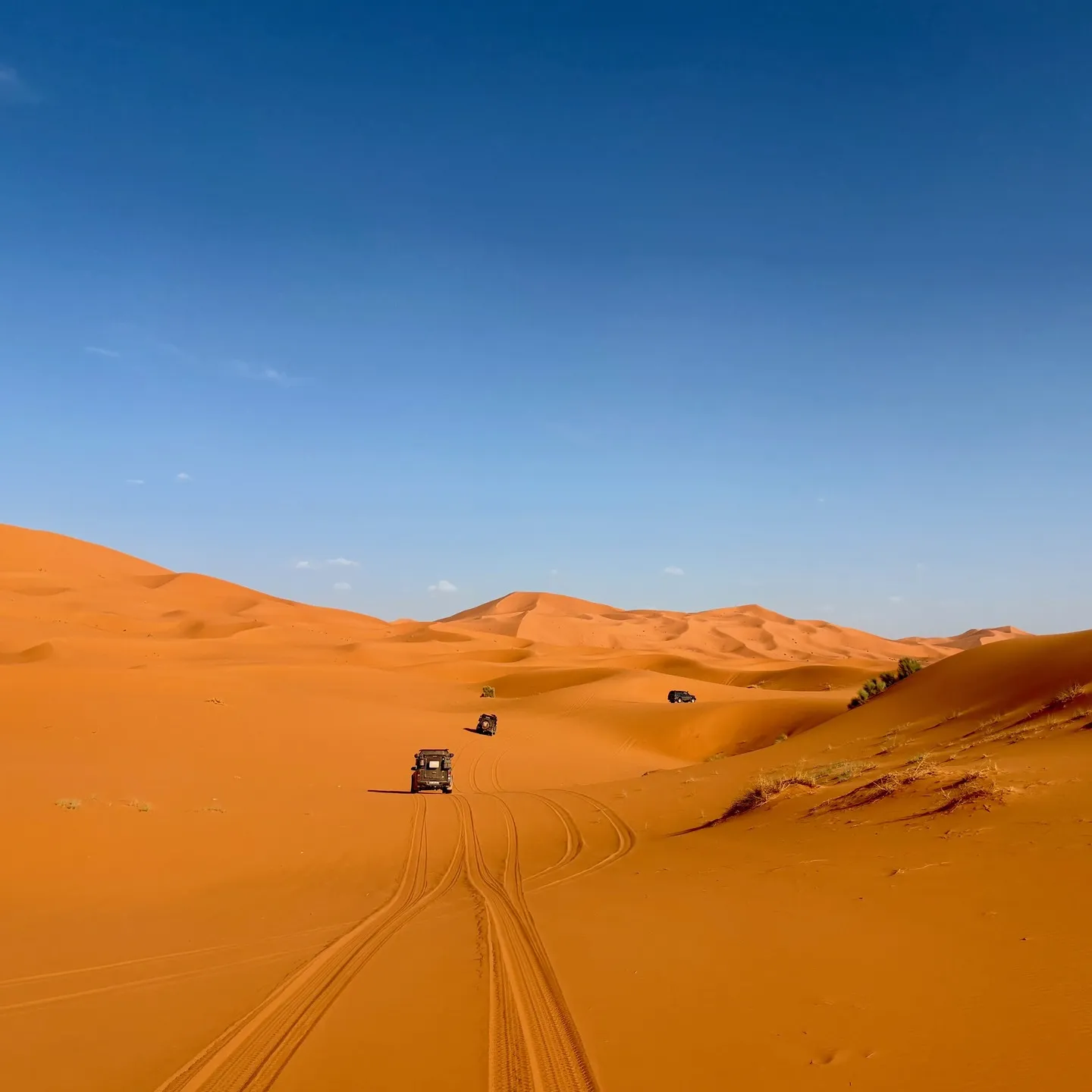
- 4×4 exploration
- Sandboarding
- Photography
- Rissani
- Khamlia
- Oasis areas
- Relaxing at your accommodation
Do not schedule all of them simply because they are available.
For detailed dune planning, read the Merzouga Dunes guide.
Rissani and the Wider Merzouga Region
Rissani appears repeatedly in the merged six- and seven-day routes.
Its market, local food and historic role in the Tafilalt region make it a useful addition when the market schedule aligns with your visit.
It works better on a longer desert tour because you do not need to choose between Rissani and having enough time at Erg Chebbi.
Khamlia and Gnawa Music
The older seven-day Marrakech–Merzouga article includes Khamlia and Gnawa music as part of a full desert day.
This is a more specific cultural experience than describing all camp music simply as “traditional Berber music.”
If music matters to you, ask what experience is actually arranged and who is performing.
6-Day Fes to Merzouga Desert Tour
Fes creates a completely different Sahara route.
The merge cluster includes several six-day Fes itineraries emphasizing Ifrane, Midelt, the Middle Atlas, Ziz Valley and Merzouga. :chatgpt-content-reference{index=”5″}
A useful structure is:
- Day 1: Fes and departure into the Middle Atlas
- Day 2: Ifrane / Midelt / Ziz region
- Day 3: Continue to Merzouga
- Day 4: Full Erg Chebbi day
- Day 5: Return toward the Middle Atlas or continue south-west
- Day 6: Fes, Marrakech or another final destination
Ifrane and Middle Atlas
The road from Fes passes through cooler mountain landscapes that contrast sharply with Merzouga.
Ifrane is a common stop, while cedar-forest landscapes and the wider Middle Atlas provide another environmental transition before reaching Midelt.
Midelt
Midelt works naturally as an overnight or lunch stop on a slower route between Fes and southeastern Morocco.
It is particularly useful when the goal is to avoid making the entire Fes–Merzouga journey one continuous transfer.
Ziz Valley
The Ziz Valley is one of the strongest features of the Fes approach.
Its palm groves and river corridor create a striking contrast with the dry surrounding plateau.
A longer tour provides enough time for viewpoints, photographs and local stops rather than seeing the valley only from the vehicle.
6-Day Casablanca to Merzouga Route
The merge cluster also includes a Casablanca-start itinerary.
This version combines cities and desert rather than focusing only on the southern road.
A typical route can include:
- Casablanca
- Rabat
- Fes
- Middle Atlas
- Merzouga
Rabat
Rabat can include Hassan Tower, historic districts and the capital’s architectural heritage.
Fes
The old Casablanca route dedicates a day to Fes el-Bali, Bou Inania Madrasa, traditional crafts and the tanneries.
This cultural component makes the route broader than a normal desert tour.
The Main Trade-Off
Six days from Casablanca is relatively fast because the itinerary must cover both northern cities and the Sahara.
If your main goal is the desert itself, starting from Marrakech, Fes or Ouarzazate normally gives you more time around Merzouga.
6-Day Ziz Valley and Sahara Route
Another merged itinerary gives more emphasis to Rissani, the Ziz Valley, Todra and Dades.
This is a useful alternative for travelers who value valleys and landscape photography.
The route can combine:
- Erg Chebbi
- Rissani market
- Ziz Valley
- Todra Gorge
- Dades landscapes
- Walking and photography
This works particularly well as a one-way route between Fes and Marrakech because those landscapes naturally connect the two cities.
6-Day Zagora and Draa Valley Desert Tour
Not every six-day desert route needs to focus on Merzouga.
The Draa Valley and Zagora route preserved in the merge cluster includes the High Atlas, Ait Ben Haddou, Zagora, markets, camel riding, a camp night, palm groves, ancient kasbahs and local villages. :chatgpt-content-reference{index=”6″}
Why Choose the Draa Valley?
Choose this route when you want:
- Palm-grove landscapes
- Kasbah architecture
- Southern market towns
- Slower exploration around the Draa
- Less emphasis on the Erg Chebbi dunes
Zagora and the Draa region should not be presented as identical to Merzouga.
If large high dunes are non-negotiable, Erg Chebbi remains the stronger choice.
7-Day Marrakech to Merzouga Sahara Tour
Seven days provides an excellent balance for travelers starting and ending in Marrakech.
One merged route uses:
- Day 1: Marrakech
- Day 2: Marrakech to Ait Ben Haddou
- Day 3: Ait Ben Haddou to Ouarzazate
- Day 4: Ouarzazate to Merzouga
- Day 5: Full Merzouga day
- Day 6: Return toward Marrakech
- Day 7: Departure
This route preserves Marrakech’s Koutoubia, souks and Jemaa el-Fna, Ait Ben Haddou, Atlas Film Studios, Taourirt Kasbah, the Draa Valley, Erg Chebbi, Khamlia, Rissani and final Marrakech time.
Compared with a six-day route, the extra day makes the cultural and desert sections noticeably less rushed.
Two Nights Around Merzouga
A seven- or eight-day Sahara tour is particularly well suited to two nights in the Merzouga region.
The first evening can focus on sunset and camp.
The next day can include:
- Sunrise
- Khamlia
- Rissani
- 4×4 exploration
- Sandboarding
- Dune walking
- Photography
- Rest
This is much different from reaching camp at sunset and starting the long road back immediately after breakfast.
7-Day Camel Trekking and Desert Camping Route
Several URLs in the merge cluster specifically target camel trekking and camping rather than only the road itinerary. :chatgpt-content-reference{index=”7″}
On a seven-day trip, camel trekking can be treated as one part of a broader Sahara stay rather than the entire desert experience.
A sunset ride, overnight camp and sunrise experience is enough for many travelers.
Longer trekking should be chosen because you genuinely want more time traveling by camel, not simply because a longer ride sounds more authentic.
For ride-specific planning, use the Sahara Camel Trekking guide.
7-Day Luxury Desert Tour
The merge cluster includes several premium-camp and luxury versions.
The geographical route does not need to change simply because the trip is higher-end.
Luxury can instead mean:
- Private transport
- Higher-end riads or hotels
- Larger desert tent
- Private bathroom
- More developed dining facilities
- Private 4×4 transfer
- More flexible stops
- Additional guiding
There is no universal definition of a luxury desert camp. Check the exact tent, bathroom, meals and transfer arrangement before booking.
7-Day Private Sahara Tour
A private route gives you more control over:
- Departure time
- Photo stops
- Lunch breaks
- Accommodation level
- Desert activities
- Walking time
- Whether to spend one or two nights near Erg Chebbi
Private does not mean the itinerary can be completely changed at the last moment. Accommodation and camp reservations may still require advance planning.
7-Day Budget Desert Tour
The cluster also contains budget-focused six- and seven-day itineraries.
Budget travel usually changes the transport and accommodation choices rather than the geography itself.
Ways to control cost include:
- Shared transport
- Simpler guesthouses
- Standard rather than premium camp
- Fewer paid activities
- Choosing only the activities you actually value
Do not create an unrealistic schedule simply to save one accommodation night.
8-Day Atlas Mountains and Sahara Tour
An eight-day route allows the Atlas Mountains to become a genuine part of the trip rather than only a road crossing.
The existing eight-day source combines Marrakech, Atlas Mountains, Amazigh communities, Ait Ben Haddou, Ouarzazate, Dades and the Sahara, while also suggesting trekking, cultural activities and photography. :chatgpt-content-reference{index=”8″}
This is especially useful for travelers who want both mountain and desert landscapes.
Atlas Trekking
A dedicated trekking section can include valley walking, terraced landscapes and mountain villages.
The difficulty should match your fitness and season.
A Mount Toubkal summit attempt is not a casual add-on to every Sahara tour. It requires its own planning and significantly changes the physical demands of the itinerary.
Local Food and Cultural Activities
The older eight-day material suggests traditional meals, cooking and festivals.
A cooking class can fit naturally into a longer trip.
Festival attendance should only be included when actual travel dates coincide with a verified event.
Photography
Eight days gives photographers more opportunities to work with different light and landscapes:
- Atlas valleys
- Earthen architecture
- Dades cliffs
- Erg Chebbi dunes
- Sunrise and sunset
- Ziz or Draa palm groves
8-Day Kasbahs and Sahara Route
Another version uses the additional days for historic kasbahs and southern settlements rather than mountain trekking.
This works well for travelers interested in architecture and road-trip landscapes.
Possible emphasis:
- Ait Ben Haddou
- Ouarzazate
- Taourirt Kasbah
- Dades Valley
- Todra Gorge
- Merzouga
- Rissani
- Draa or Ziz Valley depending on direction
8-Day Immersive Merzouga and Dades Route
Several merged URLs specifically emphasize Merzouga, Dades and a more immersive desert stay. :chatgpt-content-reference{index=”9″}
This version suits travelers who would rather spend more nights in the south than add another major city.
Use the extra time for:
- Two nights around Merzouga
- A full Dades day
- Valley or gorge walking
- A slower Ait Ben Haddou visit
- A 4×4 desert excursion
- A relaxed return route
Merzouga or Zagora for a 6-8 Day Tour?
| Feature | Merzouga / Erg Chebbi | Zagora / Draa route |
|---|---|---|
| Landscape | Large sand dunes | Palm valley, arid plains and desert-edge landscapes |
| Best for | Travelers prioritizing classic Sahara dunes | Travelers prioritizing Draa Valley, kasbahs and southern culture |
| Route fit | Works well between Fes and Marrakech or as Marrakech round trip | Works naturally with Ouarzazate and the Draa Valley |
Marrakech, Fes or Casablanca: Where Should You Start?
Marrakech
Choose Marrakech when the High Atlas, Ait Ben Haddou, Ouarzazate, Dades and Todra are central to the trip.
Fes
Choose Fes when you want the Middle Atlas, Ifrane, Midelt and Ziz Valley approach.
A one-way Fes → Merzouga → Marrakech route is especially efficient.
Casablanca
Choose Casablanca when your international flight arrives there and you want to combine Rabat and Fes with the Sahara.
Six days is relatively fast; seven or eight gives the cities and desert more room.
Round Trip or One-Way Desert Tour?
A round trip is useful when your flights or accommodation require returning to the same city.
A one-way tour is often better geographically.
For example:
Fes → Merzouga → Todra → Dades → Ait Ben Haddou → Marrakech.
This avoids driving back over the same route and turns the Sahara tour into part of the journey between two major cities.
Camel Trekking or 4×4?
Both provide different ways to experience Erg Chebbi.
Camel Trekking
Best for a slower approach to the dunes, especially around sunset or sunrise.
4×4
Best for covering a wider part of the surrounding desert region and for travelers who do not want to ride.
Some tours combine both.
4×4 Desert Experiences
Several merged six-day articles specifically promote 4×4 dune experiences. :chatgpt-content-reference{index=”10″}
An organized 4×4 route can visit areas beyond the normal camel path, but it should use appropriate tracks and a local driver.
Do not take an ordinary rental car onto desert tracks unless the rental agreement and route clearly permit it.
Desert Camp: Standard or Luxury?
Camp categories vary significantly.
Before booking, check:
- Private or shared tent
- Private or shared bathroom
- Bed configuration
- Electricity
- Heating or cooling arrangements
- Dinner and breakfast
- Camel or 4×4 transfer
- Luggage arrangements
Use the Merzouga Desert Trip guide for a deeper comparison.
Group, Private or Guided?
Group Tour
Useful for lower per-person transport costs and travelers who are comfortable with a fixed schedule.
Private Tour
Useful for families, couples, photographers and anyone who wants more control over stops and accommodation.
Guided Tour
A guide can add cultural and historical context, but confirm whether the person traveling with you is a driver, driver-guide or specialist guide.
Best Time for a 6-8 Day Sahara Tour
Spring
Spring works well for combining mountain, valley and desert experiences.
Summer
Merzouga and inland southern Morocco can become extremely hot.
Plan dune activities for early morning and late afternoon and reconsider demanding trekking during extreme heat.
Autumn
Autumn is another strong period for a mixed Atlas and Sahara itinerary.
Winter
Desert days can be comfortable while nights become cold.
Atlas conditions may differ substantially and can include snow or temporary road disruption.
What to Pack
- Comfortable walking shoes
- Lightweight daytime clothes
- Warm layers for mountains, desert evenings and sunrise
- Sun hat
- Sunglasses
- Sunscreen
- Reusable water bottle
- Scarf for sun, wind and sand
- Small overnight bag
- Power bank
- Personal medication
- Comfortable trousers if camel riding
- Appropriate walking footwear for Atlas trekking
Families and Older Travelers
Six to eight days is generally easier than the fastest desert tours because long driving stages can be divided more sensibly.
Ask in advance about:
- Child seats
- Vehicle space
- Bathroom stops
- Camp access
- 4×4 alternative to camel riding
- Private bathrooms
- Walking difficulty
Cultural Visits Along the Route
The merged articles include local meals, markets, village visits, music and hosted experiences.
These can add depth when they involve an actual host, artisan, guide or performer.
A village or family should not automatically be described as an attraction. Visits should be arranged respectfully and with the participants’ agreement.
How Much Should a 6-8 Day Sahara Tour Cost?
There is no useful universal price because cost depends on:
- Group or private transport
- Starting city
- Hotel level
- Camp category
- Number of desert nights
- Included guides
- 4×4 activities
- Camel rides
- Meals
- Season
Compare written inclusions rather than only the headline price.
What to Check Before Booking
- Exact route
- Daily overnight location
- Vehicle type
- Private or shared transport
- Hotel and riad names or category
- Camp category
- Camel or 4×4 arrangements
- Meals included
- Entrance fees
- Local guides
- Activities
- Cancellation terms
A tour that simply lists Marrakech, Atlas Mountains and Merzouga without explaining the overnight stages does not tell you enough about the actual pace.
Which 6-8 Day Sahara Tour Is Best?
| Your priority | Best route style |
|---|---|
| Classic first Sahara trip | 6-7 days Marrakech → Ait Ben Haddou → Dades/Todra → Merzouga |
| Middle Atlas and Ziz Valley | 6-day Fes → Merzouga route |
| Cities + desert | 7-8 days Casablanca → Rabat/Fes → Merzouga |
| Atlas trekking + dunes | 8-day Atlas and Sahara route |
| Draa Valley and kasbahs | 6-8 day Zagora/Draa-focused route |
| Maximum desert time | 7-8 day Merzouga route with two desert nights |
Common Planning Mistakes
Using the Extra Days Only to Add More Stops
The main advantage of a seven- or eight-day tour is slower pacing.
Assuming Every Route Needs Both Zagora and Merzouga
They support different geographical routes. Choose according to your interests.
Spending Only One Evening at Erg Chebbi on an Eight-Day Tour
If the Sahara is the main purpose of the trip, protect a full desert day.
Adding a Toubkal Summit Without Enough Time
Serious trekking needs its own schedule and physical preparation.
Assuming Every Camp Is Luxury
Verify the actual tent and bathroom standard.
Expecting Every Cultural Stop to Be a Staged Performance
Local interaction should be specific, hosted and respectful.
FAQ
Is six days enough for a Sahara desert tour?
Yes. Six days is enough for a strong Marrakech-to-Merzouga route with the Atlas Mountains, Ait Ben Haddou, Ouarzazate or Dades and a full desert experience. It also works from Fes via the Middle Atlas and Ziz Valley.
Is seven days better than six for Merzouga?
Seven days gives you more flexibility for two nights around Merzouga, a full desert day and slower road stages. It is particularly useful if you want Rissani, Khamlia, 4×4 exploration or a premium camp without rushing the rest of the route.
What can I add with an eight-day Sahara tour?
Eight days can support dedicated Atlas trekking, deeper exploration of southern kasbahs and valleys, or additional time around Erg Chebbi. The extra days are best used for depth rather than simply adding another distant city.
Should I start a Sahara tour from Marrakech or Fes?
Choose Marrakech for the High Atlas, Ait Ben Haddou, Ouarzazate, Dades and Todra route. Choose Fes for Ifrane, the Middle Atlas, Midelt and Ziz Valley. A one-way Fes-to-Marrakech route through Merzouga combines both approaches efficiently.
Is Zagora the same as Merzouga?
No. Merzouga sits beside Erg Chebbi’s large sand dunes. Zagora is associated with the Draa Valley and a different desert-edge landscape. Choose according to the scenery and route you actually want rather than treating the names as interchangeable.
How many nights should I spend around Merzouga on a 6-8 day tour?
One night is enough for sunset, camp and sunrise, but two nights is better when the Sahara is a major priority. A second night gives you a full day for dunes, 4×4 exploration, Rissani, Khamlia, walking or simply more time in the desert.
Use the Extra Days to Experience the Sahara, Not Just Reach It
A 6-8 day Sahara desert tour gives you enough time to make the journey and the desert equally important.
Six days can connect Marrakech with the High Atlas, Ait Ben Haddou, Ouarzazate and Merzouga, or Fes with the Middle Atlas, Ziz Valley and Erg Chebbi. Seven days makes two desert nights and slower southern travel easier. Eight days creates room for Atlas trekking, deeper kasbah exploration or a more immersive Merzouga stay.
The strongest route depends on your starting city and priorities. Choose Merzouga when the large Erg Chebbi dunes matter most. Choose a Draa Valley and Zagora route when palm landscapes, kasbahs and southern culture are more important. Start in Fes when the Middle Atlas and Ziz Valley fit your wider trip, or use a one-way Fes-to-Marrakech route to avoid unnecessary backtracking.
For shorter Sahara routes, compare the 3-5 Day Sahara Desert Tours guide. For the dunes themselves, use the Merzouga Dunes guide. For camp planning, use the Merzouga Desert Trip guide, and for camel-specific choices use the Sahara Camel Trekking guide.
If you want a private route adjusted around your starting city, hiking level, camp standard and desired amount of road time, use the custom Morocco trip planner.
Explore destinations, tours and locally organized Morocco experiences with Visit Morocco Together.
Ready to Experience Morocco?
Turn this inspiration into your next adventure. Our travel experts are ready to help.