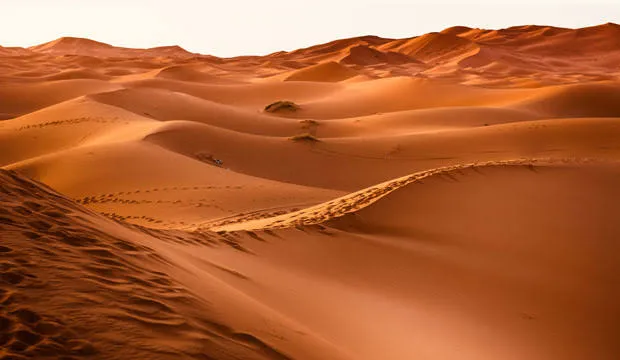
The Merzouga dunes are one of Morocco’s most recognizable landscapes. Rising beside the small desert settlement of Merzouga in southeastern Morocco, the vast ridges of Erg Chebbi form a sea of wind-shaped sand that changes color as the sun moves across the Sahara.
Some of the highest dunes rise to around 150 meters, creating a dramatic contrast with the flatter desert terrain surrounding the erg. At sunrise, the sand can appear pale gold; later in the day it becomes brighter and warmer; around sunset, deep shadows and orange tones emphasize every ridge and curve.
Visiting Erg Chebbi can be as simple as walking onto the dunes from the edge of Merzouga or as involved as taking a camel trek, joining a 4×4 excursion or spending a night at a desert camp. You do not need to choose every activity to appreciate the landscape. For many travelers, the most memorable part is simply having enough time to experience the dunes at different times of day.
What Are the Merzouga Dunes?
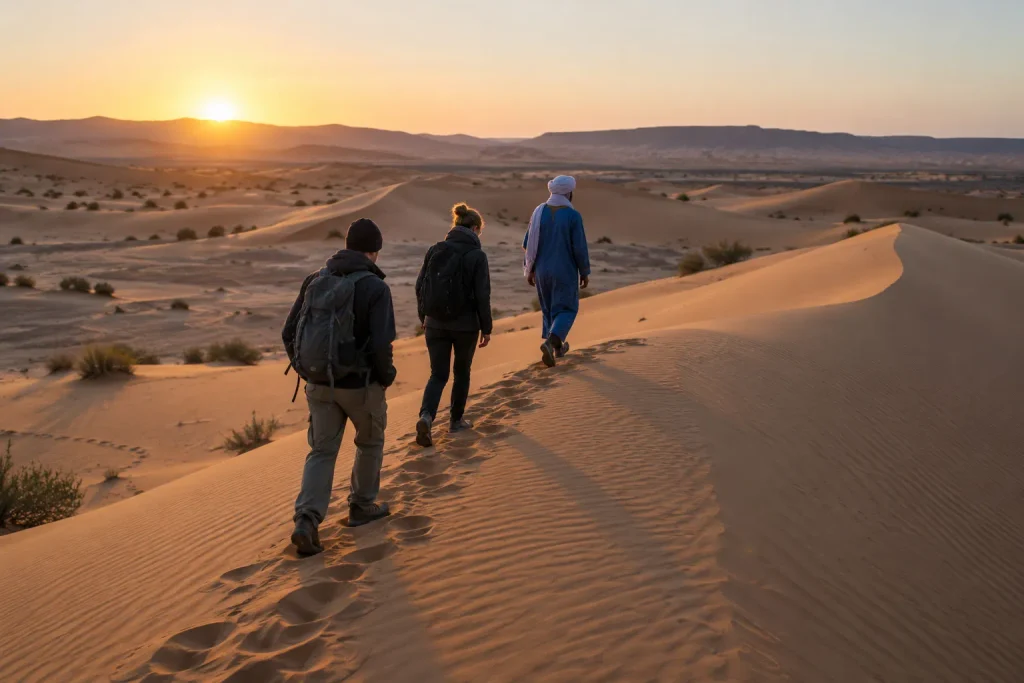
The famous dunes beside Merzouga are known as Erg Chebbi.
In desert geography, an erg is a large area dominated by wind-shaped sand dunes. Although popular images often make the Sahara appear to be an endless ocean of sand, much of the wider desert contains rocky plains, gravel and other terrain. Erg Chebbi therefore stands out as a particularly dramatic concentration of high dunes.
The dunes rise directly beside the Merzouga area, making them comparatively accessible. Travelers can stay close to the edge of the sand and then enter the dune field on foot, by camel or through an organized desert excursion.
This accessibility is one reason Merzouga has become one of Morocco’s best-known Sahara destinations.
Why Erg Chebbi Is Famous
The appeal of Erg Chebbi is not simply the height of individual dunes. It is the combination of scale, light, silence and constantly changing patterns.
Wind reshapes the surface of the sand, forming ripples, smooth slopes and sharp ridges. A location that was covered in footprints one afternoon may look noticeably different after stronger wind.
The low sun around dawn and dusk creates the most dramatic visual change. One side of a dune can glow in direct light while the opposite slope falls into deep shadow, making the terrain appear much more sculptural than it does around midday.
This is why sunrise, sunset and photography feature so prominently in Merzouga experiences.
Where Are the Merzouga Dunes?
Erg Chebbi lies beside Merzouga in southeastern Morocco.
The location means visiting the dunes requires a real road journey if you are coming from Marrakech, Fes or northern Morocco. Merzouga should not be treated as a quick excursion from Marrakech.
The journey is part of the experience because the landscape changes significantly before you ever reach the sand.
From Marrakech
The usual road journey from Marrakech crosses the High Atlas and southern Morocco.
A longer itinerary can combine:
- High Atlas scenery
- Ait Ben Haddou
- Ouarzazate
- Dades Valley
- Todra Gorge
- Merzouga and Erg Chebbi
Breaking the journey into several days makes far more sense than trying to race directly to the dunes and immediately return.
From Fes
Fes provides another logical starting point. The road toward Merzouga passes through changing Middle Atlas and southeastern landscapes before reaching the desert region.
A particularly efficient Morocco itinerary can continue:
Fes → Merzouga → Todra → Dades → Ait Ben Haddou → Marrakech.
This avoids unnecessary backtracking and makes the dunes part of a larger north-to-south journey.
When Is the Best Time to Visit Erg Chebbi?
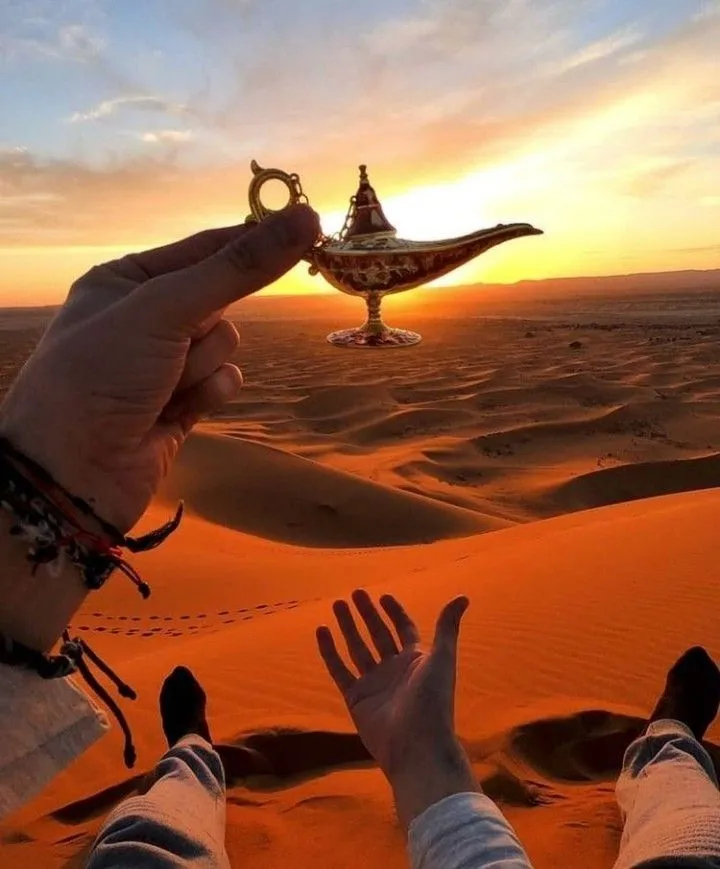
October through April is generally the most comfortable period for visiting the Merzouga dunes, particularly if you want to spend meaningful time outdoors.
The older golden-dunes article recommends September through April. September can work, but conditions may still be hotter than later in autumn.
Autumn
Autumn is one of the most useful periods for combining Merzouga with Marrakech, Fes, the Atlas Mountains and southern Morocco.
The strongest summer heat begins to ease, making dune walks and outdoor activities more comfortable.
Winter
Winter days can be pleasant, but evenings, nights and early mornings can become surprisingly cold.
If you plan to watch sunrise, carry a warm layer even if the afternoon felt comfortable.
Spring
Spring is another strong period for visiting Erg Chebbi and combining the Sahara with a wider Morocco itinerary.
Wind conditions can vary, so be prepared for blowing sand on exposed days.
Summer
Summer can bring intense heat to the Merzouga region.
If you visit during this period, schedule outdoor dune activities for early morning or late afternoon rather than building the day around long walks at midday.
Sunrise or Sunset at the Merzouga Dunes?
Both are worth seeing, but they create different experiences.
| Time | What to expect | Best for |
|---|---|---|
| Sunrise | Cooler air, quiet atmosphere and gradually increasing light | Early risers, photography and peaceful dune walks |
| Sunset | Warmer colors, long shadows and an easy transition into an evening camp stay | First-time visitors, camel rides and golden-hour photography |
If you stay overnight around Merzouga, there is little reason to choose only one. Plan to see sunset in the evening and wake early enough for sunrise the following morning.
Watching Sunrise at Erg Chebbi
Sunrise begins before the sun itself becomes visible.
Arrive at your chosen dune or viewpoint early enough to watch the color and shadow change rather than climbing in a hurry just as the sun appears.
The morning can be significantly cooler than the previous afternoon, particularly in winter.
You do not need to climb the highest dune to get a good view. A smaller ridge can provide excellent foreground shapes and may be much easier to reach before dawn.
Watching Sunset Over the Dunes
Sunset is one of the experiences specifically preserved from the original golden-dunes article.
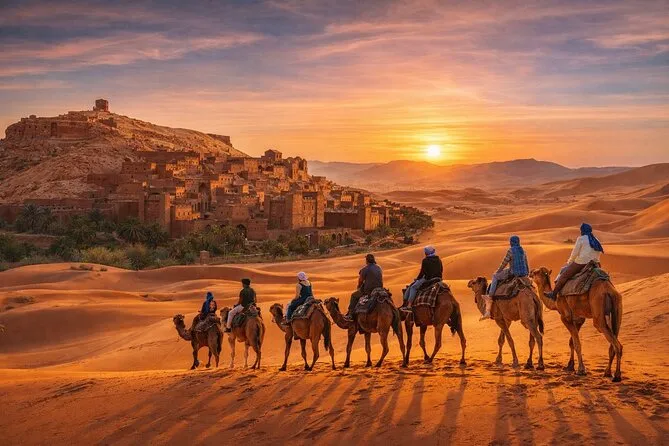
Late-afternoon light turns the ridges increasingly warm and creates deep shadow on the slopes facing away from the sun. This is also when camel groups commonly move through the dunes, adding another sense of scale to the landscape.
Do not arrive in Merzouga at the last possible moment. Allow time to check in, meet your guide if you have one and reach a suitable location before the best light begins.
Walking in the Erg Chebbi Dunes
You can appreciate Erg Chebbi without booking a major activity.
Walking onto the dunes gives you time to see sand patterns, tracks, vegetation and the way the landscape changes as nearby buildings disappear behind the ridges.
Walking on deep sand is much slower and more tiring than walking the same distance on a normal trail. Start with a modest route rather than deciding to climb the biggest visible dune simply because it looks close.
Best Time for a Dune Walk
Early morning and late afternoon generally provide more comfortable conditions and better light.
Midday can feel much hotter and offers fewer shadows, which also makes the terrain look flatter in photographs.
Finding Your Way Back
The dunes can hide familiar reference points quickly.
For a casual independent walk, stay within an area where you understand the route back to your accommodation. Use a local guide for longer explorations rather than relying only on distant dune shapes as landmarks.
Do You Need to Climb the Highest Dune?
No.
There is no single summit that every visitor needs to reach.
High dunes can provide panoramic views, but climbing loose sand requires considerably more effort than the apparent height suggests. Every step can slide backward, and heat makes the climb harder.
A smaller ridge with the right light can provide a better sunset or photograph than a physically demanding climb to a higher point.
Camel Trekking Across the Dunes
Camel trekking is one of the classic ways to experience the Merzouga dunes and was central to the original article.
The slow movement gives you time to watch the ridges change around you and can create a very different sense of scale from standing at the edge of the sand.
A sunset ride is particularly common because the light is attractive and the temperature is generally more comfortable than around midday.
Camel riding is not required to visit Erg Chebbi. Travelers who prefer not to ride can walk or arrange vehicle-based access depending on the experience.
For ride lengths, sunrise versus sunset, overnight treks and caravan-style options, use the Sahara Camel Trekking guide. Keeping those details there prevents this dune guide from duplicating the camel-specific article.
Exploring Erg Chebbi by 4×4
A 4×4 excursion allows you to explore a much wider area than a normal dune walk or camel ride.
Routes vary but may combine sandy or desert tracks with places around the wider Erg Chebbi region.
Current Merzouga activities can include Khamlia, oasis areas and wider desert viewpoints, depending on the specific tour.
Use an experienced local driver for off-road desert exploration rather than taking a normal rental car into terrain that may not be covered by the rental agreement.
Sandboarding at Merzouga
Sandboarding was another activity included in the original article.
The principle is simple: climb part of a dune and slide down on a board. No extensive previous experience is usually required for a casual session.
The climb back up is often harder than the descent because loose sand makes each step more demanding.
Choose a slope that matches your confidence and follow local guidance on where the activity is suitable.
Quad Bikes and Motorized Dune Activities
Quad bikes and buggies are available around Merzouga, but they offer a completely different experience from walking or camel trekking.
They suit travelers who want an active motorized excursion and the ability to cover more terrain quickly.
Use designated routes and local guides rather than treating every visible dune as open terrain. Responsible route choice reduces disturbance and helps keep quieter parts of the desert quieter.
Spending a Night Near the Dunes
You do not need an overnight camp to see Erg Chebbi, but sleeping near or within the desert gives you access to both sunset and sunrise without trying to fit everything into one afternoon.
Accommodation around Merzouga ranges from guesthouses close to the dune edge to traditional-style and higher-comfort desert camps.
The camp itself should not become the entire reason for visiting the landscape. Location, transfer method and access to the dunes matter just as much as decorative tents.
For tent standards, private bathrooms, meals, luggage, camp transfers and one-night versus two-night planning, use the Merzouga Desert Trip guide.
How Long Should You Spend at the Merzouga Dunes?
| Time available | What you can reasonably do |
|---|---|
| A few hours | Dune walk and sunset or sunrise |
| 1 night | Sunset, camp or Merzouga stay, night sky and sunrise |
| 2 nights | Sunrise and sunset plus a full day for walking, 4×4, sandboarding or nearby places |
For travelers arriving after a long road journey, two nights often feels much less rushed than reaching the dunes at sunset and leaving immediately after breakfast.
Stargazing Around Erg Chebbi
The original golden-dunes article emphasizes stargazing because the desert environment can provide dark skies away from major cities.
Visibility varies according to:
- Cloud cover
- Dust
- Moon phase
- Nearby camp lighting
- Your exact position
A bright moon may reduce the visibility of faint stars but can illuminate the dunes in an entirely different way.
Do not promise a perfect Milky Way or completely dark sky on every night. Stargazing is dependent on natural conditions.
Photography at the Merzouga Dunes
Photography is one of the strongest themes of the original article, and Erg Chebbi changes dramatically throughout the day.
Photograph Sunrise and Sunset
Low-angle light reveals the shape of the landscape much better than flat midday light.
Arrive early enough to photograph the transition rather than only the moment the sun crosses the horizon.
Use Dune Ridges as Leading Lines
The curved crests of the dunes naturally lead the viewer through a photograph.
Look for clean ridgelines, wind patterns and contrast between illuminated and shaded slopes.
Use People for Scale
A distant walker or camel caravan can show how large the dunes actually are.
If an identifiable person is the main subject, ask before photographing them.
Look Down as Well as Across
The small patterns in the sand can be just as interesting as the panoramic view.
Wind creates repeating ripples and textures that change constantly.
Protect Your Camera
Windblown sand can reach cameras and phones easily.
Avoid unnecessary lens changes during windy periods and keep equipment protected when you are not using it.
Culture Around Merzouga
The original article described engagement with local Berber culture through music, dance, cuisine and desert camps. Preserve that cultural interest, but describe it precisely.
Amazigh is also widely used for the Indigenous peoples of Morocco and North Africa, and communities around southeastern Morocco have varied histories and livelihoods rather than one single desert lifestyle.
Useful cultural experiences can include:
- Local food
- Hosted music
- Artisan visits
- Khamlia and Gnawa music experiences
- Rissani market when the timing fits
- Local guides explaining the desert environment
Do not assume that every camp evening represents one universal traditional way of life. Ask what an activity actually includes and who is providing it.
Khamlia, Hassi Labied and the Wider Merzouga Area
If you have more than one night, leave time for places outside the main dune ridges.
Khamlia is known for organized Gnawa music experiences. Hassi Labied provides palm-grove and oasis scenery near the dunes, while Rissani adds a market-town experience to a longer stay.
There is also a seasonal lake environment around the Merzouga region when water conditions allow.
These places complement Erg Chebbi rather than replacing time on the dunes.
Merzouga Dunes vs Erg Chigaga
Erg Chebbi is not Morocco’s only major dune experience.
Erg Chigaga lies farther southwest and is approached through the M’Hamid region. It generally requires different routing and more off-road access.
Erg Chebbi is the easier choice when your itinerary connects Fes, Merzouga, Dades and Marrakech.
Erg Chigaga may appeal more when your route already focuses on the Draa Valley and M’Hamid or when remoteness is one of the main priorities.
Do not try to include both simply because they are both Sahara destinations unless you have enough time for the extra road travel.
Erg Chebbi vs Agafay
Agafay near Marrakech is sometimes marketed through desert imagery, but the landscapes are completely different.
Erg Chebbi consists of large sand dunes beside Merzouga. Agafay is an arid, rocky landscape much closer to Marrakech.
Choose Agafay when time is limited and you want a sunset, camp meal or short desert-style escape from Marrakech.
Choose Erg Chebbi when visiting major Sahara dunes is actually one of the reasons for your Morocco trip.
What to Wear at the Merzouga Dunes
Conditions change significantly between afternoon, night and early morning.
Useful items include:
- Lightweight breathable clothing
- Long trousers
- Sun hat
- Sunglasses
- Sunscreen
- A warmer layer for evening and sunrise
- Comfortable footwear
- A scarf for sun, wind or blowing sand
- Reusable water bottle
Do not pack only for heat. Desert mornings and winter nights can feel much colder than the afternoon.
Do You Need Special Shoes?
No specialist footwear is necessary for a simple dune visit.
Comfortable shoes or sandals can work depending on the season and activity. Sand will often enter footwear regardless of the style.
If your itinerary also includes rocky terrain, camp areas or longer walking, supportive footwear becomes more useful.
Planning for Wind and Sand
Wind is part of a desert environment.
On stronger days, blowing sand can affect visibility, photography and comfort. A scarf, glasses and protection for electronics can make a significant difference.
Do not assume the dunes will look exactly like photographs taken on a completely calm evening. Changing conditions are part of the landscape.
Responsible Travel at Erg Chebbi
The dunes may look vast and empty, but visitor behavior still matters.
- Take litter back with you
- Avoid leaving plastic or food packaging in the sand
- Use established motorized routes where appropriate
- Do not drive a normal rental vehicle onto the dunes
- Respect private homes and community spaces
- Ask before photographing people
- Choose animal activities carefully
- Avoid disturbing wildlife
Small choices matter when many visitors are using the same landscape.
How the Dunes Fit Into a Wider Morocco Itinerary
Erg Chebbi works especially well as a connecting destination rather than an isolated round trip.
One efficient route is:
Fes → Merzouga → Todra Gorge → Dades Valley → Ait Ben Haddou → Marrakech.
Another approach starts in Marrakech, travels through southern Morocco to Merzouga and then continues north toward Fes.
Use the Morocco Itineraries guide if you are deciding how many days to dedicate to the wider route.
Common Mistakes When Visiting the Merzouga Dunes
Arriving Only for a Few Minutes at Sunset
The landscape changes throughout the day. Stay overnight when the itinerary allows.
Assuming You Need to Climb the Highest Dune
Smaller ridges can provide equally impressive views with less effort.
Trying to Walk Too Far at Midday
Deep sand, exposure and heat make distances feel much longer.
Thinking a Camel Ride Is Mandatory
Walking and vehicle-based alternatives are available.
Expecting Perfect Stargazing Every Night
Moonlight, cloud and dust affect the night sky.
Treating Merzouga as a Quick Marrakech Excursion
Erg Chebbi is part of a multi-day road journey from Marrakech.
Confusing Erg Chebbi With Agafay
They are entirely different landscapes and require very different travel times.
FAQ
Are the Merzouga dunes the same as Erg Chebbi?
Yes. When travelers refer to the famous Merzouga dunes, they are generally talking about Erg Chebbi, the large dune field beside Merzouga in southeastern Morocco.
How high are the Erg Chebbi dunes?
Some dunes rise to around 150 meters above the surrounding landscape. You do not need to climb the highest dunes to appreciate the scale or get excellent sunrise and sunset views.
What is the best time to visit the Merzouga dunes?
October through April generally provides the most comfortable conditions for outdoor desert activities. September and late spring can also work but may be hotter, while summer requires more careful timing around early morning and evening.
Can you walk into the Erg Chebbi dunes without riding a camel?
Yes. Walking is one of the simplest ways to experience the dunes, particularly close to Merzouga. Camel rides and 4×4 excursions are optional ways to experience a different part or scale of the landscape.
Is one night in Merzouga enough?
One night is enough to see sunset, spend the evening near the dunes and wake for sunrise. Two nights is better if you want a full day for walking, photography, 4×4 exploration, sandboarding or nearby cultural experiences.
Are the Merzouga dunes close to Marrakech?
No. Merzouga is a substantial road journey from Marrakech and should be included in a multi-day route through southern Morocco. Travelers coming from Fes can also reach Merzouga as part of a one-way itinerary toward Marrakech.
Visit Erg Chebbi for the Landscape, Not Just the Checklist
The Merzouga dunes are most memorable when you give the landscape time to change around you.
Erg Chebbi does not look the same at sunrise, midday and sunset. Wind reshapes the surface, shadows move across the ridges and the color of the sand changes with the light. Walking onto a quiet ridge can be as meaningful as joining a major activity.
The original golden-dunes article correctly emphasized adventure, nature, local culture and photography. Those remain the best reasons to visit. Camel trekking, sandboarding and 4×4 exploration can add different perspectives, while local music and food can connect the dune visit with the wider Merzouga region.
But you do not need to do everything. Choose the experiences that actually interest you, protect time for sunrise or sunset and avoid reducing Erg Chebbi to one hurried photograph before the next road transfer.
Explore the broader Merzouga destination guide for the surrounding area. For an overnight camp itinerary, use the Merzouga Desert Trip guide, and for detailed ride choices use the Sahara Camel Trekking guide.
If you want to include Erg Chebbi within a longer trip through Fes, southern Morocco or Marrakech, use the custom Morocco trip planner.
Explore destinations, tours and locally organized Morocco experiences with Visit Morocco Together.
Ready to Experience Morocco?
Turn this inspiration into your next adventure. Our travel experts are ready to help.