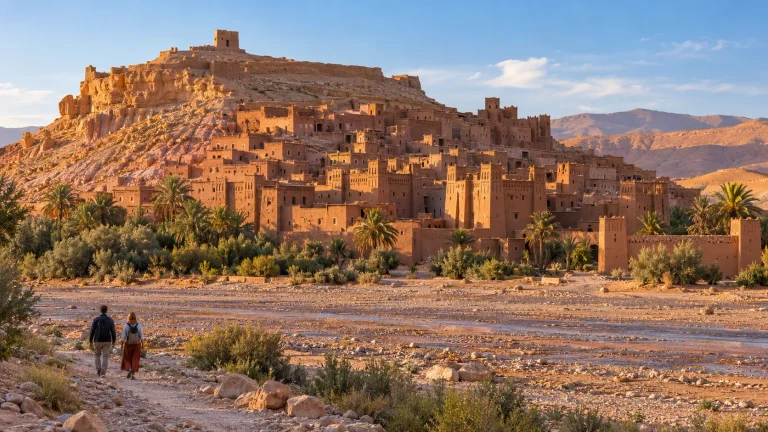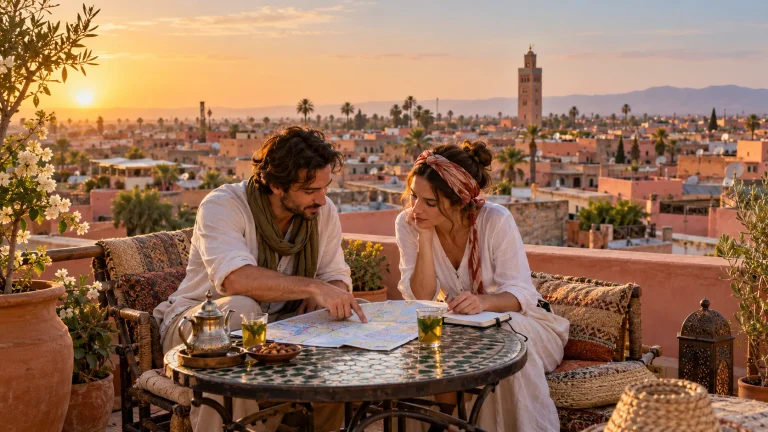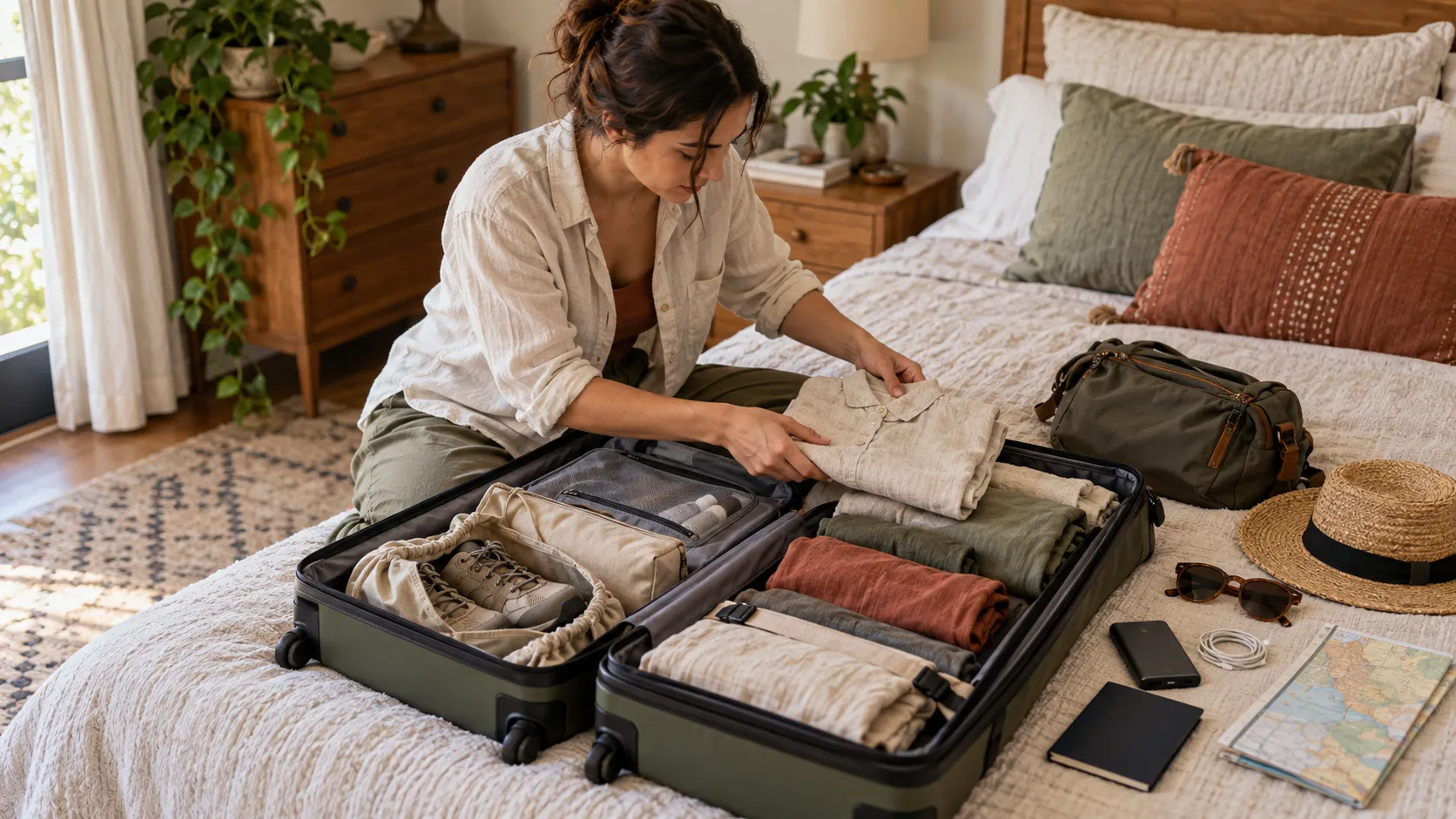
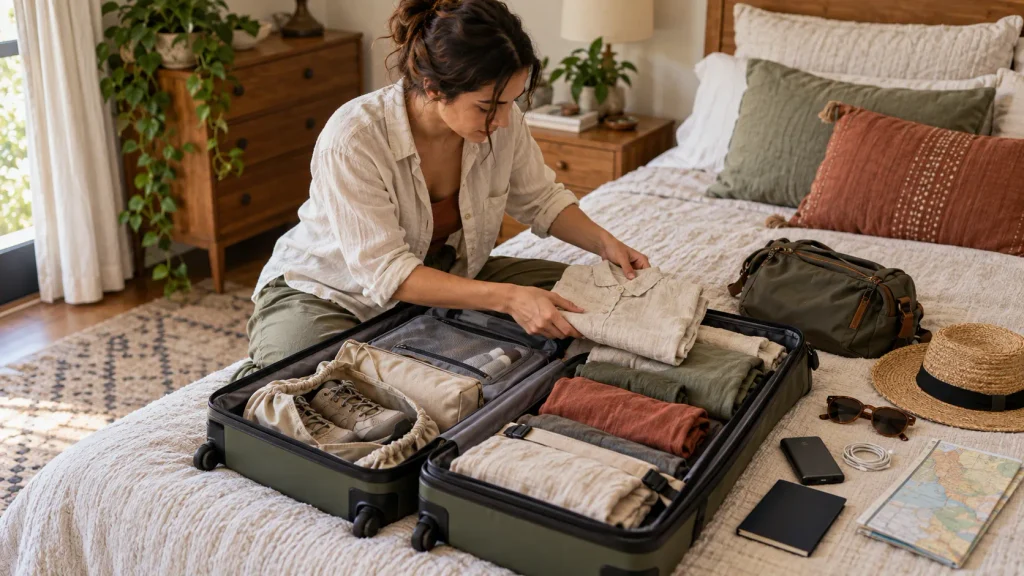
Preparing for a trip to Morocco involves more than booking a flight and choosing a hotel. Morocco combines historic medinas, Atlantic beaches, mountain villages, desert landscapes and long intercity journeys. A comfortable trip depends on matching your route, travel dates, luggage, accommodation and transport to the places you plan to visit.
This Morocco travel checklist explains what to arrange before departure, what to pack, how to prepare for different regions and when to organize private transport or a customized itinerary.
Quick checklist before travelling to Morocco
Before your departure, make sure you have:
- Checked entry and visa requirements for your nationality
- Confirmed that your passport is valid for the entire trip
- Saved digital and offline copies of important documents
- Chosen a realistic route based on travel time between destinations
- Reserved accommodation for your arrival night
- Arranged airport or intercity transport if arriving late or travelling with luggage
- Purchased travel insurance suitable for your activities
- Prepared a payment plan using cards and Moroccan dirhams
- Checked mobile data, SIM and eSIM options
- Downloaded offline maps and saved important addresses
- Packed clothing suitable for cities, mountains, desert or the coast
- Learned basic cultural etiquette and useful phrases
1. Check Morocco entry requirements before booking
The first step when you prepare for a trip to Morocco is checking the entry rules that apply to your passport and country of residence.
Visa requirements are not identical for every traveller. They can depend on nationality, residence status, passport type and the purpose of the visit. Use the official Accès Maroc entry portal to check the current requirements before booking non-refundable flights or tours.
Prepare the following documents:
- Passport
- Visa or travel authorization, if required
- Flight confirmation
- Accommodation confirmation
- Travel insurance details
- Return or onward travel information, if required by your airline or entry conditions
- Emergency contact details
- Copies of prescriptions, if you regularly take medication
Keep a digital copy in secure cloud storage and an offline copy on your phone. It is also useful to carry a paper copy of your passport identification page and insurance policy.
Do not rely only on screenshots stored on one phone. If your phone is lost, damaged or out of battery, access to a second copy can make practical problems much easier to solve.
2. Choose the right season for your route
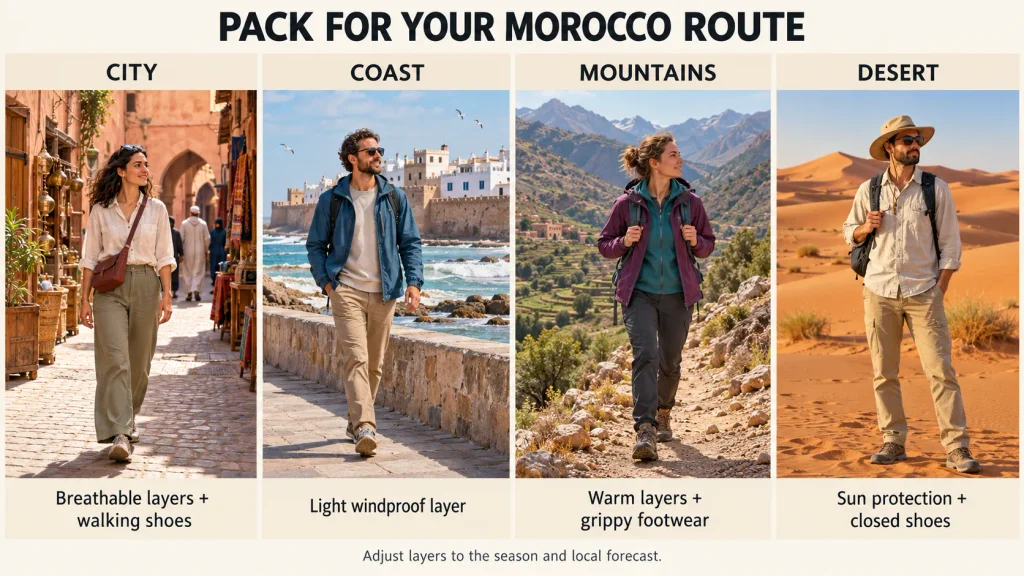
Morocco does not have one single travel climate. Conditions can vary considerably between the Atlantic coast, inland cities, the Atlas Mountains and the Sahara.
The Moroccan National Tourist Office climate guide is useful for checking the broad seasonal differences before you choose your itinerary.
Your packing and route should reflect the regions you are visiting.
Cities and medinas
Cities such as Marrakech, Fes and Meknes are generally easier to visit when you are prepared for walking, uneven streets and changing temperatures between sunny open areas and shaded medina lanes.
Spring and autumn are often comfortable for city sightseeing, but conditions can still change during the day. In summer, plan demanding walks for the morning or late afternoon and keep water with you.
Atlantic coast
Coastal destinations such as Essaouira, Agadir and Taghazout can feel cooler and windier than inland cities, even when the sun is strong.
Pack a light windproof layer, sunscreen and comfortable clothing for walking along the seafront. If you plan to surf or spend time on the beach, check the local conditions and your accommodation’s distance from the water.
Atlas Mountains
Mountain destinations such as Imlil and the Ourika Valley require more practical clothing than a standard city break.
Temperatures can change quickly with altitude. Pack layers, supportive footwear and protection from sun, wind and rain. A city itinerary and a mountain itinerary should not use exactly the same packing list.
Sahara and southern Morocco
A desert visit to Merzouga and the Sahara usually means strong sun during the day and much cooler conditions after sunset, particularly outside the warmest months.
Bring breathable layers, a hat, sunglasses, lip balm, sunscreen and comfortable closed shoes. A small backpack is more practical than taking all of your luggage into a desert camp.
3. Build a realistic route
A common planning mistake is trying to visit every major Moroccan destination in one short trip. Morocco is geographically diverse, and road journeys can take longer than expected because of mountain roads, stops, traffic and the layout of historic medinas.
Plan around one or two geographic zones rather than collecting cities.
A northern Morocco route
A northern route could combine Tangier, Chefchaouen and Fes. This works well for travellers interested in northern landscapes, blue-painted streets, historic medinas and Moroccan cultural heritage.
An imperial cities route
A route involving Marrakech, Fes, Meknes and Rabat needs careful planning because the cities are not all close to each other. Allow enough time for intercity transport and avoid changing hotels every night.
A southern Morocco route
A southern route can connect Marrakech with Ouarzazate, Ait Ben Haddou, the Dades Valley, Todra Gorge and the Sahara.
This route offers a mix of kasbahs, mountain scenery, valleys and desert landscapes, but it includes long journeys. It is more comfortable when you plan overnight stops instead of treating the entire route as a single transfer.
A coast-focused route
Travellers who prefer beaches, seafood, surfing and relaxed evenings may prefer a route around Essaouira, Agadir and Taghazout. The Coastal Escapes service can help travellers compare a coast-oriented travel style with a city or desert itinerary.
4. Prepare a timeline before departure
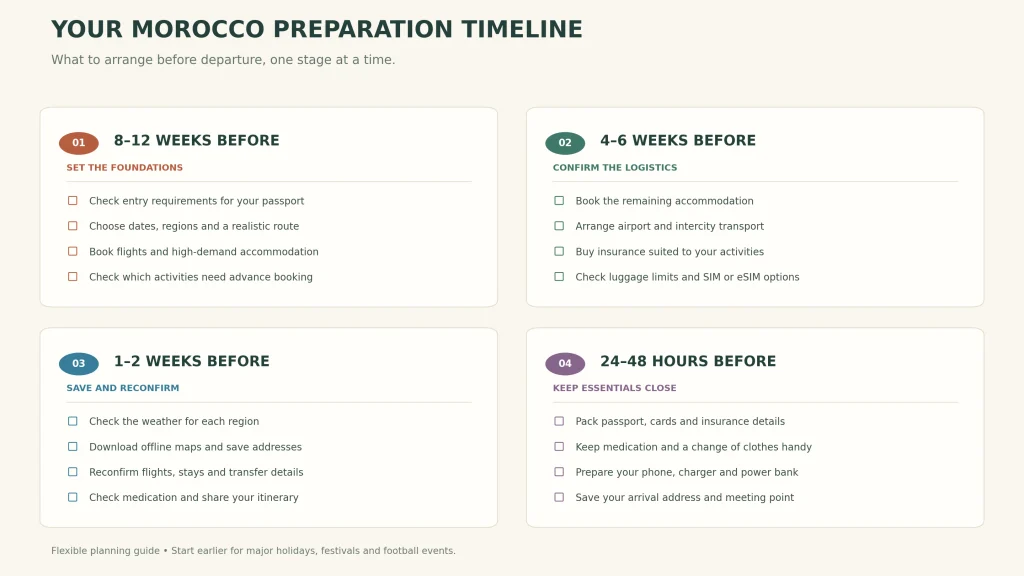
Eight to twelve weeks before departure
At this stage, focus on the decisions that affect the entire trip:
- Check entry requirements
- Confirm your travel dates
- Choose your main regions
- Book international flights
- Decide whether you want a city, desert, mountain or coast-focused trip
- Reserve high-demand accommodation
- Check whether your planned activities require advance booking
If you are travelling during a major holiday, festival or football event, plan earlier than usual. Accommodation and transport capacity may become limited in popular cities.
Four to six weeks before departure
Now arrange the practical details:
- Book accommodation in each location
- Confirm airport arrival and departure logistics
- Reserve long intercity journeys
- Purchase travel insurance
- Organize desert camps, mountain activities or surf sessions
- Check luggage limits for your airline
- Research local SIM and eSIM options
For travellers with children, mobility needs, large luggage or a complicated arrival and departure route, a custom Morocco trip plan can be useful because the itinerary can be built around your actual dates, accommodation style and travel requirements.
One to two weeks before departure
Use this period to reduce avoidable stress:
- Check the weather for each region
- Download offline maps
- Save accommodation addresses in Arabic, French or English where possible
- Notify your bank if necessary
- Prepare a small amount of emergency cash
- Reconfirm flights and accommodation
- Review airport transfer instructions
- Check medication and personal-care supplies
- Share your itinerary with someone at home
Twenty-four to forty-eight hours before departure
Keep your essential items in your hand luggage:
- Passport
- Phone and charger
- Power bank
- Insurance information
- Accommodation address
- Payment cards
- Medication
- One change of clothes
- Basic toiletries
- A light layer
If you arrive late at night, do not assume that finding transport or locating a riad inside a medina will be simple. Save the exact meeting point and arrange your arrival logistics in advance.
5. What to pack for Morocco
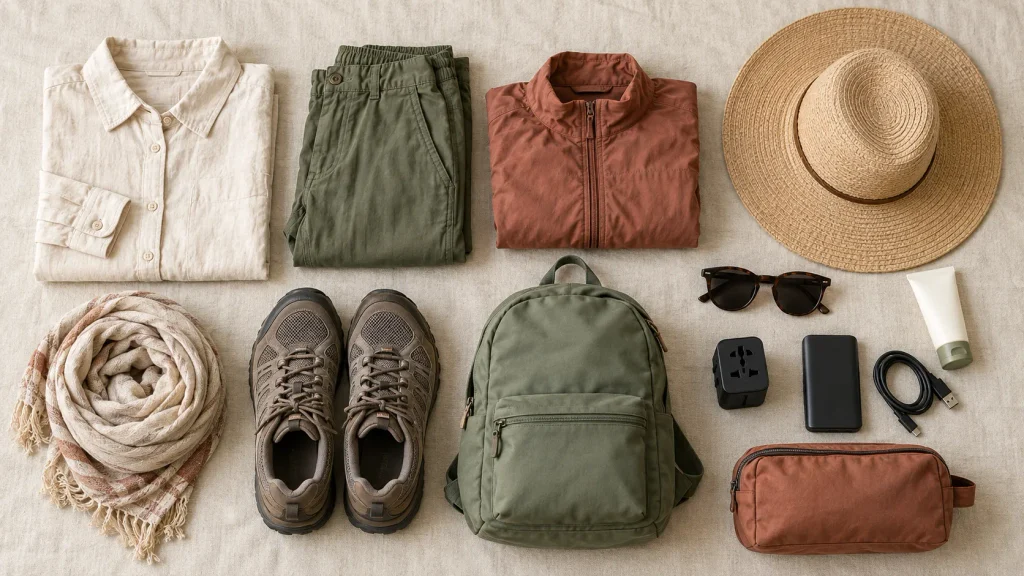
The best Morocco packing list depends on your route, but some items are useful almost everywhere.
Clothing
Pack lightweight, breathable layers that can be combined during cooler mornings and evenings. In cities and rural areas, modest clothing is generally more comfortable and culturally appropriate.
Useful items include:
- Loose trousers or long skirts
- Breathable shirts
- A light sweater or jacket
- Comfortable walking shoes
- Sandals for accommodation or warm weather
- A scarf or shawl
- Sun protection
- Swimwear and a cover-up for coastal accommodation
A scarf is practical for sun, wind, dust and cooler evenings. It is not necessary to treat it as a universal religious requirement, but it can make travel more comfortable.
Shoes
Medinas often have uneven paving, steps and narrow lanes. Choose shoes that are comfortable for several hours of walking and easy to remove when entering certain homes or religious spaces.
For mountains or desert areas, use shoes with better grip than ordinary city sneakers.
Technology
Bring:
- Phone charger
- Power bank
- Universal adapter if needed
- Offline maps
- Waterproof phone pouch for beach or boat activities
- Copies of important documents
A camera is useful, but always ask before photographing people, artisans or private spaces.
Personal items
Pack any regular medication in its original packaging. Include basic personal-care products if you rely on a particular brand, especially when travelling outside large cities.
A small day bag is more practical than a large backpack when walking through crowded medinas.
6. Organize airport and intercity transport
Transport should be part of your itinerary, not an afterthought.
Public transport can be useful between major cities, while private transfers are especially practical when:
- You arrive late
- You have large or heavy luggage
- You are travelling with children
- Your accommodation is difficult to locate
- You are connecting two destinations in one day
- You are travelling to a rural, mountain or desert area
- You need a direct route without multiple changes
For these situations, review the exact Morocco private transfers service rather than relying on a generic transport page. Check the pickup location, drop-off point, passenger count, luggage requirements and cancellation conditions before confirming.
When staying in a medina, confirm whether the vehicle can reach the accommodation directly. In many historic areas, the final section may require walking from a meeting point.
For travellers starting in Marrakech and continuing towards southern Morocco, review the specific tours from Marrakech page and compare the itinerary with your available time. Do not choose a route only because it appears short on a map.
7. Choose accommodation for the route, not only the room
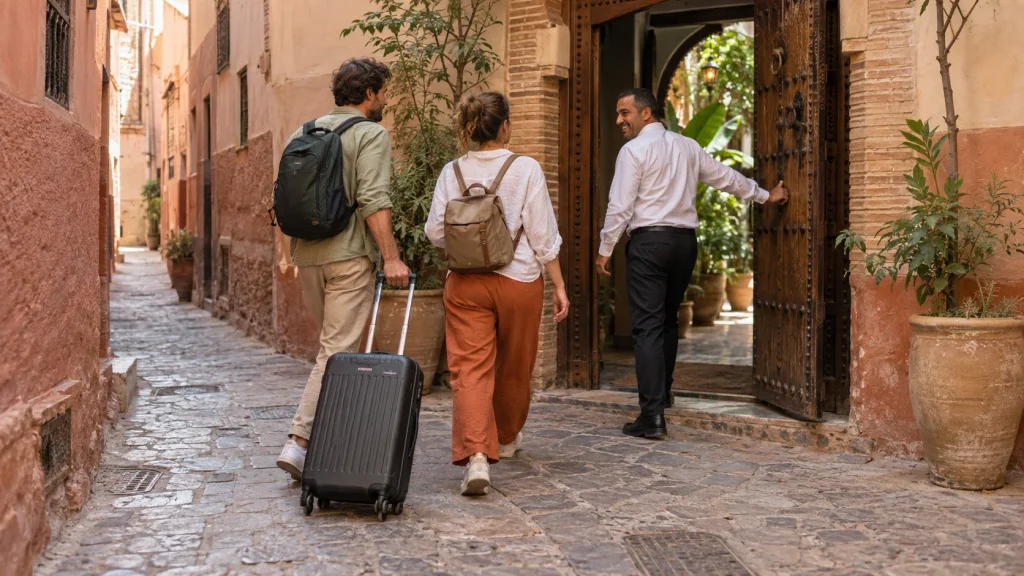
Accommodation can change the practical experience of a Moroccan trip.
Riads in medinas
Riads can offer a memorable architectural and cultural experience, but they may be located inside pedestrian areas. Before booking, check:
- Distance from the nearest vehicle access
- Whether staff can help with arrival
- Number of stairs
- Luggage assistance
- Reception hours
- Air conditioning or heating
- Bathroom layout
This is particularly important for first-time visitors arriving after dark.
Hotels in modern districts
Hotels outside the historic medina may offer easier vehicle access, larger rooms and more predictable facilities. They can be practical for families, travellers with mobility limitations or visitors who plan several day trips.
Desert camps
For a desert stay, check the type of camp, bathroom arrangements, electricity, meal schedule, transfer point and luggage instructions. Keep essential medication and valuables with you rather than placing everything in a large suitcase.
Coastal accommodation
In Essaouira or Agadir, decide whether you prefer to stay near the beach, the old town, restaurants or transport connections. The best location depends on whether your priority is swimming, surfing, sightseeing or evening dining.
8. Prepare your money and payment strategy
Morocco uses the Moroccan dirham. Carrying some local cash is practical for small purchases, taxis, markets, cafés and places outside major tourist areas.
At the same time, do not carry all of your travel money in one place. A sensible approach is to use:
- One main payment card
- One backup card stored separately
- A small amount of local cash
- A secure way to access banking apps
- Offline copies of emergency banking contacts
Before departure, check whether your bank applies international transaction or cash withdrawal fees. When using an ATM, inspect the machine and avoid accepting help from unsolicited strangers.
Do not build your entire trip around card payments. Smaller businesses and remote areas may have different payment facilities from international hotels and larger restaurants.
9. Arrange internet and communication
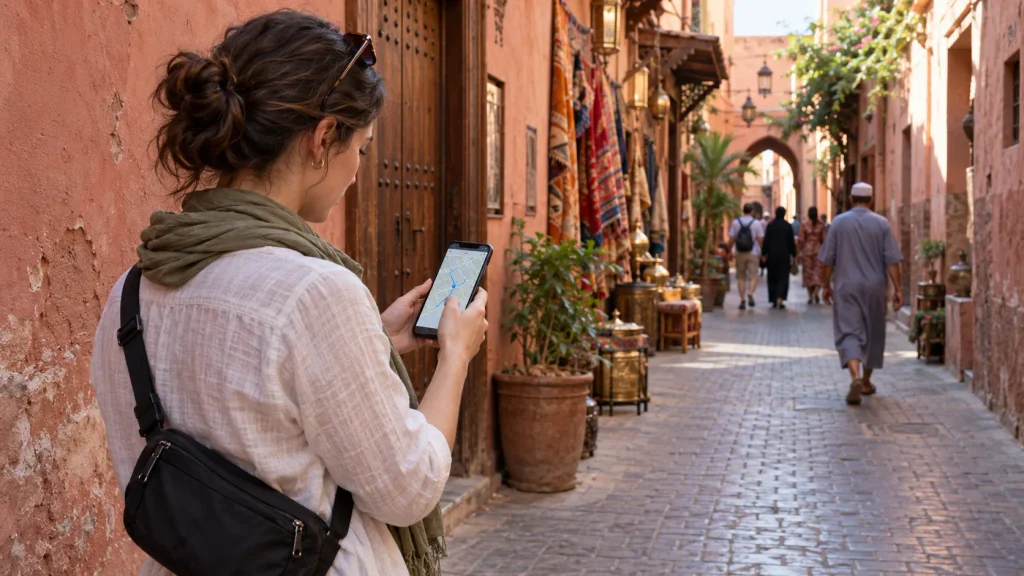
Reliable mobile data makes navigation, translation and communication easier.
Before departure, compare:
- International roaming
- eSIM availability
- Local SIM cards
- Data limits
- Coverage in mountain and desert areas
- Whether your phone is unlocked
Download offline maps because mobile coverage can be inconsistent outside cities. Save accommodation addresses, transfer meeting points and important phone numbers before leaving Wi-Fi.
WhatsApp is widely used for travel communication, but do not rely on one messaging application for every emergency. Keep your accommodation details and booking confirmations available offline.
10. Buy travel insurance for your actual activities
Travel insurance should match the trip you are really taking.
A basic policy may not cover every activity. If your itinerary includes hiking, surfing, camel excursions, mountain routes or other active experiences, check the policy wording carefully.
Consider coverage for:
- Medical treatment
- Emergency transport
- Trip cancellation
- Delayed or missed connections
- Lost or delayed baggage
- Passport replacement
- Activities included in your itinerary
Travel insurance is especially important for multi-city routes because one delay can affect accommodation, transfers and activities in several locations.
11. Learn practical cultural etiquette
Morocco is welcoming to visitors, but preparation helps you travel more respectfully.
Useful habits include:
- Dress in a way that fits the setting
- Ask permission before photographing people
- Use your right hand when offering or receiving food where appropriate
- Remove shoes when asked
- Avoid entering restricted religious areas
- Confirm prices before accepting optional services
- Keep your voice low in residential areas
- Learn simple greetings such as “salam alaykum” and “shukran”
In markets and medinas, bargaining may be part of the shopping culture, but it should remain polite. If you do not want to buy something, a clear and respectful refusal is usually better than prolonged negotiation.
During Ramadan or national holidays, opening hours and meal schedules may change. Check local arrangements close to your travel dates.
12. Prepare for the activity you are actually booking
Different activities require different preparation.
Medina and heritage walks
Wear comfortable shoes, carry water and keep your day bag secure. Start earlier if you want to explore busy markets more comfortably.
Marrakech and Fes are both rich in heritage, but their medinas are different experiences. Plan enough time to explore without turning every day into a rushed checklist.
Desert excursions
Pack light, protect yourself from the sun and keep essential medication with you. Confirm the transfer point, luggage arrangements and accommodation facilities before departure.
Mountain activities
Check the walking distance, elevation, weather forecast and footwear requirements. Do not assume that a short distance on a map means an easy route.
Surf and beach trips
For Taghazout or Agadir, check whether equipment, instruction and transport are included in your booking. Bring sun protection and a light layer for windy evenings.
Food and hammam experiences
Tell the provider about allergies, dietary restrictions or accessibility needs before the activity begins. A special request is easier to manage when communicated during the booking stage rather than at the last minute.
13. Prepare differently for each type of traveller
First-time visitors
Keep the first two days simple. Avoid planning a long road journey immediately after an international flight. Staying in one city before moving on gives you time to adjust to the climate, language and rhythm of travel.
Families
Prioritize shorter transfers, accommodation with easy access and flexible meal options. Keep snacks, water, medication and a change of clothes in your day bag.
Solo travellers
Share your route and accommodation details with someone you trust. Use official booking confirmations and agree on prices before optional services.
Older travellers
Check stairs, walking distances, bathroom access and vehicle entry points. A private transfer or customized itinerary may be more comfortable than changing transport several times.
Travellers attending football matches or events
If football is part of your trip, plan the match location separately from your sightseeing route. Confirm the venue, ticket conditions, transport after the match and accommodation distance. A city may have several districts with very different evening transport options.
14. How to prepare for a one-week Morocco trip
A week is enough for a focused itinerary, but not for every major region.
Good options include:
- Marrakech with one or two nearby day trips
- Marrakech and the Atlas Mountains
- Fes, Chefchaouen and Tangier
- Essaouira and Marrakech
- Marrakech, Ait Ben Haddou and a short southern route
A one-week itinerary combining Marrakech, Fes, Chefchaouen, the coast and the Sahara will usually involve too many long transfers.
Choose the experience that matters most and build the route around it. A shorter itinerary with fewer hotel changes often feels richer than a rushed tour of the entire country.
Frequently asked questions
Do I need a visa to visit Morocco?
It depends on your nationality, residence and passport type. Check the official Accès Maroc portal before booking.
What should I wear in Morocco?
Choose breathable layers and clothing that is comfortable and respectful in the places you visit. Coastal, desert, mountain and city routes may require different clothing.
Should I book airport transport in advance?
Advance planning is useful if you arrive late, travel with luggage, stay inside a medina or need to continue directly to another city. Review the exact Morocco transfer service and confirm the pickup details.
Is travel insurance necessary?
It is strongly recommended, especially when your itinerary includes several destinations or activities such as hiking, surfing or desert excursions. Check that the policy covers the activities you plan to do.
How much cash should I carry?
Carry enough local cash for small purchases and transport, but avoid keeping all your money in one place. The amount depends on your travel style, accommodation and card access.
Do I need a SIM card or eSIM?
Mobile data is useful for maps, translation and communication. Compare roaming, eSIM and local SIM options, and download offline maps in case coverage is limited.
Can I visit the desert on a short trip?
Yes, but a desert visit usually requires substantial travel time. Avoid adding the Sahara to an already crowded one-week itinerary unless you are comfortable with long journeys.
Should I create a custom itinerary?
A custom itinerary is useful when you have specific dates, special dietary or accessibility needs, a large group, children, multiple arrival points or a combination of cities, mountains, coast and desert. In that case, review the custom Morocco trip service.
Conclusion
The best way to prepare for a trip to Morocco is to plan around geography, season and travel pace. Check entry requirements first, choose a realistic region-based route, reserve suitable accommodation and prepare transport before arrival. Your packing list should reflect whether you are visiting medinas, the coast, the Atlas Mountains or the Sahara.
A well-prepared Morocco trip does not need to be rigid. Leave room for local food, unexpected viewpoints, slower mornings and conversations along the way. Start with the places and experiences that matter most, then organize the practical details around them.
Ready to Experience Morocco?
Turn this inspiration into your next adventure. Our travel experts are ready to help.