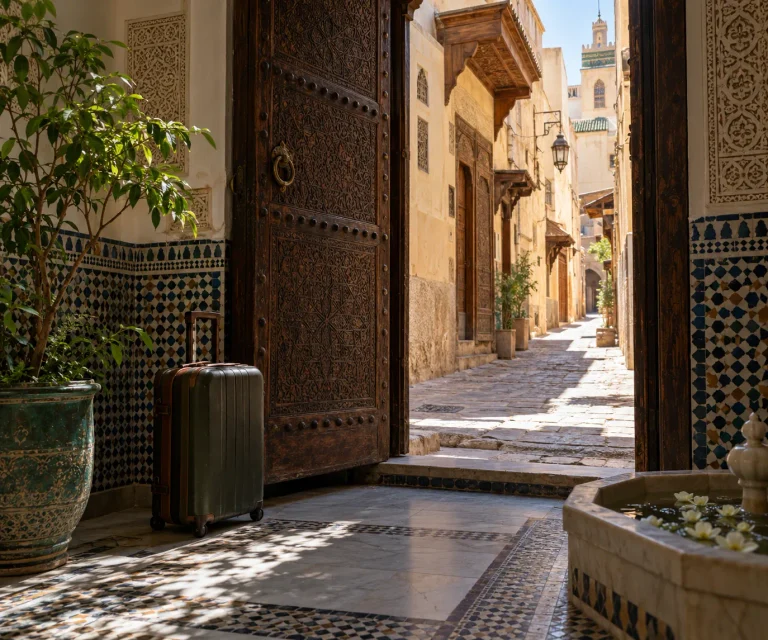
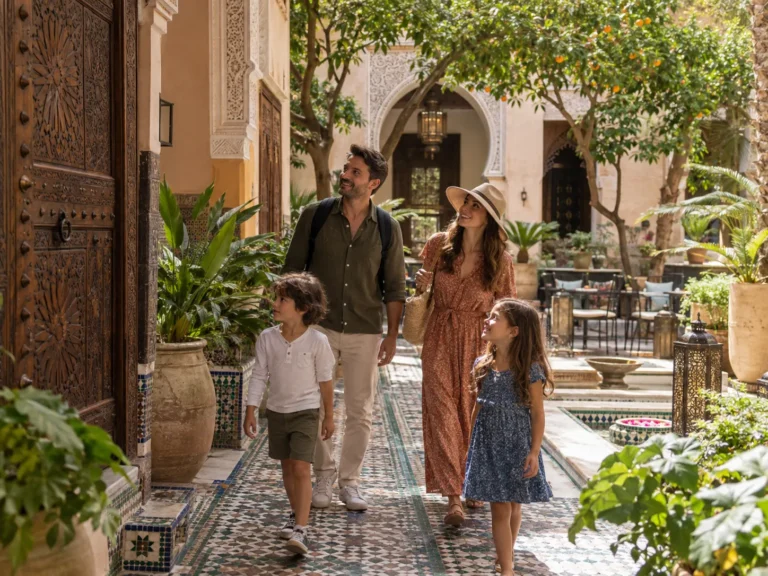
Luxury accommodation and private travel in Morocco work best when comfort, privacy and good logistics support the route rather than dominate it. A high-end trip might combine a small medina riad, a mountain retreat, a private villa or resort and a well-equipped Sahara camp, with private transport used where it genuinely makes the journey easier.
The most expensive hotel in each destination is not automatically the right choice. Location, room privacy, access, service style and the amount of time you expect to spend at the property matter just as much. Private travel is similar: having a dedicated vehicle can be valuable for mountain and desert routes, while trains, walking and local transport may still be practical for other parts of the trip.
This guide explains how to choose luxury stays, where private transport adds value and how to build an upscale Morocco journey without creating an unnecessarily rushed itinerary.
What Luxury Accommodation and Private Travel in Morocco Should Actually Provide
Luxury travel is most useful when it removes friction. That might mean arriving at a hotel without worrying about the next transfer, choosing a room where you can genuinely rest, having enough time between destinations or arranging a guide around your interests rather than joining a fixed programme.
It does not need to mean choosing the most elaborate option every day. A smaller riad in the right medina location can serve you better than a remote resort when sightseeing is the priority. A private driver can make a complicated road journey easier, while a comfortable train may be the more sensible choice between cities connected by rail.
Start with four questions: where do you want to spend your time, how much privacy do you want, which journeys are difficult independently and which accommodation features will you actually use?
Luxury Riads and Dars: For Historic City Stays
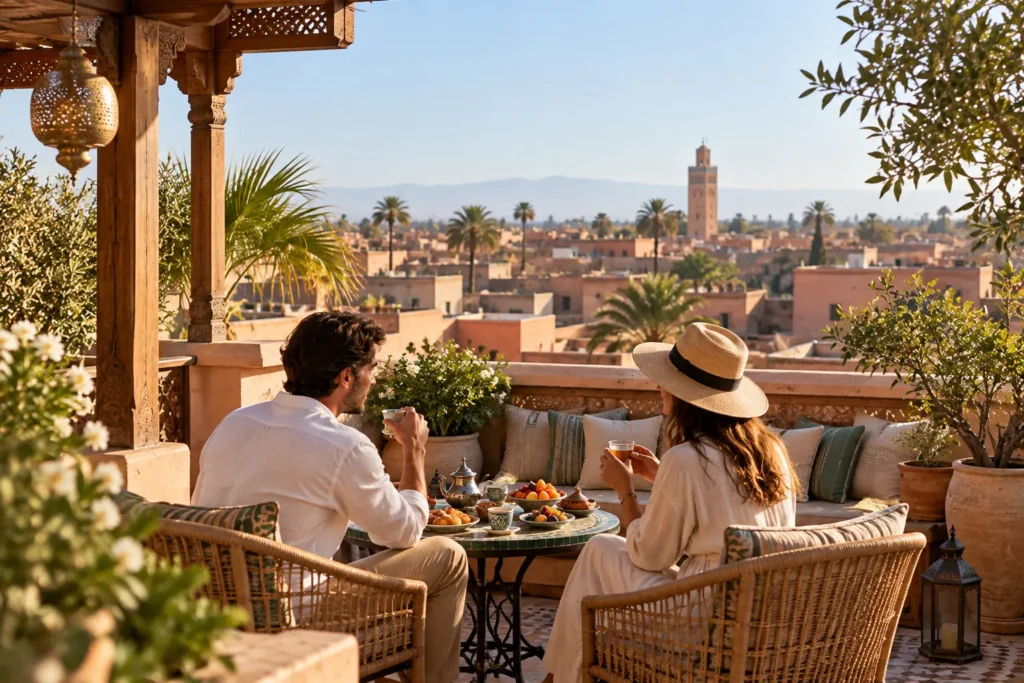
Riads and dars are among the most distinctive high-end accommodation options in Morocco’s historic cities. Both are traditional house forms arranged around an interior courtyard, although the terminology used by modern accommodation businesses is not always consistent.
In Marrakech or Fes, an upscale riad can place you within the medina while providing a quieter interior space between outings. Some properties focus on architecture and atmosphere, while others operate more like small luxury hotels with restaurants, hammams, pools and extensive service.
Location should come before decorative detail. A riad deep inside a medina may provide greater separation from traffic, but vehicles may not reach the entrance. Ask for the nearest drop-off point, the final walking route and luggage arrangements before booking.
Privacy also varies. A rooftop terrace shown in photographs may be shared, and a plunge pool may sit in a communal courtyard rather than belong to the room. If exclusive use matters, confirm exactly which spaces are private.
Palace Hotels and Resorts: For Facilities and Downtime
Large luxury hotels and resorts suit travelers who want the accommodation itself to form an important part of the trip. They can be useful when you value extensive gardens, several dining choices, larger pools, spa facilities or a room that feels removed from city activity.
Marrakech has particularly broad choices, from medina properties to hotels in Hivernage and resort-style accommodation outside the historic centre. The trade-off is often between immediate sightseeing access and the amount of space available at the hotel.
If you expect to leave after breakfast and return late every day, many resort facilities may go unused. If the intention is to combine sightseeing with quiet afternoons, the larger property can make more sense.
Confirm the specific facilities that influence your decision. Pools may operate differently by season, restaurants can change opening arrangements, and spa access or particular services may require reservations.
Private Villas: Best When Privacy Is the Priority
A villa can suit couples, families or groups who want more living space and less interaction with other hotel guests. It can also provide flexibility around meals, swimming and evenings at the property.
However, “private villa” should be checked carefully. Confirm whether the pool, garden and staff are exclusive to your booking, and establish which services are included rather than assuming the property functions like a full-service hotel.
Location is especially important. Villas outside Marrakech or other cities can provide greater privacy, but restaurants, sightseeing and evening activities may require repeated transport. If you plan to spend much of the day outside the property, a central hotel may be easier.
A villa works best when staying in is part of the itinerary rather than simply a different place to sleep.
Kasbahs and Mountain Retreats: Luxury Beyond the Cities
Luxury accommodation in Morocco is not limited to urban hotels. In the Atlas Mountains and southern valleys, converted kasbahs, lodges and guesthouses can provide a quieter stay with more emphasis on landscape and outdoor activities.
These properties can be particularly useful for breaking up a route between Marrakech and southern Morocco. Instead of treating every mountain or valley stop as a quick sightseeing visit, an overnight stay gives you time to walk, rest and experience the location at a slower pace.
Historic buildings can involve steps, uneven floors or layouts that differ from modern hotels. Ask about room access and mobility requirements in advance.
In mountain regions, also check seasonal conditions and room heating or cooling. Elevation can create a very different experience from Marrakech on the same travel dates.
Luxury Desert Camps: Check the Camp, Not Just the Label
A high-end desert camp can be an important part of luxury accommodation and private travel in Morocco, but the phrase “luxury camp” does not describe one standard level of comfort.
For a Sahara stay around Merzouga and Erg Chebbi, confirm the tent category, bed, bathroom arrangement, electricity, charging facilities, meals and temperature-control arrangements where relevant.
Ask where the camp is located and how you reach it. The map pin for a booking office or meeting point may not be the actual sleeping location. Larger luggage may also be handled separately, so establish the procedure in advance.
Privacy deserves particular attention. A private tent does not necessarily mean a private camp, and dining or evening activities may be shared with other guests. Travelers wanting exclusive use should request explicit confirmation of what is reserved solely for their party.
A Sahara stay also needs realistic routing. Merzouga is not a sensible Marrakech day trip. Allow enough time for the road journey and consider breaking the route with overnight stops in places such as the Dades Valley, Skoura or Ouarzazate.
Agafay and the Sahara Offer Different Experiences
Luxury tented accommodation near Marrakech is sometimes marketed alongside Sahara experiences, but the landscapes and logistics are different.
Agafay is a rocky, dry landscape outside Marrakech and can suit travelers who want a tented or resort-style stay without building a multi-day Sahara route. Erg Chebbi and other Saharan dune areas require a much larger journey and should be chosen because the desert itself is part of the itinerary.
Neither is automatically better. Agafay works well for convenience and a shorter Marrakech-based trip, while the Sahara makes more sense when you have enough time to travel through southern Morocco without rushing.
Private Drivers: Useful, but Not Necessary Everywhere
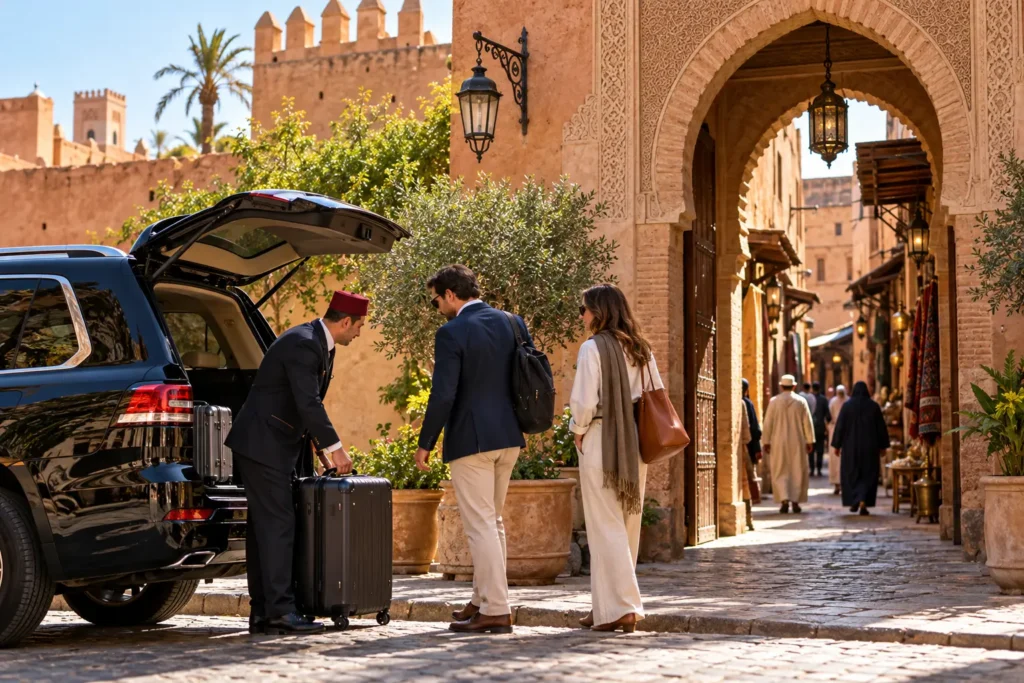
Private transport can make a luxury itinerary easier, especially when the route includes mountain roads, rural accommodation, southern valleys or the Sahara. A dedicated vehicle also allows more control over departure times and stops.
That does not mean every traveler needs a driver from arrival to departure. Rail can be practical between several major Moroccan cities, and walking remains the main way to explore historic medinas.
For example, a private vehicle may be more valuable when travelling from Marrakech across the Atlas Mountains than when moving between cities well served by trains. The best luxury trip uses the transport option that makes sense for each section rather than automatically choosing the most private one.
When booking a driver, clarify whether the person is providing transport only or also working as a licensed guide. Those are different roles, particularly for detailed visits inside medinas and historic sites.
Travelers who want prearranged transport for specific sections can compare private transfer options in Morocco without committing to a driver for the entire holiday.
Private Guides: Spend More Time on What Interests You
A private guide can add value when you want deeper context, particularly in historic cities where architecture, crafts, religious buildings and urban history are not always obvious from the street.
The advantage is flexibility. You can spend longer in the places that interest you and skip subjects that do not. A guide can also help organize a walking route through a medina more efficiently.
Private does not mean unrestricted access. Religious, residential and heritage spaces have their own rules, and some places are not open to visitors. Respect local guidance and ask before photographing people or private workshops.
When arranging specialist interests such as architecture, food, photography or crafts, explain those interests before the visit so the guide can plan accordingly.
Marrakech: The Broadest Range of Luxury Styles
Marrakech is a useful starting point for travelers who want a wide choice of luxury accommodation. You can stay in an intimate medina riad, a larger palace-style hotel, a modern property in Hivernage or a resort outside the city.
Choose the medina when you want to walk to historic sights and restaurants. Choose an outlying resort when gardens, pools and quiet time at the property matter more.
For a longer stay, avoid changing hotels simply to experience both styles unless the move serves a clear purpose. One carefully chosen property often creates a more relaxed visit than repacking halfway through.
Fes: Choose Luxury Around Medina Access
Fes rewards travelers who choose location carefully. An elegant riad within Fes el-Bali can place you close to historic streets and traditional crafts, but vehicle access is limited inside the medina.
Before booking, ask for the final walking route and nearest practical drop-off point. A property near a suitable medina entrance can sometimes offer a better balance between atmosphere and easy arrivals than one deeper inside the old city.
A modern hotel outside the medina is a reasonable alternative for travelers who prioritize lifts, straightforward vehicle access or a more conventional room layout.
The Atlas Mountains: Make Space for the Stay Itself
A mountain retreat should not be squeezed between two long driving days if the accommodation and landscape are major reasons for visiting.
If your schedule allows, give yourself time to walk, eat slowly and enjoy the property rather than arriving late and leaving immediately the following morning. This is particularly important on a luxury trip, where slower pacing often adds more value than another attraction.
Check access to mountain properties carefully. Some roads and final approaches can be affected by conditions, and travel times vary with traffic, weather and stops.
Essaouira and the Atlantic Coast: Luxury With a Slower Rhythm
Essaouira can provide a useful contrast after Marrakech or a road-based itinerary. Accommodation ranges from restored medina properties to hotels outside the old walls.
Stay in the medina for restaurants and historic streets close by, or choose a larger coastal property when the hotel itself and beach access matter more.
Atlantic conditions vary, so avoid booking a seaside hotel on the assumption of guaranteed swimming weather. The coast can still work well for walking, food and a slower pace even when conditions are not suited to the beach.
Build a Luxury Route With Fewer, Better Stops
One of the most effective ways to improve a private trip is to reduce unnecessary hotel changes. Luxury travel becomes less relaxing when every morning involves packing, checking out and driving somewhere new.
Choose overnight stops because they improve the route. A mountain or valley stay can break a long journey naturally, while a second night in Marrakech or Fes may give you time for both guided sightseeing and an unscheduled afternoon.
A private vehicle can create flexibility, but it should not become an excuse to cover excessive distances. Long road days remain long road days regardless of the quality of the car.
Where possible, separate major travel days from full sightseeing schedules and leave enough time for meals, hotel facilities and delays.
Clarify What “Private” Means Before Paying
Private travel terminology is not always consistent. A private vehicle may mean the car is exclusive to your party, while guides at individual destinations could still be booked separately. A private excursion may include shared access to the attraction itself.
Accommodation requires similar checks. Confirm whether a villa, pool, terrace, dining space or desert camp is genuinely exclusive or simply described as private because your bedroom is not shared.
For any tailor-made trip, ask for the arrangements in writing. Useful points to confirm include the named hotels or room categories, transport type, driver and guide roles, meals, activities, entrance arrangements, airport transfers and any sections that are shared.
Also review cancellation and payment conditions for the exact itinerary. These can vary by hotel, season and supplier.
Do Not Pay for Luxury Features You Will Not Use
Luxury accommodation should match your daily routine. A large resort with several pools and restaurants may offer poor value if you leave early every morning and return only to sleep.
Similarly, a secluded villa can become inconvenient when you want to dine in the city every evening. A medina riad may offer a stronger experience for sightseeing even if the room is smaller.
Decide which features matter enough to influence the booking. Privacy, location, room size, architecture, pool access, spa facilities and restaurant quality are all reasonable priorities, but few travelers need all of them at every stop.
Season Matters on a Luxury Morocco Trip
Morocco has significant regional variation, so the same accommodation feature will not have equal value everywhere or throughout the year.
In inland cities, effective cooling can matter during hotter periods. In the Atlas Mountains and desert, overnight temperatures can be much cooler depending on season and elevation. Coastal areas can experience wind and milder conditions than inland destinations.
When a swimming pool, rooftop terrace, outdoor dining area or desert tent is central to your booking, ask how it operates during your travel dates.
Do not treat photographs of clear desert skies, snow-covered mountains or calm Atlantic water as guarantees. Conditions vary.
Responsible Luxury Still Matters
A high-end trip does not need to separate travelers from the places they visit. Respect homes and religious spaces, ask before photographing people and avoid treating working communities as scenery.
In natural areas, stay on appropriate routes, avoid leaving litter and follow local guidance around dunes, vegetation and mountain trails.
Animal activities are optional. If a desert or excursion programme includes animals, ask how they are cared for and choose another transfer method when you prefer not to participate.
FAQs
Is a Luxury Riad Better Than a Five-Star Hotel?
Not necessarily. A luxury riad can provide a smaller setting and convenient medina location, while a larger hotel may offer more extensive facilities and easier road access. Choose according to how you intend to spend your time.
Do You Need a Private Driver for a Luxury Morocco Trip?
No. A private driver is particularly useful for routes involving the Atlas Mountains, rural areas and the Sahara, but trains and other transport can be more practical between some major cities. Use private transport where it improves the itinerary.
What Should You Check Before Booking a Luxury Desert Camp?
Confirm the exact tent category, bathroom, meals, electricity, luggage arrangements, meeting point and transfer to the camp. If privacy is important, establish whether the camp itself or only your tent is private.
Is a Private Villa Better Than a Luxury Hotel?
A villa can provide greater privacy and living space, while a hotel may offer more services and easier access to restaurants and facilities. The right choice depends on location and how much time you plan to spend at the property.
Can Luxury Travel in Morocco Still Use Trains?
Yes. Private travel does not require private road transport for every journey. Rail can be a comfortable and efficient option on suitable city-to-city routes, while a car and driver can be reserved for sections where road travel provides more flexibility.
Make Luxury About Better Decisions, Not More Add-Ons
Luxury accommodation and private travel in Morocco are most successful when they create more time, comfort and flexibility rather than simply adding expensive services. Choose the property that fits each destination, use private transport where the geography justifies it and leave enough space in the itinerary to enjoy what you have booked.
For travelers planning a private multi-region journey, Visit Morocco Together’s Luxury Collection can be used as a starting point for exploring higher-end Morocco travel styles.
Ready to Experience Morocco?
Turn this inspiration into your next adventure. Our travel experts are ready to help.