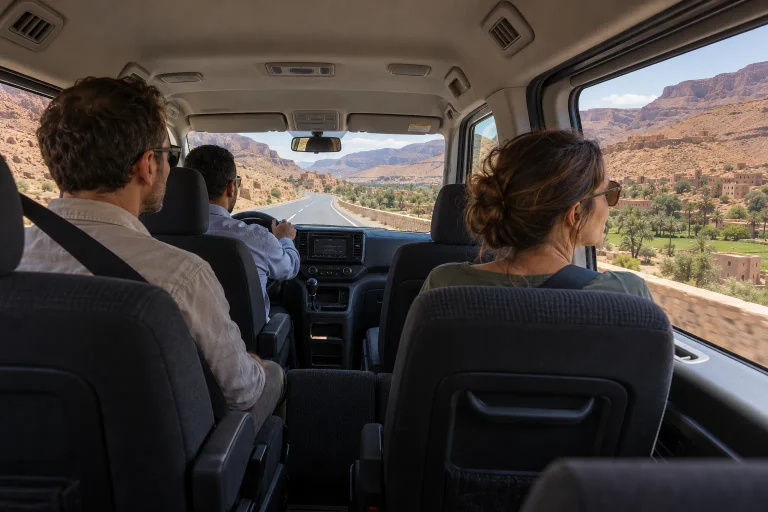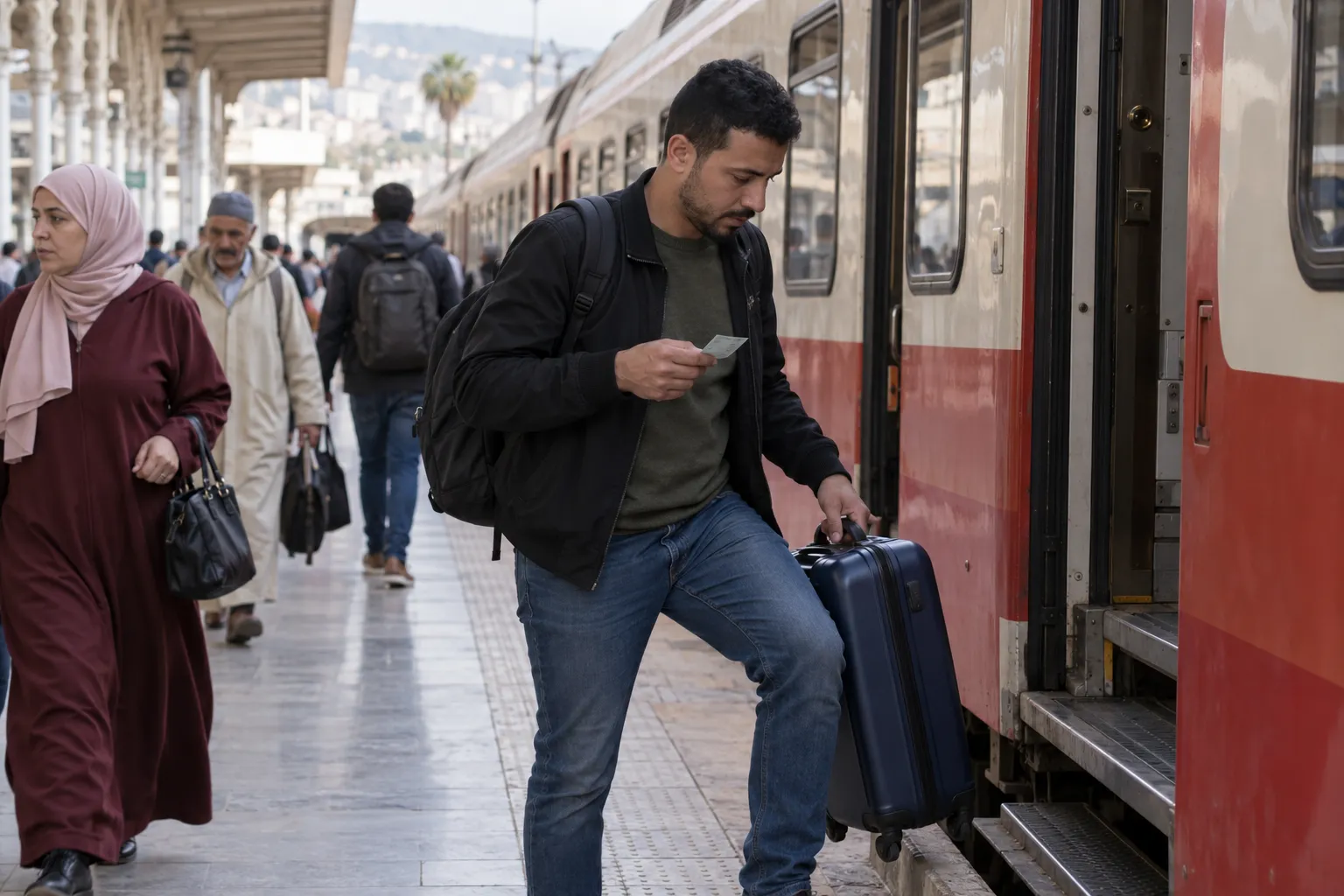
How to get around Morocco depends on your route, luggage and where you are staying. Compare trains for cities connected by rail, coaches for journeys beyond the network, and local taxis for shorter rides. Consider a rental car or private driver when you need several stops. Include the journey from the station or terminal to your accommodation when comparing time and cost.
A cheap ticket can work beautifully when both stations are convenient. The same ticket becomes less attractive when it requires two taxis, a long wait and a difficult walk with luggage. Equally, paying for a private vehicle makes little sense on a day you intend to spend walking around a medina.
This Morocco transport guide helps you make those decisions one journey at a time, with particular attention to the parts a booking screen may leave out.
How to get around Morocco depends on your route and arrival point
Start with the two places where you will actually sleep, rather than just their city names. Then identify the main transport connection and how you will reach it. This makes it easier to compare trains, buses, taxis and private transfers on equal terms.
| Journey you are planning | Start by comparing | The detail that can change your choice |
|---|---|---|
| Tangier, Rabat and Casablanca | ONCF rail, including Al Boraq where applicable | The exact station and onward journey to your accommodation |
| Casablanca–Marrakech or Casablanca–Fes | Conventional trains and private transport | Departure time, luggage and whether you need stops |
| Marrakech–Essaouira | Scheduled coach and private transfer | Terminal access and whether you are staying overnight |
| Fes–Chefchaouen | Scheduled coach and private transfer | Arrival point, uphill walking and your onward route |
| Marrakech–Ouarzazate and the southern valleys | Road transport, with the itinerary determining the vehicle | Whether you want a transfer or time at sights along the way |
| Marrakech or Fes to Merzouga | A planned road journey or available coach service plus local arrangements | Overnight stops and the separate transfer to your camp |
| A day inside a city | Walking, local taxis and urban public transport where available | Your accommodation’s access point and walking requirements |
These are starting points for comparison, not a timetable or a promise of availability. Search your actual date before fixing the surrounding bookings.
If you have not settled on the places to visit, use the Morocco destinations guide to group your stops first. Transport decisions become easier once the route has a clear direction.
Compare trains when both cities are on Morocco’s rail network
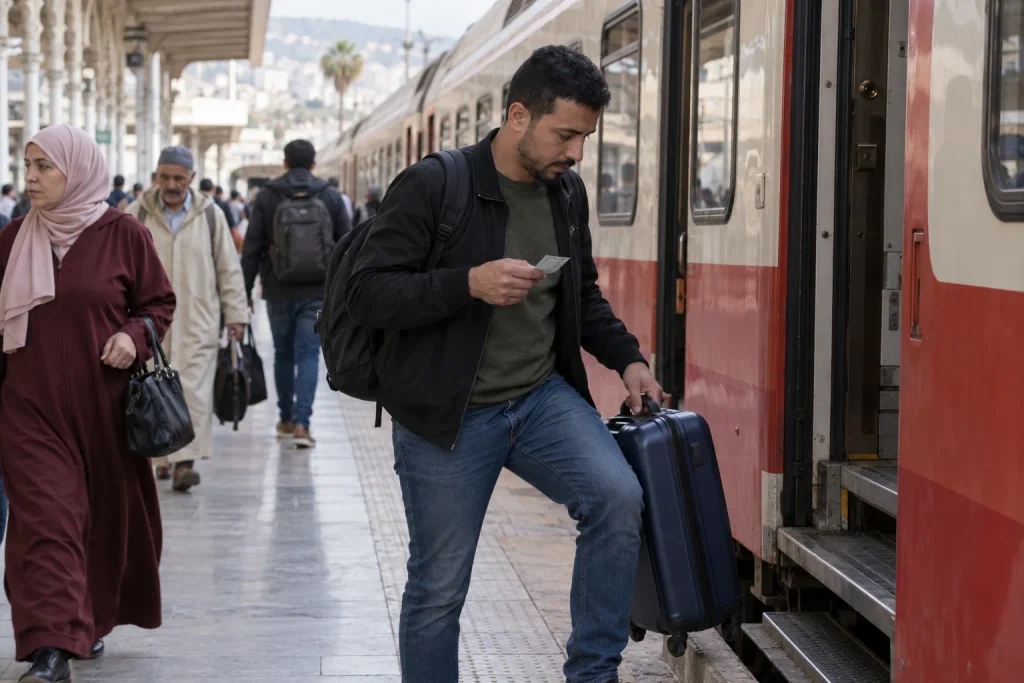
Train travel in Morocco is a useful first option for journeys involving Casablanca, Rabat, Tangier, Marrakech, Meknes and Fes. However, a city being on the network does not mean every pair has the same frequency, journey time or connection pattern.
Al Boraq serves the Tangier–Kenitra–Rabat Agdal–Casa Voyageurs corridor. Journeys onward to Marrakech or Fes can involve other train services and connections. Check the complete itinerary instead of assuming an Al Boraq booking makes every leg high speed.
Use ONCF’s official booking service to check the date, stations, train changes, fare and ticket conditions for your journey.
Match the station name to your accommodation
A ticket to “Casablanca” is not enough information for organising your arrival. Casa Voyageurs and Casa Port are different stations. Likewise, a booking showing Rabat Agdal should be used when arranging a pickup there.
Send the full station name to your accommodation or driver. If you change the ticket, send the revised arrival details too. An otherwise straightforward journey can become awkward because two people are waiting at different stations.
Before paying, check whether you can manage your bags between the street, platform and carriage. If you need assistance, confirm the arrangements for the particular stations and service rather than relying on a general description of train comfort.
Choose the class and fare around what you need: seating preferences, travelling together and flexibility if your plans change. Do not assume every inexpensive ticket has the same exchange or refund conditions.
Coaches cover important gaps, but the terminal belongs in your plan
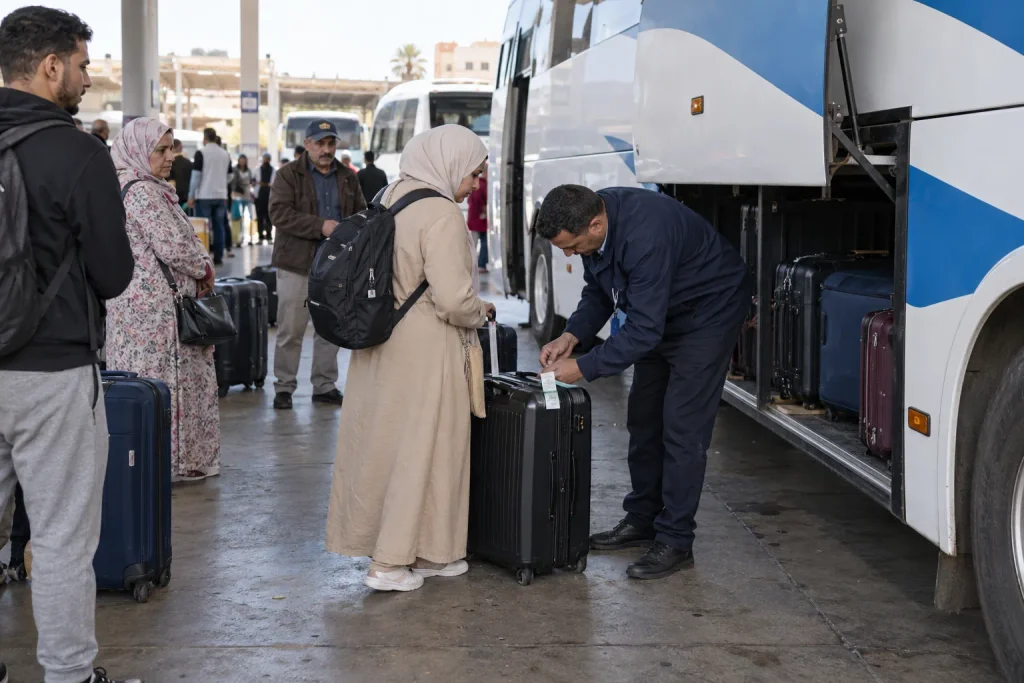
Long-distance buses are worth comparing when rail does not take you to your destination. CTM and Supratours are established operators to check for journeys beyond the main railway corridors, including popular coastal and northern stops.
For Fes–Chefchaouen, check your travel date through CTM’s official booking service. Supratours is also worth checking for Marrakech–Essaouira. Service availability, departure points and baggage arrangements should be confirmed for the actual ticket.
The boarding location matters as much as the departure time. An operator’s terminal may differ from the city’s general bus station. Save the precise location shown on your confirmation and use that when arranging your ride.
Check the luggage process before departure day
Ask whether larger bags need separate registration, payment or a baggage label. Do not apply an old blog’s per-bag fee to every operator or journey.
Keep your passport, essential medication, valuables and anything needed during the ride in a small bag you can carry. If you have a pushchair, surfboard or unusually large suitcase, confirm acceptance and space before buying the ticket.
Also check the arrival time against accommodation access. A late arrival can be workable when someone is expecting you; it becomes harder when the terminal, taxi pickup and riad entrance are all unfamiliar.
Count the complete travel day, including waiting and walking
Compare the time from leaving your first accommodation to reaching the next one. A train or bus journey time describes only part of that day.
Use this calculation:
Accommodation-to-accommodation time = access to departure point + boarding margin + main journey + connections + final transfer or walk.
For example, consider this fictional coach journey. The figures demonstrate the calculation; they are not a timetable for a Moroccan route.
| Part of the journey | Illustrative allowance |
|---|---|
| Accommodation to coach terminal | 25 minutes |
| Arrival margin before departure | 30 minutes |
| Scheduled coach journey | 3 hours |
| Collecting bags and finding onward transport | 15 minutes |
| Transfer and walk to the next accommodation | 30 minutes |
| Total before any additional delay | 4 hours 40 minutes |
That three-hour ride occupies much more of the day. If the calculation leaves only a narrow gap before a prepaid activity, choose an earlier departure, move the activity or travel the previous day.
Record one more detail beside the total: what happens if you miss this departure? A later service, a flexible hotel check-in and an alternative pickup can make a modestly longer journey easier to manage than a tight connection with no useful fallback.
Airport transport should finish at a confirmed hotel or riad meeting point
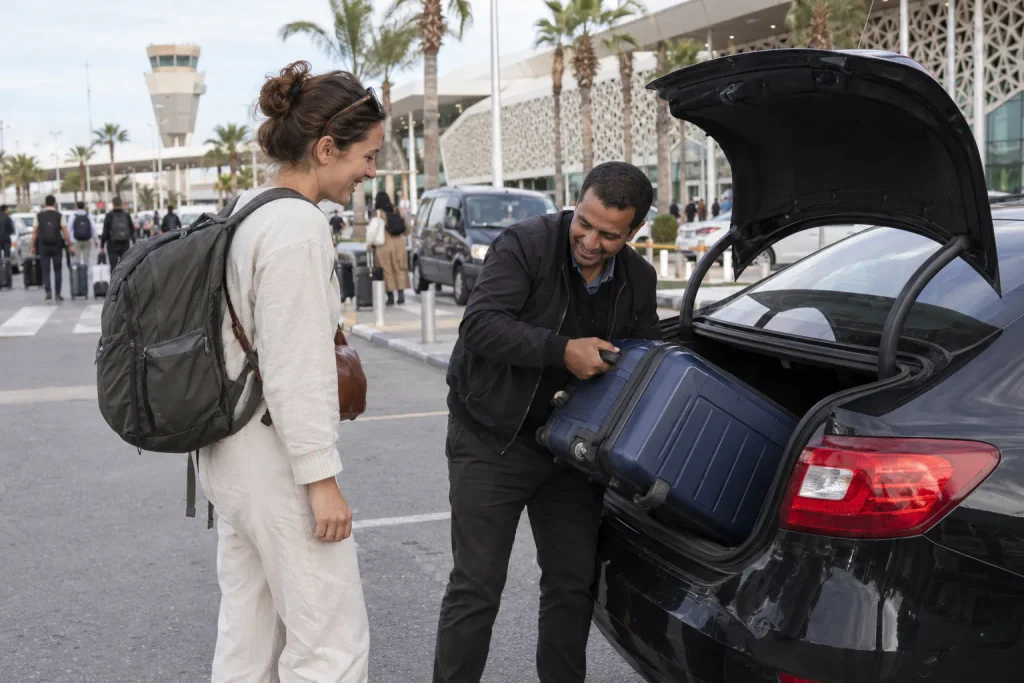
Choose an airport transfer by considering your landing time, luggage, onward connections and accommodation access. The right arrival plan includes what happens after the vehicle stops.
Casablanca Mohammed V Airport has a rail connection. Check the airport station and any onward change in ONCF’s journey planner. Use the operator’s current schedule rather than assuming that a train will be available whenever your flight lands.
For other arrivals, compare the airport’s available ground transport with a prearranged pickup. Include immigration, baggage collection and the possibility of a delayed flight when choosing any separate onward booking.
Ask your riad for the vehicle access point
Some medina accommodation requires a final walk from an accessible street or gate. A map pin on the riad’s roof does not explain where a car can stop.
Ask the property to send:
- The vehicle meeting point and a recognisable landmark.
- The walking route, including steps or uneven sections.
- Whether someone will meet you and help with bags.
- Any separate assistance charge and how it is paid.
For a quote, provide your flight number, full accommodation name, passenger count and luggage details. You can request an airport or intercity transfer through Visit Morocco Together, then confirm the precise pickup and drop-off arrangements before booking.
Petit taxis suit local rides, while grand taxis need a clear fare agreement
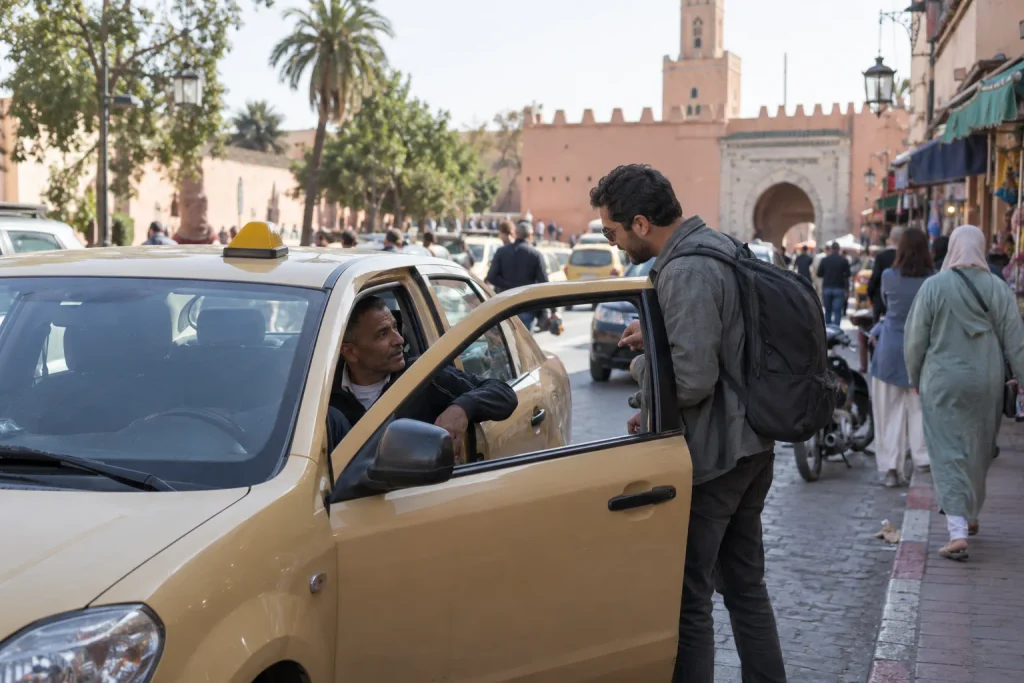
Petit taxis are generally used for journeys within a city. Grand taxis serve wider routes and may be shared or hired for private use. Confirm the arrangement before loading your luggage.
For a local ride, show the actual destination and establish how the fare will be calculated. Where the local system uses a meter, ask for it to be used. For a fixed-price arrangement, make sure the agreed amount covers the whole journey and your party.
With a shared grand taxi, ask whether the quoted fare is per seat, where the service terminates and when it departs. If you want the vehicle privately, state that explicitly. Paying for one seat and hiring the whole vehicle are different arrangements.
Avoid choosing solely by the taxi label. Your practical questions are whether everyone and their luggage fit, whether the vehicle reaches the required access point, and whether the departure arrangement suits your plans.
For repeated rides across a city, ask your accommodation which local options serve your route. A walking day with one short taxi ride requires a different budget from a day of scattered attractions.
A private transfer is most useful when it removes difficult connections
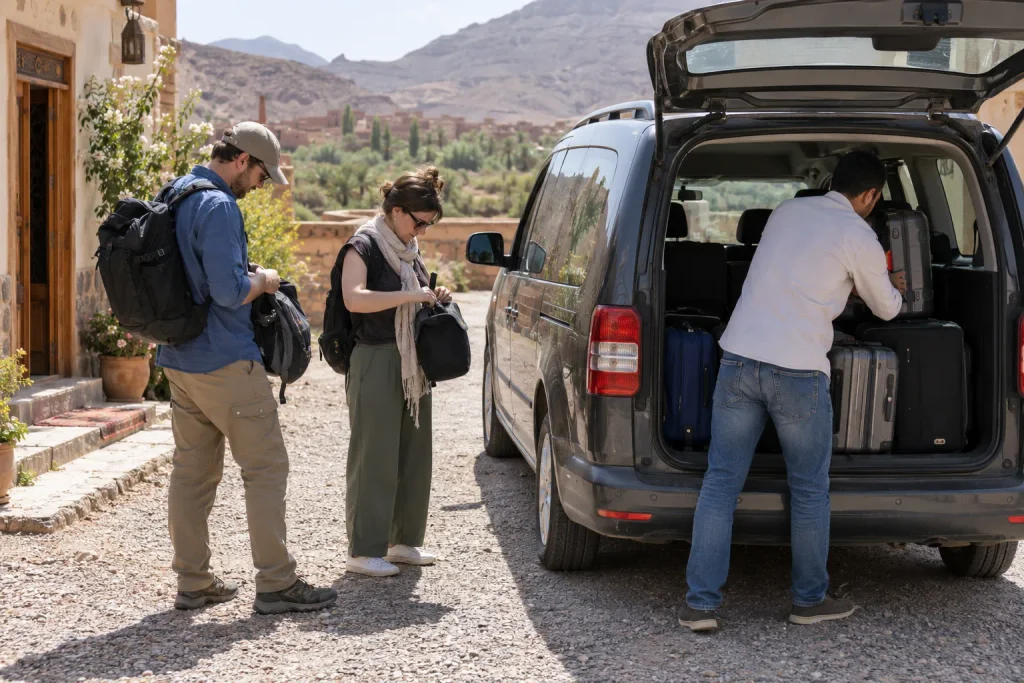
A private transfer becomes worth considering when it solves a specific problem: awkward luggage, an inconvenient departure time, several changes or an arrival point that is difficult to reach independently.
Compare it with the total public-transport cost for your party. Add the main tickets, transport to and from terminals, relevant baggage charges and any extra vehicle needed to fit the group. Divide the private quote by the number travelling only after confirming that it covers everyone and their bags.
A larger group does not automatically make a private transfer cheaper. It may require a different vehicle. Ask for a quote based on the actual passengers, suitcases and equipment.
Separate a transfer from a sightseeing day
A transfer between two cities may include only pickup, transport and drop-off. A sightseeing journey can involve waiting time, visits, a guide or admission charges. Establish which service you are buying.
For example, if you want to visit Ait Ben Haddou while travelling towards Ouarzazate, ask whether the visit and waiting time are included. “We can stop” is incomplete unless you know how long the stop lasts and whether it changes the price or arrival time.
Request a written description covering the vehicle, luggage capacity, agreed stops, waiting arrangements and cancellation terms. These details make quotes comparable.
Rent a car for the days you need flexible road access
A rental car is useful when you want control over several road stops and are comfortable taking responsibility for driving, navigation and parking. It can be unnecessary during a stay centred on walking and urban sightseeing.
One option is to collect the car when you leave the city and return it before your next extended city stay. Compare that arrangement with keeping the vehicle throughout, including collection logistics and any different-location return charge.
Check the rental agreement for permitted roads, mileage, fuel policy, deposit, damage excess, roadside assistance and additional drivers. If you need an automatic vehicle, child seat or space for bulky equipment, obtain confirmation for the booked vehicle category.
Vehicle appearance is not proof of suitability. An SUV does not automatically mean four-wheel drive, and a vehicle capable of reaching a track may still be prohibited from using it under the rental agreement.
For a remote lodge or camp, ask the property for its recommended access route before following a navigation pin. Confirm whether you should leave the rental vehicle at a meeting point and continue in arranged transport.
Reach the Sahara through a planned sequence of road journeys and camp access
For a Sahara trip, plan the journey to the gateway town and the onward camp transfer separately. Reaching Merzouga does not by itself tell you how or when you will reach your accommodation near the dunes.
Ask the camp for its meeting point, required arrival time, luggage arrangements and the transfer included in your booking. Confirm any choices between vehicle transport, a camel excursion and other activities; do not assume one automatically replaces another.
For Marrakech–Merzouga–Fes, write down the overnight stops and final city before comparing tours or drivers. A journey returning to Marrakech cannot serve the same transport purpose as a trip finishing in Fes.
Put visits into the driving plan before judging its pace
If you want kasbah visits, a gorge walk and a relaxed lunch, each needs its own time allowance. Adding them after choosing a road journey by its driving estimate produces an itinerary that looks comfortable only on paper.
Ask the operator for the expected departure, road sections, planned visits and overnight location for each day. If the proposed pace is too demanding, add a night or remove a stop. A private vehicle gives you more control over the schedule, but the distances remain.
Keep arrival at camp separate from sunset activities: ask which timing is necessary and what changes if you arrive late.
A domestic flight is worthwhile only if the full journey saves useful time
Compare flying when a long regional move would otherwise consume too much of your trip. Check the airline’s actual route and operating date first; a line on a map does not establish a usable flight connection.
Count the journey to the airport, the required check-in margin, the flight, baggage collection and onward transport. Add any connection between flights. Then compare that total with the ground option for the same day.
The useful question is what the time saved allows you to do. An earlier arrival that preserves an afternoon at your destination has a clear benefit. A flight that arrives too late to reach your accommodation conveniently may offer less value than its short flying time suggests.
If you are connecting to an international flight, establish whether the bookings form a protected connection and how baggage is handled. Separately booked journeys need their own contingency plan; do not assume one provider will resolve a missed departure caused by another.
Match the journey to the traveller who needs the most support
Choose transport that works for the whole party, including whoever finds stairs, long sitting periods, luggage handling or uncertain toilet stops hardest. A vehicle described as comfortable may still be unsuitable for a particular person.
For families, confirm child seating and luggage space, including a folded pushchair. For travellers with reduced mobility, describe what is needed: step-free access, help boarding, space for a mobility aid or a shorter walk at arrival.
Ask specific questions about each stage rather than using “accessible” as a blanket description. A suitable vehicle does not resolve steps between the drop-off point and the room.
For winding-road journeys, discuss breaks and the day’s duration before booking. If someone needs a slower pace, reduce the day’s commitments instead of relying on an early departure to make everything fit.
A useful comparison is the number of times the party must unload, carry and reload luggage. Fewer changes may justify a higher transport cost, especially when assistance is needed at every interchange.
Confirm each journey with one short written record
Before considering a transport leg finished, collect its essential details in one place. This makes it easier to spot missing arrangements and share accurate information with your accommodation or driver.
| Detail | What to record |
|---|---|
| Departure | Date, exact station or pickup point, and reporting time |
| Arrival | Station, hotel entrance or medina meeting point |
| Passengers and luggage | Everyone travelling, bags and special equipment |
| Service scope | Direct transfer, scheduled service or journey with agreed visits |
| Total price | Currency, basis of the quote and confirmed extras |
| Changes | Ticket conditions, waiting policy and cancellation terms |
| Arrival support | Who meets you, where and how to contact them |
| Fallback | What you will do if the first arrangement becomes unusable |
On a route that combines rail-connected cities with a road section, you can book each mode for the part it suits. You do not need the same vehicle or transport style for the entire holiday.
If you would like help coordinating the road sections, send Visit Morocco Together your travel dates, overnight stops, passenger count and luggage details. Use the custom-trip enquiry to ask about a route built around those needs, or contact the team on +212 7 70 20 19 56.
Ready to Experience Morocco?
Turn this inspiration into your next adventure. Our travel experts are ready to help.