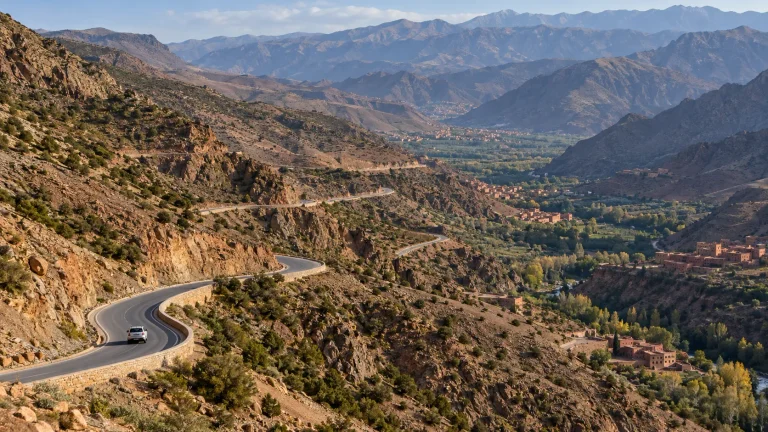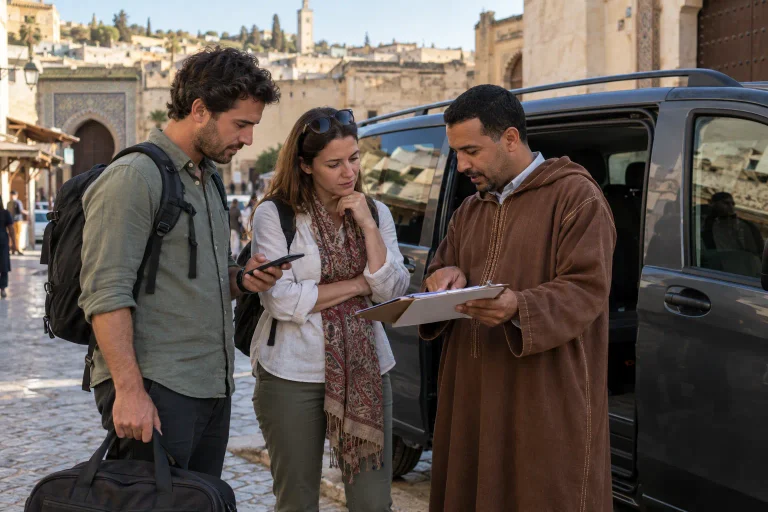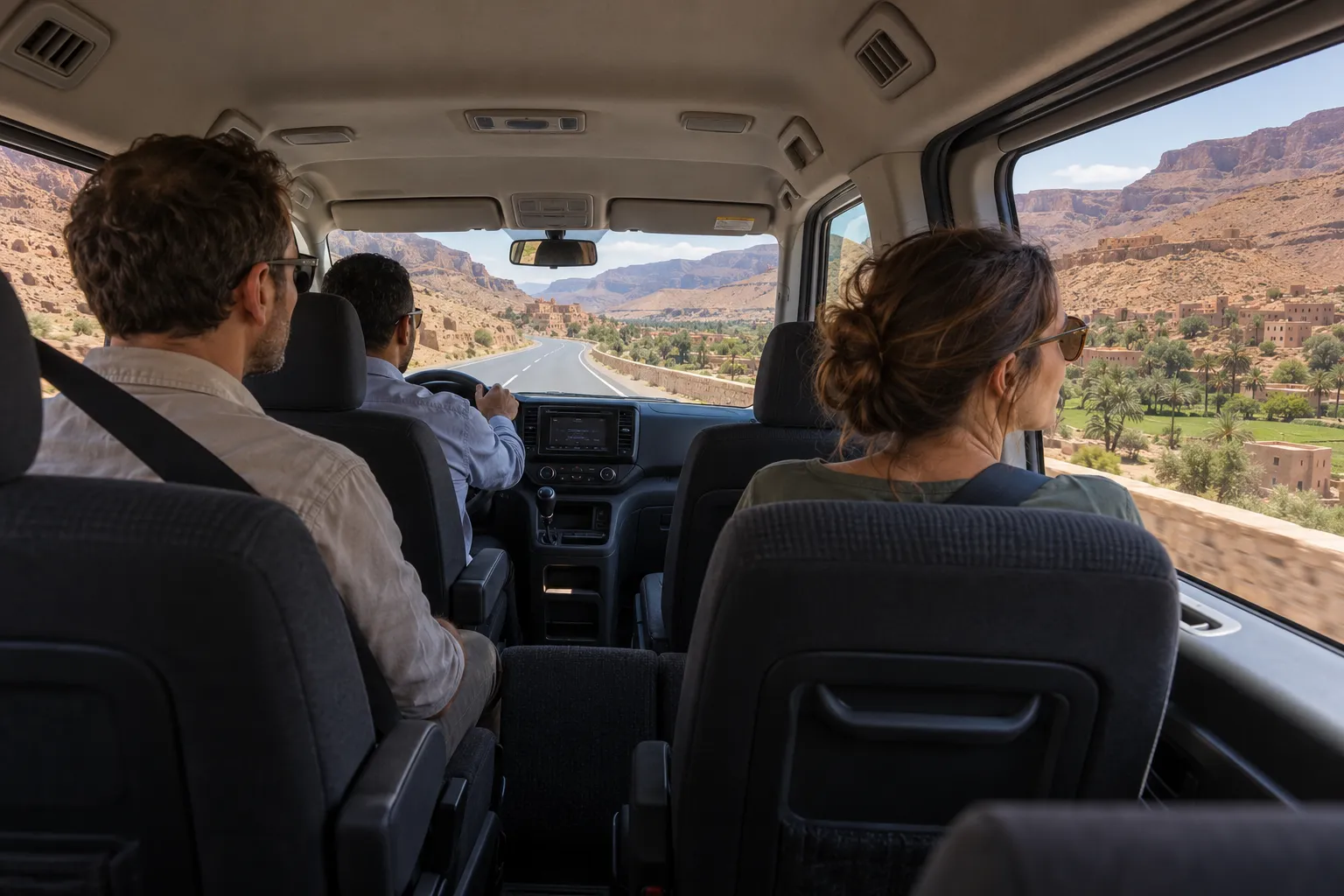
To decide whether to rent a car or hire a driver in Morocco, start with the road journey you actually want. Self-drive suits travellers who enjoy driving, want control over daily changes and are comfortable handling the vehicle, navigation and parking. A private driver suits those who want to travel by road while spending the journey as passengers.
Neither option is automatically cheaper or more flexible. Compare complete arrangements for the same route, vehicle capacity and travel days. A refundable deposit is different from an expense, and a driver booking needs clear limits on hours, waiting, stops and what the price includes.
For many trips, the practical answer is a combination: independent city stays, public transport along a suitable corridor and a car or driver for a particular road section. Within the wider choices for getting around Morocco, the useful comparison is who handles the driving and what the vehicle booking actually covers.
Should You Rent a Car or Hire a Driver in Morocco
Choose a rental car when you actively want to drive, rather than accepting that job because the advertised rate looks low.
Self-drive can suit a regional trip with several overnight stops, accommodation with workable parking and room to change plans. You hold the keys and decide when to leave, subject to the rental agreement and road conditions.
Choose a private driver when nobody in your party wants that responsibility, or when being a passenger would substantially improve the journey. This can matter on consecutive road days, winding routes or a trip where the person driving would otherwise miss much of the scenery.
A private driver also needs coordination. You agree the daily programme, communicate changes and respect the contracted working arrangements.
If the itinerary consists mainly of city stays, first ask how many days need a vehicle at all. Three nights in a medina do not necessarily justify three days of rental or a driver retained throughout.
Count Vehicle Days Before Comparing Prices
Write down your hotel nights and mark the days when you will move between places or make an excursion.
Then separate three situations:
- A day when you need transport for one journey.
- A day when you need a vehicle for several stops.
- A day when you can walk or use local transport.
A rental may still need to be paid for during a day when it remains parked. A driver quote may include availability during a city stay, or it may cover only the road stages. Ask which.
For example, two nights in Marrakech, three nights along a southern road route and two nights in Fes do not automatically require the same transport service for all seven nights. Collection, return and one-way charges determine whether a shorter vehicle booking is worthwhile.
The comparison becomes useful once both quotes cover the same work. A transfer between two hotels cannot be compared directly with a day that includes several visits and waiting time.
Compare the Total Cost of Each Arrangement
What belongs in a rental-car budget
Start with the price for your actual collection and return times, vehicle category and location. Then add applicable charges for:
- Protection or waiver options you choose.
- An additional driver or age-related supplement.
- Fuel and motorway tolls.
- Parking during overnight stays and visits.
- Child seats or other equipment.
- A different return location or delivery service.
- Out-of-hours collection or return.
Confirm the mileage allowance and the charge for exceeding it. Ask how rental periods are counted: returning later than the agreed time can affect the bill even when you think of it as the same holiday day.
Use one currency for the comparison and identify whether taxes and mandatory charges are included.
What belongs in a driver quote
Request a total for the vehicle and your party, with the route and daily programme attached.
Ask whether the amount includes fuel, tolls, parking, the driver’s meals and overnight accommodation. Establish any additional cost for extra hours, a changed route or finishing in another city.
Separate your own hotels, food, entrance fees and guiding. Those services may appear in a package quote but be absent from a transport-only booking.
Compare shared and private arrangements carefully. A price per person for a scheduled excursion does not establish the price of having a vehicle exclusively.
Divide equivalent totals by the same passenger count
For a couple, calculate the total for both travellers. For four adults, calculate the total for all four, using a vehicle that holds their luggage.
Dividing a driver quote between more passengers can improve its per-person value, but the rental cost is also being shared. Group size alone does not prove which option costs less.
The useful calculation is the complete cost for your party, then the difference you would pay to let someone else drive.
Separate the Deposit From the Insurance Excess
A rental security deposit is money held or collected against possible charges. When returned in full, it is not part of the final rental expense. It still matters because it can reduce the funds or card limit available during the trip.
Ask the supplier for the deposit amount, payment-card requirements, release process and any circumstances in which money may be retained. Allow for the bank’s processing time.
The insurance excess, also called a deductible, describes an amount for which you may remain responsible under the relevant damage or theft terms. It is not automatically charged simply because you rented the car.
Keep three figures separate:
- The amount you expect to spend on the rental.
- The security deposit or card authorisation.
- Your potential responsibility under the protection terms.
This distinction prevents a comparison from treating a large refundable hold as though it were a week’s fuel bill.
Understand what reduced excess actually covers
A label such as “full protection” needs its policy wording. Ask about tyres, glass, the underside, keys, towing and use on unpaved roads, as applicable to the product.
For example, Hertz Morocco’s published rental conditions describe exclusions that can remain despite a damage-waiver option, including certain damage outside asphalt roads. The supplier’s actual agreement matters more than the vehicle’s appearance.
Protection bought separately may work through reimbursement: you pay the rental company’s eligible charge and then submit a claim. Establish whether that is the arrangement and whether the rental deposit still applies.
Ask for the incident-reporting process before collection. Save the assistance number and know which documents would be needed after damage or a breakdown.
Check Whether You Can Rent the Vehicle You Want
Before paying, confirm acceptance of your driving licence, any required international permit, your age, driving experience and payment card.
Requirements can differ between rental companies and vehicle categories. A friend hiring successfully elsewhere does not establish that you qualify for this booking.
For UK licence holders, the FCDO’s Morocco road-travel guidance specifies carrying a 1968 international driving permit alongside the UK licence. Travellers with other licences should establish the requirements for their own documents rather than applying UK advice to everyone.
Ask the rental company which vehicle and insurance documents it supplies. If you are bringing a foreign-registered car into Morocco instead, that is a separate arrangement requiring its own checks.
If two people intend to drive, have both authorised under the agreement before leaving. Sharing the driving informally can create a problem even when both hold valid licences.
Reserve an automatic category explicitly if you need one. Also confirm passenger capacity, boot space and any equipment you cannot travel without.
When Self-Drive Offers Useful Freedom
Self-drive can be rewarding when you want to linger in one region and make your own decisions as the trip develops.
You can leave later after a slow breakfast, change an overnight stop when accommodation allows, or decide that a coastal town deserves another day. You do not need to renegotiate a driver’s programme every time your plans shift.
That freedom works within practical limits. You still need a permitted route, somewhere to park and enough time to reach the next property.
Ask yourself who will enjoy the driving. If one person is quietly accepting every long stage while everyone else rests, the convenience is unevenly shared.
Consider navigation, parking and fatigue as part of the holiday. Someone who enjoys an unhurried road trip may value those responsibilities differently from someone who finds them tiring.
For a single excursion, compare renting and returning a vehicle with an arranged outing. Visit Morocco Together’s Oued Laou day trip from Chefchaouen lists a starting rate of €149 per person, including transport and city-centre pickup and drop-off. At that starting rate, two adults would be €298 before excluded food, drinks and other extras. A private option needs its own confirmed quote; the displayed per-person rate should not be treated as exclusive vehicle hire.
What a Private Driver Should Be Contracted to Do
A driver takes on the driving service you book. Write down what that service involves.
Confirm which business supplies the transport, how to contact it and the vehicle’s authorisation and insurance for carrying paying passengers.
For a multi-day journey, establish:
- The planned route and overnight stops.
- Daily start and finish arrangements.
- Driving and waiting time included.
- Vehicle category and luggage capacity.
- Fuel, tolls, parking and driver expenses.
- What happens if you change the route.
- Contact and replacement arrangements if a problem occurs.
Ask whether you retain the same driver and vehicle throughout. If not, identify the handovers.
For a day with several visits, explain how long you expect to spend at each place. A driver waiting through a museum visit and collecting you afterwards is a different service from dropping you at the entrance.
Availability does not mean every hour of the day
Agree whether an evening restaurant journey is included after a full road day. Do not assume the driver remains on call all night.
If you want more time somewhere, discuss how it affects the remaining programme. Extra stops can reduce sightseeing later or push the final drive into darkness.
The arrangement should allow adequate breaks and rest. A driver booking cannot make an overfilled route sensible simply by transferring the work to another person.
Driving and guiding are separate responsibilities
Ask which visits include a licensed local guide and who provides that service.
A driver may help with practical information, language and meeting points without delivering a guided historical visit inside every monument or medina. Entrance fees and specialist guiding need to be identified in the booking.
Also state your preferences about shopping stops and restaurants. An agreed lunch break does not need to become a series of shop visits you did not request.
Choose According to the Road Section
City stays and the main urban corridor
When your trip centres on Casablanca, Rabat, Tangier, Fes or Marrakech, compare public transport before committing to a car throughout.
Rail can handle suitable city connections, with local transport for the final hotel approach. A car may be useful for a particular excursion while remaining unnecessary during several walking days.
This can leave the vehicle budget for the road days where you need it most.
Northern towns and the Rif
For a route through Tangier, Tetouan, Chefchaouen and surrounding countryside, compare how much regional driving you actually want.
Self-drive can suit travellers who enjoy choosing their stops and have accommodation with clear parking arrangements. A driver can suit a party that wants those road links without managing winding sections or parking.
A Chefchaouen city stay plus one coastal excursion does not necessarily require keeping a rental for the entire visit. Price the excursion and the onward journey separately.
The High Atlas and southern valleys
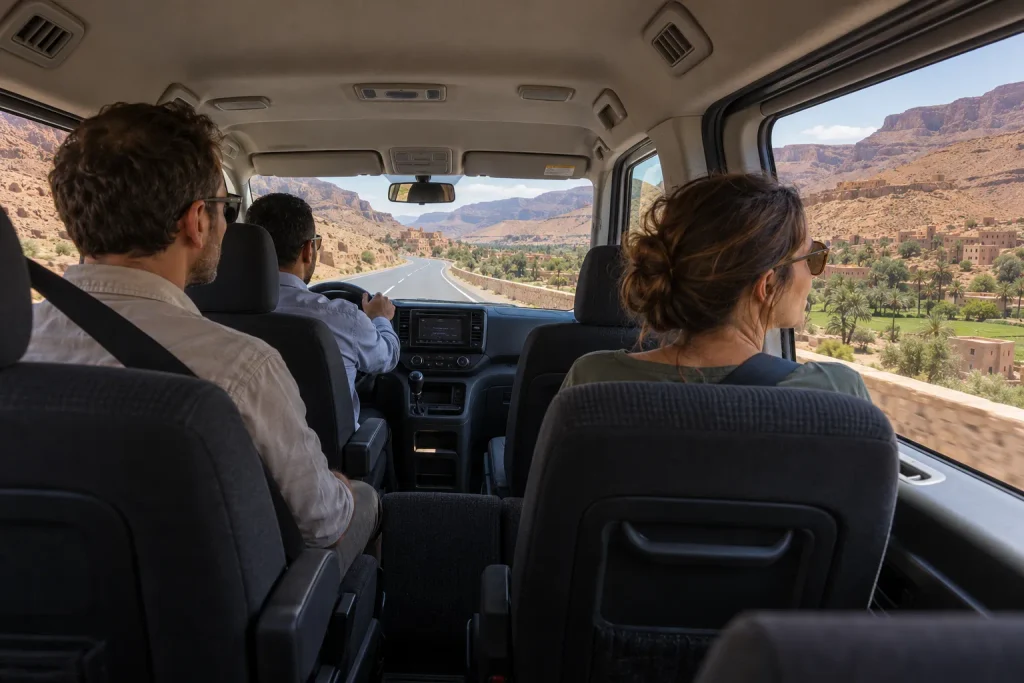
A route towards Aït Benhaddou, Ouarzazate, Skoura or the Dadès Valley can make the road a substantial part of the experience.
Choose self-drive if you are comfortable with the route, vehicle and conditions, and build in time for stops. Choose a driver if being a passenger would help you enjoy the landscape or manage consecutive travel days.
Neither choice removes weather disruption. Check conditions and allow the schedule to change when a route becomes unsuitable.
The Atlantic coast
For an extended coastal stay with smaller towns, beaches and accommodation away from the centre, a rental can provide useful everyday access.
Check the property’s actual location and parking. A beach address does not establish that you can drive to the sand or leave the car beside it.
For a simple city-to-city move followed by several days on foot, compare a transfer or coach with paying to retain a parked vehicle.
Reaching the Sahara Is Different From Driving on Sand

Reaching Merzouga by an appropriate paved-road route and driving a rental onto dunes are separate decisions.
Ask your camp where to leave the rental, how luggage is handled and whether a final transfer is required. Obtain the camp’s recommended approach rather than following a navigation pin onto a track.
An SUV is not automatically a four-wheel-drive vehicle, and having four-wheel drive does not override a rental restriction.
If you want a desert driving experience, compare a separately arranged local outing. Visit Morocco Together’s Erg Chebbi 4×4 desert excursion lists round-trip transport, a driver or guide and scenic stops. Confirm the terrain, vehicle, meeting point and private or shared arrangement before booking. It can form a local experience within a journey otherwise made independently.
This lets you choose the main road transport and the desert activity for their different purposes.
Parking and Riad Access Affect Both Choices
A private driver may avoid the task of finding overnight parking yourself, but the car still cannot enter every medina lane.
Ask your accommodation for the vehicle-access point, walking distance, steps and any luggage assistance. Confirm who will meet you when necessary.
With a rental, ask where you can leave the vehicle overnight, what it costs and how you retrieve it early in the morning. “Parking nearby” needs a more precise answer when you have luggage or limited mobility.
Count the parked days in your budget. Keeping the vehicle can still make sense if you need it again, but compare that convenience with a shorter hire.
With a driver, agree whether the drop-off ends at the road access point or includes a coordinated handover with the property. Avoid assuming that a promise of hotel delivery means the vehicle reaches the riad door.
One-Way Routes Need Two Different Checks
Ending in another city can reduce backtracking, but it has implications for both options.
For a rental, obtain approval for the collection and return locations and confirm the one-way charge. Check the return office’s opening hours and what happens outside them.
For a driver, confirm that the quote includes finishing in the final city. Ask whether any repositioning, return travel or additional overnight expense is included.
Do not assume that the absence of a line labelled “drop-off fee” means there is no cost associated with ending elsewhere. Compare the total.
For a Marrakech-to-Fes journey through the south, attach the complete overnight sequence to the request. A direct transfer between the two cities is not the same product as a multi-day journey via the Sahara.
Families and Travellers With Specific Needs
Both self-drive and a private driver can work for families. The decisive details are the seating, luggage, breaks and route.
Confirm the child-seat type and supply before paying. A large vehicle does not establish that suitable restraints are available.
If renting, ask whether the equipment is guaranteed and how installation is handled. With a driver, obtain the same confirmation rather than relying on a general promise of a family service.
For reduced mobility, discuss door openings, steps into the vehicle, walking distances and the approach to each accommodation. Specify whether a wheelchair must remain occupied during travel or can be folded and stored.
A driver can help with coordination, but assistance needs must fit the actual vehicle and service. For either choice, reduce daily stops when getting in and out takes additional time.
Compare Cancellation and Interruption Terms
Check what happens if you cancel before collection, collect late or return a rental early. A prepaid booking can have different terms from a flexible rate, and unused days do not automatically produce a refund.
For a driver, ask about cancellation deadlines and the treatment of a deposit. Establish what happens if the provider cannot supply the agreed service.
For either option, discuss interruption separately from cancellation. If a road closes or someone becomes unwell, you need to know who arranges the next step and how changed transport is priced. Keep the agreed terms with the booking.
Collection and Return Deserve Time in the Itinerary

For a rental, leave time to inspect the vehicle, record existing marks, confirm fuel and mileage, and understand the return process. Make sure any existing damage appears on the supplier’s record.
Know how to reach assistance and what to do if a warning light appears. Ask before authorising a repair independently.
At return, allow for refuelling and inspection. Keep the final paperwork and any record relating to the deposit.
For a driver booking, confirm the pickup point and contact details before the first journey. Check the agreed vehicle and luggage space when it arrives.
After a long flight, avoid building the first day around an ambitious drive. Immigration, baggage collection and handover time all affect when the road journey really begins.
A Mixed Approach Can Fit a Seven-Night Trip
As a planning example, consider two nights in Marrakech, three nights on a southern road section and two nights in Fes.
You could explore Marrakech without retaining a car, start the road arrangement when leaving the city and end it on arrival in Fes. The main choice then concerns the road section, not every day in Morocco.
For self-drive, check whether a shorter one-way rental is available on acceptable terms. For a driver, request the same overnight sequence and sightseeing stops.
If Merzouga is included, treat it as part of that multi-day sequence. Do not add it to a short direct transfer and assume the original timing or price remains valid.
For detailed destination sequences, the Morocco road-trip routes provide the broader context. Keep the vehicle decision tied to the route you actually select.
Questions About Rental Cars and Private Drivers in Morocco
Is renting a car always cheaper?
No. Compare the complete rental cost with a driver quote for the same route and party. Keep refundable deposits separate from final spending, and include the days the rental would remain parked.
Is a private driver the same as a private tour?
No. A driver booking can cover transport alone. The broader choice between private and independent travel also concerns accommodation, activities and who organises them. Hotels, meals, entrance fees and guided visits belong in the quote only when explicitly included.
Does hiring a driver give unlimited flexibility?
Changes depend on the agreed programme, working arrangements and route. Confirm extra stops and waiting time before assuming they fit.
Do I need a car while staying in a medina?
You may not need it for city sightseeing. Compare parking and collection arrangements with using local transport and starting the road booking when you leave.
Can I drive a rental car to a desert camp?
Obtain the camp’s recommended approach and the rental company’s permission for the roads involved. The final stage may require a separate transfer.
Will extra insurance remove the security deposit?
Not necessarily. A protection product and the supplier’s deposit serve different purposes. Ask what amount remains payable or held, and whether any claim works through reimbursement.
What if nobody in our group wants to drive?
Compare a private driver, scheduled public transport and specific excursions for the route. Choose the combination that covers your journeys with workable arrival and pickup arrangements.
Ready to Experience Morocco?
Turn this inspiration into your next adventure. Our travel experts are ready to help.