A Morocco road trip gives you something that trains, buses and fixed tours cannot always provide: control over the route. You can stop at an Atlas viewpoint, stay an extra night in a valley, spend longer around the Sahara or change the coastal portion of the trip according to the weather and your own pace.
The old version of this article called that idea the “Freedom Route.” There is no single official Morocco route by that name, but the principle is useful. Independent road travel lets you connect historic cities, mountain landscapes, traditional craft areas, the Sahara and the Atlantic coast without following one fixed country-wide itinerary.
The important part is using that flexibility realistically. Morocco is large enough that a road trip can quickly become a succession of long drives if you try to combine Marrakech, Fes, Chefchaouen, Merzouga, the Atlas Mountains and Essaouira in too few days. A better Morocco road trip starts by choosing one or two connected regions, deciding how much driving you actually enjoy and protecting enough nights for the places that matter most.
This Morocco road trip guide explains how to choose a route, whether to self-drive or hire a private driver, what kind of vehicle you need, how to approach mountain and desert roads, where longer itineraries make sense and how to avoid turning your holiday into a race between hotel check-ins.
Morocco Road Trip Guide at a Glance
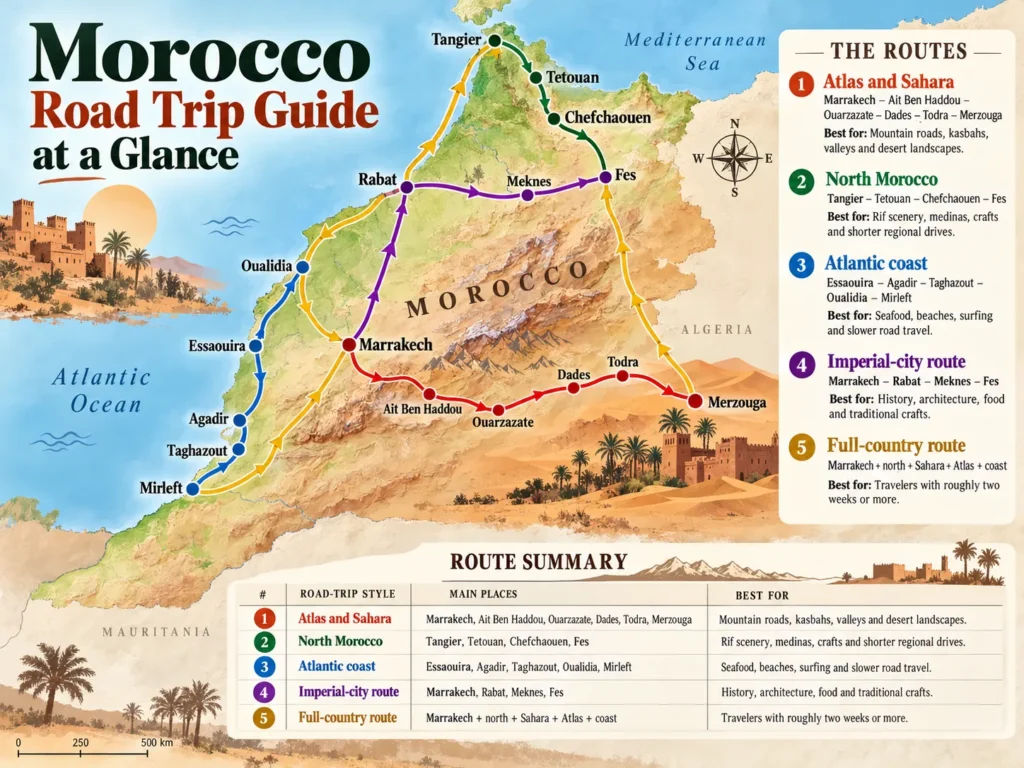
| Road-trip style | Main places | Best for |
|---|---|---|
| Atlas and Sahara | Marrakech, Ait Ben Haddou, Ouarzazate, Dades, Todra, Merzouga | Mountain roads, kasbahs, valleys and desert landscapes |
| North Morocco | Tangier, Tetouan, Chefchaouen, Fes | Rif scenery, medinas, crafts and shorter regional drives |
| Atlantic coast | Essaouira, Agadir, Taghazout, Oualidia, Mirleft | Seafood, beaches, surfing and slower road travel |
| Imperial-city route | Marrakech, Rabat, Meknes, Fes | History, architecture, food and traditional crafts |
| Full-country route | Cities + north + Sahara + Atlas + coast | Travelers with roughly two weeks or more |
Why Take a Road Trip Through Morocco?
The strongest reason to drive is not simply transportation. It is the ability to control what happens between destinations.
A train can efficiently connect major cities, but it cannot stop when the light changes over a mountain valley. A bus can take you toward another region, but you cannot usually decide to spend another hour at a viewpoint, workshop or roadside café.
A road trip can give you:
- Freedom to change departure times
- Scenic stops between major destinations
- Access to smaller towns and valleys
- More control over luggage
- Flexible accommodation choices
- The ability to slow down when you find somewhere worth staying
- Easier travel between mountain, desert and coastal regions
- A route designed around your interests rather than a transport timetable
This freedom is especially useful in southern Morocco, where places such as Ait Ben Haddou, Skoura, Dades Valley, Todra Gorge and Merzouga form a sequence rather than isolated attractions.
The journey between them is part of the experience.
Self-Drive, Private Driver or Organized Road Trip?
A Morocco road trip does not necessarily mean driving yourself. The same route can be experienced with a rental car, a private driver or a more structured organized itinerary.
Self-Drive Morocco
Self-driving gives you the greatest independence.
It works particularly well for travelers who are comfortable driving abroad, navigating unfamiliar cities, managing parking and adjusting their own schedule.
You decide when to leave, where to stop and whether an interesting valley, café or village deserves more time.
The trade-off is responsibility. You handle navigation, fuel, parking, road conditions, rental-car requirements and the concentration needed during long driving days.
Private Driver
A private driver preserves much of the flexibility of a road trip without requiring you to stay behind the wheel.
This can be valuable on routes involving the High Atlas, the long journey toward Merzouga or several consecutive road days.
You can still request scenic stops, adjust departure times and use one-way routing while somebody else handles navigation and parking.
A private driver is not automatically the same as a specialist local guide. If historical interpretation in Marrakech or Fes is important, use an appropriate city guide where necessary.
Organized or Guided Road Trip
A fully organized journey can include the vehicle, accommodation, selected activities and guiding.
The 13-day premium article being merged into this pillar emphasized higher-quality accommodation, personalized routing, varied activities and the option of traveling with an expert French-speaking guide.
That style is useful for travelers who want a road-trip experience but do not want to organize the details independently.
The important question is not whether one travel style is universally better. Choose according to how much control and responsibility you want.
Driving in Morocco: The Basics
Morocco drives on the right-hand side of the road. Road signs commonly use Arabic and French, and many rental cars have manual transmissions.
Before leaving the rental agency, make sure you understand the controls, fuel policy and rental agreement. If you normally drive an automatic car, reserve one specifically instead of assuming it will be available.
Follow posted speed limits and road signs rather than relying on an old online list of universal limits.
Expect the driving environment to change considerably between:
- Modern motorways
- Large-city streets
- National roads
- Mountain passes
- Village roads
- Valley routes
- Desert-edge roads
Driving through central Casablanca is different from crossing the High Atlas, and neither feels like entering a small town near the Sahara.
Do You Need a 4×4 for a Morocco Road Trip?
No, not for a normal road trip using the main paved routes.
The original independent-travel article suggested choosing a 4×4 for mountain roads and desert paths. Keep that advice only where the actual route justifies it.
A normal rental car can be appropriate for many routes connecting cities, the Atlantic coast and major southern destinations using paved roads.
A vehicle with more ground clearance may make sense when your accommodation or itinerary requires rougher access, but do not drive onto an unpaved desert track simply because the vehicle looks capable.
Check the rental agreement first. Off-road driving may be excluded, and damage outside permitted roads may not be covered.
For dune access around Merzouga, camp operators can often arrange a local 4×4 or another transfer rather than requiring you to drive a rental car onto sand.
Choosing the Right Rental Car
The best car is not necessarily the largest.
Consider:
- Number of travelers
- Luggage size
- Automatic or manual transmission
- Roads on your actual itinerary
- Fuel consumption
- Parking in cities
- Ground clearance where genuinely needed
- Air-conditioning
A compact vehicle can be easier around towns and parking areas, while a larger car can provide more comfort for several adults and luggage on longer journeys.
Do not choose a 4×4 purely for appearance if your itinerary stays on paved roads.
Rental-Car Pickup Checklist
Before leaving the agency:
- Photograph or video the exterior and existing damage
- Check the wheels and tires
- Confirm the fuel level
- Understand the deposit arrangement
- Confirm what insurance and excess apply
- Ask what types of road are excluded
- Confirm who is allowed to drive
- Check the return location and time
- Ask what to do after a breakdown or accident
- Confirm whether one-way return is permitted if needed
Do this before starting the road trip rather than trying to resolve uncertainty after you have already left the city.
Motorways, Main Roads and Scenic Roads
Morocco has a motorway network connecting several major urban areas, while national and regional roads connect destinations beyond it.
Motorways are useful when your goal is efficient movement between cities. Scenic roads become more important when the journey itself is one of the reasons you are traveling.
For example, a fast intercity corridor and the road through Dades Valley serve very different purposes.
Do not estimate every driving day from distance alone. A mountain road with viewpoints, villages and curves can take much more of your day than an equivalent distance on a motorway.
Before major driving days, check current road and weather conditions. Autoroutes du Maroc provides current motorway traffic and works information for its network.
Navigation and Offline Maps
The old Freedom Route article recommends downloading offline maps because mobile connectivity may become less reliable in remote areas. That remains useful advice.
Save:
- Your accommodation location
- Parking coordinates where provided
- Fuel stops on remote sections
- The main road number
- Important junctions
- Meeting points for desert camps or activities
Do not assume that the pin for a riad inside a historic medina is a place where a vehicle can physically reach the door.
Medinas are often pedestrian environments. Your actual arrival point may be a parking area, gate or nearby street followed by a walk.
Parking Around Moroccan Medinas
Parking is one of the biggest differences between a road trip and an ordinary hotel-to-hotel journey.
Historic medinas in Marrakech, Fes, Essaouira and other cities were not designed around modern vehicle access.
Before arriving, ask your riad or hotel:
- Can a car reach the property?
- Where should I park?
- Is the parking guarded or managed?
- How far is it from the accommodation?
- Can somebody help with luggage?
- Is there a specific gate I should navigate toward?
Do not wait until you are surrounded by narrow streets to work this out.
Night Driving
Whenever possible, plan major rural and mountain road sections during daylight.
Daylight makes it easier to read the road, find viewpoints, notice pedestrians and animals and understand unfamiliar junctions.
It also means you can enjoy the landscape that made you choose a road trip in the first place.
A route that repeatedly requires arriving after dark is often a sign that too much has been scheduled.
Route 1: Marrakech, Atlas Mountains and Sahara
The southern route is one of Morocco’s strongest road-trip combinations.
A typical structure links:
- Marrakech
- The High Atlas
- Ait Ben Haddou
- Ouarzazate
- Dades Valley
- Todra Gorge
- Merzouga and Erg Chebbi
This route combines some of the most useful content from the old independent, private-road-trip and desert-road-trip articles.
The road moves from Marrakech into mountain landscapes, then into earthen kasbah country, rocky valleys and finally the Sahara.
The biggest planning mistake is trying to drive directly from Marrakech to the dunes and then rush back.
Ait Ben Haddou, Ouarzazate, Dades and Todra are not simply obstacles between Marrakech and Merzouga. They are part of what makes the southern road journey worthwhile.
Driving to the Sahara
The Sahara needs multiple days from Marrakech if you want the road trip to feel enjoyable.
Merzouga sits beside Erg Chebbi and works especially well when the road journey continues onward toward Fes rather than forcing you to retrace the same route immediately.
Once you reach Merzouga, park according to your accommodation or camp instructions and use local arrangements for dune travel where required.
A desert experience can include sunset, camel trekking when desired, a camp night, sunrise or a 4×4 excursion.
The main road-trip vehicle does not need to become the desert activity vehicle.
Route 2: Marrakech, Atlas Mountains and Atlantic Coast
A mountains-and-ocean route is a good alternative for travelers who do not want the long Sahara journey.
The flexible and scenic road-trip articles being consolidated here include Marrakech, Atlas scenery and Essaouira.
A route might combine:
- Marrakech
- Imlil or another High Atlas base
- Optional hiking
- Essaouira
- Agadir or Taghazout when more coastal time is available
Imlil and Toubkal National Park
The old flexible route recommends hiking around Toubkal National Park and notes that different walking levels are available.
That is useful, but distinguish between a casual valley walk and a Mount Toubkal summit attempt. They are completely different physical commitments.
A road-trip stop in Imlil does not need to become a major mountain expedition.
Ouzoud Waterfalls
The older route also suggests adding Ouzoud Waterfalls.
Ouzoud can be worthwhile, but it should be treated as a genuine route branch or separate excursion rather than a tiny spontaneous detour between every Atlas and coastal itinerary.
Check the geography of your particular route before adding it.
Essaouira
Essaouira provides a useful contrast after inland travel.
The medina, harbor, seafood, Atlantic air, art and beaches create a slower road-trip stop.
Windsurfing and other water activities may also appeal to active travelers.
Stay overnight instead of treating the coast only as a quick turnaround drive from Marrakech.
Route 3: Northern Morocco and the Rif
North Morocco offers a completely different road-trip environment.
A practical regional route can connect:
- Tangier
- Tetouan
- Chefchaouen
- Fes
This works particularly well for travelers interested in medinas, Rif Mountain scenery, architecture, traditional crafts and a route that does not require crossing the entire country.
Chefchaouen
Chefchaouen is visually famous for its blue-painted streets, but the town should not be reduced to a photography stop.
A road trip gives you the ability to arrive later in the day, stay overnight and explore again in the quieter morning.
Fes
Fes deserves at least one proper sightseeing day.
Fes el-Bali contains historic streets, tanneries, workshops, food and religious architecture.
The old flexible-road-trip article specifically includes Al Quaraouiyine and the tanneries and recommends local dishes such as pastilla and tagine.
Park outside the medina according to your accommodation’s advice and explore the old city on foot.
Route 4: Atlantic Coast Road Trip
The Atlantic coast works particularly well when the purpose of the trip is to slow down.
Possible destinations include:
- Essaouira
- Oualidia
- Agadir
- Taghazout
- Mirleft
- Sidi Ifni
The experience is different from a Sahara route. Instead of using most days to cross large inland distances, you can structure the trip around fishing towns, beaches, surf areas, seafood and coastal landscapes.
This is often a better road trip for travelers who value relaxation over collecting major landmarks.
Route 5: Imperial Cities by Road
A history-focused journey can connect Morocco’s imperial cities:
- Marrakech
- Rabat
- Meknes
- Fes
Driving is not the only way to connect these places because rail can be efficient on some city corridors. The reason to use a car is the flexibility to add places between or around the major cities.
Possible additions include Volubilis, smaller towns, countryside stops or a northern extension toward Chefchaouen.
If you only want city-center sightseeing, compare the convenience of driving with trains before automatically renting a car for the whole trip.
Route 6: A Long Sahara-Focused Road Trip
The old desert-road-trip article emphasizes making the Sahara the main journey rather than just an overnight side trip.
This can work especially well for repeat visitors or travelers whose main interest is southern Morocco.
A desert-focused journey may combine:
- Marrakech
- High Atlas
- Ait Ben Haddou
- Ouarzazate
- Skoura
- Dades Valley
- Todra Gorge
- Merzouga and Erg Chebbi
- Rissani
- Draa Valley
- Zagora
- M’hamid or Erg Chigaga on another southern branch
Do not try to combine every desert gateway into one short road trip. Merzouga and M’hamid lead to different dune areas and need different routing.
The purpose of a longer Sahara road trip is having more time for landscapes, oasis towns and desert-edge communities, not simply increasing the number of camps.
How Many Days Do You Need for a Morocco Road Trip?
Trip length should determine the number of regions, not the other way around.
| Length | Good road-trip scope | Avoid |
|---|---|---|
| 5–7 days | One city plus one connected region | Trying to see north, Sahara and coast |
| 8–10 days | Southern Sahara route, northern route or city-and-coast route | Multiple distant one-night stops |
| 11–13 days | Several landscapes with selected two-night stays | Assuming every famous destination must be included |
| 14–15+ days | Broad country route with north, desert and selected coast | Using the extra days only to add more hotel changes |
9-Day Morocco Road Trip: Desert and Cities
The French nine-day article being merged into this guide uses Marrakech, Ouarzazate, Dades, Todra, Merzouga, Rissani, Essaouira and a final return to Marrakech.
It includes:
- Marrakech medina and Jemaa el-Fna
- A traditional riad dinner
- The High Atlas and Tizi n’Tichka route
- Taourirt Kasbah
- Atlas film studios
- Dades Valley
- Todra Gorge
- Merzouga
- Erg Chebbi camel trekking
- A desert bivouac
- Sandboarding or walking in the desert
- Nearby communities
- Sunset
- Rissani
- Essaouira
- Final souk shopping in Marrakech
That is a lot for nine days.
The useful lesson is not to copy every stop literally. A nine-day route works better when it becomes a one-way Sahara journey or when the coast is removed.
If Essaouira is important, reduce the number of inland stops rather than turning the final days into a long driving sequence.
10-Day Morocco Road Trip
Ten days is enough for a substantial road trip, but this pillar should not reproduce a fixed day-by-day itinerary.
If your priority is the Atlas Mountains, Ait Ben Haddou, Dades, Todra and the Sahara, use the dedicated 10-Day Morocco Road Trip: Atlas Mountains & Sahara.
That article is where the detailed daily schedule belongs.
This broader guide should instead help you decide whether that route is right for you and whether you want to self-drive it, use a private driver or adjust the mountain and desert portions.
Scenic Mountains, Desert and Ocean Alternative
Another old 10-day article combines Marrakech, the Atlas Mountains, Merzouga and Essaouira.
Its useful themes remain:
- Marrakech souks, palaces, Jemaa el-Fna, Majorelle and Koutoubia
- Imlil and Atlas hiking
- A mountain lodge
- Dades Valley and Todra Gorge
- Merzouga camel trekking
- Desert sunset and camp hospitality
- Essaouira medina
- Fresh seafood
- Beach time
- A final Marrakech hammam or shopping session
However, mountains, Sahara and Atlantic coast create a lot of movement in ten days. Choose this style only if landscape variety matters more than a slow pace.
Private 10-Day Road Trip Alternative
The private 10-day article adds another useful structure: Marrakech, the Atlas Mountains, Ait Ben Haddou, Ouarzazate, Dades Valley, Merzouga and Fes.
That one-way approach can be more efficient than returning to Marrakech because Fes becomes the endpoint after the Sahara.
It also preserves the old article’s emphasis on Bahia Palace, Majorelle Garden, guesthouses, local cuisine, Taourirt Kasbah, film studios, Dades viewpoints, camel trekking, campfire atmosphere, Bou Inania Madrasa and the Fes tanneries.
12-Day Morocco Road Trip
Twelve days creates more room for city stays and recovery between the long driving sections.
For the detailed Marrakech, Ourika Valley, Ouarzazate, Dades, Merzouga, Fes, Meknes and Casablanca route, read the 12-Day Morocco Road Trip Itinerary: Sahara & Cities.
Keeping that itinerary on its own page prevents this pillar from competing with it for the same search intent.
The road-trip guide answers “How should I drive around Morocco?” while the 12-day article answers “What should I do each day on this specific 12-day route?”
13-Day Personalized or Premium Road Trip
The 13-day French premium article adds a different road-trip style rather than a completely different geography.
Its main ideas are:
- Start in Marrakech
- Use a personalized route
- Continue toward the Sahara via Todra and Merzouga
- Stay in selected riads and comfortable lodges
- Add camel activities
- Visit local artisan traditions
- Include cultural performances when genuinely scheduled
- Travel with an expert guide when desired
- Adjust the trip to individual interests
These ideas belong in the pillar as an alternative to pure self-drive travel.
A premium road trip is not simply a more expensive rental car. The benefit comes from having route logistics, accommodation and specialist experiences organized while keeping the journey flexible.
15-Day Morocco Road Trip
The French 15-day road-trip article combines Marrakech, the High Atlas, Ourika Valley, Agafay, Ouarzazate, Ait Ben Haddou, Merzouga, Fes and Chefchaouen before returning toward Marrakech.
Its substantive experiences include:
- Three days around Marrakech
- Jemaa el-Fna
- Souks
- Majorelle Garden
- Bahia Palace
- Koutoubia
- Moroccan cuisine
- High Atlas scenery
- Ourika Valley
- An Agafay camp experience
- Ouarzazate
- Ait Ben Haddou
- Film studios
- Merzouga
- Erg Chebbi
- Sunset camel riding
- A desert camp
- Surrounding desert communities
- Fes medina
- Chefchaouen
With fifteen days, this kind of route becomes much more realistic than trying to compress the same destinations into a week.
However, Agafay and Merzouga provide different desert experiences. Agafay is a rocky landscape near Marrakech; Merzouga provides the large Erg Chebbi Sahara dunes. Do not present them as interchangeable.
Should You Include Both the Sahara and Atlantic Coast?
Yes, if the trip is long enough.
The old scenic road-trip article uses the contrast between Atlas Mountains, Sahara dunes and Atlantic coast as the main attraction.
That contrast is excellent on a longer trip.
On a short itinerary, however, it creates a triangle of long transfers.
A good decision rule is:
- Under 10 days: choose Sahara or coast unless driving is a major part of the holiday
- Around 10–12 days: combine both only with a carefully designed route
- Two weeks or more: mountains, desert and coast become easier to balance
Fuel, Water and Road-Day Supplies
The original independent-road-trip article recommends keeping water and snacks available because some remote stretches provide fewer convenient stops.
That is especially useful on mountain and southern routes.
You do not need to turn the vehicle into an expedition truck. Simply avoid leaving a city with almost no fuel, water or idea of where the next break will be.
For longer driving days:
- Refuel before entering a remote stretch when sensible
- Carry drinking water
- Keep simple snacks available
- Do not leave electronics dependent on one nearly empty phone battery
- Carry a charging cable and power bank
- Save accommodation details offline
Food, Crafts and Cultural Stops
A road trip should not become only scenery viewed through a windshield.
The original Freedom Route article emphasizes local artisans, souks, Moroccan cuisine and cultural events, and those elements should remain part of the pillar.
Artisans and Souks
Marrakech and Fes provide major craft areas, while smaller towns may offer pottery, weaving, leatherwork, woodwork or other regional products.
Ask where a product was made rather than assuming everything sold beside a famous destination is locally produced.
Moroccan Food
Road travel allows you to compare regional food rather than eating every meal in the same tourist district.
Tagine and couscous appear across the country, while dishes, ingredients and preparation vary by region.
The old Fes road-trip material specifically highlights pastilla alongside tagine.
Festivals and Events
If your dates happen to coincide with a festival, market or cultural event, it may be worth adapting the itinerary.
Verify dates and access before changing your route. Do not assume an event mentioned in general travel material runs every day or even every year on the same dates.
Best Time for a Morocco Road Trip
There is no single best month for every route because the Atlantic coast, Atlas Mountains, interior cities and Sahara experience different conditions.
Spring
Spring works well for many multi-region road trips. Temperatures can be easier for walking and scenic stops than during the hottest part of summer.
Summer
Summer can be extremely hot in inland and desert regions.
A coast-focused road trip can feel very different from a Sahara journey during the same month.
If the route includes Merzouga, plan desert activity around cooler parts of the day.
Autumn
Autumn is another practical period for combining cities, mountains and southern Morocco.
Winter
Winter can be enjoyable in cities and the south, but high mountain roads can be affected by cold, snow or temporary disruptions.
Check conditions close to travel rather than assuming a mountain route is always open because it appears on the map.
Driving Through the Atlas Mountains
Mountain driving is one of the reasons travelers choose a Morocco road trip, but it needs more time than a motorway journey.
Expect:
- Curves
- Changing elevation
- Weather variation
- Slow vehicles
- Viewpoints
- Village traffic
- Road works or changing surface conditions
Start major mountain stages early enough that you are not racing daylight.
If severe weather affects the route, change the schedule rather than treating the original itinerary as an obligation.
Driving to Essaouira and the Coast
The road to the Atlantic is generally less demanding than a Sahara crossing, but that does not make a coastal trip less worthwhile.
Essaouira works particularly well because the road journey leads to a destination where the vehicle becomes unnecessary for much of the stay.
Park, check into your accommodation and explore the compact historic center on foot.
The old flexible itinerary described Essaouira as an easy addition after the Atlas. Preserve the destination, but do not assume a universal two-hour drive from “the Atlas Mountains.” The Atlas covers an enormous area, and travel time depends completely on where you start.
Driving to Fes
Fes works as the end of a southern desert road trip because the journey from Merzouga can continue north rather than forcing a return to Marrakech.
This is one of the best ways to reduce backtracking.
Once in Fes, leave the vehicle outside the medina according to your accommodation’s instructions.
The old road-trip articles correctly give Fes more than a quick stop. Its medina, tanneries, food and traditional crafts justify real sightseeing time.
Should You Use Open-Jaw Flights?
An open-jaw trip means arriving in one city and departing from another.
This can improve a Morocco road trip significantly.
Examples include:
- Arrive Marrakech, depart Fes
- Arrive Tangier, depart Marrakech
- Arrive Casablanca, depart Marrakech
- Arrive Marrakech, depart Casablanca
The benefit is less backtracking.
The disadvantage can be rental-car one-way fees or different airfare.
Compare the full journey rather than booking the cheapest international flight and then spending an extra day driving back to the same airport.
Common Morocco Road Trip Mistakes
Trying to See the Entire Country in a Week
Morocco’s diversity makes this tempting, but the result can be more time driving than exploring.
Using Map Distance as the Only Planning Tool
Mountain roads, city traffic, viewpoints and lunch stops change the real travel day.
Changing Hotels Every Night
A road trip needs movement, but constant packing becomes exhausting.
Assuming You Need a 4×4 Everywhere
You do not. Choose the car for the actual roads and rental conditions.
Driving a Rental Car Onto Desert Tracks Without Permission
Use local camp access or 4×4 arrangements when appropriate.
Planning Medinas as Drive-Through Attractions
Park and explore on foot.
Driving Long Mountain Roads After Dark
Design the day so scenic and unfamiliar sections happen in daylight whenever possible.
Adding the Sahara as a Quick Marrakech Detour
Merzouga is a proper multi-day road journey.
Forcing Ouzoud Into an Unrelated Route
Check the map. A worthwhile attraction can still be an inefficient detour.
Booking Every Activity in Advance
The main advantage of road travel is flexibility. Leave some room for weather, fatigue and unexpected discoveries.
What to Pack for a Morocco Self-Drive Trip
- Driving license accepted by your rental provider
- Rental agreement and insurance information
- Passport and necessary travel documents
- Offline maps
- Phone charger
- Power bank
- Reusable water bottle
- Sun protection
- Comfortable walking shoes
- Warm layers for mountains and desert nights
- Small day bag
- Personal medication
- Accommodation addresses and contact details
Exact document and license requirements can depend on your nationality and rental provider, so confirm them before departure.
Road Trip With Children
The old Freedom Route article presents independent travel as suitable for families as well as solo and adventure travelers.
A family road trip can work very well when the route is slower.
Consider:
- Shorter driving days
- Two-night stays
- Reliable bathroom and meal stops
- Enough luggage space
- Child-seat arrangements confirmed before pickup
- Pool or rest time after long transfers
- Fewer very early departures
The ability to stop when needed is one of the strongest reasons a family may prefer a car or private driver.
Solo Morocco Road Trip
Solo travel provides maximum route flexibility, but the driver carries all of the navigation and concentration responsibility.
Keep the schedule conservative and avoid designing repeated all-day driving stages simply because there is nobody else to negotiate the itinerary with.
A solo traveler can also mix styles: self-drive one region, return the car and use trains or an organized desert journey elsewhere.
When a Private Driver Is Better Than Self-Drive
Consider a private driver when:
- You dislike unfamiliar mountain roads
- You want to enjoy the scenery rather than drive
- Your route contains several long transfers
- You are traveling with children or a larger group
- You want flexible stops without managing parking
- You are building a one-way Sahara route
- You prefer someone else to coordinate road logistics
The road trip can still feel private and flexible even when you are not personally driving.
How to Build Your Own Morocco Road Trip
Start with the arrival and departure cities.
Then choose one main experience:
- Sahara
- Atlas Mountains
- North Morocco
- Atlantic coast
- Imperial cities
Add a second region only if the number of days genuinely supports it.
Next, mark the nights rather than simply drawing a line between attractions.
Ask:
- Where will I actually sleep?
- Which days involve more driving?
- Where do I need two nights?
- Which destination can be removed if I feel rushed?
- Do I need the rental car while staying in this city?
- Can a different departure airport reduce backtracking?
The best road trip is not the route with the longest line on the map. It is the route where the driving supports the experience.
FAQ
Is Morocco good for a self-drive road trip?
Yes. Self-driving can work well for travelers who are comfortable driving abroad and want flexibility between cities, mountains, valleys and coastal destinations. Plan realistic daily distances, confirm rental terms and allow extra time for mountain roads, parking and scenic stops.
Do I need a 4×4 to drive around Morocco?
No. Many popular Morocco road-trip routes use paved roads and can be completed in a normal rental car. A higher-clearance or 4×4 vehicle may be useful for particular permitted routes, but desert dunes and specialist off-road tracks are better handled through local arrangements unless your rental contract specifically allows them.
How many days are best for a Morocco road trip?
Eight to ten days is enough for one major route such as Marrakech, the southern kasbah region and Sahara, or a focused northern or coastal itinerary. Twelve to fifteen days gives you more freedom to combine regions without changing hotels every night.
Can I drive from Marrakech to the Sahara?
Yes, but Merzouga should be treated as a multi-day journey rather than a normal Marrakech day trip. Use places such as Ait Ben Haddou, Ouarzazate, Dades Valley and Todra Gorge to structure the road journey and overnight stops.
Is self-drive better than hiring a private driver?
Self-drive gives you maximum independence and is usually best for confident drivers who enjoy managing their own route. A private driver gives you similar flexibility without navigation, parking and long driving responsibilities. The better option depends on how much of the driving itself you want to handle.
What are the best Morocco road-trip routes?
Strong options include Marrakech through the Atlas and southern kasbah route to Merzouga, Tangier and Chefchaouen through the Rif, an Atlantic coast route through Essaouira and Agadir, and a longer two-week journey combining selected northern cities, the Sahara and Marrakech. Choose by region and trip length rather than trying to combine every route at once.
Make the Road Part of the Morocco Experience
A Morocco road trip works best when the road itself matters as much as the destinations.
Self-driving gives you the freedom to pause at an Atlas viewpoint, explore a craft town, spend another night beside the dunes or change plans when a coastal stop deserves more time. A private driver can provide much of the same flexibility when you would rather watch the landscape than manage the wheel.
The original Freedom Route idea remains useful as long as it is understood correctly: freedom does not mean trying to see the whole country as quickly as possible. It means having enough control over the journey to choose where your time is actually worth spending.
For a detailed mountain-and-Sahara schedule, use the 10-Day Morocco Road Trip: Atlas Mountains & Sahara. For a longer route combining Marrakech, Ourika, southern Morocco, the Sahara, Fes, Meknes and Casablanca, use the 12-Day Morocco Road Trip Itinerary: Sahara & Cities.
If you want the freedom of a road journey without handling all of the logistics yourself, use the custom Morocco trip planner to build a route around your dates, preferred pace, vehicle style and destinations.
Explore destinations, tours and locally organized Morocco experiences with Visit Morocco Together.
Ready to Experience Morocco?
Turn this inspiration into your next adventure. Our travel experts are ready to help.