Train travel in Morocco works particularly well for a journey between cities such as Tangier, Rabat, Casablanca, Meknes, Fes and Marrakech. Start with the stations and departure you actually need, then compare the train type, seat, fare conditions and journey to your hotel. A fast rail connection is useful only when the rest of the day works around it.
For a first trip, the most important distinction is between Al Boraq, Al Atlas and local or regional services. They are not interchangeable names for the same train. Nor does a ticket containing a high-speed leg mean the whole journey is high speed.
Within the wider choices for getting around Morocco, rail can handle the city-to-city stages while a coach, transfer or excursion covers places beyond the tracks. You can build a substantial holiday around that combination without renting a car throughout.
Where Train Travel in Morocco Fits Your Route
Morocco’s passenger rail network is especially useful along the northern and central city corridors. Tangier, Kenitra, Rabat and Casablanca form an important north–south connection. Conventional services connect cities including Marrakech, Meknes and Fes, with other routes extending towards places such as Oujda and Nador.
Rail does not take you directly to every familiar travel destination. Chefchaouen, Essaouira, Agadir, Merzouga and many mountain villages need a road stage. A search result that offers a combined journey may include a coach rather than an uninterrupted train ride.
This is why a rail-first itinerary should begin with overnight bases. Choose cities where you want time to explore, then identify the stages that genuinely suit a train. Add a road journey when it serves a purpose rather than treating it as a failure of the rail plan.
If your priorities are medinas and city architecture, trains may cover much of the journey. If the main purpose is a sequence of kasbahs, valleys and desert stops, road transport will play a larger part.
Al Boraq and High-Speed Train Travel in Morocco
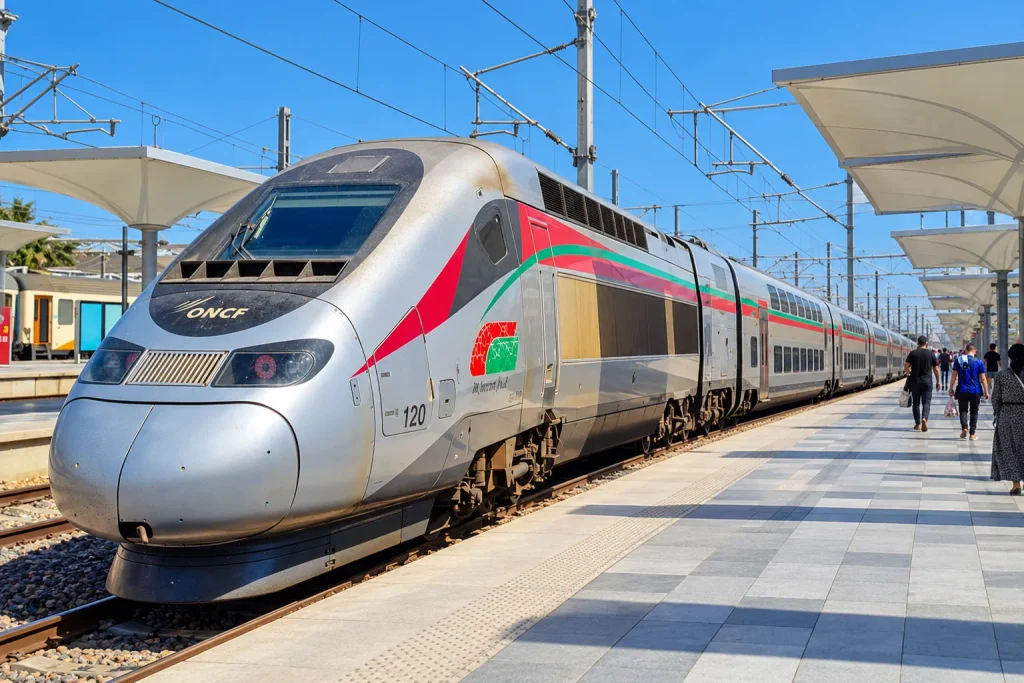
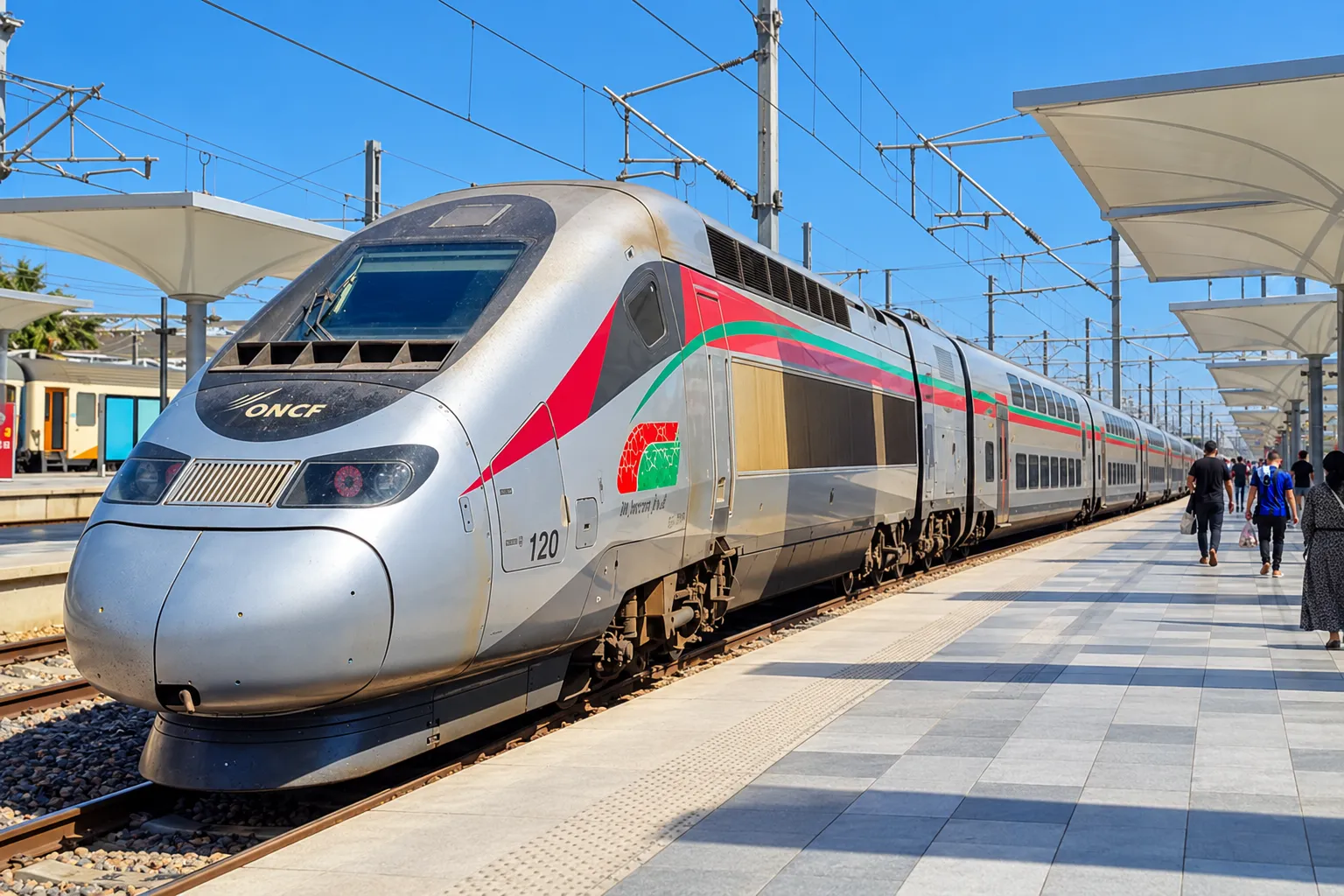
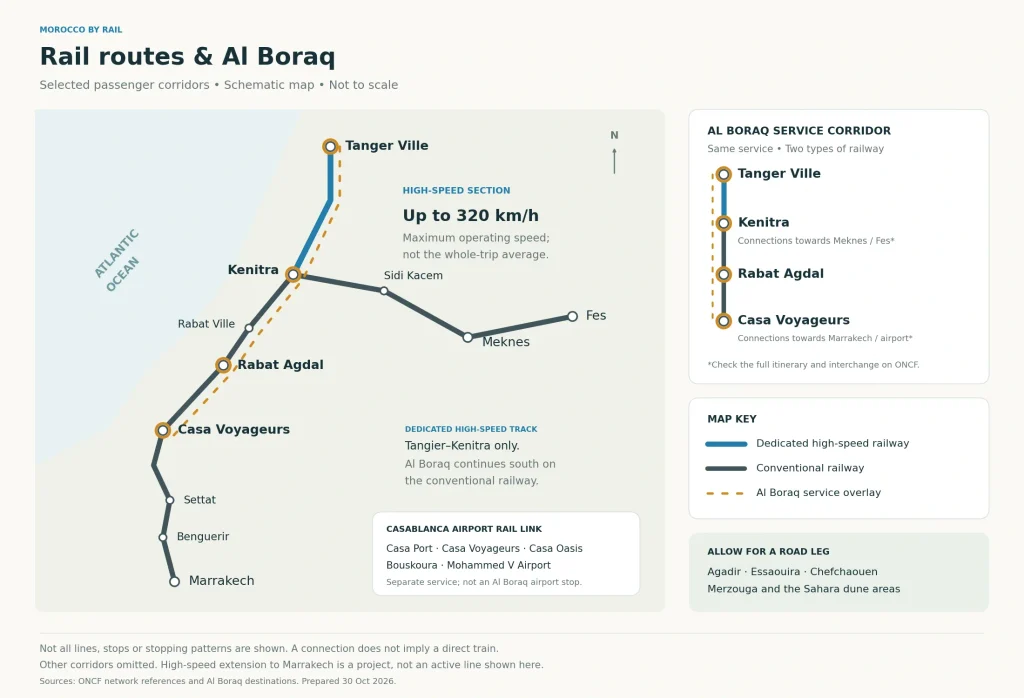
Al Boraq is ONCF’s high-speed passenger service linking Tanger Ville, Kenitra, Rabat Agdal and Casa Voyageurs. It is useful for a rail-based journey between the northern gateway, the capital and Casablanca, or as one stage of a longer journey using a connecting conventional train.
The Service Route and the High Speed Line Are Different
The dedicated high-speed line runs between Tangier and Kenitra. Al Boraq trains continue south on the conventional network to Rabat and Casablanca. You do not necessarily change trains at Kenitra simply because the high-speed infrastructure ends there.
The service can reach 320 km/h on the high-speed section. That is a maximum operating speed, not the average speed of the whole journey. Station stops, the route beyond Kenitra and operating conditions all contribute to the time on your ticket.
Tangier–Casablanca is commonly associated with a journey of around two hours and ten minutes. Treat that as an orientation figure, not a promise for every departure or a calculation of hotel-to-hotel time. Use the arrival shown for the specific train you book.
Choose the Corridor for the Places You Want to Visit
Tanger Ville–Kenitra–Rabat Agdal–Casa Voyageurs is the established Al Boraq corridor. Read the stopping pattern for your departure rather than assuming any train passing your city stops there.
For Tangier and Rabat, the service can connect two worthwhile overnight bases. Casablanca can provide another city stay or a connection, depending on your route. Kenitra is also an important interchange when travelling towards the Meknes and Fes direction.
A short railway journey can make a day visit possible, but compare the outward and return trains with the hours you want in the city. Station transfers and an evening return still occupy part of the day. An overnight stay makes more sense when you want a relaxed dinner or substantial sightseeing.
Connecting Al Boraq with Marrakech and Fes
An itinerary from Tangier to Marrakech may combine Al Boraq with Al Atlas, often using Casa Voyageurs as the interchange. For Fes, inspect the connection offered, including options through Kenitra. Do not assume the same interchange serves every itinerary.
Check the arrival station, onward platform information, connection allowance and reservations for both stages. Changing trains is part of the journey, even when both legs appear in a single search result.
If a seller describes a trip as a high-speed journey to Marrakech, inspect each leg before paying. The description may refer to the Al Boraq portion rather than a high-speed service operating all the way to Marrakech.
The high-speed extension towards Marrakech is a development project. Build travel plans around the operational trains offered for your date, rather than projected future journey times.
Upper Deck or Lower Deck
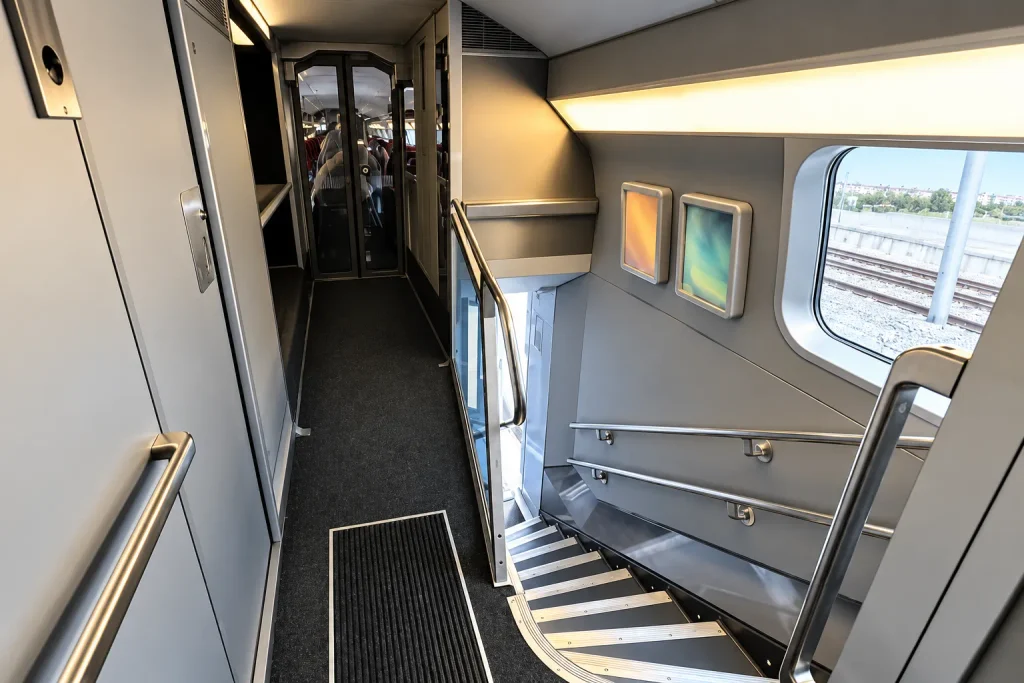
Al Boraq uses double-deck trains. Where the booking system offers a deck choice, compare it with your ability to manage stairs and luggage.
An upper-deck seat can appeal for the view. A lower-deck seat may reduce movement between levels, depending on the coach and facilities you need. Neither choice by itself confirms accessible boarding or wheelchair arrangements.
For a family or group, seats together may matter more than the deck. Inspect the assigned places, including whether they face one another or sit side by side.
Both first and second class use reservations. Your coach, deck where specified and seat belong in your boarding plan; arriving early does not entitle you to occupy another reserved place.
Comfort and Facilities Aboard
Al Boraq provides air-conditioned seating, tables or seat-back work surfaces, electrical outlets and designated luggage areas. First class offers more spacious seating, with configurations that can suit solo travellers or companions.
Choose the class for the space and arrangement you value. It does not change the train’s speed, remove the need to handle bags or guarantee a quiet journey.
Food and drinks are sold aboard through the catering service. Check the menu and availability if you intend to buy something, particularly for dietary requirements. Do not assume a first-class fare includes a meal.
Keep essential information available offline. Power and connectivity are useful additions when available, but neither should be the only way you can display your ticket or contact the accommodation.
First Class Lounge Access
ONCF advertises Al Boraq station lounges for eligible first-class passengers, including qualifying connecting journeys. Confirm the lounge location, opening arrangements and eligibility for your ticket at the station where you intend to use it.
A station lounge is separate from the onboard catering service. Refreshments or Wi-Fi in a lounge should not be interpreted as an included meal or guaranteed internet aboard the train.
Do not add a large fare difference solely for lounge access unless the timing and facilities are useful to your trip.
When Al Boraq Makes More Sense Than Driving or Flying
For travel between its served cities, compare the full rail journey with the full alternative. A flight includes airport access, check-in and onward transport; a drive includes traffic, parking and the exact pickup and drop-off.
Al Boraq can be particularly convenient when you want to move between cities without sightseeing stops on the way. A road journey may fit better when the route itself includes several visits, accommodation outside the cities or luggage that does not suit the train.
The service does not run directly from Casablanca Mohammed V Airport. An airport arrival requires its own train or road connection to the appropriate station. Leave room for flight delays, formalities and the interchange before committing to a fixed Al Boraq departure.
Understand Al Atlas and Regional Trains
Al Atlas is ONCF’s conventional intercity offer, including important journeys on the Casablanca, Marrakech and Fes corridors. Conventional means it uses the ordinary railway network; it does not mean there is no reservation.
Al Atlas provides numbered seats in first and second class. Older advice that describes all second-class travel as a scramble for unreserved seats should not be applied to these reserved services.
A valid booking is tied to the service and conditions shown on the ticket. Do not board an earlier or later train merely because the destination is the same.
TNR, or Trains Navettes Rapides, is a different category of service associated with regional and commuter journeys, including Casablanca-area connections and the Mohammed V Airport link. Use the options and ticket rules shown for the particular departure rather than applying an Al Boraq seat plan to every train.
When comparing search results, separate three things: the route, the train product and the fare. Two departures between the same stations can differ in their stopping pattern, price and reservation arrangements.
Choose the Right Station Before Buying
Station names deserve as much attention as train times. Buying a correct ticket to an inconvenient station can add another ride, while arranging a pickup at the wrong one can leave two people waiting in different places.
Casablanca
Casa Voyageurs is an important intercity and Al Boraq station. Casa Port is a separate station, and Casa Oasis is another possible stop in the city.
Choose from the stations actually served by your proposed train, then compare onward travel to the hotel. Do not substitute one Casablanca station for another in a booking or send a driver only the word Casablanca.
For an airport journey, search the Mohammed V Airport station explicitly. A ticket to Casa Voyageurs is not, by itself, an airport ticket.
Rabat
Rabat Agdal and Rabat Ville are separate stations. Al Boraq uses Rabat Agdal on its established corridor, while other services may offer different stops.
Choose the arrival around both the train and your plans. A station that suits one hotel may not suit another district.
If you are combining a rail stay with Visit Morocco Together’s Rabat Royal Capital Walking Tour, agree the meeting point separately from the railway ticket. A city walking tour should not be assumed to begin at your station.
Tangier
Tanger Ville is the city station to recognise for many rail itineraries. It is not the same place as the city’s ferry terminals.
If you are arriving from Spain, identify the port first. Tanger Med and the central Tanger Ville port involve different onward journeys. A ferry arrival time is not a train boarding time: disembarkation, formalities and the port-to-station transfer come between them.
Fes and Meknes
Fes railway station is outside the historic medina. Include the onward journey to the riad’s vehicle access point and the final walk.
For Meknes, check the station offered by your selected service and compare it with your accommodation or sightseeing plan. Do not assume that a train journey to Meknes includes reaching Volubilis, which requires a separate road journey.
Marrakech
Marrakech station serves the city’s rail arrivals, but it does not place you at every medina riad or outlying resort.
Obtain the hotel’s recommended arrival instructions. A short-looking line on a map may still involve a taxi, a walk and a luggage handover.
How to Buy ONCF Train Tickets
Use ONCF’s official booking website as your starting point for operator information and fares. You can also use ONCF’s station sales channels and its official app.
An independent booking website can sell a ticket, but its domain name or use of railway branding does not make it the operator. Compare the total charge, delivery arrangements and after-sales service before using an intermediary.
Search the actual journey
Enter departure and arrival stations, travel date, passenger details and the class you want to compare. If station names differ slightly from the spelling you know, use the location offered by the booking system and check it carefully.
Read each result as a complete journey. Identify:
- The departure and arrival stations.
- Each train and any coach segment.
- Departure and arrival times.
- Changes and connection time.
- Class and fare conditions.
- The total price for all passengers.
If the journey is not yet on sale, that is different from being sold out. ONCF describes advance sales for Al Boraq up to three months ahead, but actual availability in the booking system determines what you can buy. Do not replace an unavailable future search with a speculative timetable.
Compare the fare before payment
First class and second class describe accommodation aboard the train. Fare conditions describe what you can change or cancel. A first-class ticket is not automatically fully flexible.
Read the conditions for the exact option selected. A lower price may come with tighter restrictions. For a fixed hotel-to-hotel travel day, that can be a reasonable tradeoff; for a departure shortly after an international flight, flexibility may matter more.
Use your own passenger details and only claim a discount for which you qualify. A fare requiring a particular card or eligibility is not the general adult fare.
Check the issued ticket
After payment, look for the actual issued ticket rather than only a payment notification or provisional order.
Review the journey date, train, stations, class, coach and seat where assigned. Save the ticket and booking reference so you can access them without mobile data, and follow the delivery instructions for presenting the ticket.
If payment appears to fail, check the booking status and email before repeating the purchase. A bank authorisation or debit alone does not explain whether the ticket was issued.
When using a station counter, write down the desired stations, date, departure and passengers. Check the printed ticket before leaving the counter.
First Class or Second Class
Second class can be a sensible choice for travellers who mainly need a reserved place between two cities. On Al Boraq and Al Atlas, choosing second class does not mean accepting an unreserved journey.
First class can be worth comparing for seating space and the arrangements available on the particular train. On Al Boraq, the booking options include configurations such as individual seats, side-by-side pairs and facing groups, subject to availability.
“Club 4” describes a four-seat arrangement; it should not be treated as proof of a separate third class with additional hospitality.
Choose around the journey you will take. A solo traveller may value an individual seat. A family may prefer seats together. Someone who wants to rest may prefer a window, while someone who needs to move regularly may find an aisle more convenient.
For a group, inspect the actual assignments before payment. Buying several tickets at the same time is not a reason to ignore the seating plan.
Train interiors vary. Do not expect every conventional train to match a photograph of an Al Boraq carriage, or assume first class includes a meal, reliable internet or a quiet environment.
Prices and Journey Times Without Misleading Comparisons
ONCF fares vary with the route, train, class, departure and fare conditions. A promotional starting price is not the cost of every departure.
For a realistic Morocco travel budget, record the price of the train you are prepared to take. Add travel to the station and onward transport after arrival.
Compare the entire travel period too:
Hotel departure → station approach → boarding margin → train journey → connection if needed → arrival transfer → hotel entrance.
A fast train between Tangier and Casablanca can make rail attractive, but your actual stations and accommodation still determine the total. A Marrakech–Fes journey takes a substantial part of a travel day; it should not be treated like the shorter journey between neighbouring cities.
Avoid planning from a single old timetable or a claim such as “all major cities are a few hours apart.” Read the departure offered for your date and count arrival and departure days honestly when allocating sightseeing.
Price each leg before buying a return solely out of habit. Entering Morocco in one city and leaving from another can reduce backtracking, while a return ticket can still make sense for a genuine return journey.
Arriving at the Station and Boarding
As a practical planning allowance, aim to reach an unfamiliar station around thirty minutes before departure. Allow more if you still need to buy or change tickets, require assistance or expect an awkward approach. This is a planning suggestion, not an official universal boarding deadline.
Read the station display using the train number as well as the destination. A train’s final destination may differ from the intermediate city where you will get off.
Keep your ticket accessible for platform access or inspection. Ask railway staff if the platform or train identification is unclear.
Where coach positioning is indicated, stand near the appropriate place before the train arrives. Do not turn a tight connection into a rush along the full platform with several suitcases.
Once aboard, use the coach and seat assigned. If someone is occupying your place, show the ticket politely and ask staff for help when needed.
Set a reminder before your stop and gather belongings in good time. Wait until the train has stopped before attempting to leave, and do not block doors earlier in the journey.
Luggage on Moroccan Trains
Plan to handle your own luggage between the street, platform and carriage unless assistance has been explicitly arranged.
ONCF’s general conditions of sale and carriage set out baggage requirements. Luggage remains the passenger’s responsibility aboard, including when placed in designated storage. A porter handling your bags does not create a checked-baggage service.
Use the available racks or luggage spaces without obstructing aisles, doors or other seats. Keep passports, medication, tickets and valuables in a small bag you can retain close to you.
For a bicycle, surfboard, pushchair or mobility aid, consult the rules for that item before buying. Size, folding and covering requirements can matter. A surfboard being normal holiday equipment does not make it ordinary cabin luggage on a train.
If you need a porter, agree the assistance and charge first and keep the bags in sight. At your destination, allow time to unload without requiring someone else to carry an unexpectedly heavy case.
Packing so that you can manage each bag independently makes changes much easier, particularly when travelling alone.
What to Expect During the Journey
Bring drinking water and food that suits the journey, especially if dietary needs limit your options. Do not base a long trip on the assumption that a particular meal service will be available.
A light layer can be useful in an air-conditioned carriage. Keep basic toiletries and anything needed during the ride accessible rather than beneath a large suitcase.
Download tickets, accommodation instructions and anything you want to watch or read before departure. A socket is not a guarantee that it will work, and mobile coverage or onboard connectivity should not be the only way you can access essential information.
For remote work, consider the train a place for tasks that tolerate interruption. A fixed video meeting may be difficult if connectivity, noise or seating arrangements do not suit it.
Be considerate about calls, food and photographs. Obtain consent before making another passenger the subject of a picture, and keep bags and feet off seats needed by others.
Connections and Late Arrivals
A journey involving two trains needs more thought than a direct service.
Check where you change, whether both legs appear on the same booking and what assistance applies if the first train is delayed. Do not assume every independently purchased ticket creates a protected connection.
The shortest connection is not always the most useful. Someone with limited mobility, children or several bags may prefer a later departure with a manageable change.
If an itinerary includes Supratours or another coach, identify the boarding location and instructions for that segment. A combined journey can be useful, but you still need to know where the train ends and the road journey begins.
For a late arrival, arrange the hotel approach before boarding. Share the station name and expected arrival with the accommodation. In Fes or Marrakech, the final riad walk may require someone to meet you at an agreed accessible point.
An early international flight deserves its own plan. Avoid depending on the last possible intercity connection when a disruption would leave no workable alternative.
Changing a Ticket or Missing Your Train
Act before departure when you know plans have changed.
Check the fare conditions and use the after-sales channel that applies to the purchase. An online e-ticket and a ticket bought at a station may have different handling arrangements.
Do not assume that a ticket for one reserved train permits boarding the next. If you miss the departure, contact ONCF staff at once to establish your options under that fare.
When the operator cancels or significantly delays a train, ask about the arrangements offered for that disruption. Voluntarily cancelling your trip and responding to an operator cancellation are different situations.
Keep the original ticket, revised ticket and any relevant receipts. If you booked through an intermediary, establish whether that seller must handle the change or refund.
Treat tight onward bookings separately. A changed railway ticket does not automatically resolve a missed hotel night, excursion or flight.
Families and Accessible Rail Travel
For children, enter the correct ages and review the seating and fare options shown. Do not assume one age threshold or seat entitlement applies to every offer.
Book seats together when possible, keep essential supplies in your small bag and choose a journey with enough time to board comfortably. A stroller needs a storage plan once you reach the carriage.
Travellers who need assistance should explain the actual requirement: help through the station, step-free platform access, boarding support, wheelchair space or assistance with luggage.
Confirm arrangements for both departure and arrival, as well as any change. An accessible station entrance does not establish that every stage of the journey is suitable.
Check whether a wheelchair must be folded or whether the booked train has arrangements for remaining in it. Avoid assuming that ordinary baggage acceptance covers the support a passenger needs.
Combine Rail with Places Beyond the Network
Rail and road transport can complement each other without turning the holiday into a packaged circuit.
For Chefchaouen, choose a suitable rail gateway and arrange the onward road journey. For Essaouira, a Marrakech stay can connect with a separately planned coach or transfer. For the Sahara, allow road stages and overnight stops rather than looking for a train to the dunes.
A Fes base also allows a different kind of historical excursion. Visit Morocco Together’s Volubilis and Meknes day trip from Fes describes a road outing to Roman ruins, Moulay Idriss viewpoints and Meknes, returning to Fes. This serves a different purpose from simply buying a train ticket to Meknes.
Decide which experience you want before choosing transport. A city-to-city transfer, a day visiting several sites and a continuous sightseeing route have different time and luggage requirements.
A Nine Day Rail Based City Journey
For nine days and eight nights, a focused example is:
- Nights one and two: Tangier.
- Nights three and four: Rabat.
- Nights five and six: Fes.
- Nights seven and eight: Marrakech.
- Day nine: departure.
The example assumes your flights or other arrival arrangements fit Tangier and Marrakech. It is not a fixed package.
Use day two for Tangier, day three for the move to Rabat and day four for the capital. Day five moves you to Fes, with day six available there. Day seven is a substantial rail travel day to Marrakech; day eight is the full city day.
For a guided introduction during the first stay, Visit Morocco Together’s Tangier medina and kasbah walking tour focuses on the old city and viewpoints. Place it on the full Tangier day, with the meeting arrangements confirmed separately from your train.
If that pace feels busy, remove one city or add nights. Do not insert Chefchaouen, Essaouira and the Sahara into the same nine days simply because road connections exist.
The Morocco imperial cities guide helps if Rabat, Meknes, Fes and Marrakech are the main reason for travelling. Choose the places first, then let the rail timetable support the route.
Questions About Train Travel in Morocco
Can foreign visitors buy ONCF tickets?
Yes. Use the official sales channels and enter the passenger information requested. If an online payment does not work, check whether a ticket was issued before trying again and use another official sales option when necessary.
Is second class unreserved?
Not universally. Al Boraq and Al Atlas offer reserved seats in second as well as first class. Follow the particular ticket rather than older descriptions of Morocco’s entire second-class system.
Does Al Boraq go to Marrakech or Fes?
Do not book on that assumption. The established Al Boraq corridor links Tangier, Kenitra, Rabat Agdal and Casa Voyageurs. A longer itinerary can require a conventional train for another leg. Check the operational service shown for your date.
Can you reach Agadir, Chefchaouen or Merzouga entirely by train?
Those destinations require a road stage under the established network. Check whether any offered itinerary combines train and coach, and identify the transfer point.
Should you buy tickets in advance?
Advance purchase is useful for a particular departure, seats together or a restricted travel day. Availability can tighten around holidays and busy travel periods. Buying on the day does not guarantee the train or seating you want.
Is there a night train for my route?
Search the actual date and inspect the accommodation offered. A late departure or overnight arrival does not establish a sleeper berth. Do not reserve a trip around an old description of a night service without a current bookable option.
Can you explore Morocco without renting a car?
Yes. A city itinerary can combine rail, local transport and walking, with coaches or arranged road journeys for places beyond the network. The useful question is whether each connection fits your accommodation, luggage and time.
Ready to Experience Morocco?
Turn this inspiration into your next adventure. Our travel experts are ready to help.