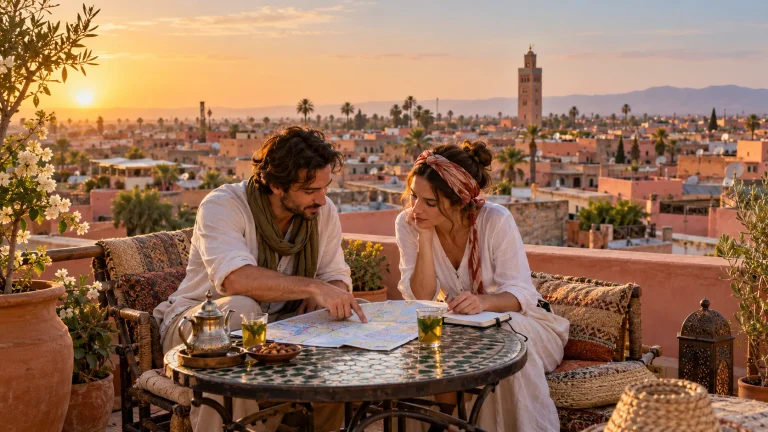
Choosing Morocco destinations is easier when you plan by region instead of collecting pins on a map. A practical Morocco destinations guide groups medinas, Atlantic towns, mountain valleys and Sahara routes by pace and by the kind of travel each needs.
The right Morocco destinations depend on what you want from the trip: city history, coast, hiking, desert, or a mix. This guide compares regions, realistic route pairings and how to protect time for the journeys between them.
Morocco Destinations at a Glance
| Travel area | Places to consider | Best suited to |
|---|---|---|
| North and the Rif | Tangier, Tetouan, Chefchaouen, Akchour | Mountain scenery, medinas and a slower northern route |
| Imperial cities | Fes, Meknes, Rabat, Marrakech | Architecture, markets, museums and historic quarters |
| Casablanca–Rabat corridor | Casablanca, Rabat | A practical arrival or departure route with city and heritage stops |
| Atlantic coast | Essaouira, Oualidia, Agadir, Taghazout | Ocean air, seafood, surfing and quieter days |
| Atlas Mountains | Imlil, Ourika Valley, Ifrane, Azrou | Hiking, village visits and cooler mountain scenery |
| Southern kasbah route | Ait Ben Haddou, Ouarzazate, Skoura, Dades Valley, Todra Gorge | Earthen architecture, valleys and scenic drives |
| Sahara and Draa-Tafilalet | Merzouga, Erg Chebbi, Zagora, M’hamid, Erg Chigaga | Dune landscapes, desert camps and multi-day overland routes |
| South, far south and east | Agadir, Taroudant, Tafraoute, Dakhla, Oujda, Figuig | Anti-Atlas landscapes, remote coast and less-travelled routes |
1. North Morocco and the Rif
The northern route pairs Mediterranean-facing cities with the Rif Mountains. Tangier works well for a city break; Tetouan adds a historic medina; and Chefchaouen is a useful base for blue-lane walks and mountain scenery. If you have an extra day, the nearby Akchour area adds waterfalls and hiking to a city-focused stay. See the Akchour Waterfalls and God’s Bridge day trip for one way to add that outing.
For travelers comparing Morocco destinations in the north, allow around three or four nights if you want to see Chefchaouen and take a day trip without rushing. Add Tangier or Tetouan when the northern cities are a main part of the journey. Mountain roads and stopovers can make this region feel slower than a simple city-to-city map suggests.
Choose the north if: you want a mix of medina time and mountain scenery, or you are building a route that starts in northern Morocco.
2. The imperial cities
Fes, Meknes, Rabat and Marrakech each offer a different city experience. Fes rewards time for its old medina and craft quarters. Marrakech is a busier base for souks, palaces, gardens and day trips. Meknes is a natural addition for travelers interested in historic architecture, while Rabat combines capital-city life with heritage sites.
You do not need to visit all four on one trip. These heritage-focused Morocco destinations work best when you choose two cities that match your interests and give each enough time for a full day in its historic centre. The Fes destination guide and Marrakech destination guide help compare two of the most common starting points. A guided old Fes medina walk can add context to a visit where navigation and layered history are part of the experience.
Morocco has nine properties on UNESCO’s World Heritage List. Among them are the medinas of Fes and Marrakesh, the historic cities of Meknes and Rabat, and the ksar of Ait-Ben-Haddou. The UNESCO country listing is a useful reference if heritage sites are a priority.
Choose the imperial cities if: you want architecture, food, museums, markets and a trip with less emphasis on outdoor activities.
3. Casablanca and the Rabat corridor
Casablanca and Rabat are often more useful as parts of a route than as a checklist of stops. Casablanca offers a modern, coastal city experience and can be convenient at the beginning or end of a trip. Rabat is a calmer city stop with historic quarters and major heritage landmarks. They can be paired with Fes or Meknes, depending on where you arrive and depart. These Morocco destinations make the most sense when they simplify a city route or add a heritage stop.
Plan one or two nights here when the cities themselves interest you or make the route easier. If your time is short, avoid adding a stop solely because it appears on the map; use those nights for a region you would otherwise have to rush.
Choose this corridor if: you want a practical city connection, contemporary Morocco, or a route that includes Rabat’s heritage.
4. The Atlantic coast
The Atlantic is not one uniform beach destination. For travelers comparing Morocco destinations on the coast, each town offers a different pace and type of stay. Essaouira is known for its walled medina, port and breezy coastal atmosphere. Oualidia is a smaller lagoon stop, while Agadir and Taghazout suit travelers looking for a warmer resort or surf-oriented base. Consider the Essaouira destination guide when deciding whether to stay overnight or visit from Marrakech. A Marrakech-to-Essaouira day trip is an option when you have limited time, though an overnight stay leaves more room for the town itself.
Allow two or more nights if the coast is a central purpose of your trip. For a brief visit, choose one coastal town rather than trying to cover several beaches in a single day. Coastal Escapes can fit this region, but it is only one of several useful travel styles: culture, photography, wellness, family travel and outdoor adventure can shape a Morocco route just as much.
Choose the coast if: you want a slower pause between city visits, Atlantic food and views, or a few days built around surfing and beach time.
5. The Atlas Mountains
The High Atlas and Middle Atlas are distinct areas, so choose the one that fits the rest of your route. Imlil is a base for mountain walks and villages in the High Atlas. The Ourika Valley is a common day outing from Marrakech, while Ifrane and Azrou belong to a different, more northerly Middle Atlas route. Some of the best Morocco destinations for hiking are in this mountain region.
If you want a short excursion from Marrakech, compare the Ourika Valley and Setti Fatma day trip with an overnight stay in Imlil. A day trip is enough for a taste of the landscape; a longer stay makes more sense when hiking is a key reason for coming. Check walking difficulty, weather and seasonal access before committing to a route.
Choose the Atlas if: you want hiking, village scenery, cooler air, or a break from medina visits. Mountain Adventures and Off The Beaten Path are examples of tour styles that can suit this area.
6. The southern kasbah route
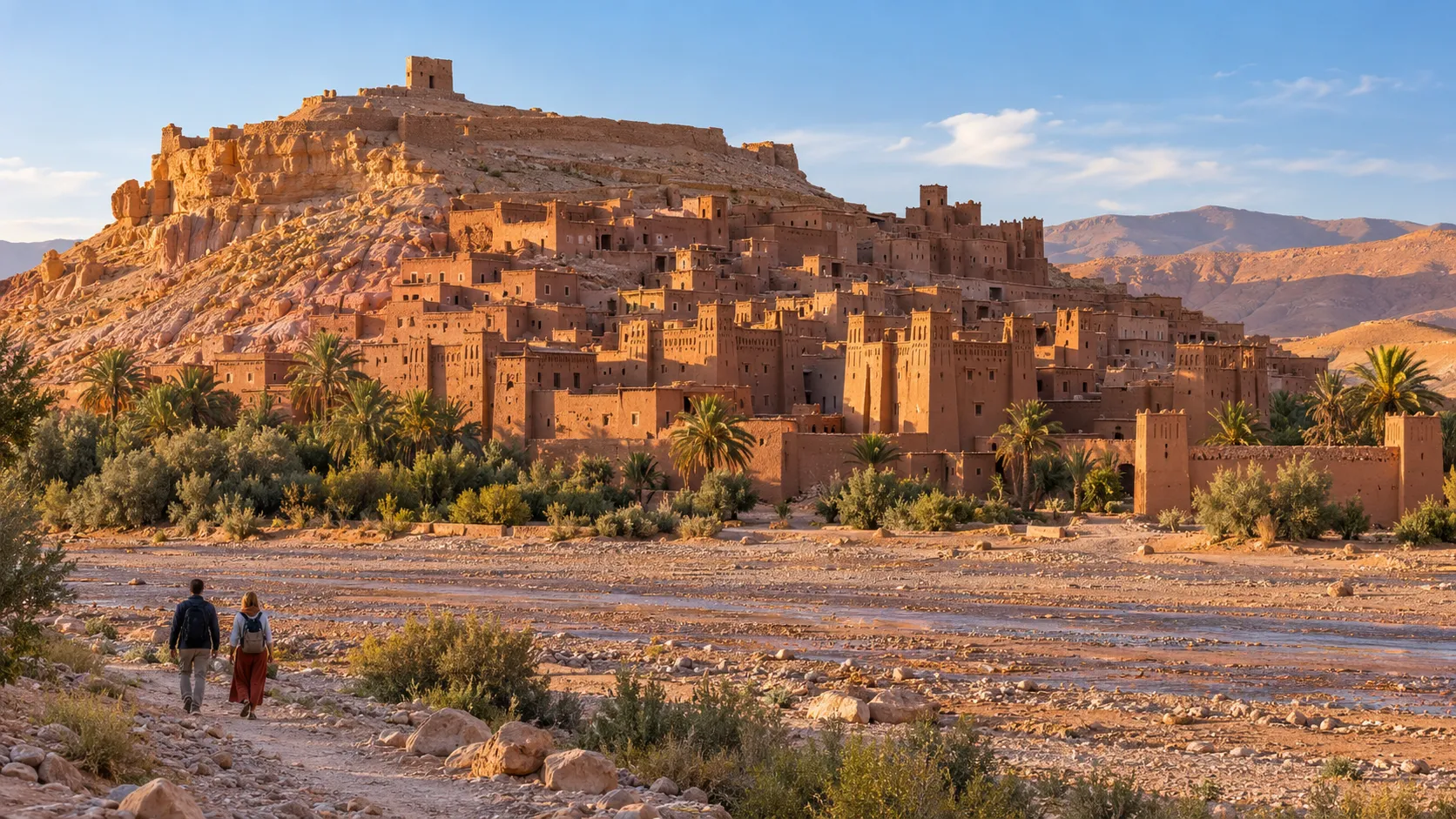
South of Marrakech, the road crosses the High Atlas toward Ait Ben Haddou and Ouarzazate, then continues through palm oases, kasbahs and valleys such as Skoura and Dades. This route is as much about the journey as the stops: viewpoints, changing landscapes and smaller overnight bases give the drive its shape. A few connected Morocco destinations make a stronger itinerary here than a rushed list of stops.
Ait Ben Haddou is a strong anchor for the historic ksar and surrounding scenery. If you are short on time, the Ait Ben Haddou and Ouarzazate day trip from Marrakech covers a long day on the road. With more time, continue south and stay overnight rather than treating every valley as a photo stop.
Choose this route if: you enjoy road journeys, historic earthen architecture, film locations and mountain-to-desert landscapes.
7. The Sahara and Draa-Tafilalet
A Sahara visit needs more planning than a day trip. Merzouga and the Erg Chebbi dunes are a familiar choice for travelers combining the desert with Fes or Marrakech. Erg Chigaga, reached through the south near M’hamid, is more remote and calls for additional road time. Zagora and the Draa Valley offer a different mix of oasis landscapes and desert-edge towns. For travelers choosing Morocco destinations for dune landscapes, the route and available time matter as much as the camp itself.
Use Merzouga as a destination anchor, then decide whether the desert belongs in a north-to-south route or a separate trip. A three-day Marrakech-to-Fes route via the Sahara shows how a desert segment can connect major cities, but it is still a multi-day journey with substantial time on the road. Desert Expeditions fit this region; a nearby rocky landscape such as Agafay should not be presented as the Sahara.
Choose the Sahara if: dunes and an overnight desert camp are among your main reasons for visiting. Leave enough time for the road journey and the experience itself.
8. The south, far south and eastern Morocco
Agadir, Taroudant, Tafraoute and Tiznit can form a southwest route that combines the coast with Anti-Atlas scenery and smaller towns. Dakhla is a much farther-south destination and works better as a separate trip or a deliberate extension than as a quick add-on to Marrakech or Fes. Visit Morocco Together’s Dakhla destination page outlines the region’s lagoon and desert-coast setting.
Eastern Morocco, including Oujda and Figuig, is also best planned around its own priorities. It sits outside the usual north-to-south visitor loop, so check transport and overnight options before adding it to a packed itinerary. These less-travelled Morocco destinations are a good reason to look beyond the most familiar tour labels: Off The Beaten Path, cultural, family and nature-focused trips may all lead to different route choices.
Choose the south or east if: you have already picked your main city or desert route and want to make a particular coastal, Anti-Atlas or remote-region stop the focus.
Choose Morocco Destinations by Trip Length
Use trip length to choose the number of regions, not just the number of cities. A small number of well-connected Morocco destinations usually makes for a more comfortable itinerary than a long list of far-apart stops.
| Time available | A realistic starting point |
|---|---|
| 3–5 nights | Base yourself in one city and add one nearby day trip. Marrakech with the Atlas or Essaouira is one example. |
| 6–9 nights | Connect two areas, such as Fes and Marrakech, or Marrakech and the southern kasbah route. Keep an eye on travel time. |
| 10–14 nights | Add a third area or a multi-day Sahara route. Choose which long transfer is worth the time. |
| 15 nights or more | Consider a broader north-to-south route, then add a coast, Anti-Atlas or far-south extension if it fits your priorities. |
These are planning ranges, not fixed rules. A hiking trip, a family holiday and a fast city itinerary need different pacing. Give multi-day road segments their own space instead of counting them as ordinary sightseeing days.
How to Build a Route That Works
- Choose your arrival and departure cities first. This sets the direction of the trip and can prevent backtracking.
- Pick two or three anchor regions. Choose Morocco destinations that connect naturally, then add nearby stops only when they support the reason you chose that area.
- Separate travel days from sightseeing days. A long drive across the Atlas or toward the Sahara changes how much you can comfortably do.
- Match transport to the terrain. Check current options for each leg; mountain valleys and desert routes need road-based planning, and long transfers deserve their own buffer. Confirm schedules and conditions close to travel.
- Choose activities to support the route. A guided medina walk, a waterfall outing, a coastal day or a desert overnight answers a different travel need. Visit Morocco Together lists several trip types, including Cultural Discoveries, Mountain Adventures, Desert Expeditions, Coastal Escapes, Photography Journeys, Family Adventures and Wellness & Retreats. Select the types that fit the route rather than trying to use every category.
If your visit is connected to the 2030 FIFA World Cup, use the official match calendar as the anchor for your dates once FIFA publishes it, then add nearby sightseeing. FIFA has named Morocco, Portugal and Spain as co-hosts and confirmed one centenary match each in Argentina, Paraguay and Uruguay. Check FIFA’s official World Cup 2030 page for official tournament updates; do not assume a particular Moroccan city will host a match.
Frequently asked questions
What are the best Morocco destinations for a first trip?
Marrakech, Fes, Chefchaouen, the Sahara and one Atlantic town are common choices, but most first trips should select only a few. The best Morocco destinations for you depend on your available time and whether you prefer city history, nature, desert or coast. Choose cities for medina and heritage time, the Atlas for outdoor scenery, the Sahara for a multi-day desert route, and the coast for a slower stay.
How many days do I need to explore Morocco destinations?
A few days can support one city and a nearby outing. A week works better for two or three connected Morocco destinations. Around ten days or more gives you room to add a longer route, such as the Sahara, without turning every day into a transfer.
Can I see Marrakech, Fes and the Sahara in one week?
It can be done as a fast route, but the Sahara leg uses several days. Marrakech, Fes and the Sahara are three Morocco destinations with substantial travel time between them. Decide whether the desert is a priority; if it is, reduce the number of other stops and protect time for the road journey.
Is the Sahara close enough for a day trip from Marrakech?
No. A proper Sahara visit involves a multi-day road itinerary. Agafay is a closer rocky landscape near Marrakech, but it is not the Sahara’s large dune environment.
Should I choose Merzouga or Erg Chigaga?
Merzouga is a practical choice for the classic Erg Chebbi dune experience and routes that connect with Fes or Marrakech. Erg Chigaga is more remote and suits travelers prepared to spend longer getting there. Choose by route and available time, not by photos alone.
Is Essaouira worth an overnight stay?
Yes, if you want time for the medina, port, food and coast at a slower pace. A day trip from Marrakech is possible, but an overnight stay gives you more flexibility.
Which Morocco region is best for hiking?
The High Atlas around Imlil is a strong option for mountain walking. For mountain-focused Morocco destinations, start with Imlil or the Rif around Chefchaouen and Akchour. The Rif around Chefchaouen and Akchour also suits travelers who want hikes alongside smaller-city stays. Match the route to your experience and check current conditions.
How should I plan a Morocco trip around the 2030 World Cup?
Start with official match dates and locations when FIFA publishes them, then build sightseeing around the confirmed base cities. Morocco is one of three co-hosts, so avoid booking a route on the assumption that a particular city will have a match.
Plan around the places you care about most
Morocco’s regions are easier to enjoy when the route leaves room for the road between them. The best Morocco destinations are the ones that fit your available days and the experiences you want most; let the trip length determine what fits. If you want help combining several areas into one practical itinerary, Visit Morocco Together can help plan a custom Morocco trip.
Ready to Experience Morocco?
Turn this inspiration into your next adventure. Our travel experts are ready to help.