A Morocco shopping guide should help you do more than decide which souvenir looks good in a market stall. Shopping in Morocco can include traditional medina souks, working artisan workshops, spice markets, contemporary design shops, cooperatives and modern fixed-price stores. The best approach depends on what you want to buy, where it was made, how much space you have in your luggage and whether the purchase needs special packing or shipping.
Moroccan markets are also worth exploring when you do not intend to buy anything. Marrakech, Fes, Rabat, Essaouira, Chefchaouen, Safi, Tiznit and smaller regional towns all offer different combinations of food, crafts and everyday trade. This guide explains which souks suit different interests, what to buy in Morocco, how to assess rugs, leather, pottery, silver and spices, how bargaining works and what to check before taking a purchase home.
Morocco Shopping Guide: Where Should You Begin?
Start with the type of item you genuinely want instead of approaching every market as a place where you need to find a bargain. A rug that may need shipping requires different planning from spices, slippers or a small ceramic bowl.
Before shopping, decide three things: what kind of product interests you, how much luggage space you can give it and what you are comfortable spending in total. For larger purchases, include packing, shipping and possible import charges in that budget.
It also helps to decide what kind of shopping experience you want. Some travelers want to see artisans at work. Others mainly want to compare finished products, explore a spice market or purchase a practical gift without negotiating for an hour.
| What interests you | Where to start | What to check |
|---|---|---|
| Rugs and textiles | Souks, specialist shops and weaving workshops | Dimensions, fibre, condition, care and shipping |
| Leather | Fes, Marrakech and other medina craft areas | Stitching, hardware, lining and actual material |
| Pottery | Safi, Fes, Rabat-Salé and ceramic shops elsewhere | Cracks, glaze, intended use and packing |
| Silver and jewellery | Tiznit and established jewellery workshops | Metal description, weight, stones and receipt |
| Spices and food gifts | Medina spice shops and food markets | Ingredients, packaging, freshness and import rules |
| Homewares and metalwork | Artisan lanes, workshops and design shops | Construction, weight, finish and transport |
Best Souks and Markets in Morocco

The best Moroccan market is not necessarily the largest one. Each city has a different combination of products, workshops, food and everyday commerce. Choose markets that already fit your travel route instead of crossing the country for a claimed bargain.
Marrakech Souks
Marrakech is one of the easiest places to compare many categories in a single area. The medina souks contain textiles, leather goods, lanterns, ceramics, slippers, rugs, spices, baskets, clothing and household items.
The market network spreads through numerous lanes rather than functioning as one single enclosed shopping center. Historically, different trades were concentrated in particular areas, although product boundaries are now much more mixed.
Marrakech is particularly useful if shopping is only one part of your holiday because you can compare many styles without adding another city to the itinerary.
If you want help navigating different craft areas, the Marrakech Souks Guided Shopping Tour focuses on spice markets, leather workshops and artisan stalls.
Fes Medina
Fes is particularly interesting when you want to see craftsmanship in the context of a historic working medina. Leather goods, metalwork, ceramics, textiles and other crafts appear throughout Fes el-Bali.
The tanneries provide context for one stage of leather production, but seeing a tannery does not prove that a particular handbag, belt or pair of slippers was produced there. Ask about the specific item you are considering.
Fes is also strongly associated with ceramics and zellige traditions. When purchasing pottery, inspect the individual piece rather than relying on the city’s reputation alone.
Rabat and Salé
Rabat offers a useful mixture of traditional shopping and contemporary retail. The medina and Rue des Consuls are natural areas for a craft-focused walk, while other parts of the capital provide fixed-price and modern shopping.
Across the river, Salé is also associated with pottery, metalwork and other craft traditions. This makes Rabat and Salé particularly useful if you want traditional shopping without building the whole trip around one large tourist souk.
A Rabat souks shopping tour is available for travelers who want a guided introduction to old-medina crafts and spice shops.
Essaouira
Essaouira combines a compact medina with workshops, galleries and craft shops. Shopping here can feel easier to navigate than the much larger market networks of Marrakech and Fes.
The city has a long association with woodworking and thuya marquetry, as well as jewellery, textiles and contemporary art. If you buy a wooden object, ask what wood was actually used rather than assuming every carved piece is thuya.
Essaouira is a particularly good place to browse slowly because shopping can be combined with the port, ramparts, galleries and Atlantic coast rather than occupying the entire day.
Chefchaouen
Chefchaouen’s compact medina contains textiles, wool products, clothing, ceramics and everyday goods alongside visitor-oriented shops. It works best as part of a northern Morocco itinerary rather than as a destination chosen exclusively for shopping.
Browse for items you genuinely like instead of assuming a particular color, design or pattern proves that the product was made in Chefchaouen.
Safi
Safi is one of the clearest choices if pottery and ceramics are the main reason for your shopping stop. The city has a strong ceramic tradition and gives travelers a chance to compare decorative work with practical vessels.
Ask whether an individual item is intended for decoration, serving food or cooking. Those uses are not interchangeable simply because an object is shaped like a tagine or bowl.
Tiznit
Tiznit is strongly associated with silver jewellery and works well for travelers already exploring Agadir, the Souss or southern Morocco.
City reputation does not replace checking the individual piece. Ask about metal composition, weight where relevant, repairs, resizing and what information will appear on the receipt.
Travelers who specifically want workshop context can consider the Tiznit Silver Jewelry Shopping Tour.
Rissani and Regional Markets
Not every worthwhile Moroccan market is primarily aimed at souvenir shopping. Regional markets can combine food, household goods, clothing, livestock-related trade and products used by local residents.
If your itinerary reaches southeastern Morocco, Rissani provides a different market experience from the large imperial-city souks. Visit for the trading atmosphere rather than expecting it to function like a Marrakech souvenir market.
Souk, Workshop, Cooperative or Fixed-Price Store?
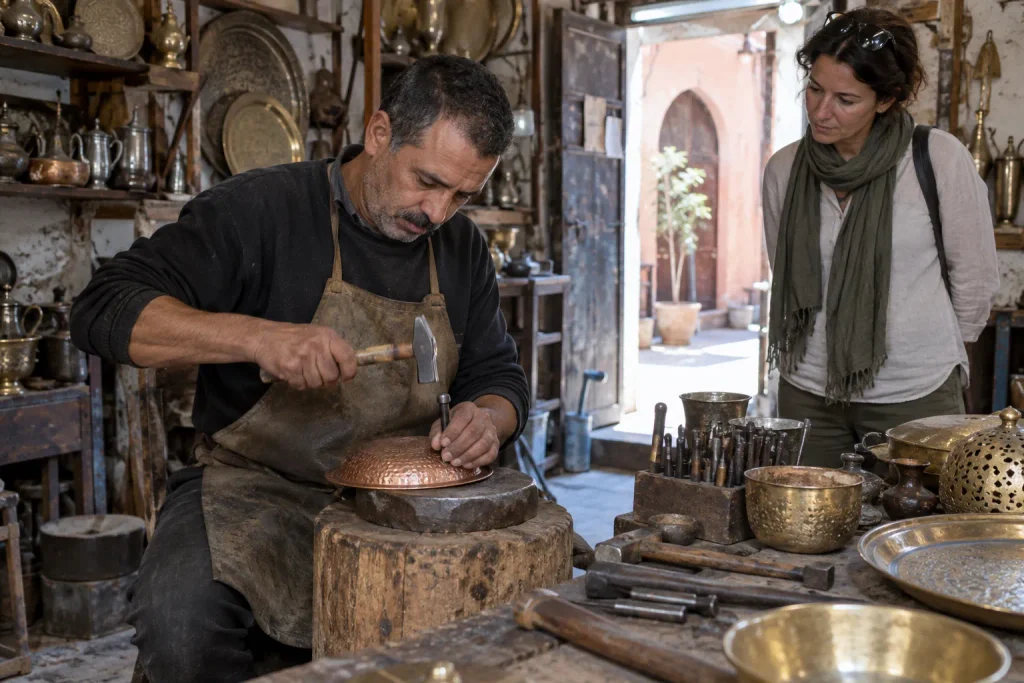
Different shopping environments answer different needs. There is no single place that is automatically more authentic or better value.
Souks and Medina Shops
Souks are useful for comparison. You can see different versions of rugs, leather goods, lamps, pottery, jewellery and textiles within a relatively small area.
Some shopkeepers also make products. Others source them from independent workshops, other Moroccan regions or wholesalers. Ask about the particular object rather than assuming everything displayed in a medina was made behind the shop.
Artisan Workshops
A workshop can help you understand how an object is made and what tools or materials are involved. Some workshops also sell directly, while others mainly produce for shops.
Ask before entering working spaces or photographing craftspeople. If you are visiting as part of a guided activity, it is reasonable to ask whether buying anything is optional.
Cooperatives and Producer Groups
A cooperative can provide useful information about production and makers, but the word itself is not proof of quality, origin or how revenue is distributed.
Ask who belongs to the group, where production takes place and whether the item in your hand was actually made by members of that organization.
Fixed-Price Shops and Modern Retail
Fixed-price stores are useful when you do not want to bargain. They may also make labeling, receipts and card payments easier.
Contemporary boutiques can be worthwhile if you prefer modern Moroccan design rather than traditional souvenir styles. Traditional craftsmanship and contemporary design increasingly overlap, particularly in larger cities.
Moroccan Spice Markets: What to Know Before Buying
Spice markets are one of the most recognizable parts of shopping in Morocco. Large baskets and containers may hold cumin, paprika, cinnamon, turmeric, dried herbs, teas and spice mixtures alongside soaps, oils, perfumes and cosmetic products.
However, a colorful display should not be confused with proof of quality. Buy according to smell, labeling, ingredients, freshness and how you intend to use the product.
Ras el Hanout
Ras el hanout is a spice blend rather than one standardized recipe. Mixtures can differ considerably between sellers, so ask what is included if the ingredients matter to you.
This is particularly important if you have allergies or dietary restrictions. A shopkeeper’s description of a blend is more useful than assuming every packet with the same name contains the same ingredients.
Saffron
If you are specifically shopping for saffron, look at the actual product and ask what you are buying rather than judging it by color alone. Whole threads and ground products are not the same thing.
If origin is important to you, ask for specific information about where the saffron was produced rather than assuming that anything sold in a Moroccan spice market was grown locally.
Cumin, Paprika and Everyday Spices
Common cooking spices can make useful gifts because they are relatively easy to pack. Ask whether the spice is whole or ground, smell it when appropriate and buy an amount you can realistically use.
For blends, ask what is included. For individually packaged products, check the seal and any available producer or date information.
Spice Markets Are More Than Souvenirs
The sensory experience described in traditional souks comes from more than spices. Food, herbs, bread, textiles, metalwork and everyday shopping all overlap in Morocco’s medinas and markets.
Take time to observe before buying. Asking a vendor how a spice is commonly used can be more useful than simply purchasing several packets because the display looks attractive.
What Are the Best Things to Buy in Morocco?
There is no essential Moroccan souvenir. The best purchase is something you genuinely like, understand and can transport home safely.
Rugs and Textiles
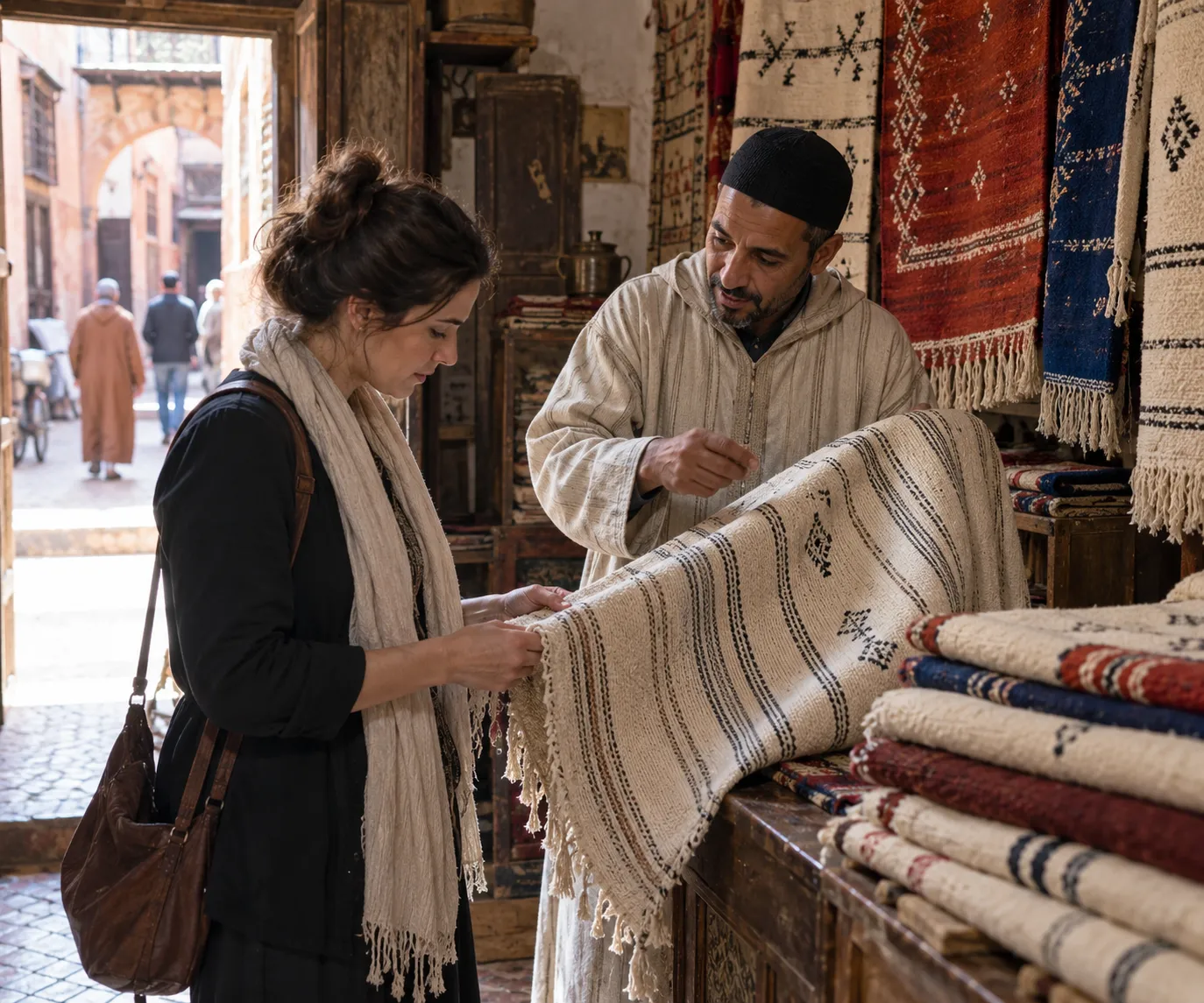
Before shopping for a rug, measure the space where you plan to use it. In the shop, confirm the exact dimensions, fibre content, construction, condition and care requirements.
Ask whether the rug you are inspecting is the exact piece that will be packed or shipped. If it will leave the shop separately from you, photograph the front, back and any distinctive details.
Regional names and design descriptions can provide context, but they should not substitute for information about the particular rug.
Leather Goods
Moroccan souks sell bags, belts, wallets, slippers and other leather products across a wide range of quality levels.
Inspect stitching, lining, edges, zippers, buckles and other hardware. Ask what type of leather is used and how the item should be cared for.
If buying slippers or a belt, try the size before leaving. Handmade sizing and finishing can vary between individual items.
Ceramics and Pottery
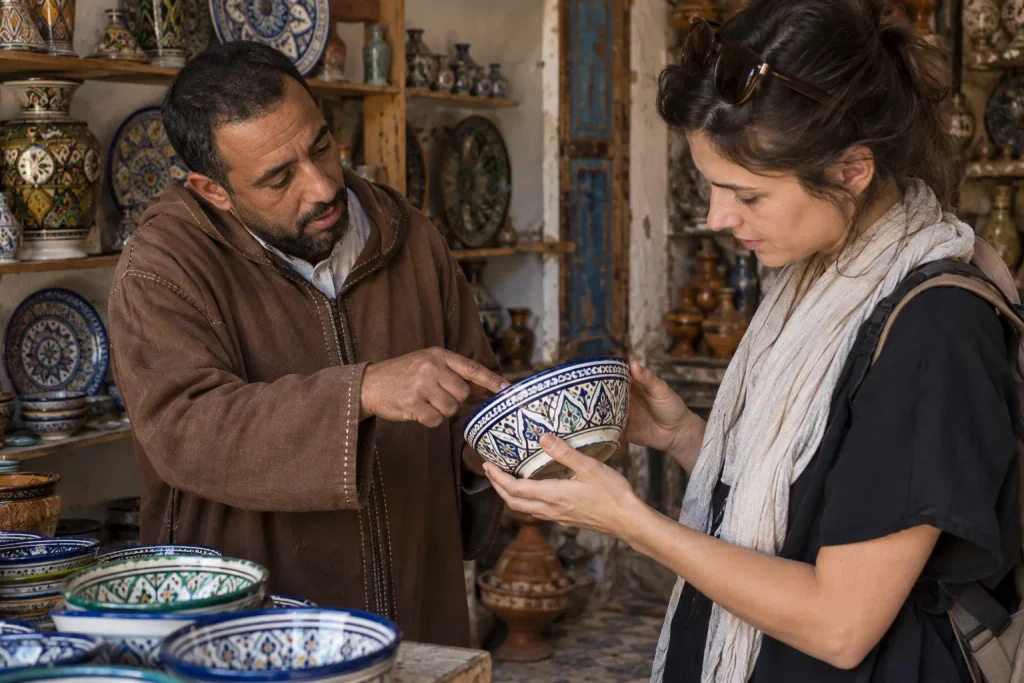
Inspect ceramic pieces for chips, cracks, stability and surface finish. Fragile pieces should also be considered in terms of how you will transport them.
A decorative tagine is not automatically cookware. If you intend to heat, cook or serve food in an item, ask the seller or maker to clarify its intended use and any care requirements.
When that information is uncertain, use the piece decoratively rather than assuming it is suitable for cooking.
Jewellery and Silverwork
Jewellery can range from inexpensive decorative pieces to higher-value silverwork. Ask what metal is being sold, whether stones or beads are natural or manufactured when that affects your decision, and whether the shop provides adjustments or repairs.
For a more valuable piece, request the material description on the receipt. Appearance alone cannot confirm metal content.
Lanterns and Metalwork
Lanterns, trays, mirrors and decorative metal objects are widely available, particularly in larger medinas.
Check joins, sharp edges, stability and overall finish. For electrical lighting, consider whether the fittings are appropriate for your home rather than assuming a decorative fixture can be installed unchanged.
Weight and shape matter if you intend to fly with the object, so decide how it will be packed before completing a large purchase.
Thuya Wood and Woodwork
Essaouira has a strong association with thuya wood and marquetry. Boxes, tables and decorative objects can be found throughout the medina.
Ask what type of wood was used in the particular object and how it should be maintained. Do not identify the wood only from smell or appearance if the material matters to the value of the purchase.
Argan Oil
Argan products are available for both culinary and cosmetic use. Check which type you are buying and read the ingredients if the product includes more than argan oil.
Look for sealed packaging, producer information and available date markings. Do not rely only on words such as “organic,” “pure” or “cooperative” without checking what is actually written on the product.
Spices and Food Gifts
Spices, tea ingredients and other food products are relatively easy to pack, but destination-country import rules still matter.
Choose clearly identifiable packaging where possible, especially for powders, herbs and blends. Check ingredient information if allergies are relevant.
How to Judge Handmade Crafts and Product Origin
Morocco has genuine regional craft traditions, but a product being sold in a famous craft city does not prove that it was made there.
The Moroccan National Tourist Office identifies regional associations including pottery in Safi, Fes and Rabat-Salé, leatherwork in Fes, thuya woodcraft in Essaouira, silverwork in Tiznit and other southern cities, and various carpet and metalworking traditions across the country. You can read its overview of Moroccan traditional craftsmanship for background.
Use regional traditions as a guide to where you might want to shop, then ask specific questions about the object you are considering:
- What material is this item made from?
- Where was this particular piece produced?
- Who made it?
- Which parts were handmade, if any?
- How should it be cleaned, maintained or repaired?
- Can those details be written on the receipt for a valuable purchase?
Terms such as “authentic,” “antique,” “handmade,” “natural” and “organic” are most useful when the seller can explain exactly what the term means for the item in front of you.
How Bargaining Works in Moroccan Souks
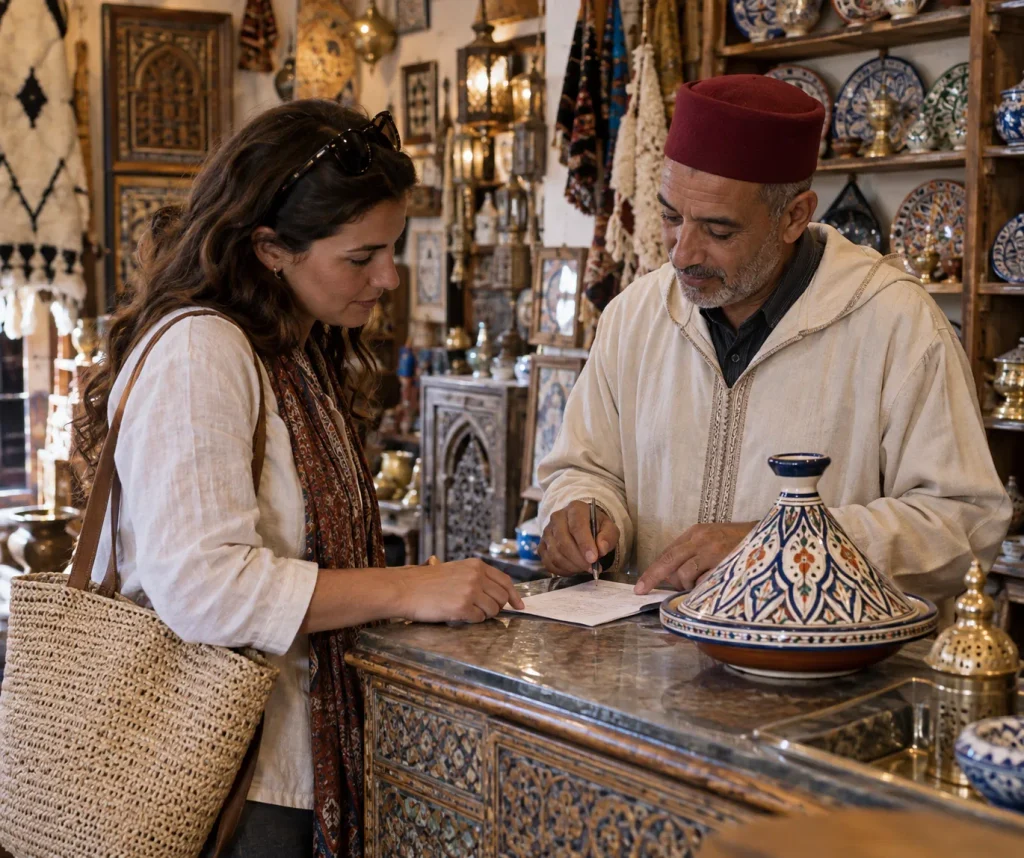
Bargaining is common in many traditional souks, but not every shop expects it and there is no universal percentage that tells you the correct final price.
A better approach is to compare genuinely similar items first. Once you know what you want, ask for the price and negotiate only if you are seriously interested in buying.
- Ask about the exact item rather than a general product category.
- Compare size, material and quality before comparing prices.
- Decide what you are willing to pay before negotiations become lengthy.
- Make a counteroffer politely rather than treating the interaction as a contest.
- If you cannot agree on a price, thank the seller and leave.
- Do not assume that accepting tea obligates you to purchase anything.
Fixed-price shops work differently. If prices are clearly displayed, treat them as fixed unless staff indicate otherwise.
Cash, Cards and Receipts
Carry some Moroccan dirhams for smaller purchases because card acceptance varies between sellers. Larger or more established shops may accept cards, but confirm before relying on that payment method.
When paying by card, check the amount and currency displayed before confirming the transaction. If a seller mentions an additional card charge, clarify it before payment.
For any expensive item, ask for an itemised receipt. Useful details include the seller’s name and contact information, the description of the item, material where relevant, price and any delivery or shipping agreement.
Photograph important receipts and keep the originals until the purchase is safely home.
How to Shop Without Feeling Pressured
The easiest way to reduce shopping pressure is to make your first walk through a market a research visit. Look at products, ask questions and compare several shops before deciding whether to buy anything substantial.
You can politely say that you are only looking. If a seller continues pushing a sale after you have declined, leave rather than entering a negotiation you do not want.
If you are shopping with a guide, explain what you want beforehand. You may be more interested in understanding craftsmanship than buying, or you may have one specific item you want help locating.
Ask whether planned shop visits are optional. A guide can help with orientation, translation and context, but the decision to enter a store or make a purchase should remain yours.
Visiting Moroccan Markets as a Cultural Experience
The souks are not only souvenir centers. Many traditional markets combine shops for visitors with food stalls, household goods, clothing, workshops and everyday services used by residents.
Watch how the atmosphere changes between streets. One lane may contain textiles, another metalwork, and another food or household products. In older medinas, the transition between trades can sometimes be more interesting than reaching one famous shop.
When a workshop is clearly open to visitors, take time to understand the process instead of focusing only on the finished object. Ask before taking close photographs of craftspeople or their workspace.
You do not need to buy something for a market visit to be worthwhile.
How to Carry or Ship Moroccan Purchases Home
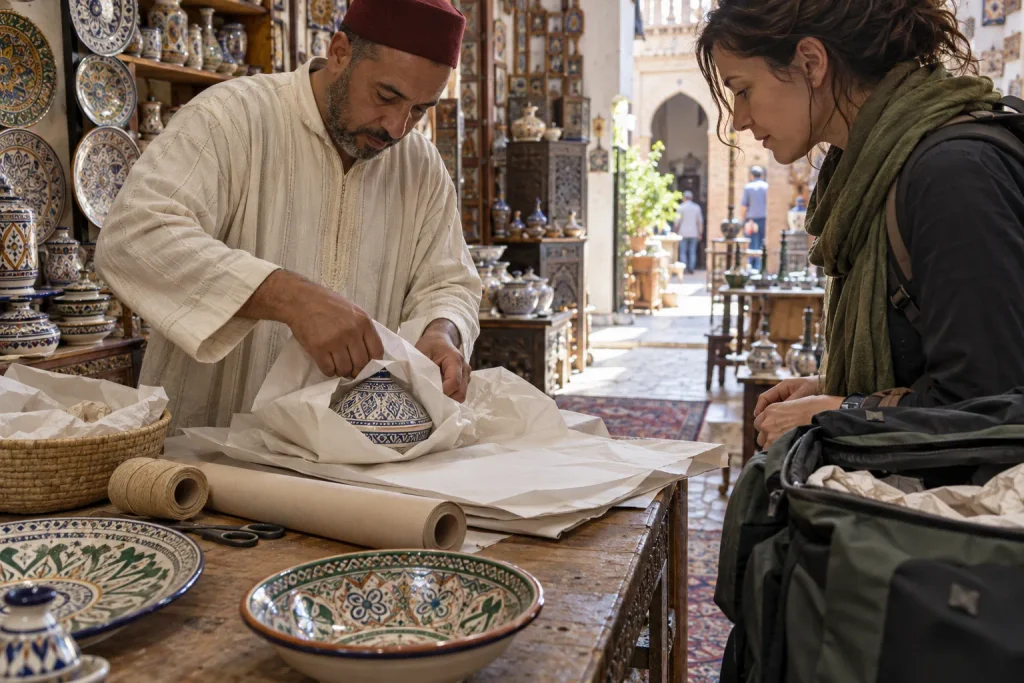
Think about transportation before paying for anything large, fragile or heavy. Airline baggage rules, shipping charges and customs requirements can turn an inexpensive object into a complicated purchase.
Taking Purchases in Your Luggage
Check your airline’s current size and weight limits. Ask for protective packing for ceramics, metalwork and other fragile pieces, but remember that a shopkeeper cannot guarantee what an airline will accept.
Leave luggage space for purchases instead of filling your allowance early in the trip.
Shipping From Morocco
If a seller offers international shipping, request the details in writing before paying. Ask about:
- Carrier or delivery service
- Parcel dimensions and approximate weight
- Tracking
- Insurance
- Dispatch timing
- Customs paperwork
- Who handles a damage or loss claim
- Whether duties and taxes at the destination are included
Photograph the exact item before it is packed, especially when purchasing a unique rug, artwork or handmade object.
Customs and Import Rules
Rules depend on both the product and your destination country. Food, plants, animal products, antiques and commercial quantities may be treated differently from ordinary souvenirs.
For questions about taking goods out of Morocco, check Morocco’s customs administration. You should also check the customs, agriculture or border authority of the country where you will arrive.
Do this before paying when the purchase depends on being legally shipped or carried home.
What Not to Assume When Shopping in Morocco
Several common assumptions can lead to disappointing purchases.
- A product sold in Marrakech was not necessarily made in Marrakech.
- A shop beside a tannery did not necessarily make every leather item it sells.
- A sign saying “cooperative” does not automatically prove who made the product.
- A handmade appearance does not establish age, origin or material.
- A decorative tagine is not necessarily safe cookware.
- A silver-colored object is not automatically silver.
- Every ras el hanout blend does not contain the same ingredients.
- Every traditional souk does not require bargaining.
- A seller offering international shipping does not mean import taxes are included.
Specific questions are more useful than assumptions.
How to Plan Shopping Around Your Morocco Route
You do not need to visit every famous souk in the country. Shopping works better when it fits naturally into destinations you already want to see.
| Your route | Useful shopping focus | Why it works |
|---|---|---|
| Marrakech only | Broad mix of crafts, rugs, leather, spices and homewares | Easy to compare many categories in one medina |
| Fes + northern Morocco | Leather, ceramics, metalwork and textiles | Strong craft context within the historic medina |
| Rabat + Salé | Carpets, pottery, crafts and contemporary retail | Mixes traditional markets with easier modern shopping |
| Essaouira + Atlantic coast | Woodwork, jewellery, art and textiles | Compact medina and slower browsing pace |
| Agadir + southern Morocco | Tiznit silverwork, argan products and regional markets | Fits naturally into a Souss and Anti-Atlas itinerary |
| Sahara route | Regional markets and practical local goods | Adds market culture without detouring to another major city |
Shop where your itinerary already takes you unless a particular craft is one of the main reasons for the journey.
FAQ
Is bargaining expected in Moroccan souks?
Bargaining is common in many traditional souks, but it is not required in every shop. Fixed-price stores usually display the amount they expect you to pay. In a negotiable setting, compare similar items, decide what the product is worth to you and keep the conversation polite.
What are the best things to buy in Morocco?
Popular purchases include rugs, textiles, leather goods, pottery, jewellery, metalwork, spices, argan products and woodwork. There is no single essential souvenir. Choose an item you will actually use and check its material, condition, origin and transport requirements before buying.
Which Moroccan city is best for shopping?
Marrakech offers the broadest easy-to-access mix for many first-time visitors, while Fes is particularly interesting for craft context. Safi is useful for pottery, Tiznit for silverwork, Essaouira for woodwork and art, and Rabat-Salé for a mixture of traditional crafts and contemporary shopping.
What spices should I buy in Morocco?
Cumin, paprika, cinnamon and ras el hanout are common choices, but buy according to what you actually cook. Ask what is included in spice blends, look for identifiable packaging where possible and check your destination country’s food-import rules before traveling home.
Do I need cash for shopping in Morocco?
Cash is useful for smaller souk purchases because card acceptance varies. Some established shops accept cards. Ask before payment, confirm the amount and currency and keep receipts for valuable purchases.
Can I ship rugs, ceramics or other purchases home from Morocco?
Some sellers provide international shipping. Get the carrier, tracking, insurance, packaging, customs and damage-claim arrangements in writing before paying. Photograph the exact item and check your destination country’s import rules and possible duties separately.
Shop With Curiosity, Not a Checklist
A useful Morocco shopping guide should make markets easier to understand rather than turn every souk visit into a search for souvenirs. Explore first, compare products, ask how and where things are made and buy only when you understand what you are paying for. Marrakech and Fes provide broad introductions to Moroccan crafts, while places such as Safi, Tiznit, Essaouira and Rabat-Salé can add more regional context when they already fit your itinerary.
Spice stalls, workshops, traditional markets and contemporary shops are all different parts of shopping in Morocco. Leave enough time to notice the people, materials and skills behind the products, even when you walk away without buying anything.
Explore destinations, tours and locally organized Morocco experiences with Visit Morocco Together.
Ready to Experience Morocco?
Turn this inspiration into your next adventure. Our travel experts are ready to help.