To choose a desert camp in Morocco, start with the desert region rather than the tent. Decide whether you want the sand dunes of Erg Chebbi near Merzouga, the more remote Erg Chigaga area beyond M’Hamid, or a shorter rocky-desert stay in Agafay near Marrakech. Then compare the camp’s exact location, bathroom setup, transfer, meals, privacy and seasonal comfort.
The words “standard,” “luxury” and “VIP” are not universal accommodation categories. One luxury camp may offer an en-suite bathroom but no cooling, while another may include more extensive facilities. A private tent does not necessarily mean a private camp.
The best camp is therefore not simply the most expensive one. It is the camp that fits your route, comfort expectations and the amount of time you actually want to spend in the desert.
Choose the Desert Region Before the Camp
Many disappointing bookings begin with photographs of a tent rather than a decision about location. Morocco has several desert landscapes, and they do not provide the same type of experience.
If your goal is a Sahara stay among large sand dunes, concentrate on Erg Chebbi or Erg Chigaga. If your trip is mainly based in Marrakech and you do not have time for a multi-day journey south or east, Agafay offers a much easier desert-style escape, but it is a rocky landscape rather than the sand-dune Sahara.
Choosing the right region first immediately narrows the camp search and prevents you from booking an experience that does not match what you imagined.
Erg Chebbi: The Most Straightforward Sahara Camp Choice
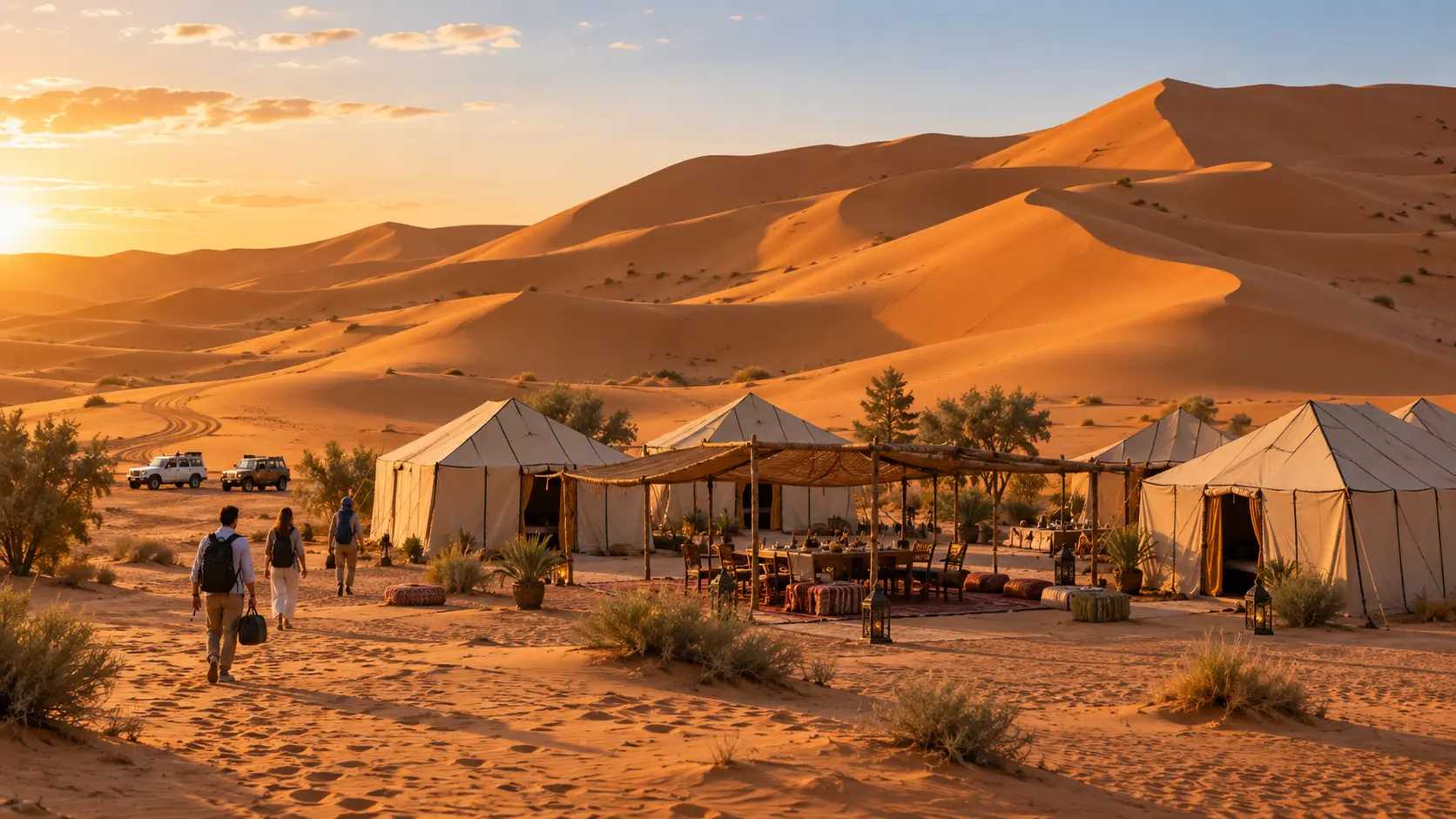
Erg Chebbi, beside Merzouga, is one of Morocco’s main dune areas and has a broad range of camps, from simple tents to more elaborate glamping-style accommodation.
It works well for travelers who want prominent sand dunes without adding the more difficult final access associated with some remote desert areas. Merzouga can also fit into a one-way journey between Fes and Marrakech when the route includes the Middle Atlas or southern valleys.
The large number of camps is both an advantage and a drawback. You have more choice, but two properties marketed in similar ways can offer very different levels of privacy and comfort.
Ask where the camp actually sits in relation to Merzouga and the dunes. A camp close to vehicle tracks may make arrival easier, while one farther into the desert may feel more removed from traffic and other properties. Neither is automatically better; choose according to your priorities.
Erg Chigaga: For Travelers Who Prioritize Remoteness
Erg Chigaga lies beyond the M’Hamid area and requires more off-road travel than reaching the main accommodation areas around Merzouga.
This makes it more suitable when remoteness is an important part of the trip and you have enough time to accommodate the access. The greater effort involved should be considered part of the itinerary rather than an inconvenience that can be ignored when comparing camps.
Camp facilities also vary. Do not assume that a more remote location automatically means either very basic camping or high-end exclusivity. Confirm the actual tent, bathroom and meal arrangements.
Erg Chigaga makes more sense when the desert itself is a major reason for the journey, rather than simply one overnight stop squeezed between cities.
Agafay: Convenient, but Not the Sahara
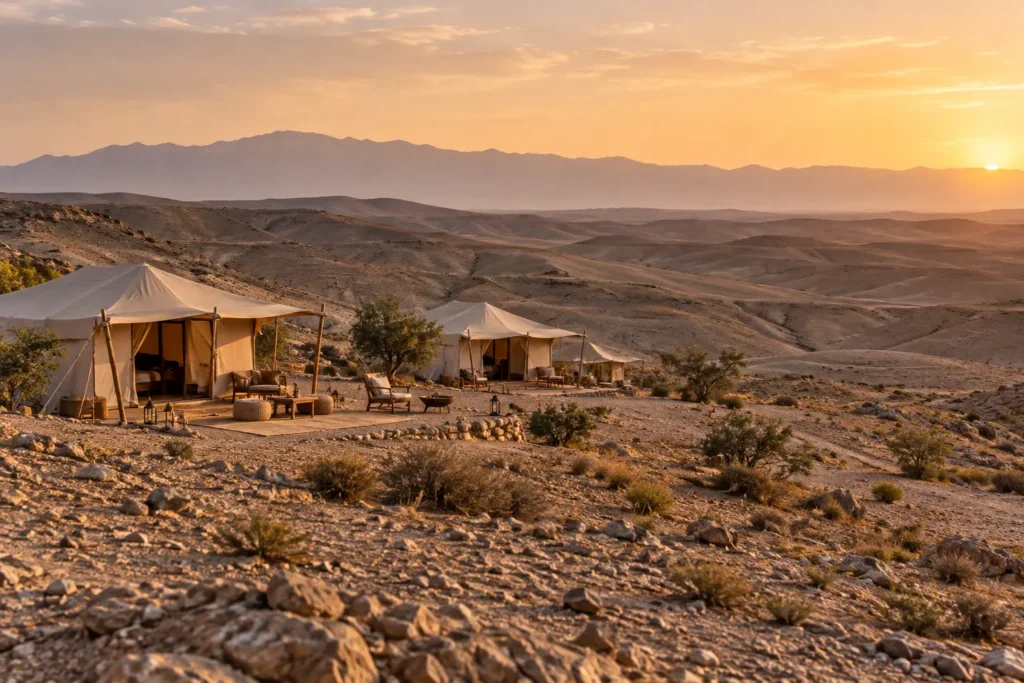
Agafay is outside Marrakech and offers a rocky, arid landscape with tented camps and resort-style properties. It can be useful for travelers who want a night away from the city without building a multi-day Sahara route.
However, Agafay should not be booked as a substitute for Erg Chebbi if your main goal is to sleep among large sand dunes. The landscapes are different.
Choose Agafay for convenience, open scenery and a short extension to a Marrakech stay. Choose the Sahara when reaching the dune landscape itself is an important part of your Morocco trip.
How to Choose a Desert Camp in Morocco by Comfort Level
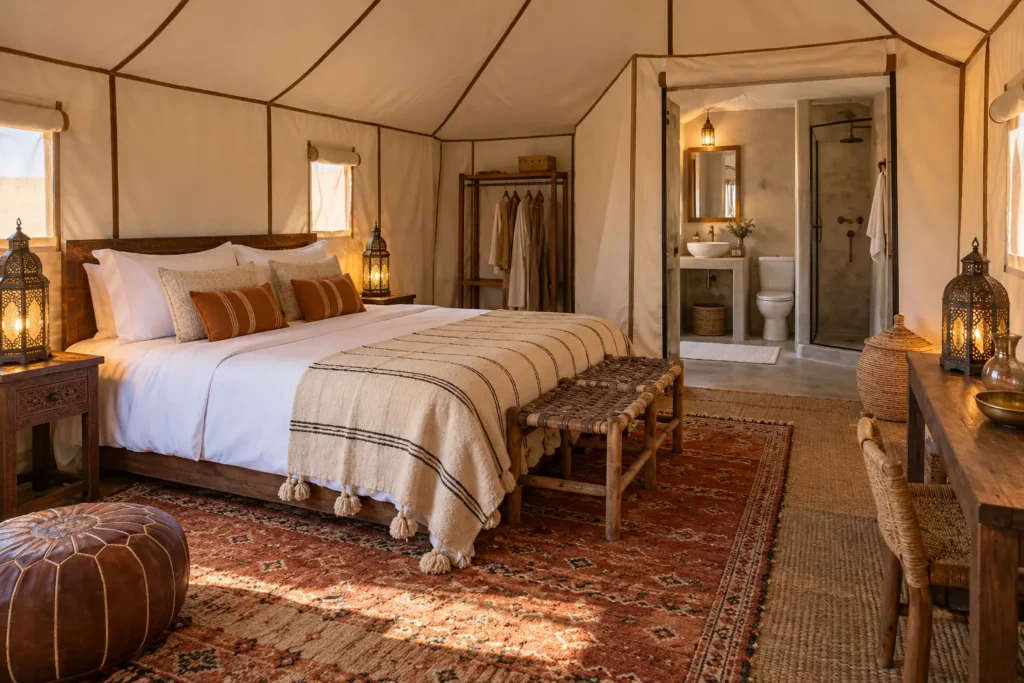
Once you know the region, compare what the camp actually provides. Marketing categories are useful only when they are backed by specific facilities.
Standard Camps
A standard camp may provide a private sleeping tent with shared bathroom facilities. Beds can be conventional rather than sleeping mats, but this varies by property.
This type of stay can suit travelers who care more about the dune setting than hotel-style comfort. Before booking, ask whether toilets and showers are shared, whether hot water is available and how far the facilities are from your tent.
Luxury Camps
Luxury camps often add larger tents, private bathrooms, upgraded bedding and more elaborate dining or communal spaces. However, none of these should be assumed from the word “luxury” alone.
Confirm whether the bathroom is genuinely inside your tent and whether it has running water and a shower. Ask what heating or cooling is available for your travel period.
Also check whether electricity is continuous or limited. A camp may provide lighting while offering charging only in particular areas or during certain hours.
Higher-Comfort or Climate-Controlled Camps
Some camps offer more advanced climate control and hotel-style fittings. These may appeal to travelers visiting during more challenging temperatures or those who want to minimize the practical compromises of sleeping in the desert.
Even here, confirm the details. Air conditioning requires power, and its availability may depend on the individual tent, camp system and local operating conditions.
Ask Exactly What “Private” Means
Privacy terminology causes frequent confusion when travelers choose a desert camp in Morocco.
A private tent normally means that strangers will not share your sleeping space. It does not necessarily mean the whole camp is reserved for you.
You may still share dinner areas, campfires, music and surrounding dunes with other guests. If you want an exclusive camp for a couple, family or group, ask directly whether private-use booking is available and exactly which areas will be exclusive.
Similarly, a “private bathroom” might be attached to your tent, located in a separate structure or assigned to you elsewhere in the camp. Ask for a precise description.
Check the Actual Camp Location
Do not rely only on the map pin displayed on a booking platform. It may indicate a village meeting point, office or general desert area rather than the tent itself.
Ask the operator to explain where you meet them, how you reach the camp and approximately what kind of transfer is involved. More important than a precise distance is understanding whether you are staying close to the edge of the dunes or deeper in the desert landscape.
Location also affects noise. Vehicle tracks, neighboring camps, generators and evening entertainment can all influence the atmosphere.
If quiet is a major reason for going to the Sahara, ask about nearby camps and how evening activities are organized.
Confirm How You Will Reach the Camp
Desert-camp transfers are part of the accommodation decision. Depending on the property and location, arrival might involve a 4×4, camel ride or another arranged transfer.
Do not assume a camel ride is compulsory. If you prefer vehicle transport, ask whether it is available before booking.
This is particularly relevant for families, older travelers, people with mobility limitations or anyone who simply does not want to participate in an animal activity.
If you do choose an animal-based activity, consider the condition and handling of the animals and avoid treating the ride as an obligatory part of a Sahara trip.
Find Out What Happens to Your Luggage
You may not need or want your full suitcase inside the camp. Some itineraries allow larger luggage to remain with a vehicle or at accommodation near the dunes while you take a smaller overnight bag.
Ask how your operator handles this before departure. Take the clothing, medication, electronics and toiletries you need for the night, but avoid carrying unnecessary luggage across the dunes.
If valuable belongings will be stored elsewhere, clarify where they will be kept and how you will retrieve them the following day.
Check the Bathroom Before the Bedroom
Photographs tend to focus on beds, rugs and lanterns, but the bathroom often determines how comfortable you actually find the stay.
Ask whether toilets are shared or private, whether the shower is attached to your tent and whether hot water is normally available. If accessibility matters, ask about steps, flooring and the route between the sleeping and bathroom areas.
Desert camps operate in remote environments, so expectations should differ from a city hotel. What matters is receiving an accurate description before you book.
Ask What Meals Are Included
Dinner and breakfast are commonly associated with overnight camp stays, but inclusions depend on the operator and package.
Confirm exactly which meals are included and whether drinks cost extra. If you have allergies, vegetarian requirements or other dietary needs, communicate them before arriving in the desert.
Food options around a remote camp are naturally limited. Unlike a city hotel, you cannot simply walk outside and choose another restaurant if the meal arrangement does not suit you.
Understand the Evening Atmosphere
Many camps organize music or a gathering around a fire after dinner. Some travelers enjoy the social atmosphere; others go to the desert primarily for quiet.
Ask how large the camp is and whether evening entertainment is routine. A smaller camp is not guaranteed to be silent, while a larger property may have separate areas that reduce noise around sleeping tents.
If early sleep, privacy or quiet stargazing is important to you, say so when choosing the camp rather than expecting every Sahara night to follow the same pattern.
Do Not Book for Guaranteed Stars, Sunrise or Sunset
Desert photography is one of the main reasons people are drawn to camp listings, but weather and visibility cannot be guaranteed.
Cloud, wind, dust and seasonal conditions can affect sunsets, sunrises and night skies. Choose a camp because you want the overall desert experience rather than because an advertisement promises a specific view.
Similarly, the appearance of the dunes changes with light and weather. Treat dramatic photographs as examples of possible conditions, not a forecast.
Choose the Season With Comfort in Mind
Sahara conditions vary significantly through the year. Hot periods can make daytime activities uncomfortable, while colder periods can bring very cool nights.
Before booking, ask the camp what bedding and temperature-control arrangements are normally provided for your dates. Bring layers appropriate to the expected conditions rather than relying only on daytime forecasts.
Seasonal conditions also affect when activities are comfortable. Operators may adjust transfer or excursion timing around heat, daylight and local conditions.
For Agafay, Erg Chebbi and Erg Chigaga alike, do not assume that one general statement about “Morocco weather” applies to every desert region.
One Night or Two Nights in a Desert Camp?
One night can work when the camp is one part of a wider Morocco route. You arrive, experience the evening and leave the following morning.
Two nights can suit travelers who want the desert itself to become a larger part of the trip. The extra day creates space for slower activities, time around the dunes and less pressure to leave immediately after breakfast.
However, do not add a second night automatically. If you prefer moving through southern Morocco and seeing valleys, kasbahs or towns along the route, another overnight stop elsewhere may add more variety.
Your decision should reflect the pace you enjoy rather than a rule about how long a Sahara stay “must” be.
Plan the Desert Camp as Part of the Route
The camp should fit the Morocco itinerary rather than force the rest of the trip into an awkward shape.
Erg Chebbi can work as part of a route involving Fes, Merzouga, the Todra Gorge, Dades Valley, Ouarzazate and Marrakech. Travelers do not need to include every stop, but a one-way route can reduce unnecessary backtracking.
From Marrakech, the Sahara requires a multi-day journey. Do not plan Merzouga as a day trip or assume that a high-comfort vehicle removes the fatigue of a long road day.
Agafay is different because it can be incorporated much more easily into a Marrakech-based stay, while Erg Chigaga needs additional time for the remote final approach.
Compare Independent Booking With a Desert Tour
You can arrange accommodation and transport separately, or choose a multi-day desert itinerary that packages the road journey, accommodation and camp stay together.
Independent planning provides more control over individual hotels and transport. A tour can simplify a complicated route, particularly when it includes several rural stops and a desert transfer.
Neither approach is automatically better. Check what is included, whether the itinerary is private or shared, how much time is spent driving and whether the camp is named before booking.
If an operator advertises only a “luxury desert camp” without identifying the property or explaining its facilities, ask for more information before paying.
Ask About Environmental Practices
Desert camps operate in landscapes where water, waste disposal and energy require careful management. These practical questions are worth asking, particularly when comparing properties with similar comfort levels.
Ask how the camp handles rubbish and wastewater, what powers lighting and charging facilities and how it limits damage around the dunes.
Responsible travel also means avoiding litter, following established vehicle or walking routes where appropriate and not removing plants, rocks or other natural material from the desert.
Low-impact practices are more meaningful than marketing labels such as “eco” when those labels are not supported by clear information.
Common Mistakes When Choosing a Desert Camp
One common mistake is booking the tent before choosing the desert. A luxury tent in Agafay and a simple camp in Erg Chebbi offer fundamentally different landscapes.
Another is assuming that “luxury” defines the bathroom, electricity and climate control. Always verify the specific facilities.
Travelers also sometimes overlook the transfer into the camp, luggage arrangements or the difference between a private tent and a private-use camp.
Finally, avoid choosing the most remote camp without considering the extra travel involved. Remoteness is valuable only when it matches what you actually want from the trip.
FAQs
Is Erg Chebbi or Erg Chigaga Better?
Erg Chebbi generally suits travelers who want easier access and a wider choice of camps. Erg Chigaga suits travelers who prioritize remoteness and are comfortable with the additional off-road journey. Neither is universally better.
Is Agafay a Sahara Desert Camp?
No. Agafay is a rocky desert landscape near Marrakech rather than the large sand-dune Sahara associated with Erg Chebbi and Erg Chigaga. It can still be a worthwhile overnight stay when convenience is the priority.
Do Luxury Desert Camps Have Private Bathrooms?
Many do, but the word “luxury” does not guarantee it. Confirm whether the bathroom is en-suite, whether the shower has hot water and whether any facilities are shared.
Do You Have to Ride a Camel to a Desert Camp?
Not necessarily. Some camps offer 4×4 transfers as an alternative. Confirm the available arrival options when booking, particularly if mobility, comfort or animal welfare influences your decision.
Is One Night in the Sahara Enough?
One night can be enough when the Sahara is one element of a wider route. Two nights can suit travelers who want a slower desert stay and more time in the dunes.
Can You Visit Merzouga as a Day Trip From Marrakech?
No. Merzouga should be incorporated into a multi-day route because the road journey is substantial. A shorter Marrakech-based desert-style stay is better considered in Agafay.
Choose the Camp After You Choose the Experience
The simplest way to choose a desert camp in Morocco is to decide what kind of desert experience you want first. Pick Erg Chebbi for accessible Sahara dunes and broad camp choice, Erg Chigaga when remoteness is the priority, or Agafay when a shorter Marrakech-based escape fits your itinerary better.
Then compare the specific camp: location, bathroom, transfer, privacy, meals, luggage, seasonal comfort and environmental practices. For travelers who want the desert built into a wider Morocco route, Visit Morocco Together’s desert expedition options provide a starting point for planning.
Ready to Experience Morocco?
Turn this inspiration into your next adventure. Our travel experts are ready to help.