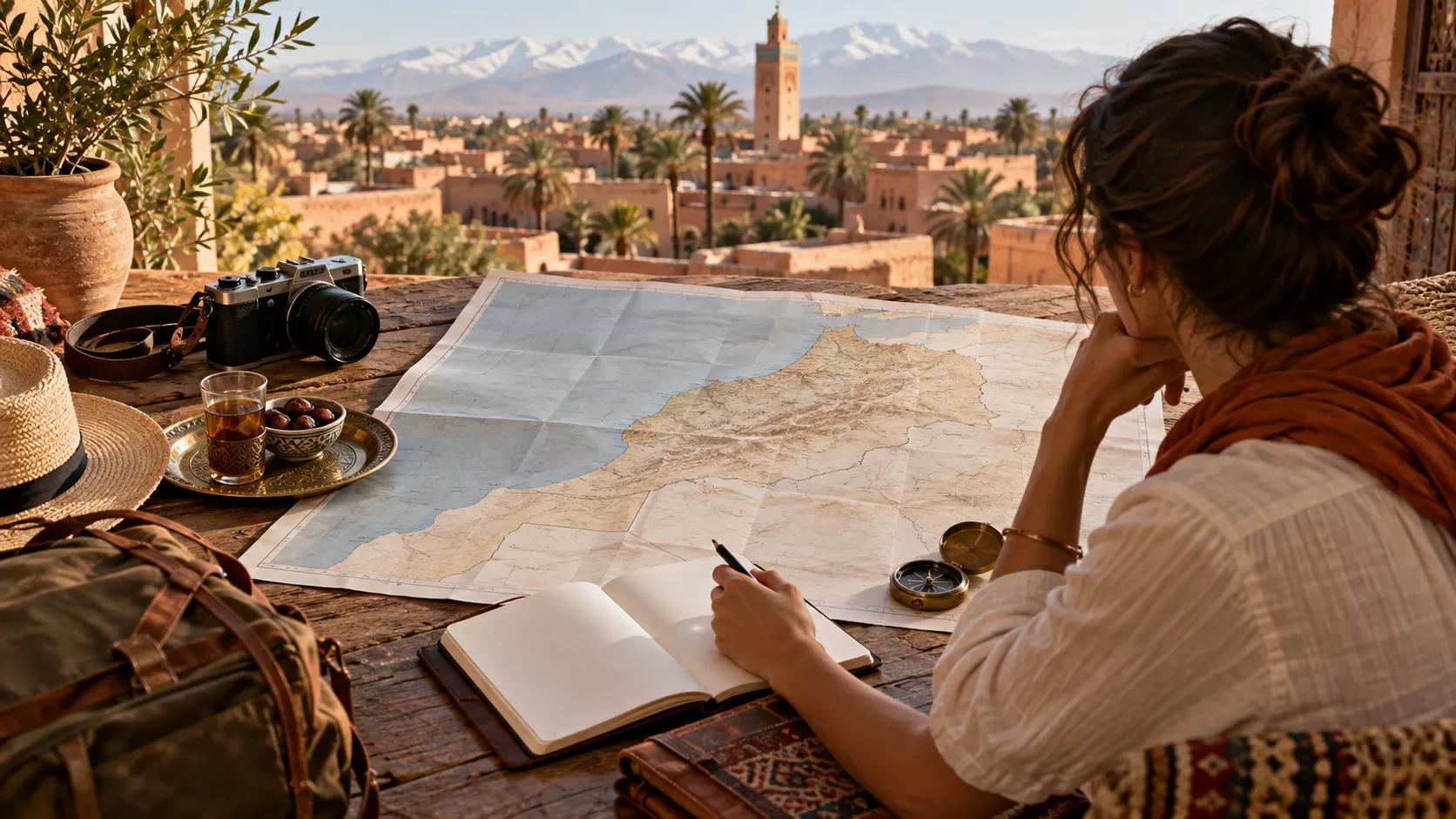
When deciding how to build a Morocco itinerary, start with three decisions: where you arrive, where you leave, and which experience matters most. Put those on a map, allocate your nights, then check the journeys between them before booking accommodation or filling each day with activities.
A useful itinerary tells you more than which cities you will visit. It shows where you sleep, what happens to your luggage, how you reach the next place and which days have enough time for sightseeing. It also leaves room for meals, rest and changes along the way.
If you are still deciding how long to stay, start with how many days to spend in Morocco. Once your dates are fixed, the steps below turn that time into a workable route. Our Morocco trip planning guide covers the wider preparation.
How to build a Morocco itinerary in eight steps
- Record your arrival, departure and any fixed commitments.
- Choose the experiences that matter most.
- Group destinations into a connected route.
- Allocate accommodation nights.
- Check transport for every move.
- Build sightseeing around settled days.
- Confirm the bookings that depend on each other.
- Review the complete journey and remove anything that makes it too tight.
Work through the route before choosing individual restaurants or shopping stops. A few early decisions about geography can save repeated hotel changes later.
Step 1: Start with your actual arrival and departure
Write down the airport or port, arrival time, departure time and any fixed event. If flights are not booked, compare route options before choosing the cheapest return fare.
Arriving in Casablanca does not automatically mean you should begin sightseeing in Marrakech. Equally, departing from Fes can make a one-way southern journey more useful than returning to your starting city.
Compare a return route with different arrival and departure cities
A return route begins and ends in the same city. It can suit a regional holiday, especially when your main experiences are nearby. The return journey still needs its own time.
A one-way route connects different endpoints. It may remove backtracking, but compare the total cost of flights, ground transport and accommodation. A lower airfare can lose its advantage if it adds another hotel night and a long repositioning journey.
Keep the final airport visible throughout planning. “Finish in Fes” and “catch an evening flight from Casablanca” are separate tasks.
Protect the first and last nights
For a late arrival, make reaching your accommodation the main task. Confirm reception arrangements and how to get from a vehicle-accessible meeting point to the property.
For an early departure, choose the final night around airport access and the transfer you can actually arrange. Avoid relying on a long road journey immediately before a flight when an earlier return would give you more flexibility.
Step 2: Choose a few priorities
List what you want from the holiday, then separate essential experiences from optional additions. Your priorities might be a full day in Fes, a night near the dunes, time for walking in the mountains or two quiet evenings by the coast.
Be specific. “See the desert” is less useful than deciding whether you want an Erg Chebbi camp night, time around Merzouga, or a different southern landscape. “Visit Marrakech” could mean a guided medina walk, gardens, architecture, food or shopping.
For a group, ask each person to name one important experience and one thing that makes travel tiring. This can reveal conflicts before bookings are made: one traveller wants several cities, while another wants fewer early starts.
When the route becomes crowded, remove an optional destination before cutting the time needed for your main reason to visit.
Step 3: Group places into a connected route
Map your proposed overnight bases, then look at how they connect. Straight lines between pins can hide mountain crossings, road detours and the time needed to reach stations.
Use regional groupings to narrow the plan:
- Marrakech, nearby Atlas valleys and an Atlantic extension.
- Tangier, selected northern towns, Chefchaouen and Fes.
- Casablanca, Rabat and other cities linked by your chosen transport.
- Marrakech, southern valleys, Merzouga and an onward journey toward Fes.
- Southern towns and the Anti-Atlas, ending on the coast.
These are starting structures. You do not need every destination in a grouping, and combining several structures usually requires more time.
Choose between a day trip and an overnight
A day trip keeps the same accommodation base but includes an outward and return journey. An overnight adds packing and check-in, while providing an evening and morning in the destination.
For the coast, the 2-day Essaouira coastal break from Marrakech illustrates the overnight option: travel out, spend a night near the old town and return the following day. Allocate both days to that segment rather than treating the second as a full Marrakech sightseeing day.
An overnight makes sense when the time in the destination matters more than keeping one hotel throughout. A day trip can suit a short visit with a narrower purpose.
Do not add a city only because it looks close
Before adding a detour, ask what you gain and what you lose. Include the extra transfer, accommodation change and any return journey.
An additional night in a city you already plan to visit can provide more useful time than another stop reached after dinner. Treat a brief visit as a brief visit rather than describing it as a full destination stay.
Step 4: Allocate nights before attractions
Write the itinerary as a list of accommodation nights first. For each place, decide whether it is a sightseeing base, a road stop or a night positioned for departure.
Two nights normally give you one full day between arrival and departure; three nights normally give you two. Partial days can add useful time, but count them according to your transport schedule.
This exercise often reveals where a route needs changing. A city with one late-arrival night has little room for sightseeing, however many attractions appear beside its name.
Give mountain stays their own place in the schedule
A mountain overnight should have a purpose beyond breaking up city sightseeing. Decide whether you want village walks, a specific trail or simply time away from the city.
The 2-day Imlil and Atlas Mountains overnight includes village walking and a guesthouse night before returning to Marrakech. It is a different commitment from a summit trek. Match the proposed walking, accommodation access and conditions to the people travelling.
If you add this segment to a city-and-coast holiday, remove something else or extend the trip. An overnight excursion occupies time even when it returns you to the same base.
Check the accommodation’s practical location
A medina address can put you near historic streets while requiring a walk from the nearest vehicle-accessible point. A property outside the old town may simplify pickup but add journeys to sightseeing.
Our guide to where to stay in Morocco covers accommodation choices in more detail. For itinerary building, record the access arrangement, check-in time and luggage plan alongside each night.
Step 5: Check every journey door to door
For each move, include the journey from your accommodation to the departure point, waiting time, the main trip, arrival formalities and the final transfer.
The Moroccan National Tourist Office’s transport overview introduces rail, coach, car and local transport options. Use it to understand the choices, then check the operator’s actual service for your travel date.
You can use different transport on different sections. A rail connection between cities and an organised road journey through the south can belong in the same holiday. Our guide to getting around Morocco explains the broader trade-offs.
Treat the Sahara as a journey with several overnight stops
Choose the desert destination and onward direction before selecting a camp. The camp night is one part of the route, alongside road travel and other overnight stops.
Visit Morocco Together’s 4-day Marrakech-to-Fes journey via the Sahara provides a concrete example: Dades, a Merzouga camp night and the Midelt region divide the crossing before arrival in Fes. Allocate city sightseeing outside those four travel days.
Compare programmes by their overnight locations, daily road demands and final drop-off. A camp photograph tells you little about the journey required to get there.
Keep important connections out of tight windows
If missing a connection would disrupt a flight or a major booking, look for room earlier in the schedule. Confirm pickup locations and the latest check-in requirements before deciding that two bookings fit together.
A driver can help organise a road journey, but traffic, access and road conditions still affect the day. Avoid building a schedule that works only if every section takes its shortest possible time.
Step 6: Build sightseeing around the available time
Give each day a main purpose. A full day in one city can support a more substantial visit than an afternoon following an intercity move.
Group activities geographically. In a city, combine nearby streets and landmarks rather than repeatedly crossing town. On a road day, choose a small number of meaningful stops instead of adding every viewpoint.
Use a simple daily structure: one main visit or journey, time for meals and breaks, and an optional activity if time and energy allow.
Keep outdoor plans adjustable
Consult the official climate and seasons guide when comparing regions, then check conditions for the specific activity and travel dates.
Walking routes, exposed viewpoints and coastal activities may need changes. Place an important outdoor experience early enough in a stay to leave another possible window where practical.
The time to visit Morocco guide covers date selection. In your itinerary, translate that choice into a suitable daily pace rather than assuming the same timetable works in every season.
Leave some time unbooked
Free time can accommodate a delayed arrival, a longer lunch, shopping or rest. It also lets you respond to what interests you once you arrive.
Keep flexibility where it is useful. An open afternoon after a long journey can be more valuable than an unplanned morning immediately before an early departure.
Two sample itineraries showing how the steps fit together

These examples illustrate night allocation and route decisions. Check transport, access and accommodation before turning them into bookings.
Seven days and six nights: Marrakech and Essaouira
Day 1: Arrive in Marrakech. Reach your accommodation and keep the evening light. Overnight in Marrakech.
Day 2: Explore Marrakech. Choose a medina walk and a small number of nearby visits. Overnight in Marrakech.
Day 3: Continue your city stay. Use the day for another interest, such as gardens, architecture or a food experience. Overnight in Marrakech.
Day 4: Travel to Essaouira. Keep the rest of the day for the port, medina or a walk according to your arrival time. Overnight in Essaouira.
Day 5: Stay in Essaouira. Allow a full day without changing accommodation. Overnight in Essaouira.
Day 6: Return to Marrakech. Leave the evening flexible and confirm your departure transfer. Overnight in Marrakech.
Day 7: Depart. Add sightseeing only if flight timing and luggage arrangements allow it.
This example uses four Marrakech nights and two Essaouira nights. It has a two-night coastal stay; it is not the same schedule as a one-night coastal tour. If you want an Atlas overnight as well, revise the night allocation rather than adding it to a full day.
Nine days and eight nights: Marrakech to Fes through the Sahara
Day 1: Arrive in Marrakech. Settle in and rest. Overnight in Marrakech.
Day 2: Marrakech sightseeing. Protect a full day for your main city interests. Overnight in Marrakech.
Day 3: Cross the High Atlas toward Dades. Build the day around the road journey and selected stops, including Ait Ben Haddou if included in your confirmed programme. Overnight in the Dades region.
Day 4: Continue toward Merzouga. Follow the agreed route through the valleys and onward to the camp arrangements. Overnight at the desert camp.
Day 5: Travel toward the Midelt region. Allow for the morning camp departure and onward road journey. Overnight in the Midelt area.
Day 6: Continue to Fes. Keep arrival-day plans flexible. Overnight in Fes.
Day 7: Explore Fes. Give the medina and your chosen visits a full day. Overnight in Fes.
Day 8: Remain in Fes. Keep a second full day for additional interests or rest, with any excursion dependent on the confirmed transport plan. Overnight in Fes.
Day 9: Depart from Fes. Arrange the transfer around your flight.
This example uses two Marrakech nights, three nights on the crossing and three Fes nights. It assumes arrival in Marrakech and departure from Fes. A Casablanca departure or a Chefchaouen extension requires a revised final section.
Step 7: Confirm bookings in the order they depend on each other
Before making payments, check that flights, overnight stays and transport form one coherent schedule. Then secure the least flexible parts, keeping cancellation deadlines visible.
Confirm:
- Arrival and departure arrangements.
- Any fixed-date event or essential timed visit.
- Multi-day transport and its overnight accommodation.
- First and last nights, plus any nights outside a tour.
- Guides, activities and local transfers around the confirmed route.
When comparing a package with independently booked sections, check exactly which nights are included. Do not reserve a separate room for a night already covered by the tour unless that is intentional.
Ask for named overnight towns, the pickup and final drop-off, accommodation categories, included meals and any locally paid costs. A route title alone is insufficient for matching bookings.
Step 8: Review the itinerary from start to finish
Read the plan as if you were travelling it tomorrow. Follow each departure, arrival, bag movement and overnight stay.
For every day, ask:
- Where do we wake up, and where do we sleep?
- How do we reach the departure point?
- What is the main commitment?
- Is there time for meals and breaks?
- What can we remove if we arrive later?
- Does the next day require an early start?
Look especially for consecutive long road days, repeated one-night stays and sightseeing scheduled before you can realistically arrive.
Consider a different route when the main circuit does not fit
You do not need to connect northern cities, the Sahara and the Atlantic in every itinerary. A more focused regional journey can suit different interests.
The 8-day Deep South and Kasbah journey from Marrakech to Agadir follows southern valleys and the Anti-Atlas, including the Tafraoute area and Taroudant, before ending in Agadir. Its published route is an alternative to a Merzouga-and-Fes crossing; confirm the specific southern overnight stops before booking.
Choose that kind of direction because it fits your interests and endpoint. Changing the route is often more effective than trying to make an unsuitable circuit fit by shortening every stay.
Questions about building a Morocco itinerary
Should I start in Marrakech or Casablanca?
Start with the flights and route that work together. Marrakech can suit a city-and-south itinerary. Casablanca may work for a route through Rabat and other cities. Compare onward travel and the departure airport before deciding.
Can I build an itinerary using public transport?
Yes, where the services and connections fit your chosen destinations. Check each section individually, including local transfers and arrival times. Some travellers combine public transport between cities with an organised segment elsewhere.
Should I book hotels before planning the route?
Choose the route and approximate night allocation first, then check accommodation and transport availability together. If an essential stay is unavailable, revise the plan before committing to connected non-refundable bookings.
Can I combine Marrakech, the Sahara, Fes and Chefchaouen?
They can form a longer journey, but the northern extension needs its own travel time and nights. Start with the Marrakech-to-Fes section, then check how Chefchaouen connects to your eventual departure city.
Do I need a private driver for the whole trip?
That depends on your route. You may prefer independent city stays and rail travel for some connections, with a driver for a road-based segment. Confirm where each arrangement starts and ends so there are no gaps or duplicate transfers.
How do I know whether my itinerary is too busy?
Check the nights and full days. If most destinations are reached late and left early, or every free afternoon has disappeared, reduce the number of stops. Protect the experiences you care about before adding more places.
What should I send when asking for a tailored itinerary?
Provide travel dates, party size, arrival and departure details, accommodation preferences, a budget range and your main interests. Include mobility needs and your tolerance for long drives or early starts. Ask for a night-by-night route and clear inclusions so you can compare proposals.
Ready to Experience Morocco?
Turn this inspiration into your next adventure. Our travel experts are ready to help.