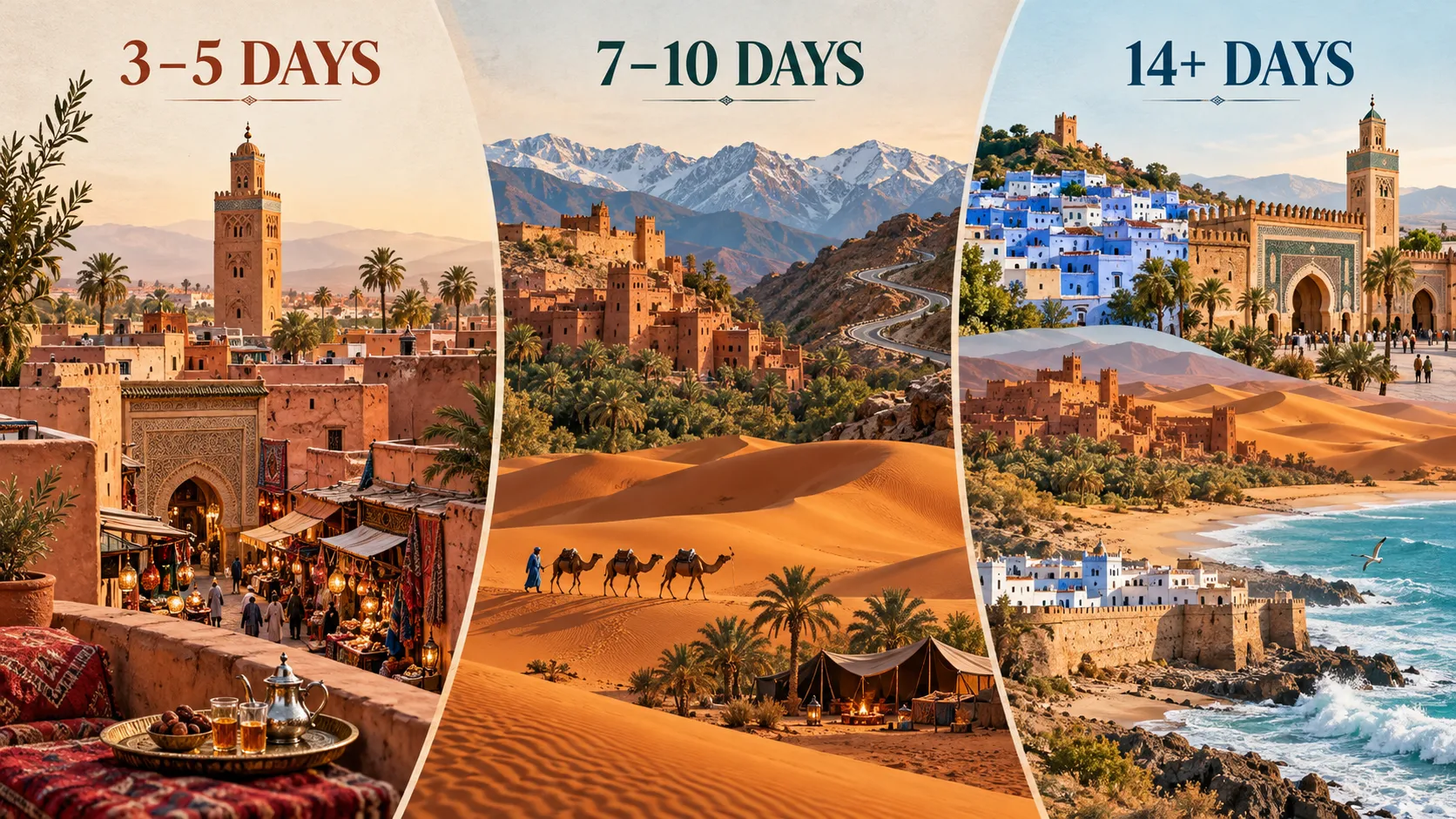

How many days in Morocco do you need? For a first visit that combines city sightseeing with a journey between regions, consider 7 to 10 days. Three to five days can suit a focused city break, while 14 days gives you more room for the Sahara, northern cities or the Atlantic coast. Your flight times, route and preferred pace matter as much as the number of days on your booking.
A week based in Marrakech and Essaouira feels different from a week connecting Marrakech, Merzouga and Fes. Both can be worthwhile trips, but the second gives a much larger share of your holiday to road travel.
Choose your main experience first, then decide how much movement you want around it. For the wider preparation process, use our Morocco trip planning guide.
How many days in Morocco fit your travel plans?
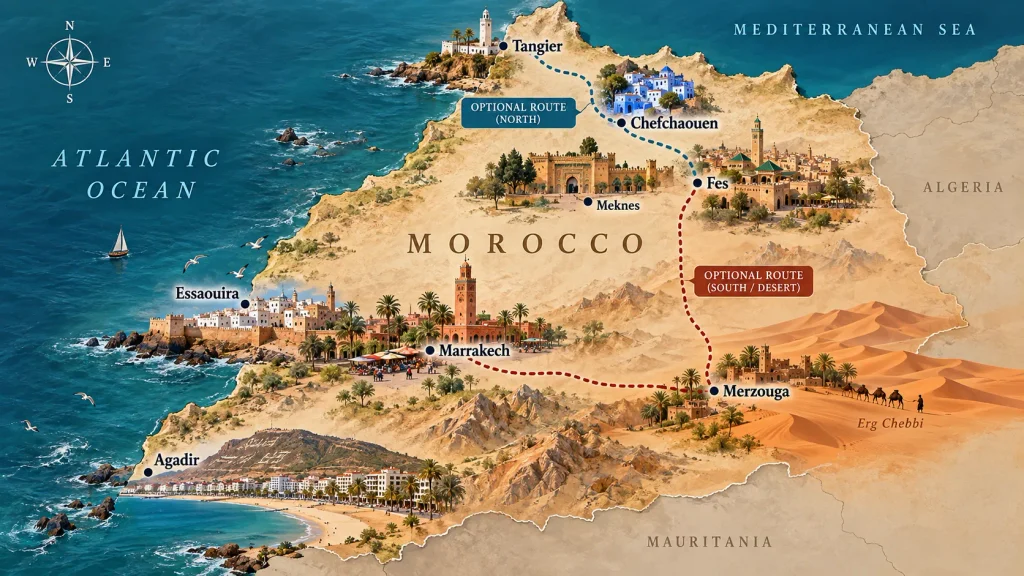
Use these suggested ranges to narrow your options. They assume you want time to explore between transfers; they are starting points for planning rather than minimum entry requirements or fixed tour schedules.
| Time available | A manageable focus | Main trade-off |
|---|---|---|
| 3 days | One city with useful arrival and departure times | Little room for a distant second destination |
| 5 days | One main base and an excursion, or two connected bases | A longer circuit reduces time in each place |
| 7 days | A regional route or a city stay with a dedicated desert segment | Choose between extra cities and longer stays |
| 10 days | A one-way journey combining cities and the Sahara, or a slower regional holiday | Adding both far northern and coastal detours increases movement |
| 14 days | Several regions with selected longer stays | A broad circuit can still involve frequent hotel changes |
| 21 days or more | Deeper regional travel, outdoor activities and rest days | Resist filling every extra day with another transfer |
If you cannot extend your leave, reduce the geographical spread. A short visit with time to enjoy meals, walks and an unplanned afternoon is a complete holiday in its own right.
Count usable days before choosing destinations
Calendar days and sightseeing days are different
Imagine arriving on Monday evening and leaving on Sunday morning. That is seven calendar days and six accommodation nights, but only five full days between your flights. Monday may allow little beyond reaching your hotel; Sunday belongs to departure arrangements.
Now compare an early Monday arrival with a late Sunday departure. The same seven-day label can provide considerably more time, although you still need to allow for baggage, transfers and tiredness.
Write down the hours you can realistically use on your first and last days before adding attractions. Avoid making your most important visit depend on everything going smoothly immediately after landing.
Hotel nights show how the route actually feels
Two nights in a city usually give you one full day between arrival and departure. Three nights usually provide two. Arrival and departure hours can add useful time, but that time should remain visible in your plan rather than being counted twice.
A stop reached late in the evening and left early the next morning is an overnight break, even if the city appears prominently in the itinerary title. That can be useful for splitting a journey, but it does not replace a stay with time to explore.
Before booking, mark each night as a city stay, a road stop, a desert stay or a night positioned for your flight. You will quickly see whether your plan matches the holiday you want.
Three days in Morocco: choose one city
Three days can work for a short introduction when you fly directly into the city you want to visit. With only two nights, keep your accommodation changes to a minimum.
In Marrakech, you could divide your available time between the medina, a small selection of landmarks, gardens, food and shopping. In Fes, allow time for the old city’s streets and craft quarters rather than treating the medina as a quick stop. Tangier can suit a city break centred on its kasbah, medina and coastal setting.
Pick a few priorities and leave room between them. A late arrival may mean choosing between a longer city walk and an excursion the following day.
Does a three-day desert tour mean three days is enough for Morocco?
A three-day tour describes a specific journey. It does not necessarily include time to explore its departure and arrival cities, recover from an international flight or reach your next airport.
For example, Visit Morocco Together’s 3-day Fes-to-Marrakech Sahara tour occupies the days between those cities. If you also want a full sightseeing day in Fes and another in Marrakech, those days need to sit outside the crossing. Your flights may require additional nights at either end.
This distinction matters when comparing a short desert product with your total holiday allowance. Read its starting point, final drop-off and accommodation nights before deciding how much leave to book.
Five days in Morocco: one base or two connected places
Five days provides more flexibility, particularly when you have four or five nights and convenient flights. It is a useful length for a focused city holiday with one change of scenery.
Consider Marrakech with an Atlas foothills excursion, or a split between Marrakech and Essaouira. Other possibilities include Casablanca and Rabat, Fes with a visit to Meknes and Volubilis, or Agadir with time around Taghazout. These are alternatives; they do not belong in one five-day route.
Choose whether the second destination deserves an overnight stay. A day excursion saves repacking, while an overnight can give you an evening and morning without the return journey on the same day.
What if you want several cities in five days?
A compact cultural circuit such as the 5-day Imperial Cities tour connects Casablanca and Marrakech through several cultural stops. This approach involves short visits and transfer-heavy days. Look at the hours available in each city rather than counting how many cities appear in the programme.
If a full day in Fes is essential, protect it before adding another stop. If your Marrakech departure leaves little sightseeing time, add a night or remove an earlier destination. A more expensive hotel will not compensate for arriving after dinner and leaving before breakfast.
Can you include the Sahara in five days?
Yes, if the desert route is the main purpose of the holiday and your starting city, transport and flight times support it. The compromise is limited time elsewhere.
Decide whether you want a short camp experience reached through substantial road travel or a longer stay around the desert edge. Those are different holidays. Do not add the Sahara to a five-day city break without rebuilding the rest of the schedule around the journey.
Seven days in Morocco: decide between regions
A week can provide a varied first visit without requiring a countrywide circuit. Choose a connected route and give your main destinations enough nights.
A city and coast combination
Marrakech and Essaouira can provide a contrast between an inland city and an Atlantic coastal stay. Divide the nights according to your interests, leaving the transfer day lighter than your settled days.
This approach suits travellers who want medina walks, food, shopping and time to pause. If you add an Atlas excursion, check what it displaces rather than simply filling the last free day.
A northern route
Tangier, Chefchaouen and Fes can form the basis of a northern journey. Your departure airport determines whether you can continue in one direction or need to allow time to return.
Additional places such as Tetouan, Asilah, Meknes or Volubilis should be selected according to your interests and transport plan. The 7-day northern Morocco tour from Tangier includes several of these stops and returns to Tangier. Check the final day’s timing before arranging onward travel. A stop for a walk or lunch is different from an overnight base with a full sightseeing day.
A week with the Sahara
If the dunes are your priority, allocate a dedicated block to the southern journey and keep the rest of the week selective. A Marrakech-to-Fes route through Merzouga can serve a different flight plan from a return journey to Marrakech.
Check whether your week means seven full days on the ground or seven calendar days including flights. The latter leaves less room for sightseeing before and after the desert segment. Avoid putting a long road return and an important flight into the same tight window.
Ten days in Morocco: connect contrasting landscapes
Ten days gives more room to combine city stays with a substantial journey between regions. A possible route direction is Marrakech, the southern valleys, Merzouga and Fes. The 10-day Morocco journey from Tangier offers another starting point, with northern cities, the Sahara and Marrakech among its destinations. Confirm the overnight allocation and final drop-off when comparing it with your flights.
The number of stops still needs restraint. Chefchaouen, Essaouira and a longer mountain stay each draw on time that could otherwise become an extra night in your main bases.
Decide which experience deserves a full day without a hotel change. It might be Fes, Marrakech, a walking day in the mountains or time around Merzouga after the camp night. Build the route around those decisions.
Use a one-way route when the flights support it
Arriving in one city and departing from another can remove a return journey. Compare the entire trip cost and schedule, including any connecting flights and the transfer to the final airport.
For example, finishing your sightseeing in Marrakech is useful if your flight leaves from Marrakech. If it leaves from Casablanca, that final connection must still appear in your plan. A tour endpoint and an airport departure are separate arrangements unless the booking explicitly connects them.
Ten days can also be spent in only two or three places. More available time does not create an obligation to cover more ground.
Fourteen days in Morocco: add depth before extra stops
Two weeks can accommodate a broader journey through cities, the southern valleys, the Sahara and selected northern or coastal destinations. It also gives you the option to slow down within a smaller area.
Use some of the additional nights where they change the experience: a second evening in a city, a full day around the desert edge, an overnight near a walking route or time by the coast without a planned excursion.
The 14-day Morocco journey from Marrakech includes Fes, Chefchaouen, Tangier, Rabat, Casablanca, Merzouga and Essaouira before returning to Marrakech. A circuit with this geographical spread still involves substantial movement. Some places may be brief visits rather than extended stays. Read the night-by-night allocation before describing a broad tour as slow.
Choose your final extension carefully
If your core route already includes cities and the Sahara, decide what the last few days should contribute. A coastal stay might provide rest. A northern extension might add different architecture and landscapes. A mountain stay might support walking or village visits.
Adding all three can undo the breathing room that made two weeks appealing. Keep the extension that answers your main reason for travelling.
How much time should you allow for the Sahara?
Start with the actual desert destination. Merzouga and the Erg Chebbi dunes require a different journey from the Zagora area or the route toward Erg Chigaga. Agafay near Marrakech offers a rocky desert landscape; it does not substitute for visiting the Sahara’s dune areas.
Then separate three questions: how long it takes to reach the area, how long you want to stay there, and where you go afterwards. One night at camp does not mean the complete journey takes only one night.
When comparing desert programmes, ask:
- How many nights are at camp, in a desert-edge hotel and elsewhere along the road?
- What time do we leave the starting city, and when should we reach the endpoint?
- How much of each day is road travel, including breaks?
- Is there time around the dunes beyond the camp arrival and departure?
- Does the final day return to the starting city or continue to another destination?
Three-, four- and five-day desert journeys can serve different routes and priorities. A longer product is useful only if the additional time goes where you want it. Compare the actual overnight stops and activities.
Let transport and season shape the duration
Compare door-to-door journeys
The Moroccan National Tourist Office’s transport overview describes rail, coach, car and local transport options. Choose the mode for each section rather than assuming the entire holiday needs one type of transport.
For any connection, include the journey from your accommodation to the station or pickup point, waiting time, the main journey and the final transfer. A quoted train journey is only part of a hotel-to-hotel move.
A private vehicle can change where you stop and how you handle luggage, but the road distance remains. Mountain routes and sightseeing stops also affect how much of the day is available after arrival. Our guide to getting around Morocco explains the broader transport choices.
Match the pace to your dates
Use the official climate and seasons guide alongside your regional plan. Check expected conditions for the places on your route, particularly where mountain access, outdoor activities or long walking days matter.
If you expect to take a substantial break during the day, allow fewer activities or another night. For walking trips, keep room to adjust the route to conditions. For travel during religious holidays or major events, check the relevant opening hours, transport schedules and booking availability.
Our guide to the time to visit Morocco covers choosing dates in more detail. Here, the decision is whether those dates allow the pace you have planned.
Adjust the route to the people travelling
Families may value fewer hotel changes, predictable meal breaks and time at their accommodation. Travellers arriving after an overnight flight may want a light first day. Anyone who finds long drives tiring can choose a smaller region instead of automatically booking a longer cross-country tour.
Independent travellers should include the practical time needed for connections and check-ins. Travellers on an organised route should check the same underlying schedule: early starts, consecutive road days, accommodation changes and free time.
For a group, agree on the experiences that matter to everyone before adding individual requests. Ten days filled with competing priorities can feel tighter than a focused seven-day trip.
Questions about how long to spend in Morocco
Is three days enough for Morocco?
Three days can be enough for a focused city break with suitable flights. Stay in one main base and select a few priorities. A three-day desert crossing uses the same time very differently and leaves little opportunity to explore its starting and finishing cities.
Is five days enough for Marrakech and the Sahara?
It can fit if the Sahara is your priority and the flights align with the route. You will have limited time in Marrakech, particularly with a late arrival or early departure. Count the desert journey and city days separately before booking.
Is seven days enough for a first visit?
Yes, with a selective route. You could choose a city and coast combination, a northern journey or a city stay with a dedicated desert segment. Avoid expecting a full introduction to every major region within one week.
Should I spend seven or ten days in Morocco?
Choose seven for a focused regional trip. Consider ten when you want to connect cities with the Sahara or protect additional full days between transfers. Compare actual nights and flight times; the extra days are most useful when they improve the pace.
Is ten days enough for Marrakech, Fes, Chefchaouen and the Sahara?
Those destinations can form a ten-day route, especially with different arrival and departure cities. Expect several substantial travel days. Check the night allocation and consider dropping one destination if you want longer stays or fewer moves.
Is two weeks too long in Morocco?
Two weeks can suit a broad circuit or a slower holiday in selected regions. Allocate time to your interests rather than adding destinations to fill the calendar. Walking, cooking, coastal stays and longer city visits can all justify additional nights.
Do I need 21 days to see Morocco?
You can have a worthwhile visit with much less time. Three weeks allows deeper travel and longer stays, but it still requires choices about regions and activities. Decide what you want from the journey before choosing its length.
Should arrival and departure days count toward the itinerary?
Count them in your calendar and accommodation planning, but use only the hours you realistically have for sightseeing. Leave space for airport procedures, transfers and rest. Confirm the final tour drop-off before connecting it to a flight.
Ready to Experience Morocco?
Turn this inspiration into your next adventure. Our travel experts are ready to help.