Choosing a time to visit Morocco starts with what you want to do. For a first trip combining Marrakech, other inland cities and the Sahara, April or October are useful months to compare. If your priority is the coast, a particular mountain route or a confirmed event, a different travel window may suit you better.
The most useful choice is a set of dates that supports your whole itinerary. A pleasant afternoon in one city does not tell you what a desert night, mountain crossing or windy waterfront will feel like.
Start by identifying your priority experience, then compare two realistic travel windows. This guide helps you make that booking decision, including what to change when your holiday dates are already fixed.
Choose your time to visit Morocco around the activity you most want to do
Let the least flexible part of your trip guide the dates. A specific trek, festival or desert stay usually needs more careful timing than a general interest in architecture, food and city walks.
Write down the one experience you would be most disappointed to miss. Then ask what could prevent it: unsuitable weather, limited operating dates, insufficient journey time or a booking that is unavailable on your chosen day.
For example, a traveller whose priority is a particular mountain walk should establish the route’s seasonal requirements before reserving surrounding hotels. Someone mainly interested in medinas and coastal towns can often change the balance of overnight stops more easily.
Use this starting comparison:
| Main purpose of the trip | Travel window to investigate first | Detail that could change your decision |
|---|---|---|
| Inland cities combined with a Sahara stay | Spring or autumn; compare April and October | Actual heat, camp arrangements and the road journey |
| Coastal sightseeing with a shorter inland visit | Dates that suit your chosen coastal base | Wind, rain and how much time remains inland |
| A specific mountain trek | The operator’s suitable window for that exact route | Altitude, snow, trail conditions and required experience |
| Museums, food and architecture | Dates that fit the cities and opening schedules | Outdoor walking time, wet-weather alternatives and room comfort |
| Football, music or another event | The confirmed edition or fixture date | Venue, tickets, accommodation and transport after the event |
These are planning priorities, not operating guarantees. The Moroccan National Tourist Office’s climate and seasons guidance highlights the country’s regional differences and points to spring and autumn for Sahara travel. Apply that broad guidance to your actual stops rather than treating Morocco as one weather zone.
Compare April and October for a mixed city-and-desert itinerary
April and October are sensible starting choices when you want inland sightseeing and a desert experience in the same trip. Neither month guarantees mild weather every day, empty attractions or dry roads.
Choose between them by comparing the itinerary you can actually book. Look at flight timings, the number of usable days, room availability and whether the outdoor activity you care about can operate as planned.
A comparison might look like this:
- April option: a workable spring route, with holiday dates and any high-altitude activity checked separately.
- October option: an autumn route, with sufficient daylight for the proposed visits and room for changes if weather interrupts an outing.
- Decision: choose the option that fits your preferred pace and confirmed arrangements, rather than declaring one month superior for every traveller.
Avoid extending that advice automatically to the whole season. Early September can still require substantial heat planning inland. A lower village walk in spring and a high mountain ascent also need different assessments.
For the detailed monthly and regional comparison, use our Morocco seasonal travel guide. Once you have narrowed the dates, this planning process helps you decide whether the route fits them.
Fixed summer dates call for a route you can enjoy in the heat
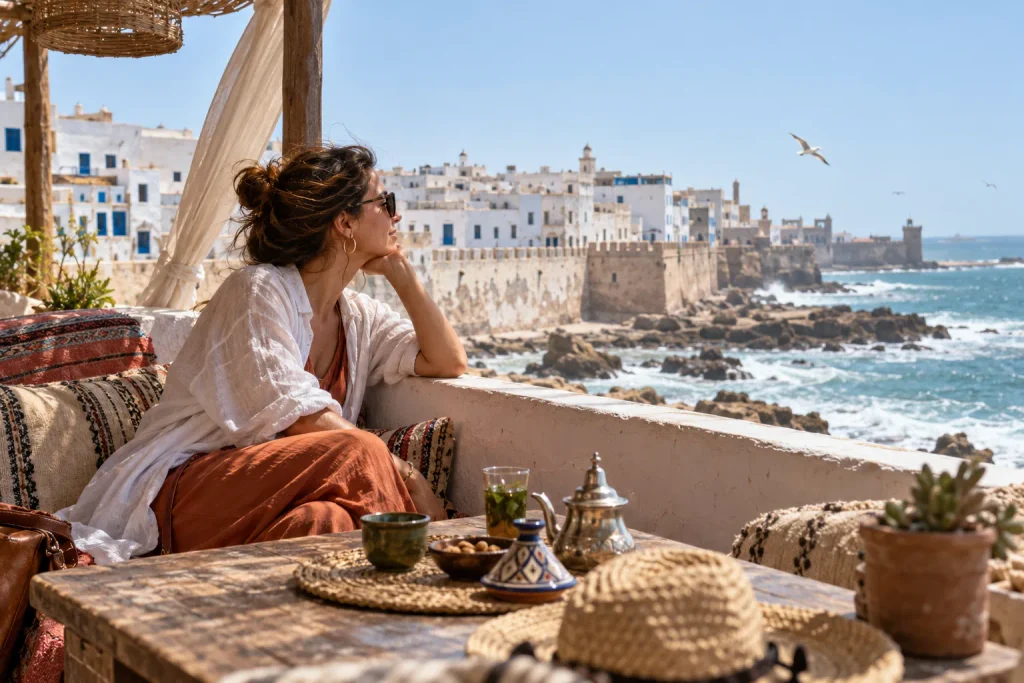
If July or August are your only available months, review the amount of exposed outdoor time and the number of inland stops before booking. Changing the route can be more useful than trying to keep a spring itinerary unchanged.
Check what a typical day would involve: walking between attractions, waiting outside, travelling in a vehicle, resting at your accommodation and eating in the evening. A schedule can look manageable on a map while leaving little space for a break.
Consider giving the coast more of the trip and shortening inland visits if that matches your interests. For a stay in Essaouira, assess whether you want several nights by the sea or just a visit from Marrakech. A coastal stop does not automatically mean calm swimming conditions; wind and sea conditions need their own check.
For accommodation, ask about the room you are reserving. Confirm cooling, ventilation and whether the location makes it easy to return during the day. A property-level amenity description may not answer every room-specific question.
If a desert overnight is essential, discuss the proposed daytime schedule, transfers and accommodation conditions before committing. An early start alone does not resolve every issue with an itinerary that includes several hours outdoors or long road journeys.
Winter dates work better when the overnight arrangements are clear
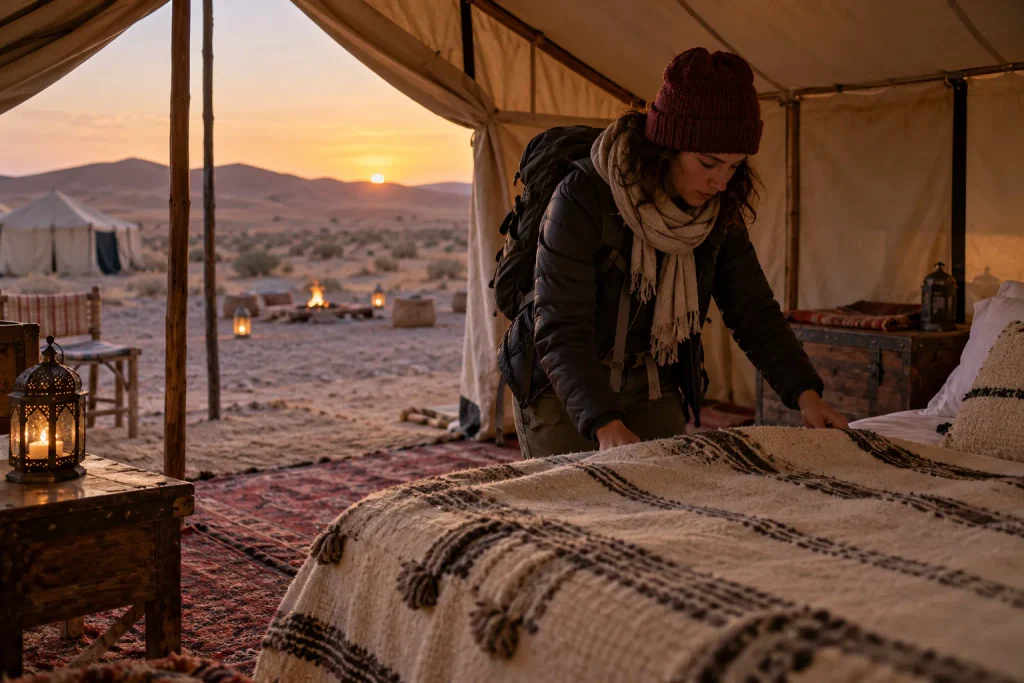
For a winter visit, examine evening comfort and the journey between stops as closely as the daytime programme. A holiday description built around sunshine can leave you unprepared for a cold room or an outing affected by mountain weather.
Ask about heating in the actual room or tent, bedding, indoor dining space and any extra equipment you would need. “Desert camp” describes a type of accommodation, not a consistent set of facilities.
For a route crossing mountain areas, ask how the operator handles access problems and what alternative would be offered. Keep the final night and onward departure practical if the journey needs to change.
A winter city break can also benefit from a modest daily plan: one main outdoor visit, an indoor option and time for a meal without another long transfer. The point is to make the trip enjoyable in more than one weather scenario.
Do not choose a mountain excursion solely because it departs from a city with a favourable forecast. Confirm the conditions for the route itself, particularly when snow, ice or reduced visibility could affect access.
Count usable days before adding a desert tour
Your available time can be a stronger constraint than the month. Count sightseeing days after accounting for arrival, departure and the main journeys; a three-day tour occupies a substantial part of a short holiday.
For example, the 3-day Merzouga Sahara tour from Marrakech uses its first day for the route towards the Dades Valley via Ait Ben Haddou, continues to Merzouga on the second day and returns to Marrakech on the third. It includes long drives, and the return is described as an evening arrival.
That makes it a multi-day travel commitment. If your entire holiday is only four days, consider how much of Marrakech you would actually see and whether the departure arrangements are comfortable. Avoid placing a flight immediately after the advertised road return.
A coastal outing presents a different trade-off. The Essaouira day trip from Marrakech includes return transport, local assistance and a guided orientation, with lunch and drinks separate. It gives you coastal time without changing hotels, but still uses a full excursion day.
Choose between these experiences according to your priorities and available days. They are different journeys, and neither should be added merely to make an itinerary appear more complete.
Compare total trip costs across exact dates
There is no single cheapest month that can be promised for every departure airport, route and accommodation choice. Compare the complete cost of two realistic itineraries using live quotes.
Keep the comparison consistent. Use the same number of nights, comparable room arrangements and the same included services. A cheaper flight that arrives late and requires another overnight stay may not produce a cheaper holiday.
Record these items for each option:
| Cost or condition | What to compare |
|---|---|
| Flights | Arrival and departure times, baggage and change terms |
| Accommodation | Room type, nights, meals and cancellation deadline |
| Ground travel | Transfers between the places where you actually stay |
| Activities | Included services, optional charges and available dates |
| Flexibility | What happens financially if a flight or outdoor activity changes |
Then consider the experience you are buying. If the cheaper dates require dropping your main activity, decide whether you would still want that version of the trip.
Public holidays, school breaks and events can affect availability, but their impact varies by place and date. Check the exact week rather than assuming every day in a named season has similar demand.
Check Ramadan and event arrangements for the year you will travel
Check dates and local operating arrangements before building your trip around a holiday, festival or fixture. Annual events and religious observances should not be copied into a new itinerary using the previous year’s calendar.
The UK’s Morocco safety and cultural guidance notes that Ramadan dates vary by year and country. For planning, confirm daytime food options, activity starting times and any changes to opening hours with the businesses you intend to use.
A festival is only a useful booking anchor once the edition, dates and venue are confirmed. A city’s usual association with an event does not establish that it will happen during your visit.
For a football trip, distinguish the scheduled match from the surrounding sightseeing. Keep transport and accommodation decisions flexible enough for the fixture arrangements you have actually confirmed.
Compare two complete travel windows before paying
Put your two choices side by side and identify the compromise in each. This is more informative than comparing a national temperature average with a flight price.
The following worksheet is an editorial planning tool, not a rating of particular months:
| Question | Option A | Option B |
|---|---|---|
| Can I do my priority activity? | Confirm the route or event | Confirm the route or event |
| How many days are genuinely usable? | Subtract arrivals, departures and transfers | Use the same calculation |
| Does the daily pace suit everyone? | Review walking, heat, rest and driving | Review the same needs |
| What if an outdoor day changes? | Name a realistic alternative | Name a realistic alternative |
| What is the total quoted cost? | Include the same categories | Include the same categories |
| What remains uncertain? | List unresolved details | List unresolved details |
If one option leaves several important questions unanswered, resolve those questions before comparing the prices. A confirmed activity and a workable arrival day are often more useful than a slightly more attractive seasonal label.
The Morocco Trip Planning Guide helps connect this date decision to your route, accommodation and reservation order. When discussing options with Visit Morocco Together, share both possible date ranges, your arrival and departure points, and the experience you want to prioritise.
Use forecasts and local advice to adjust the final programme
Seasonal patterns help choose dates; current conditions help choose what to do on a particular day. Near departure, check the places along your route rather than looking only at the first city.
Morocco’s meteorological authority publishes weather vigilance information. Use current warnings alongside local advice when reviewing a mountain outing, coastal activity or exposed excursion.
Ask an operator who decides whether an activity proceeds, when that decision is usually communicated and what happens if the programme changes. Keep the answer with your booking conditions.
Leave at least one part of the itinerary easy to rearrange where possible. A free afternoon or a movable city walk gives you more room to respond than a sequence of prepaid activities with tight transfers between them.
Common questions about choosing Morocco travel dates
What is the best month to go to Morocco?
For a first trip combining inland cities and the Sahara, start by comparing April and October. This is a planning recommendation rather than a universal winner: a coastal holiday, high-altitude trek or event-led trip may call for different dates. Choose the month that fits the activity you most want to do and the pace you can manage.
Is Morocco affected by the Iran war?
Travel to Morocco can be affected indirectly, particularly if your journey connects through the Middle East. That is separate from the security situation at your Moroccan destination.
Checked 7 October 2026: the FCDO Morocco advice reviewed for this article did not contain a nationwide warning against travel because of the Iran conflict. The FCDO’s regional tensions advice on its Iran page nevertheless warned of possible flight cancellations, periodic airspace closures and disruption in the Middle East.
For a Morocco itinerary using a regional connection, that means checking your operating airline, transit country’s advice and return journey before departure. This is not confirmation that a particular flight is cancelled, or that every route is unaffected. Review current advice again before paying and travelling.
Is Casablanca or Marrakech nicer?
Marrakech may suit you better if your priority is a holiday centred on souks, historic architecture, gardens and medina walks. Casablanca may appeal more if you want a large contemporary city, Art Deco streets, the Hassan II Mosque and an Atlantic waterfront.
Choose according to what you want to do and how the city fits your flights and route. Neither is automatically the better first stop. For travel timing, compare the conditions and daily programme in the city you will actually explore.
How many days in Morocco is enough?
As a planning rule of thumb, allow around four or five days for one base and limited excursions, seven to ten days for a focused route through a few places, or roughly twelve to fourteen days for a broader journey with more time between stops. These are suggested planning ranges, not fixed minimums.
Count arrival and departure time honestly. Extra days are useful when they create time in the places you care about; filling them with additional transfers does not necessarily make the trip more satisfying.
Ready to Experience Morocco?
Turn this inspiration into your next adventure. Our travel experts are ready to help.