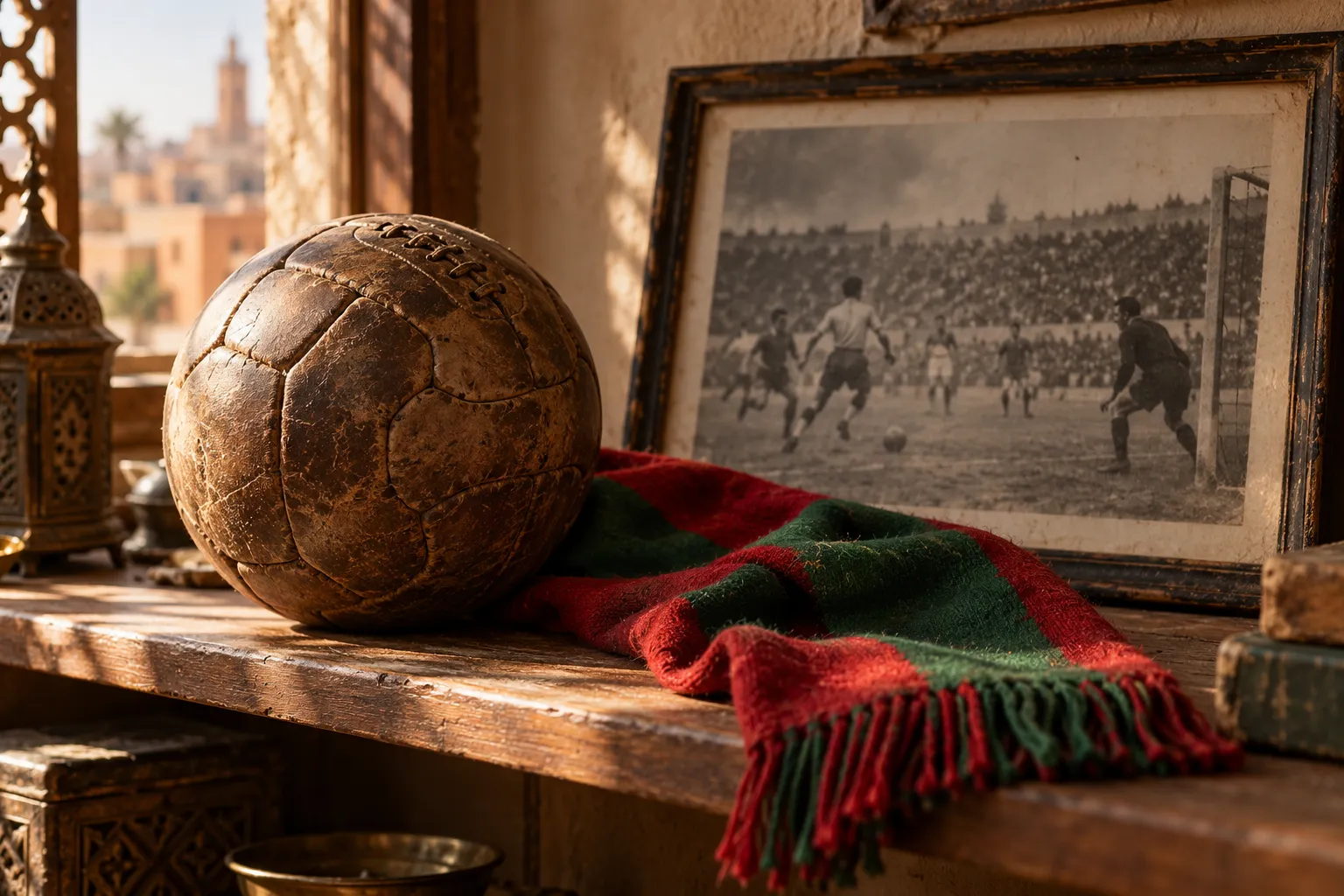
The history of football in Morocco stretches from clubs founded before independence to African titles, World Cup breakthroughs and the country’s appointment as a 2030 co-host. The Atlas Lions’ run in Qatar in 2022 brought that history to a wider audience, but Moroccan supporters already had decades of club rivalries, national-team memories and players to celebrate.
Understanding those earlier chapters gives a visitor more to talk about than the latest score. Casablanca’s clubs, Rabat’s continental achievements and the development of women’s and youth football each explain a different part of the game.
This guide follows the main milestones and connects them with places you can explore. For the practical side of attending games, use our Morocco Football and Sports Travel guide, which covers confirmed fixtures, admission and matchday journeys.
Which milestones shaped the history of football in Morocco?
Three landmarks provide a starting point: Morocco’s first Africa Cup of Nations title in 1976, its breakthrough into the men’s World Cup knockout stage in 1986, and its semi-final appearance in 2022. Club football and the achievements of other national teams give that timeline greater depth.
| Period | Main development |
|---|---|
| Before independence | Clubs including Wydad and Raja establish enduring football identities in Casablanca. |
| 1956 onward | Independence brings the domestic game under national administration. |
| 1970 | Morocco makes its first men’s World Cup appearance. |
| 1976 | The national team wins its first Africa Cup of Nations. |
| 1980s–1990s | African club titles accompany Morocco’s 1986 World Cup breakthrough and later appearances. |
| 2009 onward | Academy development becomes an important part of the modern football programme. |
| 2022 | Morocco reaches the men’s World Cup semi-finals; AS FAR wins the CAF Women’s Champions League. |
| 2023–2025 | Women’s World Cup progress, Olympic bronze, futsal success and a men’s U-20 world title broaden the story. |
| 2026 | The men’s team reaches another World Cup quarter-final. |
| 2030 | Morocco is appointed to co-host a future World Cup with Portugal and Spain. |
These milestones involve different competitions and squads. A senior men’s World Cup appearance, an Olympic medal and a youth world title should each be understood on their own terms.
How did Moroccan clubs develop before independence?
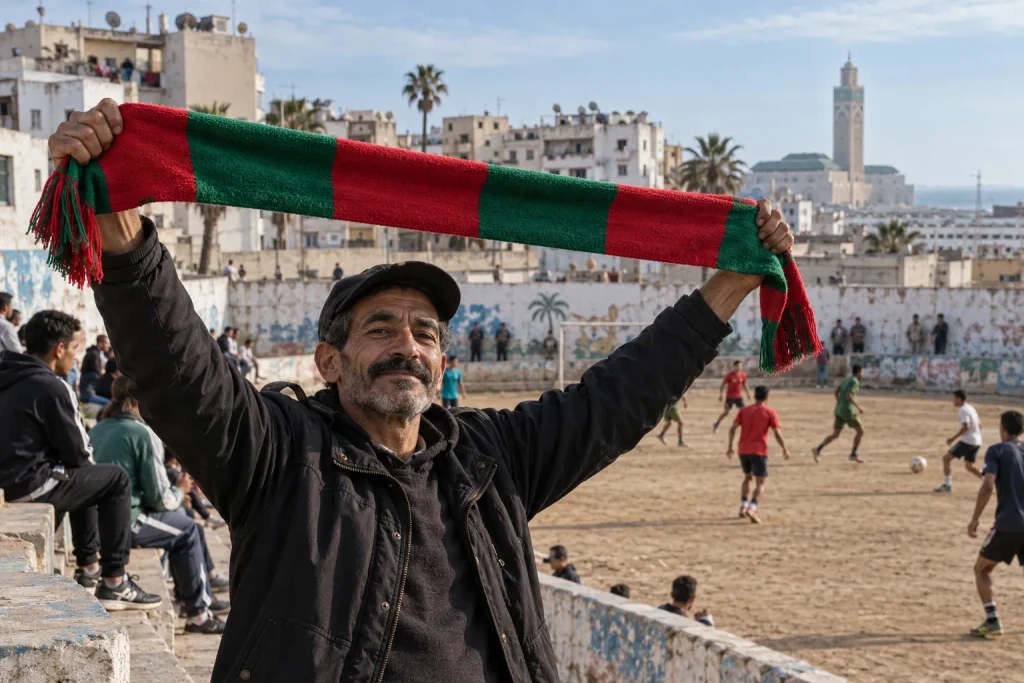
Organised club football predates Morocco’s independence in 1956. Casablanca provides two prominent examples: Wydad Athletic Club was founded in 1937, while Raja Club Athletic followed in 1949.
FIFA’s history of Wydad connects its Moroccan founders with the movement for national independence. That background explains why the club’s history extends beyond trophies and results. A sporting institution could also represent belonging and public identity.
Raja developed its own following and football traditions. Over time, the two clubs became rivals within the same city, giving Casablanca a football conversation that continues between individual derby days.
For a visitor, the useful point is that the rivalry has a history. It is worth asking supporters what their club means to them rather than assigning everyone a social background or political opinion based on a shirt.
Our Casablanca destination guide provides the wider city context. Football can be one reason to visit, alongside its architecture, neighbourhoods and Atlantic waterfront.
What changed after Morocco became independent?
After independence in 1956, the Royal Moroccan Football Federation took over the administration of the domestic game. Its historical account of Moroccan football describes this transition from the earlier league structure.
National administration gave domestic competitions and international representation a common framework. The league offered clubs a regular championship to contest, while the national team represented Morocco against opponents beyond its borders.
Those are related but separate histories. A supporter can follow a city club throughout the season and then support the Atlas Lions during an international tournament. Understanding that distinction helps explain why a national-team shirt does not tell you which club someone supports.
The national team’s familiar red and green colours also connect it with the Moroccan flag. For visitors, recognising the difference between club identity and national identity makes conversations about the game easier to follow.
Why was the 1970 World Cup an important first step?
Mexico 1970 was Morocco’s first appearance at the men’s World Cup. It established a place in the tournament decades before the knockout-stage achievements for which the team is now widely remembered.
The campaign included a 1–1 draw with Bulgaria, a result preserved in FIFA’s match archive. Morocco left at the group stage, but the appearance matters as the beginning of its World Cup record.
Keep the different firsts separate. Morocco’s tournament debut came in 1970; reaching the knockout stage came in 1986; reaching the semi-finals came in 2022. They represent successive advances rather than one achievement repeated under different descriptions.
How did Morocco win the Africa Cup of Nations in 1976?
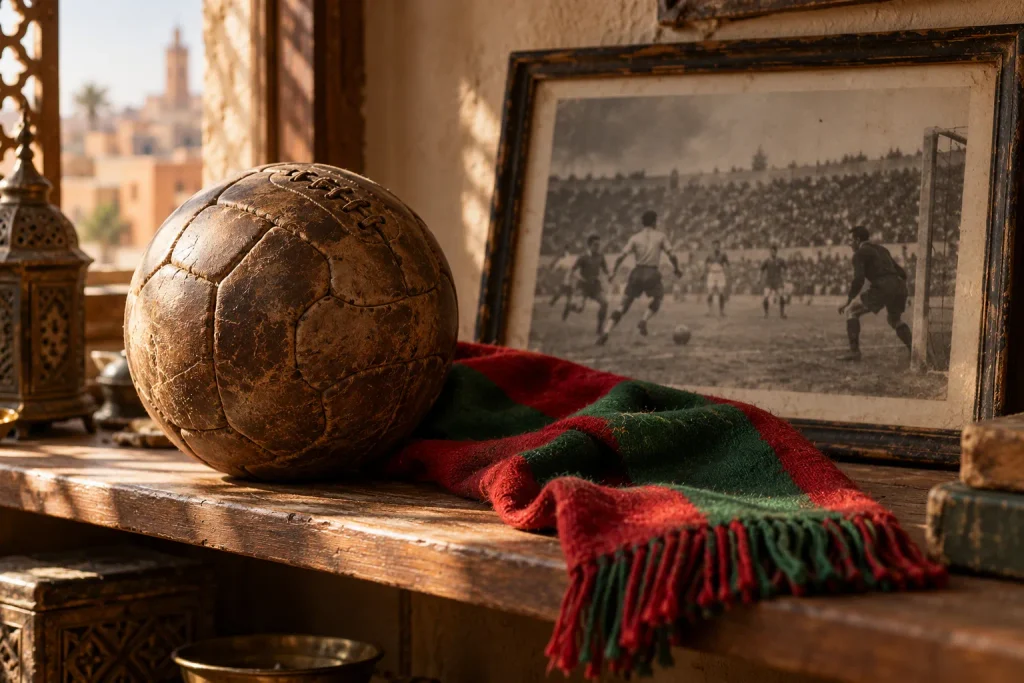
Morocco won its first Africa Cup of Nations in Ethiopia in 1976, with Ahmed Faras among the central figures. The title was decided through a final group, which makes this edition different from a tournament ending in a single knockout final.
Morocco, Guinea, Nigeria and Egypt contested that final round. After beating Egypt and Nigeria, Morocco needed a draw against Guinea in its last match to finish top.
Guinea led before Ahmed Makrouh, known as Baba, equalised late in the game. The 1–1 result secured the title. CAF’s account of the 1976 tournament records the format and the decisive equaliser.
This is an important detail when describing the achievement: Guinea was the opponent in Morocco’s last title-deciding game, but there was no separate knockout final. The championship belongs to an earlier generation whose place in Moroccan football is independent of later World Cup attention.
What made Morocco’s 1986 World Cup campaign historic?
Morocco became the first African team to reach the men’s World Cup knockout stage in Mexico in 1986. It advanced as a group winner rather than through a narrow qualification from a lower position.
Draws with Poland and England were followed by a 3–1 win over Portugal. Abderrazak Khairi scored twice in that victory, with Abdelkrim Merry, also known as Krimau, adding the third.
The campaign ended with a late 1–0 defeat to West Germany in the round of 16. Progressing beyond the group stage was nevertheless a new benchmark for African participation. FIFA’s retrospective on the 1986 team explains the significance of that breakthrough.
It also provides a useful bridge between generations. Supporters who remember 1986 may discuss a different set of players and expectations from those whose first major football memory is Qatar 2022.
How did Moroccan clubs build a continental reputation?
Morocco’s club achievements developed alongside the national team’s progress. AS FAR won the African Cup of Champions Clubs in 1985, while Raja won the same competition in 1989 before taking the renamed CAF Champions League in 1997 and 1999.
CAF’s history of Raja’s continental wins places those three titles in sequence. Wydad also won the continent’s leading club competition in 1992, 2017 and 2022, showing that Moroccan success was spread across clubs and decades.
Raja reached the FIFA Club World Cup final in 2013, when Morocco hosted the tournament, before losing to Bayern Munich. It was another occasion on which a Moroccan club appeared on a wider international stage.
For travellers, these achievements help explain why Casablanca and Rabat matter to football history in different ways. They also show why following only the national team leaves out much of the weekly game that supporters know.
Club history deserves attention beyond a trophy count. Ask about a remembered coach, a particular continental tie or a player’s route through the club. Those questions leave room for an individual supporter to tell the story in their own words.
What happened between the 1990s and Morocco’s World Cup return?
Morocco appeared at the World Cups of 1994 and 1998 but did not advance from either group stage. The 1998 team, featuring players such as Mustapha Hadji and Noureddine Naybet, remains a significant part of the national-team story.
In France, Morocco drew 2–2 with Norway, lost 3–0 to Brazil and beat Scotland 3–0. Norway’s victory over Brazil in the other final group match left Morocco outside the qualifying places.
There was then a twenty-year absence from the finals before Morocco returned in 2018. That campaign also ended at the group stage. FIFA’s Morocco team history provides the broader World Cup record.
The gap matters because later success was not an uninterrupted series of tournament advances. Different generations experienced qualification, disappointment and rebuilding. A short history should make room for those periods as well as the celebrated results.
How did player development contribute to the modern team?
Academy investment and players developed in Morocco and abroad both contributed to the modern national team. Neither pathway explains the whole squad on its own.
The Mohammed VI Academy opened in 2009. FIFA’s account of Morocco’s football development identifies it as an important part of the longer programme behind later achievements. Players including Youssef En-Nesyri, Azzedine Ounahi and Nayef Aguerd came through that academy environment.
The national team also drew on players with Moroccan family connections who developed in European football. Achraf Hakimi and Hakim Ziyech illustrate how the team’s history includes communities and training pathways beyond Morocco’s borders.
This combination helps explain the range of experience within a national squad. Facilities, coaching and recruitment create opportunities; they do not guarantee a particular tournament result. The contribution of players and coaches still has to be assessed through what the team achieves on the pitch.
Why did the 2022 World Cup change Morocco’s international profile?

Morocco became the first African and Arab team to reach a men’s World Cup semi-final in Qatar in 2022. Walid Regragui’s side finished fourth, making this its furthest run in the competition.
The team topped a group containing Croatia, Belgium and Canada. It drew 0–0 with Croatia, beat Belgium 2–0 and defeated Canada 2–1 before meeting Spain in the round of 16.
That match stayed goalless through extra time. Morocco won the shootout 3–0, with Yassine Bounou saving the penalties taken by Carlos Soler and Sergio Busquets. Pablo Sarabia’s attempt hit the post, and Achraf Hakimi scored the deciding kick. FIFA’s Morocco–Spain report records that sequence.
In the quarter-final, Youssef En-Nesyri headed the only goal against Portugal. The 1–0 victory took Morocco into the last four. France then won the semi-final 2–0, and Croatia beat Morocco in the third-place match.
The results explain the significance without needing to describe every opponent as afraid of Morocco. The team advanced through a difficult group and two knockout ties, setting a new African World Cup benchmark.
How have women’s football, youth teams and futsal added to the history?
Recent Moroccan football history includes achievements outside the senior men’s eleven-a-side team. These developments broaden both the sporting record and the teams a visitor might choose to follow.
What did the women’s teams achieve?
Morocco reached the Women’s Africa Cup of Nations final in 2022. In the same year, AS FAR won the CAF Women’s Champions League, beating Mamelodi Sundowns Ladies 4–0 in the final.
The national team then reached the round of 16 at its first Women’s World Cup in 2023. After an opening defeat to Germany, it beat South Korea and Colombia before losing to France. FIFA’s tournament results document that progression.
What did the Olympic and U-20 teams achieve?
Morocco won men’s Olympic football bronze at Paris 2024, beating Egypt 6–0 in the medal match. The following year, Mohamed Ouahbi’s team won the men’s U-20 World Cup in Chile.
Yassir Zabiri scored both goals in the 2–0 final win over Argentina. That was Morocco’s first title in the competition. An Olympic medal and an U-20 world title are distinct achievements, with different player eligibility from the senior World Cup.
Where do CHAN and futsal fit?
Morocco won the African Nations Championship, or CHAN, in the 2018 and 2020 editions, then secured a third title at CHAN 2024, which was played in 2025. CAF’s account of the three titles connects that record with domestic-league talent.
CHAN is a national-team competition for players based in their own country’s domestic league. Its title record should be kept separate from the Africa Cup of Nations.
Futsal is another separate format. Morocco won a third successive men’s Futsal Africa Cup of Nations in 2024, defeating Angola 5–1 in the final. That indoor, five-a-side achievement belongs alongside the wider football story without being added to the eleven-a-side team’s honours.
What should readers know about the 2025–2026 chapter?
Morocco reached the men’s World Cup quarter-finals again in 2026, following its semi-final appearance four years earlier.
FIFA’s 2026 results show a 1–1 draw with Brazil, a 1–0 win over Scotland and a 4–2 win over Haiti in the group stage. Morocco then advanced past the Netherlands on penalties and beat Canada 3–0 before losing 2–0 to France in the quarter-final.
That makes seven men’s World Cup appearances through 2026: 1970, 1986, 1994, 1998, 2018, 2022 and 2026.
The AFCON 2025 final requires a separate, dated explanation. On 17 March 2026, the CAF Appeal Board recorded the final as a 3–0 forfeiture win for Morocco. Senegal appealed to the Court of Arbitration for Sport.
Status checked on 8 October 2026: CAS scheduled the appeal hearing for this date and stated that a final decision would not be issued on the hearing day. The CAF ruling and the appeal should both be mentioned when describing this chapter. The hearing date alone does not resolve the dispute.
What does hosting the 2030 World Cup add to Morocco’s story?
Morocco’s appointment as a 2030 co-host adds tournament organisation to its history as a competing nation. On 11 December 2024, the Extraordinary FIFA Congress appointed Morocco, Portugal and Spain as hosts, with centenary celebration matches in Argentina, Paraguay and Uruguay.
CAF’s announcement of the appointment records that decision. It is a confirmed milestone even though the tournament itself remains in the future.
FIFA had not selected the final venue when it responded in September 2026. A co-host appointment does not settle the allocation of that match, and a stadium proposal does not establish public access, ticket availability or a completed venue.
For a history article, the distinction is straightforward: the hosting appointment has happened; the tournament has not. Detailed travel plans should follow the relevant official announcements as they are made.
How can visitors connect this history with a Morocco trip?
Casablanca and Rabat provide two starting points for connecting club history with a city visit. Keep sightseeing on its own timetable, then add a football event if a confirmed fixture and admission arrangement fit your stay.
Visit Morocco Together’s Casablanca City Discovery tour covers landmarks and architecture, including the Hassan II Mosque and Art Deco heritage. In Rabat, the medina and souks experience with the Kasbah of the Udayas offers a guided city walk. These activities give you time to explore the cities around the football; match tickets and stadium access require their own arrangements.
Conversations can be just as revealing as a stadium view. Ask which team someone follows, which generation they remember and which result meant most to them. Our Morocco culture and etiquette guide provides context for respectful visits and interactions.
A club badge or a remembered match can open a conversation. Let the person you are speaking with decide how much of their story they want to share.
Ready to Experience Morocco?
Turn this inspiration into your next adventure. Our travel experts are ready to help.