Morocco trip planning becomes much easier when you choose your route before choosing every attraction.
Morocco combines historic medinas, Atlantic beaches, Atlas Mountain villages, desert landscapes, traditional riads, artisan workshops, food experiences and modern cities. The variety is part of the appeal, but it can also make a first itinerary unnecessarily complicated.
The biggest planning mistake is trying to visit Marrakech, Fes, Chefchaouen, the Sahara, the Atlantic coast and Casablanca in one short trip. Morocco is larger than many visitors expect, and long road journeys can take more energy than the distance on a map suggests.
A better approach is to choose one main travel purpose, select a realistic region, protect enough time for transportation and then add activities around the route.
This guide explains how to plan a Morocco trip, how many days you need, which routes are realistic, when to visit, what to book first and when a private transfer or organised tour can make the journey easier.
How to plan a Morocco trip in the right order
Use this order when building your itinerary:
- Decide what type of Morocco experience you want.
- Choose a realistic number of days.
- Select your arrival and departure cities.
- Match the route to the season.
- Decide which journeys need trains, buses, private transfers or tours.
- Book the fixed parts of the trip first.
- Add activities after the route is stable.
- Keep enough time for rest, delays and unexpected discoveries.
This sequence prevents a common problem: booking attractive destinations first and only later discovering that the route requires several consecutive long travel days.
Start with a trip brief before choosing destinations
Before deciding between Marrakech, Fes or the Sahara, answer these questions:
- What is the one experience you would regret missing?
- Are you more interested in history, food, nature, beaches, shopping or desert landscapes?
- How many long travel days can you comfortably handle?
- Do you prefer independent travel or a fully organised route?
- Are you travelling solo, as a couple, with children or in a larger group?
- Do you need specific accommodation, dietary, mobility or photography arrangements?
Your answers determine the shape of the trip.
For example, a traveller interested mainly in architecture, food and traditional crafts may prefer Marrakech, Fes and Meknes. A traveller whose main goal is a desert camp should protect several days for the southern route instead of adding too many northern cities. A family may enjoy a slower itinerary with fewer hotel changes, while a couple may prefer to combine a city stay with Essaouira or Taghazout.
The best itinerary is not the one with the most place names. It is the one where each destination has enough time to feel meaningful.
How many days do you need in Morocco?
Four to five days
Choose one main city and one nearby day trip.
Suitable options include:
- Marrakech with an Atlas Mountains or Ourika Valley day trip
- Fes with Meknes and Volubilis
- Casablanca with Rabat
- Agadir with Taghazout
A full Sahara route is usually not realistic in this timeframe unless the desert is the main purpose of the trip.
Six to seven days
Choose two connected areas rather than attempting a complete country tour.
Possible routes include:
- Marrakech and Essaouira
- Marrakech and a focused southern desert route
- Fes, Meknes and Chefchaouen
- Casablanca, Rabat and one additional city
- Agadir, Taghazout and a coastal base
A Marrakech and Sahara itinerary can fit into seven days, but it may include several long road days. This route works best when the desert is more important to you than having a slow city holiday.
Eight to ten days
This is a more comfortable length for a first major Morocco itinerary.
You could combine:
- Marrakech, the southern kasbah route, Merzouga and Fes
- Fes, Chefchaouen, Tangier and Rabat
- Marrakech, Essaouira, Agadir and Taghazout
- Marrakech, Fes and the Middle Atlas
Eight to ten days gives you enough time to include a major highlight without turning every day into a transfer day.
Eleven to fourteen days
This is a practical range for combining several different landscapes.
A route might include:
- Marrakech
- Ait Ben Haddou
- Ouarzazate
- Dades Valley or Todra Gorge
- Merzouga
- Fes
- Chefchaouen
- Essaouira or another coastal destination
Even with two weeks, you still need to make choices. Adding every region can make the itinerary feel like a transport schedule instead of a holiday.
Fifteen days or more
Longer trips allow deeper regional travel.
You can add places such as Imlil, Oualidia, Taroudant, Dakhla, Ifrane, Azrou, Mirleft or the Dades Valley without treating them as quick photo stops.
Use Morocco’s three travel clocks
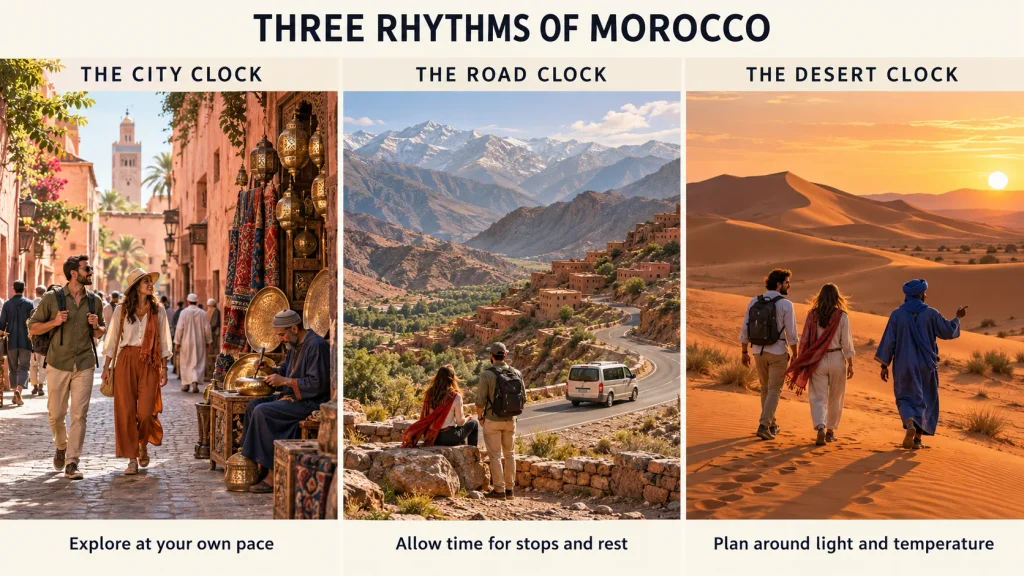
One practical way to improve Morocco trip planning is to think about three different clocks.
The city clock
City days are flexible. You can usually choose between a medina walk, a museum, a food experience, a hammam, shopping or a slow evening meal.
However, city exploration can still be tiring. The narrow streets of Fes and the busy souks of Marrakech require more walking and navigation than a normal city centre.
The road clock
Road days are less flexible.
A route through the High Atlas, Ait Ben Haddou, the Dades Valley or Todra Gorge depends on mountain roads, daylight, scenic stops, weather and overnight locations.
Do not judge a road journey only by its distance. Also consider:
- How many stops you want to make
- Whether you are travelling with children
- Whether the route crosses mountain passes
- Whether you need time for meals and breaks
- Whether you will arrive before dark
- Whether you have another long journey the next day
The desert clock
Desert experiences are organised around light and temperature.
Sunrise, sunset, heat, wind and transfer timing affect the experience more than a normal city schedule. A desert camp arrival or dune experience should not be treated like a city attraction that can be moved into any spare hour.
This is why the desert route should be planned as a complete sequence rather than added randomly between city stays.
Choose the right route family
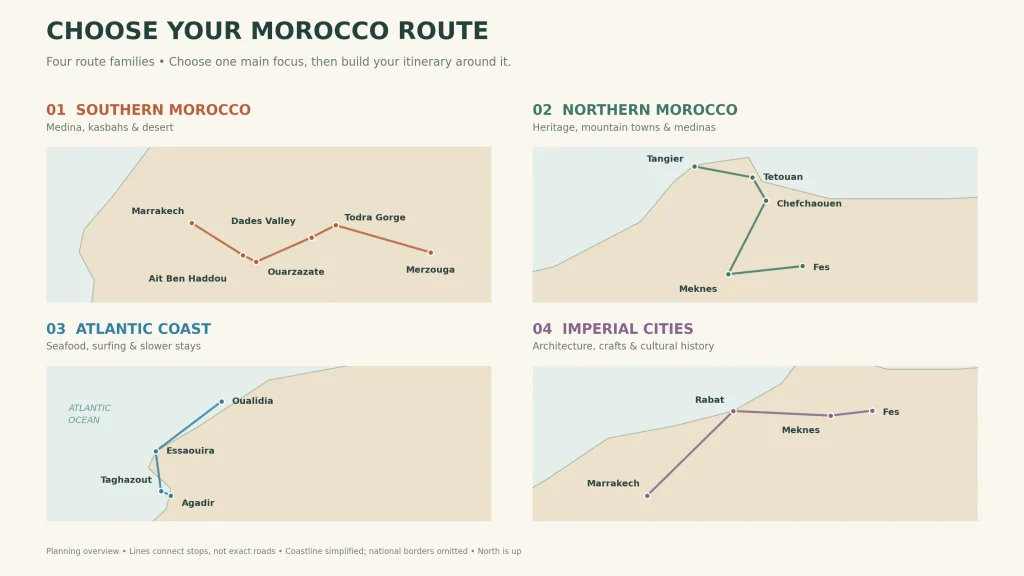
Marrakech and southern Morocco
The southern route is suitable for travellers who want a combination of:
- A historic medina
- Atlas Mountain scenery
- Kasbah architecture
- Desert landscapes
- Scenic road travel
- A desert camp
A typical route can connect Marrakech, Ait Ben Haddou, Ouarzazate, Dades Valley, Todra Gorge and Merzouga.
The main mistake is making this route too short. Travellers may spend most of the day driving and reach each destination with little time to explore.
If the Sahara is your main priority, it is more sensible to remove one city than to remove the time needed to enjoy the desert.
Northern Morocco
A northern itinerary can connect Fes, Meknes, Chefchaouen, Tetouan and Tangier.
This route is a good choice for travellers interested in:
- Historic medinas
- Andalusian influence
- Traditional crafts
- Roman history
- Blue-painted streets
- Mediterranean and Atlantic landscapes
Chefchaouen is visually distinctive, but it should not be treated only as a quick photo stop. The mountain setting, walking routes and slower atmosphere can justify an overnight stay.
Atlantic coast
The Atlantic coast works well for travellers who want a slower rhythm, seafood, beach time or water activities.
Possible stops include:
A coastal itinerary does not need to be combined with the Sahara. If your purpose is rest, surfing or a honeymoon, forcing a desert route into the same short trip may create the opposite experience.
Travellers who want a beach-focused route can explore Morocco Coastal Escapes.
Imperial cities
An imperial cities route may include Marrakech, Fes, Meknes and Rabat.
This style of travel is suitable for visitors who enjoy:
- Architecture
- Historic gates
- Palaces and gardens
- Traditional crafts
- Food markets
- Museums and cultural interpretation
Meknes can work well as a cultural stop between Fes and other northern destinations. It is usually better to connect it to an existing route than to add it as a long detour.
City and coast combination
For travellers who prefer comfort and variety, a city and coast route may be easier than a city and desert route.
A possible structure is:
- Marrakech for the medina and cultural introduction
- Essaouira for coastal scenery and seafood
- Agadir or Taghazout for a slower Atlantic stay
This route has less road stress than a full southern desert circuit and can work well for couples, families and first-time visitors who do not want several consecutive transfer days.
Choose your arrival and departure cities carefully
Your arrival and departure airports can change the entire efficiency of the route.
Marrakech is practical for southern Morocco, the High Atlas, Ait Ben Haddou and desert routes.
Casablanca can work well for international connections, Rabat, the Atlantic coast and central Morocco.
Fes is useful for heritage-focused itineraries and northern or eastern routes.
Tangier is convenient for northern Morocco and travellers combining Morocco with Spain.
Agadir is suitable for a coastal holiday, surfing trip or relaxed Atlantic itinerary.
An open-jaw route, such as arriving in Marrakech and leaving from Casablanca or Fes, may reduce backtracking. It is not always the cheapest flight option, so compare the full cost and travel time rather than looking only at the international ticket.
Choose the right transport for each section
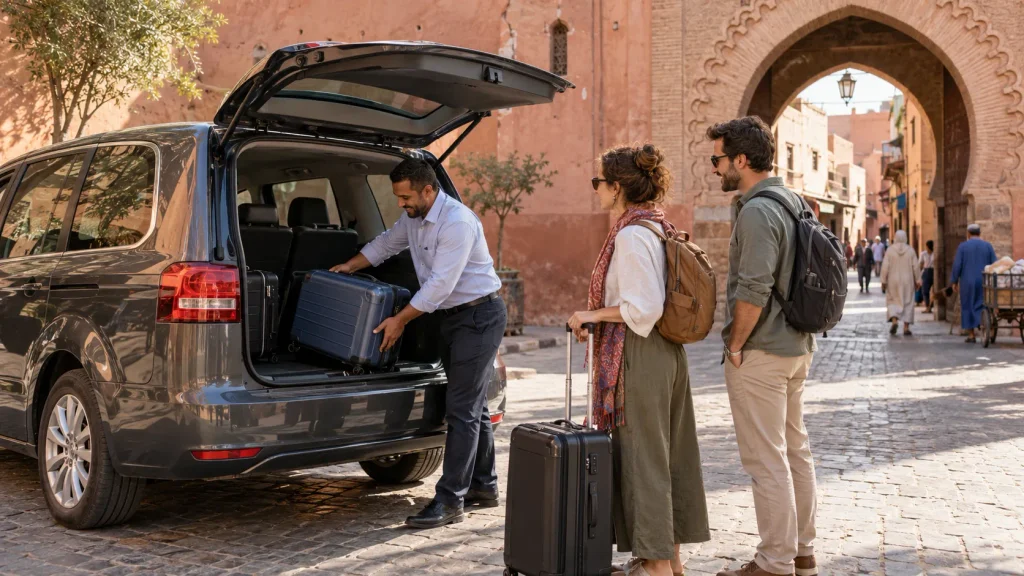
Trains
Trains are useful on established city connections, especially when you want predictable travel between major urban areas.
They are less useful for remote desert, mountain and village routes where the final destination requires road transport.
Buses
Buses can connect locations that are not served directly by rail. They may be practical for budget-conscious travellers, but allow extra time for station transfers, luggage and local arrival arrangements.
Private transfers and drivers
Private transport becomes more valuable when your itinerary includes:
- Mountain roads
- Desert routes
- Multiple scenic stops
- Remote accommodation
- Families or older travellers
- Large luggage
- A one-way route with several overnight locations
The benefit is not only comfort. A suitable driver or transfer can reduce the number of separate decisions you need to make during a long travel day.
Medina access
Many historic accommodations are located inside pedestrian areas. Vehicles may stop at a nearby gate rather than directly outside the property.
Before arrival, confirm:
- The closest vehicle drop-off point
- Walking distance with luggage
- Whether the accommodation can arrange assistance
- The correct address in a format your driver can use
Book the fixed parts first
A practical booking sequence is:
1. Confirm entry requirements
Entry rules depend on nationality, passport type, country of residence and travel purpose. Do not copy another traveller’s visa experience.
Use the official Accès Maroc eligibility portal to check the requirements for your passport and situation. Also confirm passport validity, onward travel requirements and airline conditions before departure.
2. Book international flights
Choose your arrival and departure cities only after deciding the route direction.
A one-way route may save time, but compare the flight options before committing.
3. Secure the main route anchor
If the Sahara is essential, decide the desert dates before booking every city hotel.
The same applies to a confirmed football match, a specific festival, a photography session or a limited-date activity.
4. Book the first and last nights
Your first accommodation should be easy to reach, particularly if you arrive late.
A beautiful riad deep inside a medina may not be the best choice for your first night if you are unfamiliar with the neighbourhood and travelling with heavy luggage.
5. Add accommodation between route anchors
Choose accommodation based on access, location and daily logistics, not only photographs.
Check whether:
- Vehicles can reach the entrance
- Breakfast fits your departure time
- The property can explain the walking route
- The location is suitable for your travel style
- The accommodation can support mobility or family needs
6. Add activities after the route is stable
Do not fill every free hour before confirming the transport plan.
Leave room for meals, rest, weather changes, delays and slower mornings.
Match the season to the region
Morocco does not have one single climate. The Atlantic coast, Mediterranean north, inland cities, Atlas Mountains and Sahara can feel very different during the same month.
The Moroccan National Tourist Office climate and seasons guide is a useful official reference when comparing regions.
In general:
- Spring can be comfortable for cities, mountains and outdoor activities.
- Summer can be intense inland and in the desert, while coastal areas may feel more comfortable.
- Autumn is often attractive for combining cities, outdoor routes and desert travel.
- Winter can bring pleasant daytime conditions in some areas but cold desert nights and mountain weather.
- Ramadan can affect meal timing, opening hours and the rhythm of daily life. It requires respectful planning rather than automatic avoidance.
If your itinerary includes hiking, desert camps, surfing or long drives, seasonal comfort should influence the route from the beginning.
Choose accommodation as part of the route
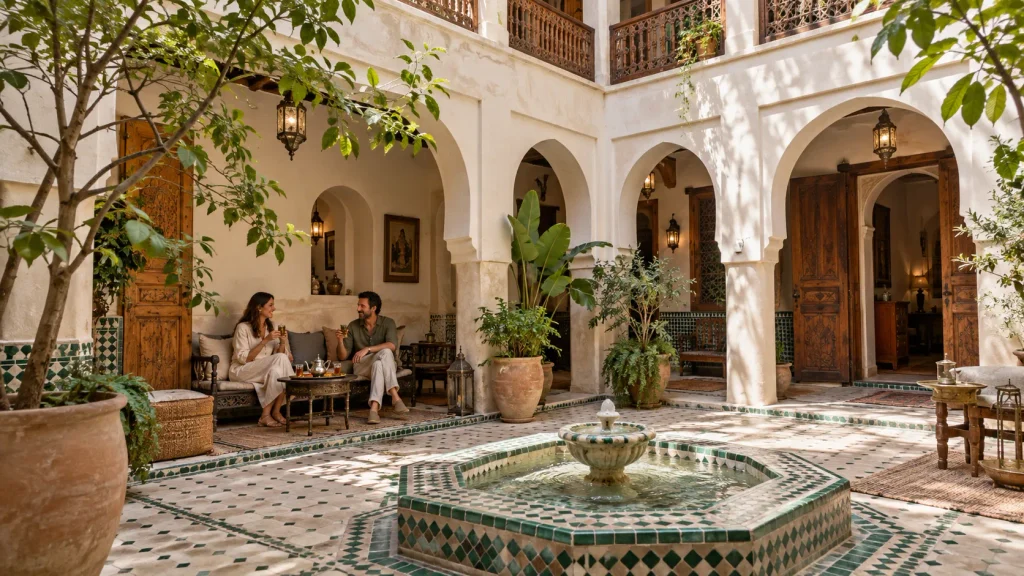
A riad, hotel, guesthouse or desert camp each creates a different type of trip.
Riads
Riads are often located in historic medinas and can provide a strong cultural experience. However, their location may require walking from a vehicle drop-off point.
Hotels in modern districts
Modern districts may offer easier vehicle access, larger rooms and more predictable facilities. They can be useful for first or last nights and for travellers with mobility concerns.
Desert camps
Desert accommodation should be assessed by access, facilities, temperature, privacy, meal arrangements and the total transfer plan.
Coastal stays
On the coast, decide whether you want to be close to the medina, beach, surf areas, restaurants or a quieter location outside the centre.
The best accommodation is the one that supports your itinerary instead of making every departure more complicated.
Prepare for internet, money and navigation
Download offline maps before leaving home. Save the addresses of your accommodation and transport points, and keep a written backup.
A SIM, eSIM or hotel Wi-Fi may work well in cities, but remote mountain and desert areas can have weaker coverage. Do not rely on mobile data for an important meeting or transfer.
Carry a small amount of local cash for taxis, markets, small cafés and places that do not accept cards. Keep a backup payment method separate from your main wallet.
A few simple greetings and directions in French, Arabic or Darija can also make daily interactions easier, even when English is available.
Plan activities without overbooking
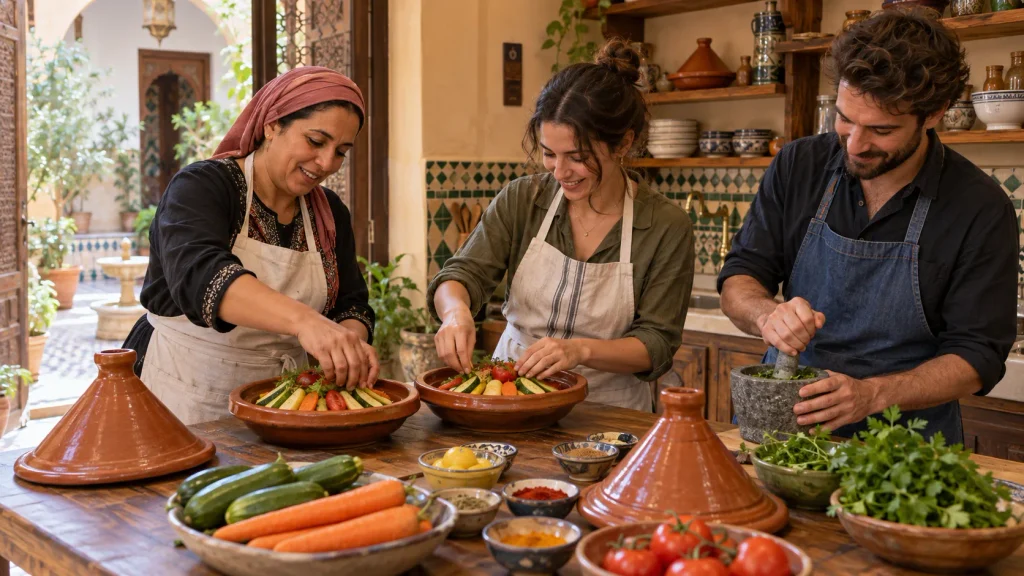
Activities should support the route, not compete with it.
Examples include:
- A guided medina walk in Marrakech or Fes
- A cooking class
- A hammam experience
- A mountain walk near Imlil or the Ourika Valley
- A desert sunrise
- A coastal surf lesson in Taghazout
- A photography session in Chefchaouen
- A craft or food experience in Meknes
Avoid placing a demanding hike immediately after an international flight or booking an early-morning activity after a late arrival.
For each activity, check the meeting location, expected duration, walking requirements, weather conditions and transport connection.
Planning around football and future events
Football can add cultural depth to a Morocco itinerary, but it should support the destination plan rather than replace it.
If attending a match is important, confirm the fixture, venue, ticketing rules and transport before arranging the rest of the trip. Then build the city experience around the match by adding local food, neighbourhoods, cultural sites and nearby destinations.
For World Cup 2030 planning, use only confirmed information about venues, cities, dates and ticketing. Avoid booking based on rumours or early promotional claims.
A football-focused trip can be especially strong when the match city connects naturally to a wider route. The result becomes a city and culture itinerary, not only a stadium visit.
Common Morocco trip planning mistakes
Trying to visit every famous city
Choose fewer places and give them enough time.
Treating the Sahara as a short excursion
The desert is a complete route experience involving road travel, temperature changes and carefully timed activities.
Booking accommodation before deciding the route
A hotel may look attractive but create unnecessary backtracking.
Ignoring the return journey
The return from the desert or mountains may require a full travel day. Protect enough time before an international flight.
Copying another traveller’s budget
Costs depend on season, accommodation, transport, group size and service level. Use current live prices from the provider you are considering, and never assume another traveller’s budget applies to your itinerary.
Booking too many activities
A full calendar can prevent you from enjoying the destination itself.
Sample itinerary frameworks
Seven-day Marrakech and southern Morocco route
- Days 1-2: Marrakech
- Day 3: High Atlas route and Ait Ben Haddou
- Day 4: Ouarzazate or Dades Valley
- Day 5: Todra Gorge and travel toward Merzouga
- Day 6: Desert sunrise and return journey
- Day 7: Marrakech or departure connection
This route is possible, but the return journey may be tiring. Extending it creates a more comfortable experience.
Nine-day Marrakech, Sahara and Fes route
- Days 1-2: Marrakech
- Days 3-5: Ait Ben Haddou, Dades Valley, Todra Gorge and Merzouga
- Day 6: Continue toward Fes
- Days 7-8: Fes
- Day 9: Departure or onward travel
This route works best when the itinerary is organised as a one-way journey rather than repeated returns to Marrakech.
Eight-day northern route
- Days 1-2: Fes
- Day 3: Meknes and Volubilis
- Days 4-5: Chefchaouen
- Days 6-7: Tangier
- Day 8: Departure
This route avoids the southern desert drive and focuses on heritage, medinas and northern landscapes.
Ten-day coastal route
- Days 1-3: Marrakech
- Days 4-5: Essaouira
- Days 6-8: Agadir or Taghazout
- Day 9: Return or connect to the departure city
- Day 10: Departure
This is a better structure for travellers who want culture and coast without adding the long desert route.
Frequently asked questions
Is seven days enough for Morocco?
Seven days is enough for one city and a nearby region, or for a focused Marrakech and Sahara itinerary. It is not enough to experience the desert, northern cities and Atlantic coast comfortably.
What is the best Morocco itinerary for first-time visitors?
The best route depends on your priority. Marrakech and the Sahara suit desert-focused travellers. Fes, Chefchaouen and Tangier suit culture and northern travel. Marrakech, Essaouira and Agadir suit travellers who want a mixture of city and coast.
Should I visit Marrakech or Casablanca first?
Marrakech is practical for southern Morocco and desert routes. Casablanca may be more suitable for travellers connecting to Rabat, the Atlantic coast or northern Morocco. Compare the complete route rather than choosing only by flight price.
Do I need a private driver in Morocco?
Not necessarily. Independent travel can work well in major cities and on established rail routes. Private transport becomes more useful for mountain roads, desert routes, multiple scenic stops and one-way itineraries.
Can I visit the Sahara in five days?
You can visit a desert area in five days if the desert is the central purpose of the trip. However, combining the Sahara with several northern and coastal destinations will usually create a rushed itinerary.
How far in advance should I plan Morocco?
Flexible city trips may be planned several weeks in advance. Desert camps, family accommodation, specific riads, festivals and confirmed sporting events may require earlier planning.
Is Morocco suitable for families?
Yes, but family itineraries should prioritise shorter transfer days, practical accommodation, rest periods and fewer hotel changes.
Should I book a tour or travel independently?
Independent travel is suitable for travellers who enjoy managing transport and daily decisions. A tour or private route can be more practical when your itinerary includes remote destinations, long drives or several connected regions.
Conclusion
Successful Morocco trip planning is not about adding the maximum number of destinations. It is about matching the route to your time, energy, interests and travel style.
Choose your main experience first. Decide whether you want cities, desert, mountains, coast or a combination. Then select an arrival city, protect enough time for transportation and add activities only after the route is realistic.
If you already know your main destination, use the relevant exact destination page for planning:
- Marrakech destination guide
- Fes destination guide
- Sahara Desert and Merzouga guide
- Chefchaouen destination guide
- Essaouira destination guide
For travellers who already know the route but want support with complex road sections, Visit Morocco Together also provides relevant Marrakech tours, private transfers and custom Morocco trip planning.
Ready to Experience Morocco?
Turn this inspiration into your next adventure. Our travel experts are ready to help.