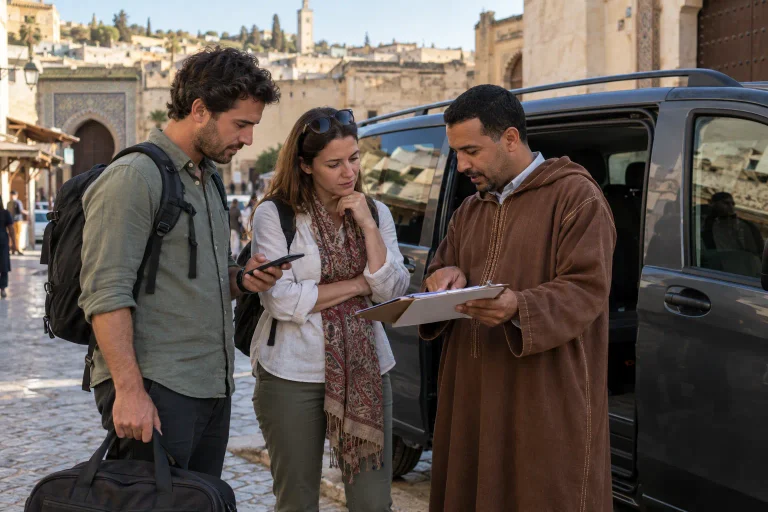
Taxis in Morocco work in two main ways: petit taxis usually handle journeys within a city, while grand taxis serve wider urban, regional and intercity routes. A grand taxi may sell individual seats or be hired for your party. Establish which arrangement you are buying before putting bags in the vehicle.
For a short city ride, start with a licensed petit taxi and clarify the meter or applicable local fare. For a shared regional journey, confirm the destination, price per seat and departure arrangement. For a private journey, agree the total for your group, the precise drop-off and any waiting or return travel.
The useful distinction is what happens between your pickup point and your accommodation. Within the wider options for getting around Morocco, taxis can fill short gaps, connect neighbouring towns or provide a private road journey when the arrangement suits your route.
How Taxis in Morocco Work
Petit taxis for journeys within a city
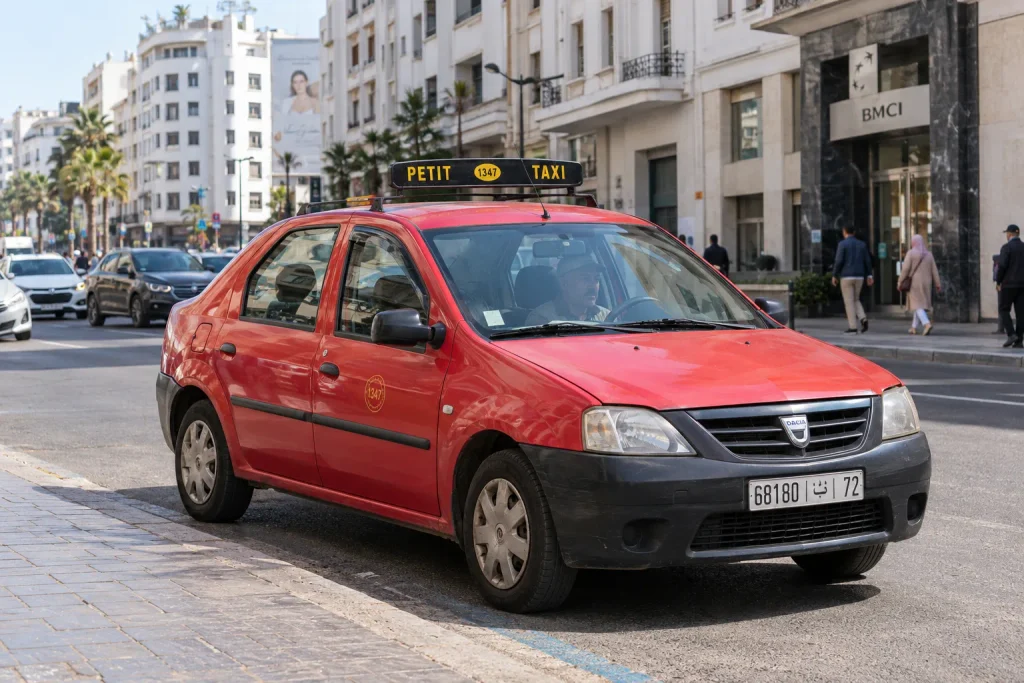
Petit taxis are small urban taxis, generally limited to three passengers in addition to the driver. Plan another arrangement for four adults, even if your destination is nearby.
Their operating area matters. Two places can look close on a map while falling outside the same city taxi area. Tell the driver the full destination before getting in rather than assuming that a nearby beach, suburb or neighbouring town is included.
Local taxi colours help you recognise the fleet. Casablanca and Agadir use red petit taxis; Rabat and Tangier use blue. Marrakech’s are commonly described as beige or ochre. Colour is an orientation aid: also look for the taxi identification and vehicle number.
A small taxi may have limited boot space. Three available passenger places do not establish that three large suitcases will fit.
Grand taxis for shared or private road journeys
Grand taxis connect cities, towns, outskirts and regional destinations. Some also provide urban journeys, so “grand” does not automatically mean a long-distance trip.
On a shared route, passengers buy places in a vehicle heading towards a set destination. Departure often depends on enough places being filled, rather than a published timetable.
A private hire gives your party exclusive use under the agreed terms. Confirm this explicitly: paying more for additional places is not, by itself, a clear agreement about exclusivity.
Vehicle layouts vary. Choose a vehicle with an appropriate passenger seat and usable seatbelt for each person. An old description of passengers squeezing into a saloon is not a seating arrangement you need to accept.
Taking a Petit Taxi Step by Step
First, have the destination ready on your phone. Use the accommodation’s full name, address and recommended road access point, not only the name of its neighbourhood.
At a rank or suitable roadside pickup, tell the driver where you want to go and how many people are travelling. Establish whether the destination is within the taxi’s operating area.
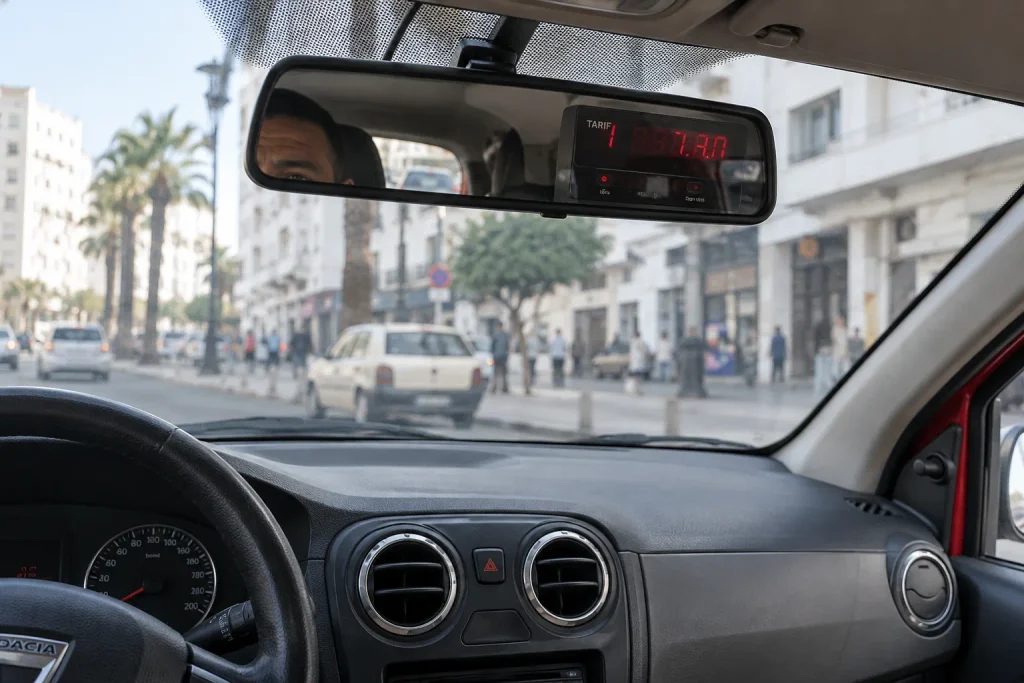
For a metered journey, ask for the meter before moving. “Le compteur, s’il vous plaît” means “the meter, please.” If the driver will not provide a clear arrangement, choose another available taxi before loading your bags.
Where a local fixed tariff applies, clarify the amount and what it covers. A fixed quote offered to a visitor should not automatically be treated as the official local tariff.
Check luggage space, sit down and fasten your seatbelt. Keep the destination accessible offline in case you lose your mobile connection.
At arrival, pay the established fare and collect all your belongings. With luggage, confirm that the boot has been emptied before the vehicle leaves.
Can a Petit Taxi Pick Up Other Passengers?
Yes, this can happen. A petit taxi may carry unrelated passengers whose journeys fit the driver’s direction.
If sharing would be uncomfortable for you, explain that before boarding and ask what arrangement is available. Hailing a vehicle with empty seats does not necessarily reserve it exclusively.
Clarify how your own fare will be recorded if another passenger joins. Do not divide a displayed total between strangers without understanding the local arrangement, or assume someone else’s destination has become yours.
A shared city taxi and a shared grand taxi are different experiences. In the former, passengers may join during an urban ride; in the latter, you may be buying a place on a particular regional route.
If you become uncomfortable, ask to finish at a suitable public place when it is safe to stop. Avoid an argument while the vehicle is moving.
Understanding Taxi Prices Without a National Fare Chart
There is no single price that describes a “taxi ride in Morocco.” The amount depends on the locality, taxi arrangement, route and any applicable supplements.
For a city ride, distinguish the meter’s starting amount, a minimum fare and the final amount. The minimum can exceed what a very short journey would otherwise register.
For a shared grand taxi, ask the fare for one person on the route you actually want. Confirm whether luggage creates an additional charge and whether another taxi will be needed after arrival.
For private hire, establish a total for the vehicle and your party. State the passenger count, bags, pickup, destination and whether you require stops.
Ask about any booking charge, night tariff, toll or agreed waiting time before departure. The important figure is the payable total under the arrangement, not a low initial number with unclear additions.
Avoid bargaining formulas such as offering half of every quoted fare. A regulated fare, a shared-seat price and a negotiated private journey call for different conversations.
Paying in Moroccan dirhams
Carry Moroccan dirhams in manageable denominations and confirm payment method before departure. Do not rely on card acceptance in a street taxi.
If paying through an app, check what the booking shows. Keep the ride and payment within the agreed system so that you retain a clear record.
When a quote is expressed in another currency, establish the amount you will actually pay and in which currency. A rough conversion mentioned in conversation should not become an unexpected payment dispute.
How to Take a Shared Grand Taxi
Find the rank for your destination
Ask your accommodation for the current departure point for the route, including its local name. A city can have several grand taxi ranks serving different directions.
A map result labelled “taxi station” is a starting point, not confirmation that it serves your destination. At the rank, state the destination before accepting a place or handing over money.
Establish whether the vehicle travels directly there or whether you change along the way. For a change, ask where it happens and whether the quoted amount covers the whole journey or only the first stage.
Confirm a seat rather than a private hire

Say that you want a place in a shared taxi. Ask:
- What is the price for one person?
- Where does the vehicle finish?
- How many places are still unfilled?
- Is luggage included in that amount?
- Does this journey require a change?
A shared taxi can leave before a bus you were considering, but it can also involve an uncertain wait. Add that waiting time when comparing your options.
You may be offered the chance to pay for additional unoccupied places. Clarify whether this simply enables departure or gives your party exclusive use for the whole journey.
Plan the return separately
Buying an outbound place does not reserve a return vehicle.
This matters for a village visit, coastal outing or walk ending late in the day. Find out where return services start and when they are normally available, then leave room for a change of plan.
If you need a driver to wait, agree a private return arrangement with the waiting period and pickup point stated. A shared route should not be treated as an on-call vehicle.
Hiring a Grand Taxi Privately
A private taxi agreement needs more detail than the names of two cities.
Confirm exclusive use, the exact departure time and the final address or vehicle access point. Add the passenger count and packed luggage, including anything bulky.
If you want sightseeing stops, name them before agreeing the price. Explain whether you mean a short photograph stop, a meal break or a visit during which the driver waits.
For a return journey, agree the return pickup time and location, waiting allowance and how additional time would be charged. Ask whether the same driver remains with you.
A private road journey also differs from a guided tour. Driving to a monument does not automatically include admission, a local guide or an explanation of the site.
For a real comparison, Visit Morocco Together lists its Fes to Chefchaouen transfer from €190. That is an advertised starting price for its private transfer service. Ask for the confirmed total for your passenger count, luggage, addresses and date, then compare it with the complete shared-taxi journey rather than a single seat price.
Reaching a Hotel or Riad Inside a Medina
“Take me to my riad” may still end with a walk.
In medinas such as Fes or Marrakech, narrow lanes and restricted vehicle access can prevent a taxi from reaching the entrance. A navigation pin alone may point to somewhere a car cannot go.
Before travel, ask the property for the nearest practical vehicle access point, its name and a saved location. Ask how far you will walk and whether the route includes steps.
If someone will meet you, confirm their name or contact method. Establish any luggage-assistance charge before accepting help.
Keep the accommodation’s number available and contact it if someone unexpectedly says the property is closed, inaccessible or has moved. Verify the situation before agreeing to another hotel.
For an evening arrival, make this handover part of the journey plan. A taxi reaching the right medina gate is useful only if you can complete the final approach with your bags.
The same detail belongs in the airport-to-hotel journey, where the taxi rank, terminal procedures and vehicle-access arrangements need their own checks.
What Changes From City to City?
Marrakech
For a ride between a modern district and the old city, identify the medina access point before leaving. “Jemaa el-Fna” can describe the area you want to reach without identifying a workable drop-off at that moment.
For a return after dinner, choose an accessible pickup point rather than relying on the same street remaining open or convenient.
Trips to Ourika, Agafay or a mountain property need a separate route agreement. Give the actual address: an excursion area can cover several villages or widely separated venues.
Fes
Distinguish Fes-Ville railway station, your riad’s medina access point and any onward grand taxi rank. These are separate destinations.
A driver taking you to an entrance for Fes el-Bali has not necessarily taken you to the closest practical entrance for your property. Send the riad’s instructions rather than selecting a familiar gate at random.
For Chefchaouen or another regional destination, clarify the departure rank and arrival point. Allow time for the final approach to your accommodation.
Casablanca and Rabat
Use the full name of your railway station or neighbourhood. Casa Voyageurs, Casa Port and Casa Oasis are different places, and a taxi ride between them needs time of its own.
In the Rabat area, tell the driver if your address is across in Salé or farther towards another municipality. Proximity does not establish that a petit taxi can serve the full journey.
For a longer onward corridor, train travel in Morocco may combine well with a short local taxi at each end.
Tangier
Distinguish Tanger Ville railway station, the city port, Tangier airport and Tanger Med port. A booking that says only “Tangier pickup” leaves too much unresolved.
For the medina or Kasbah, obtain an accessible drop-off and the walking route to your accommodation. For an outing beyond the centre, specify whether you need a one-way journey or a driver waiting for your return.
Agadir and the nearby coast
Agadir, Tamraght and Taghazout are different pickup and drop-off locations. Tell the driver the property name, especially when a listing uses “Agadir” to describe the wider holiday area.
For a surf stay, mention boards or oversized bags before accepting a vehicle. Passenger capacity and equipment space are separate questions.
A late return from a coastal restaurant also needs a pickup plan. Do not assume a taxi will be immediately available outside every property.
Are Taxi Apps Available in Morocco?
Yes, app-based ride options exist, but an app is a booking method rather than proof that every vehicle is authorised.
Uber’s official Morocco announcement describes its return through licensed transportation vehicles, initially in Marrakech and Casablanca. Check the app for service at your actual pickup point and time. A country’s availability does not mean coverage throughout every city or on every intercity route.
Other applications may use different arrangements. The UK government’s Morocco transport advice warns that some app-booked vehicles may lack the required licensing or passenger insurance.
Before boarding, match the vehicle, registration and driver details to the booking. Keep the destination and payment arrangement within the service you selected.
If a pickup point changes, choose an accessible public location and confirm it through the booking channel. An app cannot make a pedestrian lane accessible to a car.
Taxi Safety and Resolving a Fare Disagreement
Choose an identifiable licensed taxi or transport arranged through a provider you can contact. Check the passenger space and seatbelts before committing to the journey.
Keep your phone, identification and essential medication with you. For a longer or late journey, share the vehicle details and destination with someone you trust.
If the driving makes you uncomfortable, ask the driver to slow down. If necessary, finish at a suitable public place when it is safe to do so.
For a fare disagreement, refer calmly to the meter or the agreed amount. Avoid escalating the exchange in traffic. A staffed hotel, official rank or police assistance can provide a better setting for resolving a serious problem.
Record the vehicle number, journey and agreed terms when you can do so safely. Report an app-booked problem through the platform as well.
Before leaving, check the seat, footwell and boot. If you discover a missing item later, the taxi identification or booking record makes follow-up more practical.
Families, Luggage and Accessibility
Travelling with children
State every passenger, including children, when arranging transport. Do not assume a child can be added beyond the vehicle’s capacity.
If you need a child seat, request the appropriate type and confirm that it will be supplied and fitted. “Family vehicle” is too vague to establish that.
For a larger family, compare a suitable single vehicle with taking two taxis. If splitting, give both drivers the same drop-off and make sure each group has the address and a contact number.
Large bags and mobility equipment
Mention suitcases, a folded pushchair, wheelchair, walking aids or sports equipment in advance. Give dimensions when necessary.
Ask about the step into the vehicle, door opening and assistance available. A larger boot does not establish accessible boarding or a wheelchair space.
For a riad, assess the walking section as carefully as the car journey. A short transfer followed by steep steps may be unsuitable even when the vehicle itself works well.
When a Bus or Train May Be More Practical
For a journey between well-connected cities, compare taxis with the rail and coach departures available for your date.
A shared taxi can suit a regional connection, while a scheduled coach may be preferable when you want a bookable departure and defined baggage arrangements. An intercity private hire may suit a group with a complicated final address.
Compare the whole journey: reaching the departure point, waiting, travelling, changing vehicles and reaching the accommodation. “Faster on the road” does not necessarily mean earlier at your hotel.
For Marrakech to Essaouira, Visit Morocco Together advertises the private transfer between the two cities from €170. Confirm the vehicle, total and addresses for your booking. This provides a concrete private option to compare with a coach plus local rides, or a shared taxi whose departure and terminus fit your plans.
For sightseeing with several stops, compare an agreed excursion rather than expecting a point-to-point taxi arrangement to include a day of waiting.
Useful Questions Before You Get In
A few clear questions prevent many misunderstandings:
- “Le compteur, s’il vous plaît.” — The meter, please.
- “Le prix est par personne ou pour la voiture ?” — Is the price per person or for the vehicle?
- “C’est direct ou il faut changer ?” — Is it direct, or do we change?
- “Où est le point d’arrivée ?” — Where is the arrival point?
- “Les bagages sont compris ?” — Is luggage included?
- “Pouvez-vous attendre pour le retour ?” — Can you wait for the return journey?
You can show the questions in writing. Add your destination and passenger count; a clear message is more useful than trying to memorise a long conversation.
Before a private journey, save the agreed amount, route and waiting terms. For a shared journey, keep the seat fare and terminus clear.
Questions About Petit and Grand Taxis in Morocco
Can four adults take a petit taxi?
Plan a different arrangement. Petit taxis generally carry a maximum of three passengers, and luggage space can further limit suitability.
Is a grand taxi always shared?
No. Grand taxis may serve shared routes or be hired privately. Establish exclusive use explicitly if that is what your party needs.
Do grand taxis always leave immediately?
Shared services often wait for places to fill. Ask about the departure arrangement before paying, especially when you have an onward booking.
Can I reserve the return by buying an outbound seat?
An outbound shared place does not reserve a return. Arrange and confirm any return pickup separately.
Does every taxi use a meter?
No. Metered city rides, local fixed fares, shared-seat prices and private-hire totals are different arrangements. Establish which applies before departure.
Is Uber unavailable in Morocco?
That blanket statement is outdated. Uber has announced services through licensed transportation vehicles. Check live coverage for your precise location rather than assuming nationwide availability.
Can a taxi take me to the door of a medina riad?
Sometimes the final section requires walking. Obtain the property’s vehicle access point and arrange any meeting or luggage help before arrival.
Ready to Experience Morocco?
Turn this inspiration into your next adventure. Our travel experts are ready to help.