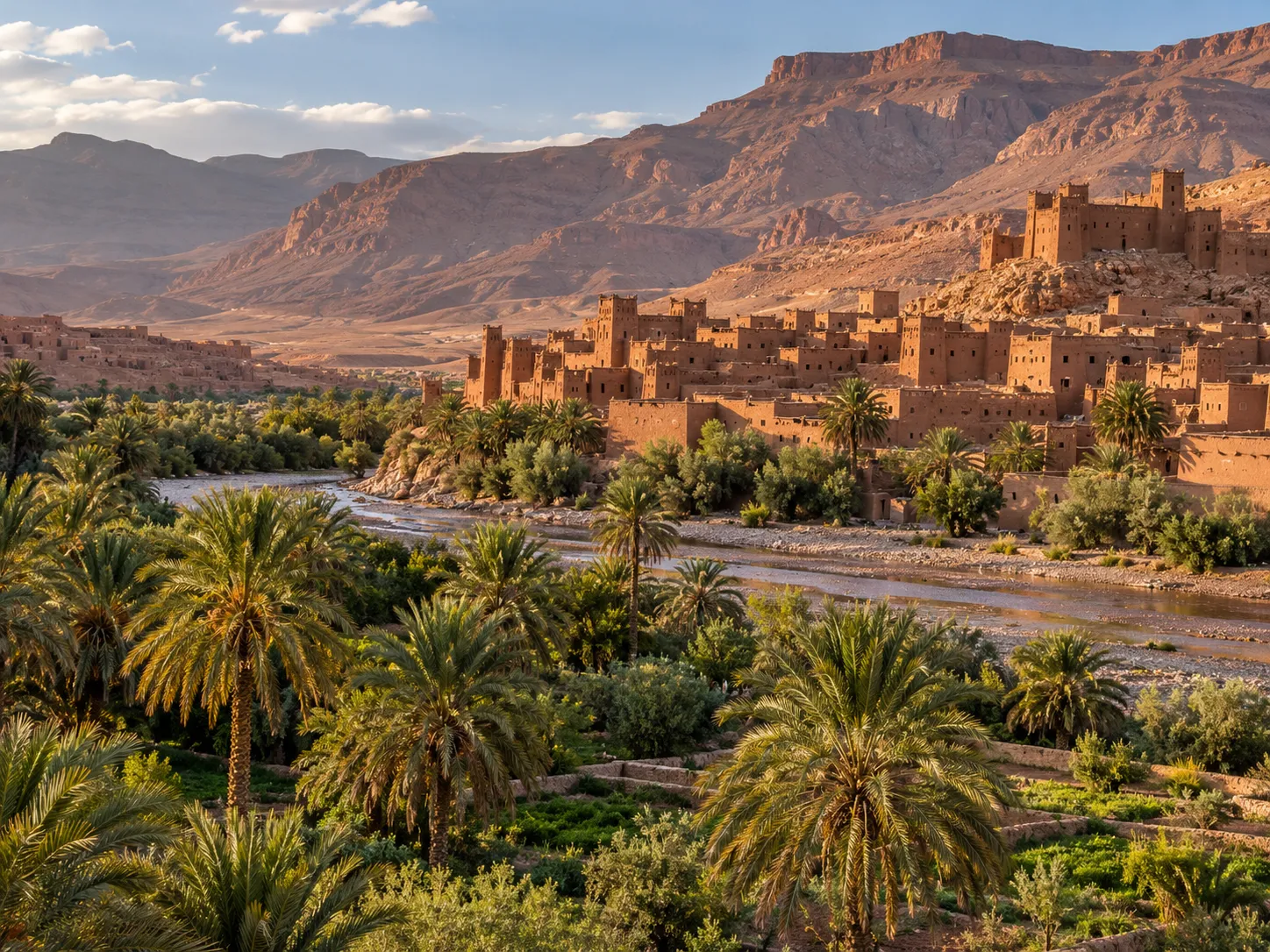
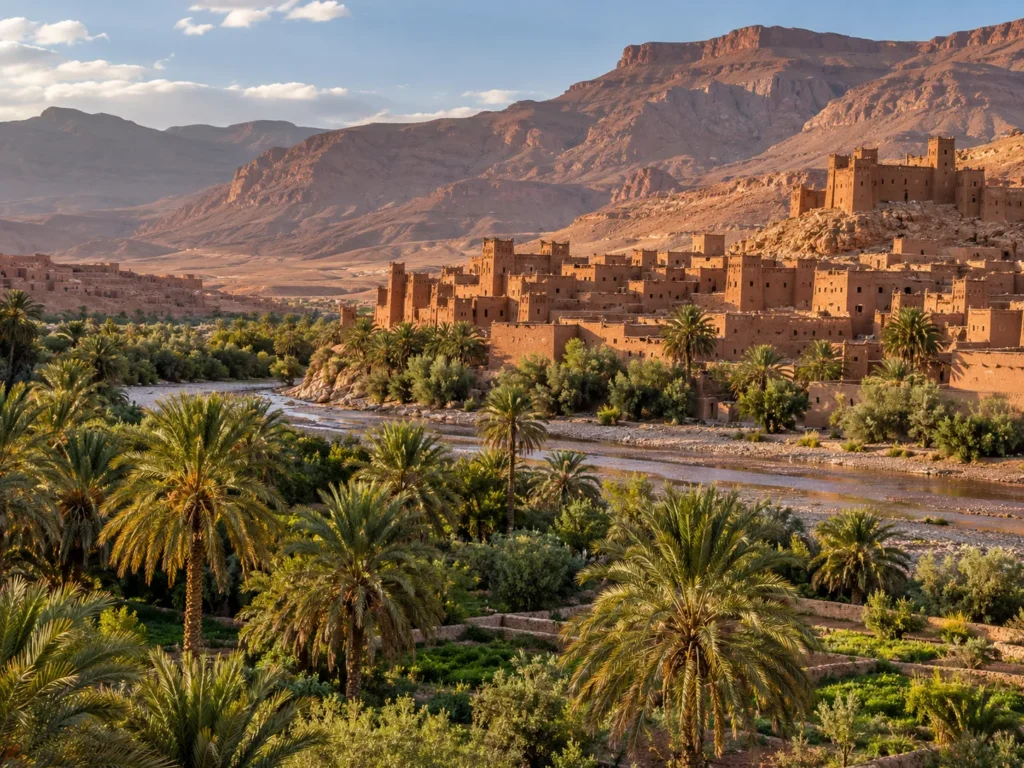
Southern Morocco is where High Atlas roads descend into earthen kasbahs, palm-filled oases, rocky valleys and the desert landscapes that eventually reach the Sahara. Many travelers cross this region quickly on the way from Marrakech to Merzouga, but the journey between the mountains and dunes is one of the most varied parts of Morocco.
A well-planned Southern Morocco route can include Ait Ben Haddou and Ouarzazate, the palm groves of Skoura, the Dades and Rose valleys, Tinghir and Todra Gorge, Rissani and Merzouga, or a different southern branch through Agdz, the Draa Valley, Zagora and M’Hamid.
The important decision is not simply whether to visit the desert. It is which southern corridor fits your time and interests, and how much room you want for kasbahs, walking, oasis landscapes, markets and smaller communities before reaching the dunes.
What Does “Southern Morocco” Mean in This Guide?
Southern Morocco can describe a very large part of the country, including Atlantic, Anti-Atlas and Saharan regions. This guide uses the term more specifically for the inland route south and east of the High Atlas that connects Marrakech with Ouarzazate, the kasbah and oasis valleys, the Draa region and the Sahara.
The main places covered are:
- Ait Ben Haddou
- Ouarzazate
- Skoura
- Rose Valley
- Dades Valley
- Tinghir
- Todra Gorge
- Erfoud and Rissani
- Merzouga and Erg Chebbi
- Agdz
- Draa Valley
- Zagora
- M’Hamid and the route toward Erg Chigaga
Agadir, Taroudant and the Anti-Atlas can form another southern route, but they are not the main focus of this kasbah-and-oasis corridor.
Southern Morocco Route at a Glance
| Area | Main character | Why stop? |
|---|---|---|
| High Atlas | Mountain passes and valleys | Landscape transition between Marrakech and the south |
| Ait Ben Haddou | Historic earthen ksar | Southern architecture and older trade-route context |
| Ouarzazate | Kasbahs and regional hub | Natural base for both eastern and Draa routes |
| Skoura | Palm oasis and earthen architecture | Walk among palms, gardens and kasbah landscapes |
| Dades / Rose Valley | Rock formations, villages and cultivated valley | Landscape, walking and a useful overnight before the Sahara |
| Tinghir / Todra | Palm oasis and gorge | Oasis agriculture and dramatic canyon walking |
| Merzouga | Erg Chebbi dunes | Sahara landscapes, camp, walking, camel or 4×4 experiences |
| Draa Valley | Long palm corridor and oasis settlements | Slower oasis travel through Agdz and Zagora |
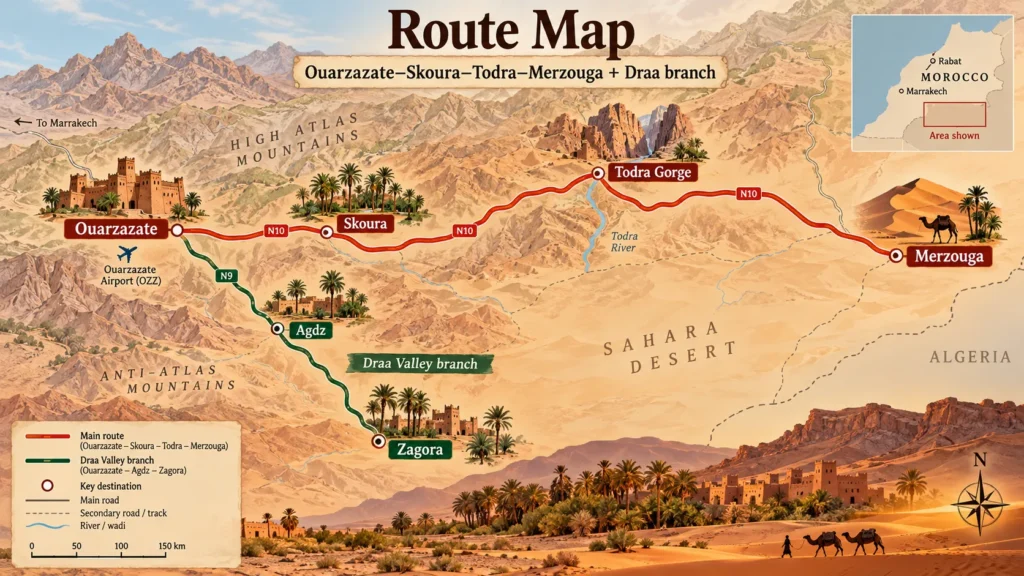
Two Main Ways to Explore Southern Morocco
From Ouarzazate, travelers can think of the region as two main corridors. They can be combined on a longer loop, but they should not be treated as identical desert routes.
Route 1: Kasbahs, Dades, Todra and Merzouga
The eastern route continues from Ouarzazate through Skoura, the Rose and Dades valleys, Tinghir and Todra before reaching Erfoud, Rissani and Merzouga.
This is the stronger option if Erg Chebbi’s large dunes are one of the main reasons for your journey.
A simplified route is:
Marrakech → High Atlas → Ait Ben Haddou → Ouarzazate → Skoura → Dades → Tinghir/Todra → Rissani → Merzouga.
Route 2: Draa Valley, Zagora and M’Hamid
The second route runs south from Ouarzazate through Agdz and the Draa Valley toward Zagora and M’Hamid.
This journey is less about rushing to one famous dune field and more about palm groves, oasis settlements, earthen architecture and the gradual transition toward the Sahara.
A simplified route is:
Ouarzazate → Agdz → Draa Valley → Zagora → M’Hamid.
Travelers heading toward Erg Chigaga normally need an additional off-road section beyond the paved approach.
High Atlas: The Gateway to Southern Morocco
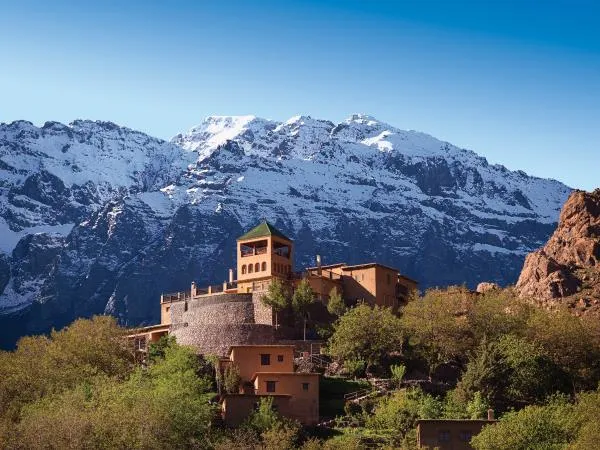
For travelers beginning in Marrakech, the Atlas Mountains create the first major landscape transition.
The route climbs away from Marrakech through increasingly rugged mountain terrain before descending toward the dry southern side of the range.
Do not treat this only as transfer time. Mountain viewpoints, valleys and earthen villages help explain why the landscape and architecture change so dramatically farther south.
If hiking is a major priority, give the Atlas its own day or overnight rather than trying to combine a substantial walk with a long road journey toward Ouarzazate.
Ait Ben Haddou: Understanding Southern Earthen Architecture
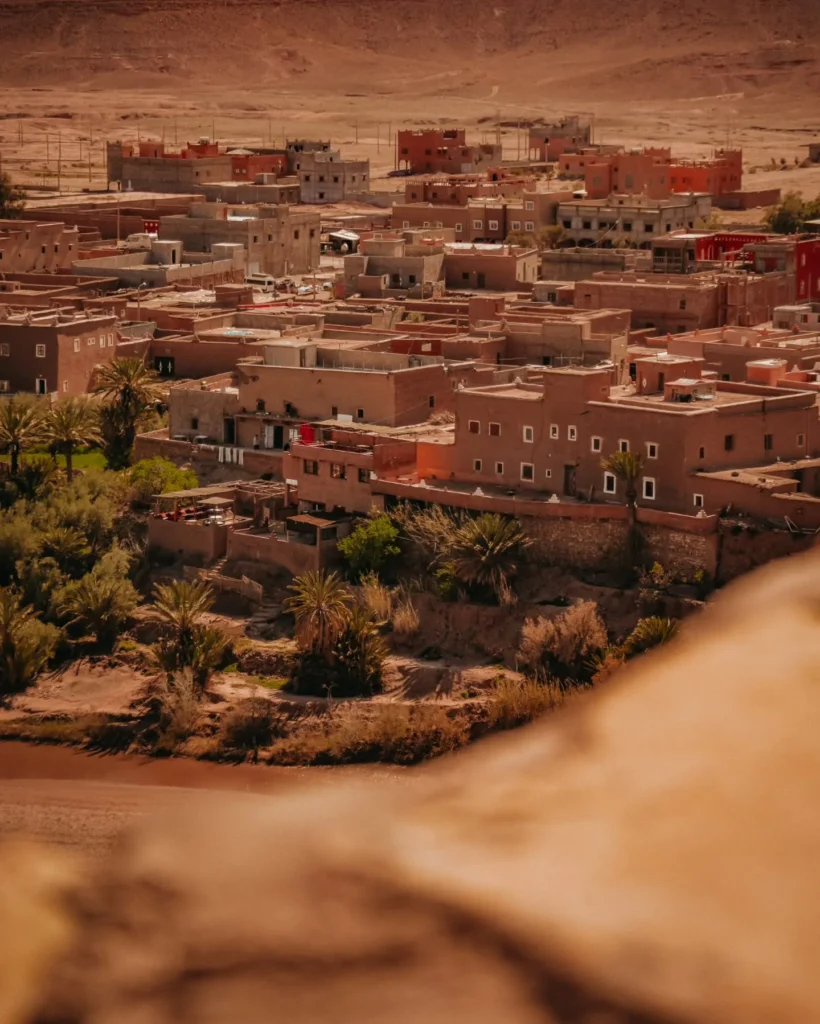
Ait Ben Haddou is one of the most important architectural stops on the route.
The fortified ksar is built largely from earth and illustrates construction traditions found across pre-Saharan southern Morocco. Its defensive walls, towers and compact settlement pattern make much more sense when viewed as part of the wider valley landscape rather than simply as a film location.
Give yourself enough time to walk through the settlement and observe the buildings from different elevations.
Film history is part of Ait Ben Haddou’s modern tourism identity, but the architecture and historic route through the region are more important to understanding southern Morocco.
Ouarzazate: Crossroads of the Southern Routes
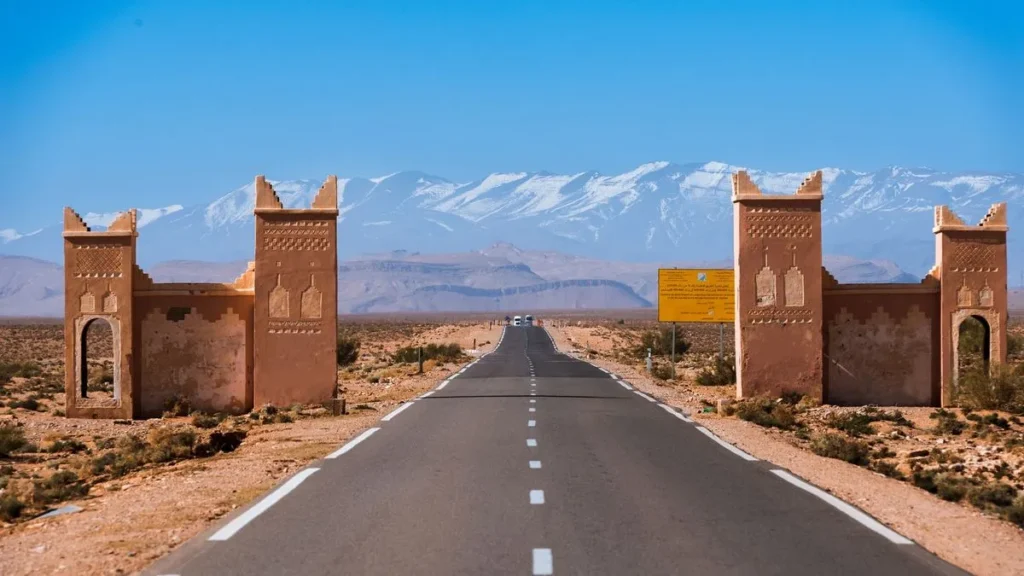
Ouarzazate is often called a gateway to the desert because several major southern routes meet around the city.
Travelers can continue east toward Skoura, Dades, Todra and Merzouga or turn south toward Agdz and the Draa Valley.
Possible stops include Taourirt Kasbah and film-related attractions, but Ouarzazate is also valuable simply as a practical overnight base.
Trying to reach Marrakech, visit Ait Ben Haddou, explore Ouarzazate and continue deep into the Dades region on the same day can leave little time for any individual place.
Skoura: Palm Groves and Kasbah Landscapes
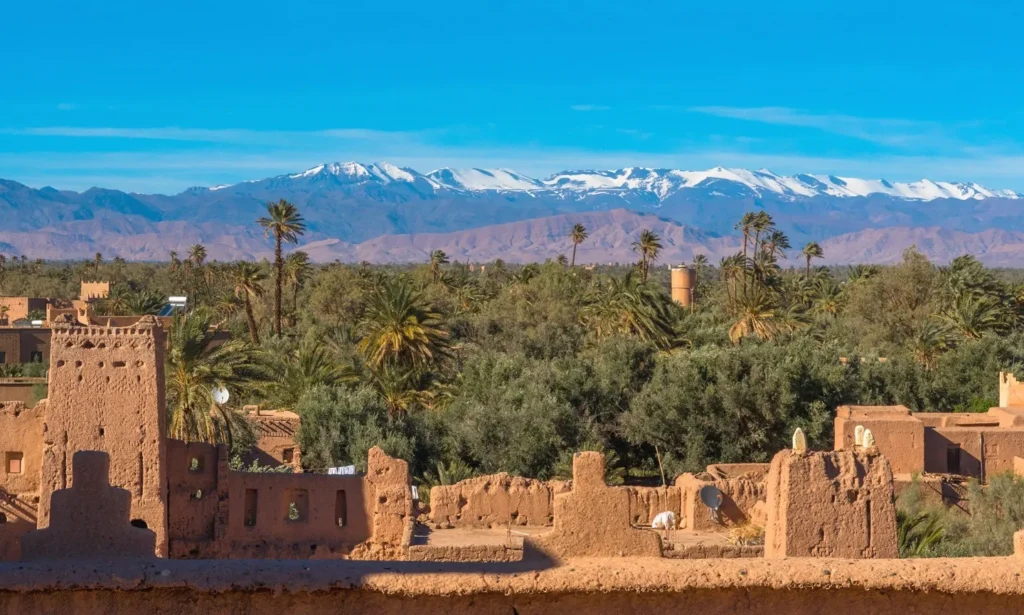
Skoura demonstrates why an oasis is much more than a patch of palm trees in an otherwise empty desert.
The palm grove includes cultivated land, settlement, irrigation and earthen architecture. Walking through this environment reveals the relationship between water, agriculture and local building traditions far better than photographing the palms from the main road.
Kasbah Amridil is one of the best-known architectural landmarks in the area.
Skoura works particularly well for travelers interested in:
- Oasis agriculture
- Palm-grove walks
- Earthen kasbah architecture
- Photography
- Slower rural stays
A night in or around Skoura can provide a quieter alternative to treating Ouarzazate only as a staging point.
Rose Valley and Dades Valley
Continuing east, the landscape develops into cultivated valleys, unusual rock formations and settlements built along the river corridors.
Rose Valley
The Rose Valley around Kelaat M’Gouna is associated with rose cultivation and seasonal products made from the harvest.
The landscape itself remains worthwhile outside flowering season, so avoid planning the entire visit around seeing fields in bloom unless your dates actually coincide with that period.
Dades Valley
Dades combines striking geology with settlements and cultivated areas along the valley floor.
Travelers often use the area as a one-night stop between Ouarzazate and Merzouga, but an additional walk or slower morning makes it easier to understand the valley beyond its roadside viewpoints.
It is also a practical place to divide the long Marrakech–Merzouga journey.
Tinghir and Todra: Oasis Meets Gorge
Tinghir provides one of the clearest contrasts in southern Morocco between dry mountain terrain and a green oasis corridor.
Palm groves and cultivated land stretch along the valley before the road reaches Todra Gorge.
Walk Through the Oasis
If time allows, walk through part of the cultivated area rather than viewing it only from a panoramic roadside stop.
The landscape helps explain how water supports agriculture and settlement in an otherwise arid environment.
Todra Gorge
The gorge is an easy place to leave the vehicle and experience the scale of southern Morocco’s canyon landscapes.
Longer hikes require more preparation, but even a short walk between the cliffs provides a useful contrast with the open valleys and dunes later in the journey.
Rissani and the Tafilalt Region
Rissani works naturally between the oasis-and-gorge route and Merzouga.
When market timing aligns with your visit, it can add a working regional-market experience to the journey.
Rather than seeing the town only as the final road stop before the dunes, consider its relationship with the wider Tafilalt oasis region and older trade routes.
Merzouga and Erg Chebbi
Merzouga sits beside Erg Chebbi and marks the Sahara-focused end of the eastern Southern Morocco route.
This is where the landscape changes from rocky and oasis environments to the major wind-shaped dunes many visitors associate with a Morocco desert journey.
Possible activities include:
- Dune walking
- Sunset and sunrise
- Camel trekking
- 4×4 exploration
- Sandboarding
- Photography
- An overnight desert camp
None of these activities is compulsory.
For the landscape itself, read the Merzouga Dunes guide. For camp and overnight planning, use the Merzouga Desert Trip guide.
Draa Valley: The Oasis Route South
The Draa Valley offers a different interpretation of Southern Morocco.
Rather than moving east toward Erg Chebbi, the road runs south through a long corridor of palm groves, cultivated gardens, villages and earthen architecture.
Agdz
Agdz provides a useful base near the upper Draa Valley and works well for travelers who want to slow the journey down.
The surrounding palm groves and villages are better appreciated on foot or with a local guide than through a quick photo stop.
Zagora
Zagora is an important regional center farther south.
The landscapes around it are different from Erg Chebbi. Do not describe every southern desert stop as though it offers the same large dunes as Merzouga.
M’Hamid
M’Hamid lies farther toward the desert edge and is a gateway for journeys toward Erg Chigaga.
This route suits travelers who value remoteness and a gradual journey through the Draa more than direct access to the large Erg Chebbi dunes.
Merzouga or Draa Valley: Which Route Should You Choose?
| Priority | Better fit |
|---|---|
| Large Sahara dunes | Merzouga / Erg Chebbi |
| Dades and Todra | Eastern route to Merzouga |
| Long palm-oasis corridor | Draa Valley |
| More remote dune journey | M’Hamid / Erg Chigaga route |
| Classic Marrakech-to-Fes desert crossing | Merzouga / Erg Chebbi |
5, 6 or 8 Days in Southern Morocco?
The merged articles include five-, six- and eight-day versions of the southern journey. They should be treated as different pacing options rather than separate pages competing for the same regional topic.
| Duration | Good focus | Pace |
|---|---|---|
| 5 days | Atlas + kasbahs + selected oasis stops + one desert region | Compact; choose either the strongest eastern highlights or a Draa-focused route |
| 6 days | Marrakech + Ait Ben Haddou + Dades/Todra + Merzouga | Balanced first journey with more time outside the vehicle |
| 8 days | Full kasbah-and-oasis loop with deeper Merzouga or Draa exploration | Best for slower valleys, walks and several two-night stays |
A 6-Day Southern Morocco Route
The original article being rewritten uses six days and provides the foundation for a practical first route.
Day 1: Marrakech
Begin in Marrakech with Jemaa el-Fna, Koutoubia and Moroccan food according to your arrival time.
Day 2: High Atlas and Ait Ben Haddou
Cross the Atlas and continue toward Ait Ben Haddou, using viewpoints and architectural stops to break the road journey.
Day 3: Continue Toward Merzouga
Travel deeper through southern Morocco toward Merzouga and Erg Chebbi.
If your overnight route allows, include Dades or Todra rather than treating every valley as a roadside photograph.
Day 4: Merzouga and the Wider Desert Region
The original article emphasizes visits to nearby Amazigh communities, local meals and everyday desert-region life.
These experiences should be arranged through willing guides, hosts, artisans or accommodation providers rather than assuming access to residential villages.
Day 5: Todra and the Return Route
Begin traveling back through the oasis and gorge corridor, allowing time to walk and break up the drive.
Day 6: Return to Marrakech
Complete the journey through the High Atlas and finish in Marrakech.
If you have an important international flight, consider sleeping in Marrakech and departing the following day rather than depending on a long road transfer running exactly to schedule.
How to Use 8 Days Better
With eight days, avoid using every extra day to add another destination.
Instead, add depth through:
- A full Skoura or Dades morning
- Two nights around Merzouga
- A longer oasis walk
- A second southern branch through the Draa Valley
- An overnight around Agdz
- More time for hiking or photography
Eight days also makes a loop possible: travel east through Skoura, Dades and Merzouga, then return through Tazzarine, N’Kob, Agdz and the Draa Valley rather than retracing the same road.
Amazigh Communities and Local Life
The older source material repeatedly uses “Berber villages” as a cultural theme.
Amazigh is also widely used for the Indigenous peoples and cultures of Morocco and North Africa.
The region includes communities with different languages, livelihoods and modern experiences, so avoid describing every village as though it represents one timeless traditional lifestyle.
Useful cultural experiences can include:
- A locally guided oasis walk
- A guesthouse meal
- A market visit
- An artisan workshop
- Learning about irrigation or agriculture
- Locally hosted music or food experiences
Visits should involve people who have agreed to host travelers rather than treating residential communities as attractions.
Food Along the Southern Route
The merged articles preserve tagine, couscous and local products as part of the journey.
Food changes with location and season, so the best experience is not necessarily searching for one supposedly universal southern dish.
Guesthouses, local restaurants and markets can introduce:
- Tagines
- Couscous
- Breads
- Dates
- Olives
- Seasonal fruit and vegetables
- Local market produce
Oasis agriculture is part of what makes the food and landscape connected, particularly around palm-growing regions.
Nature Activities in Southern Morocco
The nature-focused merged articles add walking, mountain landscapes, valleys, oasis ecosystems, cycling and desert activities to the cluster.
Walking
Good walking areas include the Atlas Mountains, Skoura palm groves, Dades, Tinghir’s oasis and Todra Gorge.
Cycling
Mountain biking can be arranged in some regions, but route conditions and traffic vary. Use a suitable local operator when equipment, navigation or support is required.
Sandboarding
Sandboarding can be added around suitable dune areas, particularly near Erg Chebbi.
Camel Trekking
Camel trekking is optional and normally forms one part of a desert stay rather than the whole Southern Morocco journey.
4×4 Travel
A 4×4 becomes particularly relevant for some desert tracks and the more remote approach toward Erg Chigaga. It is not necessary for every paved road across southern Morocco.
Responsible Oasis and Nature Travel
Oases are living agricultural environments rather than decorative green spaces created for visitors.
Stay on appropriate paths, avoid walking through crops without permission and use local guides when access is unclear.
Water is fundamental to oasis life, so tourism should not treat pools, irrigation channels or cultivated gardens as unlimited recreation areas.
Support locally run accommodation and guiding where it makes sense, and avoid damaging earthen structures by climbing onto walls or roofs that are not open to visitors.
Best Time for Southern Morocco
Spring and autumn are often the easiest periods for a route combining the Atlas, valleys and Sahara because walking and road travel are generally more comfortable.
Winter can also work well, but desert nights and mountain mornings can become cold.
Summer requires more caution. Merzouga, Zagora and other inland southern regions can become extremely hot, so demanding outdoor activities should be shifted toward early morning and evening or reconsidered during severe heat.
Weather also differs sharply between the High Atlas and the desert. Pack for the complete route rather than for Marrakech alone.
What to Pack
- Comfortable walking shoes
- Light clothing suitable for layering
- A warm layer for mountains and desert nights
- Sun hat
- Sunglasses
- Sunscreen
- Reusable water bottle
- Light scarf for sun, wind and dust
- Small day bag
- Power bank
- Personal medication
- Suitable clothing for walking or camel riding when planned
Private Driver, Tour or Self-Drive?
Private Driver
A private vehicle works particularly well when your priority is flexible stops in Skoura, Dades, Todra and smaller oasis areas.
Organized Tour
An organized route can simplify accommodation, desert transfers and longer road stages.
Compare the overnight locations rather than choosing only by tour duration.
Self-Drive
Self-driving gives you more freedom on paved routes, but desert tracks require separate consideration.
Check the Morocco Road Trip Guide if driving yourself is part of the plan.
Common Southern Morocco Planning Mistakes
Treating Everything Between Marrakech and Merzouga as a Transfer
Ait Ben Haddou, Skoura, Dades and Todra are major reasons to travel through the south, not inconveniences between Marrakech and the dunes.
Calling Every Green Palm Area an Identical Oasis
Skoura, Tinghir, the Tafilalt region and the Draa Valley have different settlement patterns, agriculture and geography.
Assuming Zagora and Merzouga Offer the Same Desert Landscape
They belong to different routes. Choose by geography rather than marketing terminology.
Trying to Combine Both Major Desert Corridors in Five Days
A short journey is stronger when you select either the eastern Merzouga route or a Draa-focused itinerary.
Using Extra Days Only to Add More Stops
Seven or eight days should create slower mornings, walks and longer stays rather than a longer checklist.
Expecting Unarranged Village Visits
Choose guided, hosted or artisan-based encounters where the people involved have agreed to receive travelers.
FAQ
How many days do you need for Southern Morocco?
Five days is enough for a focused route, but you will need to prioritize. Six days creates a better Marrakech–Ait Ben Haddou–Dades/Todra–Merzouga journey, while around eight days gives you room for oasis walks, two desert nights or a loop through the Draa Valley.
What is the best Southern Morocco route?
For a first trip focused on major dunes, a strong route is Marrakech → High Atlas → Ait Ben Haddou → Ouarzazate → Skoura → Dades → Todra → Merzouga. Travelers more interested in oasis country and a gradual desert approach can choose Ouarzazate → Agdz → Draa Valley → Zagora → M’Hamid.
Is Ait Ben Haddou a kasbah?
Ait Ben Haddou is more accurately described as a ksar, a fortified settlement containing multiple earthen buildings. Individual kasbahs are fortified residences or structures, while a ksar refers to the broader fortified settlement.
Is Skoura worth stopping at?
Yes, particularly if you are interested in oasis landscapes, earthen kasbah architecture and a slower journey through southern Morocco. The palm grove is much easier to appreciate when you walk through part of it rather than stopping only beside the main road.
Should I choose Merzouga or the Draa Valley?
Choose Merzouga when large Erg Chebbi dunes are a priority. Choose the Draa route when palm oases, Agdz, Zagora and a more gradual southern journey matter more. Longer trips can combine both corridors as a loop.
Can I visit Southern Morocco without a Sahara camp?
Yes. Kasbahs, oases, Dades, Todra, the Draa Valley and southern architecture can form a complete trip without sleeping in a desert camp. Even around Merzouga, staying in accommodation beside the dunes and exploring on foot or by vehicle is an alternative to camping.
Make the Journey Through Southern Morocco the Destination
The strength of Southern Morocco is the transition between landscapes.
You leave the High Atlas and enter a world of earthen architecture, palm oases, cultivated valleys, rocky plateaus and eventually Sahara dunes. Ait Ben Haddou, Ouarzazate, Skoura, Dades, Tinghir, Todra, Rissani, Merzouga and the Draa Valley each show a different part of that transition.
The original six-day Sahara-and-village article focused heavily on reaching Merzouga. The merged oasis, kasbah and nature articles make the topic stronger by showing that the south is much more than the final dune field.
Choose five days for a focused route, six for a balanced first journey and eight when you want the valleys and oases to become destinations rather than roadside stops.
If your main question is specifically which Sahara tour length to choose, use the Sahara Desert Tours guide. For country-wide route planning, use Morocco Itineraries.
If you want the Southern Morocco route adjusted around your dates, starting city, preferred desert region, accommodation and walking level, use the custom Morocco trip planner.
Explore destinations, tours and locally organized Morocco experiences with Visit Morocco Together.
Ready to Experience Morocco?
Turn this inspiration into your next adventure. Our travel experts are ready to help.