Moroccan football culture grew through local clubs, neighbourhood games, regular competitions and the memories supporters share. International achievements brought wider attention, but the game’s place in everyday life also comes from smaller experiences: following a club with relatives, discussing a match in a café or playing with friends on a local pitch.
For travellers, football offers a way to understand contemporary Morocco alongside its monuments and medinas. A conversation about a club can reveal connections to a city, a family or a community abroad. Different people attach different meanings to the game, and some have little interest in it.
This guide explores those cultural connections. For attending a confirmed game, use the Morocco Football and Sports Travel guide to plan admission, the venue and the journey around the match.
How did Moroccan football culture become part of daily life?
Football gained a lasting place through repeated participation and attachment. Clubs gave supporters something to follow over many seasons, while games, broadcasts and conversations allowed the sport to become part of ordinary social routines.
A major tournament creates a concentrated moment of attention. Club football provides a different rhythm: a fixture to anticipate, a result to discuss and players whose careers supporters follow over time. Both can produce memories that outlast the match itself.
The game’s familiar rules also make it possible for people with different backgrounds to share an interest. Someone may recognise a player or a famous result before knowing much about the country. That can be the beginning of a conversation, although shared interest does not mean everyone holds the same opinions.
For visitors, the useful approach is to begin with an individual. Ask whether someone follows football and which team matters to them. Their answer will usually be more informative than assuming that nationality, age or neighbourhood determines their support.
Why did clubs become connected with belonging and identity?
Clubs became institutions through which people could express attachment to a community as well as support a team. Some of those connections developed before Moroccan independence.
FIFA’s account of Wydad Athletic Club links its founders with the national independence movement. In a separate POMEPS essay on football and national identity, Eman Demerdash discusses how Moroccan clubs created spaces for collective expression during the colonial period.
That historical context helps explain why a club badge can carry meaning beyond its current league position. It does not establish that every present-day supporter interprets the club in the same political or social way.
Our short history of football in Morocco follows the earlier clubs and national-team milestones in more detail. Here, the important connection is between a sporting institution and the community that continues to give it meaning.
How do club loyalty and national-team support differ?
Club loyalty connects supporters with a particular institution; national-team support centres on Morocco’s international representation. The two can sit alongside each other without having the same emotional rhythm or audience.
In Casablanca, Raja and Wydad provide two distinct club identities within one city. Rabat has its own football associations through clubs including AS FAR and FUS. These examples show why a city’s football culture should not be reduced to a single team.
A national-team match can bring together people whose club loyalties differ. It can also interest people who rarely follow domestic competitions. That is a different kind of gathering from watching a club throughout its season.
When talking to someone, distinguish the questions. “Which club do you support?” invites a different answer from “Which Morocco match do you remember?” Neither assumes that the nearest club is automatically their favourite.
Avoid using a shirt to make assumptions about wealth, religion or political views. A person’s connection may come from family, a remembered player, an earlier home or a choice they made for themselves.
What do cafés and neighbourhood games contribute?
Cafés can provide a shared setting for watching football, while informal games make participation part of local life. Each offers a different relationship with the sport.
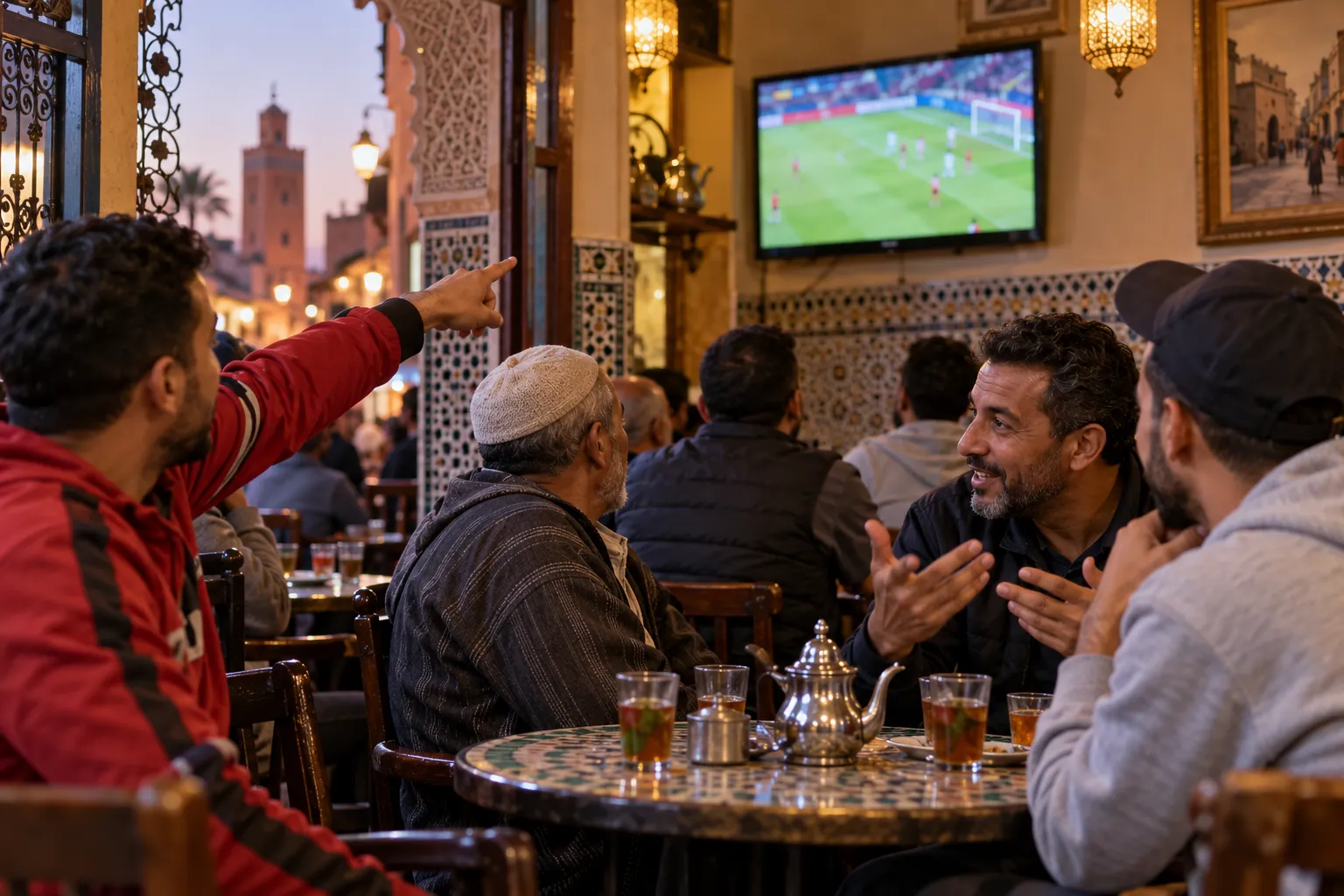
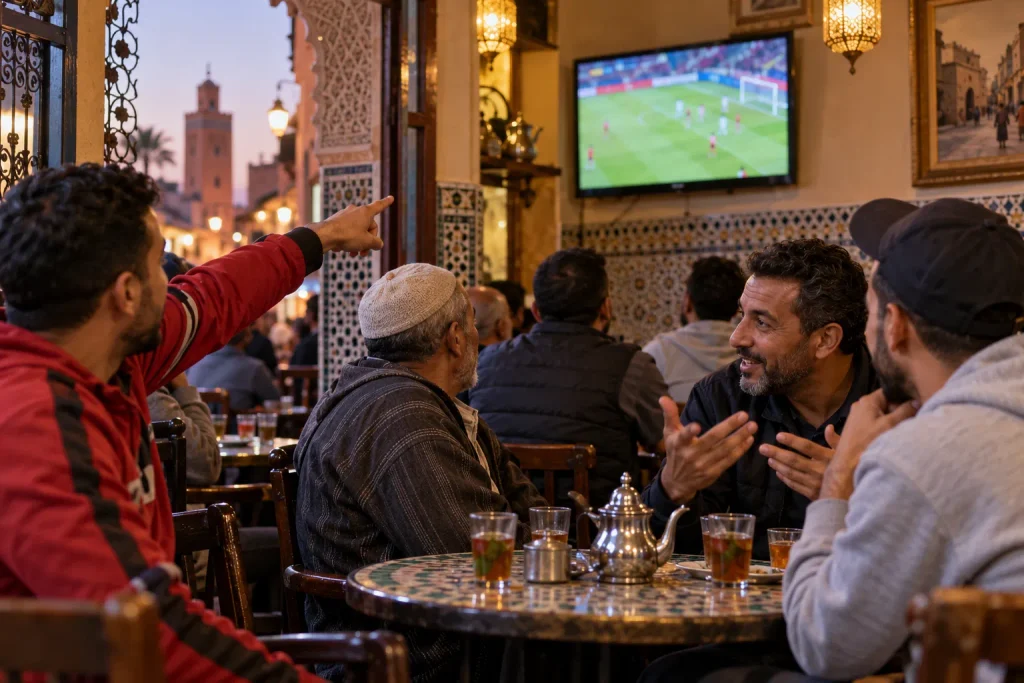
Watching with other people gives a match a social dimension: reactions are exchanged immediately, a disputed decision becomes a conversation and a familiar player can bring back an older memory. A café is also a working business with its own regular customers, layout and expectations.
If you want to watch there, ask whether it will show the exact match and whether its setting suits your companions. Choose a seat, order appropriately and follow the atmosphere around you. A screen on the wall does not establish that every fixture will be shown or that tables can be reserved.
An informal game requires another approach. If you come across people playing, watch from a position that leaves their space clear. Ask before joining and accept that they may prefer to continue with their existing teams.
Recognising the different settings helps you choose how to take part:
| Setting | What you can learn | A considerate approach |
|---|---|---|
| Café screening | How people react to and discuss a particular match | Confirm the screening and respect the business and other customers. |
| Conversation with a supporter | A personal connection to a club, player or generation | Ask an open question and let them decide how much to share. |
| Informal neighbourhood game | How people organise their own football space | Ask before participating or taking photographs. |
These are possible encounters during a visit, rather than activities that every location offers on demand.
Why do chants and supporter displays matter?
Chants and coordinated displays let supporters create an identity together. Words, rhythm, colours and visual arrangements can express loyalty, humour, frustration or social concerns.
Research by Karima Ziamari, Catherine Miller and Dominique Caubet on the performances of Moroccan ultras examines the creative and political dimensions of supporter slogans and chants. This gives a fuller context for interpreting a performance than treating it as background noise.
Organised supporter groups are one part of the football audience. Their style should not be used to describe every family, casual spectator or person watching elsewhere. Nor does understanding their cultural role tell a visitor which section is appropriate at a particular game.
Listen before joining in. Ask what a chant means if you are interested, and distinguish encouragement from words directed against an opponent or expressing a view you may not understand. There is no need to imitate a performance to appreciate its craft.
What can football reveal about language in Morocco?
Football can make everyday expressions audible to audiences who encounter Morocco mainly through other kinds of media. Chants and interviews provide examples of how people use language in public.
In her Eurac Research commentary on the 2022 World Cup, linguist Safà El Koura discusses the visibility of Darija, or Moroccan Arabic, and Amazigh identity during the tournament.
Two expressions she highlights are “Dima Maghrib”, meaning “Always Morocco,” and “Sir, sir,” meaning “Go, go.” They give visitors a starting point for recognising encouragement directed at the national team.
Her discussion is a cultural interpretation, rather than proof that a tournament changed everyone’s language attitudes. Individual speakers have different linguistic backgrounds and preferences. If you want to use a phrase, ask someone how they say it and when it fits the situation.
How does the diaspora shape Moroccan football identity?
The diaspora connects Moroccan football with families, supporters and players whose lives extend across countries. A national team can therefore have meaning for people who grew up or live outside Morocco.
In their essay on Morocco’s diaspora and belonging, Aomar Boum and Brahim El Guabli interpret football as a way of renewing connections between Morocco and its communities abroad. Their argument highlights how belonging can extend beyond the place where someone was born or trained.
For a visitor, the practical implication is to leave room for that complexity. A supporter may follow a Moroccan club and a club in another country, or share a match with relatives living elsewhere. A family’s football conversation may cross languages and time zones.
Ask about the team or memory that matters to someone instead of testing whether they are sufficiently Moroccan. Place of birth, accent and sporting preference cannot explain a person’s whole relationship with a country.
Why do family memories matter so much?
Football gives families events to remember together, from an ordinary club match to a national-team tournament. People can attach a result to who they watched with, where they were living or a relative who introduced them to the game.
During Qatar 2022, images of Moroccan players celebrating with their mothers made family relationships unusually visible. FIFA’s report on those celebrations records that part of the campaign.
Those scenes help explain one aspect of its emotional appeal. They should not be turned into a rule about how every Moroccan household follows football. Some watch together, some follow it individually and others prefer different interests.
A question such as “Who did you watch that match with?” can invite a personal memory. It is often more revealing than asking someone to explain an entire nation’s response.
How are women broadening the football conversation?
Women’s teams have added highly visible achievements and new players to follow. The national team reached the Women’s Africa Cup of Nations final in 2022 and the round of 16 at its first Women’s World Cup in 2023.
FIFA’s account of the Atlas Lionesses’ development discusses the programme behind those results. These achievements belong to the women’s game and deserve attention in their own right.
They also give girls and families recognisable players and teams to follow. Visibility creates opportunities for a wider conversation about participation, coaching and support, although international results alone cannot establish equal access in every community.
Visitors can take an interest by asking about women’s teams as well as men’s clubs. If you hope to attend a game, identify an announced public fixture and its own admission arrangements. A women’s match should not be assumed to use the same ground or access procedure as another team.
What connects football with education and community projects?
Football connects with education through structured coaching and through local projects that make sport part of a shared activity. A professional academy and a community sports field serve different purposes, but both can create space for learning.
FIFA’s account of Morocco’s football development describes the Mohammed VI Academy, established in 2009, and the combination of education and sporting development within it. That is an institutional example of planning beyond a single tournament.
At a local level, the ABURY Foundation’s account of its work in Douar Anzal describes developing a sports field in 2016 and incorporating sport into its educational activities. It provides a specific example of a community project, rather than a measure of participation across the whole country.
Playing together requires practical cooperation: agreeing on teams, sharing the space and respecting decisions. Coaching can build on those situations, while the experience will depend on the programme and the people involved.
For travellers interested in a community visit, establish whether the organisers actually welcome visitors. Agree on the purpose and arrangements in advance, particularly where children are involved. A project being described online does not establish that it runs public visits.
How can travellers explore the culture without attending a match?
You can explore football culture through a city visit, a conversation or a confirmed screening. Choose the setting according to your interests and the people travelling with you.
Begin with the city itself. Its streets, public spaces and everyday routines give context to the clubs associated with it. On a guided visit, you can ask about local football connections while keeping the advertised sightseeing programme clear.
Visit Morocco Together’s Casablanca City Discovery tour covers city landmarks and architecture, including Hassan II Mosque and Art Deco heritage. In Rabat, the medina and souks experience with the Kasbah of the Udayas offers a guided city activity. These are sightseeing services; a café reservation, stadium visit or match ticket needs its own confirmation.
Leave space for ordinary encounters without expecting a performance. Ask before photographing people or joining a game, and let conversations develop at their own pace. A respectful visit allows local participants to set the terms of their own football space.
What questions help you understand a supporter’s experience?
Open questions about a person’s own connection usually work well. You do not need detailed knowledge of the league to begin.
Try one of these and follow the answer:
- “Which club do you follow?” Leave room for a club from another city or country.
- “Who introduced you to football?” This can bring family or childhood memories into the conversation.
- “Which Morocco match do you remember most?” Let them choose the generation or competition.
- “What does that chant mean?” Ask for context rather than assuming a literal translation explains it.
- “Do you follow the women’s team or futsal too?” Give other forms of the game their own place.
Accept a short answer or a lack of interest. Football can make a connection easier when the interest is shared. The conversation is most useful when the person you meet has room to tell their own story.
Ready to Experience Morocco?
Turn this inspiration into your next adventure. Our travel experts are ready to help.