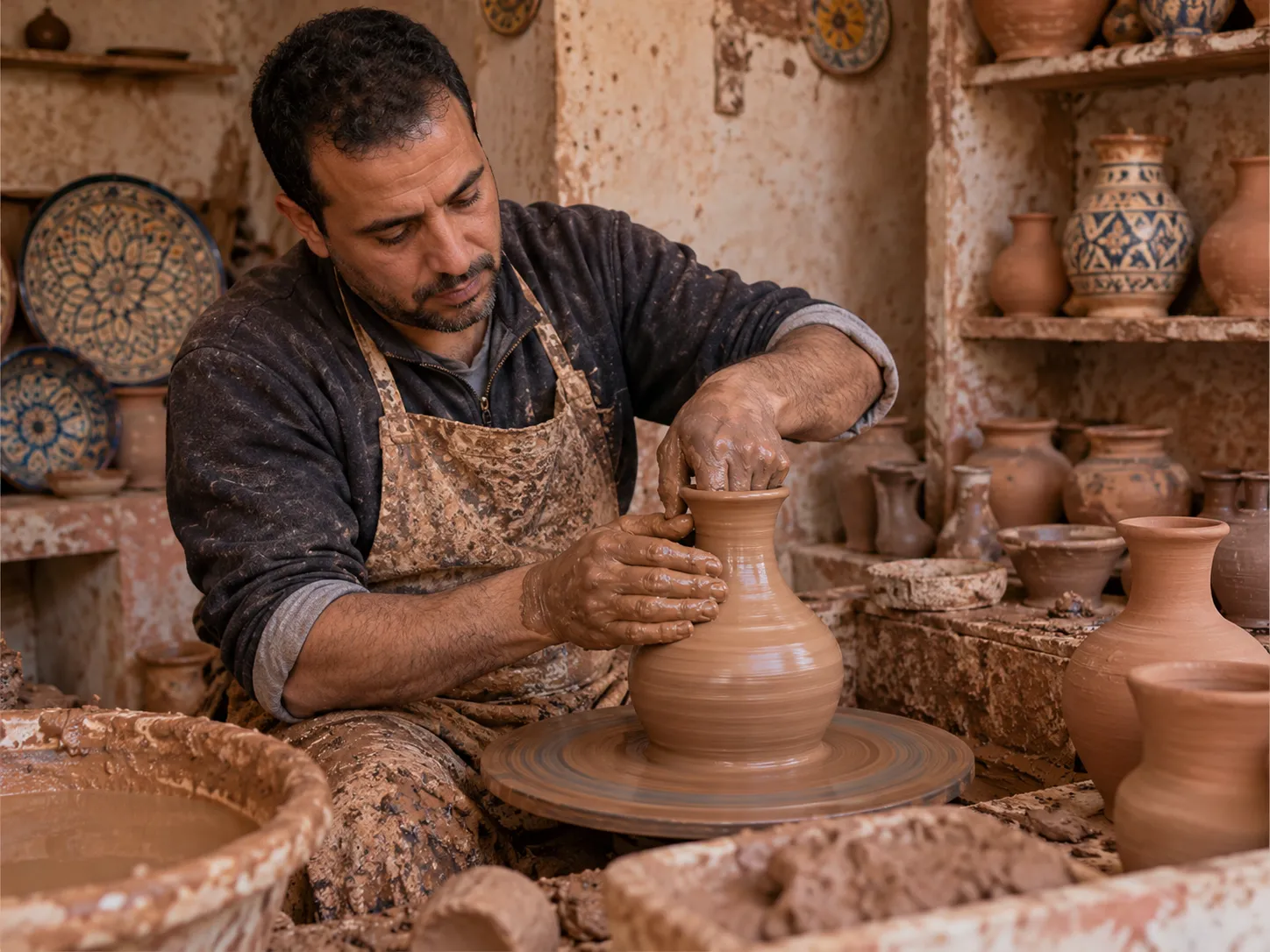
Moroccan pottery workshops give travelers a chance to see how clay becomes the bowls, tagines, plates, tiles and decorative ceramics found throughout the country’s medinas. A good workshop goes beyond watching an artisan for a few minutes: it explains the material, demonstrates the technique and gives you enough hands-on time to understand why shaping, decorating and firing ceramics require different skills.
This guide explains what to expect from Moroccan pottery workshops, where to find important pottery traditions, what you may actually make during a short class, and what to ask before booking. It also covers Safi, Fes and Tamegroute, three places with distinct ceramic traditions rather than one generic Moroccan pottery style.
Moroccan Pottery Workshops: What Should You Expect?
Not every experience advertised as a pottery workshop involves the same amount of participation. Some are genuine hands-on classes where you shape clay yourself. Others are artisan demonstrations followed by ceramic painting, and some are primarily workshop tours where you observe several stages of production.
Before booking, check which type of experience is being offered.
| Experience type | What you normally do | Best for |
|---|---|---|
| Workshop tour | Watch potters shape, decorate and prepare ceramics | Travelers mainly interested in craftsmanship |
| Wheel-throwing class | Try shaping wet clay on a potter’s wheel | Hands-on learners and beginners |
| Hand-building class | Shape clay without using a wheel | Families and complete beginners |
| Ceramic painting | Decorate a prepared or pre-fired ceramic piece | Travelers with limited time |
| Extended ceramics workshop | Combine shaping, decoration and several demonstrations | Travelers with a strong craft interest |
If a hands-on class is your priority, VMT currently offers a Safi Pottery Class Experience centered on making a ceramic piece with local artisan guidance.
How Moroccan Pottery Is Made
The full process takes much longer than a typical visitor workshop. Understanding that timeline helps set realistic expectations about what you can finish during a two- or three-hour activity.
Preparing the Clay
The process begins with clay that must be prepared before it can be shaped. The exact clay body and preparation method depend on the workshop, region and type of ceramic being produced.
Visitors usually join after the clay has already been processed and made ready for use. Preparing raw clay from the beginning would take too much time for most short travel workshops.
Shaping the Piece
A potter may shape clay on a wheel or construct an object by hand. Wheel throwing looks effortless when performed by an experienced artisan, but beginners quickly discover that controlling the speed, pressure and thickness of wet clay requires practice.
During a short class, expect the artisan to provide substantial guidance. Your first bowl or cup may be irregular, which is part of the experience rather than a failure.
Drying
Freshly shaped pottery cannot normally go directly into a kiln. Moisture needs to leave the clay gradually before firing.
This is why travelers should be cautious when a short workshop description suggests that you will shape, fully dry, glaze, fire and take home a finished ceramic piece within only a few hours.
Some workshops instead let visitors make a piece that is dried and fired later for collection or delivery.
First Firing
Once sufficiently dry, ceramics may receive an initial firing. This transforms the fragile dried clay into a harder ceramic form suitable for later decoration or glazing, depending on the production process.
Painting and Decoration
Decoration varies significantly by region and workshop. Geometric patterns, floral designs, calligraphy-inspired decoration and simpler contemporary styles can all appear in Moroccan ceramics.
The painter’s role is a skilled craft in its own right. A workshop where visitors paint a prepared piece may therefore be very different from one centered on wheel throwing, but it can still provide valuable insight into ceramic production.
Glazing and Final Firing
Many ceramics are glazed before their final firing. Heat transforms the glaze and helps create the finished surface and colors.
Exact firing temperatures, glaze recipes and workshop techniques vary, so avoid assuming that every Moroccan ceramic follows an identical process.
Safi: Morocco’s Pottery City
Safi is one of the most important destinations for travelers specifically interested in pottery. The Atlantic city has a long-established potters’ quarter where workshops produce terracotta and decorated ceramics.
Unlike visiting a general craft market, exploring Safi lets you see pottery as an industry with several stages and specialized skills. Depending on the workshop, you may see clay being shaped on wheels, vessels drying, decoration being applied and finished ceramics displayed for sale.
Safi is particularly useful for travelers who want pottery to be one of the main cultural experiences of the trip rather than a short stop inside a larger medina tour.
Hands-On Pottery in Safi
The Safi Pottery Class Experience currently runs for approximately two to three hours and focuses on creating a ceramic piece under local artisan guidance.
Travelers more interested in observation than making their own object can consider the Safi Pottery & Ceramics Workshop Tour, which focuses on studios, traditional techniques and the city’s pottery industry.
These are different experiences, so choose according to whether you want to use the clay yourself or mainly understand how professional artisans work.
Fes: Blue Ceramics and Zellige Traditions
Fes is another major center for Moroccan ceramics and decorative crafts. Fassi pottery is particularly associated with cobalt-blue decoration, often combined with detailed geometric and floral designs.
The city is also closely connected with zellige tilework. Although pottery vessels and zellige are separate crafts, both begin with clay and depend on several specialized stages of shaping, firing, glazing or cutting.
A visit to a ceramics workshop around Fes can therefore include more than watching bowls being painted. Some workshops demonstrate pottery production alongside tile making and mosaic assembly.
Pottery Workshop or Zellige Workshop?
Check the description carefully if one particular craft interests you.
A pottery workshop may focus on vessels such as bowls, plates and tagines. A zellige workshop is more concerned with glazed tiles that are cut into small geometric forms and assembled into larger patterns.
Large artisan complexes may demonstrate both, but a hands-on visitor class may focus on only one process.
Tamegroute: Distinctive Green Pottery in Southern Morocco
Tamegroute, near Zagora in the Draa Valley region, is another important place for travelers interested in Moroccan pottery. It is particularly associated with ceramics featuring distinctive green glazing, although variations in tone and finish naturally occur.
This is a useful stop for travelers already following a southern route rather than something most visitors should cross the country specifically to see.
VMT currently offers a Tamegroute Green Pottery Workshop Tour from Zagora focused on local studios and traditional craft techniques.
Tamegroute also demonstrates why Moroccan ceramics should not be presented as one national style. Fes, Safi and southern pottery centers developed their own visual traditions and workshop practices.
Wheel Throwing vs Pottery Painting
Travelers sometimes book a “pottery workshop” expecting to make an entire vessel from raw clay and discover that the activity is primarily painting.
Neither format is inherently better, but they provide different experiences.
Choose Wheel Throwing If You Want:
- Direct contact with wet clay
- To learn how a potter centers and shapes a vessel
- A messier, more technical hands-on activity
- To understand why professional wheel work takes practice
Choose Ceramic Painting If You Want:
- More time to concentrate on color and pattern
- A workshop that works well for mixed age groups
- A less physically technical craft activity
- A better chance of completing the creative part during one session
If the activity combines both, ask how much time is devoted to each part.
Can You Take Your Pottery Home the Same Day?
Not always.
A piece made from wet clay usually needs drying and firing before it becomes durable enough to use or transport safely. Glazed pieces may also require another firing.
Before booking, ask:
- Will I make something from wet clay or decorate an existing piece?
- Is firing included?
- Can I collect the finished piece later?
- How many days does firing require?
- Can the workshop deliver the finished pottery to my hotel?
- Can it be shipped internationally?
- Is shipping included or paid separately?
If you are leaving the city immediately after the class, this is one of the most important details to confirm.
How Long Does a Moroccan Pottery Workshop Take?
A basic visitor activity normally takes a few hours rather than a full day.
| Workshop type | Useful time to allow |
|---|---|
| Pottery demonstration | 30–60 minutes |
| Workshop tour | 1–2 hours |
| Hands-on pottery class | 2–3 hours |
| Extended craft experience | Half day |
The actual VMT Safi hands-on pottery class currently schedules around two to three hours, which is a realistic amount of time for instruction and creating a beginner piece without pretending to complete the entire ceramic production cycle.
Are Pottery Workshops Good for Children?
Pottery can work very well for families because it is tactile and does not require prior artistic experience.
Hand-building and ceramic painting are generally easier for younger participants than controlling a fast potter’s wheel. Workshop age policies differ, so parents should confirm minimum ages and whether children can use equipment directly.
Expect clothes and hands to get dirty. A workshop that provides aprons is helpful, but wearing clothing you do not mind exposing to clay is still sensible.
What to Wear to a Pottery Workshop
- Comfortable clothes that can tolerate clay or splashes
- Closed or stable shoes
- Short or secured sleeves around a potter’s wheel
- Hair tied back if it is long
- Minimal loose jewelry
Clay itself is part of the experience, so do not arrive dressed for an immediately following formal dinner unless you have time to change.
How to Choose a Good Pottery Workshop
A strong pottery experience should clearly explain what visitors will actually do rather than relying only on words such as “traditional,” “authentic” or “artisan.”
Before booking, check:
- Whether the experience is hands-on or observational
- How much time you personally spend working with clay
- Whether you use a wheel, hand-building techniques or paint ceramics
- Maximum group size
- Languages used for instruction
- Whether all materials are included
- What happens to your piece after the class
- Whether firing is included
- Whether collection or shipping is possible
- Whether purchasing additional ceramics is optional
A workshop visit may naturally end in a showroom or shop, particularly when artisans sell their own work. Buying something should still remain optional.
Buying Pottery After a Workshop
Watching the production process can make shopping more meaningful because you have seen some of the work behind the finished item.
When buying ceramics, look closely for cracks, significant chips and uneven damage. Handmade decoration will naturally show variation, which should not automatically be treated as a defect.
If you plan to use a bowl, plate or tagine for food rather than decoration, ask whether the piece and its glaze are intended for food use. Do not assume every decorative ceramic sold in a craft shop is designed for cooking or serving food.
For larger pieces, ask how the shop normally packs ceramics for travel before paying.
Pottery, Ceramics and Zellige: Useful Differences
| Craft | Basic description |
|---|---|
| Pottery | Clay vessels and objects shaped by hand or wheel and then fired |
| Ceramics | Broad term covering fired clay products, often including glazed pottery |
| Zellige | Glazed tiles cut into shapes and assembled into geometric mosaics |
The crafts overlap through their use of clay and firing, but the specialist skills involved can be very different.
Responsible Workshop Visits
Pottery studios are working environments rather than staged attractions. Give artisans enough space to continue their work and follow instructions around kilns, wheels and drying racks.
- Ask before photographing an artisan closely.
- Do not touch finished or drying pieces without permission.
- Keep away from kilns and hot equipment unless invited closer.
- Do not interrupt someone using a wheel simply for a photograph.
- Follow the artisan’s instructions when using tools.
- Buy finished work only if you genuinely want it.
A good workshop should leave you with greater respect for the skill involved, not simply another souvenir.
Who Are Moroccan Pottery Workshops Best For?
Moroccan pottery workshops are particularly suitable for travelers interested in design, crafts, architecture and hands-on cultural experiences. They also work well for families, couples and solo travelers looking for an activity that involves participation rather than only sightseeing.
Safi is the strongest choice if pottery is the main purpose of the visit. Fes works especially well when you want to combine ceramics with other traditional crafts, while Tamegroute makes sense as part of a southern Morocco itinerary through the Draa Valley.
Travelers with limited time should choose one good workshop rather than trying to visit pottery studios in every city.
FAQ
Where Is the Best Place for a Pottery Workshop in Morocco?
Safi is one of Morocco’s major pottery centers and is an excellent choice for a dedicated hands-on class. Fes is particularly known for decorated ceramics and zellige traditions, while Tamegroute is associated with distinctive southern green pottery.
Can Beginners Join Moroccan Pottery Workshops?
Yes. Many visitor workshops are designed for beginners and do not require previous pottery experience. An artisan will normally demonstrate the technique and help you control the clay or decoration process.
Can I Make a Pottery Piece and Take It Home the Same Day?
Usually not if you are working with fresh wet clay. The piece normally needs time to dry and may require one or more firings. Ask whether later collection, hotel delivery or shipping is available. Painting a pre-fired piece may involve a different timetable.
How Long Does a Moroccan Pottery Workshop Take?
A hands-on visitor class commonly takes around two to three hours. Short demonstrations may last less than an hour, while more detailed craft experiences can take half a day.
What Is Safi Pottery Known For?
Safi is one of Morocco’s best-known pottery and ceramics centers. Its potters’ quarter contains working studios producing terracotta and decorated ceramic objects, and the city also has a National Museum of Ceramics.
Is Fes Pottery Different From Safi Pottery?
Yes. Moroccan ceramic traditions vary by region. Fes is especially associated with intricate decorated ceramics and its famous cobalt-blue color, while Safi has its own long pottery tradition and varied ceramic production.
Choose the Right Moroccan Pottery Workshop
The best Moroccan pottery workshops are clear about what you will actually learn and do. Decide whether you want to shape clay, paint ceramics, observe professional artisans or combine several stages in one visit. Then check how long the activity lasts and what happens to your piece after you leave.
Safi is particularly rewarding for travelers who want pottery to be the focus of the experience, while Fes and Tamegroute provide different regional perspectives on Moroccan ceramics. Whichever location you choose, seeing the process firsthand makes the finished pottery found in Morocco’s medinas much easier to appreciate.
Explore destinations, tours and locally organized Morocco experiences with Visit Morocco Together.
Ready to Experience Morocco?
Turn this inspiration into your next adventure. Our travel experts are ready to help.