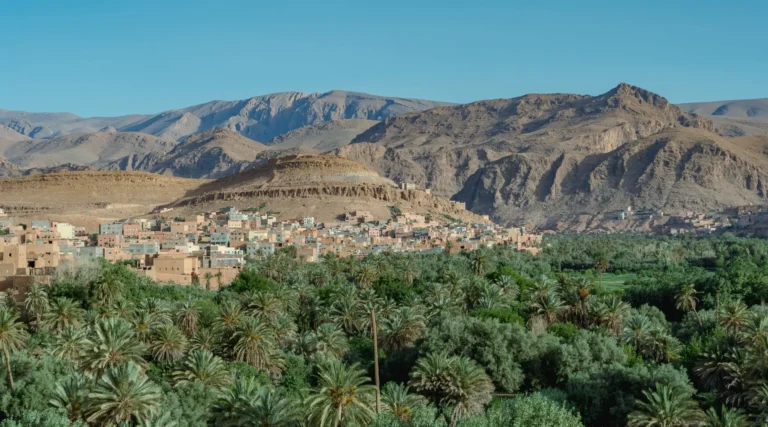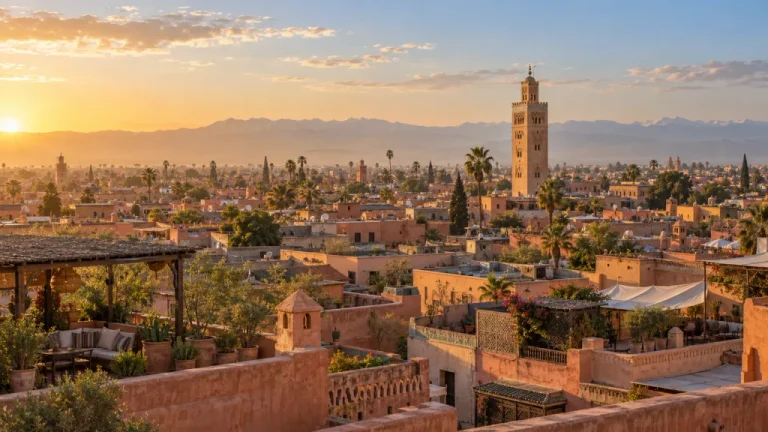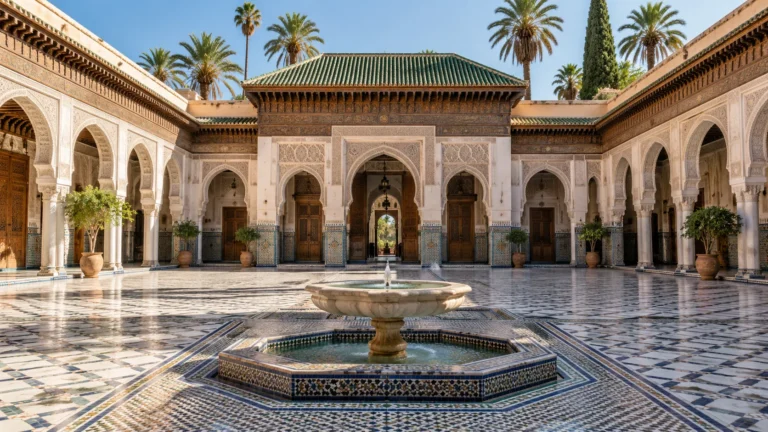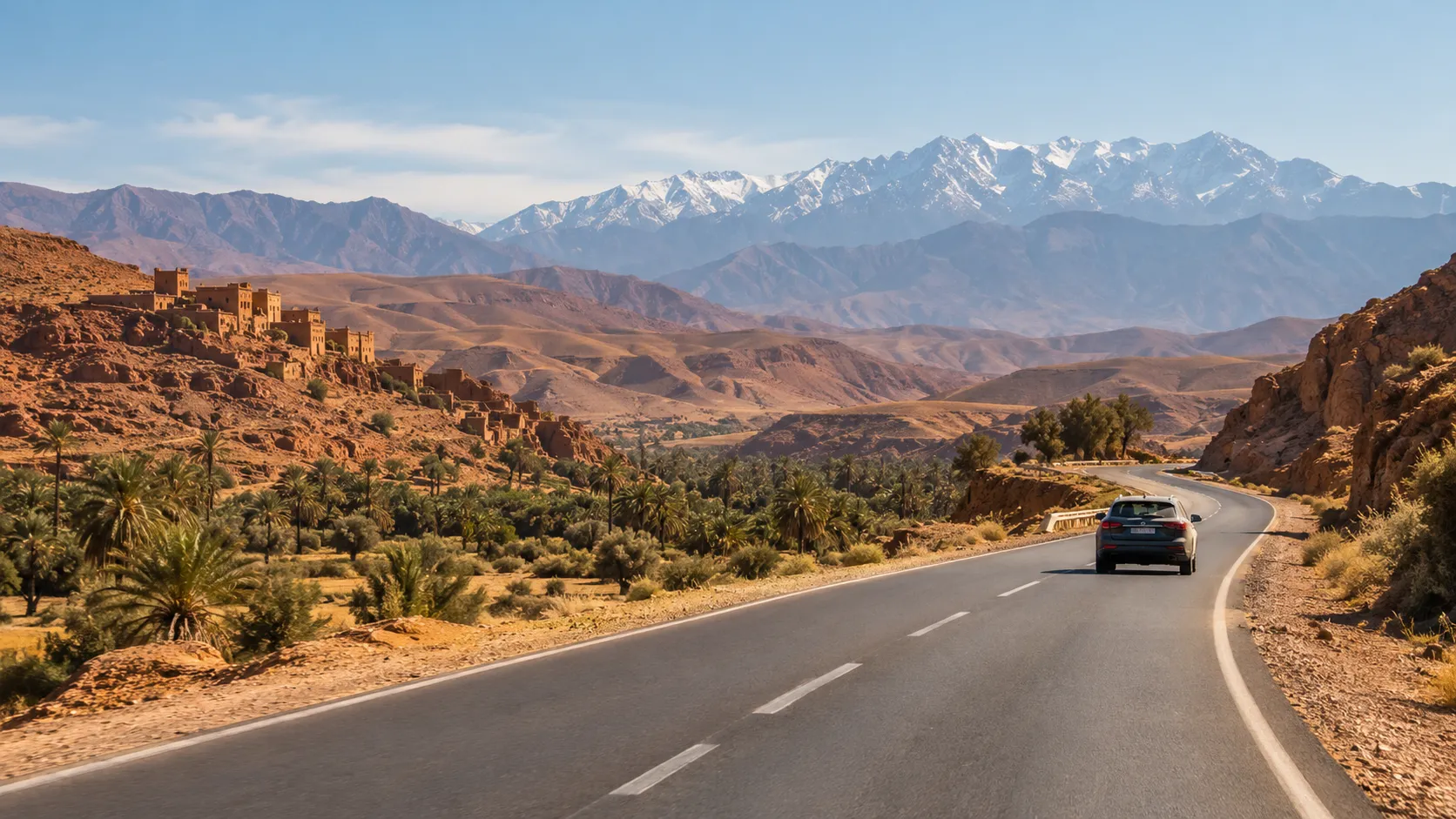
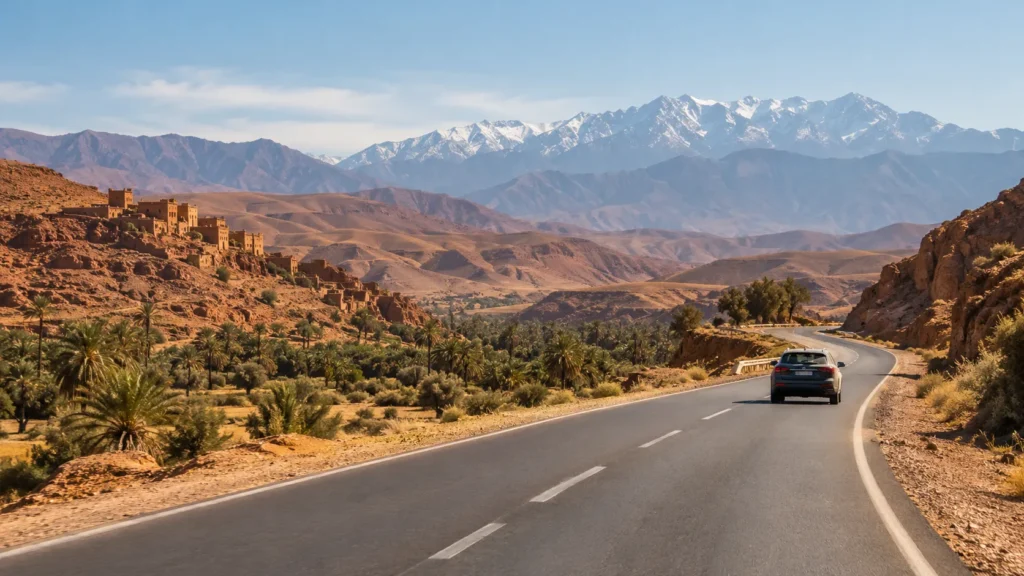
A Morocco road trip from Casablanca is a practical way to connect several of the country’s most important cities without following a simple out-and-back route. Starting on the Atlantic coast, you can travel north to Rabat, continue inland to Fes and finish in Marrakech, with the option of extending the journey through Merzouga and the Sahara before reaching the Red City.
The route brings together very different sides of Morocco. Casablanca introduces the country’s modern urban character and Atlantic coastline, Rabat combines historic monuments with the atmosphere of the national capital, Fes takes you deep into one of Morocco’s most important historic medinas, and Marrakech finishes the city route with souks, gardens, palaces and food.
The old version of this itinerary treated the Sahara as a simple extension from Marrakech. That is possible only as a multi-day journey. If large Sahara dunes are a major priority, a more logical road-trip route is Casablanca → Rabat → Fes → Merzouga → Dades and Ait Ben Haddou → Marrakech. If you have fewer days, keep the main city route and leave the Sahara for another trip.
Morocco Road Trip from Casablanca at a Glance
| Route | Main stops | Best for |
|---|---|---|
| City route | Casablanca → Rabat → Fes → Marrakech | Culture, architecture, food and historic cities |
| Sahara route | Casablanca → Rabat → Fes → Merzouga → Dades → Ait Ben Haddou → Marrakech | Cities, Sahara dunes, valleys and Atlas scenery |
| Shorter desert-style extension | Casablanca → Rabat → Fes → Marrakech → Agafay | Travelers without enough time for Merzouga |
For general rental-car, parking, navigation and self-drive planning, use the Morocco Road Trip Guide. This article stays focused specifically on the Casablanca–Rabat–Fes–Marrakech route.
Start the Road Trip in Casablanca
Your journey begins in Casablanca, Morocco’s largest city and one of the country’s major economic and commercial centers.
The old article correctly emphasized Casablanca’s modern character, Art Deco architecture, food and Atlantic setting. Rather than rushing directly toward Rabat after landing, give yourself enough time to experience the city.
Hassan II Mosque
Hassan II Mosque is Casablanca’s best-known landmark and an obvious place to begin. Its position beside the Atlantic gives it a completely different setting from the historic religious architecture you will encounter later in Fes or Marrakech.
If you want to see the interior, check the current visitor-tour arrangements rather than assuming unrestricted access.
Art Deco Casablanca
Central Casablanca contains an important collection of twentieth-century architecture, including Art Deco and other styles associated with the city’s rapid growth.
A walk through the center gives useful context before the itinerary moves into older imperial-city environments.
Markets and Moroccan Food
The original article also included markets and traditional Moroccan cuisine. Keep time for both rather than treating Casablanca only as an airport stop.
The Habous Quarter, Old Medina and central neighborhoods provide different types of shopping and street life, while Casablanca’s restaurant scene ranges from Moroccan classics to seafood and contemporary dining.
The Atlantic Coast
A walk along the Corniche adds another side of the city before you begin the inland portion of the trip.
Casablanca’s Atlantic setting also creates a useful contrast with the medinas, inland plains and eventual mountain landscapes later in the journey.
Drive from Casablanca to Rabat
Continue north to Rabat, Morocco’s capital.
This is one of the easier stages of the route, making Rabat a practical next stop rather than another demanding road day.
Rabat feels noticeably calmer than Casablanca. Its appeal comes from the combination of the modern capital, historic districts, gardens, Atlantic setting and monuments from different periods of Moroccan history.
Kasbah of the Oudayas
The Kasbah of the Oudayas is one of Rabat’s most distinctive historic areas.
Walk through its lanes and viewpoints overlooking the Bou Regreg river and surrounding city. The kasbah forms part of Rabat’s wider UNESCO World Heritage-listed urban ensemble.
Do not describe the Oudayas as a separate standalone UNESCO site; it is one component of the listed property that combines Rabat’s historic and modern heritage.
Hassan Tower
Continue to Hassan Tower, another major landmark already included in the old article.
The unfinished minaret and surrounding remains are connected with an ambitious Almohad mosque project begun in the twelfth century.
The surrounding area also includes the Mausoleum of Mohammed V.
Rabat Museums, Streets and Food
The old content emphasized Rabat’s museums, landmarks, charming streets and local food. All remain worthwhile reasons not to treat the capital merely as a lunch stop.
Depending on your interests, use additional time for museums, the medina, the riverfront, gardens or simply a slower afternoon around the old city.
Stay overnight when the schedule allows. A proper Rabat stop gives the route more variety than driving directly from Casablanca to Fes.
Continue From Rabat to Fes
The next stage takes you inland toward Fes, one of Morocco’s most important historic and cultural cities.
The landscape and atmosphere change considerably as the road journey moves away from the Atlantic corridor.
Once you reach Fes, leave enough time for the medina. This is not a destination that works well as a quick evening stop followed by an early departure.
Explore Fes el-Bali
Fes el-Bali is the historic heart of the city and part of the UNESCO-listed Medina of Fez.
The old article described its narrow streets, medieval architecture, souks, handcrafted goods, spices and textiles. Those elements should remain central to the visit.
The medina contains a dense network of streets with workshops, religious buildings, fountains, markets, traditional houses and food stalls.
Traditional Crafts and Souks
Fes is particularly important for Moroccan craftsmanship.
While walking through the medina, look beyond souvenir stalls and pay attention to working areas associated with leather, metalwork, textiles, wood and other crafts.
The Chouara Tanneries are among the city’s most recognizable craft-related sites.
Al-Qarawiyyin
The old article highlights Al-Qarawiyyin because of Fes’s long association with education and scholarship.
The institution dates to the ninth century and remains an important religious and educational landmark in the history of the city.
Access to active religious areas can be restricted, so visitors should follow current entry rules rather than assuming every part of the complex is open.
Should You Hire a Guide in Fes?
A local guide can add considerable value in Fes because the medina is both physically complex and historically dense.
A good guide can help explain the role of different neighborhoods, workshops, madrasas and religious buildings instead of simply leading you between photo stops.
Give Fes at least one complete sightseeing day. Two nights is a better minimum when the city is one of the main priorities of the road trip.
Fes to Marrakech: Choose the Direct Route or Sahara Route
This is the most important route decision in the itinerary.
The old article moved directly from Fes to Marrakech and then suggested adding the Sahara from Marrakech. That can create unnecessary backtracking when the Sahara is already one of your major goals.
You have two better options.
Option 1: Drive Directly From Fes to Marrakech
Choose the direct city route when:
- You have limited time
- The Sahara is not a priority
- You want more days in Fes or Marrakech
- You prefer fewer accommodation changes
- You want a predominantly cultural itinerary
Fes to Marrakech is a substantial intercity journey, so avoid planning major sightseeing immediately after arrival.
Once in Marrakech, focus on the city itself rather than trying to squeeze a full Sahara round trip into the final day or two.
Option 2: Fes to Merzouga and Then Marrakech
If seeing the Sahara is one of the main reasons for the trip, a stronger route is:
Fes → Merzouga → Todra Gorge → Dades Valley → Ait Ben Haddou → Marrakech.
This creates a continuous journey instead of driving to Marrakech first and then retracing a major portion of southern Morocco.
The route requires several additional days, but those road days include some of Morocco’s most varied scenery.
Adding the Sahara After Fes
The landscape changes dramatically as you travel southeast from Fes toward Merzouga.
The greener north gradually gives way to increasingly dry terrain, oasis valleys and eventually the Erg Chebbi dunes.
Merzouga and Erg Chebbi
Merzouga provides access to Erg Chebbi, one of Morocco’s best-known Sahara dune fields.
A desert stay can include:
- Sunset among the dunes
- Camel trekking when desired
- 4×4 access or exploration
- An overnight desert camp
- Stargazing
- Sunrise
Camel riding is optional. Travelers who do not want to ride can arrange vehicle-based alternatives with many camps and operators.
Desert Camp
The original article specifically included an overnight beneath the stars in a desert camp.
Keep this experience, but check the camp details carefully because comfort levels vary.
Confirm:
- Tent category
- Private or shared bathroom
- Dinner and breakfast
- Luggage arrangements
- How you reach the camp
- Return transport
- Any planned evening program
Sunset in the Sahara
The old article correctly identified sunset as one of the highlights of a Sahara journey.
Late-afternoon light brings out the ridges and shadows of the dunes and is one of the most popular times to experience Erg Chebbi.
Do not plan the road day so tightly that you spend hours crossing Morocco only to miss the landscape you traveled there to see.
Merzouga to Marrakech Through Southern Morocco
The journey west from the Sahara should not be treated as a simple return transfer.
A good route can include:
- Todra Gorge
- Dades Valley
- Ouarzazate
- Ait Ben Haddou
- The High Atlas
Todra Gorge and Dades Valley
The rocky landscapes around Todra and Dades provide a completely different environment from Erg Chebbi.
Use the valleys to divide the Sahara-to-Marrakech route into more comfortable stages instead of attempting one extreme driving day.
Ait Ben Haddou
Ait Ben Haddou is one of the most useful cultural stops on the southern route.
Its earthen architecture and position between Sahara routes and the High Atlas make it a logical road-trip stop rather than an unrelated detour.
Cross the Atlas to Marrakech
The final approach to Marrakech crosses mountain landscapes before descending toward the plains surrounding the city.
This creates a much more interesting finale than simply treating Marrakech as the place where the desert journey ends.
Marrakech: Finish the Main Road Trip
Marrakech provides an energetic finish after Rabat, Fes and the quieter desert or mountain sections.
The old article correctly emphasized the souks, Jemaa el-Fna, Majorelle Garden, Saadian Tombs and Moroccan food served in traditional riads.
Jemaa el-Fna and the Souks
Start around Jemaa el-Fna later in the afternoon and continue through the surrounding medina.
The square changes considerably toward evening, while the adjacent souks contain shops and workshops selling spices, leatherwork, lamps, textiles and other crafts.
Majorelle Garden
Majorelle Garden provides a quieter contrast with the medina and remains one of Marrakech’s most popular garden attractions.
Book ahead when necessary rather than assuming last-minute availability.
Saadian Tombs
The Saadian Tombs preserve another layer of the city’s history and fit naturally into a visit around the Kasbah district.
Eat in a Riad
The old article recommends experiencing Moroccan cuisine in a traditional riad. Keep this as part of the final Marrakech stay.
The city provides opportunities to try tagines, couscous, Moroccan salads, pastilla, pastries and modern interpretations of traditional dishes.
Is Marrakech Really the Gateway to the Sahara?
Marrakech is often marketed as a starting point for desert tours, but this description needs context.
The large Sahara dunes around Merzouga are not close to Marrakech. Reaching Erg Chebbi requires a multi-day journey through the High Atlas and southern Morocco.
This is why trips from Marrakech to Merzouga commonly use intermediate destinations such as Ait Ben Haddou, Ouarzazate, Dades Valley and Todra Gorge.
Do not plan a Merzouga Sahara experience as a normal Marrakech day trip.
What About Agafay Desert Near Marrakech?
If you have only one additional night around Marrakech, Agafay can provide a much closer desert-style landscape.
However, Agafay is not the Sahara and does not have the large sand dunes of Erg Chebbi.
It is a rocky, open landscape where camps can offer sunset experiences, meals and activities without requiring several days of road travel.
Choose Agafay when convenience matters. Choose Merzouga when large Sahara dunes are actually one of your trip priorities.
How Many Days Do You Need for This Route?
| Trip length | Recommended route | Pace |
|---|---|---|
| 5–6 days | Casablanca → Rabat → Fes → Marrakech | Fast; focus on cities |
| 7–8 days | Casablanca → Rabat → Fes → Marrakech with more city time | Balanced cultural route |
| 9–11 days | Casablanca → Rabat → Fes → Merzouga → southern Morocco → Marrakech | Better for Sahara + cities |
| 12+ days | Same route with extra nights in Fes, Sahara or Marrakech | More comfortable |
If you only have five or six days, do not add Merzouga simply to say that you visited the Sahara. Keep the city route and experience the destinations properly.
If you have nine days or more, the desert route becomes much more sensible.
Self-Drive or Private Driver?
Both work for this route.
Self-Drive
A rental car gives you flexibility between cities and becomes especially useful if you extend the itinerary through the Sahara and southern Morocco.
Self-driving is best for travelers comfortable with:
- City traffic
- Navigation
- Motorways
- Parking outside medinas
- Long road days
- Mountain driving if the Sahara route is included
For wider practical advice about rentals, navigation, parking and vehicle choice, read the Morocco Road Trip Guide: Routes and Self-Drive Tips.
Private Driver
A private driver can make the route easier when you want to enjoy the landscapes without concentrating on navigation or parking.
This becomes particularly useful if you choose the Fes–Merzouga–Marrakech route because the southern portion includes several substantial driving days.
A driver should not automatically be considered a specialist guide for every city. Arrange a local guide in Fes or Marrakech when detailed historical interpretation is important.
Where to Park in Casablanca, Rabat, Fes and Marrakech
Parking requires more thought once the route reaches historic medinas.
Before arrival, ask your accommodation:
- Whether the vehicle can reach the property
- Which gate or road to navigate toward
- Where the recommended parking area is
- Whether luggage assistance is available
This is especially important in Fes and Marrakech, where historic pedestrian streets often prevent direct vehicle access to riads.
Do not assume that a map pin inside the medina represents a drivable location.
Best Time for This Casablanca Road Trip
Spring and autumn work well for many versions of the route because conditions are generally easier for city sightseeing and, if included, southern Morocco.
Summer can become very hot in Marrakech and the Sahara. If Merzouga is part of your journey, plan desert activities for cooler times of the day.
Winter can be pleasant in the cities, but the Sahara becomes cold at night and mountain conditions need more attention if you cross the High Atlas.
The Casablanca–Rabat–Fes–Marrakech city route is less weather-sensitive than the full Sahara extension.
What to Pack
- Comfortable walking shoes for medinas and monuments
- Lightweight daytime clothing
- A warmer layer for evenings
- Sun protection
- Reusable water bottle
- Small day bag
- Power bank
- Offline map access for self-drive travel
- Personal medication
- Warmer layers if the Sahara or Atlas is included
If you are changing accommodation several times, manageable luggage is much easier than traveling with large bags that need to be carried between parking areas and riads.
Common Route Mistakes
Treating Rabat as a One-Hour Photo Stop
The capital has enough historical and cultural interest to justify a proper visit.
Giving Fes Only One Evening
The medina deserves at least one complete sightseeing day.
Calling Marrakech a Sahara Destination
Marrakech is a major starting point for multi-day Sahara routes, but Erg Chebbi is far from the city.
Driving to Marrakech Before Adding Merzouga
If you are already in Fes and definitely want the Sahara, continuing from Fes toward Merzouga is usually a more logical itinerary than going to Marrakech first and then driving southeast again.
Confusing Agafay With the Sahara
Agafay is convenient and scenic but does not offer Erg Chebbi-style sand dunes.
Scheduling Major Sightseeing After Long Road Days
Keep arrival evenings flexible, particularly after longer intercity or desert transfers.
FAQ
What is the best road trip route from Casablanca to Marrakech?
For a cultural city trip, travel from Casablanca to Rabat, continue to Fes and finish in Marrakech. If the Sahara is a major priority, travel from Fes southeast to Merzouga and then continue west through Todra Gorge, Dades Valley and Ait Ben Haddou before reaching Marrakech.
How many days do I need for Casablanca, Rabat, Fes and Marrakech?
Five or six days is possible but relatively fast. Seven or eight days gives you more useful sightseeing time, especially in Fes and Marrakech. Add several more days if you want to include Merzouga and the Sahara.
Can I include the Sahara between Fes and Marrakech?
Yes. In fact, this is one of the most logical ways to combine the cities and desert. Travel from Fes toward Merzouga, stay near Erg Chebbi, then continue through the southern valleys and High Atlas toward Marrakech.
Is the Sahara close to Marrakech?
No. The major Sahara dunes around Merzouga require a multi-day road journey from Marrakech. Agafay is much closer to Marrakech but is a rocky desert landscape rather than the large Sahara dune environment at Erg Chebbi.
Can I self-drive this Morocco route?
Yes. Casablanca, Rabat, Fes and Marrakech can be linked by road, and self-drive becomes particularly useful if you add the Sahara and southern Morocco. Be prepared for city traffic, medina parking arrangements and longer road days on the desert extension.
Should I spend more time in Fes or Rabat?
Both deserve time, but Fes generally benefits more from an additional full day because its historic medina is extensive and contains numerous craft areas, monuments and neighborhoods. Rabat can work well with one full day or an overnight stop on a faster itinerary.
Build the Route Around Your Priorities
A Morocco road trip from Casablanca works because each city contributes something different.
Casablanca starts the journey with Atlantic views, modern architecture and the Hassan II Mosque. Rabat adds the country’s capital, the Kasbah of the Oudayas and Hassan Tower. Fes brings you into one of Morocco’s great historic medinas, with centuries of scholarship, craftsmanship and urban history.
Marrakech then provides a contrasting finish with Jemaa el-Fna, souks, Majorelle Garden, the Saadian Tombs and traditional riad experiences.
If those four cities are enough, keep the road trip focused and spend more time exploring them. If the Sahara is essential, change the route after Fes and travel through Merzouga and southern Morocco before finishing in Marrakech.
That creates a stronger journey than reaching Marrakech first and then treating the Sahara as a quick nearby excursion.
For broader driving advice, vehicle choices and regional route ideas, use the Morocco Road Trip Guide. If you want the route arranged around your dates, accommodation preferences and preferred driving pace, use the custom Morocco trip planner.
Explore destinations, tours and locally organized Morocco experiences with Visit Morocco Together.
Ready to Experience Morocco?
Turn this inspiration into your next adventure. Our travel experts are ready to help.