Moroccan carpet weaving is one of the country’s most recognizable craft traditions, but understanding a handmade rug involves much more than choosing a pattern you like. Different regions use different materials, weaving techniques, colors and design traditions, and the experience of visiting a working loom can be very different from entering a carpet shop where the main purpose is selling finished rugs.
This guide explains how Moroccan carpets are made, what to expect from a weaving workshop, the difference between common rug constructions, and how to buy a carpet without feeling pressured. It also covers measurements, quality checks, bargaining, shipping and the questions worth asking before paying for a handmade piece.
Moroccan Carpet Weaving: Understanding the Craft
Carpet making in Morocco is closely connected with Amazigh craft traditions, although weaving is practiced across different regions and communities. The term “Berber rug” remains widely used in shops and international design markets, but Amazigh is increasingly preferred when referring to the people and cultural traditions behind many of these textiles.
There is no single Moroccan carpet style. Rugs made in different parts of the country can vary in pile height, weaving technique, wool, color palette, density and pattern. Some are thick and designed for warmth, while others are light flatweaves that are easier to fold and transport.
Traditional knowledge has often been passed through families and communities, particularly among women. At the same time, Moroccan carpet production continues to evolve, so contemporary weavers may combine inherited techniques with new colors, designs and materials.
How a Moroccan Carpet Is Made
The exact process depends on the rug, but understanding the basic stages makes a workshop visit and buying experience much more meaningful.
Preparing the Wool and Yarn
Many Moroccan carpets use sheep wool, although cotton and other fibers may also appear in the foundation, fringe or finished textile.
Wool must be cleaned and prepared before it can become usable yarn. Depending on the workshop and production method, you may see stages such as carding, spinning and arranging yarn for weaving.
Do not assume that every rug advertised as traditional uses wool exclusively. If material matters to you, ask specifically what the pile, foundation and fringe are made from.
Dyeing the Yarn
Natural dyes are part of some Moroccan textile traditions, and plant- or mineral-based colors may be demonstrated in certain workshops. However, synthetic dyes are also widely used.
A rug is not automatically superior because the seller describes the colors as natural, and bright color alone does not prove that synthetic dye was used. Dye source, weaving quality, material and craftsmanship should be considered separately.
If the dyeing process interests you, ask whether it takes place at the workshop you are visiting or elsewhere. Not every weaving workshop also spins and dyes its own wool.
Setting Up the Loom
The warp threads form the structural foundation of the carpet and must be tensioned on the loom before the design begins to take shape.
Large rugs can occupy a loom for a considerable period, particularly when the design is dense or the technique involves individually tied knots.
Watching this process helps explain why handmade carpets cannot be evaluated only by size. Complexity, materials, construction and the amount of labor involved also affect the finished piece.
Weaving, Knotting and Building the Design
Some carpets use knotted pile, while others use flatwoven techniques. Certain pieces combine more than one construction method.
The weaver gradually builds the textile row by row, packing the fibers together and developing the pattern across the loom. Designs may follow an established regional visual tradition, repeat familiar geometric elements or reflect choices made by the individual weaver.
Be cautious with claims that every triangle, diamond or line has one universal symbolic translation. Motifs can carry cultural or personal associations, but meanings may vary between regions, families and individual makers.
Pile Rugs and Flatweaves: What Is the Difference?
Understanding construction is more useful than memorizing dozens of shop labels.
| Construction | What to expect | Useful for |
|---|---|---|
| Knotted pile | Raised, thicker surface with yarn forming the pile | Warmth, bedrooms and living spaces |
| Flatweave | Flat surface without a deep pile | Lighter rugs, layering and easier transport |
| Mixed technique | Combination of pile and flatwoven sections | Texture and more complex surface designs |
Neither technique is automatically better. The right choice depends on where you will use the rug, the climate in your home, the amount of foot traffic and the texture you prefer.
Regional Moroccan Carpet Traditions
Shop names can make Moroccan rugs seem as if they fall into a few rigid categories, but regional textile traditions are more complex than retail labels suggest.
You may encounter names associated with Beni Ourain, Azilal, Boujad, Rabat, Taznakht and other areas. These labels can indicate regional traditions, but they are also sometimes used broadly in the international rug trade.
Taznakht and Southern Morocco
Taznakht, in the wider Ouarzazate region, is particularly associated with Amazigh carpet production. Morocco’s national tourism office specifically recommends the town for travelers interested in handmade carpets and describes the area as an important center for Amazigh craftsmanship.
Travelers already passing through southern Morocco can therefore make carpet craftsmanship part of the route rather than treating it only as a shopping activity in a major city.
Marrakech
Marrakech offers one of the widest selections for shoppers because its medina brings together rugs produced in many different Moroccan regions.
That variety is useful, but it also means you should not assume a carpet was woven in Marrakech simply because it is being sold there. Ask about the claimed region of origin and who produced it if provenance matters to you.
Fes
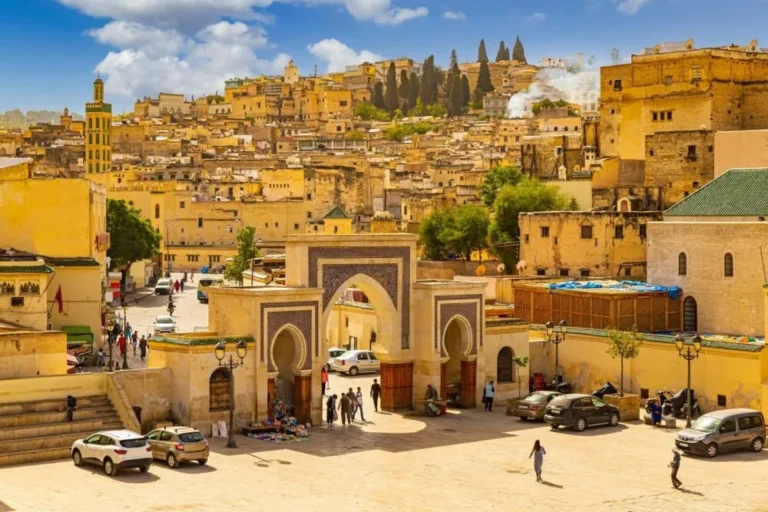
Fes is particularly useful for travelers interested in seeing several forms of Moroccan craftsmanship together. Its medina contains textile, metal, pottery, leather and other artisan trades.
VMT’s Fes artisan experience currently includes visits to pottery workshops, carpet weavers and metalworking studios, making it relevant for travelers who want craft context rather than visiting a carpet showroom alone.
What to Expect From a Moroccan Carpet Workshop
A Moroccan carpet weaving workshop can range from a short demonstration to a longer hands-on session. Before booking, check what the word “workshop” actually means.
A useful experience may show you the loom, explain the materials, demonstrate knotting or flatweaving, introduce the craftsperson and provide time to ask questions. Longer workshops may allow participants to try basic weaving themselves.
Do not assume you will make a complete rug during a short visitor workshop. Producing a full carpet can require extensive work depending on its size and complexity.
Workshop or Carpet Shop?
The distinction matters.
A working workshop focuses on the making process. A carpet showroom focuses primarily on displaying and selling finished pieces. Some businesses combine both, which is completely reasonable as long as visitors understand what they are booking.
If you want a hands-on experience rather than a shopping stop, ask in advance:
- How long is the workshop?
- Will you meet or observe the weavers?
- Will you use a loom yourself?
- Are materials included?
- Do you make a small sample to take home?
- Is purchasing a carpet optional?
- Is the activity held in a working cooperative, studio or retail shop?
How to Buy a Moroccan Carpet
You do not need to become a textile expert before buying a rug. You do, however, need enough information to judge whether the carpet suits your home and whether you are comfortable with the price.
Measure Your Space Before Shopping
Record the maximum and ideal dimensions of the area where the carpet will go before entering a shop.
Keep the measurements on your phone in both centimeters and the units you normally use at home. Moroccan carpets do not necessarily conform to standard furniture-store dimensions, which is part of their appeal but can create problems if you buy on impulse.
Ask What the Rug Is Made From
Ask about both the visible pile and the foundation. A seller should be able to explain whether a rug uses wool, cotton, another fiber or a combination.
If you are buying an older carpet, also ask about repairs, replaced sections or significant wear.
Look at Both Sides
Turn the rug over. The reverse can help you understand its structure, knotting or weaving and whether repairs are present.
Handmade rugs naturally show variation, but irregularity by itself is not proof of age, quality or authenticity. Evaluate the overall construction rather than looking for one supposedly foolproof sign.
Check the Edges and Fringe
Look at the sides of the rug and where the fringe meets the main textile. Check for loose sections, damage and repairs.
Fringe can form part of the structural warp rather than being purely decorative, so its condition deserves attention on older pieces.
Ask Whether It Is New or Vintage
“Vintage,” “old” and “antique” can be used loosely in tourist retail. If age significantly affects the asking price, ask how the seller established it.
Do not pay a substantial premium simply because a carpet is described verbally as old. Buy it because you like the piece and are comfortable with the information available.
How Much Should a Moroccan Rug Cost?
There is no reliable universal price table for Moroccan carpets.
Prices vary with dimensions, material, construction, weaving time, condition, claimed origin, seller, location and whether the piece is new or older. Retail shops in major tourist areas also operate differently from cooperatives or direct artisan sales.
For that reason, comparing several rugs is more useful than looking for a supposed fixed “correct Moroccan price” online.
If you are seriously considering a large purchase, look first, leave if necessary, compare similar pieces and return once you have a better sense of what you prefer.
Bargaining for a Carpet in Morocco
Negotiation is common in many carpet shops, but the process does not need to become confrontational.
Ask for the price, decide what the rug is worth to you and make a reasonable counteroffer if negotiation is appropriate. You are free to stop negotiating if the price remains outside your budget.
Tea, conversation or a long sales presentation does not create an obligation to buy.
Do not begin serious bargaining over a carpet you have no intention of purchasing. Once you move into detailed price negotiation, sellers may reasonably interpret that as genuine interest.
Buying Directly From Artisans and Cooperatives
A cooperative or artisan workshop can provide more visibility into the production process, but the word “cooperative” alone should not be treated as a guarantee about how revenue is distributed.
If supporting the maker is important to you, ask practical questions: Who made this rug? Is the weaver part of this workshop? How is the carpet priced? Can you learn something about where it was produced?
A transparent answer is more useful than relying on marketing labels such as “ethical,” “authentic” or “direct from the artisan” without further explanation.
Shipping a Moroccan Carpet Home
Large carpets can often be folded or rolled surprisingly compactly, but weight and shipping costs still matter.
If a shop offers international delivery, confirm the full arrangement before paying.
| Check before shipping | Why it matters |
|---|---|
| Exact rug dimensions | Confirms you receive the piece you selected |
| Photographs of the rug | Provides a record of pattern and condition |
| Written receipt | Records the item and amount paid |
| Shipping charge | Avoids confusion over whether delivery is included |
| Tracking method | Allows you to follow the shipment |
| Return policy | Clarifies your options if there is a problem |
| Customs responsibility | Import charges and procedures depend on destination |
Keep the seller’s contact information and your receipt until the rug has arrived and you have inspected it.
Common Mistakes When Buying Moroccan Rugs
The biggest mistake is buying too quickly because the presentation feels exciting. Carpet shopping can be an enjoyable part of traveling in Morocco, but a large handmade rug is still a significant purchase.
Other common problems include assuming every geometric design has a fixed ancient meaning, believing that every brightly colored carpet uses natural dyes, purchasing without checking dimensions, treating every “vintage” description as verified, or agreeing to international shipping without written details.
Take enough time to compare pieces and remember that walking away is always an acceptable decision.
Responsible Carpet and Workshop Visits
Craft workshops are working spaces. Ask before photographing individual artisans closely, particularly when someone is concentrating on weaving or preparing materials.
If an artisan explains a technique or demonstrates part of the process, listen to the explanation rather than treating the workshop only as a backdrop for photographs.
Buying a carpet is not required to make the visit worthwhile. If you do purchase one, prioritize a piece you genuinely like and ask enough questions to understand what you are buying.
Who Is a Moroccan Carpet Workshop Best For?
A workshop is especially worthwhile for travelers interested in textiles, design, interiors, cultural history and traditional crafts. It also works well for families with older children when the activity includes a short hands-on element.
Travelers planning to buy a substantial rug benefit particularly from seeing how a loom works before shopping. Understanding the labor behind the finished textile makes it easier to evaluate construction and ask better questions.
If shopping is not your priority, a short artisan visit can still provide useful cultural context without requiring you to purchase anything.
FAQ
Are Moroccan Carpets Handmade?
Many traditional Moroccan carpets are handmade using knotted, flatwoven or mixed techniques, but machine-made rugs are also sold in Morocco. Ask about construction rather than assuming every carpet in a souk or showroom was woven by hand.
What Is the Difference Between an Amazigh Rug and a Berber Rug?
The terms often refer to the same broad family of textile traditions. “Berber rug” remains common in the international market, while Amazigh is increasingly preferred when referring to the Indigenous North African peoples and their cultural traditions.
Are Moroccan Rugs Made With Natural Dyes?
Some are, but not all. Moroccan carpets may use natural dyes, synthetic dyes or combinations depending on the maker, period and production method. Ask the workshop or seller if dye type matters to you.
Where Is the Best Place to Buy a Moroccan Carpet?
Marrakech and Fes offer large selections from several regions, while places such as Taznakht are closely associated with regional carpet production. The best place depends on whether you prioritize convenience, a large choice or direct contact with weaving communities.
Do You Have to Bargain When Buying a Rug in Morocco?
Negotiation is common in many traditional shops, but not every seller or cooperative uses negotiable pricing. Ask first, stay polite and decide your maximum budget before entering a lengthy negotiation.
Can You Ship a Moroccan Carpet Home?
Many carpet sellers can arrange international shipping. Before paying, confirm the total shipping price, obtain a detailed receipt, photograph the exact rug, ask for tracking information and check who is responsible for customs or import charges.
Understanding Moroccan Carpet Weaving Before You Buy
Moroccan carpet weaving is easier to appreciate when you see the process before concentrating on the finished product. A loom, a bundle of wool and a partially completed textile reveal the time and decisions hidden behind a rug displayed in a shop.
If you plan to buy, focus on construction, material, dimensions and the piece itself rather than searching for one supposedly perfect definition of authenticity. Ask questions, compare carpets and give yourself permission to leave without buying. A rug worth taking home should suit your space and budget as well as remind you of the craft behind it.
Explore destinations, tours and locally organized Morocco experiences with Visit Morocco Together.
Ready to Experience Morocco?
Turn this inspiration into your next adventure. Our travel experts are ready to help.