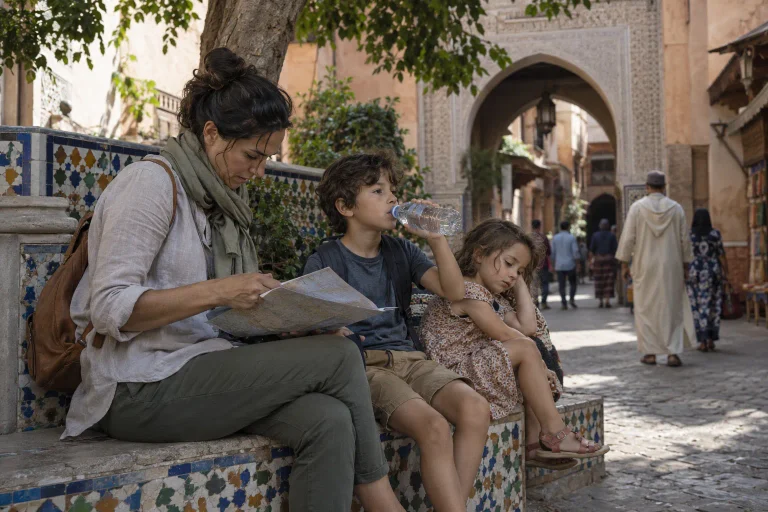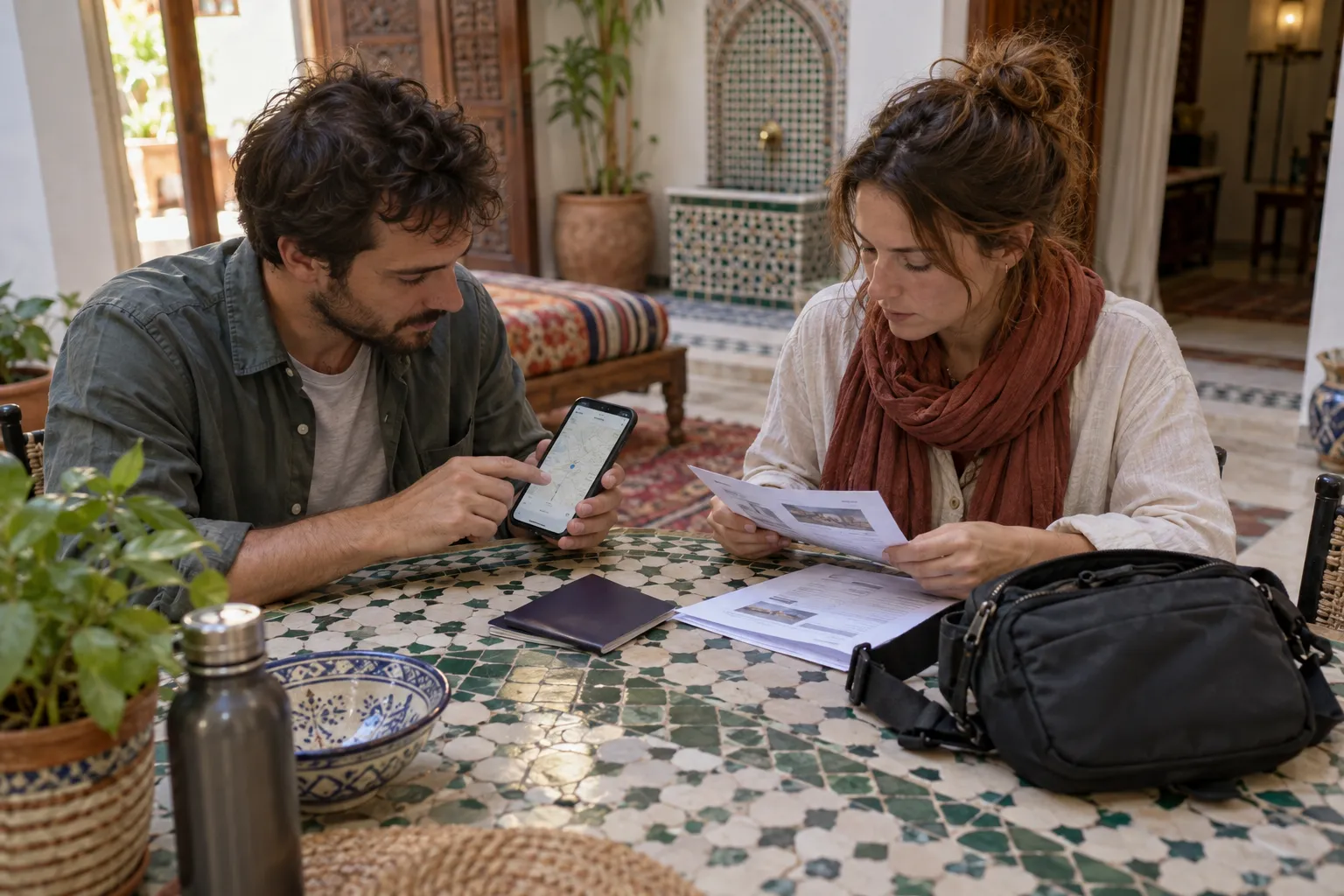
Morocco travel essentials include the things that let you pay, find your accommodation, contact your driver and get through the day comfortably. Clothes and toiletries matter, but so do a working phone, accessible booking details, suitable chargers and enough cash for the next part of your route.
Start with your first arrival and work forward. Decide how you will connect to the internet, pay for transport and locate the entrance to your accommodation. Then consider the next place where you might have fewer opportunities to withdraw cash, charge devices or wash clothes. That approach produces a packing list suited to your trip, whether you are staying in one city or crossing the mountains to a desert camp.
Which Morocco travel essentials should you arrange before departure?
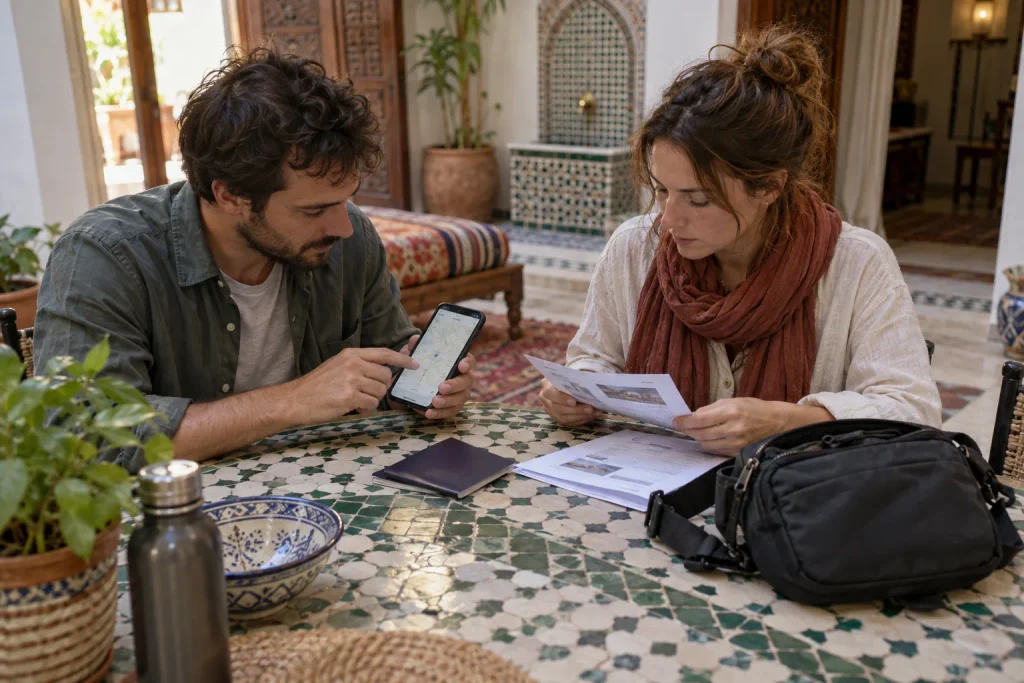
Arrange access to money, communication and your first night’s accommodation before deciding how many outfits to pack. Keep essential documents, regular medicines, your phone and charging equipment accessible during the journey. Save key information in a form you can open without an internet connection, and keep a small backup outside your phone.
Use this short arrival checklist:
- Documents: Passport, any required entry documents, insurance details and booking confirmations, with copies stored separately.
- Accommodation: Full address, contact number, check-in arrangements and instructions for reaching the entrance from the drop-off point.
- Money: A usable payment card, a way to obtain Moroccan dirhams and a separate fallback if a card fails.
- Phone: An agreed roaming or local data plan, downloaded information and a charged battery.
- Immediate needs: Regular medicine, one change of clothes and items you may need before retrieving your main luggage.
Make the rest of the list fit your stops. The Morocco destinations guide helps you distinguish a coastal stay, city itinerary, mountain visit and desert route. Each changes what needs to be within reach and what facilities you should confirm in advance.
How should you plan cash, cards and Moroccan dirhams?
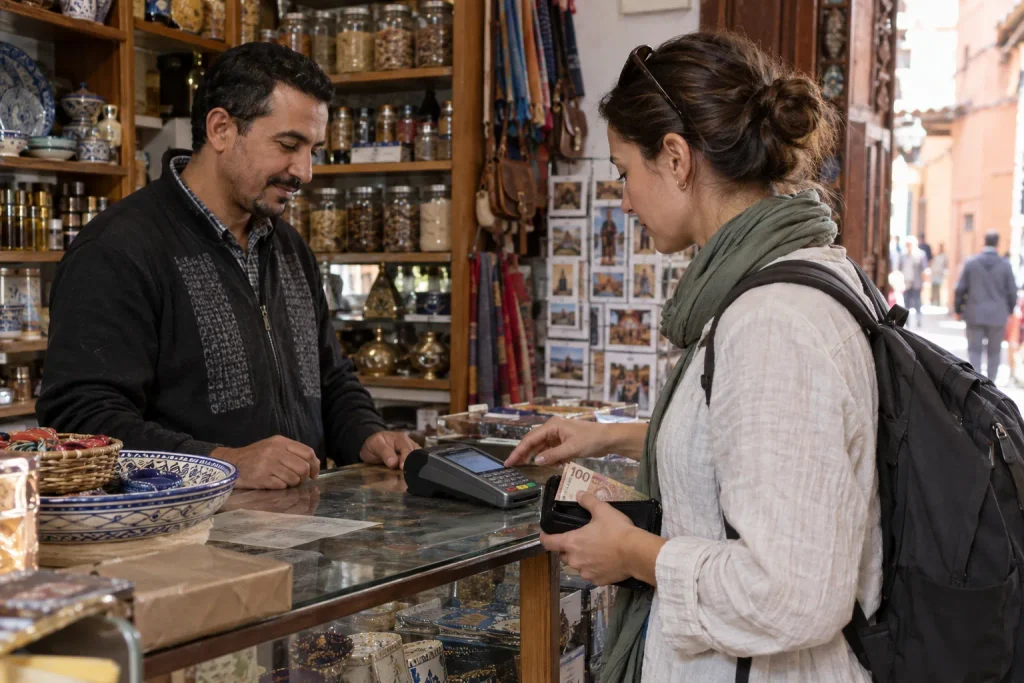
Use Moroccan dirhams for local cash spending and carry a card for businesses that accept it. The currency code is MAD, while prices may also use DH. The Moroccan National Tourist Office’s practical information explains that card acceptance varies between establishments. Ask about payment before committing to a purchase or service, particularly when cash would be difficult to obtain nearby.
Plan cash for the stretch between reliable withdrawal opportunities. Add up your expected cash-only meals, small purchases, entry charges, local transport and any unpaid balance that the provider has confirmed must be paid in cash. Add a reasonable reserve based on your circumstances. There is no single daily cash amount that fits both a prepaid city stay and a route with several separate expenses.
Before a rural departure, confirm where you can withdraw money and whether the next accommodation or activity accepts cards. Do not assume that an ATM shown on a map will be working, stocked or compatible with your card. Smaller denominations are useful for modest purchases; keep them accessible without displaying the rest of your money.
Review your card issuer’s foreign transaction and withdrawal charges. At an ATM or card terminal, check the currency, fees and amount shown before accepting. If offered conversion into your home currency, read the quoted rate and charges rather than automatically selecting the familiar currency. Keep the withdrawal receipt when useful, collect the card, and verify any unexpected transaction through your bank’s official contact channel.
What should you confirm about deposits, final payments and tips?
Get a written record of what you are paying for, the currency, the amount already paid and the remaining balance. For accommodation or an excursion, confirm when the balance is due and which payment methods are accepted. A price displayed online in one currency does not by itself explain the final invoice, exchange rate or payment fee.
A useful confirmation should identify the service, date, number of travellers, inclusions, payment schedule and applicable cancellation terms. Keep the receipt beside that confirmation. If somebody sends different payment instructions later, verify them through the provider’s established contact details before transferring money.
For tipping, first distinguish a stated service charge, a prepaid tip arrangement and a discretionary gratuity. Ask whether anything has already been included in a group package. Keep small notes available if you choose to tip, but avoid treating a percentage found online as a national rule. A separately agreed service price should be clear before the work begins.
Should you use roaming, a Moroccan SIM, an eSIM or Wi-Fi?
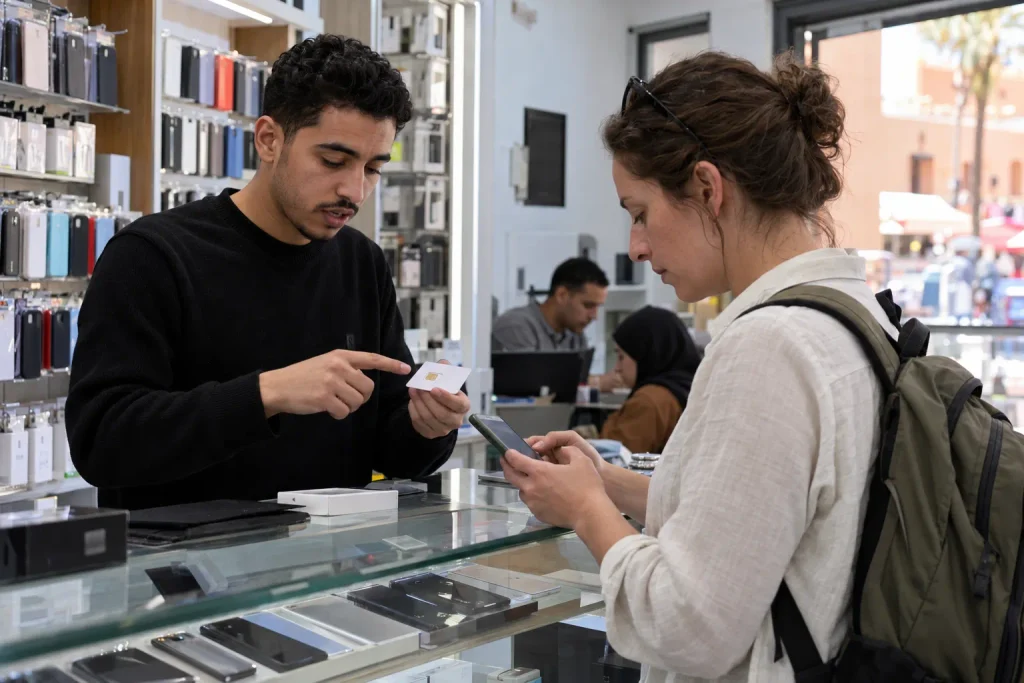
Choose the option that meets your needs for data, calls and account access at an acceptable total cost. Roaming may be convenient if Morocco is covered by your home plan. A local SIM or eSIM can provide a separate line, while accommodation Wi-Fi is useful for downloads and backups. Check the terms of the particular plan rather than assuming one option is always cheaper or more reliable.
Before buying, answer five questions:
- Will it work on this phone? Check the exact device model, eSIM support if relevant and any carrier lock.
- What is included? Identify data allowance, validity, local calls, texts, hotspot use and any speed restrictions.
- When does validity begin? Installation, activation and first use can be different events depending on the provider.
- Which network will it use? Ask about your actual stops and accommodation rather than relying on a country-wide slogan.
- How do you get help or top up? Save the provider’s instructions and make sure the payment method works for you.
Local operators include Maroc Telecom, Orange and inwi. Compare their current offers with your home carrier and any travel eSIM you are considering. For example, Orange Morocco’s eSIM guidance explains device compatibility and activation. Its instructions apply to its own service; another provider may use different activation and replacement procedures.
If buying a SIM after arrival, use an authorised seller, bring the identification it requires and confirm what you are purchasing. Test mobile data and any included calling before leaving the counter. For an eSIM, read the installation instructions while you still have dependable internet access. Keep the activation information private and do not delete the profile casually if you may need it again.
What should you do before buying a SIM at Marrakech airport?
Check that your arrival time leaves you a workable way to connect, and prepare a fallback for reaching your accommodation. Airport counters, offers and opening arrangements can change. Ask the operator for current availability rather than building your arrival around an assumed kiosk location or overnight opening time.
Have your accommodation address, pickup instructions and contact number saved offline before landing. If you are comparing offers at a counter, ask for the total price, included data, validity period and whether local calls are included. A starter SIM and a data bundle may be separate parts of the purchase; have the seller explain the package and provide a receipt.
If you will use two lines, label them clearly in the phone settings and select the intended line for mobile data. Review your home carrier’s roaming settings and charges before leaving that line active. Receiving a bank verification message and using data abroad are different functions; confirm how you will access essential accounts instead of disabling a line you still need without checking.
How reliable is internet in cities, mountains and the desert?
Treat connectivity as a question about a precise location and task. A hotel connection that handles messages may struggle with a video meeting; reception on a main road does not establish reception in a valley or camp. Ask accommodation staff or your operator which network works at the actual property and when that information was last checked.
For a city stay in Marrakech, Fes or Casablanca, confirm whether Wi-Fi reaches your room or is mainly available in shared areas. If working during the trip, ask about recent performance during your likely working hours, a usable desk, sockets and somewhere appropriate for calls. Do not infer working conditions from a listing that says only “free Wi-Fi.”
Before a desert stay around Merzouga, ask separately about the meeting point, camp and route between them. Download what you need and arrange a sensible check-in time with people at home. Save large uploads for a confirmed connection and allow time to catch up afterwards. These preparations remain useful even when there is signal: a flat battery or exhausted data allowance can interrupt communication too.
Which apps and offline information will you actually use?
Prepare a small set of tools for maps, translation, bookings, communication and money. Install and test them before travelling, then save the important information inside them for offline use where supported. Several apps that all require a live connection do not provide much backup for one another.
| Task | Preparation that helps |
|---|---|
| Finding accommodation | Save the address, entrance instructions, map pin and a nearby landmark. |
| Meeting a driver or guide | Keep the exact meeting point, local contact number and agreed time together. |
| Translation | Download supported language packs and save important written phrases. |
| Tickets and reservations | Keep an accessible copy of the booking and reference number, following the issuer’s ticket instructions. |
| Money and data | Check that banking and carrier accounts remain accessible while abroad. |
| Photography | Make storage space and choose when large backups should use Wi-Fi. |
Google Maps can be useful for downloaded areas, but its offline mode does not provide walking, cycling or public transport directions. Save the final approach to an unfamiliar accommodation before leaving a connection, and test what your chosen map app actually shows offline. A saved pin can identify a building without telling you which entrance a vehicle can reach.
A translation app is useful for short, simple exchanges, but available language packs do not guarantee accurate Darija or every local language variety. Have a host write down a complicated address or instruction when needed. For payment terms, allergies or another important matter, check understanding with a person rather than trusting a machine translation alone.
Which plugs, chargers and power supplies should you pack?
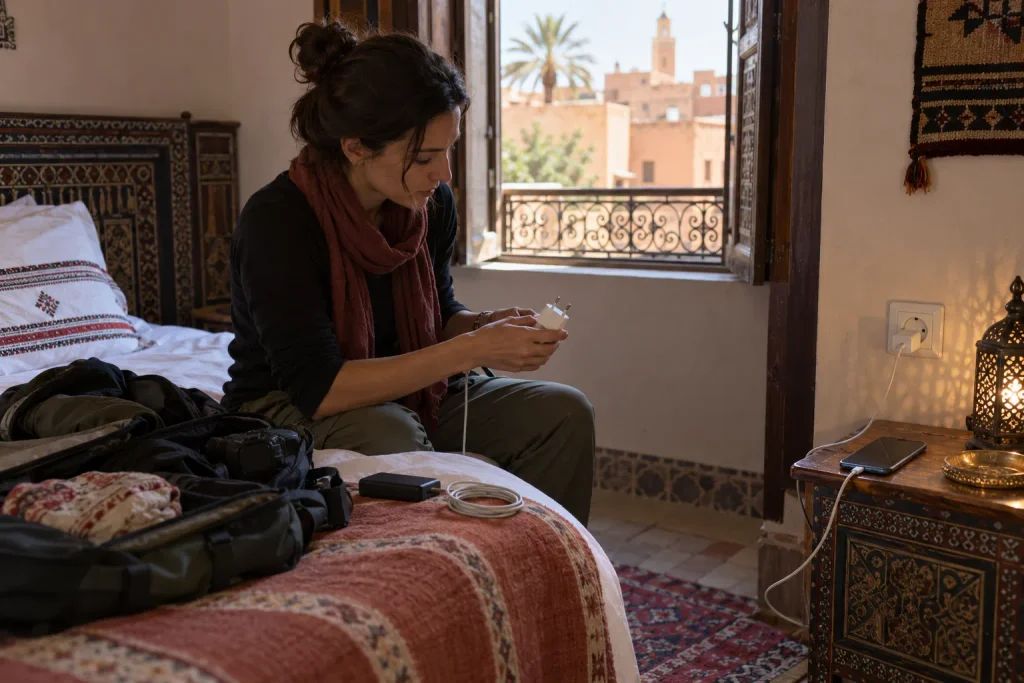
Bring an adaptor that fits Moroccan sockets and equipment rated for the local electrical supply. Electrical Safety First’s Morocco adaptor guidance lists Type C and Type E connections and a 220 V, 50 Hz supply. A plug adaptor changes how the plug connects; it does not convert voltage.
Check the input label on each charger or appliance. A charger marked 100–240 V, 50/60 Hz can normally accept the listed supply when used with a suitable adaptor, but check the manufacturer’s instructions. A device designed only for a lower voltage needs a different solution. Pay particular attention to hair appliances and other equipment that draws substantial power, and use the required earth connection where applicable.
Keep one charger and cable in your day bag rather than packing everything beneath your suitcase. For several devices, bring charging equipment with enough suitable ports and capacity. Ask a camp or remote accommodation where and when charging is available instead of assuming every tent or room has a socket. If bringing a power bank or spare battery, check the airline’s current carriage rules and the battery’s marked capacity before flying.
What belongs in your main bag and your everyday bag?
Pack clothing for the route’s weather and activities, then keep the items you need during the day in a smaller bag. Check forecasts close to departure for every region you will visit. A forecast for Marrakech does not describe conditions at a mountain stop or a desert camp.
In the main bag, pack a manageable set of clothes you can combine and rewear: breathable tops, comfortable trousers or other suitable bottoms, underwear, socks, sleepwear and layers for the expected conditions. Add rain protection, swimwear or activity equipment when the itinerary calls for it. Comfortable walking shoes are useful on uneven city streets; technical outings need their own footwear and equipment advice from the provider.
In the everyday bag, keep water, sun protection, tissues, hand sanitiser, necessary medicine, a layer, phone, charger or power bank, and relevant booking details. Use a small pouch for cables and another for personal items so you can find them during a roadside stop. Carry identity documents as required and store copies separately.
For clothes, consider comfort, coverage and the setting you are visiting. Religious and historic sites may have their own instructions, while a beach or pool is a different environment. There is no need to buy an entirely new wardrobe based on a generic list. Pack pieces you will use repeatedly, and add more specialist items only when a confirmed activity requires them.
How should you manage luggage between hotels, transfers and a camp?
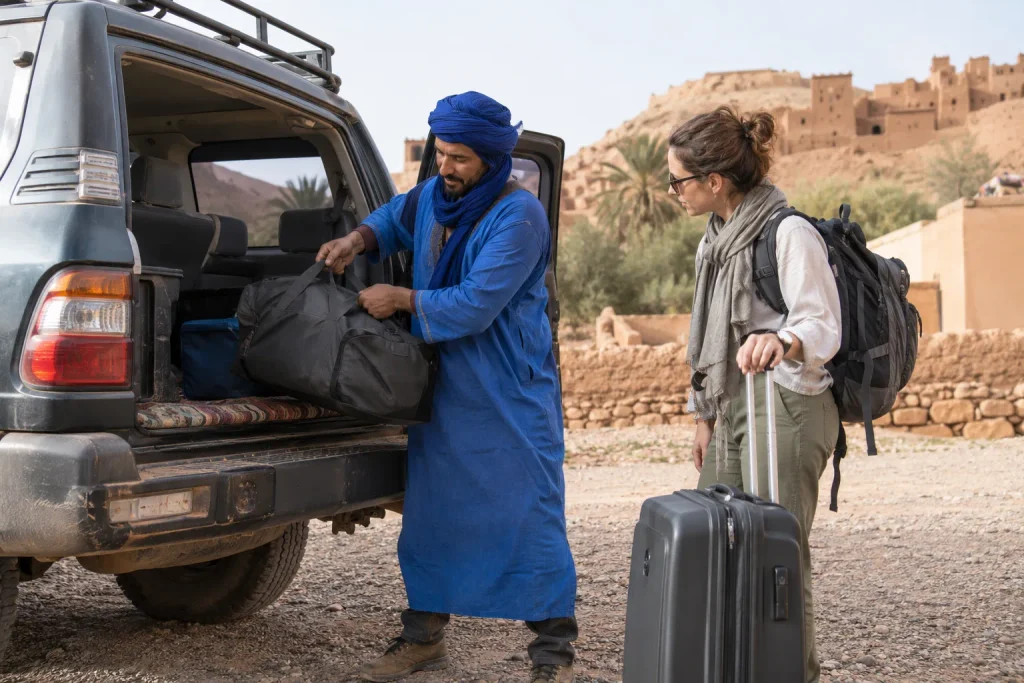
Confirm who will hold each bag, where it will be kept and when you can retrieve it. A hotel that stores luggage before check-in may have different arrangements after checkout. Ask about the price, storage area, collection hours, bag identification and whether staff will be present when you return. Keep passports, essential medicine and valuables with you rather than assuming storage is insured.
For an excursion, ask how luggage moves at every change of vehicle or accommodation. A smaller overnight bag may help, but do not leave your main luggage behind until the operator confirms the arrangement. On a journey ending in another city, it needs to travel onward with you through an agreed process.
The listed three-day Merzouga trip from Marrakech includes a hotel or riad night, a desert camp night and a camel trek. Those changes make luggage questions worth settling in advance: which bag reaches camp, how it is transported, and when the larger bag is accessible. Ask VMT to confirm the current arrangements for your booking. The itinerary alone does not establish a particular storage service or baggage limit.
When comparing other journeys, the guide to getting around Morocco can help you choose the transport mode. Then confirm the baggage allowance and loading arrangements with the specific carrier or provider, including any bulky equipment.
How do laundry and a longer stay change your packing list?
Pack according to the interval between confirmed laundry opportunities. If you can wash clothes midway through a stay, you may need fewer changes than someone moving daily. Ask whether the accommodation offers laundry, what it costs, when items come back and whether delicate garments can be handled as needed.
Leave enough time for washing and drying before an early departure. Keep a change of clothes separate when handing over most of your bag, and agree on a collection time. If planning to wash a few items yourself, check the accommodation’s arrangements and allow for drying conditions. Do not count on everything drying overnight.
For a longer tourist stay, check everyday facilities as carefully as the room photographs: accessible sockets, workspace, a suitable chair, laundry, meal options and a practical place to store luggage. If you need a coworking space, confirm current opening hours, reservations, call facilities and connection quality directly. A café or shared lounge may suit a short task but still be unsuitable for a scheduled meeting.
What is your backup if your phone is lost or stops working?
Prepare a way to reach your accommodation, access important accounts and contact your mobile provider without using the missing phone. Before departure, review the device’s official lost-phone settings, account recovery options and screen lock. Keep essential contact details and a booking reference somewhere separate; storing every backup on the same device defeats the purpose.
If the phone goes missing, use the manufacturer’s official service, such as Apple’s Find My or Google’s Find Hub, to check available options for locating or securing it. Availability depends on settings and the device’s state. Contact the carrier about suspending the line when appropriate, and secure payment or other sensitive accounts if they may be exposed. Follow official recovery instructions and avoid entering account details through unsolicited messages claiming to have found the phone.
For photographs, free storage before an excursion and back up when you have a suitable connection. A second copy can protect memories if the device is lost, but large uploads may consume a mobile allowance quickly. Decide which files need immediate backup and which can wait until you reach accommodation with confirmed internet access.
Frequently asked questions about Morocco travel essentials
Can I travel around Morocco using cards only?
Plan for some cash spending. Ask each accommodation or provider about accepted payment methods, carry Moroccan dirhams for smaller purchases, and prepare a fallback if a terminal or card fails. Replenish cash before a route where withdrawal opportunities are uncertain.
Is an eSIM better than a physical SIM for Morocco?
Choose according to phone compatibility, included services, network access and support. An eSIM can be convenient to install, while a physical SIM may suit a device without eSIM support. Compare the actual plans and their activation terms before purchasing.
Will a data-only eSIM give me a Moroccan phone number?
Do not assume so. Check whether the plan includes a local number, ordinary calls and SMS or only internet access. Save an agreed way to contact your driver or accommodation, and make sure essential account verification still works.
What plug adaptor do I need in Morocco?
Check compatibility with Type C and Type E sockets and confirm that your device accepts the local supply. An adaptor does not change voltage, so read the device or charger label before plugging it in.
Can I leave a suitcase behind during a desert camp stay?
Only after the operator confirms where it will be stored or transported and how you will retrieve it. Keep necessary medicine, documents and valuables accessible. A camp booking does not automatically include luggage storage.
Can I work online from a desert camp?
Confirm the exact camp’s connection, charging access and working conditions. Keep time-sensitive calls or uploads for a location whose facilities you have checked. An advertised Wi-Fi connection alone does not establish dependable performance for work.
What should I check the evening before a transfer?
Confirm the meeting point, local time, contact number and baggage arrangements. Charge your devices, save the route and booking details offline, prepare the next day’s cash and put anything needed during the drive in your smaller bag.
Prepare for the next stop
The most useful Morocco travel essentials are the ones that solve a specific need along your route. Before changing location, review your cash, connection, battery, luggage and accommodation instructions. A few decisions made while you still have time, power and internet can make the following day much easier to manage.
Ready to Experience Morocco?
Turn this inspiration into your next adventure. Our travel experts are ready to help.