Mountain activities in Morocco range from short village walks and scenic drives to multi-day treks, rock climbing and demanding summit ascents. Choose the amount of physical effort and time you want to commit before choosing a famous peak.
A mountain day does not have to include a summit. You can spend a morning walking through a valley, learn about a village with a local guide or enjoy a viewpoint followed by lunch. More technical activities need a different level of preparation, equipment and supervision.
Within the wider choice of things to do in Morocco, the mountains provide several ways to change the pace of a trip. The useful question is which route and activity fit your group, rather than whether everyone should follow the same excursion.
Which mountain activities in Morocco suit your ability?
Describe what you can comfortably do before comparing tours. Walking regularly on level ground, hiking on loose trails and moving over snow or exposed rock are different skills.
For a gentle outing, look for a confirmed route with limited ascent, manageable surfaces and opportunities to shorten the walk. A village name or an “easy” label does not provide that information.
For a full walking day, ask about distance, total ascent and descent, expected hours on foot and the highest point. The descent matters too, particularly for anyone with knee problems or little experience on uneven ground.
For climbing, mountain biking or a winter ascent, ask what technical experience is required. A qualified instructor can introduce some activities to beginners, but the route and teaching format must be chosen accordingly.
Then account for travel. A day trip that includes several hours in a vehicle offers a different amount of activity from one that begins beside your accommodation.
Choose a mountain area that fits your existing route
The High Atlas near Marrakech provides access to places such as Imlil, Ouirgane and the Ourika Valley. They offer different landscapes and routes, so choose the activity before assuming one is interchangeable with another.
Farther east, Aït Bouguemez and the M’Goun area can suit travellers investigating longer valley walks and trekking journeys. More remote plans need time for access and arrangements between overnight stops.
The Middle Atlas provides another setting for walks and outdoor excursions, including areas around Ifrane and Azrou. Ask for an actual walking route if that is your priority; a drive with forest stops is a different experience.
Tafraoute and the surrounding Anti-Atlas provide opportunities for walking and specialist climbing. Jebel Saghro offers another trekking landscape that deserves its own route planning.
In northern Morocco, the Rif around Chefchaouen and Akchour can add a mountain day to a northern itinerary. The Rif is a separate mountain range from the Atlas.
The wider Atlas Mountains travel areas help with choosing a base. Once that is settled, compare the specific activity and its demands.
Walk around Imlil without committing to Toubkal
Imlil can be a base for a valley or village walk as well as a starting point for higher trekking routes. You do not need to attempt Toubkal to enjoy time there.
A local walk can focus on paths between settlements, terraced slopes and viewpoints. Ask how much climbing is involved and whether the route returns by the same path or makes a circuit.
Visit Morocco Together’s guided nature walk around Imlil offers an option for discussing village and High Atlas trail time. Confirm the walking duration, elevation changes and pickup arrangements before booking; an outing based in Imlil should not automatically be understood to include transport from Marrakech.
Tell the guide what matters most to you. Someone interested in photography may prefer fewer stops with longer pauses. A mixed group may need a shorter loop and a comfortable lunch location.
Access to homes, gardens and working land requires permission. A path through a village is not an invitation to enter private areas.
Choose the route for the least confident walker, and leave the possibility of a longer walk for another day.
Make a valley walk the main activity
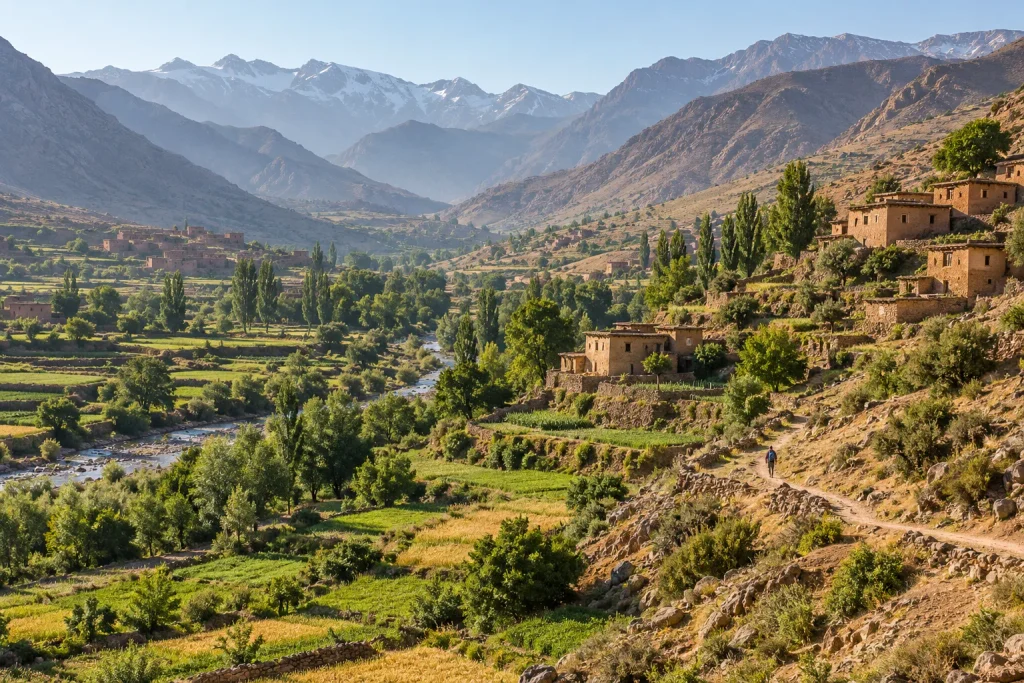
A valley walk can provide a substantial mountain experience without a summit objective. The important details are the surface, gradients, exposure and return arrangement.
Around Ouirgane or other High Atlas bases, investigate routes that match the season and your walking level. Ask whether the outing follows tracks, narrow footpaths or a combination.
Aït Bouguemez can appeal to travellers who want more time in a valley setting. An overnight stay may allow a walk to begin without a long transfer first, but check the route to the accommodation and the facilities available.
A walk described as cultural may include hosted stops or a meal. Ask who receives visitors, what has been agreed and how much time is devoted to walking.
Do not treat every valley route as easy. An apparently gentle landscape can still involve long distances, uneven steps or sections without shade.
For a one-way walk, establish how you return and what happens if the group turns back early. A clear plan gives you more freedom to enjoy the outing at a comfortable pace.
Treat Toubkal as a high-altitude objective
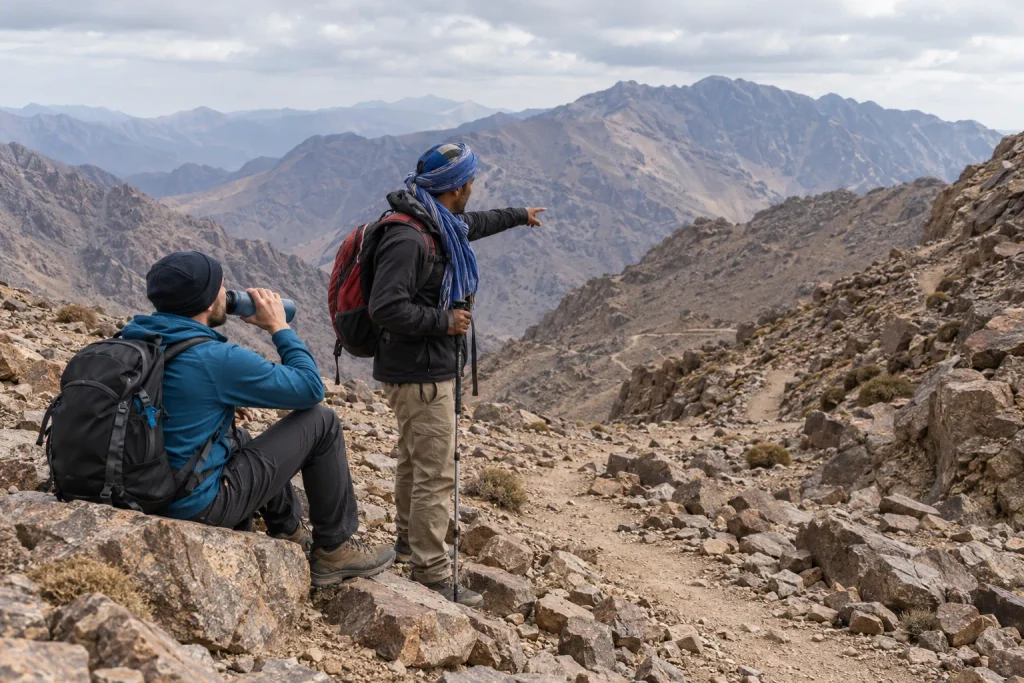
Toubkal rises to approximately 4,167 metres and is North Africa’s highest mountain. Reaching it involves more than being willing to walk uphill.
A two-day package describes a schedule, not a guarantee that the ascent suits you. Consider the rapid increase in sleeping altitude, long walking days, uneven terrain and how you have responded to altitude before.
The CDC’s guidance on high-altitude travel and altitude illness emphasises gradual acclimatisation. Fitness does not remove the risk of altitude illness, so discuss the itinerary and your circumstances before selecting a compressed ascent.
Ask the organiser how the plan allows for acclimatisation and what alternatives exist if the summit is inappropriate. Additional time should have a clear purpose rather than simply adding nights to an otherwise identical schedule.
Conditions also change the nature of the route. Snow and ice can turn an ascent into a winter mountaineering undertaking requiring suitable skills, equipment and guiding.
The summit should remain optional. Agree how the guide makes turnaround decisions and how the group is managed if one person needs to descend.
Plan a multi-day trek around daily effort and overnight stops
A longer trek gives you time to move between landscapes and settle into a walking rhythm. It also creates more logistical questions than a day outing.
Routes in areas such as the M’Goun region or Jebel Saghro should be assessed day by day. Ask for walking hours, ascent and descent, the highest and sleeping altitudes, and the nature of the terrain.
Check whether the itinerary is a circuit, a crossing or a series of walks from one base. A crossing may require transport at both ends and a plan for luggage that you do not carry.
Overnight arrangements affect the experience. Guesthouses, refuges and tents offer different privacy, bedding, washing and toilet facilities. Ask what applies at each stop rather than relying on a general accommodation category.
Find out how water and meals are provided, which dietary needs can be accommodated and how supplies are transported. If pack animals are involved, ask about loading and care.
Keep travel time after the trek realistic. A long final descent followed by a distant transfer can make the last day substantially harder than the walking description suggests.
Explore the Rif through a specific Akchour route
Akchour offers walking possibilities from a Chefchaouen stay, but the waterfalls and God’s Bridge should not be treated as one short, identical trail.
Ask which destination the outing reaches, what the route involves and whether current water levels affect access. Combining objectives can increase the day’s effort considerably.
Visit Morocco Together’s God’s Bridge outing from Chefchaouen focuses on the natural arch and surrounding Rif scenery. Confirm the walking route, any river-side or uneven sections, and the return timing before deciding whether it fits your group.
A waterfall photograph does not establish a safe swimming place. Walking to a viewpoint, entering a pool and negotiating a river section are separate activities.
Tell the guide if you prefer to avoid slippery ground or exposure. If the full route is unsuitable, ask whether there is a shorter alternative that still provides worthwhile time outdoors.
The surrounding northern Morocco travel area can support a mix of town and mountain days without adding a distant High Atlas transfer.
Walk among Anti-Atlas landscapes near Tafraoute
Tafraoute provides another approach to a mountain stay, with walking possibilities around rocky landscapes and nearby valleys. Choose it because it fits a southern route and the kind of terrain you want to explore.
Visit Morocco Together’s Tafraoute nature walk and landscape outing connects local scenery with short walking sections and viewpoints. Confirm which parts involve transport and which involve walking; several named places in a day programme do not mean a continuous trail between them.
For a dedicated hike, ask for a separate route description. Distance on a map can be misleading where paths cross rocky ground or involve repeated ascent.
Heat and shade matter here. A lower elevation does not automatically make a route comfortable in hot conditions.
Aït Mansour can add a different setting to a stay, but access, walking surfaces and private land still need consideration. Follow the guide’s agreed route.
This area can also fit a wider Deep South Morocco journey, with enough time to alternate walking and travel rather than treating each day as an endurance exercise.
Try rock climbing with instruction suited to the route
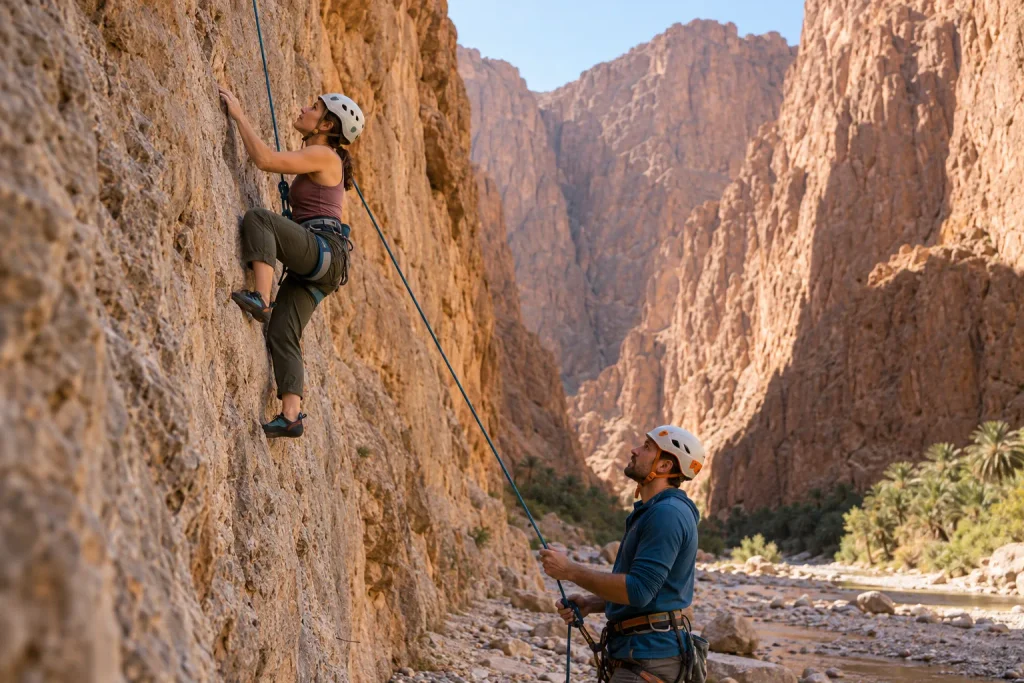
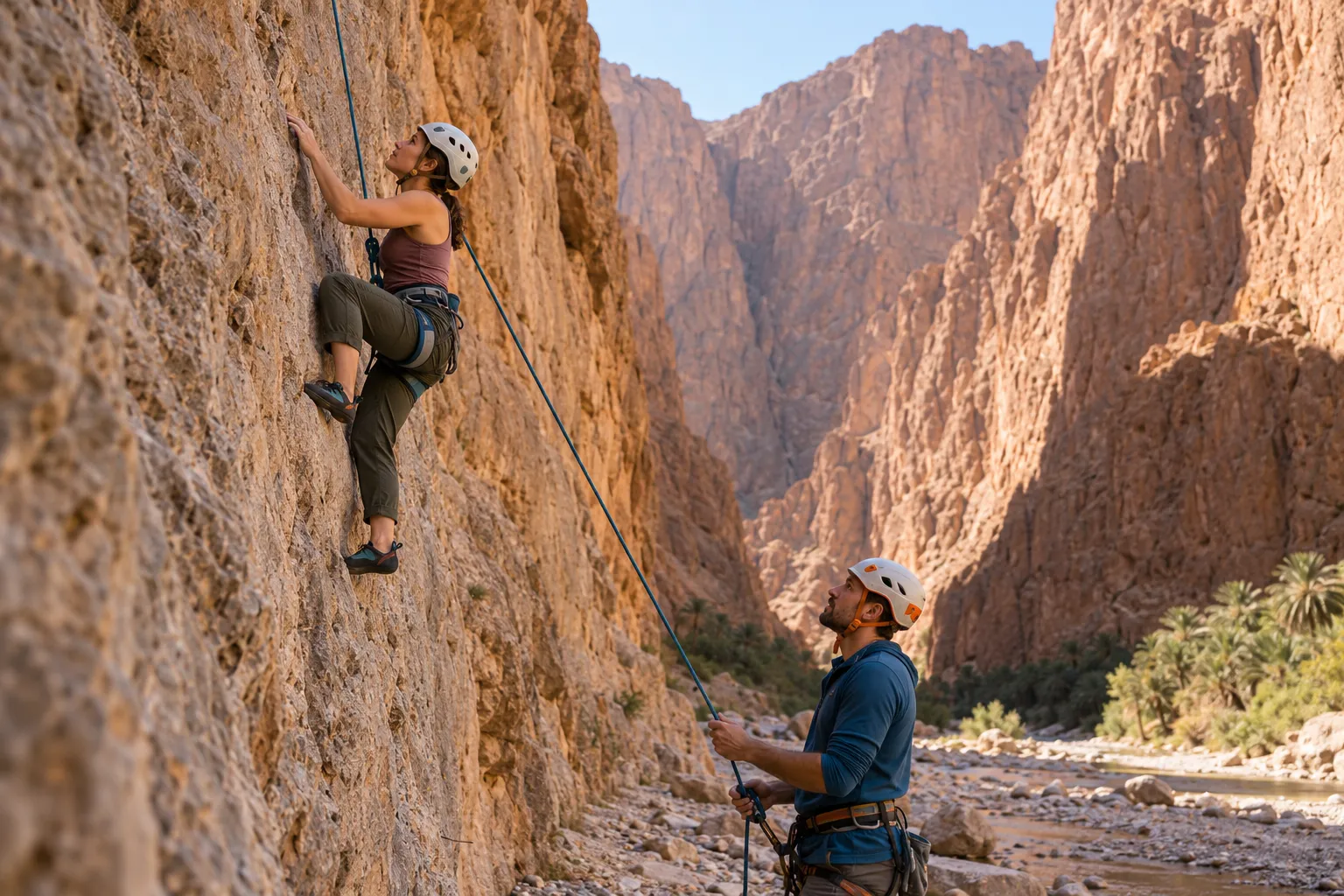
Rock climbing is distinct from a walk that includes a little scrambling. If you want to learn, choose a structured session with an appropriately qualified instructor and a clearly described teaching format.
Todra Gorge is a place to investigate introductory climbing as well as more advanced routes. Ask whether you will climb a single pitch with a rope managed from above, learn belaying skills or join another type of session.
Confirm the equipment supplied, its fit and how many participants share an instructor. A helmet, harness and suitable footwear are practical details that should be settled before arrival.
The Tafraoute area includes several climbing styles, including traditional climbing where protection and route-finding require specialist skills. Do not assume every visible rock face is a bolted beginner venue.
For experienced climbers, discuss grades, rock type, descent arrangements and the guide’s relevant qualifications. For beginners, describe comfort with heights honestly.
Avoid building a climbing session into a quick gorge photo stop. Instruction, equipment checks and taking turns need enough time for the activity to work.
Choose mountain biking by terrain as well as distance
A cycling route can be physically manageable yet technically demanding. Ask about the riding surface, steep descents, loose ground and any narrow or exposed sections.
Mountain biking in the Atlas requires a different assessment from hiring a bicycle for a level city ride. Tell the provider about your off-road experience, not just how often you cycle.
Check the bicycle size, brakes, helmet and equipment before departure. If an electric mountain bike is offered, ask about battery range for the proposed route and what support is available. Motor assistance does not replace handling skills.
Clarify whether the route uses public roads, tracks or technical trails and how traffic is managed. A vehicle-supported ride may still require participants to complete sections between access points.
Ask whether the distance includes transfers and whether there is a shorter option. A long advertised day may contain limited riding, while a short distance can involve substantial climbing.
Choose a guide who can match the route to the group and explain how mechanical problems or an early withdrawal are handled.
Take a guided trail run without chasing an event distance
Trail running can suit visitors who already run regularly and want an active mountain outing. It should be planned around terrain and elevation rather than a familiar road-running pace.
Ask for the expected ascent, surface and highest point, alongside distance. Loose descents, narrow paths and altitude can change how long a route takes.
Choose a local guide who understands both the area and the demands of running. A walking itinerary completed faster is not automatically an appropriate running plan.
Agree the pace and whether walking uphill is part of the outing. Carry the equipment specified for the route, including appropriate water and layers, rather than assuming a short run needs little preparation.
For an organised race, confirm the actual venue and course. Morocco hosts events in very different environments; a desert race should not be described as an Atlas mountain event simply because both involve outdoor endurance.
Leave recovery time afterwards, especially before a long transfer. A shorter run with room to enjoy the landscape may fit a holiday better than reproducing a training target.
Approach waterfalls and canyon activities as different outings
A walk to a waterfall, a river-side route and canyoning are different activities. The presence of water does not establish that swimming, jumping or scrambling through it is appropriate.
In the Ourika area, ask how the exact path changes after rain and whether there are steep or slippery sections. A restaurant visit beside a valley and a longer waterfall walk have different requirements.
For canyoning, select a specialist operator and ask about the route, water conditions, technical skills and equipment. Abseiling or moving through confined watercourses requires preparation beyond an ordinary walking day.
Do not copy jumps seen in a video or assume a pool has the same depth throughout the year. Water levels and access can change.
Consider whether your group actually wants a wet activity. A dry viewpoint walk may provide a more comfortable experience while still allowing time in the valley.
Discuss the alternative plan before booking, so unsuitable conditions lead to a clear decision rather than pressure to complete the original route.
Treat snow activities as condition-dependent
Snow can change mountain access and the skills needed on a route. It should influence the activity choice from the beginning, rather than becoming an equipment question after arrival.
If considering skiing around Oukaimeden, confirm current snow, road access, instruction, equipment availability and operating services. An image of a ski slope does not establish that the facilities are functioning for your visit.
For a winter trek, ask whether the route requires crampons, an ice axe or other technical equipment, and what training is needed to use it. Hiring equipment is not the same as knowing how to move safely with it.
Guide competence should match the conditions. A general sightseeing guide and someone qualified for a winter mountain route serve different roles.
Be prepared for the objective to change. Snow, ice, visibility and wind can make a lower route or another activity more appropriate.
A mountain stay can still include short walks, a village visit or time at the accommodation when higher terrain is unsuitable.
Enjoy mountain views with limited walking
Scenic outings can suit travellers who want a mountain landscape without a demanding hike. Choose a route with manageable stops and enough time to enjoy them.
Ask how close the vehicle can get to each viewpoint and whether access involves steps or uneven ground. A short walk is not necessarily a step-free one.
Also consider the drive. Winding roads, long periods sitting and limited stopping places may matter to someone who is comfortable walking but dislikes mountain travel.
Plan a meal or a hosted stop that is clearly arranged. Confirm seating, toilet access and any dietary requirements before relying on a remote lunch location.
Photography benefits from flexibility. Ask whether the driver can allow longer pauses within the agreed route rather than attempting a rapid sequence of viewpoints.
You do not need to add a token hike to make the outing count. A well-paced day with appropriate access can be a satisfying way to spend time in the mountains.
Ask better questions than whether a route is easy
Difficulty labels are useful only when the provider explains what they mean. Ask for facts you can compare with your own experience.
Before choosing a walk or trek, establish:
- Expected hours on foot, excluding the drive and meal stops.
- Total ascent and descent, plus the highest and sleeping altitudes.
- Trail surface, steep sections, exposure and possible water crossings.
- Opportunities to shorten the route or return early.
- Guide qualifications, group size and how different walking speeds are managed.
- Equipment, food, water and transport included in the price.
Describe previous outings you have completed comfortably. That gives the organiser more useful information than a broad claim of being fit.
For families, ask about the particular child’s needs, breaks and supervision. A route that suits an energetic teenager may be unsuitable for a younger child.
For mixed groups, discuss whether different routes can be provided with appropriate staffing. Do not assume one guide can accompany separate groups in different places.
Prepare for altitude and mountain weather
Conditions in Marrakech, Fes or Agadir do not describe the weather on a high trail. Ask the guide about the forecast for the route and check Morocco’s official weather service for relevant information and warnings.
Carry clothing and equipment for the confirmed activity. Sun protection and warm or waterproof layers may all be relevant, depending on the terrain and conditions.
For higher routes, take acclimatisation seriously. Symptoms such as headache, nausea or unusual fatigue after ascent need attention rather than being treated as proof that you should try harder. Tell the guide and do not continue higher while symptomatic. Worsening or severe symptoms require descent and urgent medical assessment.
Discuss health concerns with a clinician before a high-altitude plan, and explain the itinerary rather than just naming the destination.
Check that insurance covers the activity and altitude you intend to reach, including relevant rescue and medical arrangements. A general policy label does not establish the scope of cover.
Keep the plan flexible enough to change the objective. The return journey is part of the outing, not something to consider only after reaching the highest point.
Allow time for the journey and the following day
The usable mountain day begins after the transfer, briefing and any equipment preparation. Ask where the guided portion actually starts.
A local activity based in a mountain village may require you to arrange your own travel there. Conversely, a city pickup can add substantial vehicle time to a relatively short walk.
For a day trip, avoid placing a distant onward departure immediately after the expected return. Traffic, road conditions and a slower walking pace can all affect timing.
For a longer trek, arrive with enough time to check equipment and clarify the plan. After the final walking day, allow a sensible buffer before a flight or another fixed commitment.
An overnight stay can sometimes improve the rhythm by removing a same-day return drive. Check whether the accommodation and luggage arrangements suit the route.
When building a Morocco itinerary, alternate demanding activities with lighter days. A summit attempt, a long drive and another full walking day may fit on paper while leaving little room to recover.
Questions about mountain activities in Morocco
Can beginners enjoy the mountains in Morocco?
Yes. Choose a specific walk or scenic outing that matches your experience, with a clear description of ascent, surface and time on foot. A shorter village or valley route can provide a worthwhile mountain day without requiring a summit.
Is a two-day Toubkal trek suitable for everyone who is fit?
No. Fitness is only one consideration. The itinerary’s altitude gain, acclimatisation, long walking days and current mountain conditions all matter. Discuss the plan with an appropriate guide and seek medical advice when relevant before choosing a compressed ascent.
Can you combine Chefchaouen with mountain walking?
Yes. The Rif provides options near a northern stay, including routes around Akchour. Choose the exact objective and confirm its current demands; the waterfalls and God’s Bridge are different outings and should not be assumed to form one easy circuit.
Do you need specialist experience for rock climbing?
A structured introductory session can teach beginners on a suitable route. Independent climbing or more technical objectives require relevant skills and equipment. Confirm instructor qualifications, supervision and the activity format before booking.
Can you enjoy mountain activities without hiking?
Yes. Scenic drives, accessible viewpoints and clearly arranged village visits can provide time in mountain surroundings. Check the exact walking involved and the length and nature of the drive, especially if mobility or motion sickness affects your plans.
What should you book first?
Settle the route and activity level before choosing the accommodation and transport around it. For technical or multi-day activities, confirm suitable guiding, equipment and overnight arrangements early. Keep weather-dependent objectives flexible within the time available.
Ready to Experience Morocco?
Turn this inspiration into your next adventure. Our travel experts are ready to help.