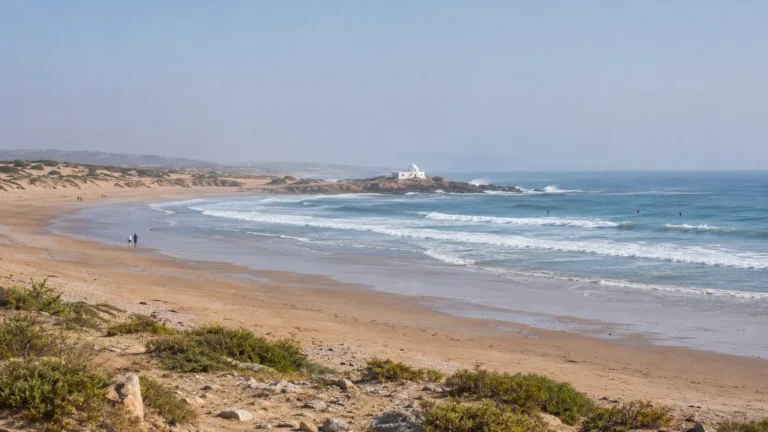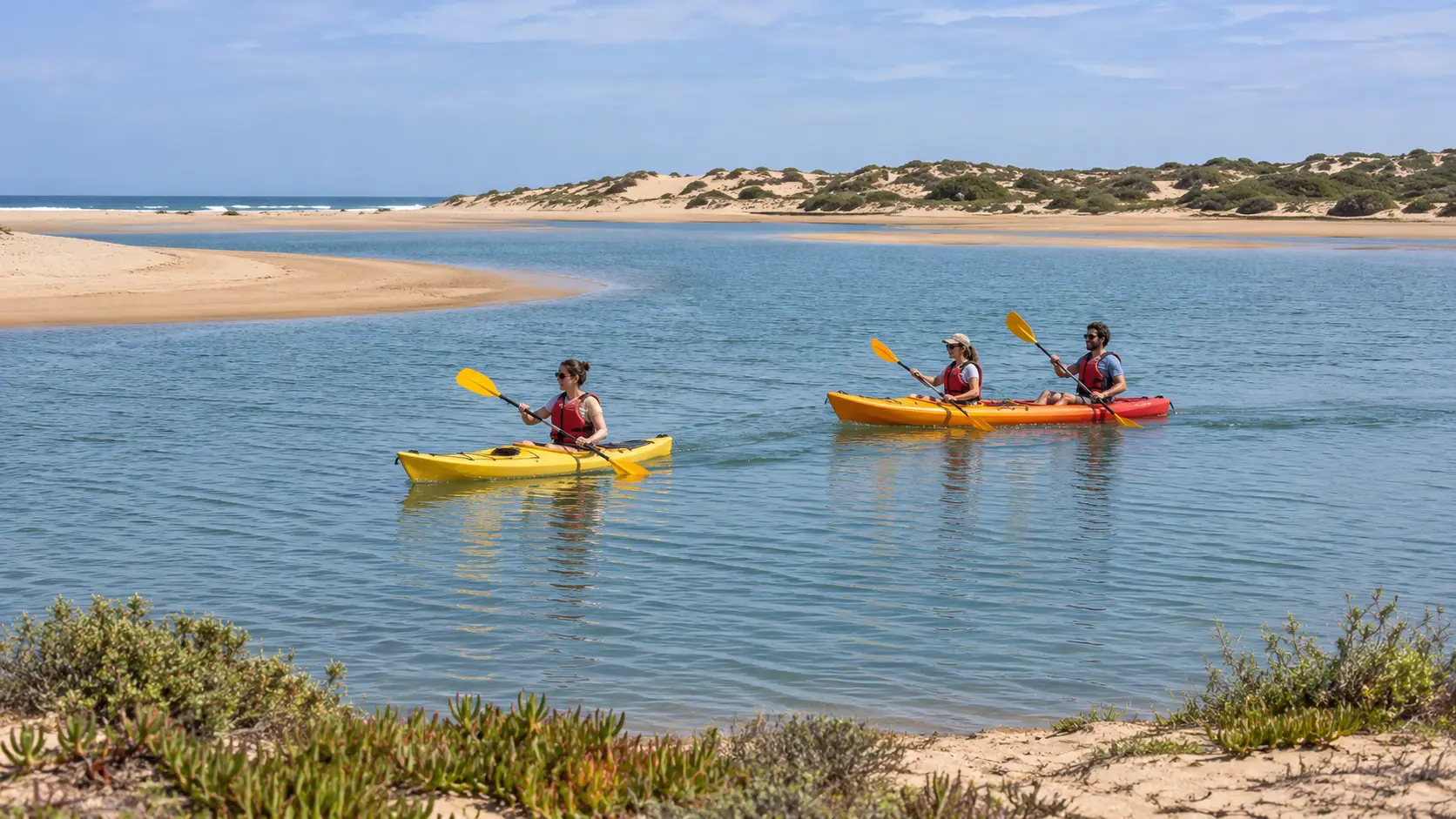
Oualidia lagoon kayaking is one of the most accessible ways to enjoy water sports on Morocco’s Atlantic coast. The lagoon’s sandy shores and protection from much of the open ocean’s swell create opportunities for relaxed paddling, beginner kayaking lessons and longer guided excursions.
Located between El Jadida and Safi, Oualidia offers a different kayaking experience from the exposed Atlantic beaches nearby. Instead of dealing directly with breaking ocean waves, paddlers can explore sections of the lagoon where conditions are often more manageable.
For first-time kayakers, a short guided session in a sheltered part of the lagoon is usually the best starting point. Travelers with previous paddling experience may prefer independent kayak rental or a longer excursion, provided the tides, wind and currents are suitable.
The most important thing to understand is that Oualidia is a tidal lagoon, not a still-water lake. Water levels change throughout the day, and some channels develop currents that can make kayaking more demanding than expected.
This guide focuses on the kayaking experience itself: where to paddle, which kayak to choose, how rentals work, when to go and what safety checks to make before entering the water.
Why Choose Oualidia Lagoon for Kayaking?
Oualidia’s main advantage is its sheltered coastal setting. Natural sand barriers separate much of the lagoon from the Atlantic’s larger breaking waves, creating areas that can be suitable for recreational kayaking.
Visitors can enjoy open water, sandy shorelines and views of the surrounding coastal landscape without needing advanced sea-kayaking skills for every route.
However, the lagoon’s conditions change with the tide and weather. Some sections remain relatively sheltered, while others experience stronger currents or become shallow as the water level falls.
Oualidia is particularly appealing to:
- Complete beginners: Travelers who want an introduction to kayaking with instruction and supervision.
- Couples: Visitors interested in sharing a tandem kayak and exploring at a relaxed pace.
- Families: Groups looking for a guided water activity, subject to the provider’s age, swimming and equipment requirements.
- Occasional paddlers: Travelers who have kayaked before but prefer a manageable coastal environment.
- Experienced kayakers: Visitors seeking a longer paddling route when local conditions permit.
Unlike open-ocean kayaking, a suitable lagoon session may involve relatively gentle paddling and frequent opportunities to adjust your pace. Still, the right route depends on your experience and the conditions on the day.
Oualidia Lagoon Kayaking Options: Which Experience Is Right for You?
There are several ways to enjoy kayaking in Oualidia. The main differences concern supervision, equipment and how much freedom you have to choose your route.
1. Guided Kayaking for Beginners
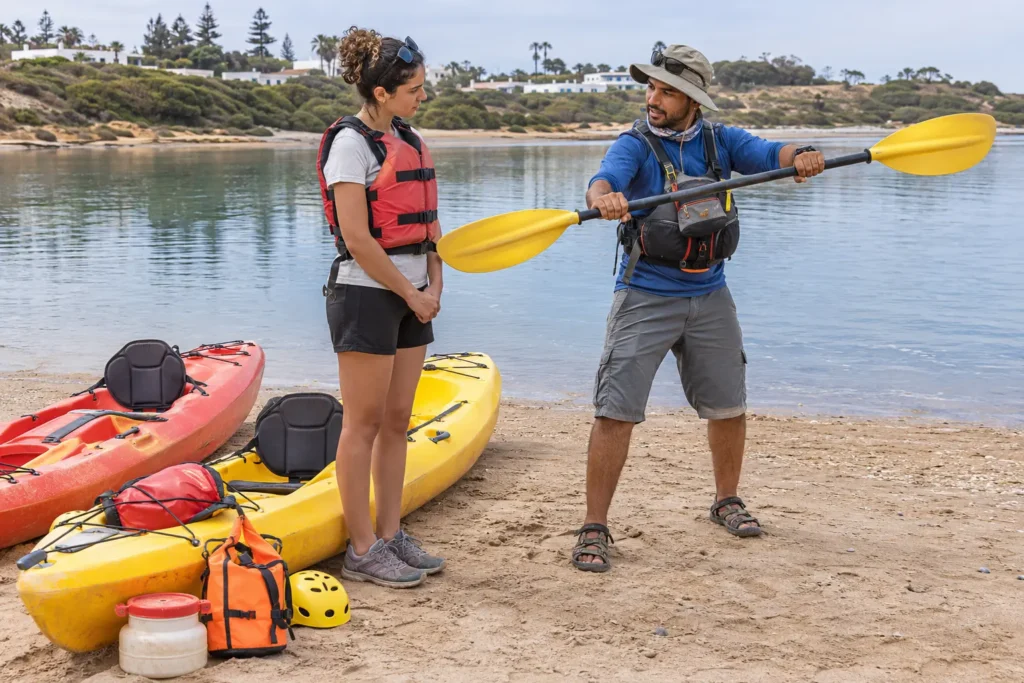
A guided kayaking experience is the most practical option for travelers who have never paddled before.
An instructor or guide can explain the equipment, demonstrate basic paddling techniques and select an appropriate part of the lagoon.
A beginner session may include:
- Introduction to the kayak and paddle.
- Fitting and checking flotation equipment.
- Instructions for entering and exiting the kayak.
- Practicing forward paddling, stopping and turning.
- A supervised route through suitable lagoon waters.
- Guidance on returning to the starting point.
Some sessions emphasize instruction, while others combine a short introduction with a recreational outing.
Best for: First-time kayakers, travelers who prefer additional supervision and visitors unfamiliar with tidal water.
Ask whether the guide remains on the water throughout the session. A brief equipment explanation followed by independent rental is not the same as a fully guided excursion.
2. Independent Kayak Rental
Independent rental gives experienced paddlers more flexibility to explore an agreed area at their own pace.
Kayak rentals are offered by some local water-sports businesses and accommodation providers in Oualidia. Availability, rental periods and operating arrangements differ.
Before taking a kayak onto the water, confirm where you are allowed to paddle and which areas should be avoided.
Independent rental is more appropriate if you can:
- Control the kayak without continuous instruction.
- Turn, stop and maintain direction.
- Understand how wind and currents affect your return journey.
- Respond appropriately if the kayak becomes unstable or capsizes.
- Follow an agreed route and return within the rental period.
Best for: Travelers with previous kayaking experience who want a flexible recreational session.
Do not rent independently simply because the water looks calm from the beach. Ask about the day’s actual conditions before launching.
3. Tandem Kayaking for Two People
A tandem kayak allows two participants to paddle together in one boat.
This can be an enjoyable option for couples, friends or an adult accompanying an eligible younger participant.
Tandem kayaking requires some coordination. Both paddlers need to work together to maintain direction, particularly when turning or paddling against the wind.
The person in the rear position often takes a greater role in steering, depending on the kayak design.
Best for: Two people who want to share the experience rather than manage separate kayaks.
Before booking, confirm the kayak’s maximum permitted load, seating arrangement and whether both participants meet the operator’s requirements.
4. Longer Guided Lagoon Excursions
Some activity providers offer extended kayaking experiences that explore more of the lagoon.
These outings can appeal to travelers who have already mastered basic paddling skills and want to spend more time on the water.
A longer excursion may include different sections of the shoreline and channels, depending on tides and wind.
The route should be selected by the guide rather than promised as an identical journey under all conditions.
Best for: Confident beginners progressing beyond an introduction and recreational paddlers comfortable with longer sessions.
Before booking, confirm how much time will actually be spent paddling and whether the route can be shortened if participants become tired.
Where Can You Kayak in Oualidia Lagoon?
The lagoon contains several paddling environments. Understanding the difference between sheltered water, shallow areas and stronger tidal channels helps you choose a more suitable experience.
The Main Lagoon Beach: A Convenient Starting Area
The beach bordering the central lagoon is one of the most practical areas for arranging a recreational kayaking session.
It provides access to the water near the town’s visitor facilities and is convenient for meeting local activity providers.
Depending on the tide and conditions, a beginner session may remain relatively close to the launching area.
This gives new paddlers an opportunity to practice turning, controlling speed and maintaining balance before attempting a longer route.
Recommended for: First lessons, short rentals and visitors who want a relaxed introduction.
The exact launching point should be confirmed with your provider. Sandbanks, beach activity and changing water levels can affect where it is practical to enter the water.
The Inner Lagoon: More Space for Longer Paddles
The inner sections of Oualidia Lagoon offer opportunities for longer kayaking excursions when water levels are suitable.
These areas can provide a quieter paddling environment away from the busiest parts of the main beach.
However, the water is not uniformly deep. Shallow sections and channels change throughout the tidal cycle.
A route that is accessible near higher water may become difficult during a falling tide.
Recommended for: Guided excursions and independent paddlers familiar with the permitted route.
Ask about the turning point and return conditions before setting off. Avoid making an unplanned long journey simply because a channel appears easy to follow.
The Atlantic Entrance: An Area to Avoid as a Beginner
Oualidia Lagoon connects with the Atlantic Ocean through tidal openings.
Near these openings, moving water can create stronger currents. Exposure to ocean swell and changing sandbanks can also make conditions more demanding.
These areas are not equivalent to the sheltered sections used for introductory kayaking.
Beginners should stay away from the Atlantic entrance and avoid attempting to paddle into the open ocean.
Experienced sea kayakers should also seek current local information before approaching these areas.
There is no need to reach the ocean entrance to enjoy kayaking in Oualidia. A well-chosen route within the lagoon can provide a satisfying experience without unnecessary exposure.
How Tides Affect Oualidia Lagoon Kayaking
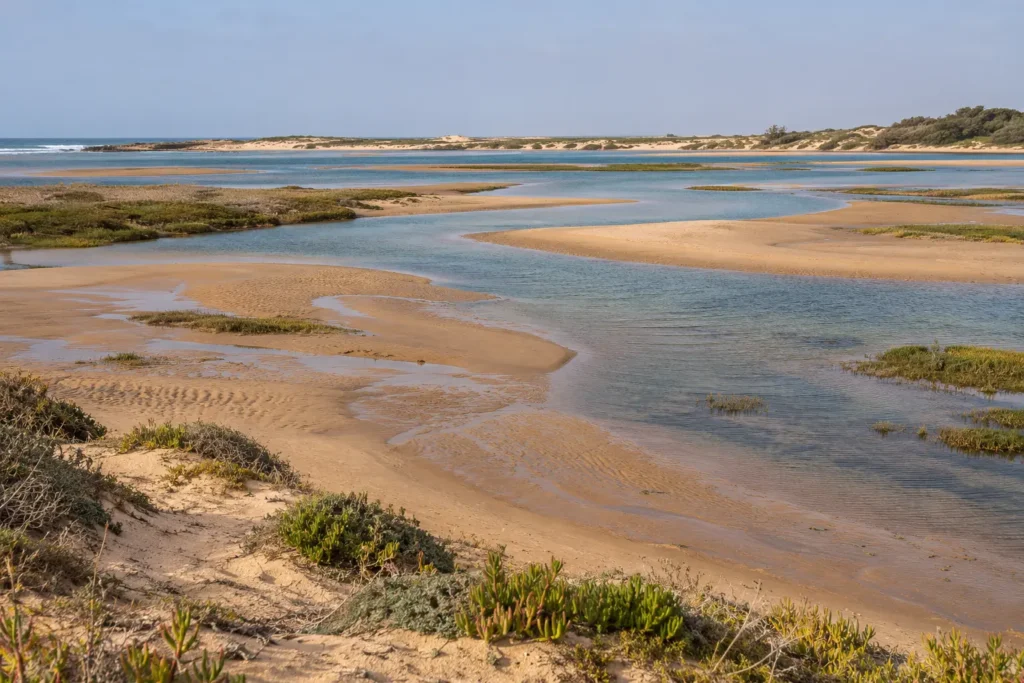
Tides are central to planning a kayaking session in Oualidia.
As Atlantic water enters and leaves the lagoon, its depth and currents change. These changes affect navigation, paddling effort and the suitability of different launching areas.
Low Tide: Less Water in Some Sections
At low tide, more of the lagoon’s sandy bottom may become exposed.
Some shallow areas can become difficult to navigate, and a kayak may need to remain within deeper channels.
This can limit the routes available for recreational paddling.
It is also possible to find yourself farther from a suitable landing point than expected if water levels continue to fall.
What to check: Ask whether the planned route will remain navigable throughout your session, not just at departure.
High Tide: Greater Depth Does Not Always Mean Weaker Currents
Higher water levels can make more areas accessible by kayak and simplify launching from certain beaches.
However, this does not mean high tide is automatically the safest time to paddle.
Currents can become particularly noticeable around narrower channels and ocean connections, including during periods close to high tide.
The relationship between tidal height and current strength varies across the lagoon.
What to check: Ask the provider about the expected current, not simply whether the water will be high enough.
Rising and Falling Tides: Plan the Return Journey
During an incoming tide, water moves into the lagoon. During an outgoing tide, it moves back toward the Atlantic.
Depending on your paddling direction, these currents may assist you or make progress more difficult.
A journey that feels easy in one direction can require more effort on the return.
This is especially relevant for longer independent rentals.
Before launching, identify the planned route, expected return time and whether the current will be changing during your session.
What Is the Best Tide for Kayaking in Oualidia?
There is no single tide level that is best for every kayaking route in Oualidia.
For beginners, the most suitable window is one that provides adequate water depth and manageable currents in a sheltered paddling area.
The local provider should consider both the tide forecast and the conditions observed on the day.
Before booking, ask three questions:
- Will the water be deep enough for the planned route?
- Are currents expected to be manageable for beginners?
- Will conditions still be suitable when we return?
A tide timetable is useful, but it does not by itself tell you the current strength at every point in the lagoon.
For a first experience, local guidance is more reliable than selecting a departure time based only on a high-tide prediction.
Kayak Rentals in Oualidia: What to Check Before Booking
Kayaking equipment can be arranged through certain local activity businesses and accommodation providers.
Some operators offer short rental periods, while others organize longer guided sessions. Single and tandem kayaks may be available, depending on the establishment.
Before booking, confirm the following details.
Equipment included
Ask whether the activity includes:
- A suitable single or tandem kayak.
- Paddles in good condition.
- A properly fitted buoyancy aid or life jacket for each participant.
- A basic safety briefing.
- Any waterproof storage or additional equipment advertised.
Equipment arrangements differ between providers. Do not assume that every rental includes the same accessories.
Rental duration and pricing
Confirm whether the price is charged per person, per kayak or for a particular rental period.
Also check whether the advertised duration refers entirely to time on the water or includes equipment preparation and instruction.
If booking a guided session, ask whether the guide and equipment are included in the same price.
Rates can change by provider, season and booking arrangement, so confirm current prices directly.
Meeting point and launching location
Not every kayaking activity starts from the same part of the lagoon.
Some providers may arrange collection or a meeting point in town, while others require participants to arrive at their equipment location.
Ask for the exact meeting point and confirm whether transport is included or must be arranged separately.
Cancellation and weather arrangements
Wind, unsuitable currents or other conditions may require the session to be delayed or cancelled.
Ask whether the operator offers rescheduling, a refund or another arrangement when kayaking cannot take place safely.
Check these terms before paying rather than assuming that every business follows the same policy.
What Happens During Your First Kayaking Session?
A first kayaking experience does not require advanced fitness or previous paddling skills when an appropriate beginner session is available.
However, participants should meet the provider’s safety and swimming requirements.
Getting comfortable in the kayak
Your introduction should begin with the correct seating position and basic equipment use.
The instructor may explain how to sit with a stable posture, position your feet and hold the paddle correctly.
You’ll also learn how to enter and exit the kayak without making it unnecessarily unstable.
Starting close to shore gives beginners an opportunity to become familiar with the boat before moving farther into the lagoon.
Learning the basic paddling techniques
Beginner instruction generally focuses on a few essential movements:
- Forward paddling: Using alternating strokes to move the kayak ahead.
- Turning: Adjusting the paddle strokes to change direction.
- Stopping: Using controlled reverse strokes to slow the kayak.
- Maintaining direction: Correcting the kayak’s course when wind or current pushes it sideways.
These skills make a significant difference to confidence on the water.
Rather than paddling quickly, focus on keeping your movements smooth and maintaining control.
Following a manageable route
Once the basic techniques are comfortable, the group may follow a short route selected for the conditions.
A beginner outing should leave room for pauses and adjustments rather than requiring constant paddling.
If you feel tired, uncertain or uncomfortable, tell the instructor early.
The purpose of an introductory session is to learn and enjoy the activity, not to cover the greatest possible distance.
Essential Kayaking Safety Tips for Oualidia Lagoon
The lagoon can offer sheltered paddling conditions, but it remains a tidal coastal environment.
These precautions are important for beginners and experienced paddlers alike.
Wear appropriate flotation equipment
Every paddler should wear a properly fitted personal flotation device throughout the session.
Check that it fits securely and does not interfere with paddling.
A flotation device helps keep a person afloat, but it does not replace swimming ability, supervision or suitable water conditions.
Check wind conditions before launching
Wind affects both kayak direction and the effort required to paddle.
A light breeze may be manageable, while stronger wind can create choppy water or push a kayak away from the intended route.
Do not assume the wind will remain constant throughout your activity.
If the conditions are too demanding for your experience, postpone the outing or select another activity.
Keep a safe distance from the ocean entrance
The channels connecting Oualidia Lagoon with the Atlantic can develop strong currents.
Beginners should remain within the sheltered area selected by the guide and avoid paddling toward the openings.
Even experienced paddlers should not enter unfamiliar tidal passages without understanding the hazards.
Understand what happens if the kayak capsizes
Capsizing is possible even in relatively calm water.
Before beginning, ask the instructor or rental provider what to do if the kayak overturns.
Understand how to exit the kayak, remain with suitable flotation equipment and obtain assistance.
Do not attempt an unfamiliar rescue technique without instruction.
Watch for other water users
The lagoon is shared by recreational paddlers, boats and other people using the water.
Keep sufficient distance from moving vessels and avoid crossing their path without adequate space.
A kayak sits low in the water and may not always be noticed immediately.
Follow any local navigation instructions provided before launching.
Know the return plan
For independent rental, agree on the paddling area and expected return time.
Ask how to contact the operator if you have difficulty returning and what assistance arrangements are available.
Do not rely solely on a mobile phone as your emergency plan.
If an operator cannot explain the safety arrangements clearly, choose another provider.
Best Time of Year for Kayaking in Oualidia Lagoon
Kayaking can be possible during different seasons, but individual conditions are more important than choosing a month alone.
Spring
Spring can provide comfortable weather for coastal activities, although windy or unsettled days still occur.
It is a useful season to consider for travelers who want kayaking to form part of a wider Atlantic-coast trip.
Summer
Summer is a popular period for visiting Oualidia, and suitable days can offer enjoyable kayaking conditions.
However, the main beach may become busier, and afternoon winds can affect paddling.
Reserve equipment in advance when possible, particularly if you are visiting during a busy holiday period.
Autumn
Autumn can offer pleasant opportunities for kayaking, depending on the wind and weather.
Travelers who prefer a quieter stay may find this period appealing, although actual visitor numbers vary.
Winter
Winter can bring cooler temperatures and more changeable Atlantic weather.
Kayaking may still be possible when conditions are suitable, but additional flexibility is useful.
If your trip is primarily focused on paddling, avoid relying on one fixed session during unsettled weather.
Morning or Afternoon: Which Is Better?
Morning can sometimes provide lighter winds and a more comfortable paddling environment, but this is not guaranteed.
Afternoon sessions may also be suitable when the tides and weather align.
The best departure time is the one that combines manageable wind, appropriate water depth and suitable currents.
Confirm the session timing with your provider rather than assuming the earliest departure is always the safest.
What to Wear and Bring for Kayaking in Oualidia
Kayaking is an active water sport, so choose comfortable clothing that allows movement and can tolerate splashes.
Useful items include:
- Quick-drying clothes: Lightweight clothing that remains comfortable when damp.
- Suitable footwear: Water shoes or secure footwear recommended by the provider.
- Sun protection: Sunscreen, sunglasses with a retaining strap and a secure hat where appropriate.
- Drinking water: Particularly important on warmer days or longer excursions.
- A dry bag: Useful for protecting small belongings if permitted by the operator.
- A towel and change of clothes: Helpful after returning to shore.
- A warm layer: Coastal wind can make the air feel cool after leaving the water.
Leave unnecessary valuables at your accommodation.
If you want to take photographs, use suitable waterproof protection and avoid handling your phone when you need both hands to control the kayak.
How Long Should You Spend Kayaking in Oualidia?
The right duration depends on your experience, fitness and how much of the lagoon you want to explore.
A short introductory session
A short guided activity is suitable for beginners who want to learn basic paddling and spend some time on the lagoon.
It is also a practical choice for travelers combining kayaking with a relaxed beach visit.
Allow time before and after the session for equipment fitting, changing and a short rest.
A longer recreational paddle
Visitors with some kayaking experience may prefer a longer session that allows more time on the water.
A guided route can be particularly useful when you want to explore beyond the immediate launching area.
However, longer excursions should not be treated as automatically better. Fatigue, wind and changing currents can make the return more difficult.
Should you stay overnight in Oualidia?
A day visit can work if you have suitable transport and a confirmed kayaking session.
However, staying overnight provides more flexibility to choose a suitable tidal window and adjust your plans if conditions change.
It also allows you to enjoy the lagoon without scheduling a long return journey immediately after paddling.
For a trip centered on water activities, an extra night can be more useful than trying to fit several excursions into one day.
How to Get to Oualidia for Kayaking
Oualidia lies on Morocco’s Atlantic coast between El Jadida and Safi.
The town is accessible by road and can be included in a coastal itinerary through this part of Morocco.
Depending on your starting point, transport choices may include:
- Rental car: Useful if you want flexible travel times or plan to explore several coastal destinations.
- Taxi: A practical option for some regional connections, with the fare and return journey agreed in advance.
- Bus and local transport: Potentially economical, although connections and onward arrangements should be checked before departure.
- Pre-arranged transfer: Convenient for travelers who prefer direct transport to their accommodation or activity meeting point.
Oualidia does not have a passenger railway station. Travelers arriving by train elsewhere will need to arrange onward road transport.
If you are visiting specifically for kayaking, confirm the session time before finalizing your arrival and departure plans.
For more destination information, explore the Oualidia travel guide.
Common Mistakes to Avoid When Kayaking in Oualidia
A few simple decisions can make your kayaking experience more comfortable.
- Choosing a rental without checking the tide: The water may be too shallow in some sections or currents may be stronger than expected.
- Assuming every part of the lagoon is beginner-friendly: Sheltered areas and tidal channels can have very different conditions.
- Renting independently without experience: Beginners are generally better served by supervised instruction.
- Ignoring the wind forecast: A return journey can become tiring when paddling against stronger wind.
- Booking without confirming equipment: Ask about flotation devices, paddle condition and the availability of appropriate kayak sizes.
- Paddling too far from the starting point: Leave sufficient time and energy for the return.
- Expecting a fixed route: Guides may need to adjust the outing because of tides or weather.
FAQs
Is Oualidia Lagoon kayaking suitable for beginners?
Yes. Sheltered sections can provide suitable conditions for beginner kayaking when tides, currents and wind are manageable. A guided introductory session is the most practical option for visitors without previous experience.
Can you rent a kayak in Oualidia without a guide?
Independent rentals may be available through local water-sports providers and accommodation businesses. Confirm the permitted route, equipment and safety arrangements. Independent kayaking is more appropriate for paddlers with basic skills and experience.
What is the best tide for kayaking in Oualidia?
The best tide depends on the route and current conditions. Higher water can make shallow sections easier to navigate, but strong currents may still occur near channels and ocean connections. Ask a local provider to recommend a suitable departure time.
Are single and tandem kayaks available?
Some Oualidia operators offer both single and tandem kayaks. Availability depends on the provider and booking date. Confirm the kayak type, seating arrangement and participant requirements before reserving.
Do you need to know how to swim?
Swimming ability is an important safety consideration for kayaking. Providers may have specific participation requirements. Confirm these in advance, and always wear appropriate flotation equipment.
Can children go kayaking in Oualidia?
Some supervised sessions may accommodate children, depending on their age, swimming ability and the equipment available. Ask about minimum ages, correctly sized flotation devices, adult supervision and whether tandem kayaking is permitted.
Plan a Comfortable Kayaking Experience in Oualidia
Oualidia lagoon kayaking offers an enjoyable introduction to paddling in a sheltered Atlantic coastal setting. Its appeal lies in the opportunity to spend time on the water at a pace that matches your experience.
For first-time kayakers, begin with a guided session in a suitable part of the lagoon. If you already have paddling experience, independent rental or a longer guided excursion may provide more flexibility.
Before booking, confirm the tides, wind, equipment, meeting point and return arrangements. These details matter more than choosing the longest route or the earliest available departure.
Travelers looking for an organized experience can explore Oualidia Lagoon kayaking with Visit Morocco Together. Review the current availability, activity details, participation requirements and inclusions before reserving.
The practical takeaway: choose a kayak and route suited to your ability, plan around both tides and currents, and keep the experience flexible. A shorter paddle in suitable conditions is more enjoyable than a longer outing that becomes difficult on the return.
Ready to Experience Morocco?
Turn this inspiration into your next adventure. Our travel experts are ready to help.