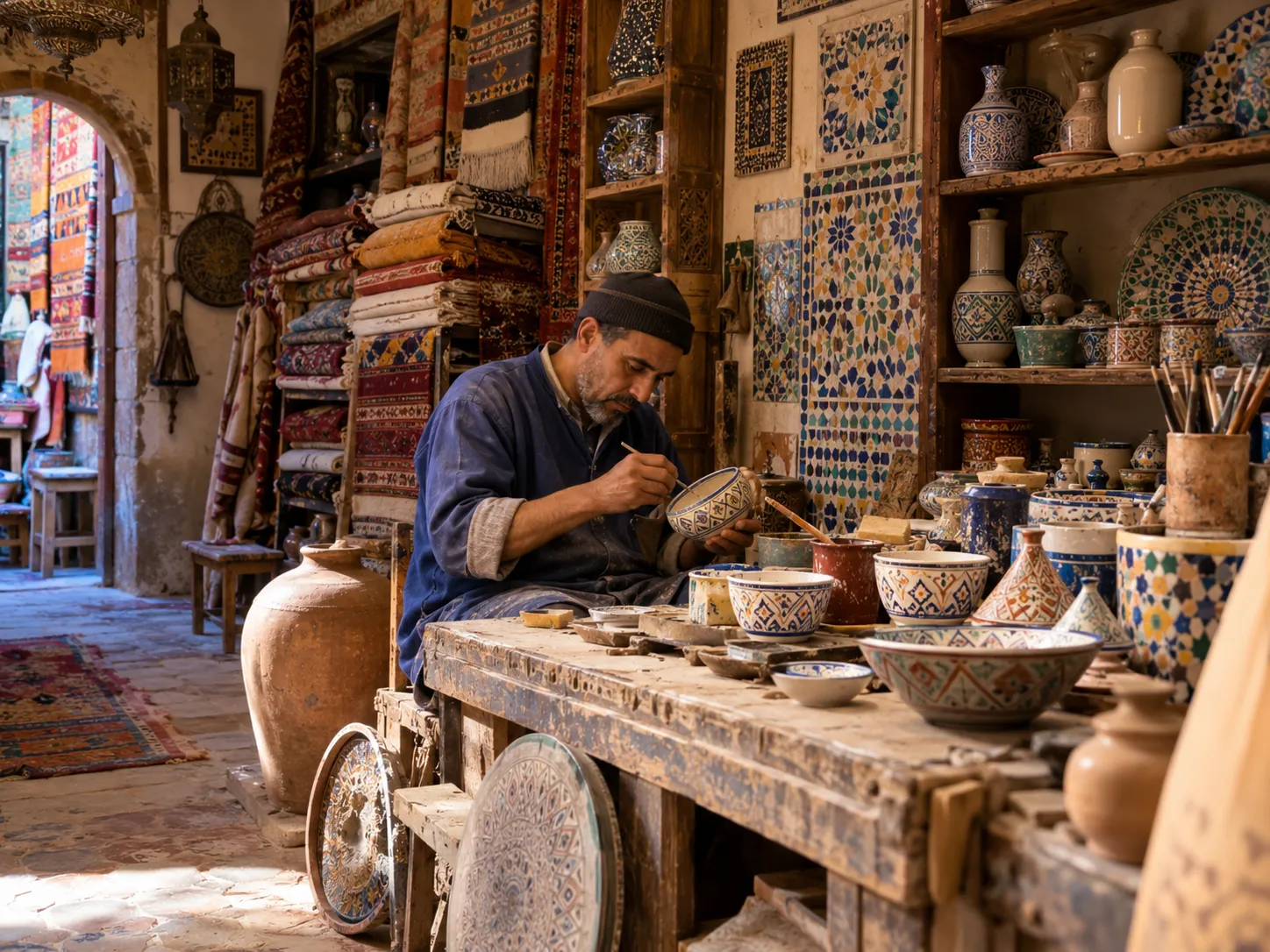
Moroccan handicrafts are easiest to appreciate when you see how they are made. A finished ceramic bowl, leather bag, woven carpet or brass lantern may look effortless in a souk, but each object represents materials, tools and techniques that can take years to master.
Across Morocco, artisans continue to work with clay, tile, leather, wool, metal and wood. Fes is particularly associated with zellige, pottery, leather and medina workshops. Safi is one of the country’s major pottery centers. Marrakech brings many different crafts together inside its souks, while the Atlas Mountains remain closely connected with weaving traditions and Essaouira is known for thuya woodwork and marquetry.
An artisan-focused trip should therefore go beyond shopping. Visit workshops where guests are genuinely welcome, learn how the process works, try a hands-on activity when one is properly organized and treat purchasing as an optional part of the experience rather than an obligation.
Moroccan Handicrafts at a Glance
| Craft | Places to consider | What you may see |
|---|---|---|
| Pottery and ceramics | Fes, Safi and other regional centers | Clay shaping, painting, glazing and firing stages |
| Zellige | Especially Fes | Tile cutting and geometric mosaic assembly |
| Leather | Fes and Marrakech | Tanning, cutting, stitching and finished leather goods |
| Carpets and weaving | Atlas regions, villages and urban workshops | Loom work, wool preparation and textile patterns |
| Metalwork | Marrakech, Fes and other medinas | Hammering, engraving and shaping brass or copper |
| Woodwork | Fes and Essaouira | Carving, cabinetry and marquetry |
What Is a Moroccan Artisan Workshop?
An artisan workshop is a place where objects are actually made rather than only displayed for sale.
The experience can take several forms.
You may simply observe an artisan working, join a guided visit that explains the process or book a hands-on workshop where participants try part of the craft themselves.
These are not the same experience.
Workshop Demonstration
An artisan shows how a particular process works while continuing normal production.
Hands-On Workshop
The activity is designed for visitors to participate under instruction. This can be appropriate for pottery, tile decoration or selected textile activities.
Shop Visit
A shop may explain how products are made even when manufacturing happens elsewhere.
Ask where the objects were produced rather than assuming every piece displayed in a medina shop was made behind the counter.
Pottery and Ceramics
Pottery is one of the major crafts preserved across all three source articles.
Moroccan ceramics vary by region in form, decoration and color. Fes and Safi are especially useful places for travelers who want to understand the craft rather than simply buy a bowl from a souk.
What Happens in a Pottery Workshop?
Depending on the workshop and stage of production, you may see:
- Clay preparation
- Hand shaping or wheel throwing
- Drying
- Decorative painting
- Glazing
- Firing
- Finishing and quality checks
A short visitor workshop usually focuses on only part of this process because drying and firing take far longer than an ordinary activity session.
Fes Pottery
Fes is one of Morocco’s most important craft cities.
Ceramics associated with the city commonly use detailed painted decoration, and pottery workshops around Fes can show both functional ceramics and architectural tile production.
A craft-focused day in Fes can combine pottery with zellige, leather, woodwork and metalwork rather than treating each medium as an isolated attraction.
The Fes Medina Guide provides the wider historical and cultural context for these crafts.
Safi: One of Morocco’s Pottery Centers
Safi deserves separate attention rather than being described only as another place selling Moroccan ceramics.
The city has a long pottery tradition and remains one of Morocco’s major ceramic centers.
A visit can include the pottery district, workshops and the wider medina.
This makes Safi particularly useful for travelers whose interest is the craft itself rather than general souvenir shopping.
Zellige: Moroccan Geometric Tilework
Zellige is one of Morocco’s most recognizable decorative arts.
You see it in riads, madrasas, fountains, palaces and other traditional buildings, where small glazed pieces form geometric compositions.
The process begins long before the final pattern appears on a wall.
Clay tiles are produced and glazed before skilled craftspeople cut them into precise shapes. The pieces are then assembled into geometric designs.
Because the final pattern depends on many individually prepared pieces, zellige demonstrates why handmade architectural decoration requires both patience and precision.
Where to See Zellige Work
Fes is particularly strongly associated with zellige craftsmanship.
Rather than seeing finished tiles only in monuments, visiting a workshop helps connect the architectural decoration to the people who cut and assemble it.
Leatherwork and Tanneries
Leather appears in every source article in this cluster.
Moroccan leather goods can include:
- Bags
- Belts
- Wallets
- Traditional slippers or babouches
- Jackets
- Decorative items
The complete process is more complicated than seeing a finished bag in a shop.
Leather production can involve tanning and preparing hides before other artisans cut, stitch and finish individual products.
Fes Tanneries
Fes provides the best-known tannery experience, particularly around the Chouara area.
Most visitors view the working tannery from terraces in surrounding buildings rather than entering the work floor itself.
Remember that a tannery is a workplace, not a performance arranged for photographs.
Give workers space, follow access instructions and ask before photographing an identifiable person closely.
Do You Have to Buy Leather After Visiting?
No.
Some tannery viewpoints are accessed through leather businesses, but seeing the tannery does not automatically create an obligation to purchase something.
Clarify the arrangement before going to the terrace.
Leather in Marrakech
Marrakech also has leather workers, tanners, dyers and many shops selling babouches, bags and other goods.
The city’s strength is the variety of crafts concentrated inside the wider souk system.
If leather production itself is your main interest, Fes generally offers the stronger specialist context. If you want to compare leather with metalwork, textiles, lamps and other souk crafts in one day, Marrakech works particularly well.
Carpets and Moroccan Weaving
Carpets and woven textiles are another major theme shared by the original pages.
Older travel writing often labels all rural Moroccan rugs as “Berber carpets.” Amazigh is also widely used today for the Indigenous communities and cultural traditions associated with many of these weaving practices.
There is no single Moroccan carpet style.
Materials, techniques, colors and motifs vary by region, community and individual weaver.
What Happens at a Weaving Workshop?
Depending on the activity, visitors may learn about:
- Wool or fiber preparation
- Loom setup
- Warp and weft
- Knotting or flat-weaving techniques
- Pattern construction
- Color choices
- Finishing
A short demonstration cannot reproduce the many hours or days required to make a complete carpet.
Do Moroccan Carpet Patterns Have Meanings?
Some designs reflect regional, community or family traditions, while individual weavers can also make their own aesthetic decisions.
Avoid assuming that every diamond, line or color has one universal symbolic definition across Morocco.
If someone explains a pattern’s meaning, ask whether they are discussing that specific rug, a local weaving tradition or a broader interpretation.
Atlas Mountain Weaving
The Atlas Mountains are particularly useful for understanding the relationship between weaving, wool, rural communities and household production.
If you visit a village or cooperative, arrange the experience with willing hosts rather than walking into a residential workspace because it appears “traditional.”
Buying directly from a producer can create a more meaningful connection with the craft, but only when the seller genuinely represents the people making the work.
Metalwork: Brass, Copper and Decorative Craft
The main artisan article adds metalwork to the cluster, and it deserves to remain in the final guide.
Moroccan metal artisans make objects such as:
- Lanterns
- Trays
- Mirrors
- Jewelry
- Decorative panels
- Household objects
Techniques can include shaping, hammering, engraving, piercing and polishing.
Metalwork in Marrakech
Marrakech is particularly useful for seeing multiple types of metalwork while exploring the souks.
Copper, brass and other metals appear in trays, lamps, lanterns, mirrors and decorative objects.
A workshop visit gives more context than looking at dozens of nearly finished objects hanging in a shop because you can see how much handwork goes into each piece.
Woodwork and Carving
Wood is another important part of Moroccan architecture and decorative arts.
In Fes, traditional woodwork can be seen both in workshops and in the carved doors, ceilings and details of historic buildings.
Artisans may produce:
- Doors
- Furniture
- Boxes
- Decorative panels
- Architectural elements
Essaouira and Thuya Wood
Essaouira has a particularly strong tradition of cabinetmaking and marquetry associated with thuya wood.
Workshops produce objects such as boxes, trays, small furniture and decorative pieces, sometimes combining wood with other materials.
This makes Essaouira useful on a craft itinerary because it contributes a specialization that is different from Fes pottery or Marrakech metalwork.
Souks as Working Craft Areas
A souk is not simply a souvenir market.
Historic commercial districts often contain retailers, workshops, food sellers, wholesalers and services used by residents as well as visitors.
In Marrakech and Fes, different streets or areas can become associated with particular trades.
Listen as well as look: hammering, cutting, woodworking and other production sounds can reveal active workshops before you see them.
Workshop or Souk: Which Is Better?
| Choose a workshop if… | Choose a souk if… |
|---|---|
| You want to understand production | You want to compare many finished objects |
| You want to meet an artisan | You enjoy browsing and shopping |
| You want a hands-on activity | You want several craft types in one place |
| Technique is your main interest | Purchasing is your main interest |
The strongest craft-focused trip usually combines both.
Hands-On Moroccan Craft Workshops
Hands-on workshops can be particularly valuable because making even a simple object demonstrates how difficult the artisan’s work actually is.
Activities may include:
- Shaping clay
- Painting pottery
- Learning basic zellige assembly
- Trying simple weaving
- Learning selected decorative techniques
Not every craft is suitable for casual visitor participation.
Tanning, specialist metalwork and advanced tile cutting involve working environments, tools or processes that may be better observed than attempted.
How to Choose a Good Artisan Workshop
Before booking, ask what the experience actually includes.
Is It a Real Workshop?
Find out whether production genuinely happens there or whether you are visiting a showroom.
Will an Artisan Teach the Activity?
A craft specialist can provide better technical context than a salesperson repeating a memorized demonstration.
Is It Hands-On?
Do not assume “workshop” means you will make something yourself.
How Long Does It Last?
A short demonstration and a half-day hands-on session provide very different experiences.
Are Materials Included?
Confirm whether clay, paint, tile pieces or other materials are included in the booking price.
Can You Take the Finished Piece Home?
Pottery may require drying or firing after the workshop, meaning a finished piece cannot always leave with you immediately.
Do Workshops Expect You to Shop?
A properly arranged cultural workshop should clearly distinguish the paid experience from optional shopping.
Buying directly from an artisan can be a useful way to support craft production, but a demonstration does not create an obligation to purchase.
If the visit is free because it is organized by a retail business, understand that there may be a stronger sales component.
Clarify expectations at the beginning rather than feeling pressured later.
How to Tell Whether a Craft Is Handmade
“Handmade” can describe very different levels of manual work.
Ask useful questions such as:
- Where was this made?
- Who made it?
- Which stages are done by hand?
- Which material is used?
- Is the item made locally or sourced elsewhere?
- Can I see similar pieces being produced?
Small differences between objects can be normal in handmade production.
However, irregularity alone does not prove authenticity.
Natural Dyes and Materials
The older source articles repeatedly describe natural dyes and fibers.
Some traditional workshops do use natural materials, while modern craft production can also use manufactured dyes and other contemporary materials.
Do not assume that every brightly colored rug, leather bag or ceramic object is colored entirely with natural pigments.
If the material matters to your purchase, ask the artisan or seller specifically.
Shopping for Moroccan Handicrafts
This guide focuses on making and workshops, but workshop visits naturally overlap with shopping.
If you decide to buy something, consider:
- Craftsmanship
- Material
- Origin
- Size and weight
- How you will transport it
- Whether shipping is offered
- Whether you genuinely like the item
For a broader guide to souks, spices, shopping and bargaining, use the Morocco Shopping Guide.
Bargaining for Artisan Goods
Prices can sometimes be negotiable in souks and independent shops, but there is no universal rule saying the first price must be reduced by a particular percentage.
Highly skilled work can take considerable time, so evaluate the object as a piece of labor and material rather than treating negotiation as a competition.
If the price is outside your budget, it is acceptable to decline politely.
Fes for Moroccan Handicrafts
Fes is probably the strongest single destination for travelers who want multiple traditional crafts concentrated within one historic city.
You can encounter:
- Leather tanning
- Leather goods
- Pottery
- Zellige
- Woodworking
- Metalwork
- Textiles
A local guide can be helpful because workshops are distributed throughout the dense street network of Fes el-Bali.
VMT’s Fes Medina Walking Tour currently includes artisan workshops and the Chouara tannery area.
Marrakech for Souk Crafts
Marrakech is a better fit when you want craft exploration mixed with general sightseeing, food and shopping.
The souks bring together leather, lamps, metal objects, textiles, ceramics and decorative products in a relatively concentrated visitor route.
Rather than trying to buy something from every craft category, choose one or two trades that interest you and spend time learning how the work differs.
Safi for Pottery
Safi is the most specialized stop in this guide.
Choose it when pottery and ceramics are a major interest rather than one activity within a broader medina visit.
Its pottery district and ceramic tradition make it particularly relevant on a longer Atlantic Coast route.
Essaouira for Woodwork
Essaouira adds thuya wood, marquetry and cabinetmaking to a craft-focused itinerary.
This can be combined with the city’s medina, galleries, port and Atlantic coast, making it a useful contrast with inland craft centers.
Atlas Mountains for Weaving
The Atlas Mountains provide a stronger context for wool, carpets and rural textile production.
Arrange workshop or cooperative visits through willing local hosts and avoid treating someone’s private home as a visitor attraction unless the experience has genuinely been organized for guests.
A 5–7 Day Moroccan Craft Route
You do not need to cross the whole country to experience several craft traditions.
A focused route might be:
Marrakech → Fes, with additional workshop activities in each city.
With more time, add a specialized destination depending on your interests:
- Safi for pottery
- Essaouira for woodwork
- Atlas Mountains for weaving
A craft trip works better when you spend real time in fewer workshops than when you travel long distances only to collect a checklist of products.
Photography Inside Workshops
An attractive workshop is still somebody’s workplace.
Ask before photographing:
- An artisan’s face
- Close-up work
- Private areas
- Children or family members
- Specialist techniques the maker may not want recorded
Permission to enter a workshop does not automatically mean permission to photograph everyone inside it.
Supporting Artisans Responsibly
All three source articles emphasize supporting local craftspeople, but this idea needs practical framing.
Useful ways to contribute include:
- Paying fairly for an organized workshop
- Buying directly from makers where practical
- Choosing workshops that identify their artisans
- Asking where products are made
- Respecting the time required for demonstrations
- Avoiding pressure for unpaid performances or photographs
Do not assume every cooperative, shop or tour stop distributes revenue in the same way. Ask how the experience is organized if direct artisan support is important to you.
Common Moroccan Craft-Tour Mistakes
Treating a Shop as a Workshop
A retailer may sell handmade goods without making them on site. Ask where production happens.
Assuming Every Carpet Pattern Has One Fixed Meaning
Textile traditions vary widely between regions and individual weavers.
Calling Every Ceramic Style “Fes Pottery”
Morocco has regional ceramic traditions, including major production in Safi.
Visiting the Tanneries Only for a Photograph
Take time to understand leather production and remember that the site remains a workplace.
Feeling Obliged to Buy
A workshop visit and a purchase are separate decisions unless the booking clearly states otherwise.
Assuming “Handmade” Means Entirely Traditional Materials
Contemporary craftspeople may combine inherited techniques with modern dyes, tools or design choices.
FAQ
What handicrafts is Morocco known for?
Moroccan handicrafts include pottery, zellige tilework, leather goods, carpets, woven textiles, metalwork, wood carving, marquetry, jewelry and other regional crafts. Techniques and styles vary significantly across the country.
Where is the best place to see Moroccan artisans?
Fes is one of the strongest all-round choices because its medina contains leather, pottery, zellige, woodwork, metalwork and textiles. Marrakech is particularly useful for browsing many souk crafts, while Safi is a stronger specialist destination for pottery.
Can tourists join Moroccan craft workshops?
Yes, some workshops are designed for visitor participation and may include pottery, painting, basic tilework or weaving. Other crafts are better observed because they require specialized tools, training or working conditions.
Is Moroccan zellige made by hand?
Traditional zellige involves producing glazed tiles, cutting them into precise geometric pieces and assembling those pieces into patterns. Fes is particularly strongly associated with this craft.
Do you have to buy something after visiting an artisan workshop?
No, unless a specific activity clearly includes a product as part of the booking. A demonstration or workshop visit should not automatically create an obligation to shop. Clarify the arrangement before entering when a free visit is connected to a retail business.
Which Moroccan city is best for pottery?
Fes is important for pottery and zellige, while Safi is one of Morocco’s major ceramic centers and is especially worthwhile for travelers whose main interest is pottery production.
Look Beyond the Finished Souvenir
The most interesting part of Moroccan handicrafts is often what happens before an object reaches the souk.
Clay must be shaped and fired. Zellige pieces have to be cut and assembled. Leather passes through multiple stages before becoming a bag or slipper. Rugs require long periods at a loom, while metal and wood objects depend on tools, repetition and skilled hands.
Fes provides the strongest all-round introduction to traditional urban crafts. Marrakech combines a wide variety of workshops and souks. Safi gives pottery more depth, the Atlas provides context for weaving, and Essaouira contributes a distinctive woodcraft tradition.
Choose workshops where visitors are genuinely welcome, ask questions about the materials and process, request permission before photographing artisans and treat shopping as an optional extension of learning about the craft.
For shopping-specific advice, continue with the Morocco Shopping Guide. For a deeper Fes experience, use the Fes Medina Guide. For a broader culture-focused route, read the Morocco Cultural Holiday guide.
If you want a Morocco itinerary built around pottery, weaving, food, medinas and artisan workshops, use the custom Morocco trip planner.
Explore destinations, tours and locally organized Morocco experiences with Visit Morocco Together.
Ready to Experience Morocco?
Turn this inspiration into your next adventure. Our travel experts are ready to help.