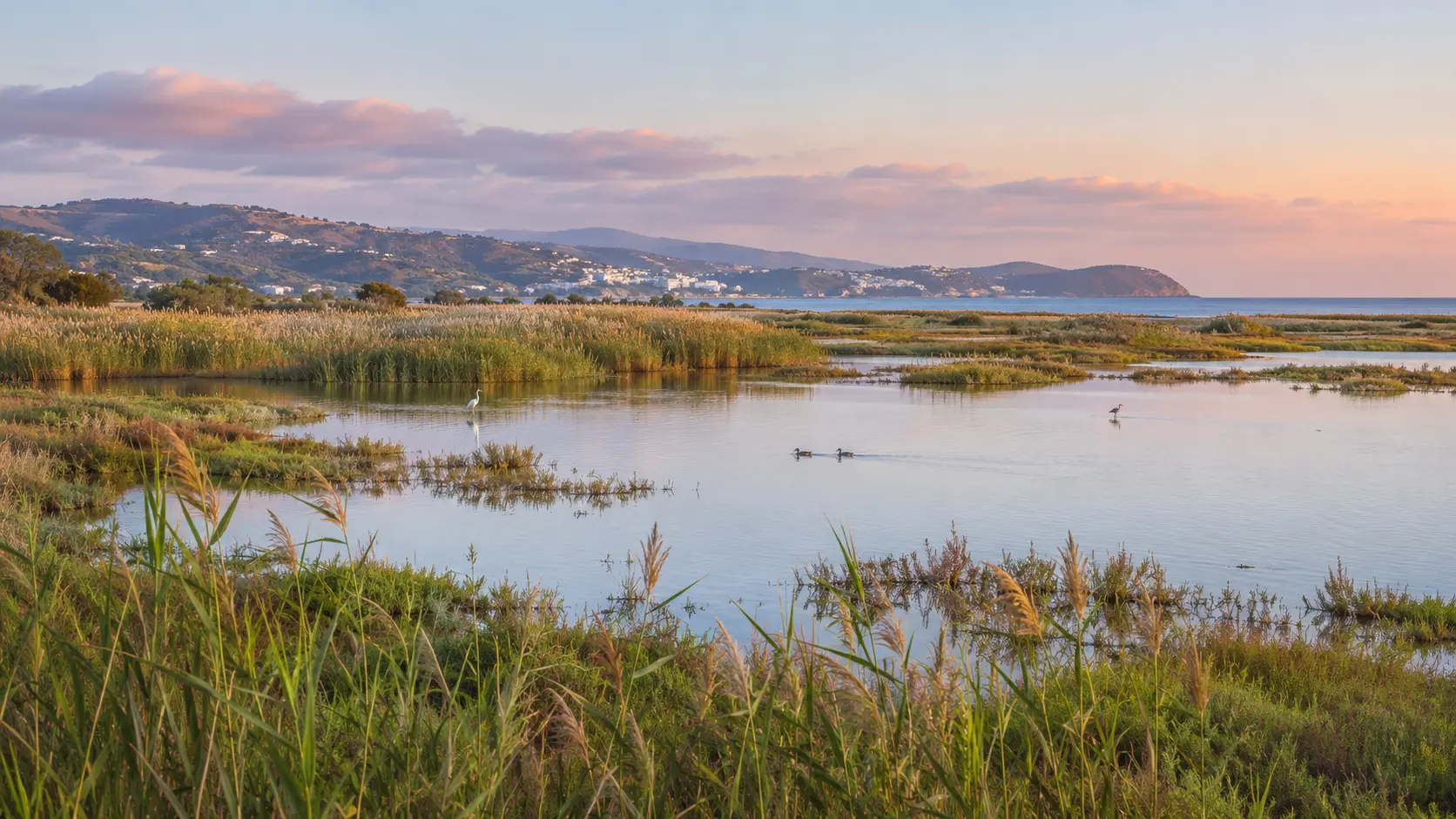
Smir Lagoon birdwatching offers a different side of Morocco’s northern Mediterranean coast. Just north of M’diq, the Smir wetland complex combines marshes, open water, reedbeds, estuarine habitat and an upstream reservoir, creating an important stop for migratory and wintering waterbirds.
The key to visiting is understanding that Smir is a sensitive wetland rather than a conventional attraction with one obvious entrance and a standardized visitor route. Birdwatching is best approached from legitimate public roads and open edges where birds can be observed at a distance. Do not enter reedbeds, cross fences, approach nests or assume that undeveloped land is open to visitors.
For travelers staying in M’diq, Smir can fit naturally into a morning or afternoon focused on nature. It is also accessible as part of a northern Morocco stay based in Tetouan, particularly for travelers carrying binoculars or already interested in wildlife.
What Is the Smir Lagoon Wetland?
The wider protected site is known as the Lagune et Barrage de Smir, or Smir Lagoon and Reservoir. It was designated a Ramsar Wetland of International Importance in 2019.
The complex includes two distinct but connected wetland areas. Near the Mediterranean coast is a marshy lagoon associated with Oued Smir. Farther inland is the reservoir behind Smir Dam. Between them, water channels, marsh vegetation, mud, open water and surrounding terrestrial habitats support a broad range of wildlife.
The lagoon is particularly notable because Mediterranean estuarine wetlands of this type are uncommon in Morocco. Its location near the Strait of Gibraltar also places it along a major route used by birds moving between Europe and Africa.
For visitors, this means Smir should not be thought of as a single lake where all birds gather in one visible area. Different species use different parts of the wetland, and water levels, vegetation, season and disturbance can change where birds are easiest to observe.
Why Smir Lagoon Is Important for Birds
Smir lies on the East Atlantic flyway and functions as a migration stopover, wintering area and breeding habitat. Around 60 species of Western Palearctic waterbirds are associated with the site during migration or wintering, while other birds use its marshes for breeding.
The variety of habitat is part of the reason. Open water can attract ducks and coots, shallow margins and exposed mud can suit waders, while reedbeds and marsh vegetation provide cover for rails, herons and other wetland birds.
Recorded birdlife has included species such as Common Pochard, Black-tailed Godwit, Northern Lapwing and Eurasian Bittern. Studies of the wider wetland have also documented herons, egrets, ibises, spoonbills, marsh harriers and numerous other waterbirds.
These records should be treated as evidence of the wetland’s ecological importance, not as a checklist of birds every visitor will see. Migration timing changes from year to year, individual species may be absent, and some birds can remain concealed in dense vegetation.
Smir Lagoon Birdwatching: What You May See
Rather than arriving with one target species in mind, it is more useful to watch for groups of birds using different habitats.
Herons and Egrets
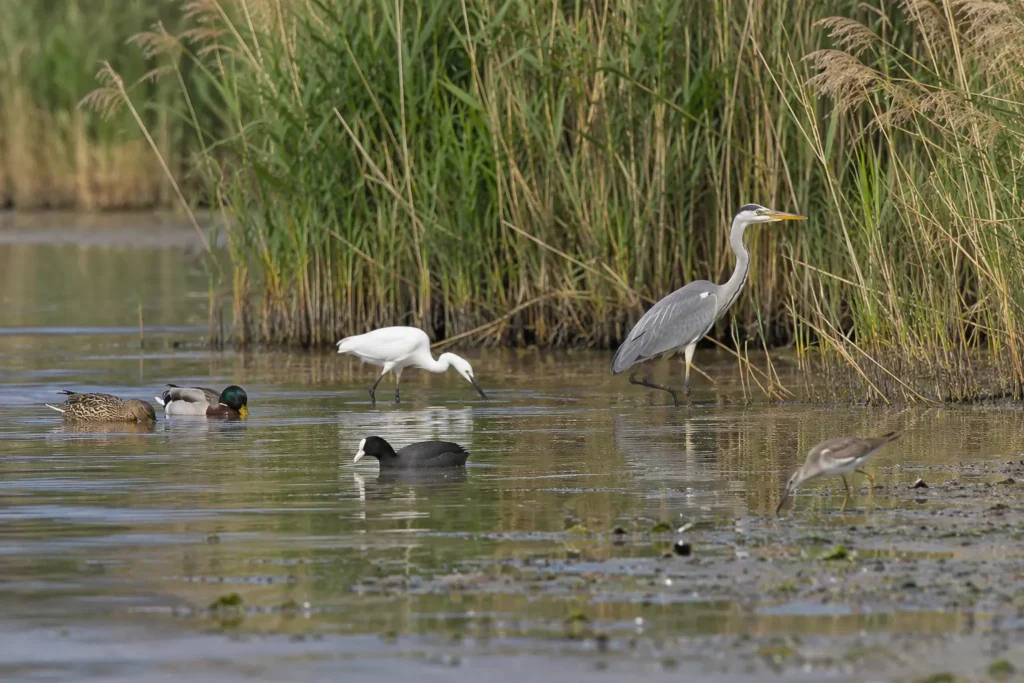
Marshes, shallow water and reed margins can support several members of the heron family. Grey Herons, egrets and other wetland species have all been recorded within the Smir complex.
Some birds remain partly hidden among reeds, so slow scanning is often more productive than walking closer to the vegetation.
Ducks, Coots and Other Waterbirds
Open-water areas can attract ducks and coots, particularly during migration and winter. Common Pochard is among the conservation-relevant species associated with the Ramsar site.
Numbers and species composition vary with season and water conditions. A quiet-looking stretch of water can also change significantly between visits.
Waders
Where suitable shallow water or muddy margins are exposed, look for waders feeding along the edges. Black-tailed Godwit, lapwings, stilts, plovers and sandpipers have all formed part of the wider historical bird record.
A telescope can be especially useful because the responsible observation point may be well away from the feeding birds.
Raptors and Birds Over the Reeds
Do not concentrate exclusively on the water. Marsh Harriers have been associated with the wetland, while migrating birds can also move through the wider landscape.
Occasionally scanning the sky, reed tops and surrounding open ground can produce sightings that would be missed by watching only the lagoon surface.
How to Access Smir Lagoon for Birdwatching
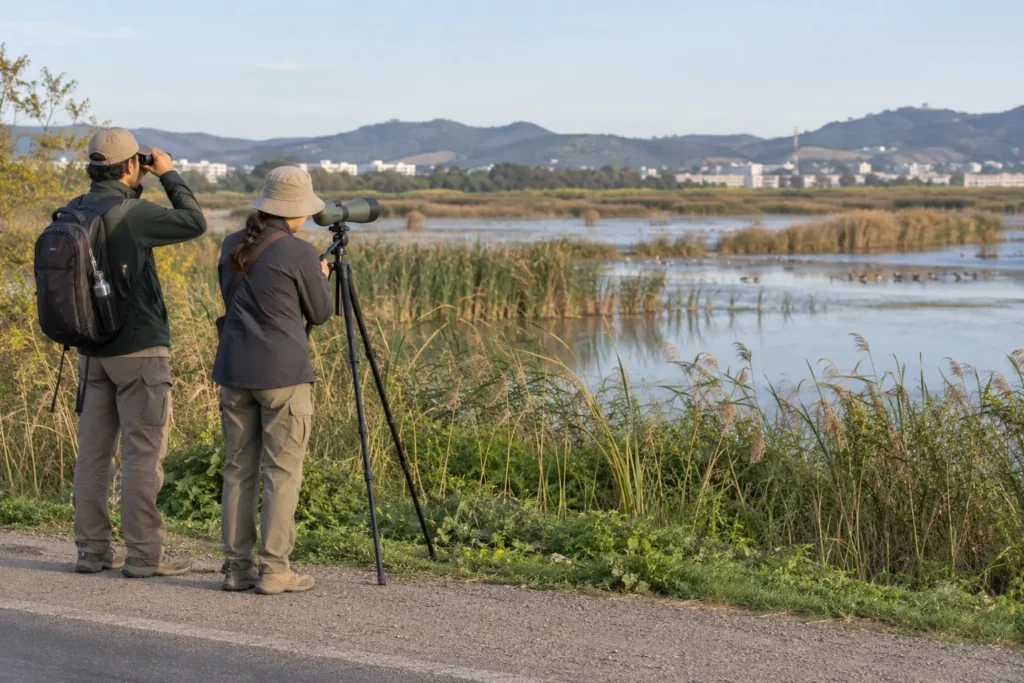
Smir is not best approached as a park with a single gate where every visitor follows the same trail. The wetland occupies a developed coastal corridor, and public roads, private property, marsh habitat and tourism infrastructure sit close together.
Use public roads and clearly legitimate stopping or walking areas to look into the wetland. If an area is fenced, signed as private or requires crossing vegetation to reach it, choose another viewpoint.
This is particularly important around breeding areas. Research at Smir has documented significant nesting sites on private land, and historical monitoring has sometimes been conducted from the road rather than by entering colonies.
Access arrangements can also change as land use, conservation projects and local infrastructure develop. Pay attention to current signs and barriers instead of relying on an old birding report that describes a route used years ago.
Coming from M’diq
M’diq is the most convenient nearby base for a Smir visit. The wetland lies along the Mediterranean coastal corridor north of the town, making it practical to combine birdwatching with time elsewhere around the M’diq and Tamuda Bay area.
A taxi or private vehicle can be useful when carrying binoculars, a telescope or camera equipment. If using a taxi, make sure you have a realistic plan for the return rather than assuming transport will always be waiting at your chosen observation point.
Coming from Tetouan
Tetouan is also a sensible base, particularly if Smir is one nature stop within a longer northern Morocco itinerary. Road conditions and traffic vary, especially during busy coastal periods, so avoid building a tightly timed schedule around the visit.
Birdwatching does not require a private driver. Travelers comfortable arranging local transport or renting a vehicle can visit independently, provided they research the exact observation area before leaving.
When Is the Best Time for Birdwatching at Smir?
There is no single season when every notable bird is present. Smir is useful to birds at different stages of the year, so the best period depends on what you hope to observe.
Autumn Migration
Autumn brings birds moving south after breeding in Europe and other parts of the Western Palearctic. Smir’s position close to the Strait of Gibraltar makes migration one of the wetland’s defining ecological roles.
Actual migration intensity varies with weather and timing, so a particular species should never be guaranteed.
Winter
Winter is important for waterbirds using the wetland complex as seasonal habitat. Ducks, coots, waders and other species may all form part of the mix.
This can be a rewarding season for travelers whose main interest is wetland birding rather than a summer beach trip along the Mediterranean coast.
Spring Migration and Breeding Season
Spring can bring both northbound migrants and breeding activity among resident or seasonal species.
It also requires the greatest restraint around nesting habitat. Stay well back from birds showing territorial, nesting or alarm behavior. Never approach nests for photographs, even when a bird appears tolerant of your presence.
Summer
Summer does not mean the wetland is empty, but it brings different conditions. The surrounding coast receives heavy seasonal tourism, while heat can make exposed birdwatching less comfortable.
An earlier start can reduce heat and visitor activity, although wildlife sightings can never be guaranteed by time of day.
Check Recent Sightings Before You Go
Historical species lists are valuable for understanding why Smir matters, but they are not a substitute for current observations.
Before visiting, check recent bird reports for the Smir area through platforms such as eBird. Look at recent checklists as well as the full hotspot list. This helps distinguish birds reported recently from species recorded years ago.
Recent reports can also give you an idea of how actively a particular area is being watched. A lack of reports does not necessarily mean birds are absent; it may simply indicate that few birders have submitted observations recently.
What to Bring for Smir Lagoon Birdwatching
- Binoculars: The most useful equipment for general viewing without approaching wildlife.
- A spotting scope if you have one: Helpful for ducks and waders on distant water or mudflats.
- Sun protection: Some observation points may have little shade.
- Drinking water: Bring your own rather than assuming facilities are available beside the wetland.
- Suitable footwear: Road edges and undeveloped ground can be uneven, particularly after wet weather.
- A field guide or birding app: Useful when separating similar waterbirds and migrants.
- A telephoto lens: If photographing birds, longer focal lengths help maintain a responsible distance.
Do not plan on finding toilets, cafés, hides or other visitor infrastructure at the exact spot where you choose to watch birds. Use nearby towns for food and practical stops rather than expecting the wetland itself to operate like a managed visitor attraction.
How to Visit Smir Lagoon Responsibly
Responsible behavior matters particularly at Smir because the wetland is both ecologically valuable and already affected by surrounding development, infrastructure and tourism pressure.
- Watch from the edge. Do not enter reedbeds, marsh vegetation or flooded areas simply to obtain a clearer view.
- Respect private property. Never cross a fence, gate or residential area to reach birds.
- Keep your distance from nesting birds. If a bird leaves a nest, repeatedly calls in alarm or changes behavior because of you, move farther away.
- Avoid playback near breeding birds. Repeated recorded calls can cause unnecessary territorial responses.
- Do not use drones around wildlife. Aerial devices can disturb resting, feeding and nesting birds even when the operator remains far away.
- Do not flush birds for photographs. Wait for natural behavior rather than forcing birds into flight.
- Keep noise low. Quiet observation is better for both wildlife and other birders.
- Take all litter away. Wetlands collect plastics and other waste easily.
- Ask before photographing people. Fishermen, residents and workers around the wetland are not part of the wildlife attraction.
Photography Without Disturbing the Wetland
Smir can be appealing to wildlife photographers, but the goal should be to photograph what birds naturally do rather than getting as close as possible.
Use binoculars first to assess the situation. If birds continue feeding, resting or preening normally, your distance is more appropriate than if they begin watching you constantly or moving away.
A long lens is especially valuable around colonies, reeds and open water. Never push into vegetation for an unobstructed photograph of a nest.
Posting photographs also deserves some care. Avoid sharing precise locations of sensitive active nests if doing so could encourage repeated disturbance.
Is Smir Suitable for Casual Birdwatchers?
Yes. You do not need to be an experienced birder to appreciate Smir. Herons, ducks, coots and other waterbirds can be rewarding even when you cannot identify every species.
The main limitation is that the experience is less structured than visiting a nature reserve with maintained trails, interpretation boards and observation hides at every viewpoint.
Beginners may therefore get more from the visit by bringing binoculars, checking recent observations beforehand and accepting that birdwatching often involves waiting rather than moving constantly through the habitat.
Accessibility and Practical Limitations
Do not assume that every observation point around Smir has level or step-free access. Road shoulders, tracks and wetland margins can be uneven, and conditions may change after rain or construction work.
Travelers with limited mobility should identify a suitable roadside or developed observation point in advance rather than depending on an improvised route through rough ground.
Similarly, families should keep children away from marsh vegetation, drainage channels and traffic. Smir is a living wetland landscape, not a fenced wildlife park.
Common Mistakes When Visiting Smir Lagoon
- Treating an old bird list as a promise. Species occurrence changes by season, year and local conditions.
- Searching for a single official entrance. Plan around legitimate observation points rather than expecting one universal visitor gate.
- Walking into reeds for a closer look. The vegetation itself is important habitat and can conceal breeding birds.
- Crossing private property. A bird visible beyond a fence does not make the land publicly accessible.
- Chasing rare birds too closely. A distant view is better than disturbing a bird to improve a photograph.
- Ignoring the wider wetland. Scan open water, mud, reeds, trees, roadside habitat and the sky rather than concentrating on one patch.
FAQs
Is Smir Lagoon open to visitors?
The wetland can be observed from legitimate public areas, but it should not be treated as one uniformly accessible park. Private land and sensitive habitat exist around the complex, so follow current signs, boundaries and any local access restrictions.
What birds can you see at Smir Lagoon?
The wider wetland supports ducks, coots, herons, egrets, waders, marsh birds and migratory species. Common Pochard, Black-tailed Godwit, Eurasian Bittern and Northern Lapwing are among birds documented at the site, but no individual species is guaranteed on a particular visit.
What is the best season for Smir Lagoon birdwatching?
Migration periods and winter are particularly important for waterbirds, while spring also brings breeding activity. Each season offers different possibilities, and recent sightings are more useful than a fixed annual checklist.
Do you need a birding guide?
No. Independent birders can visit using binoculars and recent sighting information. A knowledgeable local guide can be useful for identification and understanding current access, particularly if birdwatching is a major purpose of your northern Morocco trip.
Can you photograph birds at Smir Lagoon?
Yes, provided photography does not disturb wildlife or require entering restricted habitat. Use a long lens, stay away from nests and colonies, and avoid repeatedly moving closer when a bird reacts to your presence.
Can Smir Lagoon be combined with M’diq?
Yes. M’diq is the most natural nearby base, so a wetland visit can be paired with time along the Mediterranean coast without trying to turn the day into a long multi-destination itinerary.
Watch Smir from the Edges
Smir Lagoon is most rewarding when the wetland remains the focus rather than the visitor. Bring binoculars, check recent observations, choose legal public viewpoints and allow the birds to determine how close is close enough.
That approach gives you a better chance of seeing natural behavior while respecting one of northern Morocco’s significant wetland systems. For more nature, coastal and outdoor ideas around the country, explore Visit Morocco Together’s Things To Do in Morocco guides.
Ready to Experience Morocco?
Turn this inspiration into your next adventure. Our travel experts are ready to help.