The top 10 things to do in Marrakech combine the energy of Jemaa el-Fna, the narrow lanes of the medina, richly decorated palaces, historic religious architecture and gardens that provide a completely different atmosphere from the old city. For a first visit, you do not need to collect dozens of attractions. These ten places and experiences give you a strong introduction to Marrakech without turning the trip into a race between monuments.
This guide ranks the Marrakech must-see attractions that deserve priority, explains how long to allow for each one and shows which sights work naturally together. Most travelers can cover the highlights in two days, while three days gives you a more comfortable pace.
For tours, activities and broader city planning, see the Marrakech destination page.
Top 10 Things to Do in Marrakech at a Glance
| Rank | Attraction or experience | Useful time to allow |
|---|---|---|
| 1 | Jemaa el-Fna | 1–2 hours, ideally return twice |
| 2 | Marrakech Medina and Souks | 2–3 hours |
| 3 | Koutoubia Mosque and Gardens | 30–60 minutes |
| 4 | Bahia Palace | 1–2 hours |
| 5 | Ben Youssef Madrasa | 45–90 minutes |
| 6 | Majorelle Garden | 1–1.5 hours |
| 7 | Saadian Tombs | 45–60 minutes |
| 8 | El Badi Palace | 1–1.5 hours |
| 9 | Menara Gardens | 45–90 minutes |
| 10 | Traditional Moroccan Hammam | 1–2 hours |
1. Experience Jemaa el-Fna
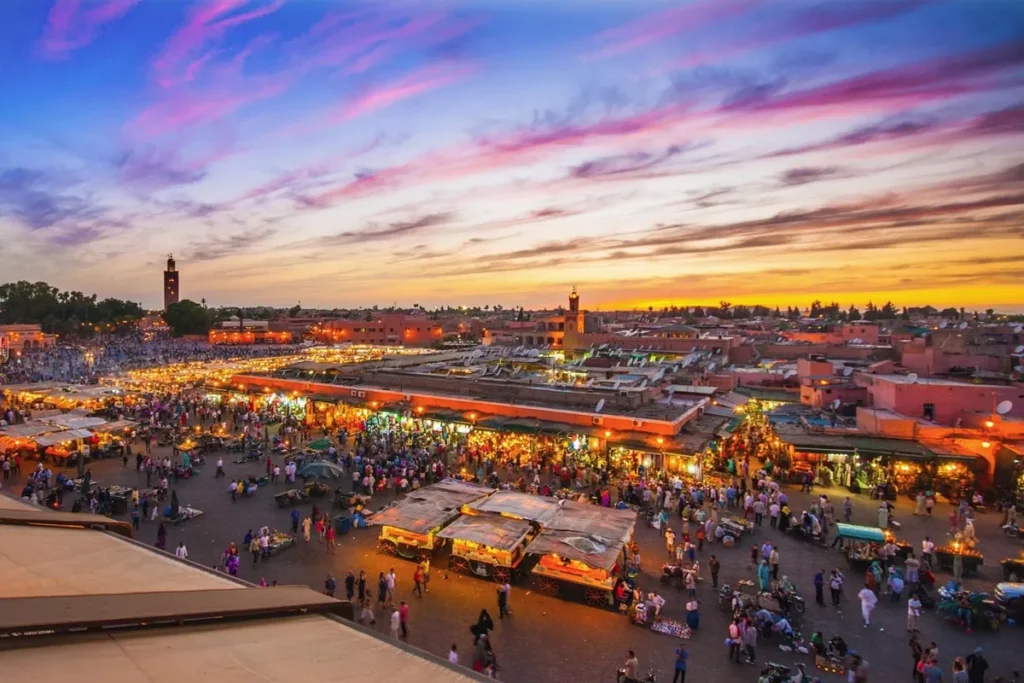
Jemaa el-Fna deserves the first position because it is less a conventional monument than the public heart of Marrakech. The square changes dramatically throughout the day, so visiting once for ten minutes does not really show you what makes it important.
During the morning and early afternoon, the space is relatively open. As evening approaches, food stalls appear, crowds increase and musicians, performers and groups gather around different parts of the square.
The best strategy is to pass through during the day, explore the surrounding medina, then return around late afternoon and remain into the evening.
A rooftop viewpoint can help you understand the scale of the square before walking through it at ground level.
Travelers who want local orientation through both the square and surrounding old city can use the Marrakech Medina & Jemaa el-Fnaa Guided Walking Tour.
Jemaa el-Fna Tip
Ask before photographing individual performers or people at close range. Do not assume that taking someone’s photograph is automatically free or welcome.
2. Explore the Marrakech Medina and Souks
The medina is one of the essential things to see in Marrakech because many of the city’s other major attractions sit within or beside it.
The souks spreading north from Jemaa el-Fna sell textiles, leather goods, metal lanterns, ceramics, spices, clothing, carpets and household items. Some lanes specialize more heavily in particular crafts, while others mix visitor-oriented shops with businesses used by local residents.
Do not approach the souks as a shopping mall where you need to cover every aisle. Choose a general direction, notice workshops and smaller streets, and accept that getting slightly turned around is part of the experience.
Shopping Without Pressure
There is no universal rule that you should automatically offer a fixed percentage of the first asking price. Some shops negotiate, others use more fixed pricing, and the appropriate price depends entirely on the item.
If you genuinely want something, ask the price, compare similar products and make a reasonable offer when bargaining is appropriate. Walking away is fine if you cannot agree.
3. See Koutoubia Mosque and Gardens

The Koutoubia minaret is one of Marrakech’s defining landmarks and an important orientation point when exploring the old city.
The mosque dates to the Almohad period, and its approximately 77-meter minaret became influential in later Islamic architecture. Morocco’s tourism office specifically notes its relationship to structures such as the Hassan Tower in Rabat and the Giralda in Seville.
The mosque remains an active religious site. Non-Muslim visitors generally appreciate it from the exterior and surrounding gardens rather than entering the prayer hall.
Koutoubia is especially easy to combine with Jemaa el-Fna because the two landmarks are only a short walk apart.
Best Time to See Koutoubia
Late afternoon is attractive when the warmer light reaches the stonework, but the minaret is worth seeing more than once because it looks very different from daylight to evening.
4. Visit Bahia Palace

Bahia Palace is one of Marrakech’s strongest attractions for traditional decorative architecture.
The palace developed during the late 19th century and unfolds through interconnected rooms, courtyards and gardens rather than one enormous ceremonial hall.
Look closely at the zellige tilework, painted wooden ceilings, carved plaster, doors and transitions between indoor rooms and open courtyards. Moving too quickly means missing much of what makes the palace worthwhile.
Allow around one to two hours depending on crowds and how interested you are in architecture and photography.
Travelers wanting more historical context can combine it with another major southern-medina landmark on the Bahia Palace & Saadian Tombs Guided Tour.
5. Explore Ben Youssef Madrasa
Ben Youssef Madrasa is one of the most important must-see places in Marrakech for visitors interested in architecture.
The historic religious school is built around a central courtyard where carved plaster, cedar wood, marble and geometric zellige work together in a much more compact space than Marrakech’s palaces.
The former student rooms surrounding the complex also help explain how the building functioned beyond its highly decorated central courtyard.
Ben Youssef sits in the northern medina, making it particularly easy to combine with a souk walk rather than visiting it on the same route as the southern palace district.
Photography Tip
Step back and look at the entire courtyard before concentrating on details. Doorways, upper galleries and carved surfaces provide useful natural frames without requiring elaborate camera equipment.
6. Walk Through Majorelle Garden
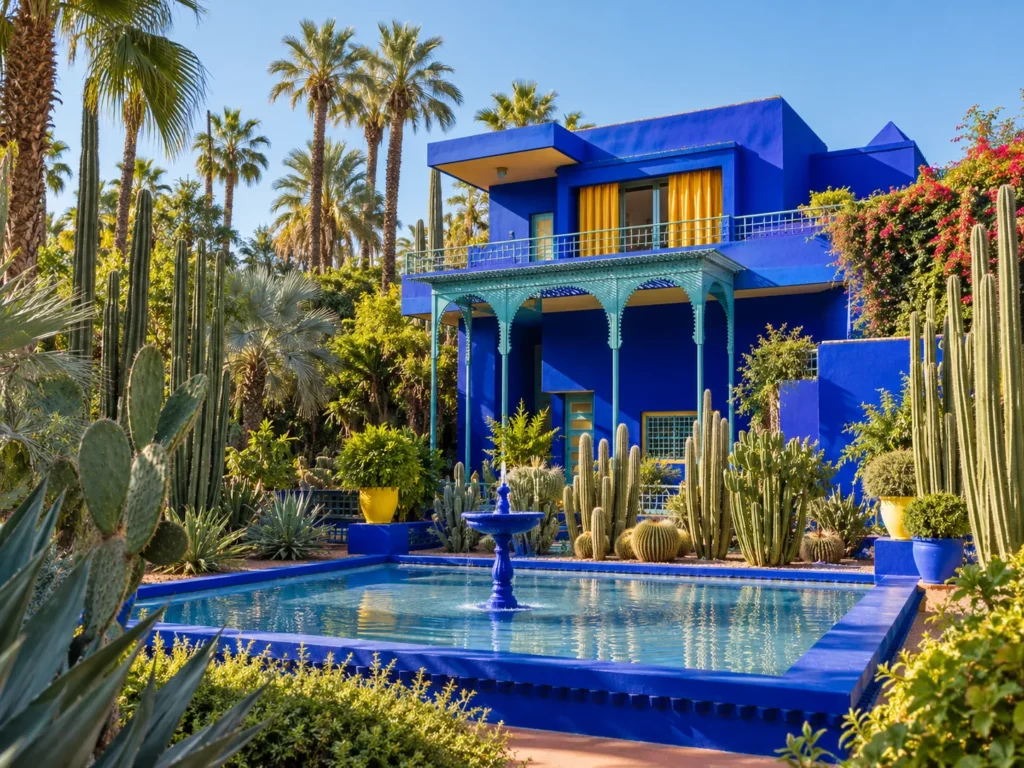
Majorelle Garden provides the strongest visual contrast to the ochre walls and crowded lanes of the medina.
The garden was developed by French painter Jacques Majorelle and later preserved by Yves Saint Laurent and Pierre Bergé. Today, its vivid blue architecture, cacti, palms, bamboo, paths and water features make it one of Marrakech’s most photographed attractions.
Because admission uses timed tickets and the garden is extremely popular, this is one attraction worth planning in advance rather than treating as a spontaneous stop between medina monuments.
Allow around one to one and a half hours for the garden itself and longer if you add the Pierre Bergé Museum of Berber Arts.
Plan Majorelle Geographically
Majorelle is outside the old medina. Combine it with Guéliz or nearby modern-city attractions rather than repeatedly traveling between the garden and southern-medina palaces during the same day.
7. Visit the Saadian Tombs
The Saadian Tombs offer a more intimate experience than Marrakech’s large palace complexes.
The royal necropolis is closely associated with the Saadian dynasty and contains highly decorated burial chambers, carved surfaces, marble columns and cedar detailing.
The site is relatively compact, which means queues or groups can make it feel much busier than larger attractions. Allow approximately an hour and avoid forcing it into the same small time block as several other ticketed monuments.
The tombs sit in the Kasbah area and work naturally with Bahia Palace, El Badi Palace and Bab Agnaou as part of a southern-medina route.
8. Walk Through El Badi Palace
El Badi Palace offers almost the opposite experience from Bahia Palace.
Instead of richly preserved decorative interiors, much of El Badi survives as monumental open ruins. Large courtyards, walls, sunken spaces and surviving architectural elements allow you to understand the scale of the former Saadian palace.
This is why visiting both palaces is worthwhile. Bahia is strongest for craftsmanship and interior decoration; El Badi is strongest for scale, historical imagination and open architectural space.
Allow at least an hour, particularly if you enjoy historical sites and photography.
VMT’s El Badi Palace Guided Tour is available for travelers who prefer more explanation of the site’s Saadian history.
9. Slow Down at Menara Gardens
Menara Gardens provides a different kind of attraction from Majorelle.
Instead of dense botanical planting and intense architectural color, Menara is a broader landscape of olive groves centered around a large historic basin and pavilion.
Morocco’s national tourism office includes Menara among Marrakech’s major attractions, and it works particularly well for travelers who want open space after spending much of the day inside narrow medina streets.
Do not arrive expecting the decorative density of Majorelle. Menara’s appeal lies in its simplicity, space and relationship with the surrounding landscape.
On clear days, the wider setting can be especially photogenic when the Atlas Mountains are visible in the distance.
10. Experience a Traditional Moroccan Hammam
Not every one of the top 10 things to do in Marrakech needs to involve another historic building.
A hammam introduces a different part of Moroccan bathing culture through warmth, washing, black soap and exfoliation with a kessa glove.
There is an important distinction between a traditional public hammam and a private visitor-oriented spa. A public hammam is a communal bathing environment, while riad and hotel spas usually provide a more private and structured treatment.
First-time visitors who want a straightforward wellness experience may prefer a private hammam. Travelers specifically interested in everyday bathing traditions may be more interested in understanding how public hammams work.
Check what your treatment includes rather than assuming massage, ghassoul clay or argan oil is automatically part of every package.
Which Marrakech Attractions Should You Prioritize With One Day?
If you have only one full day, do not try to complete all ten attractions.
A useful one-day route begins around Jemaa el-Fna and Koutoubia, continues north through the medina and souks toward Ben Youssef Madrasa, then returns toward the square for lunch.
Use the afternoon for either Bahia Palace and one nearby southern-medina monument or Majorelle Garden. Trying to fit Majorelle, Bahia, El Badi, the Saadian Tombs and Ben Youssef into the same short day creates too much movement and not enough actual visiting time.
Finish back at Jemaa el-Fna in the evening so you see how different the square feels after dark.
How to See the Top Marrakech Attractions in Two Days
Day 1: Medina and Northern Highlights
Start with Koutoubia and Jemaa el-Fna, then walk north through the souks toward Ben Youssef Madrasa.
Spend the afternoon exploring additional medina lanes, shopping or stopping for lunch and tea rather than filling every hour with a ticketed attraction.
Return to Jemaa el-Fna in the evening.
Day 2: Palaces and Garden
Use the morning for Bahia Palace, the Saadian Tombs and El Badi Palace. These attractions sit in the same broader part of Marrakech and are much more efficient to combine geographically.
After lunch, travel toward Majorelle Garden if you have booked an appropriate time slot. Alternatively, use Menara Gardens for a slower final afternoon.
A hammam works particularly well at the end of the second day when you no longer have several monuments left to visit.
What Should You Skip if You Are Short on Time?
The answer depends on your interests rather than one universal ranking.
If decorative architecture is your priority, protect Bahia Palace and Ben Youssef Madrasa and consider skipping Menara.
If gardens and photography matter more than historical ruins, choose Majorelle and reduce the number of palace visits.
If you have already seen extensive historic architecture elsewhere in Morocco, spend more time in the medina, markets, food and hammam rather than visiting every Marrakech monument simply because it appears on a checklist.
Practical Tips for Marrakech’s Top Attractions
- Give Marrakech at least two full days if you want to see most of the top attractions comfortably.
- Group sights geographically instead of repeatedly crossing the city.
- Wear comfortable shoes for medina streets and palace visits.
- Use current official information for ticket prices and opening hours because they can change.
- Reserve Majorelle Garden ahead when timed slots are required.
- Visit Jemaa el-Fna at more than one time of day.
- Ask before photographing people closely.
- Do not rely on one fixed bargaining formula in the souks.
- Carry some Moroccan dirhams for small purchases and local services.
- Leave unscheduled time for meals, cafés and wandering through the medina.
FAQ
What Are the Top 10 Things to Do in Marrakech?
The top 10 things to do in Marrakech are Jemaa el-Fna, the medina and souks, Koutoubia Mosque, Bahia Palace, Ben Youssef Madrasa, Majorelle Garden, the Saadian Tombs, El Badi Palace, Menara Gardens and a traditional Moroccan hammam.
What Are the Must-See Attractions in Marrakech?
For a first visit, prioritize Jemaa el-Fna, the medina and souks, Koutoubia, Bahia Palace, Ben Youssef Madrasa and Majorelle Garden. Add the Saadian Tombs and El Badi Palace if you have two or more days.
How Many Days Do You Need in Marrakech?
Two full days is enough for the major Marrakech attractions at a reasonable pace. Three days is better if you want gardens, museums, shopping, a hammam or more time to explore without rushing.
What Should I See in Marrakech in One Day?
With one day, focus on Jemaa el-Fna, Koutoubia, the medina and souks, Ben Youssef Madrasa and either Bahia Palace or Majorelle Garden. Return to Jemaa el-Fna after dark rather than trying to add several distant attractions.
Is Majorelle Garden a Must-See in Marrakech?
Majorelle is particularly worthwhile for travelers interested in gardens, architecture, photography and design. If you have only one day and historic Marrakech is your priority, medina attractions may deserve more of your time.
Can You Walk Between Marrakech’s Main Attractions?
Many medina attractions are walkable, including Jemaa el-Fna, Koutoubia, the souks and several historic monuments. Majorelle Garden, Menara and some modern districts are farther away, so taxis or other transport can save time.
Choose the Marrakech Must-Sees That Fit Your Trip
The top 10 things to do in Marrakech are most useful as a priority list, not a challenge to complete every attraction in one day. Start with Jemaa el-Fna and the medina, choose the architectural sites that interest you most, and leave enough time for the city itself rather than moving continuously between entrances and ticket counters.
With two days, you can combine the medina, palaces and one major garden at a comfortable pace. With three days, Marrakech becomes much easier to enjoy slowly, with space for a hammam, shopping, food and the unexpected stops that often become the most memorable parts of the city.
Explore destinations, tours and locally organized Morocco experiences with Visit Morocco Together.
Ready to Experience Morocco?
Turn this inspiration into your next adventure. Our travel experts are ready to help.