Long driving days in Morocco work better when you plan the whole day, not just the hours shown on a map. Add time for breaks, meals, visits, luggage and the final approach to your accommodation. Then check whether the remaining driving fits the people traveling, the road conditions and the daylight available.
If the day only works by skipping rest stops, rushing a visit or reaching an unfamiliar mountain guesthouse late at night, change the route. An earlier departure can help with timing, but it cannot replace sleep or remove the distance.
This matters whether you drive yourself or travel with a driver. Hiring someone changes who handles the road; it does not reduce how long passengers spend in the vehicle.
How to budget time for long driving days in Morocco
Keep three different measures in your itinerary:
- Driving time: the estimated road journey before you add planned stops.
- Travel time: driving plus breaks, visits, meals and other stops.
- The full day away from your accommodation: everything from packing and leaving the room to reaching the next room with your luggage.
A road journey described as four hours may leave much less of the afternoon free than you expect. A village lunch, a walk through a ksar and a hotel outside the town centre each need their own allowance.
When comparing ways to travel around Morocco, ask which of these measures an operator or timetable is using. A quoted transfer duration may cover the drive without the sightseeing you have in mind.
A worked example of a four hour drive

Imagine a route showing four hours of driving. The following is an illustrative time budget, using chosen allowances rather than a timetable for a particular journey:
- Four hours of driving.
- A separate 15-minute comfort stop.
- A 45-minute lunch break.
- A 90-minute visit.
- Thirty minutes for parking, unloading and walking to accommodation.
- Thirty minutes of spare time for small delays.
The total is seven hours and 30 minutes. Leaving at 09:00 would place the end of that planned block at 16:30.
If lunch also serves as a rest stop, count that time once. Conversely, a “90-minute visit” should include its parking and approach time, or you need to add those separately.
The point is to identify where the day goes. Adding an arbitrary hour to every route can miss a long walk from the car park or overestimate a simple direct transfer. Named allowances make the plan easier to adjust.
Judge the road as well as the distance
The same distance can demand very different amounts of concentration and time.
A motorway journey between major cities differs from a mountain crossing with bends, villages and slow vehicles. A short valley detour can also take longer than its distance suggests, particularly when you stop along the way.
Look at the road your accommodation actually requires. A property described as “near the valley” may be several kilometres up a side road, while its map pin can hide the practical approach.
Mountain and southern routes
Around the High Atlas, the journey is often part of the visit. If you want viewpoints, a meal and time at Aït Benhaddou, give those stops space instead of treating them as additions to an unchanged arrival estimate.
For a route toward Merzouga, separate the drive to the gateway village from the final transfer to camp. Reaching the village at sunset does not necessarily leave time to join a camp’s afternoon departure.
Read the sequence of stops before interpreting the duration. A direct intercity transfer and a route through gorges, villages and a dune camp are different journeys.
The choices involved in a Morocco road trip include the roads, accommodation access and permitted use of the vehicle. Those details can matter more than choosing the shortest line on the screen.
Decide what each driving day is for
A useful itinerary gives each day a main purpose.
A transfer day gets you to the next base. Keep activities optional and make arrival, dinner and rest the priorities.
A journey with visits includes time at places along the route. It may need an earlier overnight stop or less distance overall.
A local sightseeing day begins and ends near the same base. It can still involve substantial driving if the visits are far apart, so total the individual legs.
This distinction helps when deciding how to build a Morocco itinerary. A hotel night is not a full day in that destination, and a transfer with several photo stops is not necessarily a substantial visit.
Avoid promising yourself a full morning of sightseeing, a major cross-country journey and another guided visit after arrival. Choose what matters most and let the rest depend on the time available.
Work backward from the arrival that matters
Before choosing a departure time, establish what must happen at the other end.
That might be reaching a guesthouse while reception is open, meeting a camp transfer, returning a rental car or arriving in time for an agreed meal. Ask for the actual deadline rather than assuming that every property accepts arrivals at any hour.
Then work backward through the day:
- Allow time for the final approach, unloading and any walk.
- Add the intended visits and meal stops.
- Include driving breaks.
- Allow for the route and a reasonable margin.
- Check whether the resulting departure fits breakfast, checkout and adequate rest.
If the calculation demands a very early start after a late arrival, consider staying another night or shortening the next stage.
A sunset activity is an appointment
A desert sunset ride, a photography session or a timed visit needs more precision than an ordinary hotel check-in.
Ask when you must reach the meeting point, where luggage goes and whether changing or briefing takes extra time. Do not use sunset itself as your arrival deadline.
If the schedule becomes tight, shorten or remove an optional visit. Do not recover the time by skipping needed rest or pressuring the driver to go faster.
Give the driver proper breaks

Morocco’s road-safety agency, NARSA, recommends 15-minute breaks every two hours during long journeys, along with sufficient sleep beforehand. Its guidance also warns against continuing when fatigue develops simply because the destination feels close.
Plan suitable stopping places into the route. A fuel station, service area or another appropriate place to park is more useful than stopping wherever a timer happens to ring.
A passenger taking photographs does not necessarily give the driver a rest. If the driver is moving the vehicle, finding parking or handling luggage, account for that when discussing the schedule.
If tiredness or drowsiness develops, stop somewhere suitable and rest rather than continuing to protect the itinerary. Rearrange what happens afterward.
When sharing the driving, confirm that each driver meets the rental agreement’s requirements. A second driver can share the task, but both people still need to be fit to drive.
Divide a long stage around a useful overnight
An overnight stop should improve the following day as well as the day before it.
Compare the total route, the location of the accommodation, reception hours and where you can eat. A hotel far from the main road may add enough driving to undermine the reason for stopping.
Choose a place you can reach at a reasonable hour. Spending an extra night in a town has limited value if you arrive too late to eat comfortably and leave again before resting properly.
Where a break can fit the route
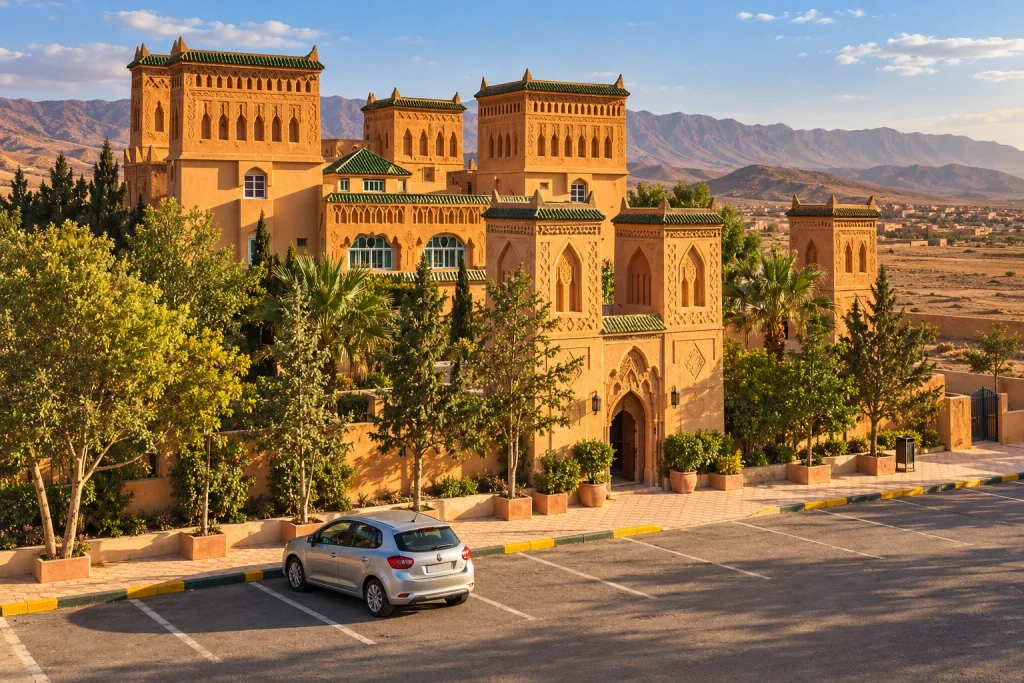
On a journey from Marrakech toward the southeastern valleys, the Ouarzazate area can separate the High Atlas crossing from the road farther east. Staying in Dadès or the Tinghir area can divide later stages, depending on the visits you want.
Between Fes and the Merzouga region, an overnight around Midelt can split the journey through the Middle Atlas and the route toward the Ziz Valley. Check the property’s precise location; “Midelt region” does not establish that every hotel sits directly on your intended road.
These are possible stopping areas, not a requirement to stay in all of them. Choose the stop that resolves the difficult stage in your own itinerary.
Visit Morocco Together’s five-day Marrakech to Fes journey through the Sahara uses overnight stops around Ouarzazate, Dadès, a Merzouga camp and Midelt. It is listed from €999 per person with four accommodation nights, breakfasts, dinners and the stated transport and camel arrangements. At that starting rate, two adults total €1,998, before lunches, drinks and applicable entrance fees. Confirm availability, room arrangements and the final quotation.
That arrangement spreads the journey across more overnight stops. It still involves driving on successive days and includes one camp night, so decide whether you want a further day without changing accommodation.
Check the rhythm across several days
A manageable individual stage can feel different when it follows several other transfers.
Look at the itinerary as a sequence. Mark the nights when you change accommodation, the longest road stages and the days with early departures. Then ask where you can have a slower morning or stay in the same place.
A two-night stay provides a full day between arrivals and departures. It does not automatically make that day restful if you fill it with another long excursion.
Read the final day of a tour carefully
An itinerary can spread the outward journey across several days and still finish with one substantial return drive.
Visit Morocco Together’s four-day Atlas, kasbahs and desert round trip from Marrakech stays around Ouarzazate, Dadès and a Merzouga camp, then returns to Marrakech on the final day. Assess that return separately: ask about departure, breaks and arrival, and choose another route if that stage does not suit your group.
Words such as “comfort” or “premium” do not explain the distribution of driving. Ask where the extra time goes: a hotel along the road, another camp night or more time visiting a place.
Remove a destination when adding a night will not solve it
Sometimes the problem is the overall route.
Adding a northern city to a southern desert trip can create another major transfer. Combining the Sahara and Atlantic coast also introduces a different direction of travel.
If you have a fixed number of days, choose the experience you most want and reduce the rest. A shorter route with time to stay can provide more useful travel than a longer list of places reached mainly at dinner.
Using different arrival and departure cities can remove a return journey, provided suitable flights and transport arrangements fit the plan. It does not eliminate the driving between the places you keep.
Self driving and traveling with a driver
Self-driving includes more than the time behind the wheel. You also handle navigation, parking, fuel and decisions when the route changes.
If several adults can share the task under the rental agreement, decide who will drive each section before leaving. Avoid leaving the unfamiliar mountain portion to someone already tired from another stage.
With a hired driver, agree on the daily route, departure, stops and expected finish. Confirm whether a late dinner transfer or another outing after hotel arrival is part of the service.
Passenger free time and driver working time are different. If the group spends an hour at a site while the driver manages the vehicle and luggage, that is not automatically an hour of rest.
A larger vehicle does not shorten the day
Ask about usable seats, luggage space, seat belts, child restraints and boarding arrangements. Photographs of an attractive vehicle do not establish how comfortably it holds your party and bags.
Vehicle type should fit the actual road and rental or operator terms. An SUV does not make an unsuitable shortcut appropriate or remove the need to respond to road restrictions.
If you dislike long road travel, consider whether part of the route could use Morocco’s passenger rail network instead. This can help between cities served by trains, while desert gateways and many smaller places still need road connections.
Plan around the traveler who needs more support
Discuss comfort before booking, rather than waiting until a long stage has begun.
With children, allow for meals, toilets and time out of the vehicle. Confirm suitable child seating and enough luggage space, including any pushchair. A very early departure followed by a busy afternoon may be harder than a shorter stage with an overnight.
For someone who finds winding roads uncomfortable, consider fewer bends and stops that provide a real break. A scenic route should be a choice, not an obligation created by an ambitious itinerary.
For reduced mobility, ask about getting into the vehicle, the space available and the walking at stops. “Hotel pickup” does not establish that a vehicle reaches the riad entrance or that the accommodation has step-free access.
Keep essentials reachable during the journey. Water, necessary medication, documents and an extra layer are less useful when buried beneath several suitcases.
Include the last part of the journey
Reaching the city boundary does not mean the day is finished.
For medina accommodation, establish the vehicle-accessible arrival point, parking and who will help with luggage if needed. Save the accommodation’s contact details and the agreed meeting location offline.
For a remote guesthouse, ask which approach road to use. A map pin can suggest a route different from the one recommended by the host.
For a desert camp, confirm the meeting time and transport beyond the paved road. If you prefer a vehicle to a camel ride, agree on that before choosing the booking.
These details affect where to stay in Morocco as much as the room photographs do. After a long journey, straightforward access and a clear arrival arrangement can be more useful than an extra facility you will barely use.
Leave room for weather and road changes
Check conditions along the whole route, especially when crossing mountains or traveling toward remote accommodation. Weather in your starting city does not establish conditions at a pass or farther along a valley.
The UK’s official Morocco road-travel guidance highlights poor lighting at night and the risks on mountain and secondary roads in bad weather. It also warns that heavy rain can cause flash flooding and advises following local authorities’ instructions.
Aim to complete unfamiliar rural and mountain sections in daylight where possible. Check the daylight hours for your travel period rather than using the same departure plan throughout the year.
If a road is closed or the approach is flooded, change the plan with appropriate local guidance. A shorter alternative on a navigation app may involve an unsuitable road or track.
Give your accommodation or camp an updated arrival estimate when circumstances change. Ask about later check-in, meal arrangements or another overnight rather than assuming every part of the original schedule remains available.
Budget for a slower route honestly
Splitting a journey can add accommodation, meals and rental days. With a driver, it may also change the vehicle quotation and overnight expenses.
Compare the whole itinerary rather than treating the extra hotel night as the only difference. Check whether breakfast, dinner, parking and transfers are already included.
Keeping the same hotel for two nights can also reduce packing and moving, but it does not remove transport costs if you use the intervening day for a distant excursion.
If the budget cannot stretch to more nights, reduce the route. Removing a distant stop may preserve both time and money more effectively than keeping every destination and compressing the driving.
Questions about long driving days
How many hours should you drive in one day
There is no single holiday-planning target that fits every driver, group and road. Assess the route, rest, daylight and the full travel day. Several hours of driving plus visits can fill most of a day; a substantially longer stage should be treated as a major transfer and split if it does not suit the travelers.
How often should you take breaks
NARSA recommends 15-minute breaks every two hours on long journeys. Plan suitable stopping places, and stop earlier if fatigue develops. A planned schedule does not mean you should continue until the next listed break.
Does hiring a driver make a long route comfortable
It removes the task of driving and navigation from the passengers. It does not remove the hours spent sitting, the bends or the need for breaks. Evaluate the daily stages as well as the vehicle and service.
Should you always add an hour to map estimates
Use specific allowances for the journey you are taking. Meals, visits, boarding, parking and accommodation access can require much more than an hour in total, while a straightforward transfer needs a different calculation. Recheck the route when conditions change.
Should you drive after landing in Morocco
Consider the arrival time, sleep and demands of the onward road. Staying near the arrival city before a major drive can be more practical than beginning a mountain crossing after a tiring flight. An early departure is useful only when you have had adequate rest.
Can you book a flight immediately after a long road transfer
A tight connection leaves little room for traffic, weather or a changed route. An overnight near your departure point provides more margin. Work backward from the airline’s check-in requirements and include the rental return or final airport transfer.
Ready to Experience Morocco?
Turn this inspiration into your next adventure. Our travel experts are ready to help.