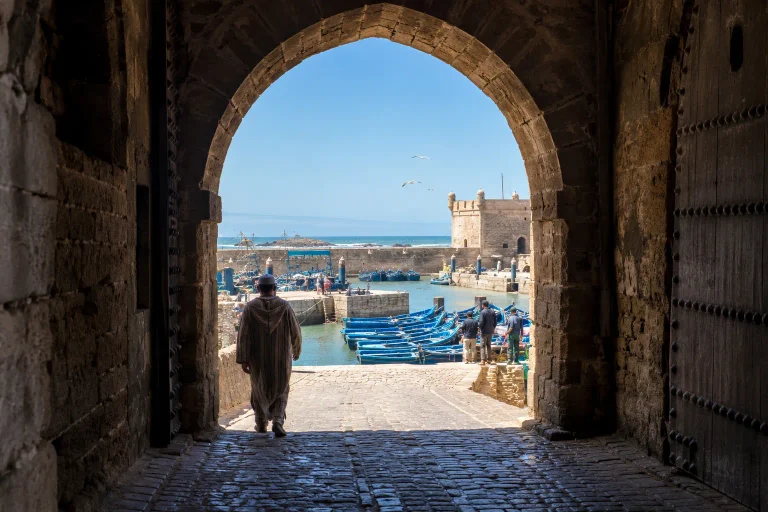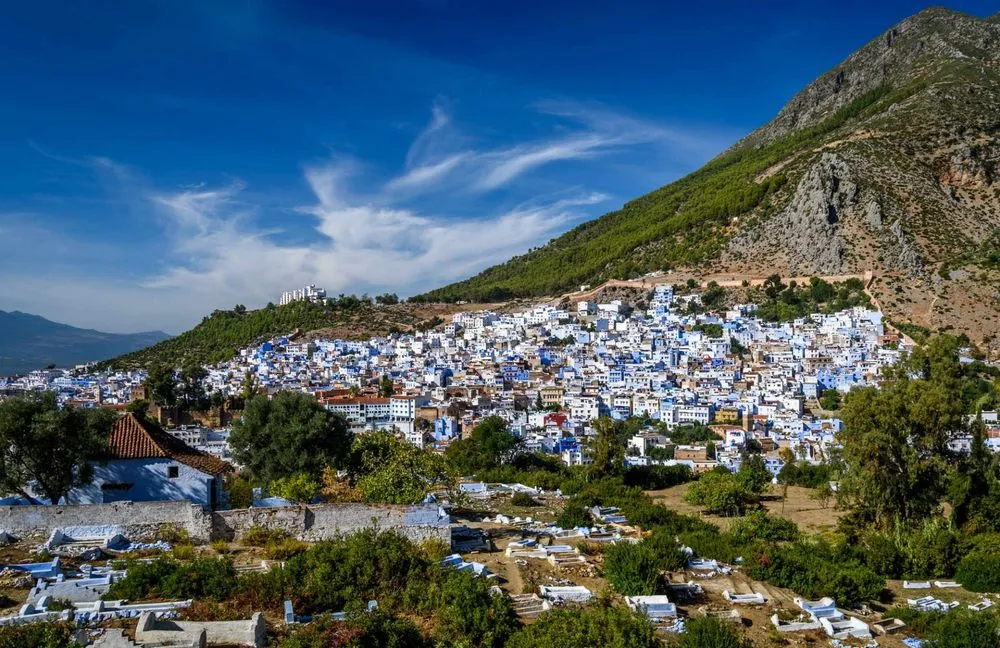
A Northern Morocco travel route offers a very different experience from the better-known Marrakech and Sahara circuits. Around Tangier, Tetouan and Chefchaouen, Atlantic and Mediterranean influences meet the Rif Mountains, while compact medinas reveal strong Moroccan, Andalusian and northern regional traditions.
The core route is relatively concentrated. Tangier works naturally as the arrival point, Tetouan adds one of Morocco’s most distinctive historic medinas, and Chefchaouen provides a slower mountain setting. With extra days, you can add Asilah, Akchour or continue south to Fes without turning the trip into a rushed country-wide itinerary.
This guide compares five- to nine-day options, explains how long to spend in each destination and shows where Fes or the Sahara fit without making northern Morocco only a transit route to somewhere else.
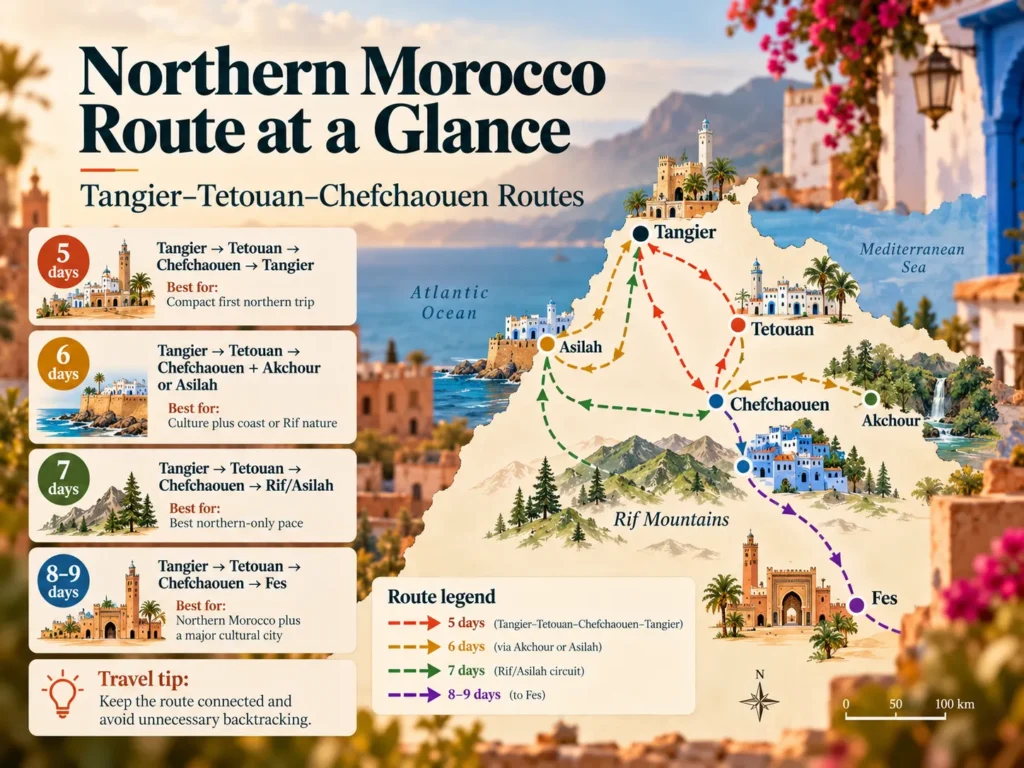
Northern Morocco Route at a Glance
| Duration | Good route | Best for |
|---|---|---|
| 5 days | Tangier → Tetouan → Chefchaouen → Tangier | Compact first northern trip |
| 6 days | Tangier → Tetouan → Chefchaouen + Akchour or Asilah | Culture plus coast or Rif nature |
| 7 days | Tangier → Tetouan → Chefchaouen → Rif/Asilah | Best northern-only pace |
| 8–9 days | Tangier → Tetouan → Chefchaouen → Fes | Northern Morocco plus a major cultural city |
Why Travel Through Northern Morocco?
Northern Morocco works particularly well when you prefer medinas, coastal scenery, mountains and regional culture over a fast journey to the Sahara.
The region combines several distinct environments without requiring the very long transfer days common in southern Morocco:
- Tangier and the Strait of Gibraltar
- Tetouan’s Andalusian-influenced medina
- Chefchaouen in the Rif Mountains
- Atlantic towns such as Asilah
- Rif hiking around Chefchaouen and Akchour
- Fes as a longer cultural extension
This makes northern Morocco especially suitable for travelers arriving through Tangier Airport or by ferry from Spain.
What Is the Best Direction for the Route?
For most travelers arriving in Tangier, a natural route is:
Tangier → Tetouan → Chefchaouen → optional Fes.
Tetouan lies between Tangier and the Rif region, so it fits naturally into the journey without requiring a major detour. Chefchaouen then provides a slower mountain stop before either returning north or continuing south toward Fes.
If you are flying home from Tangier, build the trip as a loop. If you have an open-jaw ticket, Tangier to Fes is a more efficient one-way route.
Tangier: Start Between the Atlantic and Mediterranean Worlds
Tangier is the most natural gateway to northern Morocco.
The existing source article highlights the old medina, Kasbah and Café Hafa. The longer northern routes also preserve Grand Socco, coastal viewpoints and the city’s long history as a meeting place between Moroccan, Mediterranean and European influences.
Medina and Kasbah
Begin with the historic center rather than immediately leaving for Chefchaouen.
Walk from Grand Socco toward the medina and Kasbah, allowing time for markets, cafés and coastal viewpoints along the way.
Tangier rewards wandering more than an attraction-by-attraction checklist.
Café Hafa
Café Hafa is one of Tangier’s best-known historic cafés and appears in the original article as a place to enjoy views and the city’s atmosphere.
Opening conditions and seating can change, so treat it as one possible stop rather than building the entire day around one table or viewpoint.
Cap Spartel and Hercules Caves
Travelers with additional time can extend the Tangier stay toward Cap Spartel and Hercules Caves.
These coastal sites work particularly well when you have a second Tangier day rather than trying to combine the medina, Tetouan and the coast in one rushed schedule.
Tetouan: Andalusian Heritage and Working Medina Life
Tetouan deserves more attention than it receives on many Morocco itineraries.
The Medina of Tetouan is UNESCO World Heritage-listed and reflects the city’s historic connection with Andalusia. Its compact scale makes it possible to explore architecture, souks and craft traditions without the same intensity as the larger medinas of Marrakech or Fes.
Explore the Medina
Walk through the narrow lanes and markets rather than limiting the visit to the outer squares.
The source articles emphasize traditional artisans, including pottery, weaving and other working crafts.
Approach workshops as places of work. Ask before photographing people closely and do not assume every artisan visit requires a purchase.
Royal Palace Area
The Royal Palace area helps orient visitors within the historic center, but access conditions around royal sites should always be respected.
Use public areas and follow current signs and local guidance.
Museums and Archaeological Context
The merged seven-day article recommends adding museum or archaeological context in Tetouan.
This can be useful if you are particularly interested in the region’s links with Andalusia, the Mediterranean and earlier settlement history.
Why Spend a Night in Tetouan?
A day trip from Tangier is possible, but one night works well when Tetouan’s medina and food are priorities.
An overnight stay also prevents the city from becoming only a roadside stop between Tangier and Chefchaouen.
Chefchaouen: Blue Medina and Rif Mountain Setting
Chefchaouen is internationally known for its blue-painted streets, but the best visit is not built only around photographs.
The old medina is compact enough to explore slowly, with small plazas, artisan shops, cafés and streets climbing toward the surrounding Rif landscape.
Explore Without a Strict Checklist
Leave time to walk through quieter lanes rather than searching only for specific blue doors seen online.
Uta el-Hammam can serve as a central orientation point before you explore smaller streets.
Kasbah and Local History
The merged Chefchaouen and Fes article recommends the Kasbah Museum for additional historical context.
This can provide a useful break from walking and photography, particularly during hotter or busier parts of the day.
Artisans and Local Food
The source material highlights handmade crafts, textiles, local products and regional food.
Chefchaouen is a good place to browse smaller workshops, but compare workmanship and buy because you value the object rather than because a shop has been labeled “authentic.”
Stay One or Two Nights?
One night works on a compact five-day itinerary.
Two nights is better when you want early-morning medina time, an evening viewpoint or a separate Rif Mountains outing.
Chefchaouen becomes considerably more enjoyable once it stops being treated as a two-hour photography break between Tangier and Fes.
Rif Mountains and Akchour
The Rif Mountains are an important part of northern Morocco’s identity and appear repeatedly in the merged route articles.
Travelers interested in nature can add a guided walk, viewpoint or an excursion toward Akchour.
The exact route should depend on weather, trail conditions and fitness. Mountain trails and waterfalls should not be treated as guaranteed year-round experiences without checking local conditions.
A full nature day fits much better into a six- or seven-day northern itinerary than into an express five-day route.
Asilah as an Atlantic Extension
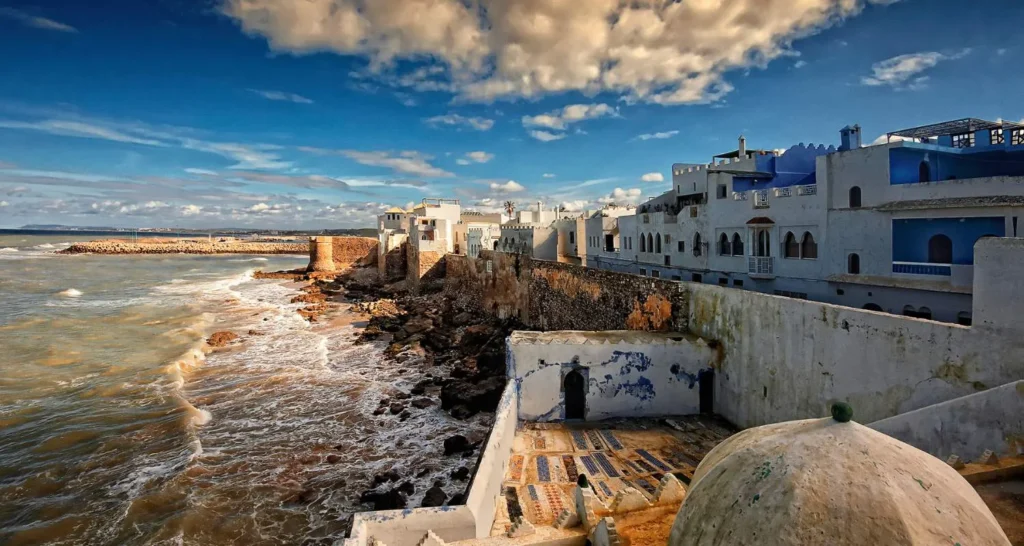
Asilah can be added when you prefer coast and art to a mountain hiking day.
The town offers whitewashed architecture, Atlantic views, fortified walls and murals, creating another contrast with Tangier, Tetouan and Chefchaouen.
Asilah works particularly well before or after Tangier because it stays on the Atlantic side of the route.
5-Day Northern Morocco Route
Five days is enough for the three core cities when you resist adding Fes, Rabat or the Sahara.
A practical structure is:
- Day 1: Tangier medina and Kasbah
- Day 2: Tangier coast or additional city exploration, then Tetouan
- Day 3: Tetouan medina and onward to Chefchaouen
- Day 4: Full Chefchaouen day
- Day 5: Return to Tangier or continue according to your flight
This is a much stronger five-day northern route than trying to include Tangier, Chefchaouen, Fes and several southern destinations.
6-Day Northern Morocco Route
Six days gives you room to add one deeper experience.
Keep the same Tangier–Tetouan–Chefchaouen foundation, then choose either:
- Akchour or another Rif Mountains outing
- Asilah and the Atlantic coast
- An additional night in Chefchaouen
A second Chefchaouen night is particularly useful for photographers and travelers who prefer slower mornings.
7-Day Northern Morocco Route
Seven days is the strongest duration if the north itself is the purpose of the trip.
A balanced week can give Tangier two nights, Tetouan meaningful time and Chefchaouen two nights while leaving one additional day for Rif nature or Asilah.
The original seven-day source emphasizes Tangier’s historic center, Chefchaouen’s medina and mountain scenery, Tetouan’s Andalusian heritage, artisan traditions and regional food. Those themes work better when spread over a full week instead of compressing the north into two transit days.
8–9 Days: Add Fes
With eight or nine days, Fes becomes the most useful major extension.
Chefchaouen and Fes complement each other well: Chefchaouen provides a smaller mountain medina, while Fes offers one of Morocco’s most complex historic urban environments.
Allow at least one full day in Fes, preferably two nights.
Fes El-Bali

The Medina of Fes is UNESCO World Heritage-listed and rewards a slower guided exploration.
Common stops include:
- Bou Inania Madrasa
- The Al-Qarawiyyin area
- Chouara Tanneries
- Traditional craft quarters
- Markets and food streets
Cooking and Artisan Experiences
The merged Chefchaouen–Fes article includes cooking classes and artisan visits.
These experiences fit particularly well when you have a second Fes day rather than trying to complete the medina and a class within one rushed afternoon.
What About the 8–9 Day Routes That Include the Sahara?
Some of the old merged URLs combine Tangier, Chefchaouen and Fes with the Sahara.
That is a different search intent from a northern Morocco route.
Once you leave Fes for Merzouga, the trip becomes a north-to-south Morocco itinerary with substantially longer driving days and a completely different geography.
If that is the journey you want, use the Morocco North-to-South Itinerary. That guide covers Tangier, Chefchaouen, Fes, Merzouga, Todra, Dades, Ait Ben Haddou and Marrakech in the correct route context.
Do not add the Sahara to an eight-day northern holiday simply because an older itinerary title includes the word “desert.” The strongest northern route protects time for Tangier, Tetouan, Chefchaouen and the Rif.
Tangier, Tetouan and Chefchaouen Travel Times
The northern cities are comparatively close by Moroccan road-trip standards.
Tangier to Tetouan is roughly an hour by road under normal conditions. Chefchaouen sits farther into the Rif, and Tangier to Chefchaouen is roughly two hours without substantial stops.
Actual journey time depends on traffic, pickup location, weather and breaks, so avoid building important timed activities immediately after a transfer.
How to Travel Around Northern Morocco
Bus
Intercity buses can work well for travelers following a simple city-to-city route.
Check current schedules directly rather than relying on an old article because departure times change.
Shared Taxi
Shared grand taxis operate on many northern routes and can be useful for shorter journeys.
Understand the departure arrangement, luggage space and whether the vehicle leaves only when enough passengers are present.
Private Driver
Private transport is useful when you want to combine Tetouan with coastal stops, add viewpoints or avoid building the trip around bus departure times.
Rental Car
A rental car provides flexibility, but parking inside historic medinas is generally not the goal. Choose accommodation with realistic vehicle access and plan to explore the old cities on foot.
Train
Tangier connects well with Morocco’s rail network, but Chefchaouen and Tetouan do not form part of the passenger rail route. Road transport is needed for the core northern circuit.
Best Food Experiences in Northern Morocco
The original articles correctly treat food as part of the route rather than an afterthought.
Tangier
The city’s coastal position makes seafood a natural option alongside standard Moroccan dishes.
Chefchaouen
Try regional Rif cooking, breads, tagines and small local restaurants rather than looking for one supposedly definitive “Chefchaouen dish.”
Tetouan
Tetouan’s cuisine reflects the city’s Moroccan and Andalusian history. The merged articles mention tagine, pastilla, pastries and mint tea among the foods worth trying.
Fes
If you extend the journey to Fes, food markets and a cooking class can add another layer to the trip.
Best Time for a Northern Morocco Route
Spring
Spring works particularly well for combining medina walking with Rif Mountain scenery.
Summer
Summer can suit the coast, but midday walking and inland hiking may become hot. Adjust the day rather than assuming northern Morocco is always cool because it is farther north.
Autumn
Autumn is another strong period for city exploration and mountain outings.
Winter
Winter can bring cooler and wetter conditions, particularly around the Rif Mountains.
Carry layers and rain protection when the route includes Chefchaouen or mountain walking.
Where to Stay
Accommodation style can change the feel of the route.
In Tangier, choose between the historic center and accommodation with easier vehicle access in the newer city.
In Chefchaouen, staying close to or inside the medina makes early-morning and evening exploration easier, but check stairs and luggage access.
In Tetouan, an overnight near the medina is useful if you want to experience the city after day-trip visitors leave.
In Fes, a riad within or near Fes el-Bali can provide atmosphere, but arrange arrival carefully because vehicles cannot reach every medina property.
Common Northern Morocco Planning Mistakes
Treating Chefchaouen as a Two-Hour Photo Stop
The town works much better with at least one night.
Skipping Tetouan
Tetouan adds a different architectural and cultural layer from both Tangier and Chefchaouen and belongs naturally on this route.
Adding the Sahara to a Short Northern Trip
Merzouga changes the journey from a compact northern route into a long cross-country itinerary.
Adding Too Many Day Trips
Asilah, Akchour and Fes are all worthwhile, but you do not need all of them on a five-day trip.
Assuming Every Medina Feels the Same
Tangier, Tetouan, Chefchaouen and Fes each have different scale, architecture and atmosphere. Give them enough time to notice those differences.
Ignoring Walking Conditions
Chefchaouen and Rif outings can involve hills, steps and uneven surfaces. Build the route around your actual mobility and fitness.
FAQ
How many days do you need for northern Morocco?
Five days is enough for a focused Tangier, Tetouan and Chefchaouen route. Six or seven days gives you room for Asilah, Akchour or slower stays. Eight to nine days works well when you also want Fes.
What is the best northern Morocco route?
A practical route starts in Tangier, continues to Tetouan and then Chefchaouen. From Chefchaouen, return to Tangier for a short trip or continue to Fes when you have eight or nine days.
Is Tetouan worth visiting if I already visit Chefchaouen?
Yes. The two cities provide different experiences. Chefchaouen is known for its blue medina and Rif Mountain setting, while Tetouan has a UNESCO-listed medina with particularly strong Andalusian architectural and cultural influences.
How long should I stay in Chefchaouen?
At least one night is worthwhile. Two nights is better if you want quiet morning and evening exploration or a separate Rif Mountains or Akchour excursion.
Can I combine northern Morocco with Fes?
Yes. Fes is the most natural major-city extension from Chefchaouen and fits well into an eight- or nine-day route. Allow at least one full sightseeing day in the medina.
Can I combine northern Morocco with the Sahara in one week?
It is technically possible to create a fast route, but it produces substantial driving and changes the focus of the journey. If the Sahara is important, allow more time and use a dedicated north-to-south itinerary rather than compressing Tangier, Chefchaouen, Fes and Merzouga into a northern city break.
Let Northern Morocco Be the Destination
A Northern Morocco travel route does not need the Sahara or Marrakech to feel complete.
Tangier provides the coastal gateway and cosmopolitan history. Tetouan introduces a smaller Andalusian-influenced medina and working craft traditions. Chefchaouen combines a compact old town with the Rif Mountains. Asilah can add the Atlantic coast, Akchour can add nature, and Fes can extend the journey into one of Morocco’s most important historic cities.
Five days is enough for the core three cities. Six or seven days allows a more relaxed northern circuit. Eight or nine days is the right point to add Fes without losing the character of the north.
If your real goal is to continue from Fes to Merzouga and eventually Marrakech, use the Morocco North-to-South Itinerary rather than forcing the Sahara into this northern route.
For broader country-wide route planning, use the Morocco Itineraries guide. If you want a private route adjusted around ferry or flight times, hiking, Fes, accommodation style and your preferred pace, use the custom Morocco trip planner.
Explore destinations, tours and locally organized Morocco experiences with Visit Morocco Together.
Ready to Experience Morocco?
Turn this inspiration into your next adventure. Our travel experts are ready to help.