The easiest way to find accommodation in Morocco is to plan your route first, choose an area that works for your daily activities and transport, then compare individual properties. A riad, hotel or desert camp is only a good choice if its location, room setup, access and booking conditions suit the way you are travelling.
For travelers planning a first visit or a multi-stop journey, the decision is not simply between a riad and a hotel. Morocco also offers hostels, apartments, rural guesthouses, mountain accommodation and Sahara camps. Different types of accommodation can make sense at different points along the same route.
This guide explains how to search, compare and book your stays without relying on photographs or headline prices alone.
Start With Your Morocco Route, Not the Hotel Search
Before opening accommodation listings, decide where you will spend each night. Reserving attractive properties before arranging your route can leave you with unnecessary travel, awkward departures or too little time in the places you most want to explore.
Put your arrival point, departure point and main destinations in a sensible order. Decide how many nights each stop needs, allowing time for travel, meals and rest. Then begin looking at individual properties.
For each overnight stop, think about what you want to do, how you will reach the accommodation with your luggage and how you will leave for the next destination. A central address is useful only when it is central to the places and transport connections you actually intend to use.
For help with the wider route before choosing rooms, browse more Morocco travel planning guides.
Choose the Area Before Choosing the Property
Location affects a Morocco stay in ways that a search result may not explain. In historic medinas, vehicles cannot reach every lane. A riad that appears close to a road on a map may still involve a walk with luggage. A property in a modern city district may have easier road access but require transport to reach the old town.
Compare the complete journey between your accommodation and the places that matter to you. These might include the medina, railway station, beach, hiking departure point or road you will use the following morning. Do not assume that the platform’s definition of the city centre matches your plans.
For a medina stay, ask the property for the nearest vehicle-accessible meeting point and directions to the entrance. When mobility, pushchairs or heavy luggage are a concern, request details about steps, slopes and walking access rather than relying on a general description such as “central” or “accessible.”
Understand the Main Types of Accommodation in Morocco
Accommodation names help narrow your search, but they do not guarantee particular facilities or service standards. Two properties described as riads, guesthouses or luxury camps can offer very different experiences. Check the individual room and location rather than treating the label as a promise.
Riads and Dars
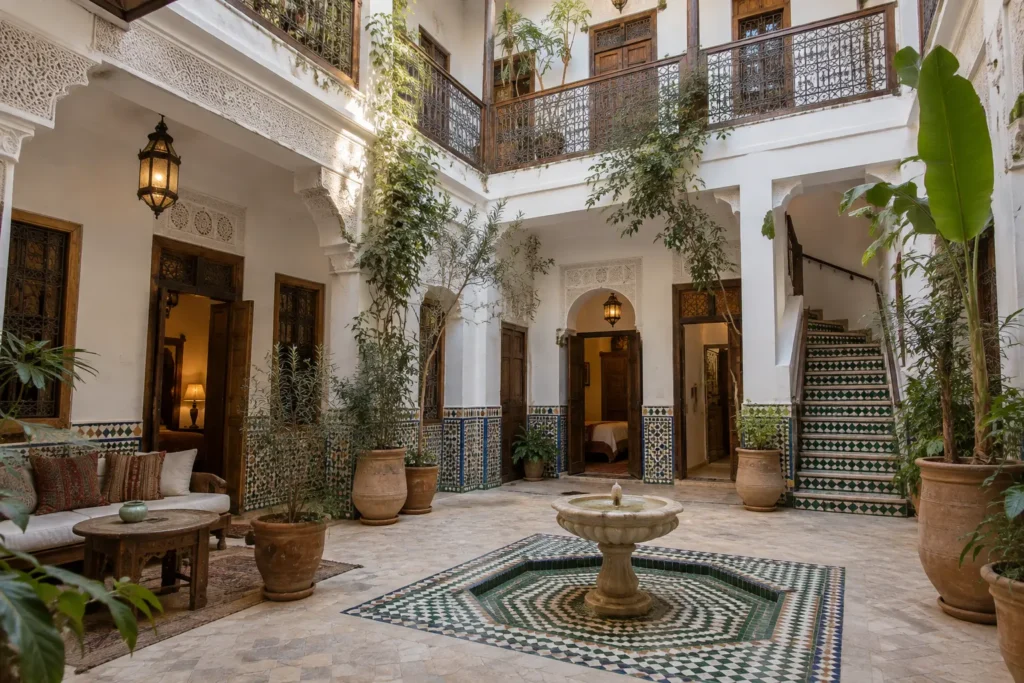
A riad is traditionally arranged around an interior courtyard or garden, and many have been converted into guest accommodation in historic medinas. Listings may also use “dar” for a traditional house or guesthouse. These terms do not tell you whether a property has a lift, swimming pool, restaurant or particular room facilities.
Choose a riad because its location and bedroom suit your plans, not simply because the courtyard photographs are attractive. Ask which floor your room is on, whether it faces a shared space and how many stairs are involved. Confirm heating, cooling and bathroom arrangements for the room category you intend to book.
Hotels and Resorts
Hotels can suit travelers who prefer conventional reception arrangements, road access or specific facilities. Resorts may appeal when spending time at the property is an important part of the holiday rather than simply somewhere to sleep between sightseeing days.
Check the exact location before deciding. A property outside the centre may offer the space you want, but consider the transport needed for meals and excursions. Verify parking, lift access, room configuration and any facilities essential to your stay.
Hostels
Hostels are worth considering for budget-conscious travelers and people interested in a more social stay. Some offer private rooms as well as dormitories, so compare the actual sleeping arrangement rather than assuming every hostel requires sharing a bedroom.
Read the details about bathrooms, luggage storage and late entry. Reviews can also help you judge whether the atmosphere suits your preferred balance between social activity and quiet evenings.
Apartments and Villas
An apartment or villa may work well for a longer stay, a family or a group wanting more living space. Before booking, check the bedroom layout, number of bathrooms and whether the kitchen facilities match your plans.
Understand how check-in works, who to contact if something goes wrong and what cleaning is included. Confirm the precise address and any additional charges rather than comparing the advertised nightly rate alone.
Rural Guesthouses, Auberges and Gîtes
In villages, valleys and mountain regions, accommodation searches may include guesthouses, auberges, gîtes and lodges. Facilities vary, so establish whether your booking includes a private room, a private bathroom and meals.
Location is particularly important outside larger towns. Ask whether a vehicle can reach the property, whether the final approach is on foot and what food or transport options are available nearby. For cooler travel periods, confirm the heating arrangements in the bedroom rather than only in shared areas.
Kasbah and Kasbah-Style Properties
On southern routes, you may encounter accommodation described as a kasbah or kasbah-style stay. Treat this as a starting point for understanding the property’s character, not as a guarantee of its age, facilities or location.
Check road access, the room setup and whether meals need to be arranged in advance. A property outside a town may suit a slower stop, but it should still fit the next day’s journey.
Mountain Refuges
Mountain refuges are a different booking decision from ordinary holiday accommodation. Choose one because it fits the trekking route and your requirements, then confirm sleeping arrangements, shared facilities, meal provision and any bedding you need to bring.
Check current operation and access arrangements for your travel dates. Do not assume that facilities or availability will match those of a village guesthouse.
Sahara Desert Camps

A Sahara camp should be planned as part of the wider desert journey rather than booked as an isolated hotel night. Establish where the camp is, where you meet the operator and how you travel between that meeting point and your tent.
Confirm the bathroom arrangement, bedding, meals, electricity or charging facilities, temperature-control options and luggage handling. Ask about transport both into and out of the camp. A description such as “luxury” is not a substitute for these details.
When activities are offered, check which are optional and whether an alternative transfer is available. An animal activity should not be assumed to be a necessary part of the stay.
How to Search for Accommodation in Morocco
Start with your exact dates and the correct number of adults and children. Availability, room suitability and prices depend on these details, so a general search can create an unrealistic impression of your options.
Use the map alongside the listing page. Look at the property’s relationship to the areas you will visit and the transport you expect to use. Then create a shortlist of a few realistic choices rather than saving dozens of properties that meet only some of your needs.
Large booking platforms can be useful for discovering accommodation, applying filters and reading guest reviews. When a property has an official booking channel, compare that option too. Neither direct booking nor a platform is automatically the better choice.
Compare the same room type, occupancy, meal arrangements and cancellation conditions. A flexible booking with breakfast is not directly equivalent to a non-refundable room-only rate.
Contact the property when an unanswered question could change your decision. A clear response about access, room layout or late arrival is more useful than making assumptions from photographs.
Read Reviews for Practical Information
Reviews are most useful when you look for patterns rather than focusing on the overall score. Repeated recent comments about cleanliness, noise, maintenance or communication deserve more attention than one unusually enthusiastic or disappointed account.
Look for details that relate to your needs. A guest describing the walk from the taxi drop-off point may help you assess luggage access. Comments about courtyard noise, stairs, hot water or room temperature can be more informative than a broad statement that the property was excellent.
Check whether the reviewer stayed in the room category you are considering. Photographs and comments about a suite may not tell you much about the smallest room in the same building.
Give more weight to recent patterns than to an isolated complaint from years ago. Properties can change, and travelers have different expectations.
Compare the Total Cost of the Stay
Accommodation prices vary by destination, dates, occupancy, room type and booking conditions. Rather than relying on a fixed national budget estimate, compare suitable properties for your actual travel dates.
Read the full booking summary to understand what the displayed total includes. Check breakfast or other meals, taxes, additional charges, deposits and payment terms. For apartments, clarify cleaning charges where applicable. For camps, establish whether the necessary transfers are included.
Consider costs created by the location as well. A cheaper room outside your preferred area may require extra transport, while a more expensive property within walking reach of your daily plans may reduce those journeys.
Value also depends on flexibility. When your route is not settled, a refundable booking may be more useful than a lower rate that cannot be changed. Read the conditions for the exact rate you select, including cancellation deadlines and no-show terms.
Confirm the Details That Matter Before Paying
Before committing to a restrictive booking, confirm the practical details that could affect your stay. Start with the room: its floor, bed arrangement, bathroom, heating or cooling and any stairs between the entrance and bedroom.
Next, check arrival arrangements. Ask where a taxi or transfer can stop, how to reach reception and what happens if you arrive late. For a rental-car journey, clarify parking rather than assuming that nearby road access means parking is available.
Families should confirm the room’s permitted occupancy and the availability of any cot or extra bed they need. Travelers with mobility requirements should ask for precise information about entrances, doorways, steps and bathrooms. A general accessibility label may not answer those questions.
Confirm meals, payment methods and the cancellation conditions before paying. Keep important answers with your reservation so you can refer to the agreed details later.
Plan Arrival, Departure and Luggage Together
A good accommodation choice should make both arrival and departure manageable. This matters especially in medinas, where a driver may be able to reach a nearby meeting point but not the property’s door.
Request arrival instructions before travelling and save the address, contact number and meeting point where you can access them without an internet connection. Clarify whether luggage assistance is available and whether it carries an additional charge.
For an early flight, train or road departure, work backwards from the required departure time. Consider the walk to your pickup point and any arrangements needed to leave the property early. A medina stay may still work well, provided those details are settled.
Choose transport according to the journey. Public transport, taxis and private transfers can each be appropriate; booking accommodation does not automatically mean you need a private driver throughout the trip.
Avoid Unnecessary Hotel Changes
Moving accommodation takes more time than checking out. Packing, carrying luggage, travelling and settling into another room can take useful time away from a short stay.
Within one city, a single well-chosen base is often more practical than splitting a few nights between different properties. Change accommodation when it supports the route or creates a genuinely different part of the trip, such as moving from a city stay to a mountain guesthouse.
Do not add a distant overnight stop simply because a property looks appealing. Check that the journey fits the time available, especially when mountain roads or a Sahara route are involved. Merzouga should be planned within a multi-day journey, not treated as a sensible Marrakech day trip.
How Far in Advance Should You Book?
There is no single booking window that suits every Morocco trip. Your dates, destination, preferred property and room requirements all influence how much flexibility you have.
When travel dates are fixed or you need a particular family room, accessible setup or small guesthouse, searching earlier gives you more opportunity to compare suitable options. Do not assume that a specific room will remain available while the rest of the itinerary is being arranged.
When plans are still changing, prioritize appropriate cancellation terms. You can secure a workable option without committing to a restrictive booking that later forces an inconvenient route.
Be Considerate Where You Stay
Treat shared areas and the surrounding neighborhood with the same care as your room. Keep noise down around residential lanes and guesthouse courtyards, follow the property’s guidance on shared facilities and ask before photographing staff or other guests.
In rural accommodation and camps, use water thoughtfully, dispose of waste as instructed and avoid leaving litter outside the property. Small practical choices matter more than assuming that an accommodation label guarantees responsible operation.
Frequently Asked Questions About Morocco Accommodation
Is a riad better than a hotel?
Neither is automatically better. A riad may suit a traveler seeking a medina stay, while a hotel may be more convenient for road access or specific facilities. Choose according to the individual property’s location, room and access arrangements.
Can a taxi take me directly to my accommodation?
That depends on the address. Some medina properties require a final walk from a vehicle-accessible street. Ask the accommodation for its recommended drop-off point rather than relying on a map pin alone.
Is it better to book directly or through a platform?
Compare both where available. The useful differences are the total price, room conditions, payment process, cancellation terms and available booking support. Do not assume one method always offers a lower price or more flexibility.
Should I book every night before travelling?
That depends on how fixed your route is and how specific your accommodation needs are. Reserving key stays can make a structured trip easier, while flexible bookings leave room for adjustments. Avoid leaving an essential room requirement unresolved simply to keep the itinerary open.
Choose Accommodation That Supports Your Whole Trip
To find accommodation in Morocco that works for you, start with the route, narrow the location and compare the actual room rather than the most attractive photograph. Give access, comfort, total cost and booking conditions as much attention as the property’s appearance.
For a multi-city journey, you can plan a custom Morocco itinerary with Visit Morocco Together, using your preferred pace, accommodation style and transport needs as the starting point.
Ready to Experience Morocco?
Turn this inspiration into your next adventure. Our travel experts are ready to help.