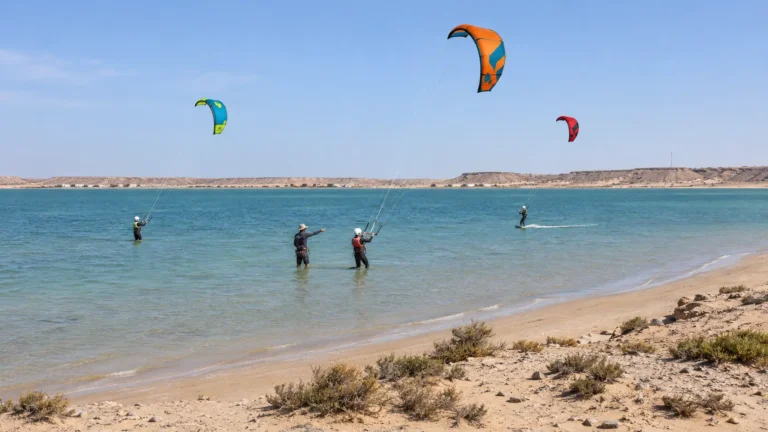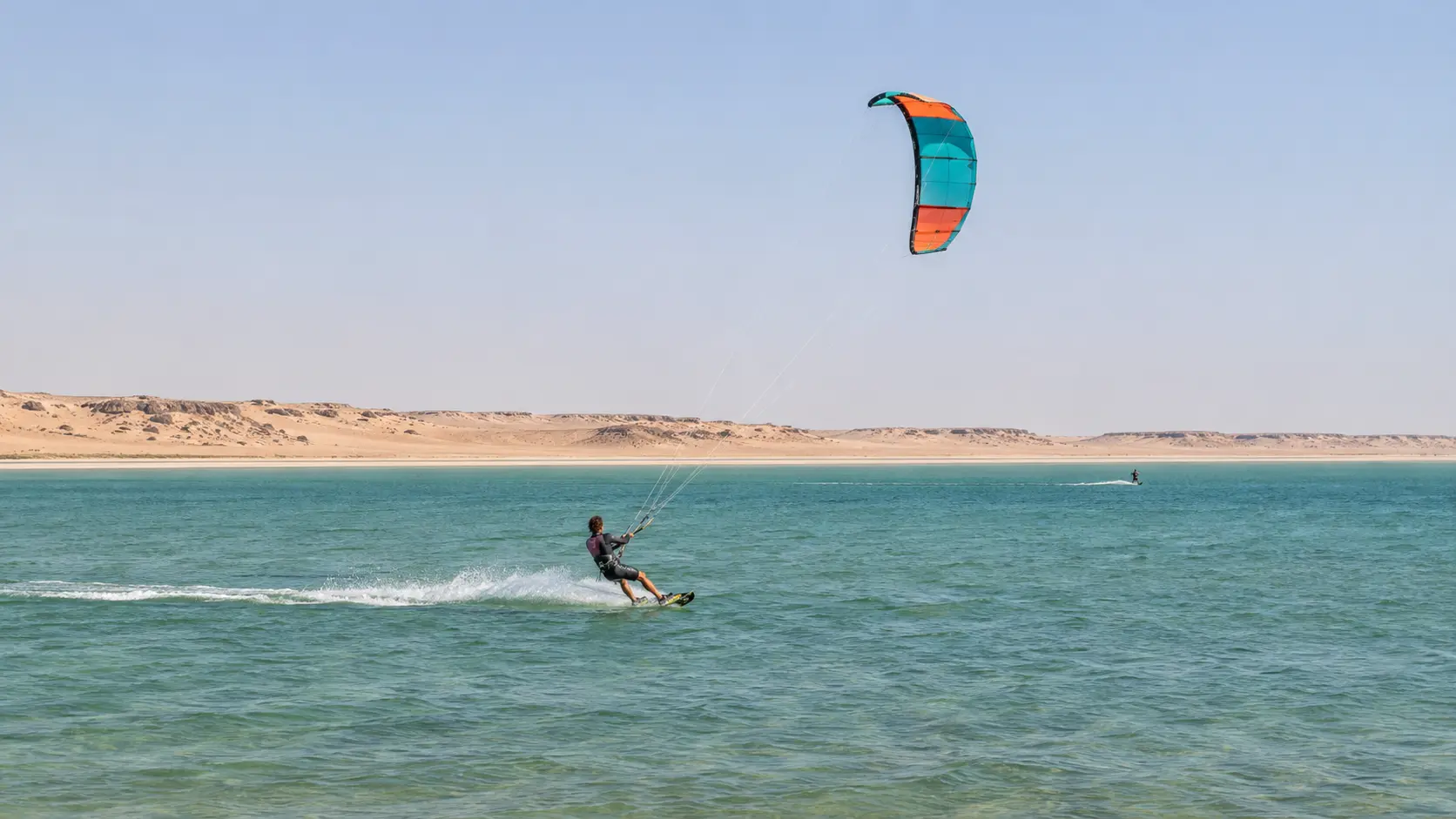
PK25 Dakhla is one of the established kitesurfing areas on Dakhla Lagoon, known for its flat-water riding, shallow sections and convenient access from beachfront watersports centres. Located roughly 25 kilometres north of Dakhla town, it is a practical choice for travellers who want to spend more time on the water and less time travelling between different spots.
The main attraction is the lagoon itself. Compared with Dakhla’s Atlantic-facing beaches, PK25 offers water sheltered from ocean swell, making it suitable for kitesurfing lessons, freeriding and freestyle practice when conditions allow.
However, PK25 is not equally suitable at every tide or wind strength. Water depth changes, sandbanks become exposed, and stronger winds can create choppy conditions. The best approach is to choose an established launch area, check local conditions and confirm what support is available before entering the water.
Where Is PK25 Dakhla?
PK25 takes its name from Point Kilométrique 25, referring to its location along the road from Dakhla. The area sits on the lagoon-facing side of the peninsula, north of the city and away from the breaking Atlantic waves.
The surrounding landscape is largely open desert, with stretches of sandy shoreline and views across the lagoon towards Dragon Island. Several watersports facilities and accommodation providers operate along this part of the coast.
The name PK25 can refer to the wider kitesurfing area or to the beachfront PK25 hotel and watersports centre. These are related but not identical references. When arranging a lesson, rental or transport, confirm the exact meeting point rather than assuming every PK25 operator uses the same entrance or launch.
Nearby lagoon camps, including Dakhla Attitude, also operate their own watersports facilities. Each centre may have different launching arrangements, designated teaching areas and equipment policies.
Why PK25 Dakhla Is Popular for Kitesurfing
PK25 combines three useful features for a kitesurfing holiday: relatively flat water, established watersports infrastructure and accommodation close to the launch areas.
For riders who want regular sessions, this arrangement reduces the need to organise transport every time the wind becomes suitable.
Flat Water for Freeriding and Freestyle
The lagoon is protected from direct Atlantic swell by the Dakhla Peninsula. In suitable conditions, its shallow sections offer smooth water for practising board control, transitions and freestyle manoeuvres.
The water becomes less uniform farther from shore, especially when the wind strengthens or the tide rises. Some areas remain relatively smooth, while others develop short wind-driven chop.
Experienced riders may enjoy longer freeride runs, but the available space depends on water depth, designated activity zones and other users.
Beachfront Launching and Watersports Facilities
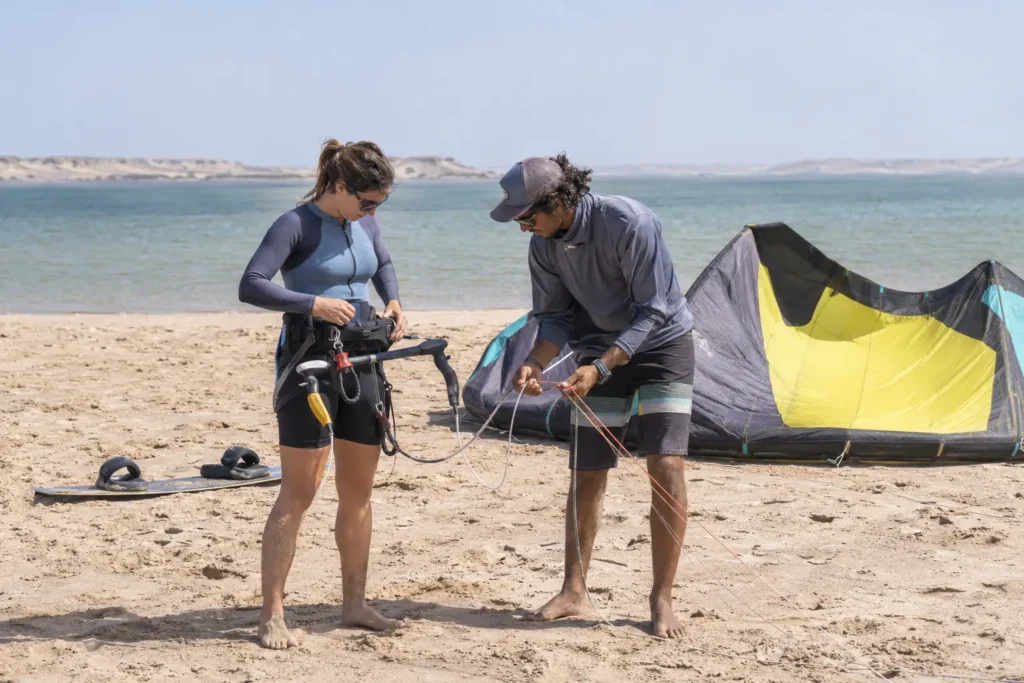
One advantage of PK25 is that established centres operate directly beside the lagoon. The Duotone Pro Center at PK25 provides kitesurfing instruction, equipment rental, storage and beach assistance, alongside other watersports services.
This can be particularly convenient when travelling with equipment or planning several sessions during the same stay.
However, the presence of a watersports centre does not mean that every section of shoreline is an unrestricted launching area. Follow local instructions about kite preparation, launching, landing and movement between teaching zones.
A Riding Area for Different Experience Levels
PK25 attracts beginners, progressing riders and experienced kitesurfers, although they may use different parts of the lagoon.
- Beginners: Established schools can select appropriate teaching areas and supervise the first sessions when wind and water conditions permit.
- Intermediate riders: The lagoon provides opportunities to practise riding upwind, transitions, controlled turns and longer runs.
- Experienced riders: Suitable shallow-water sections can be useful for freestyle, while other areas may offer freeriding and foiling opportunities.
For travellers who have never kitesurfed before, the separate guide to Dakhla kitesurfing lessons for beginners explains instruction, safety skills and how to choose a school. This PK25 guide focuses instead on the location, water access and practical conditions of the spot.
PK25 Dakhla: Lagoon Access, Water Depth and Tides
The tide is one of the most important factors when planning a session at PK25. It changes how far the water extends towards shore, how much space is available for riding and which shallow areas are suitable for different equipment.
What Happens at Low Tide?
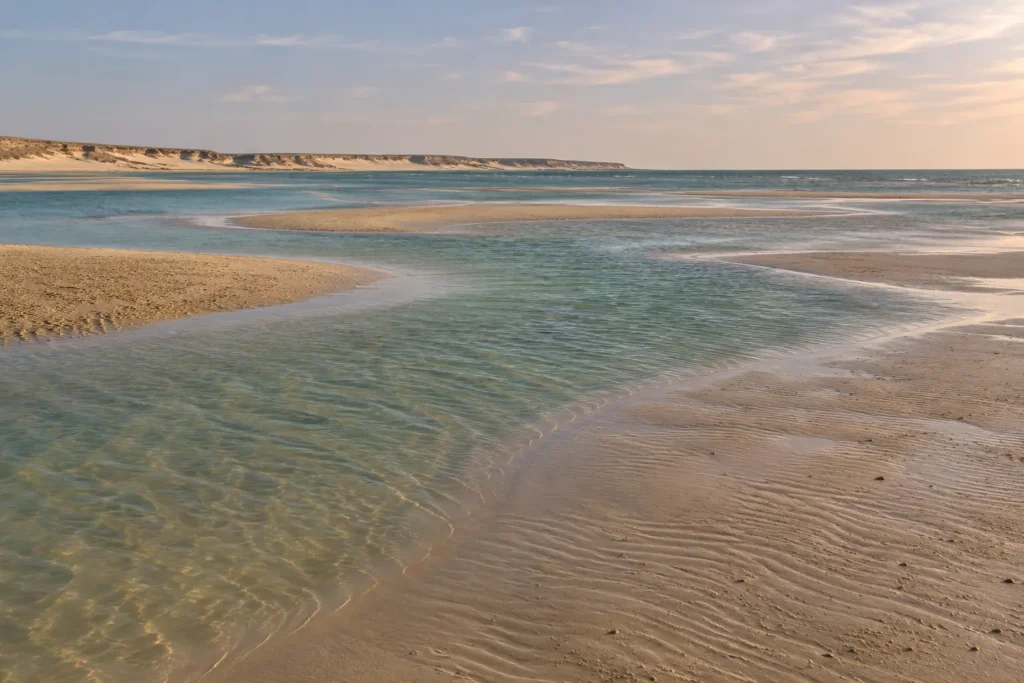
As the tide falls, sandbanks and shallow sections become more exposed. Some remaining water areas can be exceptionally flat, which is attractive for certain riding styles.
However, low tide can also make launching less convenient. Riders may need to walk farther before reaching sufficient depth, and some areas become too shallow for normal board riding.
Exposed sand, shells and rocky sections can present hazards when carrying equipment or walking barefoot. Hydrofoil users need particular care because their equipment requires more water depth.
Do not assume that lower tide always means better riding. The most useful water level depends on the equipment, intended session and exact launch point.
What Happens at High Tide?
Higher water levels cover more of the lagoon’s sandbanks and can make it easier to reach deeper riding areas from suitable launches.
The trade-off is that open sections may become choppier, especially in stronger wind. Water that was shallow enough to stand in earlier can also become significantly deeper.
For learners, the local instructor should determine whether the depth and available space are appropriate. Independent riders should check the tide before setting up rather than relying on previous sessions.
Is the Lagoon Shallow Everywhere?
No. Although PK25 is known for extensive shallow-water areas, deeper sections and channels exist within the wider lagoon. Water depth also changes throughout the tidal cycle.
Being able to stand near the launch does not mean you can stand throughout your riding area.
All riders should be comfortable in the water, understand their equipment’s safety systems and know how to respond if they cannot return directly to shore.
Wind Conditions and the Best Time to Visit PK25
Dakhla benefits from frequent wind associated with the Atlantic coastline and the surrounding desert landscape. At PK25, northerly and northeasterly winds commonly create suitable kitesurfing conditions, depending on the exact launch area.
The local wind angle matters as much as the wind speed. A direction that works well at one section of the lagoon may be less suitable at another.
Spring and Summer
From roughly spring through early autumn, Dakhla generally experiences more frequent and stronger winds. This makes the period attractive for travellers planning a kitesurfing-focused holiday.
However, the stronger wind that appeals to experienced riders can be demanding for beginners. Particularly energetic summer conditions may require smaller equipment, more careful session planning or postponement of lessons.
Wind can also strengthen during the day, so morning and afternoon conditions may differ considerably. Do not assume that one particular hour will always provide the best riding.
Autumn and Winter
Kitesurfing remains possible outside the main windy period, but conditions can be less consistent. Autumn and winter may bring lighter wind days and cooler conditions on the water.
This can appeal to travellers who prefer a quieter atmosphere and are willing to adjust their sessions around the forecast.
If you are booking accommodation primarily to kitesurf, allow flexibility rather than expecting every day to be rideable. Check the latest wind forecast, tidal information and local recommendations before travelling to the launch.
How to Reach PK25 from Dakhla Town
PK25 is reached by road from Dakhla, making it accessible for travellers staying in the city as well as those using lagoon-side accommodation.
The most practical option depends on whether you are visiting for one session, carrying personal equipment or staying at a watersports camp.
- Accommodation transfer: Some lagoon-side properties arrange airport or city transfers. Check whether transport is included in your booking or charged separately.
- Taxi or prearranged driver: A useful option for a day visit without your own vehicle. Confirm the exact destination, fare and return arrangements before departure.
- Rental car: Offers flexibility if you are staying in town and visiting several locations. Follow established roads and access tracks rather than driving across exposed lagoon flats.
- Watersports-centre shuttle: Some operators offer transport arrangements for riders staying elsewhere. Confirm eligibility, pickup location and charges directly with the centre.
Travellers planning a day visit should contact their chosen watersports centre beforehand. Ask whether non-residents can use its launch, equipment storage, changing facilities and beach assistance.
Do not assume that arriving at the general PK25 area automatically provides access to a hotel’s private facilities or supervised riding services.
Do You Need to Stay at PK25 to Kitesurf There?
Staying beside the lagoon can be convenient, but it is not necessarily required to arrange a session in the PK25 area.
The beachfront PK25 accommodation offers the advantage of being close to the water, with an established watersports centre nearby. Other lagoon camps provide alternative accommodation and launch arrangements.
For travellers whose main goal is kitesurfing, a lagoon-side stay can reduce repeated transport planning and make it easier to rest between sessions.
Staying in Dakhla town may suit travellers who prefer a wider choice of restaurants and services or want to combine watersports with time exploring the city.
The trade-off is additional travel to and from the lagoon. If you intend to ride daily, consider that journey when comparing accommodation rather than looking only at room prices.
For independent riders visiting PK25 without staying overnight, confirm whether a day-use arrangement is available and what it covers. Launch assistance, rescue support, storage, showers and equipment rental should never be assumed to be included together.
Equipment Rental, Wingfoiling and Other Riding Options
PK25 is primarily associated with kitesurfing, but its watersports infrastructure also supports other wind-powered activities.
Kitesurf Equipment Rental
Established centres offer kiteboarding equipment for suitable riders. Rental may include different kite sizes, boards and accessories, with equipment selection depending on wind conditions and ability.
Independent rental generally requires sufficient experience. A provider may assess your ability to ride safely, stay upwind and handle the equipment before approving an unsupervised session.
Travellers bringing their own equipment should ask about storage, launching assistance, beach-service requirements and any related fees.
Wingfoiling and Kitefoiling
Wingfoiling and kitefoiling are also offered through watersports facilities in the PK25 area.
Foiling brings an additional consideration: the foil must have sufficient clearance beneath the board. A shallow section suitable for a twin-tip kiteboard may be unsuitable for a hydrofoil.
Ask the centre which areas and tide stages are appropriate for your equipment. Beginners to foiling should seek instruction rather than assuming previous experience with another watersport is enough.
Safety and Local Rules Before Launching
PK25’s sheltered lagoon setting is useful for kitesurfing, but it should not be confused with a controlled swimming pool. Wind direction, changing depth, equipment and other riders all affect safety.
Before launching, confirm the following:
- Designated launch area: Find out where kites can be prepared, launched and landed without interfering with lessons, pedestrians or other equipment.
- Wind direction: Confirm whether the actual wind angle is suitable and whether any sections present an offshore drift risk.
- Tidal conditions: Check for exposed sandbanks, rocky areas, shells and deeper water beyond the standing zone.
- Rescue arrangements: Ask whether boat assistance covers your planned riding area, during which hours it operates and whether access is included in your booking.
- Other water users: Respect teaching zones, give beginners room and follow established kitesurfing right-of-way rules.
- Equipment suitability: Use gear appropriate for the actual wind, your weight and experience. Check safety systems before entering the water.
Strong sunlight, wind exposure and time in the water can also make long sessions tiring. Bring drinking water and sun protection, and ask the centre about appropriate wetsuit protection for the season.
Respect the lagoon environment by keeping clear of sensitive wildlife areas and working sites, including oyster-farming zones. Use designated access routes, avoid damaging exposed tidal flats and take litter away from the shoreline.
PK25 Compared with Other Dakhla Kitesurf Spots
PK25 is one of several riding locations around Dakhla, but it is important to understand that they do not all offer the same conditions or access arrangements.
PK25 vs. Speed Spot
Speed Spot is known for particularly flat water that can appeal to experienced freestyle riders. Its layout and usable riding areas are tide-dependent, and access may require a planned excursion.
PK25 is generally more straightforward as a regular base because established accommodation and watersports centres are positioned beside the lagoon.
If you want to explore Speed Spot, arrange the route, riding requirements and return transport with a local operator rather than treating it as an ordinary extension of your PK25 session.
PK25 vs. Atlantic Ocean Surf Spots
PK25 is a lagoon destination. It is not an ocean wave-riding beach.
Travellers interested in Atlantic waves should consider separate locations on the ocean-facing side of the Dakhla Peninsula, such as Foum El Bouir. These spots have different swell, current and shoreline conditions.
Do not assume that equipment, instruction or skills suited to flat-water kitesurfing automatically transfer to ocean wave riding.
What If You Are Not Interested in Kitesurfing?
The wider Dakhla Lagoon offers alternatives such as kayaking, passenger boat trips and other water-based outings, depending on the operator and conditions.
For a broader comparison, see the guide to Dakhla Lagoon activities, including kitesurfing, kayaking and boat trips. It helps travellers choose an experience rather than focusing on a particular launch location.
Practical Tips for Planning a PK25 Visit
A successful visit depends more on the conditions and arrangements at the water’s edge than on fitting several attractions into one day.
- For a single session: Confirm the centre’s meeting point, tidal window, equipment requirements and return transport before leaving Dakhla town.
- For a multi-day kitesurfing stay: Consider accommodation near your preferred launch, but keep time available for wind changes and rest.
- For independent riders: Verify the exact access and rescue arrangements rather than assuming services are included because a centre operates nearby.
- For travellers with non-kiting companions: Check whether your chosen accommodation provides comfortable spaces away from the wind and suitable activities for those who will not ride.
- For travellers with mobility requirements: Ask about the route from accommodation or parking to the water, sand conditions and available assistance. Do not assume every beachfront facility provides step-free access.
It is worth keeping the day flexible. The ideal riding window may not match your preferred meal or sightseeing schedule, and a session can be postponed if conditions become unsuitable.
FAQs
Is PK25 Dakhla Good for Beginners?
It can be suitable for beginner kitesurfing lessons when an established school identifies an appropriate teaching area. Shallow water is helpful, but wind strength, water depth and other riders still need to be assessed.
Can You Visit PK25 Without Staying at the Hotel?
A day visit may be possible through local watersports arrangements. Contact the chosen centre before travelling to confirm whether non-residents can access its facilities, rent equipment or use beach and rescue services.
Is PK25 Always Flat Water?
No. Shallow areas can provide smooth water, but stronger wind and higher tides can create chop. Low tide may expose sandbanks and reduce the available riding depth.
Can You Rent Kitesurfing Equipment at PK25?
Yes, equipment rental is offered by established watersports operators in the area. Independent rental normally depends on your riding ability and the provider’s requirements. Check current equipment availability and rental conditions in advance.
Is PK25 the Same as Dakhla Attitude?
No. PK25 and Dakhla Attitude are associated with nearby lagoon-side accommodation and watersports facilities, but they are distinct locations. Confirm which property or centre your booking refers to, including its specific launch and meeting point.
Choose PK25 for Convenient Lagoon Riding
PK25 Dakhla is a practical choice for riders who want established lagoon access, flat-water opportunities and facilities close to their accommodation. Its main advantage is not that the wind and water are always perfect, but that several aspects of a kitesurfing stay can be organised around one accessible riding area.
If your priority is regular kitesurfing, choose the launch and support arrangements that match your experience. Check the tide, follow the local team’s guidance and leave room to change the day’s plan when conditions require it.
For help understanding how PK25 fits with the peninsula’s ocean beaches, lagoon experiences and other attractions, explore the Visit Morocco Together Dakhla destination before planning the rest of your stay.
Ready to Experience Morocco?
Turn this inspiration into your next adventure. Our travel experts are ready to help.