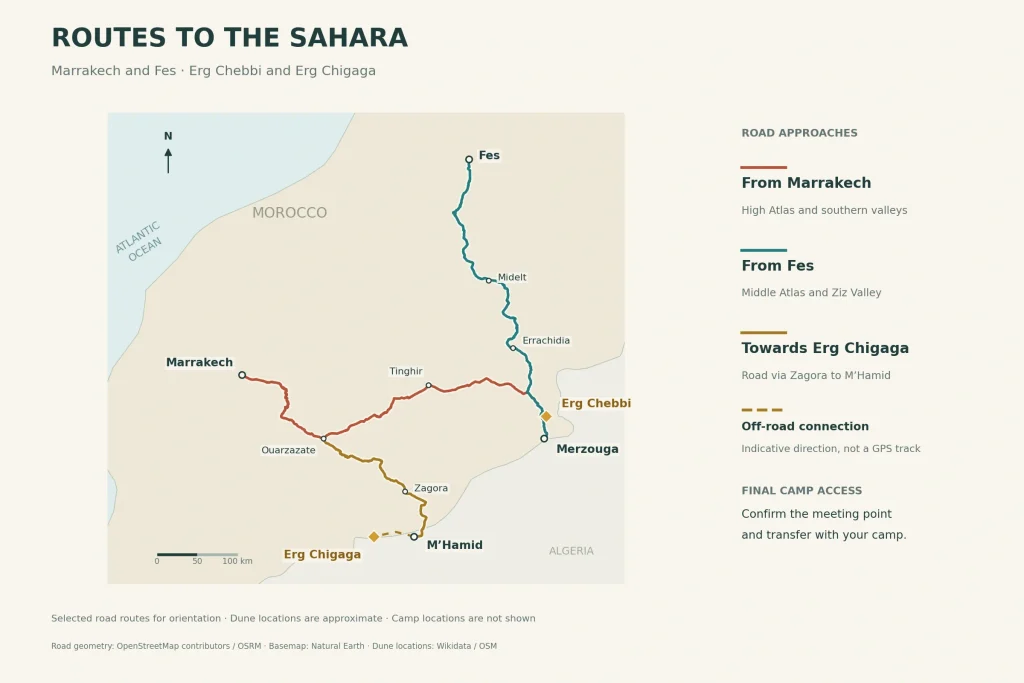
How to reach the Sahara Desert depends first on which dunes you want to visit. For Erg Chebbi, travel to Merzouga from Marrakech or Fes, then join the transfer arranged by your camp. Fes has the shorter road approach; Marrakech offers a longer route through the High Atlas and southern valleys. For Erg Chigaga, plan around M’Hamid and a separate off-road journey.
Neither dune area makes a practical road day trip from Marrakech or Fes. A three-day Merzouga journey from Marrakech is a fast option, while four or more days give you more room to break up the driving. A two-day return from Fes is possible, but it means two long travel days around one camp night.
The useful comparison is your entire journey: city pickup, road or flight, arrival in the desert gateway, camp transfer and onward departure. When weighing your options for getting around Morocco, include those final connections. A cheap ticket that leaves you far from your accommodation may cost more time and money than you expected.
Choose your Sahara destination before choosing transport
Merzouga and Erg Chebbi
Merzouga is a gateway village beside Erg Chebbi, the dune field used by many desert itineraries connecting Marrakech and Fes. Nearby settlements, including Hassilabied, also serve accommodation around the dunes.
A booking described simply as “Merzouga” could mean a village hotel, a guesthouse facing the sand or a camp reached by an additional vehicle journey. Ask for the accommodation’s location and its meeting point before arranging transport.
Erg Chebbi fits naturally into a route that approaches from one city and continues to the other. It also works as a return journey from either city, provided you allow enough time for both road legs.
M’Hamid and Erg Chigaga
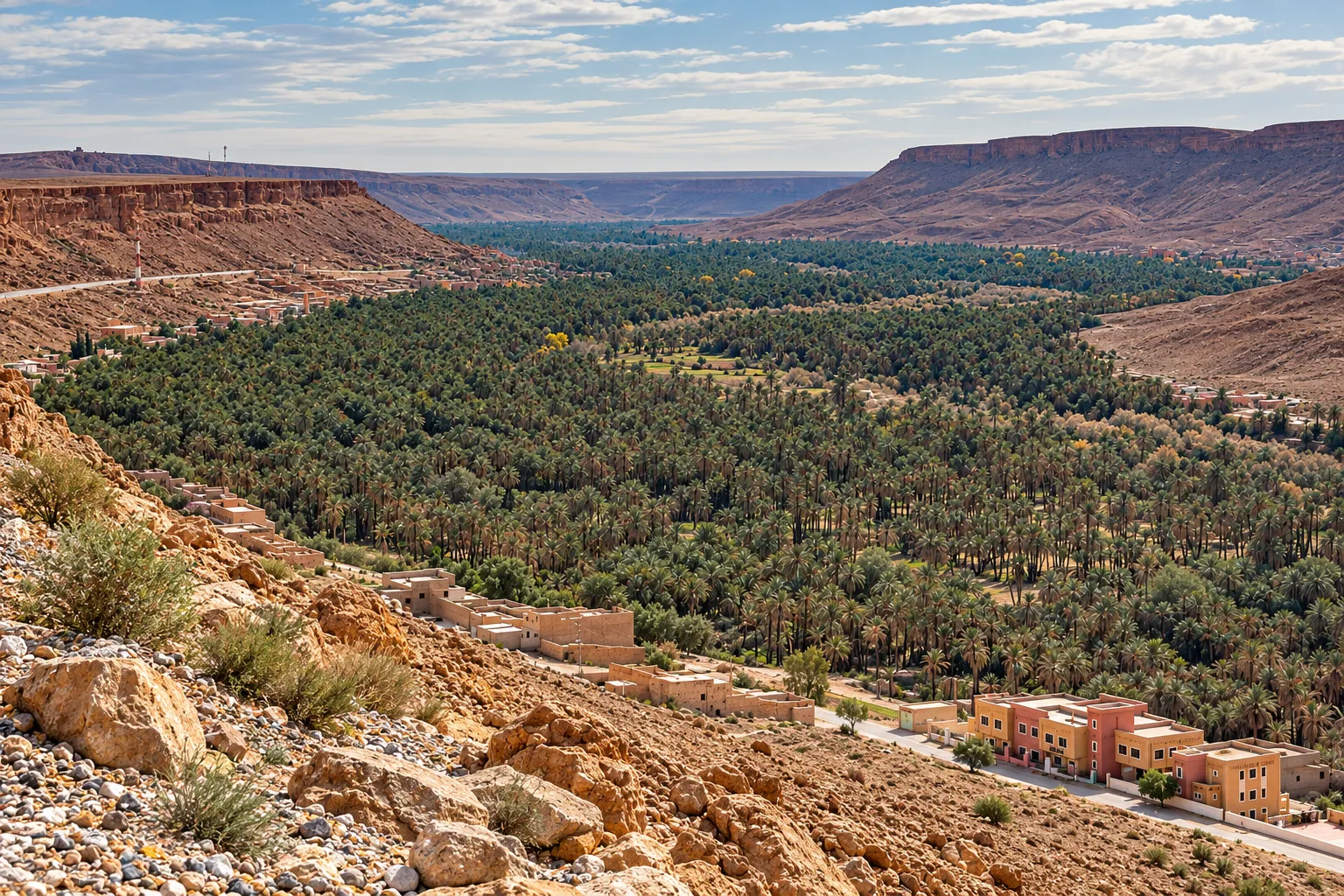
Erg Chigaga lies in a different direction. A common approach from Marrakech goes through Ouarzazate, Agdz and the Draa Valley toward Zagora and M’Hamid. From M’Hamid, reaching the main dune area involves an off-road journey that should be arranged with the camp or an experienced local operator.
A coach ticket to Zagora does not get you to Erg Chigaga. You still need the onward road connection and desert transfer. A camp near M’Hamid may also be much closer than one at Erg Chigaga, so the village name alone does not establish the journey time.
Fes is more conveniently placed for Merzouga than for this southwestern desert route. Choose Chigaga from Fes because it fits a longer southern itinerary, rather than assuming it is an alternative stop near Erg Chebbi.
Agafay is a different experience
Agafay is a rocky landscape near Marrakech. It can suit an evening excursion or an overnight stay when you have little time, but it does not provide the Sahara sand dunes found at Erg Chebbi or Erg Chigaga.
The landscape differences matter before you compare package prices. Our Sahara Desert travel guide explains the dune areas and the types of stays you can build around them.
How to reach the Sahara Desert from Marrakech
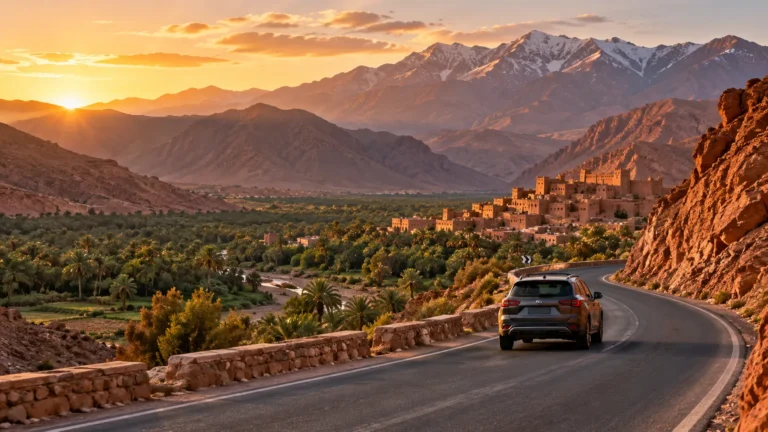
The usual road approach to Merzouga crosses the High Atlas, continues through the Ouarzazate region and travels east toward the dunes. Depending on your itinerary, stops can include Aït Benhaddou, the Dadès Valley and Todra Gorge.
Allow roughly nine to ten hours or more of driving between Marrakech and Merzouga, before substantial sightseeing and meal stops. The exact journey depends on your pickup address, chosen roads, traffic and conditions. A long visit to a ksar or gorge cannot simply be added without changing the arrival time.
For most visitors, dividing the outward journey across two days makes more sense than trying to reach camp straight from Marrakech.
Where to break the journey
Ouarzazate gives you an earlier overnight stop after the mountain crossing. This can suit a later departure or more time around Aït Benhaddou, but leaves a longer onward stage.
The Dadès Valley takes you farther east on the first day. It is a common overnight choice on shorter desert itineraries, though reaching it still involves a substantial day on the road.
The Tinghir and Todra area puts you closer to Merzouga. That can ease the following stage, provided the first day has not become an overloaded list of visits.
Choose the overnight location by balancing the two driving days. A hotel described as “between Marrakech and the desert” could be anywhere along a very long corridor.
What a three-day trip actually involves
A typical three-day pattern is:
- Cross the High Atlas and stay in the southern valleys.
- Continue toward Merzouga and spend the night at camp.
- Leave the dunes and travel back to Marrakech or onward to Fes.
That is two nights away, usually with only one at camp. The last day can be particularly long. If your priority is more time in the dunes, check whether an extra day adds a second desert night or only another hotel along the road.
A private vehicle can give you control over stops, but it does not shorten the distance. Children, motion sickness and an interest in photography can all justify a slower schedule.
How to reach the Sahara Desert from Fes
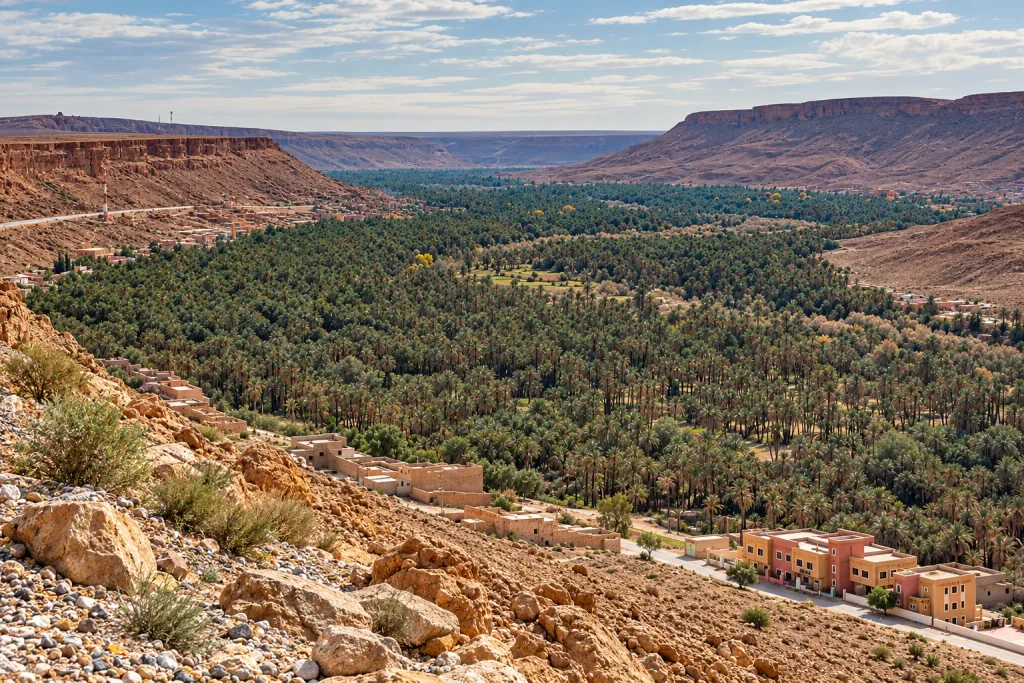
From Fes, the road toward Merzouga usually passes through the Middle Atlas, the Midelt region and the Ziz Valley before continuing through the Tafilalet area toward the dunes.
Think of it as a full travel day. Around seven to eight hours of driving is a useful starting estimate, with breaks and visits extending the journey. The shorter distance compared with Marrakech does not make Merzouga a nearby excursion.
Ifrane, the cedar forest area and valley viewpoints can provide breaks, but there is no need to stop everywhere. If reaching camp before its afternoon departure matters, agree on the day’s priorities before leaving Fes.
Is a two-day return from Fes worthwhile
It can work when one camp night is your main goal and you accept substantial driving on both days. It suits travelers who prefer a short, organized visit over managing several separate transport bookings.
Visit Morocco Together’s two-day Sahara trip from Fes lists return transport, a camp night, camel rides, dinner and breakfast, with an advertised starting price of €329 per person. That makes €658 for two adults at that starting rate, before lunches, drinks and personal spending. Confirm the selected camp option, departure and final price; the itinerary remains road intensive.
Adding another night near the dunes can give you a morning without an immediate return departure. Alternatively, continue toward Marrakech over several days and use the desert as part of your route across Morocco.
Continue from Marrakech to Fes through the desert
A one-way desert itinerary can connect two cities you already want to visit. It avoids returning along the same road, but it should be treated as a multi-day journey with overnight stops.
A Marrakech–Fes transfer by a direct intercity route and a Marrakech–Merzouga–Fes desert itinerary are different products. Check the actual route before interpreting a journey time or comparing a transfer price with a camp package.
For a practical comparison, Visit Morocco Together’s four-day Marrakech to Fes journey through the Sahara adds a Midelt-area night after the camp stay. The listed starting price is €849 per person, or €1,698 for two adults at that rate, including three accommodation nights, breakfasts, dinners and the stated transport and camel arrangements. Lunches, drinks and applicable entrance fees are extra. Confirm whether you are booking the group departure or a private arrangement.
That extra overnight changes where you rest. It does not automatically provide a second camp night. Read the nightly sequence alongside the headline duration.
The reverse direction can work too. Match it to your flights and the availability of the particular departure, rather than assuming every itinerary operates both ways. A trip with different arrival and departure cities can help you avoid crossing the country again just to reach your flight home.
Taking a bus to Merzouga
Public coaches are useful if you want to arrange your own accommodation and can work around the timetable. They provide transport between scheduled stops; they do not include a guided road itinerary or access to a camp.
Supratours lists Merzouga within its network, including connections involving Marrakech and Fes. Search your exact travel date and direction before booking. A destination appearing on a network page does not establish a departure time or seat availability.
From Marrakech, expect a long coach journey that can occupy most of the day. On routes with an overnight departure, consider how well you sleep on buses and what you will do on arrival.
Confirm the destination printed on the ticket
Merzouga, Rissani, Erfoud and Errachidia are separate places. A ticket ending in one of the larger towns can leave you with a further road journey before you reach your guesthouse or camp meeting point.
Before payment, establish:
- The departure terminal and the time you must arrive there.
- The exact arrival stop and whether accommodation pickup is available.
- The scheduled arrival time and the camp’s latest transfer time.
- Luggage arrangements and any separate baggage charge.
- The return or onward service you will need after the stay.
Send the arrival details to your accommodation and request an agreed meeting point. An unfamiliar stop after dark is a poor place to discover that neither party arranged collection.
Plan for early and late arrivals
An early arrival does not necessarily include immediate access to a hotel room, breakfast or a shower. Ask whether luggage storage, a waiting area or paid early check-in is available.
A late arrival may miss the camp’s usual departure. Agree in advance whether a later vehicle transfer is possible, whether it costs extra or whether you should stay in the village that night.
The wider decisions about terminals, baggage and separate connections are covered in our explanation of CTM and long-distance bus travel in Morocco. For this journey, the crucial extra step is joining the coach arrival to the camp’s own transport.
Flying closer to the dunes through Errachidia
Errachidia Airport, code ERH, is a useful gateway for Erg Chebbi. You still need a road transfer toward Merzouga, commonly around two hours depending on the meeting point, followed by whatever access your camp requires.
Ryanair lists Marrakech to Errachidia flights. Availability and operating days vary, so check the actual flight before arranging a camp stay around it. Royal Air Maroc also lists Casablanca–Errachidia flights, which may be relevant to a wider itinerary or a suitable connection.
Compare the complete door-to-door plan:
- Transport to the departure airport and the required check-in time.
- Any connection and waiting time.
- Checked baggage charges.
- Collection at Errachidia Airport.
- The road journey and final camp transfer.
- Accommodation if the flight arrives too late for your intended camp experience.
Flying can reduce driving, particularly when a direct flight fits your plans. It also skips the southern valleys or Middle Atlas scenery you would otherwise pass through.
One useful compromise is to drive one direction and fly the other. This works only when the flight schedule, transfer and onward plans fit together.
Ouarzazate and Zagora are other airports to consider for southern Morocco, but neither puts you at the Erg Chebbi dunes. Choose the airport for the camp’s location and onward road journey, rather than the word “desert” in a destination description.
Renting a car or arranging a driver
A rental car gives you flexibility along the paved approach roads. You do not generally need a 4×4 simply to reach Merzouga village, although weather, roadworks and your chosen accommodation can change the practical requirements.
Get the camp’s arrival instructions before navigating there. A map pin may point across sand or along a track unsuitable for your vehicle. Confirm where you can park, whether there is a charge and who will transport you onward.
For a one-way rental, check the permitted return location and drop-off fee before building the itinerary. A vehicle collected in Marrakech cannot automatically be returned in a small desert town.
With a driver, specify the full service: city pickup, overnight stops, camp meeting point, waiting arrangements and final drop-off. Ask whether the quotation covers the driver’s overnight costs and the vehicle for the entire itinerary.
A driver is not automatically a licensed guide for every monument, and a private transfer does not automatically include entrance fees or camp accommodation. Ask for an itemized description so you can compare the same services across quotations.
Reaching Erg Chigaga through M’Hamid
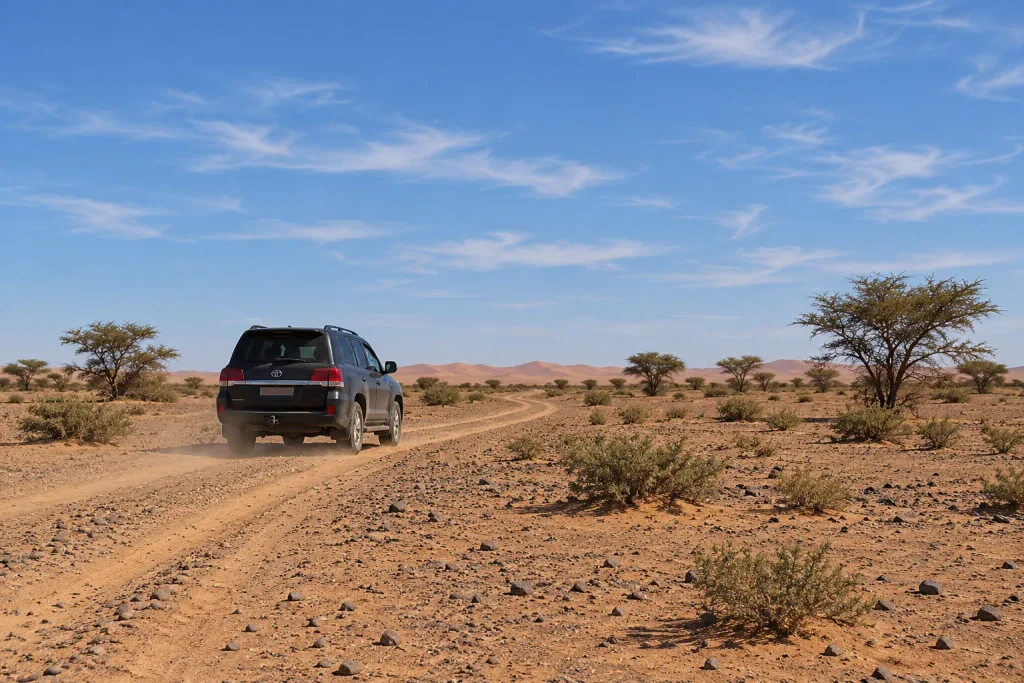
For Erg Chigaga, build the journey around M’Hamid and the off-road section. From Marrakech, a staged route through the High Atlas, Ouarzazate and the Draa Valley gives you places to stop before reaching the desert gateway.
Ask the camp where its vehicle collects guests and how long that particular transfer takes. Some Chigaga journeys involve around two hours off-road from M’Hamid, but the camp location and route determine the actual timing.
This section is not equivalent to a short taxi ride at the end of a paved road. Passengers should understand the vehicle type, expected ride and luggage arrangements before choosing the stay.
If self-driving, leave the rental vehicle at the agreed parking location and use the arranged desert transport. Do not attempt to follow an unfamiliar sand track because a navigation app proposes it.
A route entering or leaving through Foum Zguid may be possible with an appropriate local arrangement. Agree on that itinerary from the start; it is not an interchangeable pickup point for a booking based in M’Hamid.
Arrange the final transfer to your camp
The last connection deserves its own confirmation, even when the city-to-desert transport is already booked.
Ask the camp for:
- A named meeting point with a map location and contact number.
- The meeting time and what happens if you are delayed.
- The vehicle or walking and riding arrangements from that point.
- Confirmation of which transfers are included in the price.
- The place and time you will return to after the stay.
Camel riding should be discussed separately from reaching the accommodation. If you prefer a vehicle, ask whether the selected camp offers it and whether the alternative costs extra. Do this before booking, especially if a camel ride is part of the advertised package.
For accessibility needs, request specific information about vehicle boarding, walking on sand, tent access and bathrooms. A vehicle transfer alone does not establish that the accommodation is accessible.
Keep medication, documents, water and a warm layer with you. Ask whether your main suitcase travels to camp or stays at the meeting-point property, and how storage is handled.
Build a realistic arrival and departure buffer
If you want a sunset experience, work backward from the camp’s meeting time. A late city departure, extended lunch or extra sightseeing stop can use the available daylight before you reach the dunes.
Mountain roads and desert approaches can be affected by snow, heavy rain, flooding, heat or poor visibility. Check the conditions for the whole route with your transport provider; clear weather at your city hotel does not establish conditions along the journey.
Leave room for a change of plan. Staying at a gateway guesthouse and joining the camp later can be more practical than forcing a delayed transfer.
Protect your departure as well. Avoid placing a long desert-to-city drive immediately before an important flight. An overnight in your departure city gives you more margin and a chance to rest.
For the journey itself, comfortable layers, closed shoes, sun protection, drinking water and a small overnight bag are useful. Your packing choices for Morocco should account for both mountain breaks and the camp, rather than only the temperature in Marrakech or Fes.
Questions about getting to the Sahara
Is Marrakech or Fes closer to the Sahara
Fes has the shorter road approach to Merzouga and Erg Chebbi. Marrakech fits the southern route through the High Atlas and Ouarzazate and is more conveniently placed for a journey toward M’Hamid and Erg Chigaga. Choose the dune area first.
Can you take a train to Merzouga
There is no passenger train to Merzouga. Trains can cover another part of your Morocco itinerary, but reaching the dunes requires road transport, or a flight to a suitable airport followed by road and camp transfers.
Can you visit the Sahara in one day from Marrakech
A return road trip to Erg Chebbi or Erg Chigaga is not a practical day excursion. Agafay offers a much nearer desert-style landscape, but it is a different destination with rocky terrain.
Do you need a 4×4 for Merzouga
The paved approach to Merzouga generally does not require one. Access from the village or another meeting point to your particular camp may require an arranged desert vehicle. Get the camp’s instructions before driving beyond the paved road.
Can a bus take you directly to a desert camp
An intercity coach takes you to its scheduled stop. Arrange the onward connection with the camp and confirm the price, meeting point and timing. Do not assume a village arrival includes collection.
Is one night at camp enough
One night can fit a short visit, but it leaves limited time between arrival and departure. Two nights may suit you if you want a full day near the dunes. Check the nightly itinerary because a four-day tour can still include only one camp night.
Can you get to camp without riding a camel
Some camps arrange vehicle access, but the availability, price and meeting point vary. Request that option before booking rather than assuming you can change the transfer when you arrive.
Ready to Experience Morocco?
Turn this inspiration into your next adventure. Our travel experts are ready to help.