What to pack for Morocco depends on your route, the season and what you will do between hotel stays. Start with comfortable walking shoes, clothing you can layer, sun protection, personal toiletries, essential documents and the chargers you actually use. Then add items for a desert night, mountain walk or water activity only if they belong in your itinerary.
A short Marrakech break needs a different bag from a journey through Fes, the Atlas Mountains and Merzouga. You do not need a separate wardrobe for every destination, but you do need to prepare for the conditions and activities on your route.
The most useful packing list separates everyday essentials from activity-specific additions. Use your Morocco trip planning guide and confirmed bookings to decide which sections below apply.
What to pack for Morocco at a glance
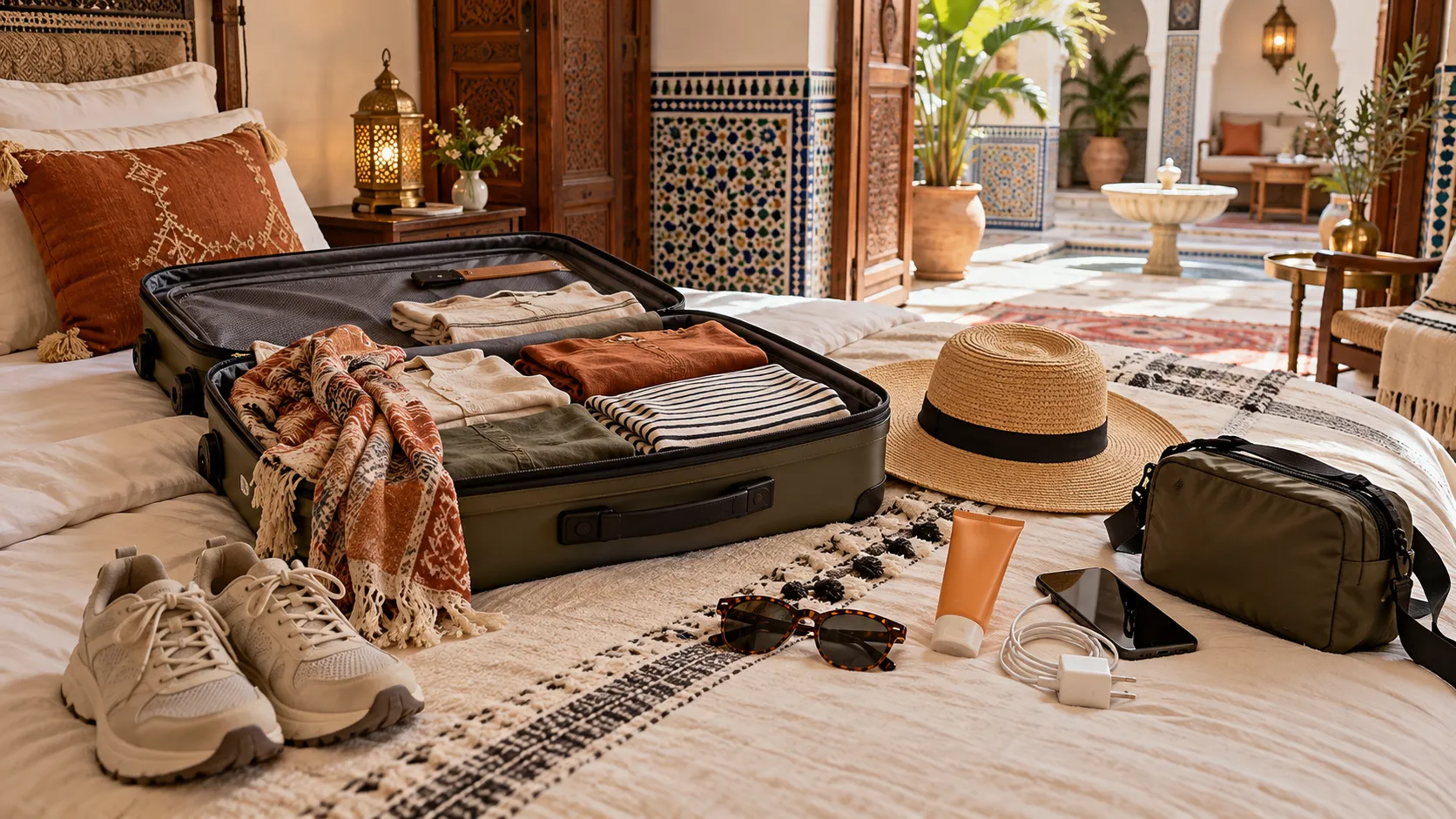
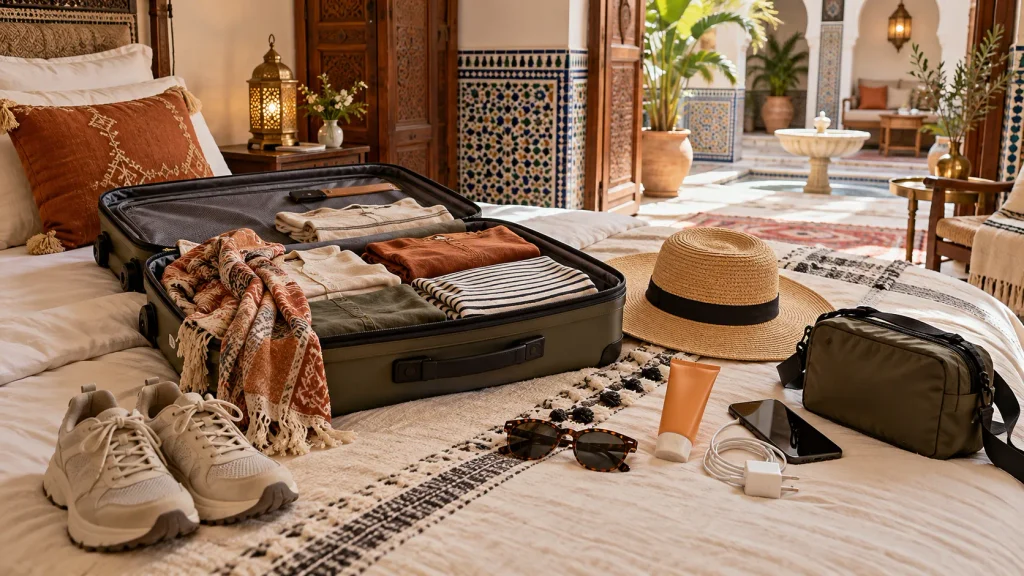
For a typical city-based visit, start with:
- Passport, any required entry documents and accessible booking details.
- Insurance information and emergency contacts.
- Payment cards and a small wallet for everyday spending.
- Comfortable walking shoes you have already worn.
- Breathable tops and trousers, skirts or dresses that work together.
- A warmer layer, with outerwear matched to the forecast.
- Underwear, socks and sleepwear.
- Sun hat, sunglasses and sunscreen.
- Toothbrush, toiletries and the personal supplies you rely on.
- Regular medication and any required supporting documents.
- Phone, charging cable and a suitable plug adapter.
- A small day bag, reusable bottle and tissues.
- An overnight bag if a camp stay or excursion requires one.
Add swimwear, specialist footwear, a towel or walking equipment according to your actual plans. Check what your accommodation and activity provider supply before buying or packing duplicates.
Start with your route and airline allowance
Write down the places where you will sleep and the activities you have booked. Check the forecast for more than your arrival city, particularly if your route includes higher elevations, the coast or a desert overnight.
Next, check the baggage allowance attached to every flight. Cabin dimensions, personal-item rules and checked-bag weight depend on the airline and fare. There is no single Morocco luggage allowance.
If your journey involves several accommodation changes, leave enough room to repack without unpacking everything on the floor. A bag that closes only when compressed at home becomes awkward once clothes have been worn and souvenirs added.
Choose luggage you can handle at the accommodation entrance
A wheeled suitcase can work for a hotel-based trip, while a backpack or soft bag may suit frequent moves. Neither is essential for everyone.
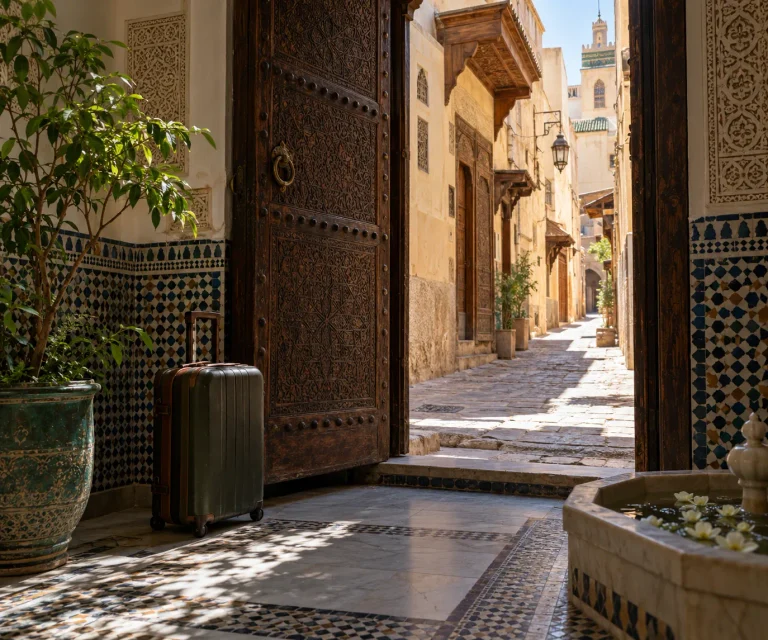
The important question is whether you can carry the loaded bag up steps or along a short uneven approach when needed. Ask your riad where vehicles can stop and whether luggage assistance is available. Do not assume a driver can reach the reception door.
Keep any arranged assistance and its meeting point with your arrival details. This is especially useful after dark, when following an address pin may be less straightforward than following the property’s instructions.
Plan for laundry before adding more clothes
Choose how many days you want to cover before washing clothes. Confirm laundry turnaround with accommodation if you are relying on it, especially during short stays.
A two-week holiday does not automatically require twice as many outfits as a one-week trip. It does require enough time for clothes to be washed and dried before the next move.
Pack a separate bag for worn clothing. If handwashing is part of your plan, take a small amount of suitable detergent and check that the accommodation permits it.
Clothing to pack for everyday travel
Choose pieces you can combine and rewear, with a mix of lightweight coverage and warmer layers. Loose trousers, breathable shirts and comfortable tops can serve city walks, road journeys and casual meals.
Include options that cover shoulders and knees when needed, rather than relying on one outfit for every setting. Requirements at individual sites differ; check them before the visit. A lightweight scarf or overshirt can be useful, but it does not replace checking a venue’s rules.
You do not need to buy a new wardrobe to travel. Begin with clothes that already fit comfortably when you walk, sit for a road journey or climb steps.
A suggested clothing list for seven days
For a week with an opportunity to rewear or wash clothes, a starting point is:
- Four or five everyday tops.
- Two or three bottoms, including at least one lightweight long option.
- One long-sleeved shirt or light overshirt.
- One fleece, cardigan or similar warmer layer.
- Underwear and socks for the days between laundry opportunities.
- Sleepwear suitable for the expected overnight conditions.
- A jacket or rain layer selected for the route and forecast.
- Swimwear only if your accommodation or activities make it useful.
Count the clothes worn on the flight within this total. A dress can replace a top-and-bottom combination, and a shirt suitable for dinner can also be worn during the day.
These quantities are suggestions, not a required uniform. Adjust them for laundry access, children, personal preferences and activities that leave clothes wet or dusty.
Keep dressier clothing proportionate to the trip
One outfit that works for a planned dinner may be enough. Check the venue if a particular dress code matters.
Avoid filling the case with clothes reserved for occasions that are not in your itinerary. Comfortable shoes and a layer you will use repeatedly usually earn their space more easily than several evening outfits.
Shoes for medinas, road stops and excursions
Bring a pair of walking shoes that fit well and provide grip. Test them on a long walk before departure. New footwear can create problems even when the trip does not include hiking.
Sandals can be a useful second pair for warmer conditions or accommodation, provided they suit the walking you intend to do. Flip-flops are more useful for a pool or shower than for a long day on uneven streets.
For Visit Morocco Together’s Tangier medina and kasbah walking tour, comfortable shoes, water and a light jacket belong in the daily kit. A city walk needs practical footwear without automatically requiring heavy hiking boots.
Pack hiking footwear only when the route calls for it
A village walk, a longer rocky trail and a winter mountain ascent have different equipment needs. Ask the guide about terrain, walking time, elevation and conditions before choosing shoes.
If your holiday includes a demanding trek, follow its specific equipment list. A general Morocco packing list cannot determine the footwear, clothing or technical equipment needed for that route.
Wear your bulkier shoes while travelling if it helps your bag fit the allowance, and keep a separate pouch for footwear inside the case.
Adjust your packing for the season and region
Check conditions for each overnight location shortly before departure. Clothing that works in an inland city may need an extra layer for a coastal evening or a higher-elevation stay.
Our guide to the time to visit Morocco explains the regional planning choices. For packing, turn those choices into a few practical adjustments.
Spring and autumn
Take layers you can add or remove during the day. Keep the warmer layer accessible on road journeys rather than buried at the bottom of the suitcase.
Add rain protection when the forecast and your planned walking make it useful. Avoid assuming that a photograph of sunshine represents the conditions for your entire route.
Summer
Prioritise breathable clothing, a sun hat and items that provide comfortable coverage. Pack enough everyday clothing to manage perspiration between laundry opportunities.
If your itinerary moves into mountains or includes early starts, check those conditions separately before removing all warmer clothing.
Winter
Check the expected lows as well as daytime conditions. Depending on the route, you may need an insulated layer, warmer sleepwear, additional socks and rain protection.
Ask accommodation about heating if it affects what you need overnight. Do not assume that all riads, mountain guesthouses or desert camps have the same facilities.
For snow or winter trekking, obtain the operator’s route-specific list. A city jacket is not a substitute for mountain equipment.
Pack a small bag for a Sahara camp night
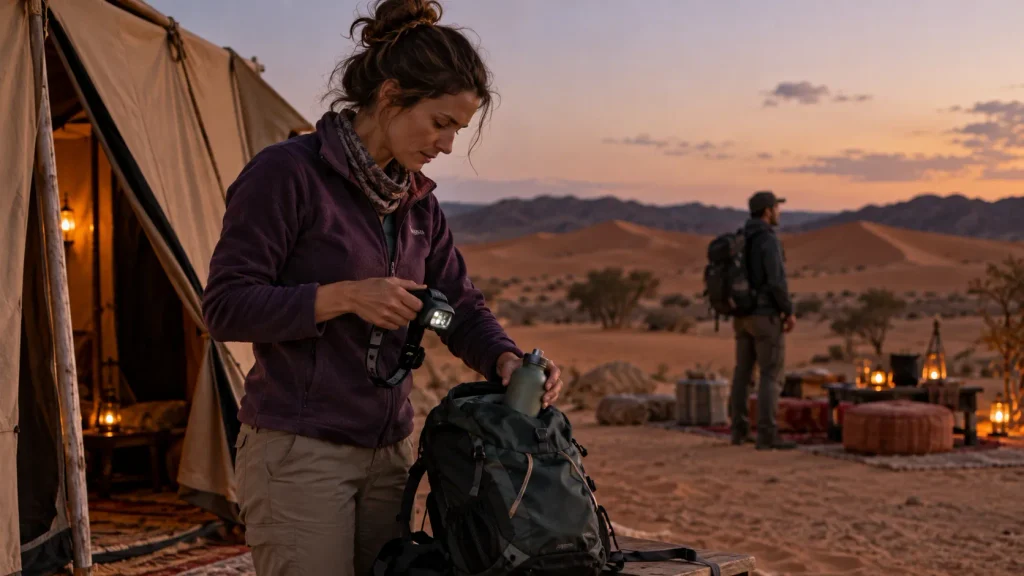
A camp stay is easier to manage when you can separate the things you need overnight from your main luggage. Confirm where the larger bag will be kept or transported, who handles it and when you will have access to it again.
For a typical overnight, consider:
- One change of underwear and suitable sleepwear.
- A warmer layer matched to the forecast.
- Essential toiletries and medication.
- Phone, camera and charging supplies.
- A small torch or headlamp.
- Sun hat, sunglasses and sunscreen for the journey.
- Closed-toe shoes and socks.
- A pouch to protect electronics from sand.
Keep your documents and valuables with you according to the agreed luggage arrangement. Avoid packing a bag so heavily that it is uncomfortable to carry.
For a Merzouga camel trek with a desert camp stay, ask Visit Morocco Together about overnight bag size, main-luggage handling and the camp’s facilities before finalising your packing. Confirm bedding, bathroom arrangements, towels and charging access instead of assuming they are identical across camps.
Do you need a sleeping bag?
That depends on the booked camp or expedition. Ask whether bedding is supplied and whether additional sleep equipment is recommended for your dates.
A furnished camp stay and a trekking expedition should not share an automatic equipment list. Pack a sleeping bag, liner or towel only when the actual arrangement justifies it.
Keep sand-sensitive equipment packed away
Use a closable pouch or protective bag for cameras and spare electronics. Take out only what you need at a stop, and avoid changing lenses in blowing sand.
A scarf can be useful in dusty conditions, but it is not a replacement for appropriate eye protection or following the guide’s instructions if conditions change.
Packing for the coast, pools and water activities
Bring swimwear when you intend to use a pool, beach or booked water activity. Add a change of clothes and a bag for wet items so damp clothing does not share space with documents or electronics.
A light outer layer can be useful between an activity and your return journey. Ask whether a towel is provided before adding one.
For kayaking in Oualidia Lagoon, pack clothing you can move in and do not mind getting splashed. Keep your phone and valuables off the water unless you have suitable protection. Confirm footwear, buoyancy aids and any other supplied equipment with the activity team.
For surfing or other specialist activities, check whether a wetsuit and equipment are included and how sizing is arranged. Swimwear alone may not cover the conditions or the session’s requirements.
Documents, payment items and personal supplies
Keep your passport, any required entry documents and essential booking information accessible during the journey. Store a secure backup of important details separately from the originals.
Carry the first accommodation’s address and arrival instructions in a form you can use without mobile data. Include the contact details for your transfer or accommodation when one is arranged.
Use the Morocco entry requirements checklist to review the documents relevant to your nationality and journey. A packing checklist cannot establish whether you need a visa or another authorisation.
Organise payment items without carrying everything together
Take the cards and payment methods you intend to use, with access to backup funds if needed. Keep a small wallet for everyday spending and separate it from items you do not need to take out repeatedly.
The cash amount depends on your route, accommodation and payment arrangements. Avoid treating another traveller’s exchange amount as a required sum for everyone.
Pack the personal products you rely on
Bring toothbrush and toothpaste, deodorant, essential skincare, sunscreen and any menstrual or continence products you prefer. Add contact-lens supplies, glasses or a spare pair when relevant.
Small packs of tissues and hand sanitiser can be convenient on day trips. Take a reusable bottle, but fill it with water you know is suitable for drinking; carrying a bottle does not mean every available water source is safe.
Keep toiletries in a bag that contains leaks. For cabin travel, check liquid rules at your departure and connecting airports rather than assuming one container limit applies throughout the journey.
Keep regular medication accessible
Plan enough of your regular medication for the trip and any reasonable delay, within the quantities and import conditions that apply. Keep identifying packaging and supporting prescription information where relevant.
Check the rules for your specific medicine and transit countries before departure. Ask your prescriber or pharmacist about storage needs and travel arrangements if necessary.
A small first-aid pouch can hold dressings and blister supplies. Choose additional medicines with appropriate professional advice rather than copying a generic list of painkillers, antibiotics or stomach treatments. Our Morocco safety, health and insurance guide covers wider preparation.
Electronics, adapters and charging
Pack your phone, the correct cable and a charger, then add other devices only when you have a use for them. A camera may justify its space; a laptop may not if you are taking it only out of habit.
Before buying a travel adapter, check your existing plugs and the input label on each device. Electrical Safety First’s Morocco guidance identifies Type C and E plugs and a 220 V, 50 Hz supply. A plug adapter changes the connection; it does not convert voltage. Use an adapter suitable for the appliance, including its earthing requirements.
Check hair appliances particularly carefully. A label marked only for a lower supply voltage cannot be treated as compatible simply because its plug fits an adapter.
Put power banks and spare batteries in the right bag
Keep power banks and spare lithium batteries in cabin baggage, with terminals protected against short circuits. If your cabin bag is taken for loading into the hold, remove these items first.
Follow IATA’s lithium battery guidance and your operating airline’s current rules on battery capacity, approval, quantity and onboard use. Do not travel with a swollen or damaged battery.
Charge the devices you need before leaving your accommodation. Confirm charging availability at a camp or remote stay rather than relying on a socket at the next stop.
Prepare useful information offline
Download the maps, booking details and accommodation instructions you need. Keep essential contact numbers accessible without relying on a message history that has not loaded.
A charged phone is helpful, but your arrival plan should still work if you temporarily lose data access. A short written note with the address and meeting instructions takes little space.
Divide your belongings into three practical bags
Your cabin bag
Keep documents, valuables, regular medication, essential electronics and a change of basic clothing accessible. Add any supplies you would need if checked luggage arrived later.
Allow for security screening and your airline’s size and weight limits. Before a gate check, remove the items that must remain in the cabin.
Your main luggage
Pack the bulk of your clothing, permitted toiletries, spare footwear and items you do not need during the day. Group things so you can find a warmer layer or an overnight change without emptying the case.
Leave space for purchases. If you plan to buy fragile crafts, consider both protection and the final baggage allowance before shopping.
Your daily bag
Carry only what the day’s activity needs: water, sun protection, phone, a payment method, tissues and a layer if conditions call for it.
A bag with a secure closure can keep small items organised. Keep it manageable for stairs and walking, and follow any venue’s bag restrictions.
What you can often leave at home
Remove items that duplicate supplied facilities or have no role in the trip:
- A large towel when your accommodation and activities supply what you need.
- A sleeping bag for a camp that confirms suitable bedding.
- Several pairs of shoes for a trip without varied footwear needs.
- Full-size toiletries when smaller containers cover your stay.
- Heavy specialist equipment for an activity that provides it.
- Multiple evening outfits without occasions to use them.
- Electronics you have no plan to use.
Do not cut essentials to reach a lighter-bag target. The aim is a manageable bag that supports the trip, including personal needs.
A final check before closing your bag
Review your forecast, confirmed activities and luggage allowance together. Then put your shoes on, lift the packed bag and check whether you can handle it comfortably.
Make sure the items for your first evening are easy to reach. Confirm laundry, towels, camp bedding and equipment only where you are relying on them.
The final packing decision should follow your itinerary. A city walk, a camp night and a lagoon activity each need a small adjustment; they do not require three separate suitcases.
Questions about packing for Morocco
Can I travel to Morocco with cabin baggage only?
Yes, if your belongings fit the allowance and restrictions for every flight. Laundry access and a coordinated clothing selection can help. Check activity-specific equipment and personal requirements before deciding.
Should I bring a suitcase or a backpack?
Choose the bag you can manage on your route. A suitcase can suit hotel stays, while a soft bag or backpack may be easier for some frequent moves. Confirm accommodation access and vehicle luggage space rather than assuming one design suits all trips.
Do I need hiking boots?
Not for every itinerary. Comfortable walking shoes may cover city visits and some easy walks. Obtain a specific equipment list for a demanding trail, trek or winter mountain activity.
Should I pack warm clothes for the desert?
Check the overnight forecast and your camp’s facilities. Take layers suitable for the dates rather than assuming desert travel means hot conditions at every hour.
Do I need to pack a headscarf?
A lightweight scarf can be useful for layering, sun or dust protection, and any site requirements that apply. It is not a general requirement to cover your hair throughout a tourist visit. Check individual venues instead of treating all visits as having one dress rule.
Can I buy forgotten items after arrival?
You may be able to replace ordinary supplies, but availability, opening hours and your preferred brands vary. Bring the personal products, correctly fitting equipment and medication you rely on instead of depending on a last-minute purchase.
How much should I pack for two weeks?
Start with a shorter clothing rotation and a realistic laundry plan, then add the layers and activity items your route requires. Pack enough underwear and socks between washes, and leave time for drying before your next move.
What should I ask my tour provider before packing?
Ask about luggage size, overnight bag arrangements, accommodation access, towels, bedding, charging and activity equipment. Include any personal requirements so the answers apply to your booking rather than a general tour description.
Ready to Experience Morocco?
Turn this inspiration into your next adventure. Our travel experts are ready to help.