Morocco entry requirements depend on the passport you hold, your travel purpose and, for some entry routes, your residence status or other visas. Before confirming your trip, check which permission you need, whether your passport meets the applicable validity rules, and which supporting documents you should carry.
The useful question is more specific than “Can tourists enter Morocco?” It is: “Can I board this journey and enter on these documents for these dates?” Two people travelling together can have different answers, even when they live at the same address and share one booking.
This checklist covers short tourist visits and the documents to organise before departure. Moroccan authorities decide admission. Requirements should be checked again for your actual travel date, particularly after a passport renewal, a route change or a change in your residence status.
Morocco entry requirements start with your passport and travel purpose
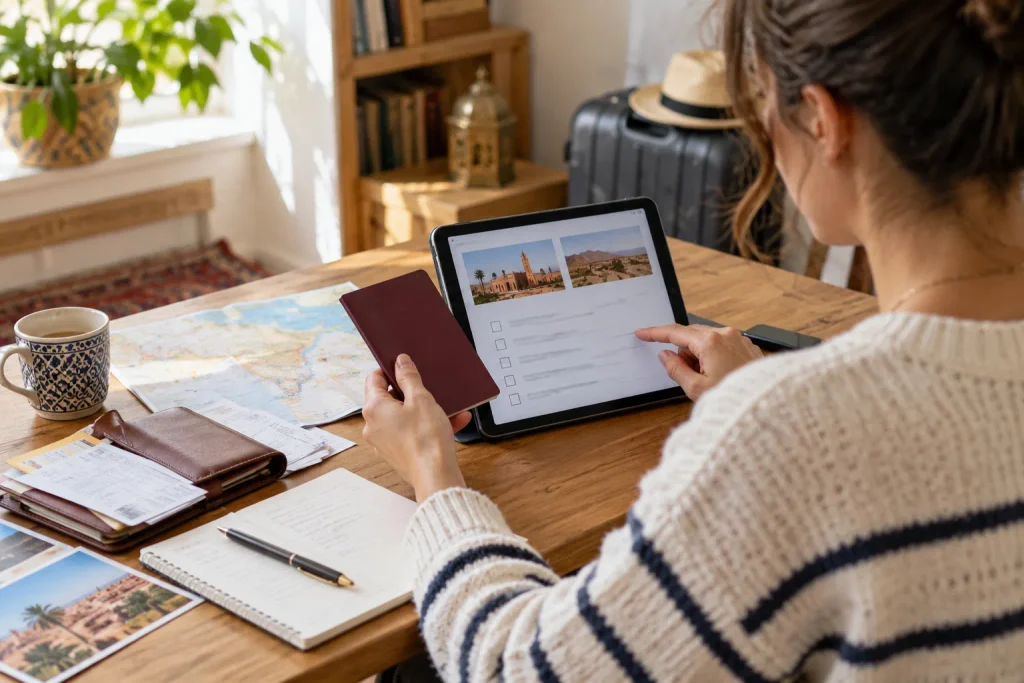
Check every traveller individually using their nationality, passport type, residence country, travel dates and reason for visiting. Where a residence permit or another country’s visa supports eligibility, its type and expiry date also matter.
Use the official Accès Maroc portal to check the relevant entry route. Its eligibility questions include nationality, residence, passport type, travel purpose and other valid visas. If your circumstances do not fit the available options, contact the Moroccan embassy or consulate responsible for your place of residence.
Prepare a short record for each person:
| Detail | What to record | Why to check it early |
|---|---|---|
| Travel document | Nationality, document type, number and expiry date | An ordinary passport and an emergency travel document may follow different procedures |
| Proposed visit | Arrival date, departure date and purpose | Permission must match the journey you intend to make |
| Supporting status | Relevant residence permit or other visa | These documents may affect the entry route available to you |
| Complete itinerary | Departure airport, connections and return route | A transit country can introduce an additional document check |
| Accompanying travellers | Each person’s documents and any child travel arrangements | One person’s eligibility does not establish the whole group’s position |
Keep sensitive document details in a private travel folder, rather than a shared itinerary circulated widely. A simple checklist can show that an item has been checked without displaying the passport number to everyone in the group.
Once your entry position is clear, the Morocco trip planning guide helps you arrange the wider route and booking sequence.
Visa-free entry, an eVisa and a travel authorisation are different
Establish the permission applicable to your passport before treating a booking confirmation as evidence that you can travel. A visa exemption, an electronic visa and an electronic travel authorisation are distinct arrangements.
AEVM means Electronic Travel Authorisation to Morocco. Do not assume that a reference to visa-free travel also answers whether an authorisation is required for your circumstances.
For a familiar example, current UK guidance allows full British citizen passport holders to visit for tourism without a visa for up to 90 days. That statement does not cover every category of British travel document or everyone resident in Britain.
Keep these three decisions separate:
- Eligibility: which entry route applies to you?
- Approval: if an application is required, has permission actually been issued?
- Use: do its dates, permitted stay and number of entries fit your itinerary?
A submitted application, payment receipt or pending status is not the issued permission you are waiting for. Check the result and document details before treating this part of your preparation as complete.
Detailed application instructions, nationality lists and processing choices belong in a visa-specific check. Here, the priority is ensuring that the permission you obtain matches the passport and journey you will use.
Passport validity must be checked against the guidance for your document
There is no reliable reason to apply one travel blog’s passport-validity sentence to every visitor. The official guidance reviewed for this article gives different instructions for different audiences.
| Official source and scope | Published passport guidance |
|---|---|
| UK entry guidance for full British citizen passports | Expiry date at least three months after arrival |
| U.S. State Department’s Morocco information for U.S. travellers | Lists at least six months’ validity at entry and one blank page per stamp |
These are summaries of the respective published pages, not a universal nationality-by-nationality determination. If your document is close to expiring, ask the Moroccan consulate and your operating carrier to confirm the requirement for your exact circumstances before committing to travel.
Also inspect the passport itself. UK guidance warns that damaged passports can lead to refusal of entry. A readable scan does not resolve damage to the original document.
Check the name, date of birth and passport number against any issued permission and carrier record. If you renew your passport after receiving an authorisation, ask the issuing authority what must be updated or reapplied for; do not assume that permission linked to the old number transfers automatically.
When asking for clarification, include your passport type, nationality, expiry date, proposed arrival and departure dates, and transit route. That produces a more useful answer than asking simply whether “three months is enough”.
The validity of an eVisa is different from its permitted stay
Read the dates and conditions on the issued document before choosing your departure date. An entry window does not describe how long you may remain after arrival.
The official Accès Maroc eVisa conditions describe a maximum validity of 180 days from issue, a single entry and a stay of no more than 30 days. The issued permission governs your trip; those 180 days are not a six-month allowance to stay.
The same conditions instruct holders to present their eVisa for boarding and border checks. They list supporting residence or visa documents where applicable, a return ticket, evidence of means, and insurance covering hospital care and medical repatriation. Consult the full conditions for the precise financial evidence and document requirements.
Under-18 eVisa holders must be accompanied by a parent or legal representative. An eVisa does not guarantee admission.
A practical date check needs three separate fields: when permission can be used, the allowed stay, and the number of entries. If your itinerary includes leaving Morocco and returning, resolve that second entry before booking it. Adding another country to a holiday can change the paperwork as well as the route.
Carry documents that explain the journey you are actually making
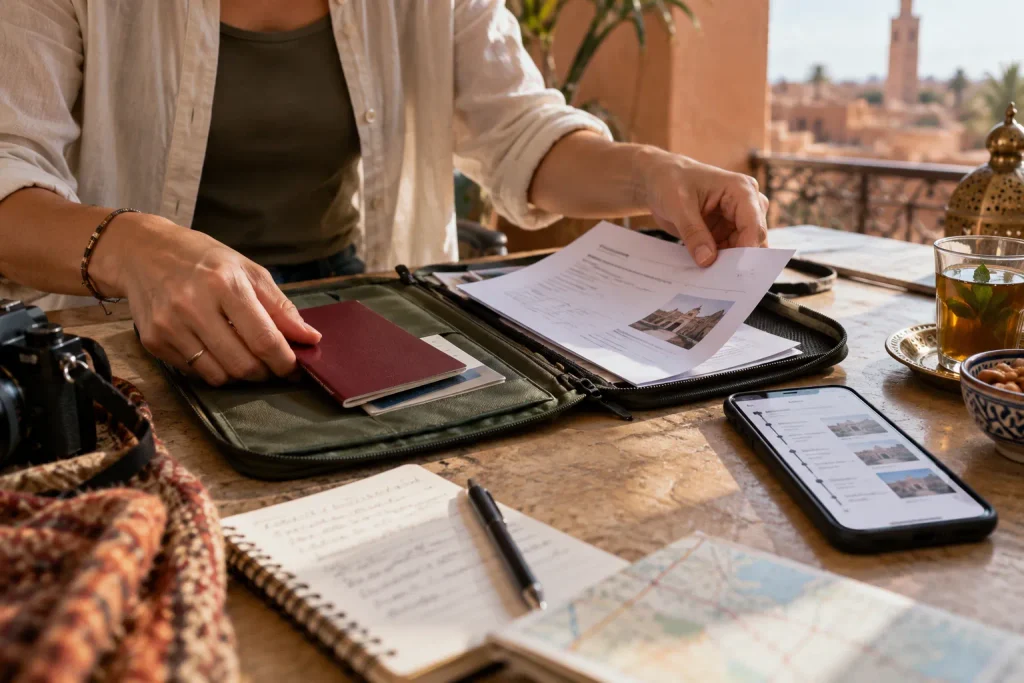
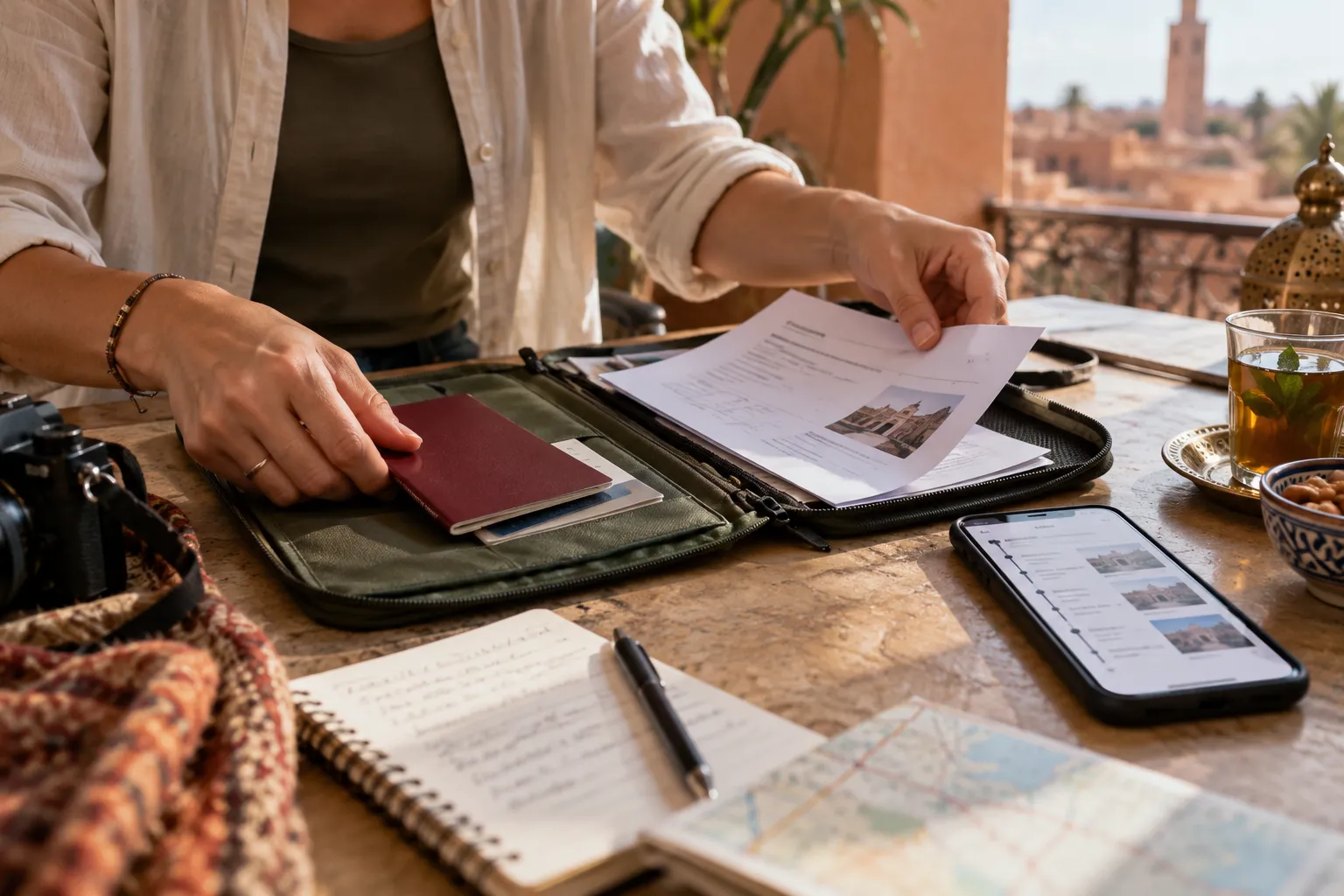
Build a small, accessible travel folder with your issued permissions and current reservations. Treat the following as an organising checklist; the exact evidence required depends on your entry route and circumstances.
| Keep accessible | Check before departure |
|---|---|
| Passport and applicable entry permission | Personal details match and documents cover the planned journey |
| Supporting residence or visa documents | The documents used to establish eligibility remain available and applicable |
| Return or onward reservation | Dates match the itinerary; confirm whether an onward ticket satisfies your particular entry conditions |
| Accommodation or host details | Full name, address, contact details and arrival date are saved |
| Relevant tour confirmations | They describe the services actually booked, including dates and any overnight stays |
| Insurance documents | The policy names, dates and required scope of cover match the visit |
| Any case-specific paperwork | Child travel documents, medical certificates or other evidence requested by the relevant authority |
Accommodation details are useful even when nobody asks to see a printed hotel voucher. Save the property’s full address and a reachable contact, not just its name on a map. For a visit to friends or family, ask the consulate which host documentation applies instead of assuming a hotel booking is necessary.
A city excursion confirmation does not explain where you will sleep for the whole trip. Likewise, an itinerary proposal is different from a confirmed reservation. Keep the document descriptions accurate, and update your folder when plans change.
Download readable copies for offline access and keep the originals where you can reach them during the journey. Test the folder with your phone in flight mode. If a reservation is only visible inside an app after login, save an accessible copy as well.
Connecting flights require their own document check
Check every transit point before buying a connecting itinerary. Permission to visit Morocco does not establish permission to transit through another country.
Royal Air Maroc provides an IATA-based visa and vaccination checker covering nationality, residence, departure, transit and destination. Its trip-information tool is intended for ordinary passports and airport travel; its own notes say it should not be used for overland journeys.
For an unusual connection, ask your carrier specific questions:
- Will baggage be checked through, or must you collect it and check in again?
- Does the connection involve entering the transit country?
- Are you changing airports or staying overnight outside the transit area?
- Are the document rules different for your passport type?
These questions are especially useful with separate tickets. Do not infer the immigration arrangement from the length of the layover or the fact that both flights appear in one search result.
If you arrive by ferry or travel with a vehicle, check the operator’s requirements and the relevant Moroccan border and customs procedures separately. A passenger document check does not settle the paperwork for a car, rental agreement or other belongings.
Children and unusual travel documents need an individual check
Review a child’s permission to travel alongside their passport and entry eligibility. Ask which documents are needed when a child travels with one parent, another adult or a different surname, including whether consent or relationship documents require a particular format.
The U.S. State Department specifically warns that children with U.S. passports and a Moroccan parent can face difficulties leaving Morocco without that parent’s permission. Families in this situation should obtain case-specific guidance before departure.
The same individual approach applies to dual nationals and holders of emergency, refugee or other non-standard travel documents. Describe the actual document to the consulate and carrier rather than selecting the closest ordinary-passport category in an online form.
If different documents are needed for different parts of a journey, ask how to present them consistently. Make that plan before check-in, particularly where an entry authorisation contains one specific passport number.
Health certificates and restricted belongings require separate preparation
Check medical entry requirements for your recent travel history as well as your destination. A general statement about vaccination requirements may not cover someone arriving from a country with a particular health restriction.
TravelHealthPro’s Morocco information says proof of polio vaccination may be necessary for some travellers and directs readers to current country-specific information. It lists no yellow fever certificate requirement under the International Health Regulations. Discuss applicable certificates and recommended vaccines with a travel-health professional; they answer different questions.
Travel insurance also deserves a separate check. Meeting a document requirement does not establish that a policy covers every planned activity or circumstance. Our Morocco safety, health and insurance guide explains how to review cover against your route.
Check permissions before packing regulated equipment. For example, Morocco’s Ministry of Industry and Trade publishes a drone import-licence form among its official import procedures. Do not assume that being allowed to carry a battery on an aircraft resolves permission to import or operate a drone.
For medication, professional equipment or substantial cash holdings, ask the relevant Moroccan authority about the precise item or amount. Keep immigration permission and customs permission as separate checks.
At passport control, confirm the entry record before moving on
Keep your travel documents and first accommodation details ready, answer questions accurately, and check your passport when it is returned. UK guidance advises that passports should receive an entry stamp and notes that missing stamps have caused departure difficulties.
If the record is missing or unclear, ask the border official to clarify it while you are still there. Save a private copy of the completed entry page afterwards, alongside your travel documents.
Do not schedule your first activity as though landing time were the time you reach your hotel. Allow for immigration, baggage collection, customs and the onward journey without assuming a fixed queue length.
If your first stop is Casablanca, give yourself time to settle in before a fixed sightseeing commitment. The Casablanca City Discovery tour is one option to discuss for a later slot or the following day. Confirm the actual starting time, duration and pickup point with Visit Morocco Together before booking around your flight.
Resolve a longer stay before your authorised period ends
If your plans change, contact the immigration office at a Moroccan police station before the permitted stay expires. Ask what procedure applies to your entry status and which documents are needed; requesting an extension does not itself establish that one has been granted.
UK guidance directs visitors seeking more than 90 days to request an extension. U.S. guidance warns that an overstay can require a court appearance and a fine before departure. A longer accommodation booking does not extend immigration permission.
Keep departure arrangements inside the permission you actually hold. If illness or disruption affects your departure, contact the relevant authority promptly and retain supporting records rather than assuming the circumstances automatically extend your stay.
If a passport is lost, the U.S. guidance also notes the need for a local police report when departing on a replacement document. Contact your own embassy or consulate and recheck the return route, including transit acceptance of the replacement.
Finish with a document check for every traveller
Before leaving home, open each person’s travel folder and compare it with the final itinerary. Check the passport, issued permission where applicable, supporting documents, accommodation details and departure arrangements together.
After any change, ask what else it affects. A later flight can change the stay length. A new passport can change the details on an authorisation. A different connection can introduce another country’s document requirements.
For the remaining tasks, the broader checklist for preparing a trip to Morocco covers packing, communications and practical arrangements. Complete the entry checks first, then build the holiday around dates and documents that work for everyone travelling.
Ready to Experience Morocco?
Turn this inspiration into your next adventure. Our travel experts are ready to help.