The languages spoken in Morocco include Arabic and Amazigh, the country’s two official languages, alongside Moroccan Arabic (Darija), French, Spanish and English. Which language you hear most often depends on the region, setting and people you meet.
Darija is widely used in everyday conversation, while Arabic and Amazigh have official recognition. French remains important in business, education and many urban settings. Spanish is particularly useful in parts of northern Morocco, and English is increasingly encountered in tourism.
For travelers, the practical answer is simple: you do not need to speak Arabic to visit Morocco. English can be sufficient in many established tourist areas, but learning a few Darija phrases and having a translation option will make independent travel easier, especially outside major destinations.
This guide explains Morocco’s main languages, their regional differences, which ones are useful for visitors and the everyday expressions worth learning before your trip.
Languages Spoken in Morocco: The Main Differences
Morocco’s linguistic diversity reflects its Amazigh heritage, Arab history, Mediterranean connections and relationships with European countries.
However, it is important to distinguish between official languages, everyday spoken languages and foreign languages used for work, education and tourism.
- Arabic: One of Morocco’s two official languages. Standard Arabic is used in formal writing, education, official communication and news media.
- Amazigh: Morocco’s other official language, with several regional varieties and a standardized written form using Tifinagh.
- Darija: Moroccan Arabic, widely spoken in everyday conversations, markets, homes and public spaces.
- French: Common in business, higher education, professional settings and many tourist services, although it is not an official language.
- Spanish: Used particularly in parts of northern Morocco, reflecting historical and geographical connections with Spain.
- English: Increasingly used in tourism, hospitality and international communication, with proficiency varying considerably.
- Hassaniya: A variety of Arabic associated with Saharan communities, particularly in southern areas.
Many Moroccans use more than one language or language variety, sometimes changing between them according to the conversation.
That does not mean everyone speaks the same combination. A hotel receptionist in Marrakech, a shopkeeper in Tetouan and a resident of a village in the Anti-Atlas may have very different language preferences.
Arabic in Morocco: Official Arabic vs Everyday Darija
One of the most important distinctions for travelers is the difference between Standard Arabic and Moroccan Arabic.
Both are forms of Arabic, but they serve different purposes and can sound noticeably different.
Modern Standard Arabic: The Formal Language
Modern Standard Arabic is used across much of the Arabic-speaking world for formal communication.
In Morocco, it is associated with written documents, formal education, government communication, television news and other official contexts.
Classical Arabic also has an important role in religious and historical literature.
Visitors may encounter Standard Arabic on signs, documents, public information and in news broadcasts.
However, it is not generally the variety used for relaxed everyday conversations.
If you have studied formal Arabic, your knowledge may help with reading and communication, but you should expect differences when listening to informal Moroccan speech.
Darija: The Language of Everyday Conversation
Darija is the name commonly used for Moroccan Arabic.
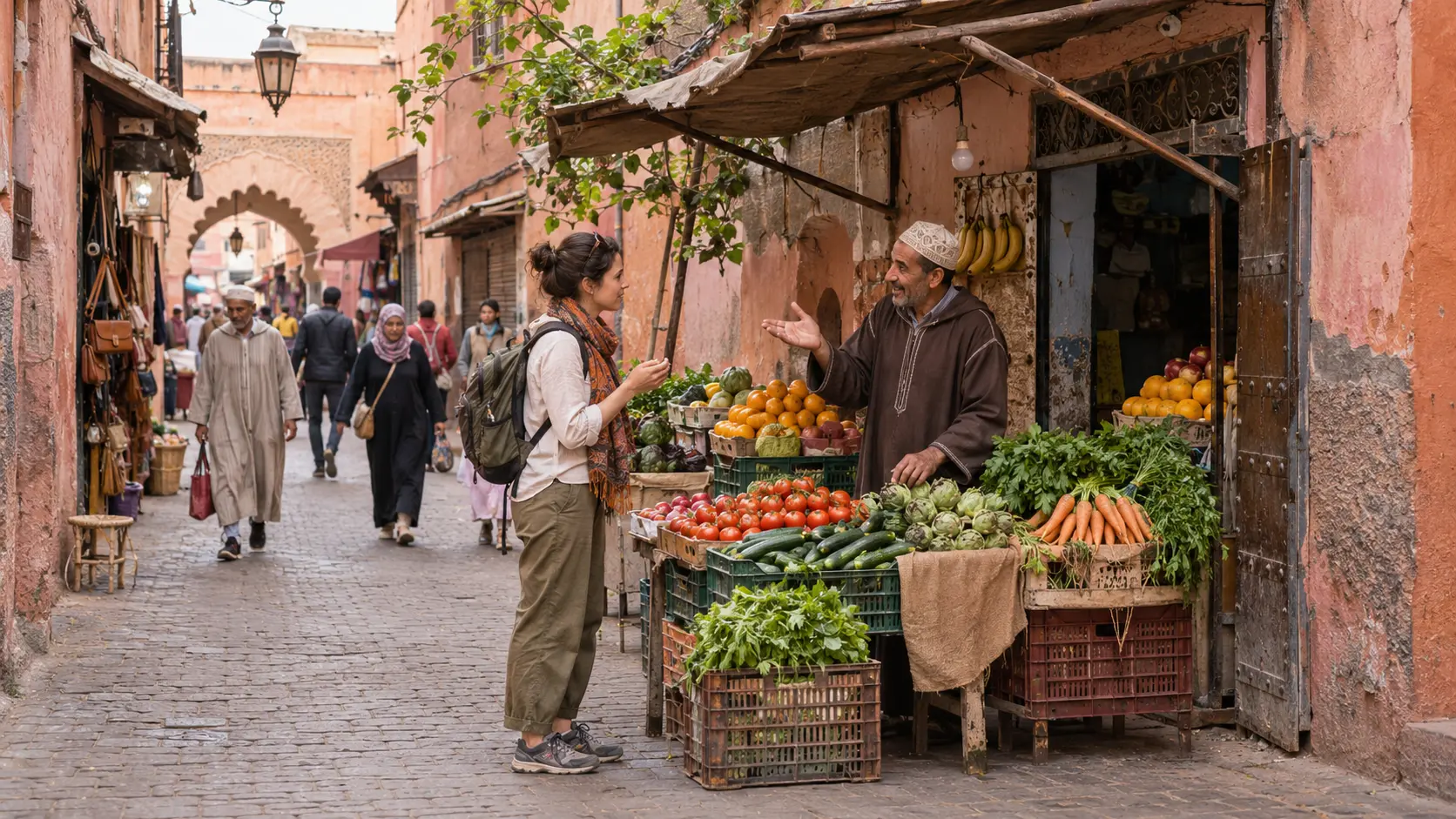
It is widely spoken across Morocco and is especially useful for everyday interactions such as ordering food, asking directions, greeting someone or discussing a price.
Darija has developed through centuries of linguistic contact. Its vocabulary and expressions reflect Arabic alongside influences from Amazigh languages, French, Spanish and other sources.
Its pronunciation, grammar and everyday vocabulary differ from Modern Standard Arabic.
For example, a phrase learned from a general Standard Arabic textbook may be understood but sound unusually formal in a Moroccan market or café.
Darija itself also varies by region. Speakers from different Moroccan cities and rural communities may use different words, accents and expressions.
Traveler tip: If you want to learn a few practical expressions before visiting Morocco, prioritize everyday Darija rather than attempting to study formal Arabic grammar.
Amazigh: Morocco’s Indigenous Language Heritage
Amazigh, sometimes referred to as Berber in older travel literature, represents an important part of Morocco’s indigenous cultural and linguistic heritage.
It is not a dialect of Arabic. Amazigh languages belong to a different branch of the Afro-Asiatic language family and have their own linguistic histories.
Morocco’s 2011 Constitution recognized Amazigh as an official language alongside Arabic. Its use in public administration, education and other institutional settings continues to develop through implementation measures.
For travelers, it is particularly important to understand that Amazigh is not spoken identically throughout the country.
Tarifit: The Rif Mountains
Tarifit is associated particularly with the Rif region in northern Morocco.
It is spoken in communities around the eastern and central Rif, including areas associated with Al Hoceima and Nador.
The wider north is linguistically diverse, so Tarifit should not be assumed to be the main language of every northern town.
In places such as Tangier, Tetouan and Chefchaouen, visitors may encounter Moroccan Arabic, regional speech varieties, French or Spanish, depending on the setting.
Central Atlas Tamazight: The Atlas Regions
Central Atlas Tamazight is spoken in parts of central Morocco, particularly around the Middle Atlas and neighboring areas.
It forms an important part of the linguistic heritage of communities in and around the Atlas Mountains.
The term Tamazight can also be used more broadly when discussing Amazigh languages collectively. This can create confusion because it is both a general label and the name of a particular regional variety.
For travel planning, distinguish between Amazigh as the broader language heritage and Central Atlas Tamazight as a regional form.
Tachelhit: Souss and Southwestern Morocco
Tachelhit, also written Tashelhit or Shilha, is widely associated with southwestern Morocco.
It is spoken in parts of the Souss region, Anti-Atlas and High Atlas, including communities around Agadir, Taroudant and Tafraoute.
Travelers exploring these areas may hear Tachelhit in markets, homes and community settings alongside Darija and other languages.
If you are interested in the region’s cultural heritage, our Tafraoute destination guide provides an introduction to this part of the Anti-Atlas.
What Is the Tifinagh Alphabet?
Amazigh is commonly represented in Morocco’s standardized written form using Tifinagh, a writing system with distinctive geometric characters.
Travelers may notice Tifinagh on public signs, educational materials and cultural displays, sometimes alongside Arabic and Latin-script text.
Its visibility reflects the official recognition of Amazigh as part of Morocco’s national heritage.
However, seeing Tifinagh on a sign does not mean that everyone nearby reads or speaks the same Amazigh variety.
The three major regional varieties described above are useful for understanding the country’s linguistic geography, but they do not capture every local difference.
French in Morocco: How Useful Is It for Travelers?
French remains an important language in Morocco despite not having official-language status.
Its contemporary role is connected partly with Morocco’s history under the French protectorate between 1912 and 1956.
Today, French is encountered in many professional, commercial, educational and administrative settings.
Travelers may find it useful when:
- Communicating with hotels and guesthouses.
- Reading certain restaurant menus and commercial information.
- Speaking with service providers in major cities.
- Arranging some transport or accommodation services.
- Asking for help when English is not understood.
French can be especially practical in cities such as Casablanca, Rabat, Marrakech and Fez.
However, it is misleading to assume that every Moroccan speaks fluent French.
Language skills vary by education, community, occupation and personal experience. In some rural areas, a regional Amazigh language or Darija may be more useful.
Traveler tip: If you already speak French, it can be a valuable communication option. If you do not, there is no need to learn French specifically for a short Morocco holiday.
Is Spanish Spoken in Morocco?
Yes. Spanish is spoken in parts of Morocco, particularly in northern areas with historical connections to Spain.
The language’s presence reflects geographical proximity across the Strait of Gibraltar, trade, migration and the period of Spanish administration in parts of Morocco.
Travelers may encounter Spanish speakers in destinations such as Tangier and Tetouan.
However, Spanish proficiency is uneven. It should not be assumed that everyone in northern Morocco speaks Spanish or that it will be equally useful across the rest of the country.
Moroccan Arabic and other local languages remain important in everyday interactions.
If you speak Spanish and are exploring northern Morocco, it is reasonable to try it politely. Be prepared to use another language when necessary.
Our Tangier travel guide can help you explore a city with longstanding Mediterranean and international connections.
Can You Travel Around Morocco Speaking Only English?
Yes, many travelers can visit Morocco using English, especially when staying in established tourism destinations.
English is used by many people working in hotels, tour companies, restaurants and other visitor-oriented businesses.
You are more likely to find English-speaking assistance in popular destinations such as Marrakech, Fez, Essaouira and major tourist areas of Casablanca and Rabat.
However, English is not universally spoken.
Communication may become more difficult when using local transport, shopping in neighborhood markets or visiting smaller towns where international tourism is less prominent.
Where English Is Usually More Practical
English can often be sufficient when arranging:
- Accommodation at internationally oriented hotels and riads.
- Guided tours advertised for English-speaking visitors.
- Activities with established tourism businesses.
- Restaurant meals in popular visitor districts.
- Airport pickups and pre-arranged travel services.
Even in these settings, confirm the language of any guide, instructor or driver before booking if fluent communication is important to the experience.
Where You May Need Another Communication Method
In smaller towns, rural communities and some everyday service situations, English may be less useful.
That does not make independent travel impossible, but it makes preparation more valuable.
Save accommodation addresses, use offline maps and keep a translation app available.
For a complex journey through several rural regions, a knowledgeable local guide may provide useful cultural and linguistic context. A private guide is not essential for every traveler, however.
Which Languages Are Spoken in Different Moroccan Regions?
Morocco’s language patterns become easier to understand when considered geographically.
These are broad associations, not fixed boundaries. Migration, education and individual multilingualism mean that the language used in one household may differ from the language spoken next door.
Marrakech, Fez, Casablanca and Rabat
Darija is widely used in everyday conversation, while Standard Arabic appears in formal settings.
French is encountered in many commercial and professional environments, and English is used in parts of the tourism sector.
Amazigh languages are also spoken by residents whose family and regional backgrounds connect them with different parts of Morocco.
Tangier, Tetouan and Northern Morocco
Darija and northern Arabic varieties are common in many urban settings.
Spanish has a notable historical presence in parts of the north, while Tarifit is important in sections of the Rif.
French and English may also be useful in tourism-related businesses.
Agadir, Souss and the Anti-Atlas
Tachelhit is an important regional language, particularly in communities connected with the Souss and Anti-Atlas.
Darija is also widely used, especially in urban and commercial settings.
French and English may be encountered in tourism businesses, although the combination varies between locations.
Middle Atlas and Southeastern Morocco
Central Atlas Tamazight and other Amazigh varieties are important across parts of these regions.
Darija is also used, particularly when communicating between people with different first languages.
In more remote communities, do not assume that English or French will always be understood.
Saharan Areas of Southern Morocco
Hassaniya Arabic is part of the linguistic heritage of Saharan communities.
Morocco’s Constitution specifically recognizes the importance of preserving Hassaniya as part of the country’s cultural identity.
Other languages are also used in southern towns and communities, reflecting different backgrounds and local histories.
As elsewhere in Morocco, it is better to ask which language someone prefers than to make assumptions based on location alone.
Useful Moroccan Darija Phrases for Travelers
Learning a few Darija expressions can make greetings, shopping and simple conversations more comfortable.
You do not need perfect pronunciation. A polite attempt, followed by a willingness to listen, is generally more useful than memorizing long phrases you cannot use naturally.
These common expressions are written in simplified Latin spelling. Pronunciation and spelling vary because Darija does not have one universally followed Latin transliteration system.
- Salam alaykum — Hello; literally a greeting of peace.
- Wa alaykum salam — The customary reply to salam alaykum.
- Labas? — How are you? or All good?
- Afak — Please.
- Shukran — Thank you.
- La, shukran — No, thank you.
- Bshhal? — How much?
- Fin kayn…? — Where is…?
- Ma fhemtsh — I don’t understand.
- Bslama — Goodbye.
Using Darija in Markets and Shops
For a simple purchase, begin with a greeting before asking about a product or price.
Bshhal? is useful when asking how much something costs, while shukran works when thanking someone.
If you do not want to purchase, la, shukran is a polite way to decline.
Bargaining is common in some traditional souks, but not every shop negotiates. Ask clearly and respect the seller’s response.
Using Darija for Directions
Fin kayn…? can help when asking where something is located.
However, understanding a spoken answer may be more difficult than asking the question.
Having the destination saved on a map or written down can be especially helpful.
If you do not understand the response, it is better to say so politely rather than pretend that the directions are clear.
Understanding Written Languages and Signs in Morocco
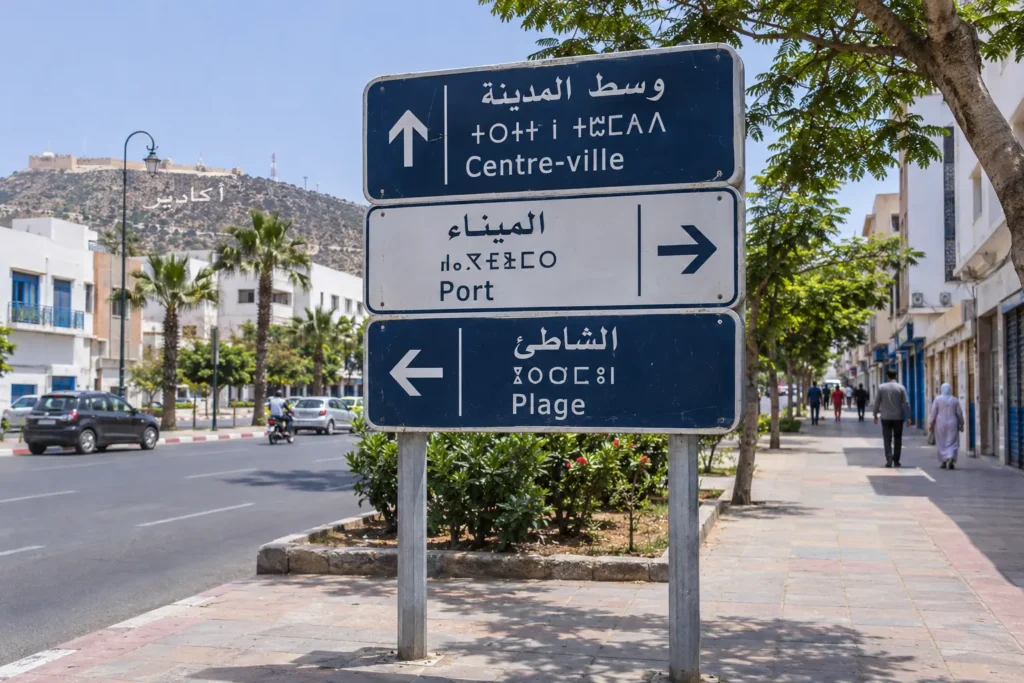
Visitors will encounter several writing systems and spelling conventions during a Morocco trip.
Arabic script is used for Standard Arabic and can also be used when writing Darija.
Tifinagh is used for standardized written Amazigh.
Latin letters appear in French, English and Spanish text, as well as in many Moroccan place names written for international visitors.
You may notice that the same place has more than one Latin spelling.
For example, Fez is also written Fes, while Tachelhit may appear as Tashelhit or Shilha in different contexts.
These spelling variations do not necessarily indicate different destinations or languages.
When arranging transport, it is useful to keep the exact location marked on a map rather than relying only on a written place name.
Practical Communication Tips for Traveling in Morocco
Language differences rarely require complicated preparation, but a few habits can prevent misunderstandings.
Start with a Greeting
A short greeting before asking a question is a considerate approach in shops, cafés and everyday interactions.
Even if the rest of the conversation takes place in English or French, beginning with salam can establish a polite tone.
Avoid treating language as a performance. The purpose is communication, not demonstrating how many local words you have memorized.
Ask Which Language Someone Prefers
Do not assume a person speaks Arabic, Amazigh, French or English based on their appearance, clothing or hometown.
If you have more than one language available, ask which is easiest for the other person.
For guided activities, confirm the guide’s working language in advance, especially when historical explanations or safety instructions are important.
Save Important Information in Writing
For accommodation, transport and other arrangements, save:
- Your accommodation’s name, address and telephone number.
- A map pin showing the correct entrance or meeting point.
- Booking confirmations and relevant transport details.
- Any important dietary or accessibility requirements written clearly.
- The contact details of someone who can help if communication becomes difficult.
Written information can reduce confusion when pronunciation or place-name spelling differs.
Use Translation Apps Carefully
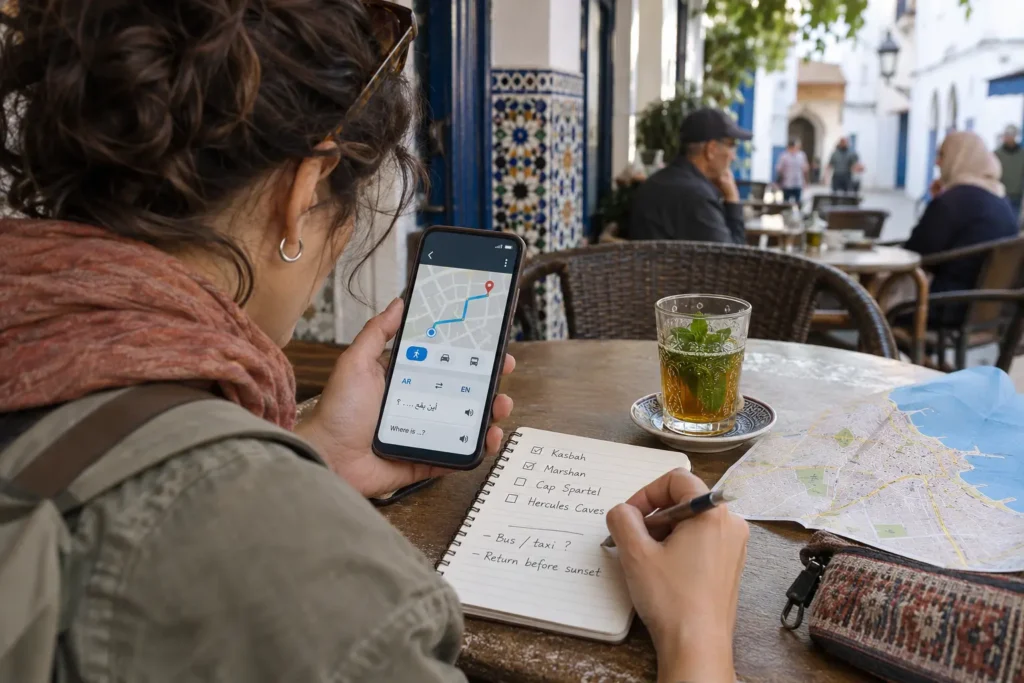
Translation apps can help with menus, signs and short conversations, particularly when an internet connection is unavailable and offline language packs have been downloaded.
However, automated translation may struggle with informal Darija and regional Amazigh varieties.
When accuracy matters, such as for medical information, legal issues or important booking conditions, seek reliable interpretation rather than depending entirely on a translation app.
Respect Language and Cultural Identity
Amazigh languages are not simply alternative forms of Arabic, and Morocco’s linguistic communities should not be treated as interchangeable.
A person’s preferred language may reflect family background, education, regional connections or individual choice.
Approach those differences with curiosity and respect. There is no need to insist on using a particular language when both people would communicate more comfortably another way.
FAQs
What are the two official languages of Morocco?
Arabic and Amazigh are Morocco’s two official languages. Amazigh gained official recognition under the 2011 Constitution, while Arabic remains central to formal administration and written communication.
Is French an official language in Morocco?
No. French is widely used in business, education and various professional settings, but it is not one of Morocco’s constitutionally recognized official languages.
Do I need to learn Arabic before traveling to Morocco?
No. Many tourism businesses can communicate in English, French or other languages. However, learning simple Darija greetings and courtesy phrases can make everyday interactions more comfortable, particularly when traveling independently.
Can I speak English in Marrakech and Fez?
English is used in many hotels, riads, guided tours and tourism-oriented businesses in both cities. However, fluency varies, especially outside visitor-focused establishments. Save important addresses and booking details in case you need another way to communicate.
Is Moroccan Arabic the same as Standard Arabic?
No. Moroccan Arabic, or Darija, differs from Modern Standard Arabic in pronunciation, vocabulary and grammar. Standard Arabic is associated more with formal writing and communication, while Darija is widely used in everyday speech.
Do people in the Atlas Mountains speak Amazigh?
Many Atlas communities speak Amazigh languages, although the variety depends on the region. Central Atlas Tamazight is associated with parts of the Middle Atlas, while Tachelhit is important in parts of the High Atlas and southwest. Darija and other languages are also used.
Communicate with Confidence During Your Morocco Trip
Understanding the languages spoken in Morocco helps travelers appreciate the country’s cultural diversity while making practical decisions about communication.
Arabic and Amazigh have official recognition, Darija is widely used in everyday life, and French, Spanish and English provide additional communication options in different regions and settings.
For most visitors, there is no need to study several languages before departure. Learn a few polite Darija expressions, keep essential information accessible and remain flexible about how you communicate.
If you are interested in exploring the cultural differences between Moroccan regions, you can also browse more Morocco travel guides.
For a journey connecting destinations with different linguistic and cultural traditions, explore Morocco cultural travel experiences with Visit Morocco Together and compare the available itineraries.
The practical takeaway: You do not need fluent Arabic, Amazigh or French to enjoy Morocco. A few useful phrases, clear communication and respect for people’s language preferences will help you travel more comfortably and connect with the places you visit.
Ready to Experience Morocco?
Turn this inspiration into your next adventure. Our travel experts are ready to help.