Desert activities in Morocco range from short walks and sunset camel rides to sandboarding, guided quad outings and nights at camp. The right choice depends on where you will be, how much time you have after getting there and whether you want quiet, physical activity or a mix of both.
Start by separating the activity from the journey. A camel ride that begins in Merzouga is a local excursion. Reaching Merzouga from Marrakech or Fes adds substantial travel. An evening in Agafay fits a different kind of itinerary and offers a rocky landscape rather than the Sahara’s sand dunes.
Among the wider choice of things to do in Morocco, a desert stay works well when you protect enough time to enjoy the place. You do not need to fill every hour or try every activity to make the journey worthwhile.
Which desert activities in Morocco should you choose?
Choose the experience first, then check whether the location and schedule support it. If you want time on foot and quiet evenings, ask about guided walks and the camp’s surroundings. If you want a motorised outing, investigate the route, supervision and actual driving time.
For a first visit, one main activity and a slower period can be enough. A sunset outing followed by dinner leaves a different impression from a day divided between several vehicles and tightly timed stops.
Consider everyone in your group. Riding a camel, sitting in a vehicle on uneven tracks and climbing a dune place different demands on the body. A private booking may allow adjustments, but it does not make every activity suitable.
Finally, distinguish what is included from what is merely available nearby. A camp may have sandboards without providing instruction, offer excursions at extra cost or arrange transfers separately. Ask for the confirmed programme before comparing prices.
Match the activity to the desert landscape
Merzouga and Erg Chebbi
Merzouga provides a base for activities around the Erg Chebbi dunes. Staying nearby lets you arrange an excursion without making every outing part of a long intercity tour.
This setting can suit a short camel ride, a guided walk, sandboarding where arranged, photography or a camp stay. Accommodation outside the dunes also gives travellers the option of daytime activities followed by a hotel night.
Ask where an excursion begins and ends. “Merzouga pickup” does not automatically include collection from another city or every accommodation in the surrounding area.
M’Hamid and Erg Chigaga
The M’Hamid area provides access to a different desert journey, including routes toward Erg Chigaga. Reaching the larger dune fields can involve substantial travel over unpaved terrain.
Choose it when the approach and time outdoors form part of what you want to experience. Confirm the starting point, vehicle arrangements and how much time remains for walking or rest after travelling.
A remote location does not guarantee solitude. Ask about the actual route and camp setting rather than assuming fewer facilities mean an empty landscape.
Zagora and the Drâa Valley
Zagora can support excursions combining desert landscapes with the Drâa Valley’s settlements and palm groves. The town name alone does not establish which dunes or camp a package visits.
If large sand dunes are your priority, request the specific location. A short stay in the Zagora area and a journey onward toward Erg Chigaga are different commitments.
Agafay near Marrakech
Agafay suits travellers who want an outing from Marrakech without allocating several days to the Sahara. Its stony hills and open ground provide a different setting for a ride, dinner or overnight stay.
Choose it for that landscape. Photographs of tents, camels and evening light should not create an expectation of Erg Chebbi-style dunes.
The broader Sahara Desert travel choices become relevant when deciding how to reach the dune regions. Once your base is settled, you can compare activities on their own terms.
Take a camel ride that fits your comfort and schedule
A short camel excursion can provide time in the landscape without committing to a longer trek. Decide whether you want a return ride, transport toward a camp or an outing with substantial time on foot.
Ask how long you will actually ride. Total excursion duration may also include a briefing, waiting, a viewpoint stop and transfers. A sunset ride should explain whether you return before dark or continue to a camp.
Mounting and dismounting can feel less steady than the ride itself. Tell the organiser about relevant limitations and ask whether assistance and an alternative transfer are available. You should be able to decline the ride before the arrangements become difficult to change.
Look at the handling and condition of the animals. Ask about rest, load limits and how the operator adjusts outings during hot conditions. A photograph of a camel does not establish the standard of care.
Wear clothing that allows you to sit comfortably, secure loose belongings and follow the handler’s instructions. Keep photography secondary while mounting or moving over uneven ground.
If a short ride is enough, there is no reason to book a lengthy trek simply because it appears on a standard itinerary.
Walk the dunes with a guide and an achievable route
Walking gives you control over the pace and lets you notice changes in texture, light and terrain. It can also be more demanding than the distance suggests because feet sink into loose sand.
Describe your group’s walking confidence before choosing a route. Ask about time on foot, repeated climbs, rest opportunities and the return arrangement. A viewpoint visible from camp may still involve a tiring ascent.
Choose a guide who can adapt the route to conditions. Wind, heat and visibility affect an outing, and familiar-looking dunes are not a reliable navigation system.
For a short walk near accommodation, ask staff to identify an appropriate route and turnaround point. Do not extend an informal stroll into a remote excursion without the arrangements that requires.
A longer desert walk is a separate activity with its own water, food, navigation and support needs. Confirm who carries supplies, where breaks take place and how a participant can leave the route if necessary.
You can also choose a lower route. Enjoying the dunes does not require climbing the highest ridge in sight.
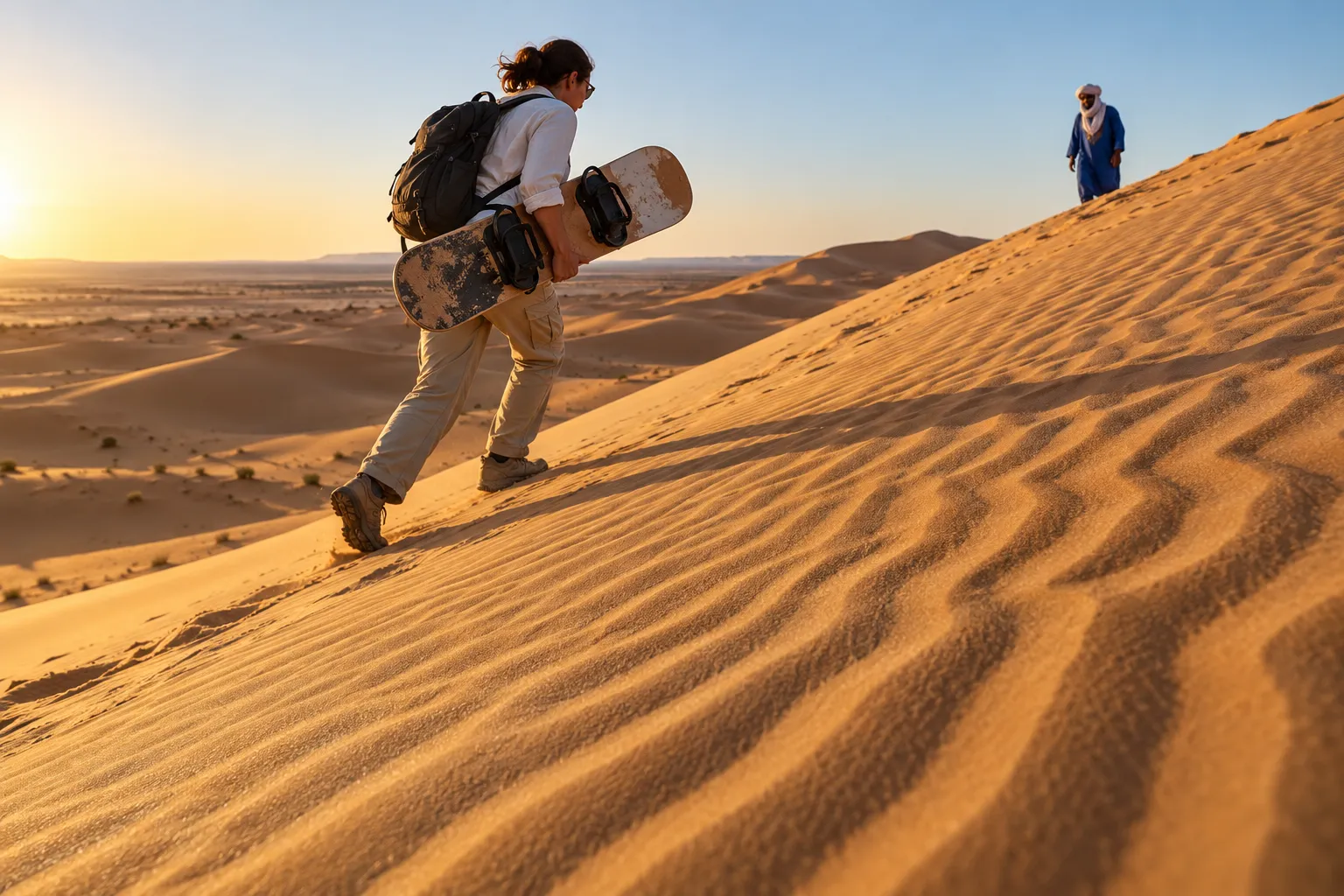
Try sandboarding with time for the climb back

Sandboarding adds a physical activity to a dune stay, but the return uphill is part of every descent. A short session can be enough, particularly after travelling or riding.
Ask whether the activity includes instruction or just use of a board. Equipment, slope selection and supervision should match your experience. Do not assume a general camp inclusion amounts to a structured lesson.
Check the slope and run-out area with the organiser before starting. Keep clear of vehicle routes, walking groups and other riders. Use equipment intended for the activity rather than copying improvised slides seen online.
Confirm whether you will sit or stand, what footwear is expected and what protective equipment is appropriate. Let the instructor select a manageable starting slope.
Wind and the condition of the sand affect how a board moves. The activity may be slower or less consistent than a promotional video suggests.
If sandboarding is a main reason for your visit, discuss it before booking the camp. If it is simply an optional extra, leave room to decide once you see the conditions and understand the effort involved.
Compare quad and buggy outings by driving time and supervision
Motorised desert activities need more detail than a vehicle photograph and a package duration. Ask how much time is spent driving, whether you control the vehicle and how the group is supervised.
A quad and a buggy have different controls and seating arrangements. Neither should be assumed suitable because the operator welcomes beginners. Confirm the briefing, practice time and participation requirements for the exact vehicle.
Visit Morocco Together’s Erg Chebbi quad outing from Merzouga provides a local activity option around the desert landscape. Before reserving, establish the riding duration, equipment, driver and passenger requirements, and whether the quoted price applies per person or per vehicle.
Age limits, licensing requirements and passenger rules must come from the provider for that activity. A general family-friendly description is not enough to establish that a child can drive or ride.
Ask about deposits, damage liability and insurance arrangements before accepting the vehicle. Understand what happens if conditions change or you decide not to continue after the briefing.
Choose guided routes that keep clear of people, animals, cultivated areas and restricted ground. The aim should be a controlled outing, with enough space and instruction to enjoy the terrain.
Use a guided 4×4 trip to explore beyond one viewpoint

A guided vehicle excursion can connect different parts of the desert area and provide breaks from walking. It may include dunes, stony plains, oasis areas or arranged stops in settlements, depending on the route.
Clarify the purpose. A sightseeing drive, a camp transfer and a specialist off-road trip are different products, even when the same type of vehicle is used.
Ask how much of the outing is spent inside the vehicle, whether walking is optional and how rough the tracks are expected to be. Seats, seatbelts and space for luggage matter more than an adventurous title.
Discuss stop preferences beforehand. Someone interested in landscape photography may want fewer, longer pauses. A traveller interested in local life may prefer explanation at a small number of agreed places.
Any hosted visit needs consent and clear arrangements. A household should not be treated as a guaranteed attraction simply because it appears beside a desert route.
If motion on uneven tracks is uncomfortable for you, ask about a gentler alternative. A shorter route or accommodation near accessible dune edges may fit better than a full circuit.
Stay at a desert camp without assuming you must ride
An overnight camp gives you time for dinner, evening light and a morning in the desert. The transfer into camp is a separate choice from the decision to sleep there.
For travellers who prefer vehicle access, Visit Morocco Together’s Merzouga camp experience without a camel ride offers a relevant option to discuss. Confirm where collection begins, the transfer conditions and the accommodation included; a local Merzouga arrangement should not be mistaken for transport from Marrakech or Fes.
Ask about the tent and bathroom layout, bedding, electricity and arrangements for temperature extremes. “Luxury” and “standard” are broad labels that do not answer these practical questions.
The location matters as much as the room. Find out how close neighbouring camps are, whether music is amplified and whether there is a quiet place to sit outside.
Also establish the meal schedule, dietary arrangements and checkout procedure. A late arrival followed by an early departure leaves little time to enjoy an otherwise appealing camp.
You can choose a hotel near the dunes instead. It may provide a more suitable base for day excursions, particularly when direct access, familiar facilities or a shorter transfer matters.
Watch sunset or sunrise without filling the whole day
A change of light can be an activity in itself. You do not need to combine it with a ride, a long drive or a strenuous climb.
Ask where you will watch from and how you will reach the spot. A low ridge or accessible area near accommodation may provide an enjoyable view without the effort of a high dune.
For sunset, agree the return plan before setting out. If part of the route takes place after dark, know who accompanies you and how you will identify the meeting point.
For sunrise, check how the outing fits with breakfast and departure. Avoid squeezing it between a late night and an early onward transfer if that leaves everyone tired.
Photographers may prefer to arrive before the light changes and stay afterwards. A group excursion built around a brief photo stop may not provide that flexibility.
Cloud, wind and airborne dust can change the view. Treat the outing as time in the landscape, with photography as an opportunity rather than a promised result.
Plan stargazing around darkness and conditions

A desert location can provide a rewarding night sky, but it does not guarantee clear stars. Cloud, dust, moonlight and lighting around the camp all affect what you can see.
Ask whether “stargazing” means free time outdoors or a guided astronomy session. If you expect a telescope, confirm that it is provided, usable and part of the booked activity.
For a darker sky, consider when the Moon is above the horizon as well as its phase. NASA’s explanation of Moon phases can help you understand that part of the planning. Bright moonlight can also make the surrounding landscape interesting, even when faint stars are harder to see.
Choose an agreed viewing place close enough to return safely. Do not walk into unfamiliar dunes after dark just to escape a camp light.
Bring a layer and ask whether seating is available. A comfortable period outside can be more enjoyable than repeatedly moving around to find a photograph.
If night photography is important, discuss lighting, access and timing with the camp before arriving. A decorative tent photograph does not reveal the darkness of the site.
Add oasis walks and cultural visits for a different pace
A desert stay can include time learning about the surrounding settlements and cultivated areas. This adds another perspective to the dunes, provided visits are properly arranged.
Around Merzouga, excursions may offer stops in Khamlia or oasis areas. Ask which places the itinerary includes and who will explain them. A named village does not guarantee a particular performance or invitation.
For music, confirm whether you are attending a public performance, a paid session or another agreed format. Ask before recording and allow the musicians to describe their own work.
An oasis walk should respect working fields, irrigation channels and private land. Follow the authorised route and do not pick produce or enter gardens without permission.
A family visit needs the same care. Know who is hosting, what the visit involves and how payment is handled. Avoid labels that assume everyone living near the desert has the same identity or way of life.
The context behind cultural experiences in Morocco matters here too. A conversation or demonstration deserves enough time to become more than a brief stop between vehicle activities.
Choose an Agafay evening when your trip is based in Marrakech
Agafay can work when you want a change of scenery during a Marrakech stay. Decide whether your priority is dinner, a ride, a quiet overnight stay or a motorised activity, then compare the actual programme.
Visit Morocco Together’s Agafay sunset outing with dinner from Marrakech combines a camel ride, camp dinner and entertainment with a return transfer. Confirm the pickup point, seasonal timing and arrangements if you prefer not to ride.
Choose the atmosphere as carefully as the inclusions. Dinner with a show can be sociable, but it serves a different purpose from a quiet meal or a night focused on observing the sky.
Ask about shared tables, music, dietary requirements and which drinks cost extra. If a pool appears in the photographs, establish whether access is included rather than assuming it forms part of an evening package.
Allow for the return to your accommodation. A riad in a pedestrian area may require a walk from the vehicle meeting point.
Agafay is a valid choice for its own landscape and convenience. It should not be sold to yourself as the same journey as visiting the Sahara dunes.
Build a realistic activity schedule after arrival
Your first desert activity should fit how you arrive. A long road day can leave little energy for a physical outing, and a delay may remove the daylight on which an excursion depends.
If you arrive late, dinner and rest may be enough. You can arrange a morning activity when the schedule allows rather than rushing to complete a prepaid list.
With one night near the dunes, choose a main outing and leave the rest flexible. If sunset is central to your plans, agree an arrival deadline and what happens if transport runs late.
With two nights in the area, you can separate activities. One day might contain a guided excursion, while the other allows a shorter walk, a cultural visit or time at the accommodation. Check whether staying an extra night means remaining in the same camp or moving elsewhere.
Keep midday plans appropriate to the conditions. A tent without suitable cooling or a shaded rest area may not provide the comfortable break you expect.
When planning how many days to spend in Morocco, count the approach and onward journey alongside the time in the desert. An attractive local excursion does not shorten the distance between cities.
Prepare for heat, wind and changes to the programme
Choose activities using the forecast for the actual area rather than the weather at your arrival airport. Inland conditions, night temperatures and wind can differ from the coast.
Check Morocco’s official weather service and ask the organiser how relevant warnings affect the route. A clear sky at camp does not establish conditions along an entire transfer or remote excursion.
Carry the water and clothing agreed for the activity. Closed footwear, sun protection and layers for cooler periods are practical considerations, with the exact equipment depending on whether you are walking, riding or driving.
Protect cameras and phones from blowing sand and keep essential belongings secured. For longer outings, establish communication arrangements rather than relying on continuous mobile coverage.
Understand the change policy before paying. Weather may require a different start time, an alternative route or cancellation. Ask how those decisions are made and which refund terms apply.
If you have health or mobility concerns, describe the demands of the activity when obtaining advice. An organiser also needs to know what adjustments you require before confirming participation.
Compare the total cost of the experience
Compare like with like. A short return ride, a camp stay with meals and a multi-day journey from another city have different costs and inclusions.
Ask whether the price covers transport to the start, the activity itself, equipment, meals and the return arrangement. Optional extras can change the final amount substantially.
For quad or buggy bookings, establish whether a price applies to the driver, passenger or whole vehicle. For camps, check occupancy, bathroom arrangements and whether transfers are charged separately.
For walks, determine whether guiding, water, meals and support transport are included. For cultural stops, clarify admission or performance payments before arriving.
A written description is more useful than a broad package label. Keep the final inclusions and cancellation terms with your booking confirmation.
Leave part of the budget uncommitted if you are unsure how much activity you want. You may prefer an extra quiet morning to another excursion once you arrive.
Questions about desert activities in Morocco
Can you visit the Sahara on a day trip from Marrakech?
A same-day return is not a practical choice for enjoying the major Sahara dune areas such as Erg Chebbi or Erg Chigaga. Allocate several days for the journey and time there. Agafay provides a different desert landscape for an outing from Marrakech.
Can you enjoy the desert without a camel ride?
Yes. Choose an excursion or accommodation arrangement with a confirmed vehicle transfer, or stay near the dunes and arrange suitable walks. Check the route and transfer conditions in advance because avoiding a camel ride does not necessarily mean avoiding uneven terrain.
Are sandboarding and quad biking included in a camp stay?
Only if the confirmed package says so. Equipment access, instruction and organised outings may be separate. Ask about actual activity time, supervision, participation requirements and any additional charges.
Which activities are suitable for children?
That depends on the child, the conditions and the provider’s requirements. Short walks, suitable viewpoint stops and time at accommodation may be easier to adapt than motorised outings or longer rides. Confirm minimum ages, equipment, supervision and the ability to shorten an activity.
Do you have to sleep at a desert camp?
No. Accommodation near the dunes can provide a base for local activities followed by a hotel night. Compare the access, facilities and excursion arrangements that matter to you.
How many activities should you book for one night?
One main activity is often enough when a camp stay also includes dinner and an early departure. Check arrival and checkout times first. Add another outing only if there is enough usable time and your group wants it.
Ready to Experience Morocco?
Turn this inspiration into your next adventure. Our travel experts are ready to help.