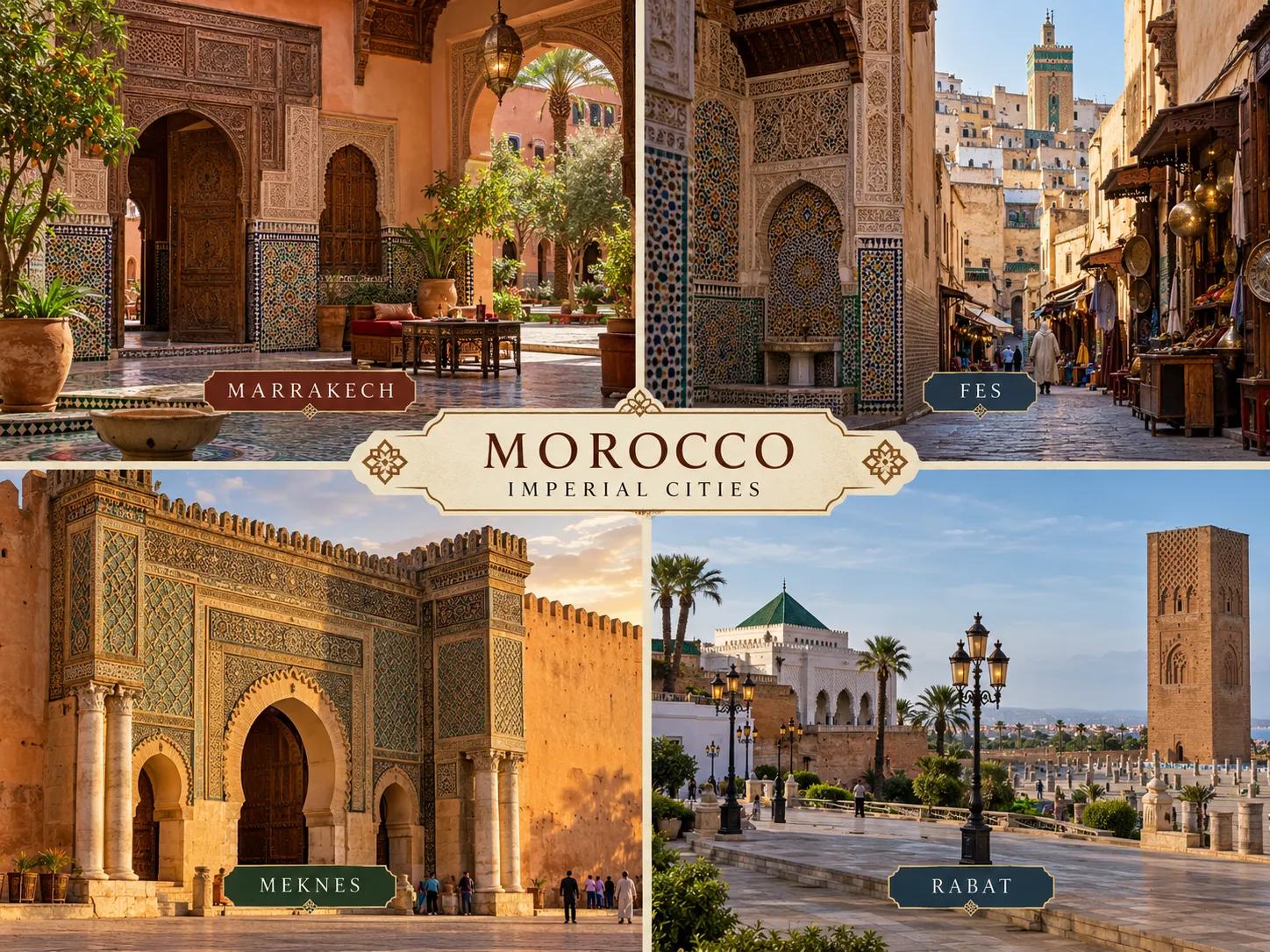
Morocco’s imperial cities—Marrakech, Fes, Meknes and Rabat—connect centuries of royal history, architecture, religious scholarship, craftsmanship and urban life. Each city served as a seat of power during a different period, but they do not feel like four versions of the same destination.
Marrakech is energetic and visually dramatic, with monumental architecture, gardens, souks and Jemaa el-Fna. Fes has one of Morocco’s most complex historic medinas and remains closely associated with scholarship and traditional crafts. Meknes reveals the monumental ambitions of Sultan Moulay Ismail, while Rabat combines older Almohad and Andalusian heritage with its role as Morocco’s modern capital.
A strong Morocco imperial cities itinerary gives these differences time to emerge. Seven days is possible, eight days provides better balance, and nine days gives you room for deeper sightseeing or an extension to Volubilis without turning the journey into a race between hotels.
What Are Morocco’s Four Imperial Cities?
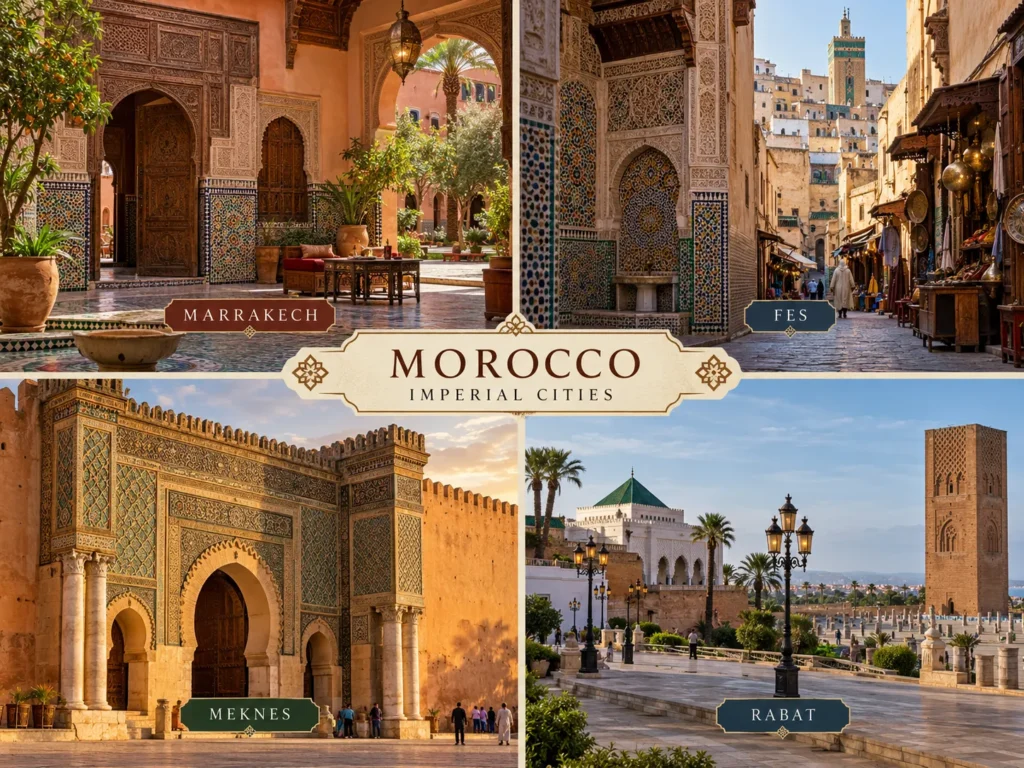
The four imperial cities are Marrakech, Fes, Meknes and Rabat.
They are described as imperial cities because each has served as a capital or major royal center during different periods of Moroccan history.
| City | Character | Main highlights |
|---|---|---|
| Rabat | Modern capital with major historic layers | Hassan Tower, Mausoleum of Mohammed V, Kasbah of the Oudayas, gardens |
| Fes | Historic cultural and spiritual center | Fes el-Bali, Bou Inania Madrasa, Al-Qarawiyyin area, crafts and tanneries |
| Meknes | Monumental royal city associated with Moulay Ismail | Bab Mansour, royal complexes, granaries/stables, medina and museums |
| Marrakech | Major historic capital with busy medina life | Koutoubia, Bahia Palace, Saadian Tombs, Jemaa el-Fna, gardens and souks |
What Is the Best Imperial Cities Route?
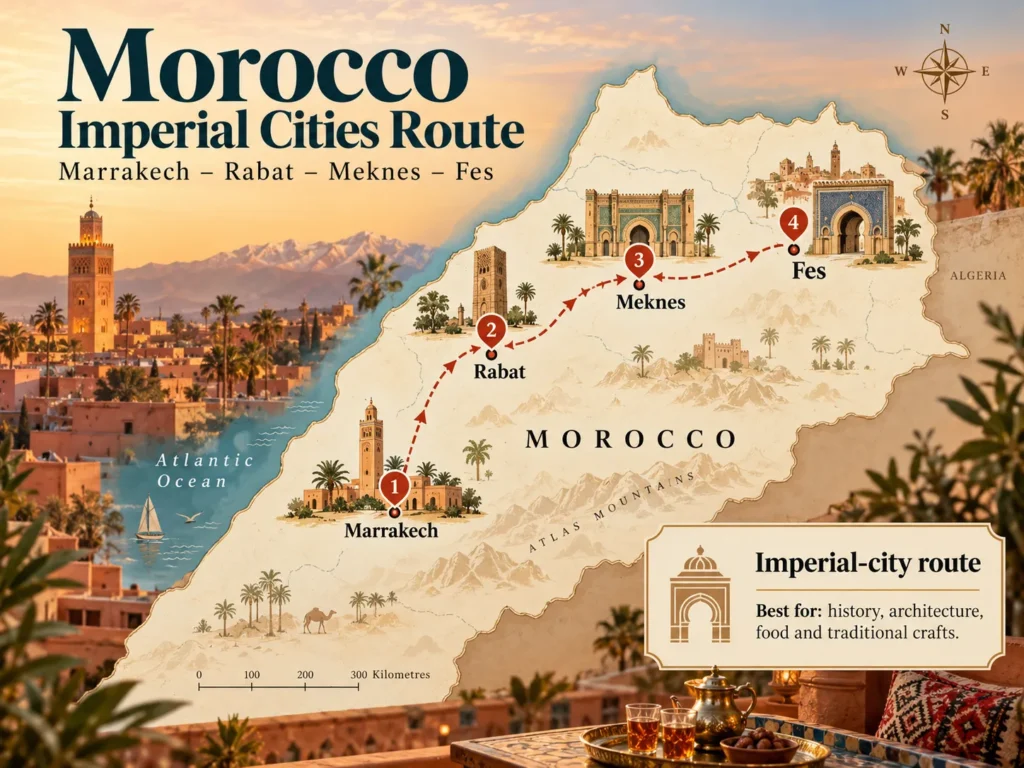
There is no requirement to visit the cities in one fixed order.
A practical one-way route can be:
Rabat → Meknes → Fes → Marrakech.
Another logical version is:
Marrakech → Rabat → Meknes → Fes.
Your international flights may determine which direction works better.
Meknes and Fes are close enough that travelers who want fewer hotel changes can stay in Fes and visit Meknes as a day trip. Rabat deserves at least a substantial day rather than being treated only as an airport or train stop.
Rabat: Royal Heritage and the Modern Capital
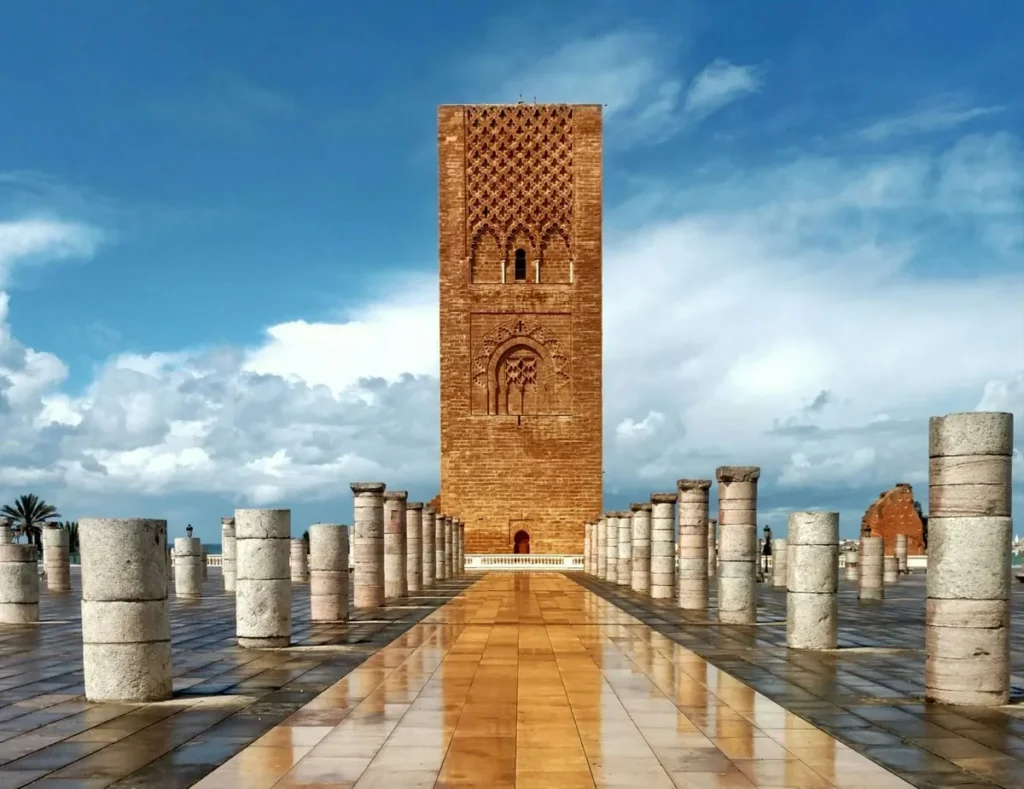
Rabat provides a useful introduction to the imperial cities because its history is visible alongside the institutions and neighborhoods of Morocco’s present-day capital.
The original articles consistently preserve three major landmarks: Hassan Tower, the Mausoleum of Mohammed V and the Kasbah of the Oudayas.
Hassan Tower
Hassan Tower is part of an ambitious Almohad mosque project begun in the 12th century.
The tower, surrounding columns and open archaeological space provide a different impression from the tightly packed medinas of Fes and Marrakech.
Mausoleum of Mohammed V
The mausoleum stands beside the Hassan Tower complex and adds another period of royal history to the visit.
Follow current visitor access and dress expectations at religious and ceremonial sites.
Kasbah of the Oudayas
The Kasbah of the Oudayas overlooks the Bouregreg and Atlantic side of the city.
Its narrow residential lanes, fortifications and gardens create a quieter atmosphere than Marrakech’s central medina.
Andalusian Gardens
The eight-day source includes Rabat’s Andalusian Gardens as part of the first city visit.
They work well as a slower stop after monuments and provide context for the Andalusian influences visible in parts of northern Moroccan architecture and design.
Why Rabat Feels Different
Rabat is particularly useful because it demonstrates that an imperial-city journey is not only a tour of medieval medinas.
The modern city, administrative areas, coastal setting and historic quarters coexist within the same capital.
Fes: Medina, Scholarship and Traditional Crafts
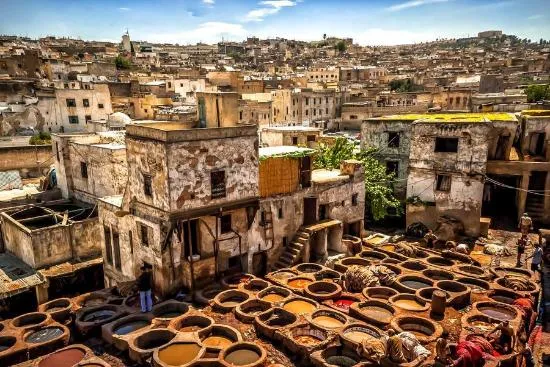
Fes usually deserves the most guided time of the four cities.
The Medina of Fes is extensive and still contains religious buildings, fondouks, markets, residences, workshops and craft quarters within its historic urban fabric.
Fes el-Bali
Rather than trying to navigate the medina by following a checklist of individual monuments, use a local guide for at least part of the first day.
The benefit is not only avoiding wrong turns. A knowledgeable guide can explain how neighborhoods, workshops, religious institutions, markets and residential areas fit together.
Bou Inania Madrasa
Bou Inania Madrasa is one of the most important architectural stops preserved from the merged cultural-tour article.
Its carved plaster, tilework and woodwork provide a closer look at Marinid-era decorative traditions.
Al-Qarawiyyin Area
The Al-Qarawiyyin complex is closely associated with Fes’s long tradition of religious scholarship and learning.
Visitor access to religious interiors can be restricted, so plan around the spaces open to non-Muslim visitors rather than assuming that every historic building can be entered.
Chouara Tanneries
The tanneries are among Fes’s most recognizable working landscapes.
Viewing arrangements generally depend on particular surrounding terraces or shops. Clarify access and any expectations before entering rather than assuming every rooftop has identical conditions.
Artisan Workshops
The merged articles emphasize Fes’s pottery, leatherwork, metalwork and other traditional crafts.
Visit workshops because you want to understand the process, not because a guide or seller makes purchasing feel obligatory.
Ask before photographing artisans closely.
How Long Should You Stay in Fes?
Two nights is a practical minimum for most imperial-city itineraries.
A full day can cover the principal medina experience, while another half or full day creates room for crafts, food, museums or a slower return to places that interested you.
Meknes: Moulay Ismail’s Imperial Capital

Meknes is sometimes compressed into a brief stop between Rabat and Fes, but its role in the imperial-city story is significant.
The city became an imperial capital under Sultan Moulay Ismail in the late 17th and early 18th centuries. Monumental gates, fortifications and royal infrastructure reflect the scale of his building program.
Bab Mansour
Bab Mansour is the city’s best-known monumental gate and provides one of the strongest architectural introductions to Meknes.
Moulay Ismail’s Royal Legacy
The merged articles preserve the Mausoleum of Moulay Ismail, royal stables and other monumental royal structures as key parts of the city’s story.
Opening conditions can change during restoration or religious periods, so verify current access before building the day around one interior.
Royal Stables and Granaries
The scale of the former royal infrastructure helps visitors understand that Meknes was designed as more than an ordinary regional medina.
Dar Jamai and Museums
The imperial-history source also includes Dar Jamai as an example of Meknes’s decorative and artistic heritage.
A museum stop can add useful context to the city’s architecture, crafts and elite domestic life.
Food Around Meknes
The Meknes region is closely associated with olives and agricultural landscapes.
Use local food as part of the journey rather than simply moving through the city between monument stops.
Volubilis: An Optional Extension From Meknes
Volubilis is not one of Morocco’s imperial cities, but it is one of the most logical historical extensions from Meknes.
The archaeological site adds a much earlier Roman-era layer to an itinerary otherwise centered largely on Islamic dynasties and later royal capitals.
A Meknes and Volubilis day works particularly well when you stay two or more nights in Fes.
Do not describe Volubilis as part of the imperial-city heritage itself. It complements the route because of geography and historical contrast.
Marrakech: Palaces, Souks and the Red City
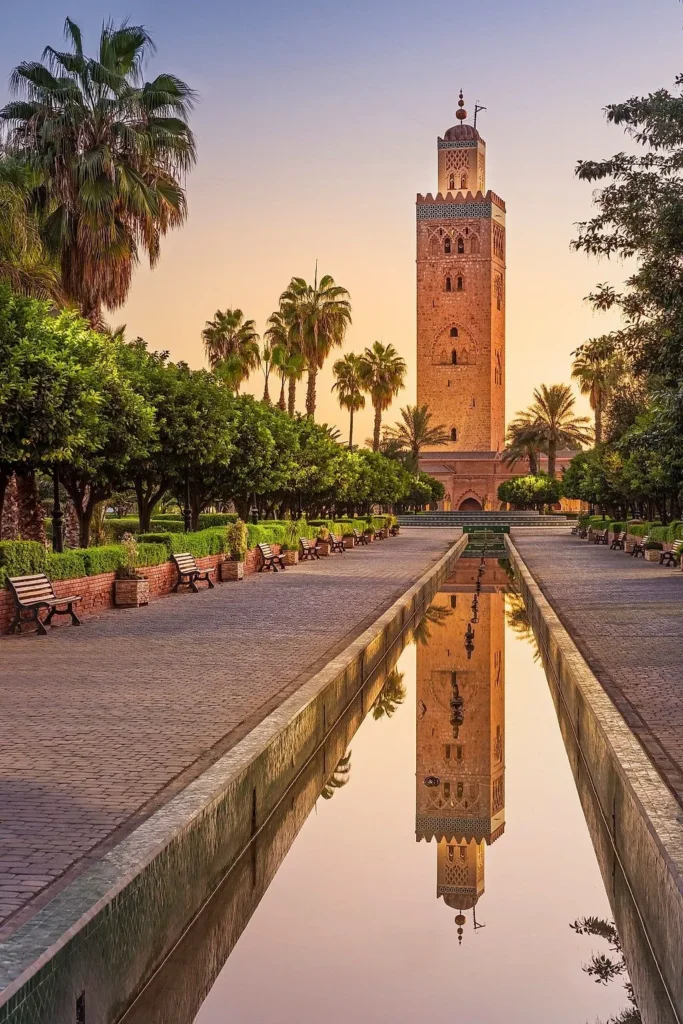
Marrakech provides the most energetic end—or beginning—to the imperial cities route.
Its historic importance stretches back to the Almoravid foundation of the city and its later role under the Almohads and other dynasties.
Koutoubia Mosque
The Koutoubia minaret is one of Marrakech’s defining architectural landmarks.
Non-Muslim visitors normally experience the mosque from its exterior and surrounding gardens, so the visit should be planned accordingly.
Jemaa el-Fna
The square changes throughout the day.
Return in the evening rather than trying to understand it through a single midday visit. Food stalls, pedestrians and performers give the square a very different atmosphere after dark.
Bahia Palace
Bahia Palace is one of the major palace sites retained across the merged imperial-history material.
Its decorated courtyards and rooms provide useful context for elite architecture from a later period than many of Marrakech’s medieval monuments.
Saadian Tombs
The Saadian Tombs add another royal dynasty to the imperial-city narrative and fit naturally into a historical Marrakech day.
Majorelle Garden
Majorelle Garden belongs to a different period and is not an imperial monument, but the old route articles repeatedly include it as part of the Marrakech stay.
Keep it as an optional garden and design experience rather than presenting it as evidence of Marrakech’s imperial history.
Souks and Crafts
Leave time for the souks instead of viewing them only while moving from one monument to another.
Metalwork, leather, textiles, wood, spices and decorative objects remain part of the city’s working commercial life.
How Are the Four Imperial Cities Different?
| City | Strongest reason to visit | Suggested time |
|---|---|---|
| Rabat | Royal heritage plus the modern capital | 1–2 nights |
| Fes | Historic medina, scholarship and crafts | 2–3 nights |
| Meknes | Moulay Ismail’s monumental royal city | 1 day or 1 night |
| Marrakech | Palaces, monumental architecture, souks and public life | 2–3 nights |
7-Day Morocco Imperial Cities Route
Seven days is possible, but the route should stay focused on the four imperial cities.
A practical structure is:
- Rabat: 1 night
- Fes: 2 nights
- Meknes: day visit between or from Fes
- Marrakech: 3 nights
The old seven-day article begins in Rabat, gives Fes meaningful sightseeing time, stops in Meknes and finishes with several days in Marrakech. That underlying structure remains strong.
Seven days leaves little room for Chefchaouen, the Sahara or a long Atlas excursion. Add those only by extending the trip.
8-Day Morocco Imperial Cities Route
Eight days creates a better balance and matches one of the major merged French sources.
The extra day can be used for:
- A second full Fes day
- An overnight in Meknes
- Meknes plus Volubilis
- An additional Marrakech day
- A short Atlas or Imlil outing after the four cities are covered
The old eight-day article uses several days in Marrakech and adds an Atlas-area excursion near the end.
That can work when nature is important, but the four imperial cities should remain the main focus of an imperial-city itinerary.
9-Day Morocco Imperial Cities Route
Nine days is the most comfortable of the source durations.
Rather than adding more distant regions, use the extra time to slow the existing route:
- 1–2 nights Rabat
- 2–3 nights Fes
- 1 day Meknes and Volubilis
- 3 nights Marrakech
This allows guided sightseeing, independent medina time, museums, food and craft experiences without changing accommodation every morning.
If you have nine days and your real priority is also Chefchaouen or the Sahara, switch to a broader Morocco itinerary rather than continuing to call the journey an imperial-cities tour.
Should You Stay Overnight in Meknes?
Both approaches work.
Stay overnight when:
- You prefer slower cities
- Moulay Ismail’s architecture is a major interest
- You want Meknes without day-trip time pressure
- You plan to visit Volubilis separately
Use Fes as the base when:
- You want fewer hotel changes
- Your trip is seven or eight days
- Fes is the main cultural priority
- You are comfortable combining Meknes and Volubilis into one excursion
Guided or Independent Imperial Cities Tour?
Local Guides
A local guide is particularly valuable in Fes and can also add historical context in Marrakech, Meknes and Rabat.
Confirm whether the guide specializes in history, architecture, food or general city orientation.
Private Driver
A private driver can simplify intercity travel and hotel transfers, particularly if you want to include Volubilis.
A driver and a licensed city guide are not necessarily the same role.
Independent Travel
The imperial cities can also be combined independently using rail and road connections.
Independent travelers should allow enough transfer time between accommodation and stations rather than treating the published journey time as the complete door-to-door trip.
Architecture to Look For Across the Route
The value of visiting all four imperial cities is not simply seeing four collections of monuments.
Watch how architectural ideas change and repeat:
- Zellige tilework
- Carved plaster
- Cedar and other carved wood
- Courtyard planning
- Monumental gates
- Ramparts
- Gardens and water
- Madrasas
- Palaces
- Kasbah and royal complexes
Dynasties reused and adapted earlier architectural models, so the cities make more sense when viewed as connected chapters rather than independent sightseeing lists.
Food Across the Imperial Cities
The merged cultural articles correctly preserve food as part of the imperial-city experience.
Fes
Fes is particularly associated with elaborate culinary traditions. Try regional preparations, pastilla, tagines, breads and seasonal dishes rather than limiting the visit to one famous recipe.
Meknes
The wider Meknes region is associated with olives, agricultural produce and vineyards.
Marrakech
Jemaa el-Fna adds a street-food dimension to the route, while restaurants and riads offer a different style of dining.
Rabat
Rabat combines traditional Moroccan food with a contemporary capital-city restaurant scene and Atlantic influences.
Cooking Classes
The merged Fes/Meknes/Marrakech article recommends cooking classes as a way to understand ingredients and preparation methods.
This works particularly well on an eight- or nine-day trip where you have enough time for experiences beyond monument visits.
Crafts and Artisan Traditions
Fes and Marrakech provide the strongest craft sections of the route, although each city has its own markets and artisan traditions.
Possible subjects include:
- Leather
- Pottery
- Metalwork
- Carved wood
- Textiles
- Embroidery
- Zellige
- Decorative plasterwork
When visiting workshops, ask before taking close photographs and separate learning about the process from any decision to buy.
Best Time for Morocco’s Imperial Cities
Spring and autumn are useful starting points because the itinerary involves substantial walking in medinas and monuments.
Summer remains possible but can be very hot in Marrakech, Fes and Meknes. Shift walking toward mornings and later afternoons and protect time to rest.
Winter can work very well for cultural sightseeing, although mornings and evenings may be cool and rain is possible.
Use the Morocco Seasonal Travel Guide to compare your exact month and regions rather than treating all four cities as having identical conditions.
Where Should You Stay?
Rabat
Choose between the historic-center atmosphere and easier transport access in the modern city.
Fes
A riad in or near Fes el-Bali provides atmosphere and easy medina access, but ask about luggage transfer and walking distance from the nearest vehicle drop-off.
Meknes
An overnight near the historic city works well if you want quieter evening and morning exploration.
Marrakech
A medina riad gives you easy access to historical sights and souks, while properties farther outside the old city may offer larger pools, easier vehicle access and more space.
Common Imperial Cities Planning Mistakes
Trying to Add the Sahara to Seven Days
That creates a different itinerary. The Sahara requires several substantial road days and deserves its own planning.
Giving Fes Only Half a Day
Fes has the most complex medina of the four cities and deserves at least one full sightseeing day.
Skipping Meknes
Meknes is essential to understanding the imperial-city sequence, even if you visit it as a day trip from Fes.
Treating Rabat Only as a Transfer Stop
Hassan Tower, the Oudayas and Rabat’s modern-and-historic urban layers justify meaningful time.
Listing Every Marrakech Attraction in One Day
Protect time for the medina and souks instead of moving constantly between ticketed monuments.
Confusing Nearby Attractions With Imperial Cities
Volubilis, Chefchaouen and Casablanca can all complement a Morocco itinerary, but they are not part of the four-city imperial group.
FAQ
What are the four imperial cities of Morocco?
The four imperial cities are Marrakech, Fes, Meknes and Rabat. Each served as an important royal capital during different periods of Moroccan history and preserves a different combination of palaces, medinas, religious architecture and royal monuments.
How many days do you need for Morocco’s imperial cities?
Seven days is the practical minimum for all four cities. Eight days provides better pacing, while nine days allows more time in Fes and Marrakech or an excursion to Volubilis without rushing.
What is the best order for visiting the imperial cities?
Rabat → Meknes → Fes → Marrakech works well when starting on Morocco’s Atlantic side. Marrakech → Rabat → Meknes → Fes also works when flights favor Marrakech. Meknes can be visited from Fes if you want fewer hotel changes.
Is Meknes worth visiting if I already visit Fes?
Yes. Meknes represents a different imperial period and is particularly associated with Sultan Moulay Ismail. Bab Mansour, the royal complexes and the city’s monumental scale distinguish it from Fes.
Can you visit Volubilis on an imperial cities tour?
Yes. Volubilis is not an imperial city, but it is a logical historical extension from Meknes or Fes. It adds Roman archaeological history to a route otherwise focused primarily on Morocco’s later royal capitals.
Do I need a guide for the imperial cities?
You can travel between the cities independently, but a knowledgeable local guide is especially useful in Fes and can add historical context in Marrakech, Meknes and Rabat. Confirm separately whether intercity transport, city guiding and entrance fees are included.
Four Cities, Four Different Chapters of Moroccan History
The value of a Morocco imperial cities journey comes from seeing how the country’s centers of power changed over time.
Fes preserves an extraordinary historic medina shaped strongly by Idrisid and Marinid periods. Marrakech reflects the ambitions of the Almoravids, Almohads, Saadians and later rulers. Meknes shows the monumental vision of Moulay Ismail and the early Alaouite period. Rabat combines older Almohad and Andalusian heritage with its continuing role as Morocco’s modern capital.
The merged articles include many useful attractions—Hassan Tower, the Oudayas, Bou Inania Madrasa, the Fes tanneries, Bab Mansour, the royal stables, Bahia Palace, Saadian Tombs and Majorelle Garden—but the final article is stronger when those places are organized around the historical differences between the four cities rather than presented as one long checklist.
Choose seven days for a focused route, eight for better balance and nine if you want deeper city time or Volubilis.
For a broader culture-focused journey that also includes rural areas, food and local life, read the Morocco Cultural Holiday guide. For country-wide trip-length comparisons, use Morocco Itineraries.
If you want a private imperial-cities route designed around your arrival city, preferred hotels, guided visits and travel dates, use the custom Morocco trip planner.
Explore destinations, tours and locally organized Morocco experiences with Visit Morocco Together.
Ready to Experience Morocco?
Turn this inspiration into your next adventure. Our travel experts are ready to help.