Choosing Morocco accommodation for families is less about finding a property labelled “family-friendly” and more about checking whether the room, location and facilities work for your particular trip. For city stays, a well-located riad or apartment can reduce daily transport. Resorts can provide more space and child-focused facilities, while mountain guesthouses and desert camps make sense when they fit naturally into a wider route.
The most practical family itinerary often combines accommodation types. You might use a riad for a few nights in Marrakech, a guesthouse in the Atlas Mountains and a hotel or apartment on the coast. The important part is not trying every style, but choosing each stay around your children’s ages, sleeping arrangements, daily travel and need for downtime.
This guide explains what to check before booking, where different accommodation styles work well and how to avoid common family travel problems.
What Makes Morocco Accommodation for Families Work Well?
A large room is useful, but family accommodation needs more than floor space. Start with the sleeping arrangement. Ask whether a “family room” contains separate beds, a sofa bed, an extra bed or two connecting bedrooms. When booking two rooms, confirm whether they actually connect internally if that matters to you.
For babies and younger children, ask about cots before booking rather than assuming they are available. Families with older children may value separate sleeping areas more than a single larger bedroom.
Next, look at the property itself. Stairs, terraces, balconies, courtyards and swimming pools can be part of the appeal of Moroccan accommodation, but their layouts vary considerably. If your children are young, ask specific questions about barriers, railings, doors and supervision rather than relying on a general “family-friendly” description.
Meal arrangements also matter. A hotel with an on-site restaurant can simplify evenings after a long sightseeing day. An apartment with a kitchen may suit families who prefer flexible meals, while a rural guesthouse may require dinner to be arranged in advance.
Finally, consider how easily everyone can return for a break. A beautiful property becomes less convenient if every nap, meal or clothing change requires a long journey across the city.
Riads: Good for Culture, but Check the Layout Carefully
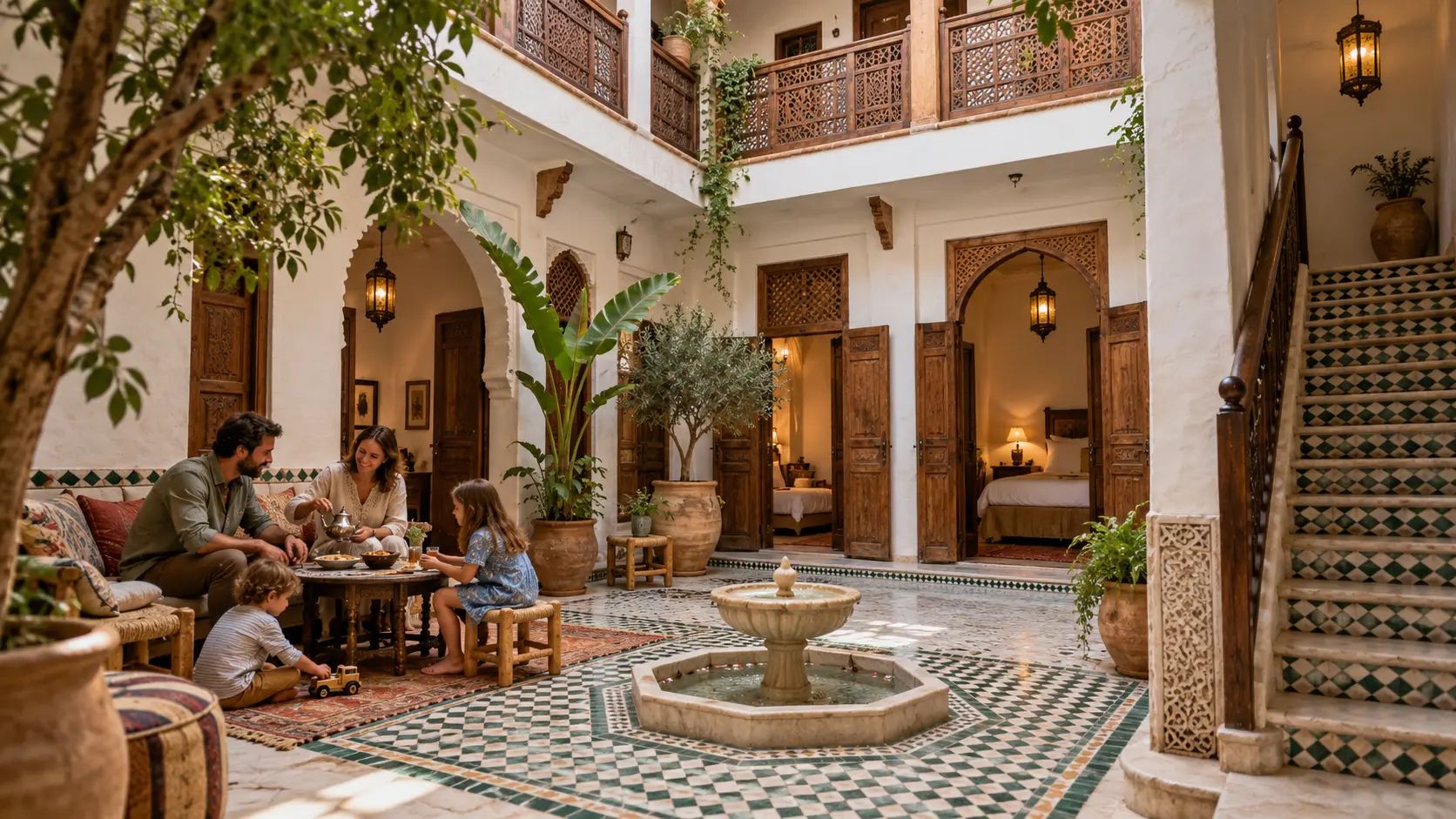
A riad can be one of the most distinctive choices for a family stay in Morocco. These traditional houses are usually organized around an interior courtyard, and many now operate as small hotels or guesthouses.
Riads can work particularly well in Marrakech and Fes when your plans focus on exploring the medina on foot. Staying inside or near the old city can make it easier to return to your room between sightseeing periods.
The trade-off is that traditional buildings were not designed to the same pattern as modern family hotels. Some have steep stairs, open galleries or roof terraces. Courtyard pools can be compact and may not have the barriers you expect at a resort.
Ask where the family room is located, how many stairs are involved and whether children can move between rooms without entering a public corridor. If you need a cot, extra bed or connecting rooms, get confirmation for the exact booking rather than relying on general property information.
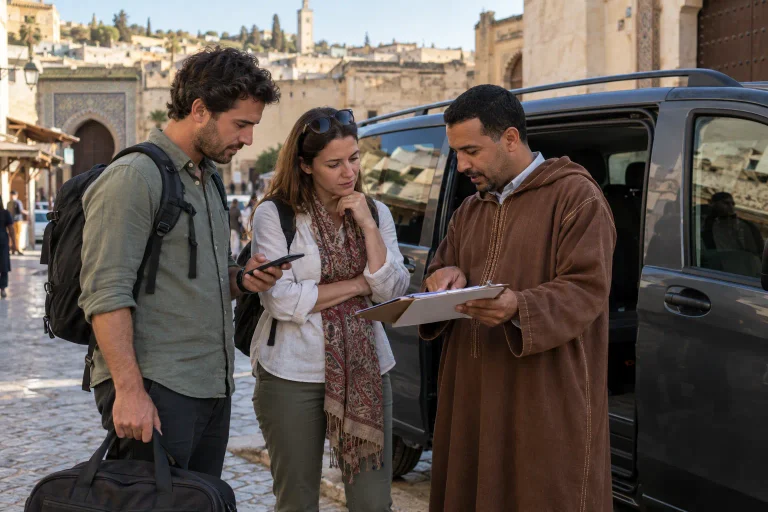
Medina access matters too. Taxis and transfers cannot reach every lane. Ask for the nearest vehicle-accessible drop-off point and how much walking remains with children and luggage. A property close to a gate can sometimes make arrival easier than a riad deep in the medina.
Hotels and Resorts: Useful When Facilities Matter
Hotels and resorts are often easier to compare when your priorities include connecting rooms, lifts, several restaurants, larger swimming pools or organized children’s activities.
A resort can be especially useful if the accommodation itself is intended to be part of the holiday. Families who want slow mornings, pool time and fewer daily transfers may prefer a property outside the busiest sightseeing areas.
The compromise is location. A resort on the outskirts of Marrakech may provide gardens and more space but require transport whenever you want to explore the medina. A coastal resort can work well for beach-focused days but may be less convenient for sightseeing elsewhere.
Do not assume every hotel has a children’s club, heated pool or family restaurant simply because it markets itself to families. Check age limits, opening periods and whether any children’s facilities will operate during your dates.
Pool temperature deserves particular attention outside the hottest months. An attractive outdoor pool may not be heated, and whether it feels comfortable depends on the season and conditions.
Apartments and Villas: More Space and Flexibility
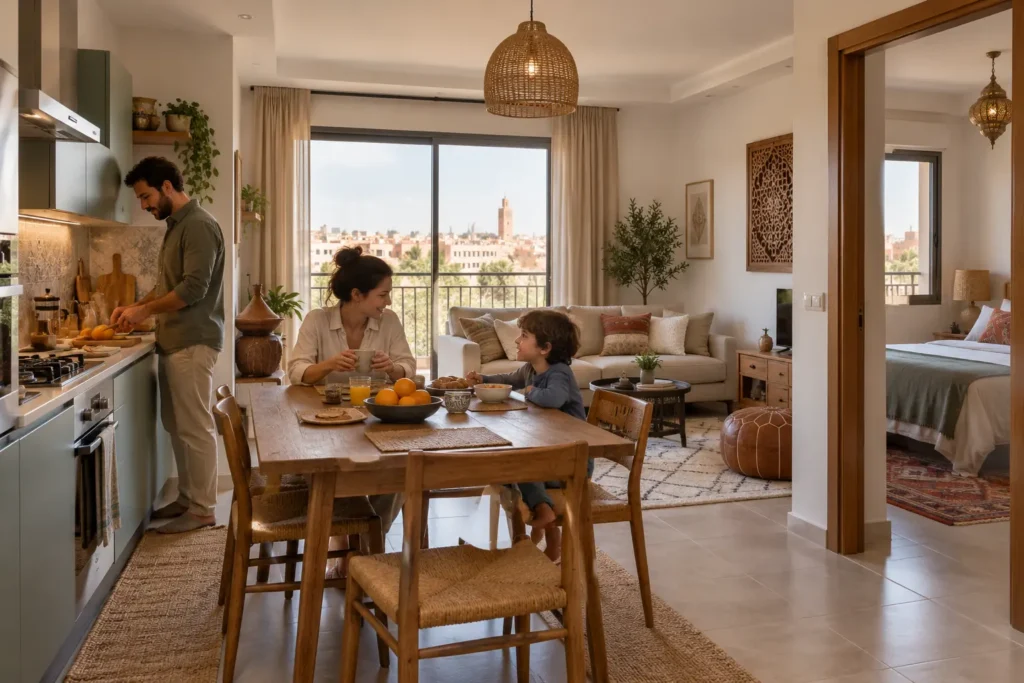
A self-catering apartment can be one of the most practical options for Morocco accommodation for families, particularly for longer stays or larger households.
A kitchen allows more flexibility around breakfast, snacks and children’s preferred foods. Separate bedrooms can also make evenings easier when younger children go to sleep before adults or teenagers.
Apartments can work well in modern districts of Marrakech, Casablanca and other larger cities, as well as in coastal destinations. However, the level of service differs from a hotel. Check how keys are collected, whether reception is staffed, what cleaning is included and whom you contact if there is a problem.
Confirm the actual kitchen facilities rather than assuming “self-catering” means a fully equipped kitchen. A microwave and small refrigerator may be enough for one family but not another.
For villas, check the exact location carefully. Extra space can be attractive, but an isolated property may create repeated taxi or rental-car journeys for meals and sightseeing.
Guesthouses: A Practical Choice for Smaller Destinations
Guesthouses can suit families travelling beyond Morocco’s major cities. In the Atlas Mountains, southern valleys and smaller towns, they can provide a comfortable base without the formality of a larger hotel.
The main advantage is often location. Staying close to the place you want to explore reduces the need for a long road journey before and after every activity.
Facilities vary widely, so ask about bathrooms, heating or cooling, family-room configuration and meals. In a rural area, nearby restaurants may be limited, making dinner at the guesthouse more important than it would be in Marrakech.
Mountain accommodation requires particular attention to access. A guesthouse may involve stairs, uneven paths or a final section on foot. Families using pushchairs or travelling with limited mobility should request specific information before booking.
Desert Camps: Plan the Journey as Carefully as the Tent
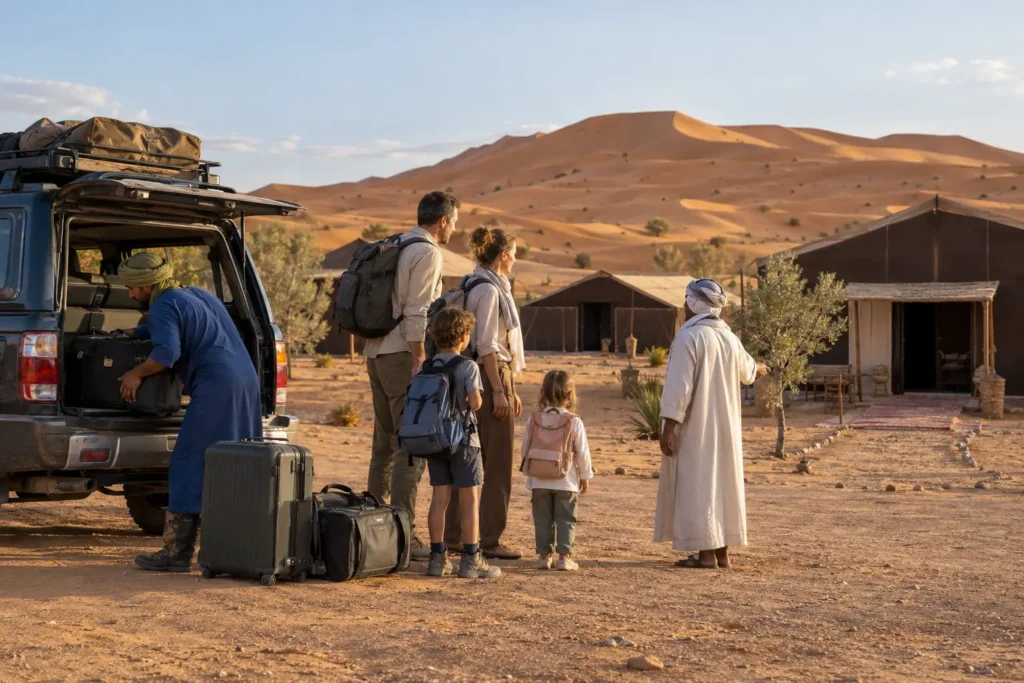
A Sahara camp can become part of a family route, but it should be planned as a complete travel experience rather than as an isolated hotel night.
For Merzouga and Erg Chebbi, first decide how the desert fits into the wider journey. Reaching this part of Morocco involves substantial road travel from major cities, so it should not be treated as a quick excursion from Marrakech.
Before choosing a camp, confirm the tent configuration, bathroom arrangement, bedding, meals, electricity and how you reach the camp from the meeting point. Families should also ask how larger luggage is handled.
Do not assume camel transport is compulsory. If you prefer not to include an animal activity, ask whether vehicle access or another transfer can be arranged. Where animal activities are offered, consider welfare standards rather than treating them as an automatic part of a desert stay.
Season matters in the Sahara. Daytime and overnight conditions can differ substantially, and heat or cold may affect how comfortable a camp feels for children. Ask the operator about conditions expected for your dates without treating a general seasonal description as a weather guarantee.
Where to Stay in Morocco With Children
Marrakech: Choose Between the Medina and a Resort
Marrakech gives families one of the widest choices of accommodation styles. A medina riad suits families who want historic sights and souks close to their room. A hotel in the modern city can simplify road access, while properties around the Palmeraie or other outlying areas can provide more space for pool and garden time.
For younger children, consider how often you expect to return to the accommodation during the day. A central property may be more practical than a larger resort if your schedule involves naps or short sightseeing periods.
If the hotel itself is a major part of the holiday, accepting a longer journey into the medina may be a reasonable trade-off.
Fes: Prioritize Medina Access
In Fes, accommodation location can significantly affect a family stay. Fes el-Bali is largely explored on foot, and some riads require a substantial walk through narrow lanes from the nearest vehicle-accessible point.
Families who want the medina experience can look around practical access areas such as Bab Boujloud or Batha, then confirm the final walk to the chosen property. A modern hotel outside the old city may suit travelers who prioritize easier vehicle access or specific hotel facilities.
Essaouira and Agadir: Good for Slower Coastal Days
Coastal stays can provide useful downtime during a longer Morocco itinerary. Essaouira suits families who want a compact historic city alongside the coast, while Agadir offers a different experience with a modern beachfront and a broader selection of resort-style accommodation.
Do not assume swimming conditions based on photographs or the season alone. Atlantic weather, wind and sea conditions vary. Choose the accommodation for the facilities and location you can confirm, not for guaranteed beach weather.
Atlas Mountains: Choose Around Access and Activities
Mountain stays can add a very different pace to a family trip. Villages and guesthouses can work well when you want walks, scenery and quieter days between city stops.
Choose walks according to the abilities of the family rather than selecting accommodation because a famous trekking route is nearby. Ask the property about road access, walking terrain and meal arrangements.
Mountain weather can differ markedly from Marrakech, particularly at elevation. Check seasonal conditions and make sure heating, bedding and appropriate clothing are part of your planning.
Family Rooms, Connecting Rooms or Two Separate Rooms?
Room terminology is one of the easiest places to make a booking mistake. “Family room” does not have one universal layout. It might mean a larger bedroom containing several beds, a suite with separate sleeping spaces or another configuration.
Connecting rooms should have an internal door between them, while adjoining or adjacent rooms may simply be beside or near each other. If an internal connection is essential, ask the accommodation to confirm it explicitly.
Also check maximum occupancy. A room that looks large enough in photographs may not permit the number or ages of guests in your family under the property’s booking rules.
When children are older, two rooms may provide more comfort. With younger children, a genuine family suite or guaranteed connecting arrangement may be more practical. The right setup depends on your family rather than on a particular accommodation category.
Check Pools, Terraces and Stairs Before Booking
Traditional architecture and warm-weather facilities can create questions that matter more when travelling with children. Do not assume a courtyard pool is fenced or that a roof terrace has the same type of barriers you have encountered elsewhere.
Ask for photographs or specific descriptions when these details affect your decision. Check whether the route between bedroom, restaurant and pool involves stairs and whether lifts are available where required.
Parents know the level of supervision their own children need. The useful goal is to understand the property accurately before arriving, rather than expecting every family to need the same setup.
Make Meals Easier
Family travel often works better when every meal does not become a major outing. Before booking, check whether breakfast is included, whether dinner is available and whether meals need to be ordered in advance.
For dietary needs, contact the accommodation directly and describe what is required. Do not assume that a buffet, children’s menu or kitchen automatically covers an allergy or dietary restriction.
In a city, staying near several restaurants gives you alternatives. In a mountain guesthouse or desert camp, meals at the property may form a larger part of the stay, making advance communication more important.
Build the Route Around Family Energy, Not Hotel Changes
One of the simplest ways to improve a family trip is to reduce unnecessary accommodation changes. Every move involves packing, checking out, travelling, handling luggage and settling everyone into another room.
Two or three nights in one practical base can often work better than changing hotels just to experience another neighborhood or accommodation style. Longer stays also leave room for a quiet afternoon when children need one.
Separate demanding road days from demanding sightseeing days where possible. On a desert route, for example, avoid assuming children will want a full programme immediately after a long drive.
Good Morocco accommodation for families should support the route rather than make the itinerary more complicated.
Budget for the Complete Family Stay
Headline room prices are not enough for a useful comparison. Check whether you need one room or two, whether breakfast is included and whether cots or extra beds carry a charge.
Location can also change the overall cost. A cheaper resort outside a city may involve more taxis, while a central riad can reduce transport but provide fewer on-site facilities.
For apartments, include cleaning or other booking charges shown before payment. For camps or rural stays, confirm meals and the transport needed to reach the property.
Prices and availability change by date and occupancy, so compare suitable properties using your real family size rather than a generic two-person search.
Common Mistakes When Booking Morocco Accommodation for Families
A common mistake is choosing a property because it has a pool without checking whether the room arrangement or location works. Another is assuming the words “family hotel” guarantee connecting bedrooms, children’s activities or suitable facilities.
In medinas, families sometimes underestimate the final walk from a taxi drop-off point. In rural areas, they may overlook meal arrangements or the road to the property. At desert camps, the transfer to the tent can be missed when comparing accommodation listings.
Avoid changing properties too often, and do not choose the most remote option simply because it looks peaceful. The extra travel has to fit the family’s energy and the rest of the itinerary.
FAQs
Are Riads Suitable for Families With Children?
Many are, but suitability depends on the individual property. Check room configuration, stairs, terraces, pool layout and the final walk from vehicle access. Some riads are easier for families than others.
Are Apartments Better Than Hotels for Families?
Apartments can provide more space and kitchen facilities, particularly for longer stays. Hotels may be easier when you value reception services, housekeeping, restaurants or organized facilities. Neither option is automatically better.
Should Families Stay Inside the Medina?
A medina stay can reduce sightseeing journeys and provide a distinctive setting, but consider luggage access, stairs and busy lanes. Families who prioritize simple road access may prefer accommodation near a medina gate or in the modern city.
Is a Desert Camp Suitable for Children?
It can be when the road journey, tent facilities, temperatures and transfer arrangements suit your family. Ask detailed questions before booking and do not assume that every camp provides the same comfort or access.
Do Family Hotels in Morocco Have Kids’ Clubs?
Some resorts do, but it is not standard. Check whether a club operates during your dates, which ages it accepts and whether supervision or activities are included in your booking.
Choose Accommodation Around the Family You Actually Travel With
The right Morocco accommodation for families is the property that solves your real daily needs: suitable beds, manageable access, useful meals, enough downtime and a location that fits the route. A traditional riad can be ideal for one family, while another may be happier with an apartment, resort or guesthouse.
Build the journey around realistic travel days and fewer unnecessary hotel changes, then verify each property’s room configuration and facilities before paying. For a route that combines different regions and accommodation styles, you can also explore VMT’s family adventure options in Morocco.
Ready to Experience Morocco?
Turn this inspiration into your next adventure. Our travel experts are ready to help.