Visiting religious and historic sites in Morocco is an opportunity to understand the country’s architecture, cultural traditions and centuries of history. From the Hassan II Mosque in Casablanca to Marrakech’s historic madrasas and the ancient ruins of Volubilis, these places offer different experiences and require different approaches.
The most important rules are simple: check whether visitors are allowed inside, dress respectfully, avoid disturbing worshippers, ask before photographing people and never touch or damage historic structures.
One distinction is especially important in Morocco. Most active mosques do not admit non-Muslim visitors, while certain historic religious schools, museums and monuments are open for sightseeing. The Hassan II Mosque in Casablanca is a notable exception, offering organized guided visits.
This guide explains what to wear, how to behave, when photography is appropriate and how to explore Morocco’s religious and historical heritage respectfully.
Essential Etiquette Before Entering a Site
The easiest way to avoid misunderstandings is to check the rules before entering rather than assuming that every monument welcomes visitors in the same way.
Keep these principles in mind:
- Confirm access: A historically important building may still be an active place of worship or a private religious institution.
- Dress appropriately: Clothing covering the shoulders and knees is a sensible starting point for many religious and historic settings.
- Follow local instructions: Respect signs, barriers, designated entrances and staff directions.
- Keep noise low: Avoid loud conversations, music and disruptive phone use.
- Respect worshippers: Do not interrupt prayers, ceremonies or private religious activities.
- Ask before photographing: Permission to enter does not automatically mean permission to photograph everything.
- Protect the monument: Do not climb on fragile structures, touch delicate decoration or enter restricted areas.
These guidelines apply across Morocco, but individual sites may have more specific requirements. Always follow the rules displayed at the entrance.
Religious and Historic Sites in Morocco: Know the Difference
Morocco’s historical attractions include active mosques, former religious schools, mausoleums, archaeological sites, palaces and inhabited medinas.
Understanding which type of place you are visiting helps you recognize what behavior is appropriate.
Active mosques: Access is generally restricted
Mosques are places of Muslim worship, not simply architectural monuments.
In Morocco, most active mosques are not open to non-Muslim tourists. This applies to many famous buildings that visitors can admire from outside.
For example, the Koutoubia Mosque in Marrakech is an important city landmark, but non-Muslim visitors should not attempt to enter its prayer hall.
The same general restriction applies to the active mosque of Al-Qarawiyyin in Fez.
Visitors can appreciate these buildings from permitted public spaces without entering areas reserved for worship.
Do not follow someone through a mosque entrance simply because a door is open. An open door does not necessarily indicate public tourist access.
If you are uncertain, ask an authorized attendant or local guide before approaching.
Hassan II Mosque: A notable exception in Casablanca
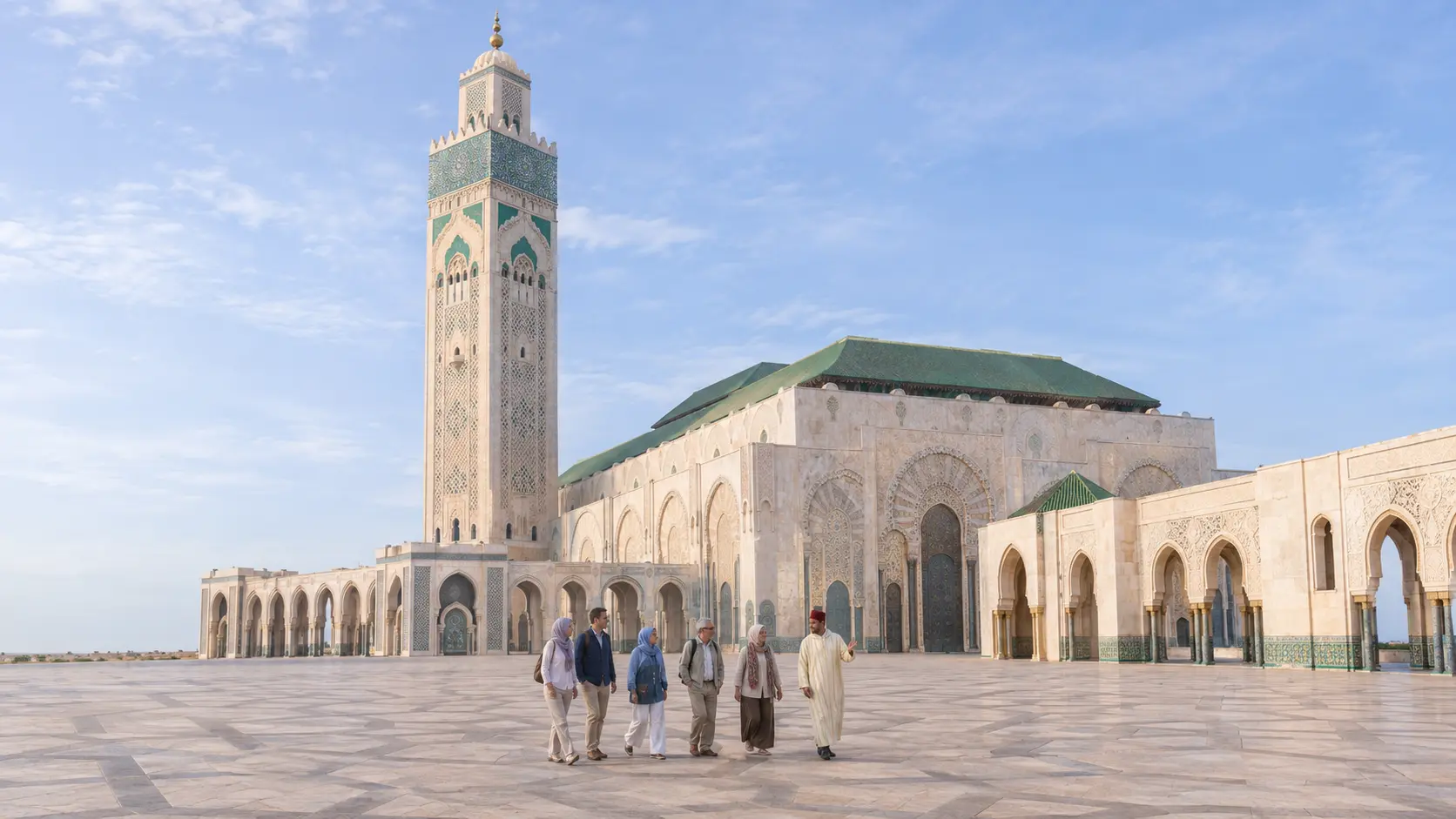
The Hassan II Mosque in Casablanca is one of the most important exceptions to Morocco’s usual mosque-entry restrictions.
Non-Muslim visitors can explore designated interior areas through organized guided visits.
The mosque’s official visitor rules require clothing that covers the shoulders, torso and extends below the knees. Visitors must remove their shoes before entering the prayer hall and follow their guide’s instructions.
Eating, drinking and smoking are prohibited during the visit, and restrictions apply to video recording and electronic devices.
The mosque remains an active place of worship, so public visiting arrangements are organized around its religious function.
Planning tip: Check the current guided-tour schedule, ticket arrangements and visitor rules before arriving. Religious observances and other circumstances may affect the programme.
For other attractions in the city, explore our Casablanca travel guide.
Historic madrasas: Religious heritage open to visitors
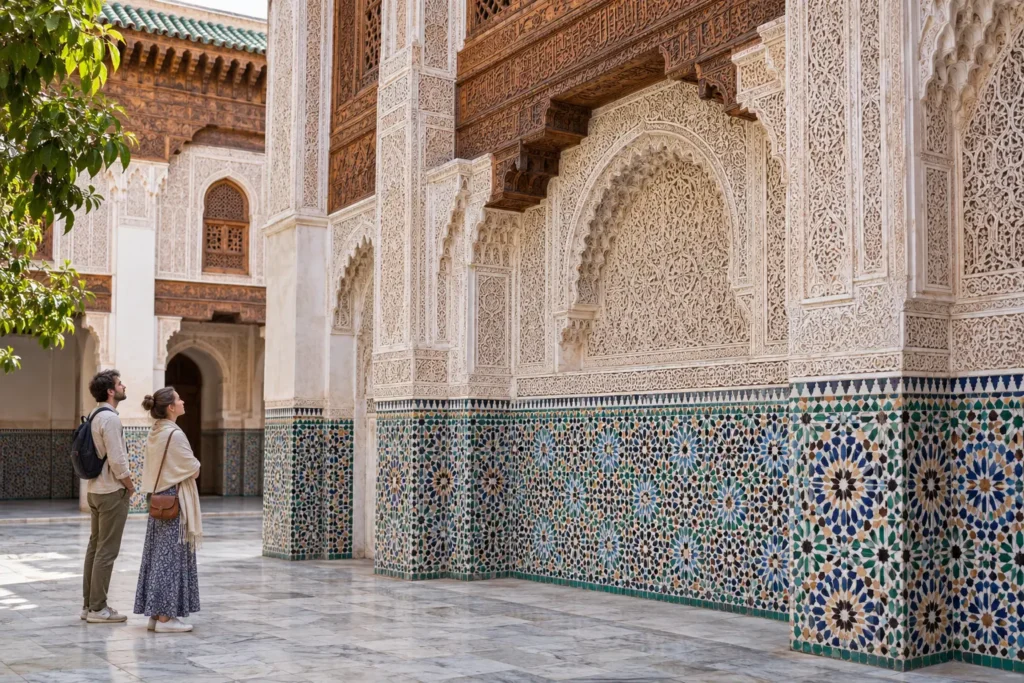
A madrasa, also written medersa, is an educational institution traditionally associated with Islamic learning.
Some historic madrasas in Morocco are preserved as architectural monuments and admit visitors.
One example is the Ben Youssef Madrasa in Marrakech, known for its central courtyard, intricate zellij tilework, carved wood and decorative plaster.
Because it operates as a visitor attraction, access differs from that of an active mosque.
However, its religious and educational heritage still deserves respect.
Speak quietly, follow the designated visiting route and avoid touching decorative surfaces.
Do not assume that every religious school is open. The appropriate distinction is between an institution that officially welcomes visitors and one that continues to serve a restricted religious or educational function.
Mausoleums, shrines and religious tombs
Morocco also has mausoleums, religious shrines and burial places associated with important historical and spiritual figures.
Some welcome visitors into designated areas, while others have restricted access or are reserved for particular religious activities.
A shrine may have deep meaning for the surrounding community even when its architecture attracts travelers.
If entry is permitted, avoid blocking people who are praying or paying their respects.
Do not touch graves, lean against tomb structures or use burial spaces as photographic props.
When access is restricted, appreciate the building from the permitted public area rather than looking for an alternative entrance.
Synagogues, churches and Jewish heritage sites
Morocco’s religious history also includes longstanding Jewish communities and Christian institutions.
Historic synagogues, Jewish cemeteries and churches can provide additional perspectives on the country’s cultural heritage.
Access arrangements differ. Some buildings are active places of worship, some are historic visitor sites and others require prior permission.
When visiting, respect the practices of the particular community and follow instructions concerning clothing, photography, head coverings and restricted areas.
Avoid assuming that rules appropriate for a mosque are identical to those of a synagogue or church.
What Should You Wear to Religious Sites in Morocco?
Appropriate clothing demonstrates consideration for the setting and can help avoid problems at entrances.
For many religious attractions, modest, comfortable clothing that covers the shoulders and knees is a practical choice for all visitors.
However, there is no single dress code covering every historic or religious site in Morocco.
Clothing for men and women
Suitable options often include:
- Long trousers or skirts.
- Shirts or tops covering the shoulders.
- Comfortable, non-revealing clothing.
- Footwear appropriate for walking on historic surfaces.
- A light outer layer for additional coverage when necessary.
Very short shorts, revealing tops and beachwear are generally poor choices for religious settings.
At the Hassan II Mosque, the published visitor requirements specifically call for clothing extending below the knees.
Plan around the rules of the actual site rather than assuming that ordinary city sightseeing clothing will always be sufficient.
Do women need to cover their hair?
Women are not automatically required to cover their hair at every religious or historical attraction in Morocco.
Head-covering requirements depend on the institution, the area being visited and the circumstances.
Follow the specific instructions at the entrance. Carrying a lightweight scarf can provide flexibility, but it should not be treated as a substitute for checking the rules.
Men should also respect any requirements concerning hats or head coverings.
When should you remove your shoes?
Some religious spaces require visitors to remove their shoes before entering.
At the Hassan II Mosque, this is part of the official guided-visit procedure.
However, footwear does not need to be removed at every historic building or religious monument.
Follow posted instructions and use designated shoe-storage arrangements where provided.
How to Behave During Prayers and Religious Ceremonies
A religious building may attract visitors because of its architecture, but it can also serve an important spiritual purpose.
If you are permitted into an active religious setting, behave as a guest rather than treating the space as a conventional museum.
Keep conversations quiet
Speak softly and silence your phone.
Avoid playing music, taking phone calls or discussing the building loudly while others are praying or reflecting.
Even when photography is permitted, repeated camera sounds or lengthy photo sessions can disturb the atmosphere.
Do not interrupt worshippers
People attending religious activities should be able to do so without interference.
Do not walk directly in front of someone praying, interrupt a ceremony to ask questions or move into a restricted area for a better view.
Follow designated visitor routes and remain with the group when a guided visit requires it.
If you are unsure where to stand, ask an attendant.
Respect religious occasions
Prayer times, Friday congregational worship, Ramadan and religious holidays may affect access to sites and nearby facilities.
During Ramadan, be particularly considerate around people observing the fast. Where food or drink is available to travelers during the day, choose an appropriate setting rather than eating conspicuously beside worshippers or people fasting.
Do not assume that a religious celebration is a public performance.
Some gatherings are private or intended for community members. Participation should occur only when you have been clearly welcomed.
Photography Etiquette at Moroccan Religious and Historic Sites
Morocco’s monuments offer excellent architectural subjects, but photography should never take priority over worship, privacy or conservation.
Check whether photography is allowed
Some museums and monuments permit ordinary photography, while others restrict flash, tripods, video recording or photography in particular rooms.
At the Hassan II Mosque, visitors must follow the mosque’s restrictions on video cameras and electronic equipment.
Always check the rules before taking out your camera.
Do not assume that because other visitors are taking photographs, the activity is permitted.
Ask before photographing people
Religious clothing, prayer, traditional craftsmanship and everyday community life can attract a photographer’s attention.
However, residents and worshippers are not exhibits.
Ask for permission before photographing individuals, especially during personal or religious activities.
Do not photograph children without appropriate permission from a parent or guardian.
If someone declines, respect the answer without attempting to take the picture discreetly.
Avoid disruptive poses and equipment
Do not climb onto tombs, monuments or walls for photographs.
Avoid blocking entrances, occupying prayer areas for portraits or asking people to move so you can create a particular image.
Flash photography may be restricted around sensitive decoration, while tripods and professional filming equipment may require separate permission.
A photograph is never worth damaging a historic site or disturbing someone who is worshipping.
How to Protect Historic Monuments and Archaeological Sites
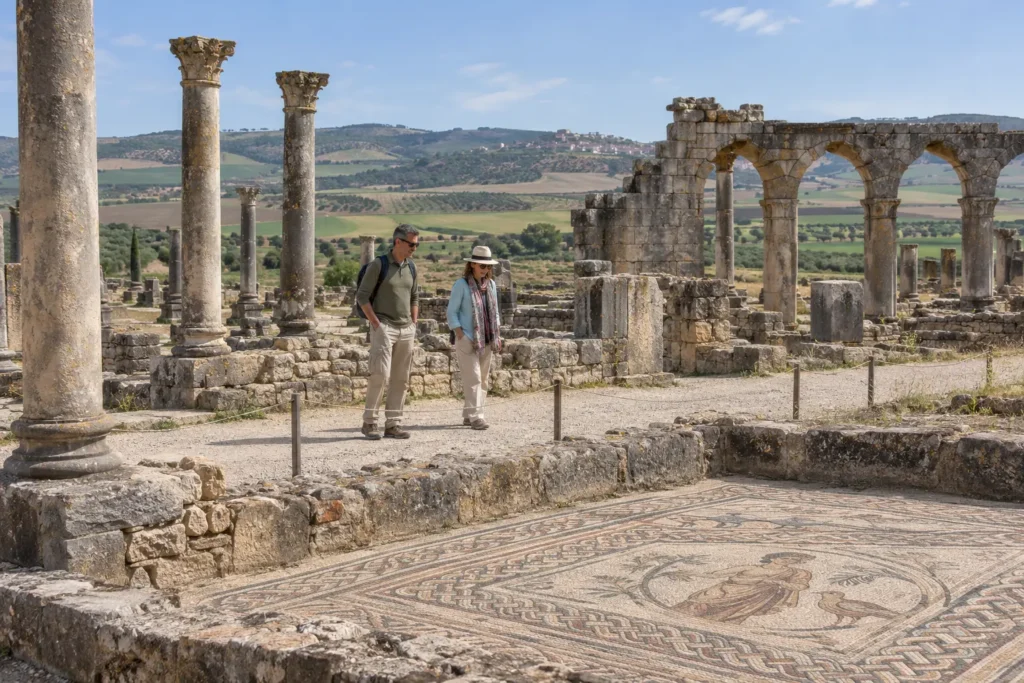
Historic sites face different challenges from active religious buildings.
At archaeological ruins, palaces and traditional settlements, the main priorities include protecting fragile materials and staying within permitted visitor areas.
Do not touch or climb on fragile structures
Historic mosaics, carved plaster, painted surfaces and old stonework can deteriorate through repeated contact.
Avoid touching decorations, sitting on ancient walls or climbing onto structures for a better photograph.
Follow marked paths and stay behind barriers even when a restricted area appears easy to reach.
Leave everything where you find it
Do not remove stones, pottery fragments or other materials from archaeological sites.
Even small objects can have historical significance when left in their original context.
At places such as Volubilis, the value of the ruins depends partly on preserving the relationship between buildings, streets, mosaics and archaeological remains.
Visitors should observe rather than disturb these features.
Respect traditional buildings and inhabited settlements
Historic neighborhoods and fortified settlements are not necessarily abandoned.
In Morocco, places such as the medinas of Fez and Marrakech and the historic settlement of Ait Ben Haddou reflect cultural heritage alongside the lives of local communities.
Do not enter homes or private courtyards without permission.
In traditional earthen settlements, avoid climbing on walls or walking across fragile roofs and structures.
Use established paths and follow any instructions concerning restoration areas.
Respecting Residents in Morocco’s Historic Medinas
Many historic sites are located within medinas, the traditional old quarters of Moroccan cities.
These neighborhoods contain shops, homes, schools, religious institutions and working spaces.
For visitors, this means that respectful behavior extends beyond the entrance to a monument.
While exploring a medina:
- Keep residential doorways and narrow passages clear.
- Move aside for residents, deliveries and working carts.
- Avoid looking into homes through open doors or windows.
- Keep noise low in residential streets, particularly in the evening.
- Ask permission before entering artisan workshops or private courtyards.
- Do not leave litter or damage traditional surfaces.
- Respect working animals and avoid encouraging activities involving animals that appear distressed or poorly treated.
Remember that a street which looks picturesque to a visitor may be someone else’s route home.
For more advice about exploring historic neighborhoods, see our Fez destination guide.
Guides, Entrance Fees and Donations
Many Moroccan heritage attractions can be visited independently, while others offer organized guided visits or require visitors to join a supervised group.
Choose the arrangement that matches the site and your interests.
Use official entry arrangements
Check the current visiting conditions before arriving.
Tickets may be sold at an official entrance or through an authorized booking system, depending on the attraction.
A person offering access outside a closed gate does not necessarily have authority to admit visitors.
Do not pay someone who claims they can bypass a religious restriction or enter a closed area through an unofficial route.
Choose guides for context, not unauthorized access
A knowledgeable guide can help explain architecture, religious history and the appropriate behavior at each stop.
This can be useful in large historic medinas or places where the significance of architectural details is not immediately obvious.
However, a guide cannot legitimately override the access rules of a religious institution or protected monument.
Agree on the route, language, duration and price before starting a paid guided visit.
Make donations only when appropriate
Some religious or heritage institutions accept voluntary contributions.
If you wish to donate, use an official collection arrangement or follow instructions from authorized staff.
A donation should not be interpreted as permission to enter restricted spaces, photograph worshippers or ignore visitor rules.
Where to Practice Respectful Heritage Travel in Morocco
Different Moroccan destinations offer opportunities to explore religious and historic heritage while learning how access rules vary.
Casablanca: Hassan II Mosque
Casablanca is particularly relevant for travelers interested in seeing the interior of a functioning mosque through an organized visitor programme.
The Hassan II Mosque offers an opportunity to understand Moroccan religious architecture while following clear visitor requirements.
Plan the visit around the official tour schedule and allow time for arrival and security or entry procedures.
Marrakech: Ben Youssef Madrasa and Historic Monuments
Marrakech allows visitors to compare an accessible former religious school with active mosques whose interiors are generally restricted to non-Muslims.
Ben Youssef Madrasa is particularly useful for understanding the relationship between education, architecture and decorative craftsmanship.
Other historic attractions include palaces and monuments with separate visitor arrangements.
Plan around the locations of the sites within the medina rather than trying to visit everything in one hurried walk.
For practical city information, explore our Marrakech travel guide.
Fez: Historic Madrasas and Living Religious Heritage
Fez offers a concentration of historic religious buildings, traditional craftsmanship and centuries-old urban architecture.
Some historic madrasas admit visitors, while active religious spaces have different restrictions.
A guided introduction can help explain these distinctions and identify places that can be explored respectfully.
Allow sufficient time for walking, as many medina streets are narrow and vehicle access is limited.
Rabat: Historic Monuments and Sacred Heritage
Rabat contains important religious and historic landmarks, including the Hassan Tower and the Mausoleum of Mohammed V.
Visitors should check the current access arrangements for each site and respect any areas reserved for ceremonies or official activities.
The surrounding historic districts also provide opportunities to explore the city’s architectural heritage.
Volubilis: Protecting Ancient Archaeology
Volubilis, near Meknes, provides a different type of heritage experience.
Its ancient ruins, streets and mosaics require careful treatment because archaeological remains can be vulnerable to damage.
Stay on permitted routes and avoid touching mosaics or climbing onto structures.
It fits naturally into a visit to Meknes or the wider Fez region, with road transport needed to reach the site.
Planning a Comfortable Visit to Historic Attractions
Respectful travel also means allowing enough time to visit without rushing.
Historic sites often involve walking, waiting at entrances and navigating areas with limited vehicle access.
Before setting out, consider:
- Opening arrangements: Check current admission rules, closures and visiting periods.
- Religious observances: Prayer times, Ramadan and special ceremonies may affect access.
- Walking conditions: Old medinas and archaeological sites may have stairs, slopes and uneven surfaces.
- Accessibility: Ask about step-free access, seating and the distance between vehicle drop-off points and entrances.
- Weather: Inland cities can be hot in summer, while some coastal and northern destinations experience cooler or wetter conditions.
- Children: Explain rules about quiet behavior, barriers and fragile structures before entering.
For a history-focused visit, choose a few nearby sites rather than attempting to cross a large city repeatedly.
Casablanca and Rabat can be combined using the railway network, while Fez, Meknes and Volubilis make a geographically sensible regional itinerary using a combination of rail and road transport.
A private driver may be convenient for certain connections, but it is not necessary for every heritage visit.
Common Mistakes to Avoid at Religious and Historic Sites
The most frequent problems arise from treating all heritage attractions as if they follow the same rules.
- Assuming every mosque welcomes tourists: Most active mosques in Morocco restrict non-Muslim entry.
- Using a camera without checking: Photography may be restricted, especially around worshippers or delicate interiors.
- Wearing inappropriate clothing: Religious settings may require greater coverage than ordinary sightseeing areas.
- Entering an unmarked doorway: It may lead to a private residence or restricted religious space.
- Touching historic decoration: Repeated contact can damage fragile surfaces.
- Paying for unauthorized access: Use official admission procedures and respect closures.
- Overloading the itinerary: Rushed visitors are more likely to overlook instructions and disturb others.
FAQs
Can non-Muslims enter mosques in Morocco?
Most active mosques in Morocco do not admit non-Muslim tourists. The Hassan II Mosque in Casablanca is a notable exception, offering organized guided visits. Check the specific site’s current rules rather than assuming admission is permitted.
What should tourists wear to Moroccan religious sites?
Clothing covering the shoulders and knees is a sensible starting point. Some sites have stricter requirements. At the Hassan II Mosque, visitors must wear clothing covering the torso and extending below the knees. Follow the rules of each location.
Do women have to wear a headscarf at historic sites?
Not generally. A headscarf is not a universal requirement for visiting Moroccan historical attractions. Individual religious institutions may have specific rules, so check before entering.
Can you take pictures inside Moroccan mosques and mausoleums?
Photography rules vary. Some sites restrict filming, flash or photography in particular areas. Never photograph worshippers without permission, and follow instructions from authorized staff or guides.
Is it appropriate to visit religious sites during Ramadan?
Visiting suitable public attractions may still be possible, but access arrangements and schedules can change. Respect fasting, prayer and private religious activities, and confirm the site’s current visiting conditions before arrival.
Do you need a guide to visit Moroccan historical monuments?
Not always. Many museums, palaces and archaeological sites can be explored independently. A guide can provide useful historical context, while some religious attractions require organized visits. Check the entry arrangements for each site.
Visit Morocco’s Heritage with Respect and Curiosity
Understanding how to behave at religious and historic sites in Morocco makes visits more comfortable for travelers and more considerate toward the people who use and maintain these places.
Start by identifying whether the attraction is an active place of worship, a preserved religious monument or an archaeological site. Confirm visitor access, dress appropriately and follow the instructions provided.
Respecting privacy, protecting historic materials and allowing time to appreciate the setting are more important than collecting photographs or visiting as many monuments as possible.
If you want to explore Morocco’s religious architecture, imperial cities and historic neighborhoods with additional local context, you can browse Morocco cultural travel experiences with Visit Morocco Together and compare the available itineraries.
The practical takeaway: Before entering any religious or historical attraction, ask three questions: Is visiting permitted? What behavior is expected? How can I leave the place exactly as I found it? Following those principles will help you experience Morocco’s heritage thoughtfully and respectfully.
Ready to Experience Morocco?
Turn this inspiration into your next adventure. Our travel experts are ready to help.