Moroccan hospitality customs shape many everyday interactions, from being welcomed with a glass of mint tea to exchanging greetings, visiting someone’s home and sharing a meal. For travelers, understanding these small gestures can make conversations more comfortable and cultural experiences more meaningful.
The most useful advice is straightforward: greet people warmly, acknowledge offers of hospitality, follow your host’s lead and respect personal boundaries. Accepting tea is often appreciated, but you do not have to drink something you cannot have, accept every invitation or purchase anything simply because someone has welcomed you.
This guide focuses on the social meaning of Moroccan tea, guest etiquette, home visits and everyday hospitality. It explains what visitors can reasonably expect, how to respond politely and why customs differ between families, regions and settings.
What Does Moroccan Tea Represent in Everyday Life?
Tea, commonly called atay in Moroccan Arabic, is closely associated with welcoming guests and spending time together. It can accompany family visits, conversations between friends, business discussions or a meeting with someone new.
Offering tea is often a way of making another person feel welcome. The drink creates an opportunity to sit together before moving into a longer conversation or another activity.
The setting matters. Tea shared in a family home has a different meaning from tea ordered in a café or served during a commercial demonstration. Each can be enjoyable, but they should not be treated as identical experiences.
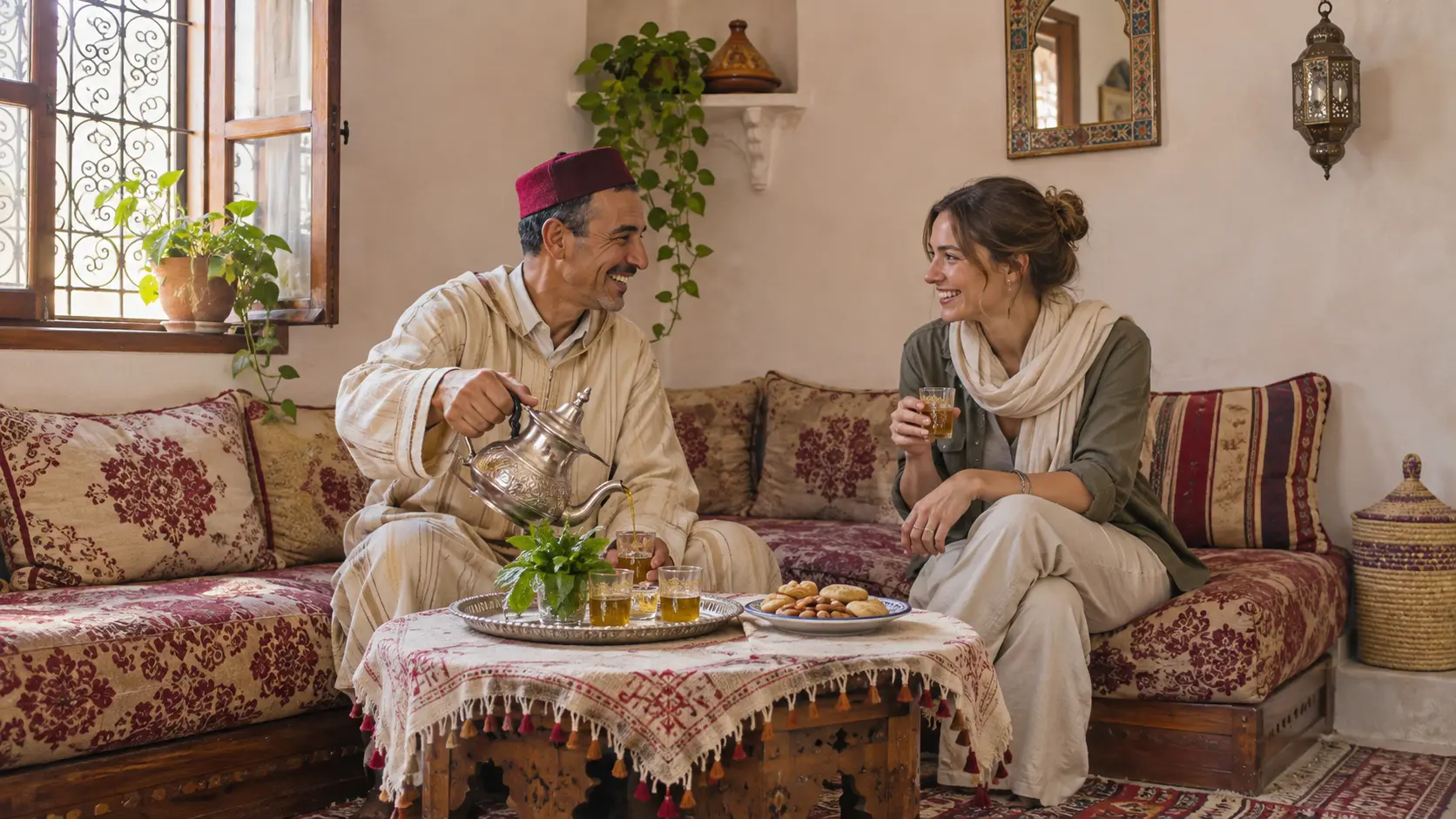
Moroccan mint tea is traditionally served in small glasses, sometimes from a decorative metal teapot. Preparation and presentation can be important expressions of care, although not every household follows an elaborate ceremony.
What makes the gesture meaningful is not necessarily the appearance of the tea service. It is the attention given to the person receiving it.
For more about tea ingredients, preparation and everyday food traditions, read our separate guide to Moroccan breakfast and tea culture.
Moroccan Hospitality Customs: How to Respond to Tea
Travelers sometimes hear that accepting Moroccan mint tea is compulsory or that refusing a glass is deeply offensive. The reality is more flexible.
Hospitality is important, but individual preferences, family habits and circumstances matter. A considerate response is usually more valuable than following a supposed rule about how many glasses you must drink.
Accepting tea as a guest
If someone offers you tea and you would like some, accepting with a smile and a simple thank-you is a natural response.
In a private home, let your host organize the service. You do not need to handle the teapot, request a particular pouring technique or treat the moment as a performance.
Tea may be served with pastries, nuts or other refreshments, but an accompanying snack is not guaranteed. Follow the host’s lead rather than expecting a particular arrangement.
Most importantly, allow the interaction to be a conversation. Asking a thoughtful question or showing interest in what someone is saying can be more meaningful than commenting repeatedly on the tea itself.
Is it rude to refuse Moroccan tea?
Declining a genuine offer of hospitality may sometimes be interpreted as a lack of interest, particularly when an invitation is intended to create a social connection. However, a polite refusal is not automatically disrespectful.
If you cannot drink tea, have limited time or simply do not want another glass, thank the person and explain briefly if you feel comfortable doing so.
You might say, “Thank you very much, but I cannot stay for tea today.” There is no need to invent a medical explanation or accept something against your preferences.
If you would prefer a different drink, you can ask whether an alternative is available. The host may be happy to accommodate you, but it is best not to assume that every option can be provided.
Do guests have to drink three glasses?
The idea of serving three glasses appears in traditional accounts of Moroccan and wider Maghrebi tea hospitality. It is sometimes connected with sayings about the changing character of successive servings.
However, there is no universal requirement for every guest to drink exactly three glasses. Some visits involve one serving, others include refills, and casual tea drinking may have no formal sequence.
If you have enjoyed enough, you can decline another glass with appreciation. Avoid treating the number of servings as a test of respect.
Visiting a Moroccan Home: Practical Guest Etiquette
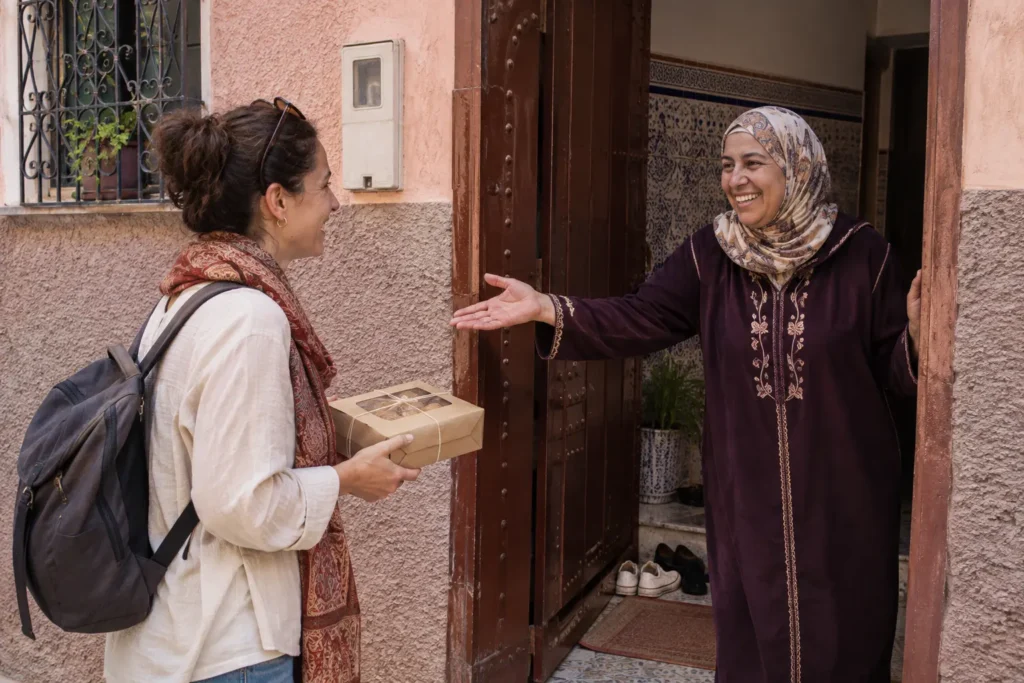
A genuine invitation into someone’s home can offer insight into family life and everyday traditions. It also requires more consideration than visiting a café, restaurant or public attraction.
Households have their own routines, and visitors should not expect every Moroccan home to operate according to the same customs.
Before arriving: invitations and small gifts
If a family invites you for tea or a meal, confirm a convenient time and whether any arrangements are needed. Avoid assuming that an informal conversation automatically means an invitation to visit.
Bringing a small gift is a thoughtful gesture, particularly when you are visiting someone for the first time.
Appropriate options may include:
- A small selection of pastries or sweets.
- Fresh fruit or another modest food gift.
- A thoughtful item from your home region, if suitable for the household.
A gift is not always necessary, and its value is less important than the consideration behind it. Avoid bringing alcohol or unfamiliar food items without knowing whether they are appropriate for your hosts.
Entering the home and finding your place
Removing shoes before entering certain rooms is customary in many Moroccan homes. However, practices differ, so the simplest approach is to observe what your host does or ask politely.
Wait to be shown where to sit. Some homes have a separate reception room for guests, while others use a shared family living space.
Do not assume that you may walk through the rest of the property. Bedrooms, kitchens, terraces and other areas can be private.
Photography also requires permission. A family invitation is not permission to photograph children, personal belongings or private interiors.
Sharing a meal with a Moroccan family
Food is another important expression of hospitality. A host may offer generous portions or encourage guests to eat more, particularly during a special family meal.
Some meals are served in individual dishes, while others involve sharing food from a central plate. When eating from a shared dish, it is generally considerate to take from the section nearest you rather than reaching across the table.
The right hand is traditionally preferred when eating with bread or passing food. If cutlery is provided, use it normally. Follow the household’s arrangement rather than assuming every Moroccan meal must be eaten by hand.
If you have allergies or dietary restrictions, explain them before the meal whenever possible. This allows the host to understand your needs without creating confusion once food has been served.
There is no need to force yourself to finish every additional helping. Thank your host and decline politely when you have had enough.
Knowing when to leave
A home visit may involve more conversation and refreshments than a quick meeting elsewhere. Nevertheless, travelers should not assume their hosts have unlimited time.
If you have another commitment, communicate it clearly and respectfully. When leaving, thank your host for the invitation and the time spent together.
The aim is to appreciate the hospitality without creating pressure on either side.
Everyday Social Customs That Help Travelers Connect
Moroccan hospitality extends beyond tea and home visits. Greetings, conversation and respectful personal interactions all influence how people experience an encounter.
Begin with a greeting
In Morocco, beginning an interaction with a greeting is a considerate habit, whether you are entering a small shop, approaching a guesthouse reception or meeting someone for the first time.
A simple “Salam alaykum” is a familiar greeting. You may also hear the shorter “Salam” in casual conversation.
Depending on the situation, people may exchange questions about one another’s well-being before discussing practical matters.
As a traveler, you do not need to master a long conversation. Greeting someone before asking for directions, information or assistance is a useful starting point.
Handshakes and personal space
Handshakes are common in many Moroccan social settings, but not everyone is comfortable with the same forms of physical contact.
Preferences can depend on familiarity, individual choice and religious or cultural practice. This is particularly relevant when greeting someone of a different gender.
Let the other person indicate whether a handshake is welcome. A verbal greeting, smile or respectful gesture can be enough when physical contact is not offered.
Do not interpret a declined handshake as personal hostility. It may simply reflect someone’s preferred boundaries.
Conversation, curiosity and privacy
Conversations may begin with everyday subjects such as work, family, travel or where someone comes from. These exchanges can help establish familiarity before more detailed discussion.
However, travelers should not assume that everyone enjoys personal questions. Respect privacy if someone gives a brief answer or changes the subject.
The same applies when someone asks about your background. You can answer warmly without sharing information you would prefer to keep private.
Local people are individuals with different personalities and responsibilities, not representatives of a single cultural script.
Tea in a Shop, Riad or Café: Understanding the Difference
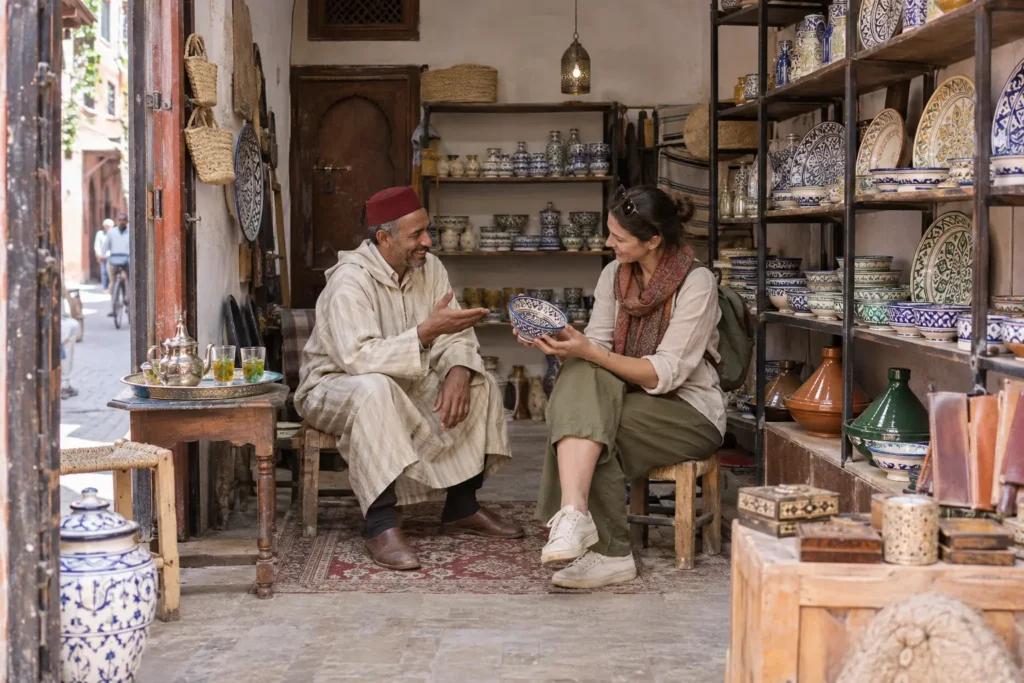
One of the most useful distinctions for travelers is the difference between personal hospitality and a service connected with tourism or shopping.
The same glass of tea can appear in several settings, but the expectations around the interaction may not be the same.
Tea offered in a souk or craft shop
Shopkeepers sometimes offer tea while visitors look at carpets, ceramics, textiles or other goods. The offer may be genuinely friendly while also creating a relaxed atmosphere for a sales conversation.
Accepting a glass does not mean that you have agreed to purchase anything.
If you are interested in an item, discuss its price and terms clearly. If you decide not to buy, thank the shopkeeper and leave politely.
You can also decline tea when you do not have time or do not want to begin a longer conversation.
Do not treat every shopkeeper’s invitation as a sales tactic, but do not assume every experience connected with a demonstration is complimentary. If there is uncertainty about a charge, ask before participating.
Welcome tea at a riad or guesthouse
Some riads and guesthouses welcome arriving guests with tea. This can be a pleasant introduction to the accommodation, particularly after a journey.
The service may be complimentary, part of a booked package or separately charged, depending on the property and situation.
Visitors should distinguish between the host’s welcoming gesture and the commercial arrangements of their stay. Check what is included rather than assuming every property offers the same experience.
Tea ordered in a neighborhood café
In a café, tea is ordinarily something you order and pay for. It can still provide an opportunity to observe everyday social life, but it is not equivalent to receiving a private invitation.
Some cafés are lively meeting places, while others are quieter or serve different local customers. Respect the atmosphere of the establishment, including its seating arrangements and the privacy of other guests.
A café visit does not require starting conversations with strangers. Enjoying the surroundings respectfully is enough.
Useful Moroccan Arabic Phrases for Hospitality
A few words of Moroccan Arabic, commonly called Darija, can make everyday interactions easier.
- Salam alaykum: A common greeting meaning “peace be upon you.”
- Wa alaykum salam: The traditional response to that greeting.
- Shukran: Thank you.
- La, shukran: No, thank you.
- Labas?: An informal way to ask whether someone is well.
- Bslama: Goodbye.
These are approachable Latin spellings rather than a standardized transcription. Pronunciation and everyday expressions can vary.
Morocco is also linguistically diverse. Arabic and Amazigh are official languages, and visitors may encounter different Amazigh languages, French and other languages depending on the region and setting.
Do not worry about perfect pronunciation. A respectful attempt, followed by attentive listening, is generally more useful than memorizing a long collection of expressions.
How to Experience Moroccan Hospitality Respectfully
Travelers do not need a private home invitation to gain a meaningful understanding of Moroccan social customs.
A conversation with a guesthouse host, a locally organized cultural activity or time spent in a neighborhood café can provide opportunities to learn without intruding on someone’s personal life.
For visitors interested in a hosted meal or cultural exchange, an arranged experience can be a practical option. It makes expectations clearer for both the guest and the person providing the experience.
Before booking, confirm:
- Whether the visit takes place in a private home or a commercial venue.
- What the experience includes and how long it is intended to last.
- Whether the host is compensated for their time and work.
- Which languages are available for conversation or explanation.
- Whether dietary restrictions or accessibility needs can be accommodated.
- Whether photography is welcome and where it is restricted.
These questions help travelers choose an experience that fits their interests while respecting the people involved.
A paid cultural activity can be worthwhile without being presented as a spontaneous family invitation. What matters is that everyone understands the arrangement.
Do Moroccan Hospitality Customs Vary by Region?
Yes. Customs can differ between households, communities, generations and social settings.
A family in Fez may have different hosting routines from a household in the Atlas Mountains or a coastal city. Likewise, the expectations surrounding a formal family gathering may differ from those of an informal visit between friends.
Differences are not limited to geography. Personal preferences, time constraints, family traditions and the occasion itself can influence how guests are welcomed.
A traveler should therefore avoid assuming that every Moroccan family serves tea in the same way, expects the same gestures or observes the same social conventions.
Observation and respectful questions are more reliable than rigid etiquette rules. If you are uncertain about shoes, seating, photographs or food, asking your host is usually the simplest solution.
FAQs
Is accepting Moroccan mint tea mandatory?
No. Accepting tea is often appreciated as a friendly response to hospitality, but it is not mandatory. If you cannot or do not want to drink it, thank the person and decline politely.
Should I bring a gift when visiting a Moroccan family?
A modest gift such as pastries or fruit can be thoughtful, especially for a first visit. It is not a universal requirement. If you know the host well enough, you can ask whether there is anything useful to bring.
Does accepting tea in a Moroccan shop mean I must buy something?
No. Tea may be offered during a sales conversation, but accepting it does not create a purchase obligation. You can appreciate the hospitality while making an independent buying decision.
What should I do if I am unsure about a Moroccan greeting?
Begin with a verbal greeting and allow the other person to indicate whether a handshake or another gesture is welcome. Respecting personal space is more important than trying to follow a universal greeting rule.
Can tourists visit Moroccan homes to experience local hospitality?
Yes, when they have a genuine invitation or have arranged an appropriate hosted experience. A private home is not a tourist attraction, so visits should always be welcomed by the household and respect its boundaries.
Is Moroccan hospitality the same in cities and rural areas?
No. Hospitality traditions share certain values, but daily routines and expectations vary. Urban and rural settings, family habits and individual preferences all influence how guests are received.
Approach Moroccan Hospitality with Respect and Curiosity
Understanding Moroccan hospitality is less about memorizing rules and more about recognizing the intention behind everyday gestures.
An offer of tea may communicate welcome. A greeting can establish a friendly connection. Sharing food may express generosity. None of these moments requires travelers to ignore their own boundaries or assume that every Moroccan household follows the same customs.
The most useful approach is to respond with appreciation, respect privacy, communicate clearly and give people the same consideration you would expect as a guest in your own home.
If you would like cultural experiences to form part of a wider journey, explore Morocco Cultural Discoveries travel options with Visit Morocco Together. Review the individual itineraries and inclusions to choose activities that suit your interests.
And remember that hospitality is a two-way interaction. Being a considerate visitor matters just as much as receiving a warm welcome.
Ready to Experience Morocco?
Turn this inspiration into your next adventure. Our travel experts are ready to help.