Learning a few Darija phrases for travelers can make everyday conversations easier during a trip to Morocco. Whether you are ordering mint tea in Marrakech, asking directions in Fez or shopping at a local market, simple Moroccan Arabic expressions are useful even when you speak only a little of the language.
Start with greetings, please, thank you, how much and I don’t understand. These expressions cover many of the situations visitors encounter. You do not need to speak fluent Darija, and English or French may be available in tourism settings.
Darija is the everyday variety of Arabic widely spoken in Morocco. It differs from Modern Standard Arabic, which is used mainly in formal contexts. Morocco is also home to Amazigh languages, and people’s preferred languages vary between regions and communities.
This practical guide covers greetings, shopping, restaurants, transport, directions and useful requests for assistance. Each phrase includes a simple English meaning, with pronunciation guidance where helpful.
Darija Phrases for Travelers: 10 Essentials to Learn First
If you have limited time before your trip, start with these ten expressions. They are short, widely useful and relatively easy to practice.
- Salam — Hello. A simple greeting suitable for many everyday interactions.
- Labas? — How are you? An informal way to ask if everything is fine.
- 3afak — Please. Useful when making a polite request.
- Shukran — Thank you. One of the most useful words to remember.
- Sme7 liya — Excuse me or sorry.
- Bsh7al? — How much? Useful when shopping or checking a price.
- Bghit… — I want… A useful beginning for simple requests.
- Ma fhemtsh — I don’t understand.
- Wakha — Okay or agreed.
- Bslama — Goodbye.
You can use several of these together. For example, begin with salam, ask a question using 3afak, and finish with shukran.
Pronunciation does not need to be perfect. Speaking clearly, listening carefully and showing patience are more important than memorizing a long vocabulary list.
How to Pronounce Moroccan Darija
Darija is primarily a spoken language, and there is no single universally followed system for writing it in Latin letters.
You may see the same expression written in several ways. For example, shukran may also appear as chokran, while bsh7al may be written as bshhal or bchhal.
These spelling differences do not necessarily change the meaning.
Why are there numbers in Darija words?
When Darija is written using Latin letters, numbers sometimes represent Arabic sounds that do not have straightforward English equivalents.
- 3: Represents the Arabic letter ayn (ع), a voiced sound produced deeper in the throat. You will see it in words such as 3afak.
- 7: Represents the Arabic letter ha (ح), a stronger breathy sound produced in the throat. It appears in words such as bsh7al and sme7.
- Kh: Represents a sound similar to the ch in the Scottish pronunciation of loch, as heard in l-khir.
- Gh: Represents a voiced sound produced toward the back of the mouth, as in ghali.
- Sh or ch: Usually represents the sound heard at the beginning of the English word shoe.
English-friendly pronunciation guides are approximations. Listening to Moroccan speakers is the most reliable way to become familiar with the sounds.
For your first trip, learning to recognize a few spoken phrases is more useful than trying to master every pronunciation rule.
Moroccan Darija Greetings and Introductions
Greetings are an important part of everyday communication in Morocco.
Before asking for directions, ordering something or starting a conversation, a short greeting is a considerate way to begin.
How to say hello and goodbye
- Salam alaykom (sa-LAM a-LAY-kom) — Peace be upon you. A common greeting.
- Wa alaykom salam — And upon you be peace. The customary response.
- Sbah l-khir (s-bah l-kheer) — Good morning.
- Msa l-khir (m-sa l-kheer) — Good evening.
- Bslama (b-SLA-ma) — Goodbye.
The shorter salam is also widely used.
These expressions work in many settings, including shops, accommodation properties and everyday encounters.
Asking how someone is
- Labas? (la-BASS) — How are you? Is everything okay?
- Labas, lhamdullah — I’m fine, thank God.
- Kif dayr? — How are you doing? When speaking to a man.
- Kif dayra? — How are you doing? When speaking to a woman.
- Shukran bzzaf — Thank you very much.
When someone asks labas?, replying with labas, lhamdullah is a common response.
You may hear several greetings or questions exchanged before a conversation begins. There is no need to memorize a lengthy greeting sequence; responding politely is enough for a visitor.
Introducing yourself
- Smiyti… — My name is…
- Ana mn… — I am from…
- Shnu smitek? — What is your name?
- Mr7ba — Welcome.
For example, you can introduce yourself with smiyti followed by your name.
These phrases are useful when meeting an accommodation host, guide or someone you are having a longer conversation with.
Darija Phrases for Shopping in Moroccan Souks
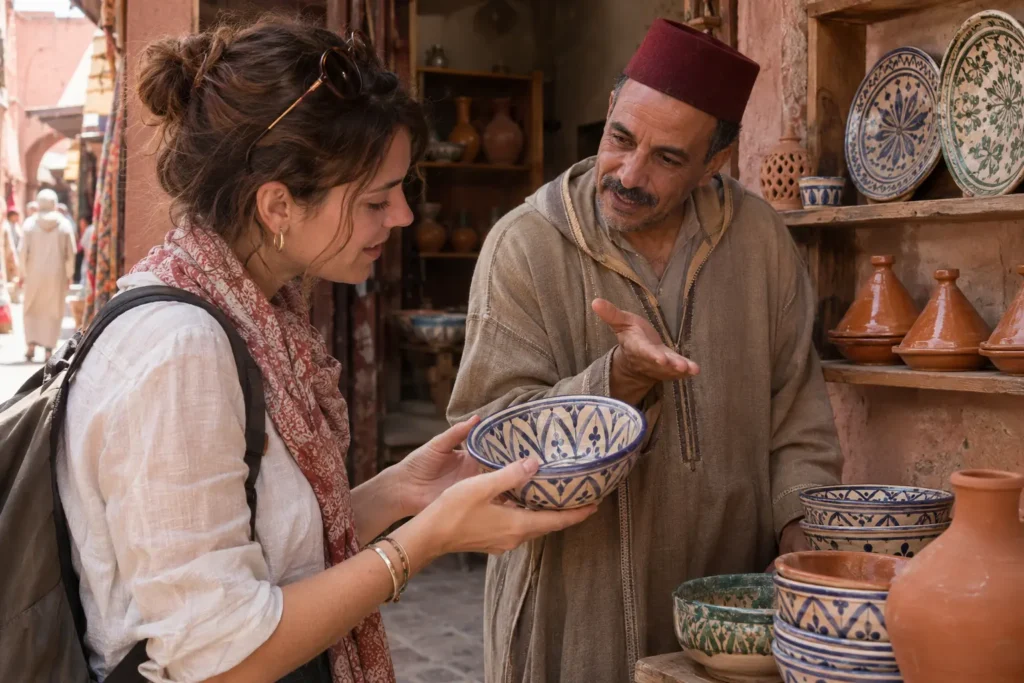
Traditional markets are among the places where a few Darija expressions can be particularly useful.
In cities such as Marrakech and Fez, shopkeepers may also speak English or French. However, Darija can help when asking prices, buying everyday items or making a simple request.
Asking about prices
- Bsh7al? — How much?
- Bsh7al hada? — How much is this?
- Ghali bzzaf — Very expensive or too expensive.
- Nqes shwiya — Lower the price a little.
- Flous — Money.
For example, if you are interested in a handmade item, begin with a greeting and ask bsh7al hada?
If the shopkeeper gives a price you consider too high, you can politely say ghali bzzaf.
Bargaining is common in some traditional souks, but it is not appropriate in every shop. Fixed-price stores, supermarkets and many restaurants operate differently.
Knowing Darija does not guarantee a lower price. Compare products, understand the quoted amount and negotiate respectfully only when appropriate.
Buying or declining an item
- 3tini… — Give me… Often used when requesting an item.
- Bghit… — I want…
- Ma bghitsh — I don’t want it.
- La, shukran — No, thank you.
- Safi — That’s enough, finished or okay, depending on the situation.
You can soften a request by adding 3afak for please.
If you are only browsing, you do not need to begin a negotiation. A polite la, shukran is enough when declining an offer.
Useful Darija Phrases for Restaurants and Cafés
Food-related expressions are useful when visiting cafés, bakeries, markets and restaurants.
The most practical word to learn is bghit, meaning I want. You can use it with simple food and drink vocabulary.
Ordering food and drinks
- Bghit lma — I want water.
- Bghit atay — I want tea.
- Bghit nakol — I want to eat.
- Atay — Tea, commonly used when referring to Moroccan mint tea.
- Khobz — Bread.
- Hadshi bnin bzzaf — This is very delicious.
For example, bghit atay, 3afak is a simple way to ask for tea politely.
If you enjoy a meal, hadshi bnin bzzaf is a way to express appreciation.
Menus and food preparation vary between establishments, so do not rely on a few memorized words when communicating important dietary restrictions.
Food allergies and dietary requirements
If you have a food allergy, severe intolerance or medical dietary requirement, prepare a clear written explanation in a language the establishment can understand.
Ask about ingredients, preparation and possible cross-contact. A short Darija expression saying you do not eat a particular food may not communicate the seriousness of an allergy.
Translation apps can help with routine questions, but important medical dietary information should be checked carefully rather than relying on an uncertain translation.
Asking for the bathroom
Fin kayna twalit? (feen ka-YNA twa-LEET) means “Where is the toilet?”
This is useful in restaurants, cafés and other public places.
Be aware that the availability of public toilets varies, particularly when traveling between cities or through rural areas.
Darija Phrases for Taxis, Transport and Directions
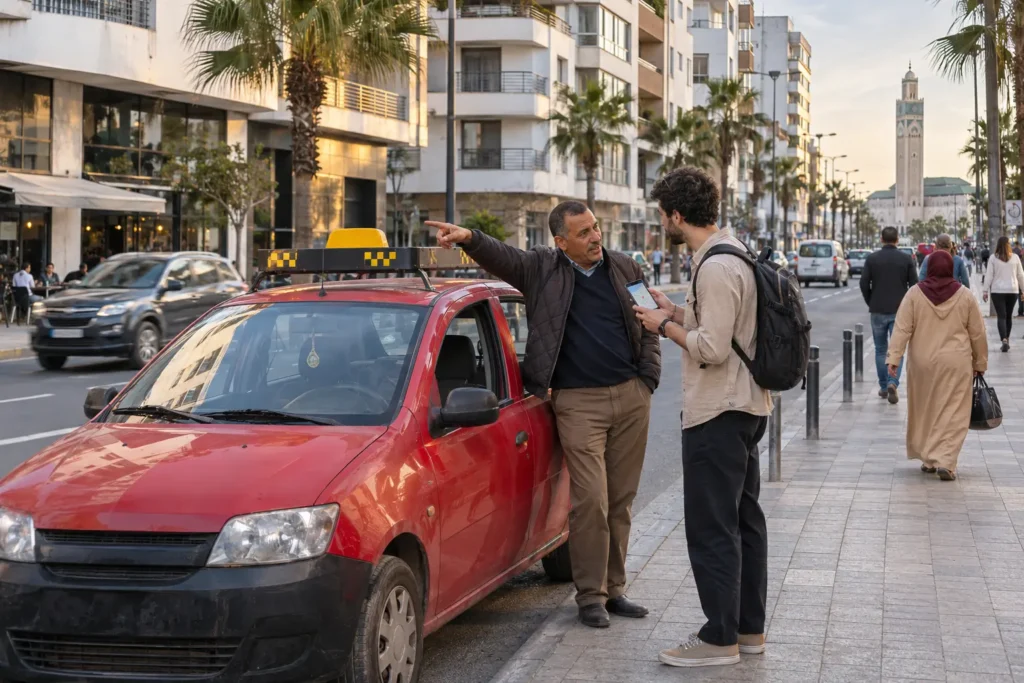
Transport is another situation where basic Moroccan Arabic can be helpful, especially when traveling independently.
A destination name written on your phone is still useful because place names may have different spellings or pronunciations.
Asking where something is
- Fin? — Where?
- Fin kayn…? — Where is…?
- Fin kayn tobis? — Where is the bus?
- Kifash nmshi l…? — How do I get to…?
- Tlaft — I’m lost.
The form kayn can change to kayna depending on the grammatical gender of the place or object being discussed.
For a beginner, fin? together with a place name and a map can still help communicate the question.
Understanding basic directions
- Nishan — Straight ahead.
- L-ymin — Right.
- L-ysar — Left.
- Hna — Here.
- Daba — Now.
These words are especially useful when someone gives walking directions in a medina or explains where a taxi should stop.
In large historic medinas, accommodation entrances may be reached only on foot. Ask your host for the nearest practical vehicle drop-off point rather than assuming a taxi can reach every doorway.
At a hotel or transport counter
- 3andi réservation — I have a reservation.
- Bghit nshri tikiy — I want to buy a ticket.
- Lyoum — Today.
- Ghdda — Tomorrow.
- Fouqach? — When?
Darija often incorporates words borrowed from French, including terms used for reservations and tickets.
For transport arrangements, always confirm the date, departure point and agreed price or ticket details. Do not rely on a spoken exchange you only partly understand.
How to Say You Don’t Understand in Darija
You may learn how to ask a question but struggle to understand the reply. That is normal when using a language for the first time.
These expressions are particularly useful when someone responds quickly.
- Ma fhemtsh — I don’t understand.
- Bshwiya, 3afak — Slowly, please.
- Shwiya — A little.
- Wash katahdar b nagliziya? — Do you speak English? When addressing a man.
- Wash katahdari b nagliziya? — Do you speak English? When addressing a woman.
Darija verbs sometimes change according to the person being addressed. This is why the English-language question has different forms in the last two examples.
If you do not remember the correct ending, avoid worrying about it too much. You can ask whether someone speaks English or French in a simple way and use a translation tool if needed.
Ma fhemtsh, bshwiya 3afak is a particularly useful combination when you need someone to slow down.
Darija Words for Asking for Help
In an unfamiliar city, knowing how to request assistance can be useful.
These expressions are worth recognizing, even if you do not expect to use them.
- 3awni, 3afak — Help me, please.
- Khasni tbib — I need a doctor.
- Fin kayn sbitar? — Where is the hospital?
- Tlaft — I’m lost.
- Ma fhemtsh — I don’t understand.
For an urgent problem, use the quickest reliable way to seek assistance. Contact emergency services or ask accommodation staff or another appropriate person to help communicate.
A memorized phrase is not a substitute for professional medical assistance, accurate interpretation or an emergency plan.
Useful Darija Numbers for Travelers
Numbers can help when shopping, purchasing tickets or checking quantities.
You do not need to memorize every number before your trip. Start with the simplest ones and learn to recognize them when spoken.
- Wahed — One.
- Juj — Two.
- Tlata — Three.
- Arba3a — Four.
- Khamsa — Five.
- Setta — Six.
- Seb3a — Seven.
- Tmenya — Eight.
- Tes3ud — Nine.
- 3shra — Ten.
Morocco uses the Moroccan dirham, but prices can sometimes be expressed informally using other local monetary terms.
If you are unsure about a quoted amount, ask the seller to write the price in dirhams before agreeing.
This is more dependable than trying to guess a price from unfamiliar spoken numbers.
Simple Darija Conversations to Practice Before Your Trip
Practicing short exchanges can be more useful than memorizing individual words without context.
Example 1: Greeting someone at a shop
You: Salam alaykom.
Shopkeeper: Wa alaykom salam.
You: Labas?
Shopkeeper: Labas, lhamdullah.
You: Bsh7al hada?
This short exchange combines a greeting, a polite question and a practical shopping phrase.
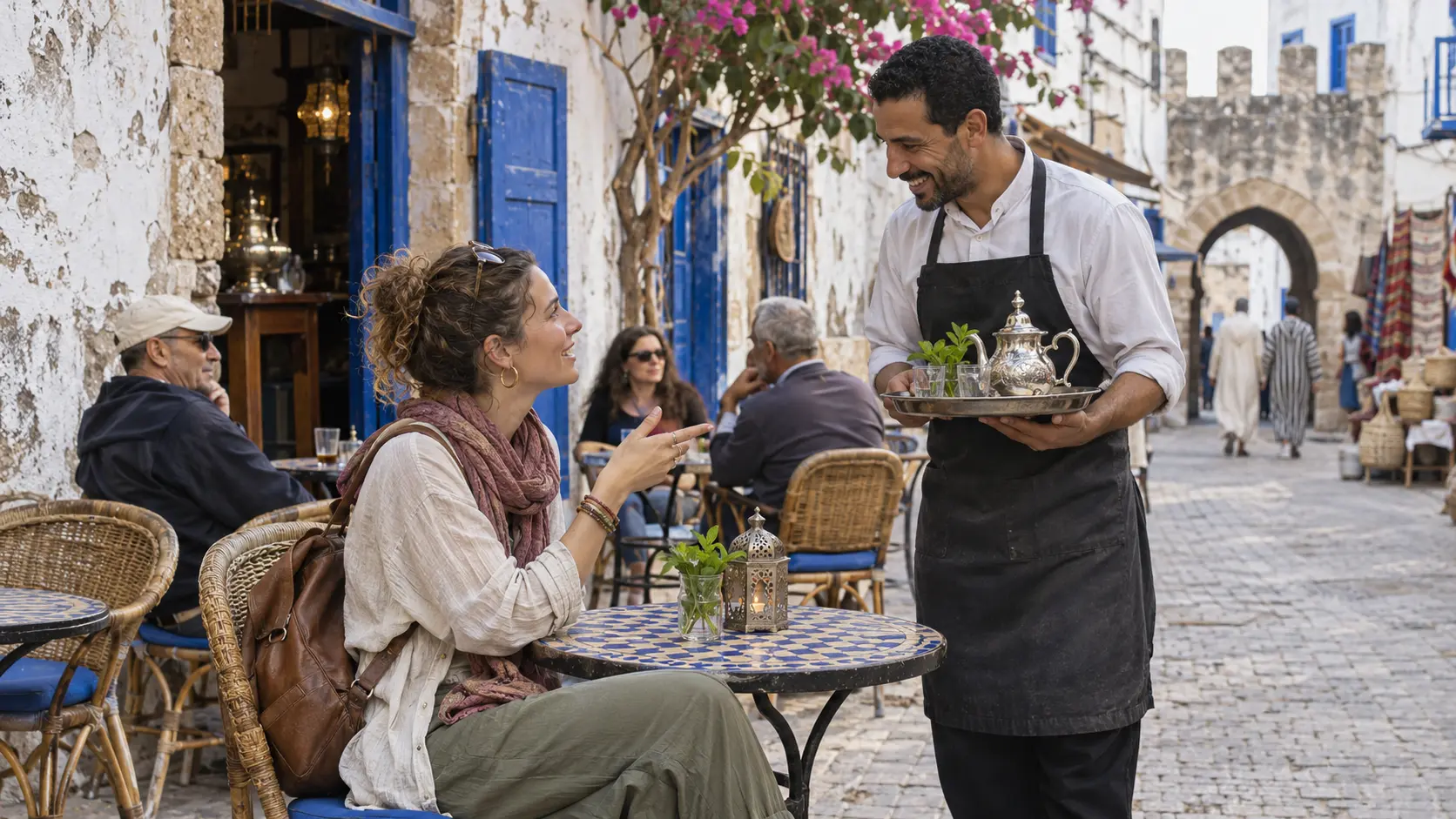
Example 2: Ordering tea at a café
You: Salam.
You: Bghit atay, 3afak.
After receiving the tea: Shukran.
The vocabulary is simple, but it is enough to communicate a basic request.
Example 3: Asking for directions
You: Sme7 liya, fin kayn…?
If the reply is too fast: Bshwiya, 3afak.
If you still do not understand: Ma fhemtsh.
Show the destination on your phone when necessary.
These examples are simplified practice exchanges, not scripts that every conversation will follow exactly.
Where Darija Is Most Useful in Morocco
Darija is widely understood in many parts of Morocco, particularly in cities, markets and everyday public life.
It can be useful in:
- Marrakech: Shopping in souks, ordering in local cafés and asking for directions.
- Fez: Navigating markets, speaking with shopkeepers and communicating in the historic medina.
- Casablanca and Rabat: Everyday urban interactions, transport and local businesses.
- Essaouira: Buying food, visiting markets and talking with local service providers.
- Smaller towns: Simple greetings and requests where English may be less commonly available.
However, Darija is not the only language used in Morocco.
Many communities speak Amazigh languages, particularly in parts of the Rif, Atlas Mountains and southwest. French is also used in many professional and tourism settings, while Spanish has a notable presence in parts of northern Morocco.
Do not assume that everyone prefers Darija or speaks the same regional variety.
If someone is more comfortable in another language, use whichever method allows you both to communicate clearly.
How to Practice Darija Before Traveling
You can make useful progress without taking a formal language course.
Focus on recognizing common words and responding comfortably rather than learning long, complicated sentences.
Listen before memorizing pronunciation
Written Darija can be difficult for English speakers because spellings vary and some sounds have no direct English equivalent.
Listen to recordings by Moroccan speakers when possible, then repeat short expressions aloud.
Concentrate on phrases you expect to use, such as greetings, prices and simple requests.
Practice a few realistic situations
Try rehearsing a simple conversation before visiting a café or market.
For example, practice greeting someone, asking a price and saying thank you.
Short, practical exchanges are easier to remember than large vocabulary lists.
Keep a small phrase list on your phone
Save your most useful phrases so they remain accessible without an internet connection.
Include:
- Basic greetings and polite expressions.
- Shopping and price questions.
- Food and drink requests.
- Directions and transport vocabulary.
- Expressions for asking someone to speak slowly.
- Important personal information that may be needed during your trip.
If you have specific dietary, medical or accessibility requirements, prepare a separate explanation that has been checked for accuracy.
Common Mistakes When Using Darija
A few misunderstandings are easy to avoid.
- Expecting perfect pronunciation: Focus on being understood rather than sounding like a native speaker immediately.
- Confusing Darija with Modern Standard Arabic: Everyday Moroccan expressions often differ from formal textbook Arabic.
- Assuming every Moroccan speaks the same languages: Regional languages and personal preferences vary.
- Expecting Darija to guarantee a discount: Speaking a local phrase can make communication friendlier, but it does not determine the price.
- Relying on translation apps for important details: Informal Darija may not be translated reliably, especially for medical or complex requests.
- Using phrases without listening: A short conversation requires understanding the response, not simply repeating memorized words.
Polite communication matters more than having an extensive vocabulary.
FAQs
Is Darija the same as Arabic?
Darija is the variety of Arabic widely spoken in Morocco. It differs from Modern Standard Arabic in everyday vocabulary, pronunciation and grammar. Someone who has studied Standard Arabic may recognize some words but still need time to understand spoken Darija.
Do I need to speak Darija to visit Morocco?
No. Many tourism businesses can communicate in English, French or other languages. However, a few Darija phrases are useful for greetings, shopping and routine conversations, particularly when traveling independently.
Will Darija phrases work in the Atlas Mountains and Rif?
Darija may be useful, but Amazigh languages are important in many mountain communities. Central Atlas Tamazight, Tarifit and Tachelhit are associated with different regions. Ask which language someone prefers rather than assuming Darija is always their first language.
Why do Darija words have different spellings?
Darija is primarily spoken, and Latin-letter spelling is not fully standardized. The same word may appear with different vowels or letter combinations. Numbers such as 3 and 7 are also used to represent Arabic sounds.
Are Darija phrases different when speaking to men and women?
Some expressions change according to the gender of the person being addressed. For example, kif dayr and kif dayra are different forms of asking how someone is. Other common expressions, such as salam and shukran, can be used without making that distinction.
Start with a Few Phrases and Build Confidence
Learning Darija phrases for travelers is a practical way to prepare for everyday communication in Morocco. You do not need to memorize every expression in this guide before departure.
Start with salam, 3afak, shukran, bsh7al, ma fhemtsh and bslama. Once these feel familiar, add the phrases most relevant to your trip, whether that means ordering food, shopping or arranging transport.
Remember that Morocco is multilingual. Darija is widely spoken, but Amazigh languages, French, Spanish and English are also part of the country’s linguistic landscape.
For more advice on Moroccan culture, local customs and exploring different regions, browse our Morocco travel guides.
The practical takeaway: A few correctly understood words, a polite greeting and a willingness to listen will take you further than trying to memorize complicated sentences. Use Darija as a helpful starting point for communication, and remain flexible when another language works better.
Ready to Experience Morocco?
Turn this inspiration into your next adventure. Our travel experts are ready to help.