Understanding Moroccan customs and etiquette helps travelers feel more comfortable in everyday situations, from greeting a shopkeeper in Marrakech to sharing a meal with a local family or visiting a historic neighborhood in Fez.
The most useful habits are simple: greet people before asking questions, dress appropriately for the setting, respect personal space, ask permission before taking photographs and follow your host’s lead when visiting a home.
Morocco is a multilingual country with diverse Amazigh, Arab, Andalusi, Jewish and other cultural influences. Customs vary between families, generations, cities and rural communities. There is no single set of social rules followed identically by everyone.
Visitors are not expected to understand every tradition. Showing consideration, asking polite questions and adapting to the situation are usually more valuable than memorizing strict rules.
This guide covers greetings, hospitality, clothing, dining, religious practices, shopping, photography and other everyday situations travelers are likely to encounter in Morocco.
Essential Moroccan Etiquette: What Visitors Should Know First
If you remember only a few guidelines before your trip, start with these practical habits.
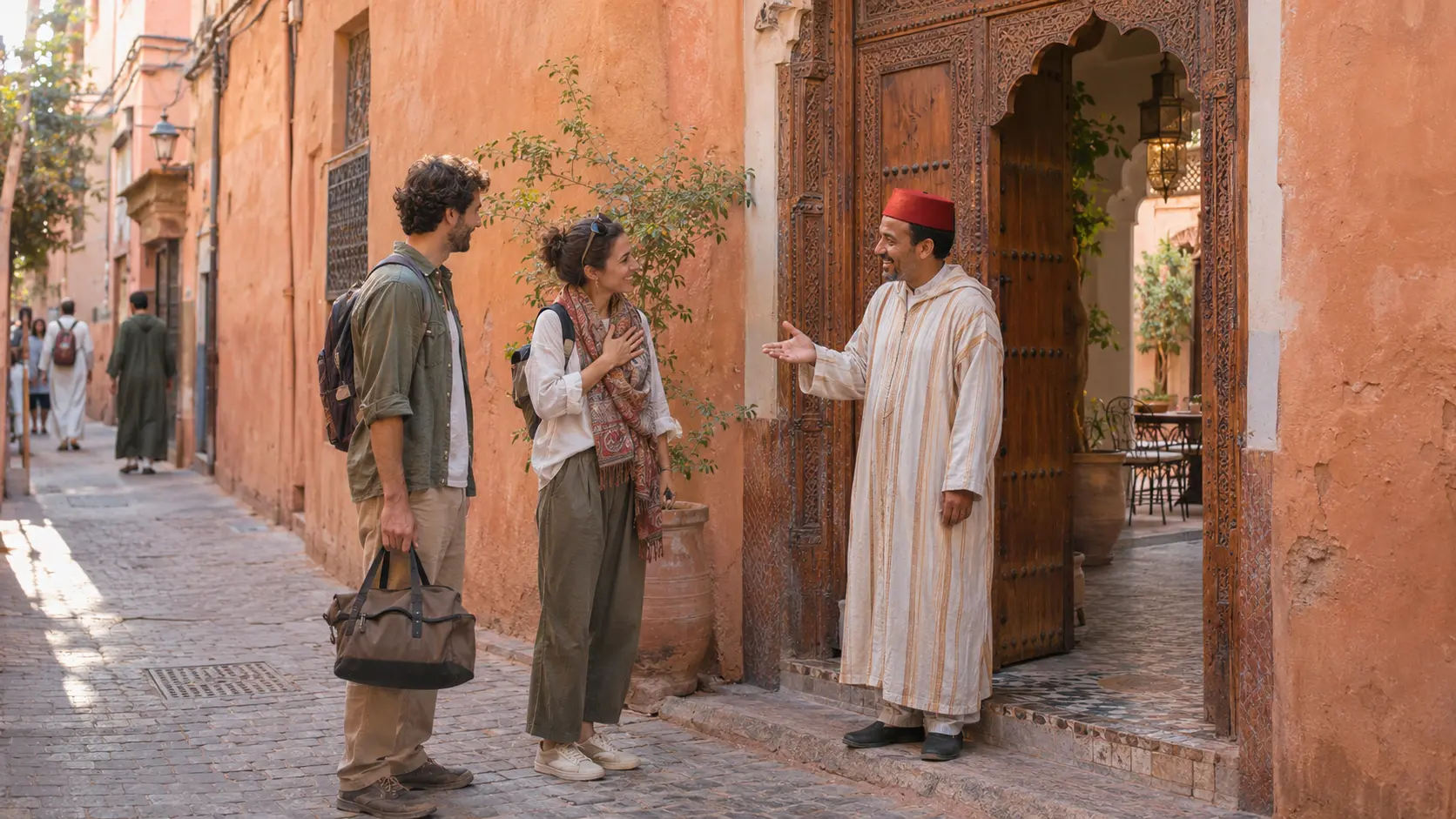
- Begin with a greeting: A simple “salam” before requesting something is a considerate way to start a conversation.
- Follow the other person’s lead: Handshakes, physical greetings and personal space preferences vary.
- Dress for the setting: Casual clothing is common in many cities, while more modest clothing is appropriate in religious spaces and some residential communities.
- Accept or decline hospitality politely: An offer of tea is a kind gesture, not a requirement to drink or purchase anything.
- Ask before photographing people: Respect anyone who prefers not to be photographed.
- Respect religious spaces: Most active mosques restrict non-Muslim entry, and worshippers should not be disturbed.
- Clarify prices: Agree on charges before accepting optional services or beginning a paid activity.
- Remember that medinas are neighborhoods: Keep entrances clear, respect residents and avoid treating private spaces as attractions.
These are useful starting points rather than inflexible rules. The most appropriate behavior depends on where you are and the people involved.
How to Greet People in Morocco
Greetings play an important role in Moroccan social interactions.
When entering a shop, meeting an accommodation host or asking someone for directions, it is considerate to begin with a greeting rather than immediately making a request.
Useful Darija greetings
Darija, or Moroccan Arabic, is widely spoken in everyday life. Learning a few expressions can make simple conversations easier.
- Salam alaykum: Peace be upon you; a common greeting.
- Wa alaykum salam: The customary response to salam alaykum.
- Labas? How are you? Is everything okay?
- Shukran: Thank you.
- 3afak: Please.
- La, shukran: No, thank you.
- Bslama: Goodbye.
Pronunciation and Latin-letter spelling vary, so do not worry about reproducing every sound perfectly.
Morocco also has Amazigh-speaking communities, and French, Spanish or English may be useful in particular settings. Avoid assuming someone’s preferred language based on their appearance or region.
Handshakes and physical greetings
Handshakes are common in Morocco, particularly during introductions. Friends and relatives may also exchange cheek kisses or other familiar greetings.
However, physical contact is not appropriate in every interaction.
Some people prefer not to shake hands with someone of another gender for personal or religious reasons. Others are comfortable doing so.
The simplest approach is to let the other person initiate physical contact.
If they do not offer a handshake, a smile, verbal greeting or slight nod is sufficient. Some people also place a hand over the heart as a gesture of respect.
You are equally free to decline physical contact politely if you are uncomfortable.
Conversation and personal questions
Asking how someone is doing before beginning a conversation is a common courtesy.
Friendly questions about your journey, hometown or experience in Morocco may also arise.
You do not need to answer questions that feel too personal. Likewise, avoid asking strangers intrusive questions about income, family circumstances or religious beliefs.
Conversations about food, travel, craftsmanship and local attractions are often easier starting points.
What to Wear in Morocco: Understanding Local Dress Customs
Morocco does not have one universal clothing style. You will see traditional garments, contemporary Western clothing, headscarves and many different personal choices.
For travelers, dressing appropriately is mainly about recognizing the difference between a beach, a city street, a private home and a religious setting.
Clothing in major cities
In destinations such as Marrakech, Casablanca, Rabat and Tangier, casual Western-style clothing is common.
Visitors can generally wear comfortable everyday clothes, although very revealing outfits may attract attention in some settings.
Clothing covering the shoulders and knees is a practical choice when you plan to explore traditional markets, residential streets and cultural attractions.
This is a useful guideline, not a universal legal requirement for ordinary public spaces.
Clothing in rural communities
In some villages and rural areas, more conservative clothing may feel appropriate.
Loose trousers, longer skirts and shirts covering the shoulders are practical options, particularly when visiting local homes or community spaces.
However, rural Morocco is not culturally uniform. Customs differ between communities, and visitors should avoid treating every village as though it follows identical traditions.
Do women need to cover their hair?
Women visiting Morocco are not generally required to wear a headscarf in ordinary public spaces.
Moroccan women make different clothing choices, including whether to cover their hair.
Some religious institutions have specific visitor requirements. Check these before entering rather than assuming that one rule applies everywhere.
A lightweight scarf can be useful for sun protection, cooler weather or additional coverage when appropriate.
Beachwear and swimwear
Swimwear is appropriate in suitable beach and pool settings.
When leaving the beach or entering restaurants, shops and residential streets, changing into everyday clothing is generally more considerate.
Coastal destinations differ in atmosphere, so use the immediate surroundings as your guide.
Moroccan Hospitality: Tea, Invitations and Visiting Homes
Hospitality is an important part of social life in many Moroccan households.
Visitors may be offered mint tea, pastries or a meal, particularly when meeting hosts or participating in arranged cultural experiences.
The appropriate response is appreciation, not necessarily acceptance of everything offered.
What does an offer of mint tea mean?
Moroccan mint tea is commonly associated with welcoming guests and spending time together.
Tea may be offered in a family home, riad, shop or workshop.
In a home, it is often a gesture of hospitality. In a commercial setting, it may also form part of the customer experience.
Accepting tea in a shop does not oblige you to buy anything.
If you would like tea, accept it and enjoy the conversation. If you do not want it or cannot drink it, thank the person and decline politely.
There is no need to force yourself to drink something because you are concerned about offending the host.
Visiting a Moroccan home
If you receive an invitation to someone’s home, remember that household customs vary.
A few considerate habits include:
- Confirm the invitation: Agree on a suitable time rather than assuming you can arrive whenever convenient.
- Bring a small gift when appropriate: Pastries, fruit or another modest offering may be appreciated.
- Ask about shoes: Some households prefer visitors to remove them before entering certain rooms.
- Follow seating arrangements: Allow your host to suggest where you should sit.
- Respect private areas: An invitation into a sitting room does not automatically include access to the rest of the home.
- Thank your host: Express appreciation for the invitation and anything offered.
Do not bring alcohol as a gift unless you know it is appropriate for that particular household.
If you cannot accept an invitation, a polite explanation is enough.
Respecting personal boundaries
Hospitality should not be confused with unlimited access to someone’s time, home or family.
Ask before photographing a host’s children, entering another room or sharing pictures of a private visit online.
Likewise, you are not obligated to accept an invitation from someone you have just met.
Trust your judgment and make arrangements that feel appropriate and comfortable.
Moroccan Dining Etiquette: Sharing Meals Respectfully
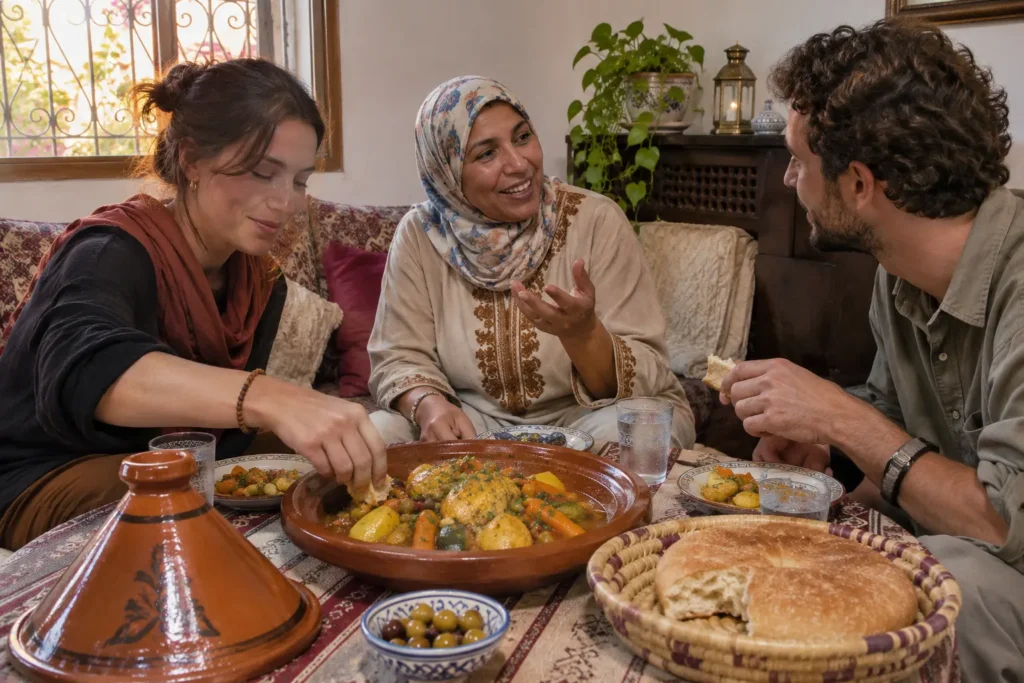
Food plays an important role in many Moroccan gatherings, and traditional meals may be served differently from those in restaurants designed primarily for international visitors.
There is no need to memorize complicated rules, but understanding a few common practices is useful.
Eating from a shared dish
In some homes, tagine and other dishes are served communally.
When eating from a shared plate, people often take food from the section directly in front of them rather than reaching across the dish.
Bread may be used to collect food instead of cutlery.
If the arrangement is unfamiliar, watch your host and follow their lead.
Do not assume that every Moroccan meal is eaten communally. Individual plates and utensils are also common.
Why the right hand matters
When eating with your fingers from a shared dish, using the right hand is a common traditional practice.
The right hand is also often preferred when offering or receiving food.
If you are left-handed or need to use utensils, do not become unnecessarily anxious. The purpose is to be considerate and maintain good hygiene.
Wash your hands before eating and follow the arrangements provided by your host.
When should you begin eating?
At a hosted meal, wait for an indication that everyone is ready to begin.
You may hear bismillah, meaning “in the name of God,” before eating.
Visitors are not required to recite religious expressions, but they should respect those who do.
If you have dietary restrictions, allergies or food preferences, communicate them clearly before the meal rather than waiting until the food has been served.
Declining additional food politely
A host may encourage you to eat more, but you do not need to continue if you are full or unable to eat something.
Thank them and decline gently.
Showing appreciation for the preparation and hospitality matters more than forcing yourself to finish everything.
Religion and Ramadan: How Visitors Should Behave
Islam is central to many aspects of Moroccan cultural life, including religious celebrations, architecture and daily routines.
Visitors do not need to participate in religious practices, but they should respect people who are observing them.
Respecting mosques and prayer
Most active mosques in Morocco restrict entry by non-Muslim tourists.
The Hassan II Mosque in Casablanca is a notable exception, offering organized visits under specific conditions.
If you want to visit a religious building, check its current access policy and follow instructions from authorized staff.
When walking near a mosque or someone praying:
- Keep noise and phone use to a considerate level.
- Do not interrupt worshippers for questions or photographs.
- Avoid walking directly in front of someone performing prayers.
- Respect restricted entrances and private religious spaces.
- Follow any specific dress or photography requirements.
A historic building can be architecturally interesting while remaining an active place of worship.
What changes during Ramadan?
During Ramadan, Muslims who observe the fast abstain from eating and drinking between dawn and sunset.
Travelers who are not fasting are not generally expected to fast themselves.
However, discretion is appreciated when eating, drinking or smoking around people observing the fast during daylight hours.
Hotels and some restaurants may continue serving meals, while other businesses adjust their hours.
Before visiting during Ramadan:
- Check restaurant and attraction opening arrangements.
- Allow flexibility around meal times and daily schedules.
- Avoid unnecessarily eating or smoking in crowded public places during fasting hours.
- Be considerate of people observing religious practices.
- Ask before attending or photographing a religious gathering.
Ramadan dates change annually according to the Islamic calendar, so check the relevant dates for your travel year.
Traveling during Ramadan can still be rewarding, but visitors should adapt their plans to the daily rhythm.
Alcohol and public behavior
Alcohol is available in licensed establishments in Morocco.
However, drinking alcohol in the street or outside permitted licensed settings is illegal.
Visitors should follow local laws and avoid public intoxication or behavior that disturbs others.
Respectful conduct matters particularly around religious buildings, family spaces and residential neighborhoods.
Moroccan Customs and Etiquette in Souks and Public Spaces
Markets and public squares are places where travelers regularly interact with shopkeepers, guides, artisans and other service providers.
Understanding how commercial interactions work can help prevent confusion.
Is bargaining expected in Morocco?
Bargaining is common in some traditional souks, especially when purchasing handicrafts, textiles and souvenirs.
However, bargaining is not appropriate everywhere.
Supermarkets, fixed-price shops, many restaurants and other businesses generally use set prices.
When negotiation is appropriate:
- Begin with a greeting and ask the price politely.
- Decide what the item is worth to you before negotiating.
- Make a reasonable offer rather than treating the conversation as a competition.
- Accept that the seller may decline your offer.
- Only agree to a final price if you genuinely intend to purchase.
There is no universal discount percentage that every visitor should expect.
Prices depend on the product, craftsmanship, shop and commercial circumstances.
If you do not want to buy something, a friendly “la, shukran” is sufficient.
Agreeing on prices for services
In tourist areas, someone may offer to show you a workshop, help with luggage, guide you through a medina or provide another service.
If the service is optional and paid, clarify the price before accepting.
A person offering directions is not automatically a professional guide, and a friendly conversation does not necessarily imply a commercial arrangement.
When uncertain, ask directly whether there is a charge.
For formal guided visits, agree on the route, language, duration and price in advance.
How to decline unwanted offers
You can refuse a product, service or invitation without being rude.
Use a brief response, such as “la, shukran,” and continue walking if you are not interested.
There is no need to explain repeatedly or engage in a long negotiation.
If someone continues pressing you after you decline, prioritize your own comfort and move toward a busier public area or seek assistance when necessary.
Politeness does not require tolerating unwanted attention.
Should you tip in Morocco?
Tipping is customary in many hospitality and tourism settings, including restaurants, hotels and guided activities.
However, the appropriate amount depends on the service, whether a charge is already included and the circumstances.
There is no need to follow one fixed tipping percentage for every interaction.
Carrying some small-denomination Moroccan dirhams can be convenient when you want to thank someone for helpful service.
Remember that a voluntary tip is different from an agreed service fee. Confirm expected charges before an activity rather than treating all payments as optional gratuities.
Photography Etiquette in Morocco
Morocco offers many interesting photographic subjects, from medina architecture to traditional workshops and public squares.
However, photography should not interfere with privacy, religious practice or local work.
Always ask before photographing people
Ask permission before taking an identifiable portrait of a shopkeeper, artisan, resident or other person.
For photographs involving children, obtain appropriate permission from a parent or guardian.
If someone declines, respect their decision.
Do not assume that a person wearing traditional clothing is available for photographs simply because you find their appearance interesting.
Photography in markets and public squares
Some performers and people offering photographic experiences in busy tourist areas may expect payment.
When a photograph is part of a commercial interaction, confirm the arrangement before taking it.
Do not encourage activities that involve poor treatment of animals for the sake of a photograph.
In working markets, avoid blocking stalls, interrupting customers or photographing private workspaces without permission.
Restricted photography areas
Photography near sensitive political or military locations is legally restricted in Morocco.
At museums, mosques and historic monuments, separate rules may apply to flash photography, video recording and professional equipment.
Check signs and staff instructions before photographing.
Respecting Neighborhoods, Historic Sites and Local Communities
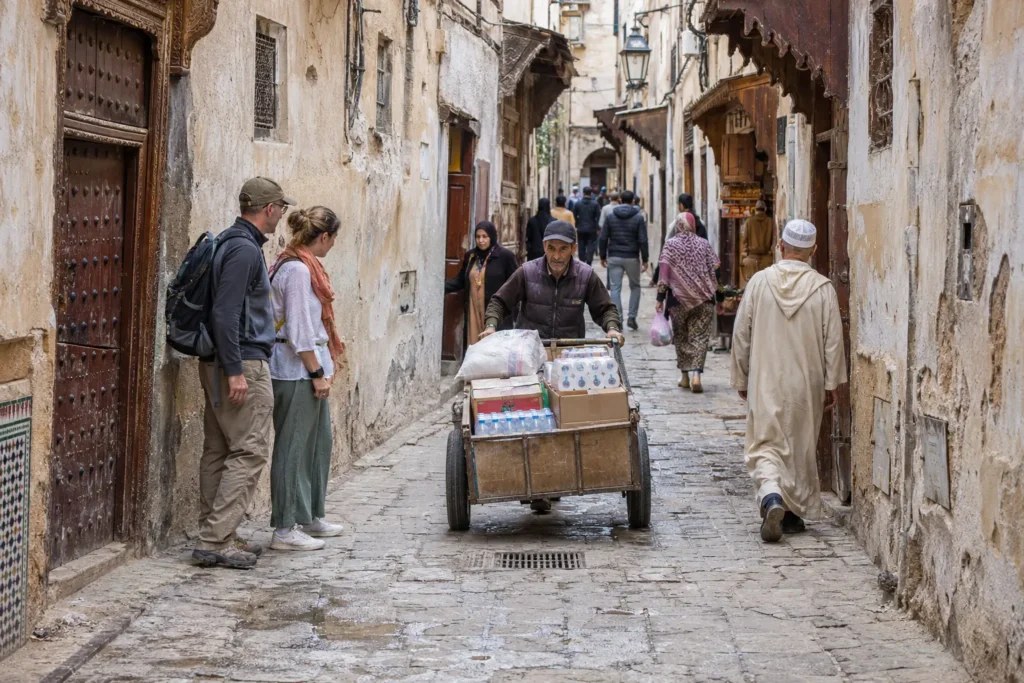
Morocco’s medinas, villages and historic settlements are not simply sightseeing attractions.
They include family homes, workplaces, schools and community spaces.
Exploring historic medinas
In places such as Marrakech and Fez, narrow streets can be crowded with residents, shoppers, delivery carts and occasional motorized traffic.
Move aside when necessary and avoid blocking doorways for photographs.
Do not enter a private courtyard simply because its doorway is open.
For travelers who want to explore traditional architecture and craftsmanship, our Fez destination guide provides useful context for visiting one of Morocco’s major historic medinas.
Visiting villages and rural communities
A village visit should not be treated as unrestricted access to residents’ homes or daily activities.
If a tour includes a household visit, confirm that the hosts have agreed to receive visitors and understand what the visit involves.
Ask before entering homes, photographing residents or observing private activities.
When walking through farmland or mountain communities, use established routes, avoid damaging crops and respect local property.
Protecting historic and natural places
At archaeological sites, monuments and traditional settlements, avoid touching fragile decoration, climbing on structures or removing objects.
In natural areas, stay on established trails where appropriate and carry away your litter.
Responsible travel is about making practical decisions that reduce disruption to the people and places you visit.
Public Affection and Personal Space in Morocco
Public behavior expectations can vary across Morocco, particularly between different social settings and generations.
As a general rule, avoid conspicuous kissing and intimate physical affection in public, especially near religious spaces and family-oriented environments.
Physical affection between close friends may be expressed differently depending on personal and cultural traditions, so do not interpret every gesture through the customs of your home country.
Visitors should also respect other people’s personal boundaries.
Do not assume that a friendly conversation is an invitation to physical contact or a more personal relationship.
When in doubt, leave space and allow the other person to indicate what feels comfortable.
Do Moroccan Customs Differ Between Regions?
Yes. Moroccan etiquette is influenced by regional traditions, language, family background, urban life and personal preferences.
It would be misleading to describe one city as uniformly modern or another as uniformly traditional.
In major cities, visitors may encounter a wide range of clothing styles, languages and social habits.
In some smaller communities, family and religious traditions may be more visible in everyday public life.
However, neither setting should be reduced to a stereotype.
The most useful approach is to observe the immediate environment, follow posted rules and ask respectful questions when something is unclear.
This is especially important when moving between Moroccan Arabic-speaking and Amazigh-speaking communities, where language preferences and cultural traditions may differ.
Common Etiquette Mistakes to Avoid in Morocco
Many awkward situations can be prevented by paying attention to a few details.
- Skipping greetings: Beginning immediately with a demand can feel abrupt.
- Assuming everyone wants a handshake: Allow people to choose their preferred greeting.
- Photographing without consent: Respect personal privacy, particularly in homes and residential areas.
- Assuming tea creates a purchase obligation: Hospitality and commercial transactions should be kept distinct.
- Bargaining everywhere: Learn whether the business uses negotiated or fixed prices.
- Entering restricted religious areas: Check visitor rules before approaching.
- Ignoring Ramadan arrangements: Meal schedules and social expectations may change during the fasting month.
- Using one rule for every region: Customs vary between households, communities and individuals.
- Being afraid to decline: You can remain courteous while saying no to something you do not want.
FAQs
What is considered polite behavior in Morocco?
Greeting people before asking questions, thanking hosts, respecting personal space and asking permission before photographing someone are useful habits. Follow local instructions in religious and historic places and remember that customs vary between individuals and communities.
Is it rude to refuse mint tea in Morocco?
No. Tea is often offered as a gesture of hospitality, but visitors can decline politely. Thank the person and briefly explain if necessary. Accepting tea in a shop does not mean you must purchase anything.
Do tourists need to dress modestly in Morocco?
Modest clothing is a practical choice in religious settings and some residential or rural communities. Casual Western clothing is common in many cities. Women are not generally required to cover their hair in ordinary public spaces, although particular institutions may have specific dress rules.
Can non-Muslims enter mosques in Morocco?
Most active mosques in Morocco restrict non-Muslim entry. The Hassan II Mosque in Casablanca is a notable exception, offering organized visits subject to current arrangements. Always confirm access before entering a religious site.
Should visitors bargain in Moroccan markets?
Bargaining is common for some crafts and souvenirs in traditional souks, but not all shops negotiate. Ask prices politely, decide what you are willing to pay and agree only when you intend to purchase. Fixed-price businesses should be treated differently.
Can tourists eat in Morocco during Ramadan?
Yes. Travelers who are not fasting can eat at establishments serving food. However, it is considerate to be discreet around people observing the fast during daylight hours. Restaurant schedules and business opening times may change, so check current arrangements.
Travel Respectfully Without Overthinking Every Interaction
Understanding Moroccan customs and etiquette does not require memorizing a long list of social obligations.
Start with a greeting, pay attention to the setting and respect other people’s choices. Ask before taking photographs, follow a host’s lead when sharing a meal and confirm prices before accepting commercial services.
Remember that Morocco is diverse. The way people greet one another, share food or interact in public may vary between families, cities and regions.
If you would like to prepare further for your journey, explore our Morocco travel guides for practical advice on destinations, cultural experiences and planning.
The practical takeaway: Good etiquette in Morocco is less about following rigid rules and more about being attentive, courteous and willing to adapt. A respectful greeting, a clear question and consideration for the people around you will help make everyday travel interactions more comfortable and meaningful.
Ready to Experience Morocco?
Turn this inspiration into your next adventure. Our travel experts are ready to help.